AMaRaNTA: Automated First-Principles Exchange Parameters In 2D Magnets
Pith reviewed 2026-05-18 14:32 UTC · model grok-4.3
The pith
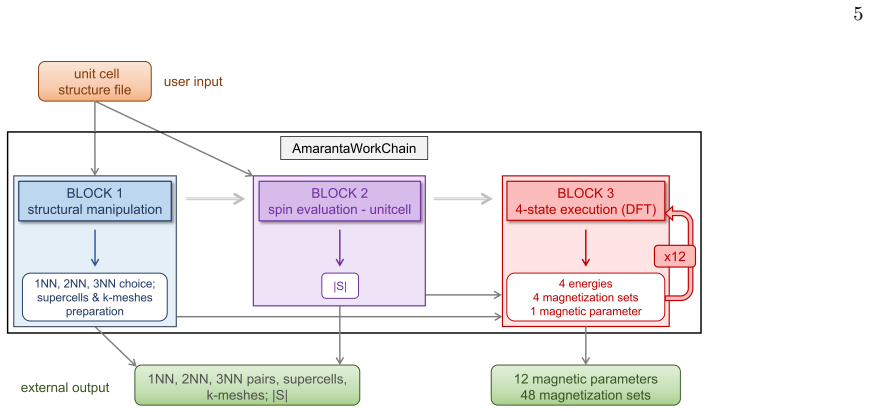
AMaRaNTA automates the four-state energy-mapping method to extract nearest-neighbour exchange tensors plus second- and third-neighbour scalars and single-ion anisotropy from DFT total energies in 2D magnets.
A machine-rendered reading of the paper's core claim, the machinery that carries it, and where it could break.
Core claim
AMaRaNTA automates the four-state formulation of the energy-mapping method to extract the nearest-neighbour exchange tensor together with scalar second- and third-nearest-neighbour exchange interactions and single-ion anisotropy from DFT total energies. Together these parameters provide a minimal yet sufficient set to capture magnetic frustration and anisotropies essential for stabilising several observed magnetic states in 2D materials. When applied to a representative subset of the Materials Cloud 2D Structure database the package demonstrates robust, automated and reproducible screening of magnetic interactions with clear potential for high-throughput simulations.
What carries the argument
The four-state energy-mapping procedure applied to DFT total energies, automated inside the AMaRaNTA package to compute the full nearest-neighbour exchange tensor and the listed scalar parameters.
If this is right
- Enables systematic and reproducible extraction of magnetic parameters across large numbers of 2D materials.
- Supplies the minimal parameter set needed to model frustration and anisotropy effects that stabilise long-range order.
- Supports high-throughput computational screening of magnetic interactions in existing 2D structure databases.
- Reduces the manual multi-step labour previously required for energy-mapping calculations.
Where Pith is reading between the lines
- The automated parameters could be fed directly into classical spin simulations to estimate finite-temperature properties or critical temperatures.
- Similar automation pipelines might be extended to three-dimensional magnets or to include selected higher-order interactions when the minimal set proves insufficient.
- Integration with materials databases could create end-to-end discovery loops that propose new 2D magnets with targeted magnetic textures.
Load-bearing premise
The four-state energy-mapping procedure applied to DFT total energies yields exchange parameters that are transferable and sufficient to describe the low-energy magnetic states of interest without significant contamination from higher-order exchange terms or from numerical choices in the DFT setup.
What would settle it
Direct comparison showing that magnetic ground states or ordering temperatures predicted from the extracted parameters fail to match experimental measurements on the same 2D magnets would indicate that higher-order terms or DFT artifacts dominate.
Figures



read the original abstract
Two-dimensional (2D) magnets host a wide range of exotic magnetic textures, whose low-energy excitations and finite-temperature properties are typically described by effective spin models based on Heisenberg-like Hamiltonians. A key challenge in this framework is the reliable determination, from ab initio calculations, of exchange parameters and their anisotropic components, crucial for stabilising long-range order. Among the different strategies proposed for this task, the energy-mapping method -- based on total-energy calculations within Density Functional Theory (DFT) -- is the most widely adopted, but it typically requires laborious, multi-step procedures. To overcome this limitation, we introduce AMaRaNTA (Automating Magnetic paRAmeters iN a Tensorial Approach), a computational package that systematically automates the energy-mapping method, specifically through its ``four-state'' formulation, to extract exchange and anisotropy parameters in 2D magnets. In its current implementation, AMaRaNTA returns the nearest-neighbour exchange tensor, complemented by scalar parameters for second- and third-nearest-neighbour exchange interactions as well as single-ion anisotropy. Together, these provide a minimal yet sufficient set of parameters to capture magnetic frustration and anisotropies, essential for stabilising several observed magnetic states in 2D materials. Applied to a representative subset of the Materials Cloud 2D Structure database, AMaRaNTA demonstrates robust, automated and reproducible screening of magnetic interactions, with clear potential for high-throughput simulations.
Editorial analysis
A structured set of objections, weighed in public.
Referee Report
Summary. The manuscript introduces AMaRaNTA, a Python package that automates the four-state energy-mapping procedure applied to DFT total energies in order to extract the nearest-neighbour exchange tensor together with scalar second- and third-nearest-neighbour exchanges and single-ion anisotropy for 2D magnets. The tool is demonstrated on a representative subset of the Materials Cloud 2D Structure database, with the central claim that the resulting minimal parameter set is sufficient to capture magnetic frustration and anisotropies while enabling robust, automated and reproducible high-throughput screening.
Significance. If the automated procedure faithfully reproduces the accuracy of the underlying four-state mapping and if the extracted parameters prove transferable, the package would lower the barrier to systematic first-principles studies of 2D magnets, supporting reproducible screening across large material databases. The emphasis on a compact, physically motivated parameter set rather than a fully general multi-spin fit is a constructive design choice that aligns with the needs of many observed 2D magnetic states.
major comments (2)
- [Application to Materials Cloud subset] Application section (Materials Cloud subset): no quantitative validation, benchmark comparisons, or error estimates are reported for the extracted parameters against either manual four-state calculations or literature values for established 2D magnets. This absence prevents assessment of whether automation preserves the accuracy of the original method, directly undermining the claim of 'robust' screening.
- [Methodology (four-state formulation)] Four-state mapping description: the procedure extracts the NN tensor and scalar J2/J3/SIA under the assumption that energy differences between the four configurations are dominated by bilinear terms. In frustrated 2D systems, four-spin or biquadratic contributions can contaminate these differences; the manuscript contains no test (e.g., comparison against larger supercell multi-configuration fits) that quantifies the size of such contamination for the chosen materials.
minor comments (2)
- [Abstract] The abstract states that the parameter set is 'minimal yet sufficient' but does not explicitly justify why higher-neighbour or anisotropic terms beyond J3 and SIA can be neglected for the target magnetic states.
- [Figures and Tables] Figure captions and table headings would benefit from explicit statements of the DFT settings (functional, cutoff, k-mesh) used for each material to allow direct reproduction.
Simulated Author's Rebuttal
We thank the referee for the constructive and detailed report. We address the two major comments point by point below, indicating the revisions we will incorporate to strengthen the validation and discussion of methodological assumptions.
read point-by-point responses
-
Referee: [Application to Materials Cloud subset] Application section (Materials Cloud subset): no quantitative validation, benchmark comparisons, or error estimates are reported for the extracted parameters against either manual four-state calculations or literature values for established 2D magnets. This absence prevents assessment of whether automation preserves the accuracy of the original method, directly undermining the claim of 'robust' screening.
Authors: We agree that direct quantitative benchmarks are necessary to substantiate the robustness claim. The present application section emphasizes the automation workflow and its application to a broad database subset rather than exhaustive per-material validation. In the revised manuscript we will add a new validation subsection that reports side-by-side comparisons of AMaRaNTA outputs with manually performed four-state calculations for at least five representative materials, together with available literature values and associated error estimates. These additions will allow readers to assess how faithfully the automated procedure reproduces the underlying method. revision: yes
-
Referee: [Methodology (four-state formulation)] Four-state mapping description: the procedure extracts the NN tensor and scalar J2/J3/SIA under the assumption that energy differences between the four configurations are dominated by bilinear terms. In frustrated 2D systems, four-spin or biquadratic contributions can contaminate these differences; the manuscript contains no test (e.g., comparison against larger supercell multi-configuration fits) that quantifies the size of such contamination for the chosen materials.
Authors: The four-state mapping follows the standard bilinear approximation used throughout the literature for this class of calculations. We acknowledge that higher-order terms may become non-negligible in strongly frustrated cases. The current manuscript does not contain explicit tests that isolate such contamination via larger supercell multi-configuration fits. We will expand the methodology section with a dedicated paragraph discussing the validity range of the bilinear assumption, supported by appropriate references, and we will include a quantitative estimate of contamination for one representative material by comparing the standard four-state results against an extended set of spin configurations. revision: yes
Circularity Check
No significant circularity: AMaRaNTA automates an established external mapping procedure
full rationale
The paper presents a software tool that automates the application of the pre-existing four-state energy-mapping method to independent DFT total-energy calculations. The central output (nearest-neighbour exchange tensor plus scalar J2, J3 and SIA) is computed directly from those external energies rather than being redefined or fitted inside the paper itself. No load-bearing step reduces by construction to a self-citation, an internal ansatz, or a fitted input relabelled as a prediction; the method is treated as an established external technique whose validity is assumed rather than re-derived. The manuscript therefore remains self-contained against external benchmarks and receives the default non-circularity finding.
Axiom & Free-Parameter Ledger
axioms (1)
- domain assumption Density-functional theory total-energy differences between collinear spin configurations accurately reflect the effective exchange interactions in 2D magnets.
Lean theorems connected to this paper
-
IndisputableMonolith/Cost/FunctionalEquation.leanwashburn_uniqueness_aczel unclear?
unclearRelation between the paper passage and the cited Recognition theorem.
The AMaRaNTA effective spin Hamiltonian is based on the bilinear Heisenberg model... J(1)ij is the full nearest-neighbour second-rank exchange tensor... decomposed as J(1)ij = J(1)ij I + Kij + Dij
What do these tags mean?
- matches
- The paper's claim is directly supported by a theorem in the formal canon.
- supports
- The theorem supports part of the paper's argument, but the paper may add assumptions or extra steps.
- extends
- The paper goes beyond the formal theorem; the theorem is a base layer rather than the whole result.
- uses
- The paper appears to rely on the theorem as machinery.
- contradicts
- The paper's claim conflicts with a theorem or certificate in the canon.
- unclear
- Pith found a possible connection, but the passage is too broad, indirect, or ambiguous to say the theorem truly supports the claim.
Reference graph
Works this paper leans on
-
[1]
AMaRaNTA: Automated First-Principles Exchange Parameters In 2D Magnets
for improved device performance. From a theoretical standpoint, the existence of mag- netism in 2D systems is particularly intriguing. The cel- ebrated Mermin-Wagner theorem [17] implies that long- range magnetic order is forbidden in 2D at any finite temperature, being completely destroyed by thermal spin fluctuations. However, this result holds strictly...
work page internal anchor Pith review Pith/arXiv arXiv 2025
-
[2]
On the Magnetic Properties of a CrBr3 Single Crystal.J
Tsubokawa, I. On the Magnetic Properties of a CrBr3 Single Crystal.J. Phys. Soc. Jpn.15, 1664–1668 (1960)
work page 1960
-
[3]
Dillon, J. F. & Olson, C. E. Magnetization, Resonance, and Optical Properties of the Ferromagnet CrI3.J. Appl. Phys.36, 1259–1260 (1965)
work page 1965
-
[4]
Huang, B.et al.Layer-dependent ferromagnetism in a van der Waals crystal down to the monolayer limit. Nature546, 270–273 (2017)
work page 2017
-
[5]
Gong, C.et al.Discovery of intrinsic ferromagnetism in two-dimensional van der Waals crystals.Nature546, 265–269 (2017)
work page 2017
-
[6]
Wang, X.et al.Raman spectroscopy of atomically thin two-dimensional magnetic iron phosphorus trisulfide (FePS3) crystals.2D Mater.3, 031009 (2016)
work page 2016
-
[7]
Lee, J.-U.et al.Ising-Type Magnetic Ordering in Atom- ically Thin FePS3.Nano Lett.16, 7433–7438 (2016)
work page 2016
-
[8]
Gong, C. & Zhang, X. Two-dimensional magnetic crys- tals and emergent heterostructure devices.Science363 (2019)
work page 2019
-
[9]
Gibertini, M., Koperski, M., Morpurgo, A. F. & Novoselov, K. S. Magnetic 2D materials and heterostruc- tures.Nat. Nanotechnol.14, 408–419 (2019)
work page 2019
-
[10]
Jiang, X.et al.Recent progress on 2D magnets: Funda- mental mechanism, structural design and modification. Appl. Phys. Rev.8(2021)
work page 2021
-
[11]
H.et al.The Magnetic Genome of Two- Dimensional van der Waals Materials.ACS Nano16, 6960–7079 (2022)
Wang, Q. H.et al.The Magnetic Genome of Two- Dimensional van der Waals Materials.ACS Nano16, 6960–7079 (2022)
work page 2022
-
[12]
Song, T.et al.Giant tunneling magnetoresistance in spin-filter van der Waals heterostructures.Science360, 1214–1218 (2018)
work page 2018
-
[13]
Wang, Z.et al.Tunneling Spin Valves Based on Fe3GeTe2/hBN/Fe3GeTe2 van der Waals Heterostruc- tures.Nano Lett.18, 4303–4308 (2018)
work page 2018
-
[14]
Zhang, B., Lu, P., Tabrizian, R., Feng, P. X.-L. & Wu, Y. 2D Magnetic heterostructures: spintronics and quantum future.npj Spintronics2, 1–10 (2024)
work page 2024
-
[15]
Deng, Y.et al.Gate-tunable room-temperature ferro- magnetism in two-dimensional Fe3GeTe2.Nature563, 94–99 (2018)
work page 2018
-
[16]
Zhang, G.et al.Above-room-temperature strong intrin- sic ferromagnetism in 2D van der Waals Fe3GaTe2 with large perpendicular magnetic anisotropy.Nat. Commun. 13, 1–8 (2022)
work page 2022
-
[17]
Chen, Z., Yang, Y., Ying, T. & Guo, J.-g. High-Tc Ferromagnetic Semiconductor in Thinned 3D Ising Fer- romagnetic Metal Fe3GaTe2.Nano Lett.24, 993–1000 (2024)
work page 2024
-
[18]
Mermin, N. D. & Wagner, H. Absence of Ferromagnetism or Antiferromagnetism in One- or Two-Dimensional Isotropic Heisenberg Models.Phys. Rev. Lett.17, 1133– 1136 (1966)
work page 1966
-
[19]
Irkhin, V. Yu., Katanin, A. A. & Katsnelson, M. I. Self-consistent spin-wave theory of layered Heisenberg magnets.Phys. Rev. B60, 1082–1099 (1999)
work page 1999
-
[20]
Lado, J. L. & Fernández-Rossier, J. On the origin of magnetic anisotropy in two dimensional CrI3.2D Mater. 4, 035002 (2017)
work page 2017
-
[21]
Sødequist, J. & Olsen, T. Two-dimensional altermagnets from high throughput computational screening: Symme- try requirements, chiral magnons, and spin-orbit effects. Appl. Phys. Lett.124, 182409 (2024)
work page 2024
-
[22]
A thermodynamic theory of “weak” ferromagnetism of antiferromagnetics.J
Dzyaloshinsky, I. A thermodynamic theory of “weak” ferromagnetism of antiferromagnetics.J. Phys. Chem. Solids4, 241–255 (1958)
work page 1958
-
[23]
Anisotropic Superexchange Interaction and Weak Ferromagnetism.Phys
Moriya, T. Anisotropic Superexchange Interaction and Weak Ferromagnetism.Phys. Rev.120, 91–98 (1960)
work page 1960
-
[24]
Milivojević, M., Orozović, M., Picozzi, S., Gmitra, M. & Stavrić, S. Interplay of altermagnetism and weak ferromagnetism in two-dimensional RuF4.2D Mater. 11, 035025 (2024)
work page 2024
-
[25]
Rößler, U. K., Bogdanov, A. N. & Pfleiderer, C. Sponta- neous skyrmion ground states in magnetic metals.Nature 442, 797–801 (2006)
work page 2006
-
[26]
Yi, S. D., Onoda, S., Nagaosa, N. & Han, J. H. Skyrmions and anomalous Hall effect in a Dzyaloshinskii- Moriya spiral magnet.Phys. Rev. B80, 054416 (2009)
work page 2009
-
[27]
Heinze, S.et al.Spontaneous atomic-scale magnetic skyrmion lattice in two dimensions.Nat. Phys.7, 713– 718 (2011)
work page 2011
- [28]
-
[29]
Zhang, Y.et al.Emergence of skyrmionium in a two- dimensional CrGe(Se,Te)3 Janus monolayer.Phys. Rev. B102, 241107 (2020)
work page 2020
-
[30]
Xu, C.et al.Topological spin texture in Janus monolay- ers of the chromium trihalides Cr(I,X) 3.Phys. Rev. B 101, 060404 (2020)
work page 2020
-
[31]
Ga, Y.et al.Anisotropic Dzyaloshinskii-Moriya in- teraction protected by D2d crystal symmetry in two- dimensional ternary compounds.npj Comput. Mater.8, 1–7 (2022)
work page 2022
-
[32]
Nano Lett.22, 2334–2341 (2022)
Cui, Q.et al.Anisotropic Dzyaloshinskii–Moriya Inter- action and Topological Magnetism in Two-Dimensional Magnets Protected by xn–P4m2-hwc Crystal Symmetry. Nano Lett.22, 2334–2341 (2022)
work page 2022
-
[33]
Liang, J.et al.Very large Dzyaloshinskii-Moriya inter- action in two-dimensional Janus manganese dichalco- genides and its application to realize skyrmion states. Phys. Rev. B101, 184401 (2020)
work page 2020
-
[34]
Moessner, R. & Chalker, J. T. Low-temperature proper- ties of classical geometrically frustrated antiferromagnets. Phys. Rev. B58, 12049–12062 (1998)
work page 1998
-
[35]
Ramirez, A. P. Strongly Geometrically Frustrated Mag- nets.Annu. Rev. Mater. Res.453–480 (1994)
work page 1994
-
[36]
Spin liquids in frustrated magnets.Nature 464, 199–208 (2010)
Balents, L. Spin liquids in frustrated magnets.Nature 464, 199–208 (2010)
work page 2010
-
[37]
McGuire, M. A. Crystal and Magnetic Structures in Lay- ered, Transition Metal Dihalides and Trihalides.Crystals 7, 121 (2017)
work page 2017
-
[38]
Rastelli, E., Tassi, A. & Reatto, L. Non-simple magnetic order for simple Hamiltonians.Physica B+C97, 1–24 (1979)
work page 1979
-
[39]
Schmidt, B. & Thalmeier, P. Frustrated two dimensional quantum magnets.Phys. Rep.703, 1–59 (2017)
work page 2017
-
[40]
Chakrabartty, D.et al.Role of Competing Magnetic Exchange on Non-Collinear to Collinear Magnetic Or- dering and Skyrmion Stabilization in Centrosymmetric Hexagonal Magnets.ACS Nano19, 3614–3623 (2025). 12
work page 2025
-
[41]
Amoroso, D., Barone, P. & Picozzi, S. Spontaneous skyrmionic lattice from anisotropic symmetric exchange in a Ni-halide monolayer.Nat. Commun.11, 1–9 (2020)
work page 2020
-
[42]
Cheong, S.-W. & Mostovoy, M. Multiferroics: a magnetic twist for ferroelectricity.Nat. Mater.6, 13–20 (2007)
work page 2007
- [43]
-
[44]
Fumega, A. O. & Lado, J. L. Microscopic origin of mul- tiferroic order in monolayer NiI2.2D Mater.9, 025010 (2022)
work page 2022
-
[45]
Song, Q.et al.Evidence for a single-layer van der Waals multiferroic.Nature602, 601–605 (2022)
work page 2022
-
[46]
NobelLecture: Electronicstructureofmatter— wave functions and density functionals.Rev
Kohn, W. NobelLecture: Electronicstructureofmatter— wave functions and density functionals.Rev. Mod. Phys. 71, 1253–1266 (1999)
work page 1999
-
[47]
Oroszlány, L., Ferrer, J., Deák, A., Udvardi, L. & Szun- yogh, L. Exchange interactions from a nonorthogonal basis set: From bulk ferromagnets to the magnetism in low-dimensional graphene systems.Phys. Rev. B99, 224412 (2019)
work page 2019
-
[48]
Korotin, Dm. M., Mazurenko, V. V., Anisimov, V. I. & Streltsov, S. V. Calculation of exchange constants of the Heisenberg model in plane-wave-based methods using the Green’s function approach.Phys. Rev. B91, 224405 (2015)
work page 2015
-
[49]
He, X., Helbig, N., Verstraete, M. J. & Bousquet, E. TB2J: A python package for computing magnetic in- teraction parameters.Comput. Phys. Commun.264, 107938 (2021)
work page 2021
-
[50]
Martínez-Carracedo, G.et al.Relativistic magnetic interactions from nonorthogonal basis sets.Phys. Rev. B108, 214418 (2023)
work page 2023
-
[51]
Zimmermann, B.et al.Comparison of first-principles methods to extract magnetic parameters in ultrathin films: Co/Pt(111).Phys. Rev. B99, 214426 (2019)
work page 2019
-
[52]
Valence bond description of antiferro- magnetic coupling in transition metal dimers.J
Noodleman, L. Valence bond description of antiferro- magnetic coupling in transition metal dimers.J. Chem. Phys.74, 5737–5743 (1981)
work page 1981
-
[53]
Liechtenstein, A. I., Katsnelson, M. I., Antropov, V. P. & Gubanov, V. A. Local spin density functional approach to the theory of exchange interactions in ferromagnetic metals and alloys.J. Magn. Magn. Mater.67, 65–74 (1987)
work page 1987
-
[54]
Szilva, A.et al.Quantitative theory of magnetic inter- actions in solids.Rev. Mod. Phys.95, 035004 (2023)
work page 2023
-
[55]
Sandratskii, L. M. & Guletskii, P. G. Symmetrised method for the calculation of the band structure of noncollinear magnets.J. Phys. F: Met. Phys.16, L43 (1986)
work page 1986
-
[56]
Sandratskii, L. M. Symmetry analysis of electronic states for crystals with spiral magnetic order. I. General prop- erties.J. Phys.: Condens. Matter3, 8565 (1991)
work page 1991
-
[57]
Nanotechnol.13, 246–252 (2018)
Mounet, N.et al.Two-dimensional materials from high- throughput computational exfoliation of experimentally known compounds.Nat. Nanotechnol.13, 246–252 (2018)
work page 2018
-
[58]
Haastrup, S.et al.The Computational 2D Materials Database: high-throughput modeling and discovery of atomically thin crystals.2D Mater.5, 042002 (2018)
work page 2018
-
[59]
Torelli, D., Moustafa, H., Jacobsen, K. W. & Olsen, T. High-throughput computational screening for two- dimensional magnetic materials based on experimental databases of three-dimensional compounds.npj Comput. Mater.6, 1–12 (2020)
work page 2020
-
[60]
Gjerding, M. N.et al.Recent progress of the Compu- tational 2D Materials Database (C2DB).2D Mater.8, 044002 (2021)
work page 2021
-
[61]
Sødequist, J. & Olsen, T. Type II multiferroic order in two-dimensional transition metal halides from first principles spin-spiral calculations.2D Mater.10, 035016 (2023)
work page 2023
-
[62]
Xiang, H., Lee, C., Koo, H.-J., Gong, X. & Whangbo, M.-H. Magnetic properties and energy-mapping analysis. Dalton Trans.42, 823–853 (2012)
work page 2012
-
[63]
Li, X.et al.Spin Hamiltonians in Magnets: Theories and Computations.Molecules26, 803 (2021)
work page 2021
-
[64]
Xiang, H. J., Kan, E. J., Wei, S.-H., Whangbo, M.- H. & Gong, X. G. Predicting the spin-lattice order of frustrated systems from first principles.Phys. Rev. B 84, 224429 (2011)
work page 2011
-
[65]
Xu, C., Feng, J., Xiang, H. & Bellaiche, L. Interplay between Kitaev interaction and single ion anisotropy in ferromagnetic CrI3 and CrGeTe3 monolayers.npj Comput. Mater.4, 1–6 (2018)
work page 2018
-
[66]
Xu, C.et al.Possible Kitaev Quantum Spin Liquid State in 2D Materials withS = 3 /2.Phys. Rev. Lett.124, 087205 (2020)
work page 2020
-
[67]
Huber, S. P.et al.AiiDA 1.0, a scalable computational infrastructure for automated reproducible workflows and data provenance.Sci. Data7, 1–18 (2020)
work page 2020
-
[68]
Kresse, G. & Hafner, J. Ab initio molecular dynamics for liquid metals.Phys. Rev. B47, 558–561 (1993)
work page 1993
-
[69]
Kresse, G. & Furthmüller, J. Efficient iterative schemes for ab initio total-energy calculations using a plane-wave basis set.Phys. Rev. B54, 11169–11186 (1996)
work page 1996
-
[70]
Campi, D., Mounet, N., Gibertini, M., Pizzi, G. & Marzari, N. Expansion of the Materials Cloud 2D Database.ACS Nano17, 11268–11278 (2023)
work page 2023
-
[71]
Anyons in an exactly solved model and beyond.Ann
Kitaev, A. Anyons in an exactly solved model and beyond.Ann. Phys.321, 2–111 (2006)
work page 2006
-
[72]
Rau, J. G., Lee, E. K.-H. & Kee, H.-Y. Generic Spin Model for the Honeycomb Iridates beyond the Kitaev Limit.Phys. Rev. Lett.112, 077204 (2014)
work page 2014
-
[73]
Menichetti, G., Calandra, M. & Polini, M. Elec- tronic structure and magnetic properties of few-layer Cr2Ge2Te6: the key role of nonlocal electron–electron interaction effects.2D Mater.6, 045042 (2019)
work page 2019
-
[74]
Uhrin, M., Huber, S. P., Yu, J., Marzari, N. & Pizzi, G. Workflows in AiiDA: Engineering a high-throughput, event-based engine for robust and modular computa- tional workflows.Comput. Mater. Sci.187, 110086 (2021)
work page 2021
-
[75]
H.et al.The atomic simulation environ- ment—a Python library for working with atoms.J
Larsen, A. H.et al.The atomic simulation environ- ment—a Python library for working with atoms.J. Phys.: Condens. Matter29, 273002 (2017)
work page 2017
-
[76]
Zhuang, H. L., Xie, Y., Kent, P. R. C. & Ganesh, P. Com- putational discovery of ferromagnetic semiconducting single-layerCrSnTe 3.Phys. Rev. B92, 035407 (2015)
work page 2015
-
[77]
Chittari, B. L.et al.Electronic and magnetic proper- ties of single-layerM PX3 metal phosphorous trichalco- genides.Phys. Rev. B94, 184428 (2016)
work page 2016
-
[78]
Yang, K., Ning, Y., Ma, Y., Zhou, Y. & Wu, H. Con- trasting magnetism inVPS3 and CrI3 monolayers with the common honeycombS = 3/2spin lattice.Phys. Rev. B111, 134421 (2025)
work page 2025
-
[79]
Liu, C.et al.Probing the Néel-Type Antiferromagnetic Order and Coherent Magnon–Exciton Coupling in Van Der Waals VPS3.Adv. Mater.35, 2300247 (2023). 13
work page 2023
-
[80]
Riedl, K.et al.Microscopic origin of magnetism in monolayer3 d transition metal dihalides.Phys. Rev. B 106, 035156 (2022)
work page 2022
discussion (0)
Sign in with ORCID, Apple, or X to comment. Anyone can read and Pith papers without signing in.