Metric response of relative entropy: A universal indicator of quantum criticality
Pith reviewed 2026-05-18 12:20 UTC · model grok-4.3
The pith
The susceptibility extracted from the quantum relative entropy metric on a small subsystem diverges at quantum critical points as total system size grows to infinity.
A machine-rendered reading of the paper's core claim, the machinery that carries it, and where it could break.
Core claim
The diagonal component of the metric response of the quantum relative entropy, obtained by tracing out all but n adjacent sites from the ground state, defines a susceptibility that diverges at quantum critical points in the thermodynamic limit. For the transverse-field Ising model the peak of this susceptibility scales as the square of the logarithm of total length N, while the non-integrable Ising chain with three-spin interactions shows power-law divergence. The same quantity encodes the uncertainty of entanglement-Hamiltonian gradients and connects directly to Petz-Rényi entropies. Divergence also appears at finite N in classical limits once n is large enough that the reduced density-mesh
What carries the argument
The quantum relative entropy metric formed from reduced density matrices of n adjacent sites, with its diagonal component acting as a susceptibility to Hamiltonian-parameter changes.
If this is right
- The QRE susceptibility diverges at quantum critical points once the thermodynamic limit is taken.
- The height of its peak scales as the square of the logarithm of system size in the integrable transverse-field Ising model.
- Power-law scaling of the peak occurs in the non-integrable three-spin Ising chain.
- The susceptibility is directly linked to the variance of entanglement-Hamiltonian gradients and to Petz-Rényi entropies.
- Divergence appears even at finite total length when the subsystem size n is large enough in classical limits, owing to the finite rank of the reduced density matrices.
Where Pith is reading between the lines
- Local measurements on a fixed-size block could in principle locate critical points without access to the entire wave function.
- Analogous metric constructions built from other quantum-information distances might furnish additional independent probes of criticality.
- The finite-N divergence in classical regimes offers a route to diagnose effective rank reductions or near-degeneracies in reduced states.
Load-bearing premise
The second derivative of the quantum relative entropy after tracing out most sites remains a faithful indicator of criticality even when the kept subsystem size stays fixed while the total chain length grows without bound.
What would settle it
If the peak height of the QRE susceptibility fails to diverge as the square of the logarithm of N in the transverse-field Ising model exactly at its critical point, or fails to follow power-law growth in the non-integrable chain, the claimed indicator would be ruled out.
Figures




read the original abstract
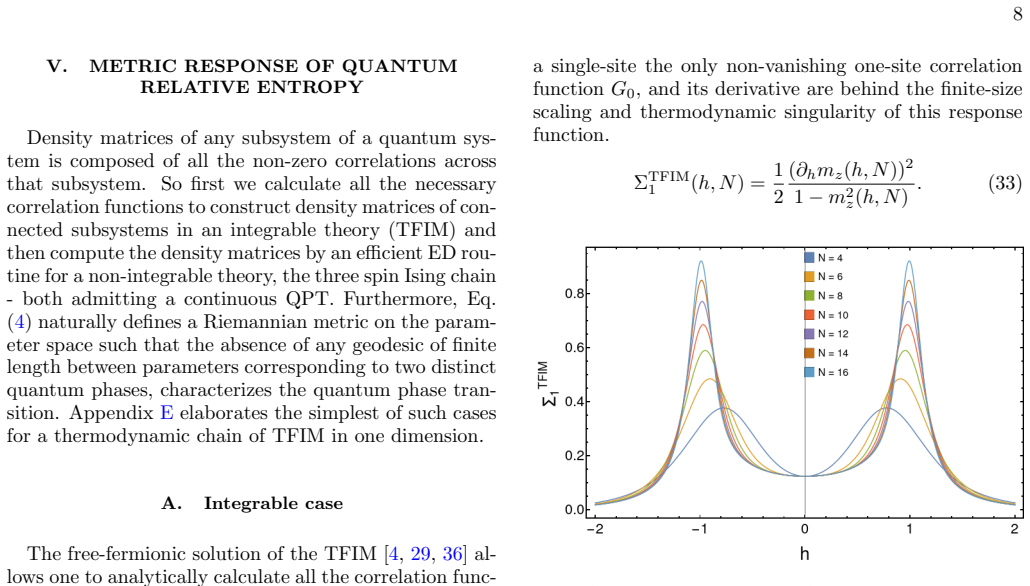
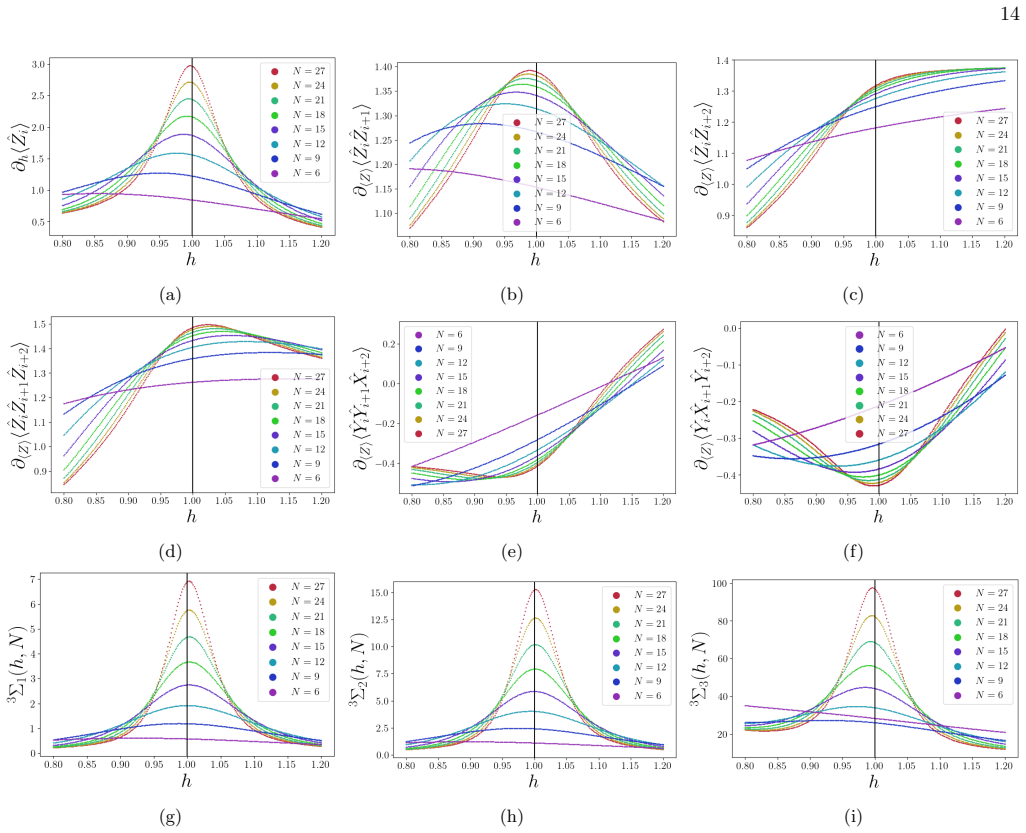
The information-geometric origin of fidelity susceptibility and its utility as a universal probe of quantum criticality in many-body settings have been widely discussed. Here we explore the metric response of quantum relative entropy (QRE), by tracing out all but $n$ adjacent sites from the ground state of spin chains of finite length $N$, as a parameter of the corresponding Hamiltonian is varied. The diagonal component of this metric defines a susceptibility of the QRE that diverges at quantum critical points (QCPs) in the thermodynamic limit. We study two spin-$1/2$ models as examples, namely the integrable transverse field Ising model (TFIM) and a non-integrable Ising chain with three-spin interactions. We demonstrate distinct scaling behaviors for the peak of the QRE susceptibility as a function of $N$: namely a square logarithmic divergence in TFIM and a power-law divergence in the non-integrable chain. This susceptibility encodes uncertainty of entanglement Hamiltonian gradients and is also directly connected to other information measures such as Petz-R\'enyi entropies. We further show that this susceptibility diverges even at finite $N$ if the subsystem size, $n$, exceeds a certain value when the Hamiltonian is tuned to its classical limits due to the rank of the RDMs being finite; unlike the divergence associated with the QCPs which require $N \rightarrow \infty$.
Editorial analysis
A structured set of objections, weighed in public.
Referee Report
Summary. The paper claims that the diagonal component of the metric response of the quantum relative entropy (QRE), computed on the reduced density matrix of n fixed adjacent sites in spin chains of length N, defines a susceptibility that diverges at quantum critical points in the thermodynamic limit. It demonstrates square-logarithmic divergence for the transverse field Ising model and power-law divergence for a non-integrable Ising chain with three-spin interactions. The susceptibility is connected to uncertainties in entanglement Hamiltonian gradients and Petz-Rényi entropies, and the authors distinguish QCP divergences (requiring N to infinity) from rank-deficiency divergences at finite N in classical limits when n is large enough.
Significance. If substantiated, this provides a new universal probe of quantum criticality rooted in information geometry. The distinct scaling behaviors in integrable and non-integrable models, the explicit connections to other information measures, and the careful distinction between different types of divergences are notable strengths. The central construction is internally consistent, and the concern about the faithfulness for fixed subsystem size n as system size N grows does not appear to be a load-bearing issue based on the reported results and derivations.
minor comments (2)
- The abstract states that the susceptibility diverges and gives two scaling forms, yet provides no explicit derivation steps, error bars, or raw data; the main text should include these to support the central claims about divergences at QCPs.
- The link between the QRE susceptibility and uncertainties of entanglement Hamiltonian gradients, as well as the connection to Petz-Rényi entropies, is asserted without shown intermediate equations or explicit formulas; expanding this in the relevant section would improve clarity.
Simulated Author's Rebuttal
We thank the referee for their positive and constructive report. We are pleased that the referee finds the central construction internally consistent, the distinction between QCP divergences and rank-deficiency divergences at finite N noteworthy, and the connections to other information measures valuable. We appreciate the recommendation for minor revision and will incorporate editorial improvements in the revised manuscript.
Circularity Check
No significant circularity in derivation chain
full rationale
The central construction defines a susceptibility as the diagonal component of the metric response extracted from the second derivative of the quantum relative entropy on the reduced density matrix of a fixed subsystem of n sites. This is presented as a new information-geometric quantity whose divergence at QCPs is demonstrated via explicit scaling analysis in the TFIM (square-log) and three-spin model (power-law) as N→∞. No step reduces by construction to a fitted input, self-citation load-bearing premise, or imported uniqueness theorem; the link to Petz-Rényi entropies is stated as a direct connection without serving as the justification for the main claim. Finite-N rank-deficiency effects are explicitly separated from the thermodynamic-limit critical divergences, leaving the derivation self-contained against the reported numerics and model-specific calculations.
Axiom & Free-Parameter Ledger
axioms (2)
- standard math Quantum relative entropy is differentiable with respect to Hamiltonian parameters and its Hessian defines a valid metric on the space of reduced density matrices.
- domain assumption The thermodynamic limit N to infinity can be taken while keeping subsystem size n fixed.
Lean theorems connected to this paper
-
IndisputableMonolith/Cost/FunctionalEquation.leanwashburn_uniqueness_aczel unclear?
unclearRelation between the paper passage and the cited Recognition theorem.
The diagonal component of this metric defines a susceptibility of the QRE that diverges at quantum critical points (QCPs) in the thermodynamic limit... Σij(λ⃗)=1/2 tr[ρ̂·∂i ln ρ̂·∂j ln ρ̂]
-
IndisputableMonolith/Foundation/RealityFromDistinction.leanreality_from_one_distinction unclear?
unclearRelation between the paper passage and the cited Recognition theorem.
We study two spin-1/2 models... TFIM and a non-integrable Ising chain with three-spin interactions... square logarithmic divergence in TFIM and a power-law divergence
What do these tags mean?
- matches
- The paper's claim is directly supported by a theorem in the formal canon.
- supports
- The theorem supports part of the paper's argument, but the paper may add assumptions or extra steps.
- extends
- The paper goes beyond the formal theorem; the theorem is a base layer rather than the whole result.
- uses
- The paper appears to rely on the theorem as machinery.
- contradicts
- The paper's claim conflicts with a theorem or certificate in the canon.
- unclear
- Pith found a possible connection, but the passage is too broad, indirect, or ambiguous to say the theorem truly supports the claim.
Reference graph
Works this paper leans on
-
[1]
For infinite system it identically diverges at the thermodynamic critical points h=±1
Numerical results There is no phase transition for any finite system as the susceptibility remains finite. For infinite system it identically diverges at the thermodynamic critical points h=±1. Starting from smallest sizes Σ TFIM s (N, h) con- verges to the thermodynamically singular behavior as h→1 with its turning points approaching to the QCP, maxima d...
-
[2]
Analytical results for the thermodynamic singularity The derivatives of the correlation functions cause the metric response of QRE to become singular in the ther- modynamic limit ofN=∞where system changes its phase ath= 1. However for anyN→ ∞the response maximizes ath c d(N), so due to the asymptotic conver- genceh d(N)→1 the value of the response ath= 1 ...
work page 2020
-
[4]
S.-W. Tsai and J. B. Marston, Physical Review B 10.1103/PhysRevB.62.5545 (2001)
-
[5]
Lebreuilly, Physical Review A96, 10.1103/Phys- RevA.96.033828 (2017)
B. Damski, Physical Review E87, 10.1103/phys- reve.87.052131 (2013)
-
[6]
M. H. Kolodrubetz, D. Sels, P. Mehta, and A. Polkovnikov, Physics Reports (2016)
work page 2016
-
[7]
M. A. Nielsen and T. J. Osborne, Physical Review A 10.1103/PhysRevA.72.062323 (2005)
-
[8]
A. V. Zhukov, M. Kol´ aˇ r, and T. F. George, Physics Let- ters A 10.1016/j.physleta.2007.03.075 (2007)
- [9]
-
[10]
M. Kolodrubetz, V. Gritsev, and A. Polkovnikov, Physi- cal Review B 10.1103/physrevb.88.064304 (2013)
-
[11]
P. Zanardi, M. G. A. Paris, and L. C. Venuti, Physical Review A 10.1103/PhysRevA.76.062318 (2007)
-
[12]
P. Zanardi, P. Giorda, and M. Cozzini, Phys. Rev. Lett. 10.1103/PhysRevLett.99.100603 (2007)
-
[13]
Nielsen, Notices of the American Mathematical Soci- ety (2022)
F. Nielsen, Notices of the American Mathematical Soci- ety (2022)
work page 2022
-
[14]
E.-j. Kim, U. Lee, J. Heseltine, and R. Hollerbach, Phys. Rev. E93, 062127 (2016)
work page 2016
-
[15]
Kim, Entropy23, 10.3390/e23111393 (2021)
E.-j. Kim, Entropy23, 10.3390/e23111393 (2021)
-
[16]
M. P. do Carmo,Differential Geometry of Curves and Surfaces, revised and updated second edition ed. (Prentice-Hall, 1976) revised and updated republication by Dover Publications, 2016
work page 1976
-
[17]
K. Strimmer,Statistical Methods: Likelihood, Bayes and Regression, Department of Mathematics, University of Manchester (2023), lecture notes for MATH20802
work page 2023
-
[18]
[ˆρA, ˆH E A ] = [e− ˆHE A , ˆH E A ] = [P∞ j=0 ( ˆHE A )n n! , ˆH E A ] = 0
-
[19]
K. P. Seshadreesan, L. Lami, and M. M. Wilde, Journal of Mathematical Physics59, 10.1063/1.5007167 (2018)
- [20]
-
[21]
D. A. Abanin and E. Demler, Phys. Rev. Lett.109, 020504 (2012)
work page 2012
- [22]
-
[23]
R. Horodecki, P. Horodecki, M. Horodecki, and K. Horodecki, Reviews of Modern Physics81, 865–942 (2009)
work page 2009
-
[24]
A. F. Albuquerque, F. Alet, C. Sire, and S. Capponi, Phys. Rev. B81, 064418 (2010)
work page 2010
-
[25]
J. Cardy,Scaling and Renormalization in Statistical Physics, Cambridge Lecture Notes in Physics (Cam- bridge University Press, 1996)
work page 1996
-
[26]
A. Belavin, A. Polyakov, and A. Zamolodchikov, Nuclear Physics B241, 333 (1984)
work page 1984
-
[27]
H. W. J. Bl¨ ote, J. L. Cardy, and M. P. Nightingale, Phys. Rev. Lett.56, 742 (1986)
work page 1986
- [28]
-
[29]
Y. Zou, A. Milsted, and G. Vidal, Phys. Rev. Lett.124, 040604 (2020)
work page 2020
-
[30]
Fradkin,Field Theories of Condensed Matter Physics, 2nd ed
E. Fradkin,Field Theories of Condensed Matter Physics, 2nd ed. (Cambridge University Press, 2013)
work page 2013
-
[31]
E. H. Lieb, T. D. Schultz, and D. C. Mattis, Annals of Physics 10.1016/0003-4916(61)90115-4 (1961)
-
[32]
Sachdev,Quantum Phase Transitions(Cambridge University Press, 2011)
S. Sachdev,Quantum Phase Transitions(Cambridge University Press, 2011)
work page 2011
-
[33]
G. B. Mbeng, A. Russomanno, and G. E. Santoro, Sci- Post Phys. Lect. Notes , 82 (2024)
work page 2024
- [34]
-
[35]
Turban, Journal of Physics C: Solid State Physics15, L65 (1982)
L. Turban, Journal of Physics C: Solid State Physics15, L65 (1982)
work page 1982
-
[36]
K. A. Penson, R. Jullien, and P. Pfeuty, Phys. Rev. B 26, 6334 (1982)
work page 1982
- [37]
- [38]
-
[39]
P. Weinberg and M. Bukov, SciPost Physics2, 10.21468/scipostphys.2.1.003 (2017)
-
[40]
See their documentation for more de- tails
Because QuSpin allows to - 1¿ define the computational basis as the spectrum of N i σz i , 2¿ define the Hamilto- nian in this basis easily for any local operator, and 3¿ take trace of reduced density matrices usingin-built methods in the library, for simple and straightforward implemen- tation of this idea. See their documentation for more de- tails. But...
-
[41]
M. Jian, X. Lei, and W. Xiao-Guang, Communications in Theoretical Physics53, 175 (2010)
work page 2010
-
[42]
L. Campos Venuti, C. Degli Esposti Boschi, M. Roncaglia, and A. Scaramucci, Physical Review A73, 10.1103/physreva.73.010303 (2006)
-
[43]
A. Vershynina, E. A. Carlen, and E. H. Lieb, Scholarpe- dia8, 30920 (2013), revision #169781. [42]B(H) is the subspace of all thebounded linear operatorsin the Hilbert spaceH. Density matrices, which are positive semi-definite, i.e., Hermitian and without any negative eigenvalue along with trace 1, fall insideB(H)
work page 2013
-
[44]
Relative entropies and their use in quantum information theory
F. Leditzky, Relative entropies and their use in quantum information theory (2016), arXiv:1611.08802 [quant-ph]
work page internal anchor Pith review Pith/arXiv arXiv 2016
-
[45]
A. M¨ uller-Hermes and D. Reeb, Annales Henri Poincar´ e 18, 1777–1788 (2017)
work page 2017
-
[46]
P. E. Frenkel, Quantum7, 1102 (2023)
work page 2023
-
[47]
E. Barouch and B. M. McCoy, Physical Review A 10.1103/PhysRevA.2.1075 (1970)
-
[48]
E. Barouch and B. M. McCoy, Physical Review A 19 10.1103/PhysRevA.3.786 (1971)
-
[49]
C-5 is derived for theXYchain, defined in Eq
[29] presents a general method of calculating the two-site correlations of a free fermions in one dimension, but the specific Eq. C-5 is derived for theXYchain, defined in Eq. 2.1 therein. Appendix A: From spins to fermions and back The first two of the subsections will follow a similar route taken in [29] making use of the derivation of Eq. C-5 therein; ...
-
[50]
+ H.c. i eiπ ˆN + 1 .(A7) WithN= the size of the periodic spin chain, andN=⟨gs| ˆN |gs⟩= number of fermionic excitation in the ground state.H PBC is the Hamiltonian of our interest. Note that even though the number of fermionsNis not conserved byH PBC, the parity of a state ˆP=e iπ ˆN = (−1) ˆN is aconstant of motionwith eigenvalue±1 [31]; for even parity...
-
[51]
i , =⇒ ˆHp={0,1} =−J NX j=1 c† jcj+1 +c † jc† j+1 + H.c
+ H.c. i , =⇒ ˆHp={0,1} =−J NX j=1 c† jcj+1 +c † jc† j+1 + H.c. +h NX j=1 1−2c † jcj .(A10) In this way the boundary terms are compactly treated asc N+1 ≡(−1) p+1c1 for both the fermionic parity sectors. For a finite-sized translationally invariant system, the momentum is quantized differently for different parity sectors and where the allowed momentum va...
-
[52]
The presence of only{c † kc† −k, c −kck, c † kck, c † −kc−k}whenk∈ ¯K+, ensures that excitations can arise only in pairs at the symmetric momentum values aroundk= 0 therefore considering only the paired terms minima of the ground state energy is achieved by even number of fermionic excitations in the ground state; and
-
[53]
Together these simplify the ground state energy from the previous table, which are as follows
The boundary contributions only care about the number of fermions at that mode which can only be 0 or 1, which can only increase the number of electron by at most 1, flipping the overall fermionic parity. Together these simplify the ground state energy from the previous table, which are as follows
-
[54]
ForNevenandNeven: Boundaries or the center of the Brillouin zone do not manifest anyway,
-
[55]
ForNoddandNeven: we must have ˆn 0 = 0 due to the presence of ˜HB 0 in order to preserve even parity,
-
[56]
ForNoddandNodd: we must have ˆn π = 1 due to the presence of ˜HB π in order to preserve odd parity, and lastly,
-
[57]
ForNevenandNodd: both the boundary terms atk= 0 andk=πcontribute so that they can be written as ˜HB 0 + ˜HB π = (2(h+J)ˆn0 −h) + (2(h+J)ˆn π −h) = 2h(ˆn0 + ˆnπ −1) + 2J(ˆn0 −ˆnπ).(A14) Forh >0 this is minimized by ˆn π = 1 and ˆn0 = 0. Hence the additional unpaired fermionic mode contributes by the presence of a unpaired fermionic excitation at the bounda...
discussion (0)
Sign in with ORCID, Apple, or X to comment. Anyone can read and Pith papers without signing in.