REVIEW 5 major objections 5 minor 30 references
Self-Improving Neural Pruning: A Graph Neural Network Framework for Scalable Mixed Bundle Pricing
T0 review · 5 major / 5 minor · reviewed 2026-08-04 · deepseek-v4-flash
Pith's one-line read A graph neural network can predict which products customers will bundle in the optimal solution, and pruning the bundle space with those predictions preserves near-optimal revenue while cutting computation time dramatically.
desk verdict Plausible GNN pruning pipeline for mixed bundle pricing, but the abstract oversells: promised theory and iterative self-improvement are absent, and near-optimality at scale rests on an unproven structural assumption. read the letter →
The pith
A machine-rendered reading of the paper's core claim, the machinery that carries it, and where it could break.
The reading
What carries the argument
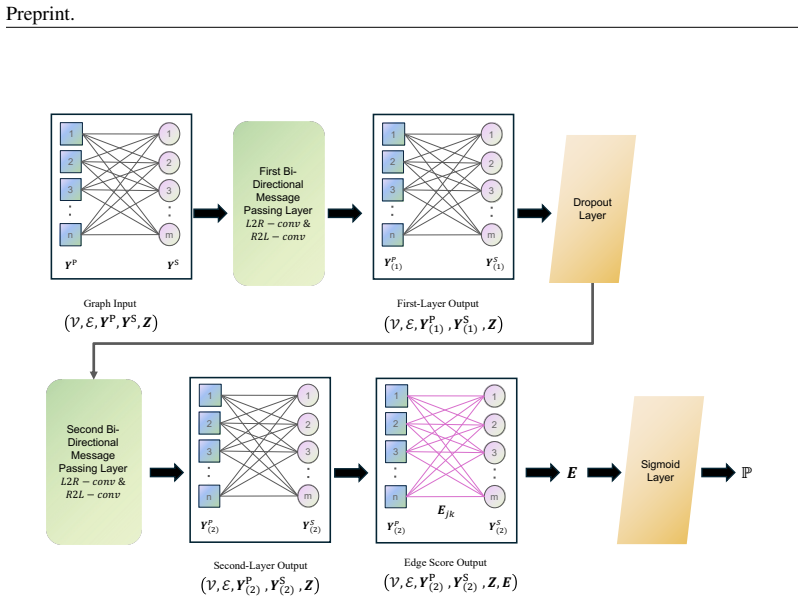
A bipartite customer-product graph with utility-weighted edges, where a two-layer bi-directional GCN with softmax aggregation produces edge logits, sigmoid-transformed to probabilities P_kj that product j belongs to segment k's optimal bundle. These probabilities drive two pruning rules—Fixed Cutoff Pruning (keep products with P_kj >= 0.5) and Progressive Cutoff Pruning (keep nested prefixes of probability-ranked products)—that shrink the 2^n bundle space to O(m) or O(mn) candidates, which are then priced exactly via the Hanson-Martin MILP. A probability-guided local search adds or drops products using LP lower-bound checks to refine the candidate family.
What would settle it
Enumerate all instances with n≤10 and m up to 30 using the paper's synthetic distribution (f(x)=√x, concave utilities) and compute the exact mixed-bundling optimum. If there exists any segment whose optimal bundle is not equal to {j: P_kj ≥ 0.5} and not a prefix of P_kj-sorted products—with probabilities from a converged GCN—then FCP/PCP provably cannot recover that optimal solution; measuring the resulting revenue loss would test the central claim.
Extended reading notes
Core claim
The paper's central claim is that an edge-output GCN, trained on optimal mixed-bundling solutions for small instances, predicts per-product assignment probabilities P_kj that allow most of the optimal revenue to be recovered with a drastically reduced bundle space. The authors prove that under mild distinguishability conditions this GCN class can recover the optimal product-assignment mapping. In numerical tests, FCP (keeping products with P_kj >= 0.5) and PCP (keeping nested prefixes of probability-ranked products) both retain more than 97.5% of optimal revenue on n=10 instances while solving much faster than the full MILP; a probability-guided local search adds another ~1% revenue. For n u
Load-bearing premise
The load-bearing premise is that the optimal bundle for each customer segment can be recovered from per-product marginal probabilities alone, meaning any optimal bundle that mixes a low-probability product with high-probability ones—or is not a prefix of the probability-ranked list—is excluded before pricing begins.
Editorial extensions
If this is right
- FCP and PCP retain more than 97.5% of optimal revenue on n=10 instances relative to the exact mixed-bundling baseline, with PCP achieving around 1% higher revenue than FCP and FCP+LS adding another ~1%.
- For n=15 to 25, the proposed strategies beat bundle-size pricing (BSP) in revenue or runtime; PCP revenue ratios versus BSP reach about 1.17.
- The methods scale to n=100 products: FCP runs in about 0.03 seconds regardless of n, and PCP solves in under 300 seconds, a regime where exact mixed bundling is intractable.
- The iterative self-improvement procedure generates high-quality solutions on larger instances for retraining, extending the approach beyond small-instance training data.
- The GCN class is expressive enough to recover the optimal product-assignment mapping under mild distinguishability conditions, providing theoretical support for the pruning approach.
Reading between the lines
- The same pipeline could be transferred to other exponential-choice problems, such as assortment optimization or pricing under discrete choice models, wherever a bipartite graph encodes feasible sets and a GCN can predict inclusion margins.
- PCP implicitly assumes optimal bundles are nested prefixes in probability order; testing that structural assumption directly on exact solutions for n up to 12 would reveal whether the prefix restriction is a source of revenue loss.
- Because larger instances are trained on BSP-supervised or self-generated solutions rather than exact optima, the method may inherit BSP biases; validating against exact solutions on moderate n would clarify the gap.
- The O(1) runtime of FCP relative to n suggests that the computational bottleneck shifts to the MILP on the retained bundle set, so further gains could come from improved MILP warm-starts rather than graph learning.
Editorial analysis
A structured set of objections, weighed in public.
Referee Report
Summary. The paper proposes a GCN-guided pruning framework for the mixed bundle pricing problem. A customer-product graph is encoded, and a two-layer edge-output GCN is trained on optimal mixed-bundling solutions to predict, for each customer segment and product, the probability that the product belongs to the segment's optimal bundle. These probabilities are used to construct restricted candidate bundle families: Fixed Cutoff Pruning (FCP) keeps one bundle per segment containing products with predicted probability at least 0.5, and Progressive Cutoff Pruning (PCP) keeps nested prefixes of products sorted by predicted probability. The restricted mixed bundling MILP is then solved over the retained bundles. A probability-guided local search is also introduced to refine assignments, and experiments on synthetic data report revenue ratios above 97% of optimal for n=10, superior revenue to bundle-size pricing for n=15-25, and scalability to n=100. The abstract additionally claims a theoretical expressiveness result for the GNN class and describes an iterative self-improvement procedure, neither of which appears in the body.
Significance. If the empirical and theoretical claims were fully supported, this would be a valuable contribution: a scalable method for mixed bundle pricing with non-additive valuations is genuinely needed, and the idea of learning per-product inclusion probabilities to prune an exponential bundle space is natural and potentially practical. The authors also deserve credit for providing a reproducible experimental setup in principle, for comparing against an exact MB baseline on n=10, and for clearly identifying the computational bottleneck. However, the central near-optimality claim currently rests on unproven structural assumptions about the candidate families, the PCP variant modifies the pricing model without justification, the advertised theoretical result is missing, and the local-search acceptance criterion relies on an invalid inference from LP bounds. These are load-bearing gaps, so the significance is conditional on substantial revision.
major comments (5)
- [Section 4.3] The pruning step assumes that the optimal bundle for each segment lies in F_FCP or F_PCP, i.e., that it is either the set of products with P_kj >= 0.5 or a prefix of products sorted by P_kj. No theorem or argument establishes that optimal MB solutions have this threshold/prefix structure. For n=10, Table 5.1 checks the resulting candidate family indirectly via revenue ratio, but for n>10 no exact optimum or upper bound is available. Table 5.3 in fact shows RR(FCP/PCP) degrading from 0.972 at n=10 to 0.852 at n=100, which suggests the adequacy of the structural assumption is not constant in n. The near-optimality claim for larger instances is therefore unsupported.
- [Section 4.3 (PCP)] For PCP, the authors write that because the candidate bundles form a nested chain, 'we replace the within-segment sub-additivity constraints by a chain of monotone price inequalities p_{b_i} <= p_{b_{i+1}}.' This changes the mathematical model being solved. Sub-additivity does not imply price monotonicity for nested bundles, and Appendix B proves a different statement: equivalence between 2-way partition sub-additivity and K-way cover sub-additivity under price monotonicity. It does not justify replacing sub-additivity with monotone inequalities. Consequently, the PCP revenues reported in Tables 5.1-5.3 are for a modified pricing model, and comparisons with MB or BSP are not apples-to-apples.
- [Abstract and Section 4.2] The abstract states: 'Theoretically, we show that under mild distinguishability conditions the proposed edge-output GNN class is expressive enough to recover the optimal product-assignment mapping.' No such theorem or proof appears in the paper. The only proof in Appendix B concerns sub-additivity equivalence. Either the statement should be removed from the abstract and introduction, or the theorem and its assumptions must be stated and proved in the body.
- [Section 4.4 and Appendix A.2] The local search uses an LP relaxation with fixed segment-bundle assignments and claims that 'any improvement detected under LP is guaranteed to be valid for MILP.' The LP value is a lower bound on the MILP value, but an increase in this lower bound does not imply an increase in the MILP optimum: the neighbor's LP can be higher while its true MILP value is lower. Thus the acceptance criterion is not sound as stated. This undermines the FCP+LS improvement claims in Table 5.1.
- [Abstract and full text] The title and abstract advertise 'Self-Improving Neural Pruning' and an 'iterative self-improvement procedure' that 'generates high-quality solutions on larger instances for retraining.' The body contains no such procedure: Section 4.4 describes only a one-shot local search, and no retraining or iteration over generated solutions is presented. This is a central advertised component of the method, and its absence makes the manuscript incomplete relative to its own claims.
minor comments (5)
- [Section 5] All tables report averages over 100 samples without standard deviations, confidence intervals, or statistical tests. Given the small differences in some revenue ratios (e.g., 0.9874 vs. 0.9877 in Table 5.1), the reported advantages may not be significant, and the reader cannot assess variability.
- [Section 5 / Appendix D] The paper does not describe the training/validation split, the data generation process for the optimal MB training labels, or the number of random seeds. Appendix D lists hyperparameters but not how they were selected. This limits reproducibility despite the reproducibility statement.
- [Section 3.1] The text says 'we use a simplified price sub-additivity constraints in (13)', but the sub-additivity constraint appears in (14). Also, constraint (12) contains indices 'R_kb θ_jb - P_jb', which appear to be typos; presumably it should be 'R_kb θ_jb - P_jb' with consistent segment indices. Please check all equation indices.
- [Section 4.3] In FCP, when all probabilities for a segment are below 0.5, the highest-probability product is retained. The cutoff 0.5 is chosen by hand and its sensitivity is never studied. A small experiment varying this threshold would help justify the choice.
- [Appendix A.2] The LP formulation fixes assignments 'externally by assigning each segment with their exact FCP optimal bundle prediction,' but the local search in Algorithm 1 does not use this fixed-assignment LP as a lower bound of the MILP with the same fixed assignment; it compares LP values across different assignments. Clarifying this distinction would help.
Circularity Check
No circular derivation: pruning is an unverified structural assumption; the only self-citation is non-load-bearing, and omitted theory/self-improvement are support gaps, not circularity.
full rationale
The derivation chain is not circular. The GCN's edge probabilities (Sec. 4.2: 'the model predicts a segment-product probability matrix P...') are trained on optimal mixed-bundling solutions; the candidate families in Sec. 4.3 ('we set the fixed cutoff to 0.5... This reduces the feasible space from 2^n to O(m)') are then solved as HM(F_FCP)/HM(F_PCP). The near-optimal revenue ratios in Table 5.1 are empirical results against the exact MB baseline, not quantities that are defined by the model output. No fitted parameter is renamed as a prediction, and no equation reduces to another by construction. The 0.5 cutoff and the prefix-bundle structure are hand-chosen structural assumptions; for n>10 no exact baseline exists (Table 5.2 compares only to BSP), so the assumption's adequacy at scale is a correctness risk, not circularity. The only overlapping self-citation is Li et al. (2025) in Related Work ('In a similar vein, we apply GCNs directly to the bundle pricing problem'); it is background, not load-bearing. Two claimed deliverables are absent from the body: the abstract's theoretical claim ('under mild distinguishability conditions the proposed edge-output GNN class is expressive enough to recover the optimal product-assignment mapping') and the 'iterative self-improvement procedure' mentioned in the abstract. These are omitted proofs/missing method sections, not circular steps. Score 2 reflects the one minor non-load-bearing self-citation.
Assumptions & free parameters
free parameters (7)
- FCP/PCP cutoff threshold =
0.5
- GCN hidden dimension =
128
- Dropout rate =
0.5
- Learning rate =
0.01
- Batch size =
512
- Training epochs / early stopping patience =
500 epochs, patience 50
- Local search max iterations
assumptions (7)
- domain assumption Reservation value R_kb = f(sum_{j in b} u_kj) with f increasing concave
- domain assumption Cost structure c_kb = sum_j c_j^u + c_k^s
- domain assumption Customer self-selection by surplus maximization
- domain assumption Price monotonicity p(A)<=p(B) for A subset B
- domain assumption GCN trained on small instances transfers to larger n and unseen instances
- ad hoc to paper Candidate families F_FCP and F_PCP contain a near-optimal bundle for every segment
- ad hoc to paper PCP's monotone price inequality chain is a valid substitute for within-segment sub-additivity
Cite this review
Pith. "Pith review of Self-Improving Neural Pruning: A Graph Neural Network Framework for Scalable Mixed Bundle Pricing." pith.science (2026). https://pith.science/paper/HKIESOXR
@misc{pith2026250922557,
  author       = {Pith},
  title        = {Pith review of: Self-Improving Neural Pruning: A Graph Neural Network Framework for Scalable Mixed Bundle Pricing},
  year         = {2026},
  howpublished = {\url{https://pith.science/paper/HKIESOXR}},
  note         = {Machine review of arXiv:2509.22557}
}
read the original abstract
Mixed bundle pricing is a classic revenue management problem arising in industries such as e-commerce, tourism, and video games. It refers to designing product combinations (i.e., bundles) and determining their prices to maximize expected profit. Exact mixed-bundling formulations capture this structure but are computationally intractable because the number of possible bundles grows exponentially with the number of products. We propose a graph neural network (GNN)-guided pruning framework for scalable (non-)additive bundle pricing. Instead of learning on the exponential bundle-level formulation, we encode each instance as a compact customer-product graph and train an edge-output GNN to learn the product-assignment probabilities from optimal mixed-bundling solutions. The predicted probabilities are then converted into restricted candidate bundle families through fixed cutoff pruning and progressive cutoff pruning; the final prices and assignments are obtained by solving the mixed bundling formulation over the retained bundles. We further introduce a GNN-guided local search and an iterative self-improvement procedure for larger instances. The local search refines the retained bundle family by prioritizing high-confidence add/drop moves, while the iterative self-improvement procedure generates high-quality solutions on larger instances for retraining. Theoretically, we show that under mild distinguishability conditions the proposed edge-output GNN class is expressive enough to recover the optimal product-assignment mapping. Experiments show that the proposed policies recover over 98% of the optimal profit on small instances and outperform bundle-size pricing on larger instances with substantial runtime savings.
Figures

Reference graph
Works this paper leans on
-
[1]
On the benefit (or cost) of large‐scale bundling
Tarek Abdallah. On the benefit (or cost) of large‐scale bundling. Production and Operations Management, 28 0 (4): 0 955--969, 2019
2019
-
[2]
Large-scale bundle-size pricing: A theoretical analysis
Tarek Abdallah, Amir Asadpour, and Jared Reed. Large-scale bundle-size pricing: A theoretical analysis. Operations Research, 69 0 (4): 0 1158--1185, 2021
2021
-
[3]
William James Adams and Janet L. Yellen. Commodity bundling and the burden of monopoly. The Quarterly Journal of Economics, 90 0 (3): 0 475--498, 1976
1976
-
[4]
Bundling information goods: Pricing, profits, and efficiency
Yannis Bakos and Erik Brynjolfsson. Bundling information goods: Pricing, profits, and efficiency. Management Science, 45 0 (12): 0 1613--1630, 1999
1999
-
[5]
Elmachtoub, Michael L
Ningyuan Chen, Adam N. Elmachtoub, Michael L. Hamilton, and Xiao Lei. Loot box pricing and design. Management Science, 67 0 (8): 0 4809--4825, 2021
2021
-
[6]
Component pricing with a bundle size discount
Ningyuan Chen, Xiaobo Li, Zechao Li, and Chun Wang. Component pricing with a bundle size discount. 2022. Available at SSRN: https://ssrn.com/abstract=4032247
2022
-
[7]
On the complexity of simple and optimal deterministic mechanisms for an additive buyer
Xi Chen, George Matikas, Dimitris Paparas, and Mihalis Yannakakis. On the complexity of simple and optimal deterministic mechanisms for an additive buyer. In Proceedings of the 29th Annual ACM-SIAM Symposium on Discrete Algorithms, pp.\ 2036--2049, 2018
-
[8]
Bundle-size pricing as an approximation to mixed bundling
Chenghuan Sean Chu, Phillip Leslie, and Alan Sorensen. Bundle-size pricing as an approximation to mixed bundling. American Economic Review, 101 0 (1): 0 263--303, 2011
2011
Show all 30 references
-
[9]
Accelerating primal solution findings for mixed integer programs based on solution prediction
Jian-Ya Ding, Chao Zhang, Lei Shen, Shengyin Li, Bing Wang, Yinghui Xu, and Le Song. Accelerating primal solution findings for mixed integer programs based on solution prediction. In Proceedings of the 34th AAAI Conference on Artificial Intelligence, pp.\ 1452--1459, 2020
2020
-
[10]
Smart initial basis selection for linear programs
Zhenan Fan, Xinglu Wang, Oleksandr Yakovenko, Abdullah Ali Sivas, Owen Ren, Yong Zhang, and Zirui Zhou. Smart initial basis selection for linear programs. In Proceedings of the 40th International Conference on Machine Learning, pp.\ 9650--9664, 2023
2023
-
[11]
Exact combinatorial optimization with graph convolutional neural networks
Maxime Gasse, Didier Chételat, Nicola Ferroni, Laurent Charlin, and Andrea Lodi. Exact combinatorial optimization with graph convolutional neural networks. In Proceedings of the 33rd Conference on Neural Information Processing Systems, pp.\ 15580--15592, 2019
2019
-
[12]
Digital media market size, share & growth report, 2023
Grand View Research . Digital media market size, share & growth report, 2023. URL https://www.grandviewresearch.com/industry-analysis/digital-media-market-report
2023
-
[13]
Khalil, Didier Chételat, Maxime Gasse, Yoshua Bengio, Andrea Lodi, and M
Prateek Gupta, Elias B. Khalil, Didier Chételat, Maxime Gasse, Yoshua Bengio, Andrea Lodi, and M. Pawan Kumar. Lookback for learning to branch. arXiv preprint arXiv:2206.14987, 2022
2022 arXiv
-
[14]
Kipp Martin
Ward Hanson and R. Kipp Martin. Optimal bundle pricing. Management Science, 36 0 (2): 0 155--174, 1990
1990
-
[15]
Hitt and Pei-yu Chen
Lorin M. Hitt and Pei-yu Chen. Bundling with customer self-selection: A simple approach to bundling low-marginal-cost goods. Management Science, 51 0 (10): 0 1481--1493, 2005
2005
-
[16]
Attention, learn to solve routing problems! arXiv preprint arXiv:1803.08475, 2019
Wouter Kool, Herke van Hoof, and Max Welling. Attention, learn to solve routing problems! arXiv preprint arXiv:1803.08475, 2019
2019 arXiv
-
[17]
From small to large: A graph convolutional network approach for solving assortment optimization problems
Guokai Li, Pin Gao, Stefanus Jasin, and Zizhuo Wang. From small to large: A graph convolutional network approach for solving assortment optimization problems. arXiv preprint arXiv:2507.10834, 2025
2025
-
[18]
Convex optimization for the bundle size pricing problem
Xiaobo Li, Hailong Sun, and Chung-Piaw Teo. Convex optimization for the bundle size pricing problem. Management Science, 68 0 (2): 0 1095--1106, 2021
2021
-
[19]
Learning to pivot as a smart expert
Tianhao Liu, Shanwen Pu, Dongdong Ge, and Yinyu Ye. Learning to pivot as a smart expert. In Proceedings of the 38th AAAI Conference on Artificial Intelligence, pp.\ 8073--8081, 2024
2024
-
[20]
Reaping the benefits of bundling under high production costs
Will Ma and David Simchi-Levi. Reaping the benefits of bundling under high production costs. In International Conference on Artificial Intelligence and Statistics, pp.\ 1342--1350. PMLR, 2021
2021
-
[21]
Inside Amazon’s Prime playbook: How the subscription giant chooses what benefits to add next , 2024
Modern Retail . Inside Amazon’s Prime playbook: How the subscription giant chooses what benefits to add next , 2024. URL https://www.modernretail.co/operations/inside-amazons-prime-playbook-how-the-subscription-giant-chooses-what-benefits-to-add-next/
2024
-
[22]
Solving mixed integer programs using neural networks
Vinod Nair, Sergey Bartunov, Felix Gimeno, Ingrid von Glehn, Pawel Lichocki, Ivan Lobov, Brendan O'Donoghue, Nicolas Sonnerat, Christian Tjandraatmadja, Pengming Wang, Ravichandra Addanki, Tharindi Hapuarachchi, Thomas Keck, James Keeling, Pushmeet Kohli, Ira Ktena, Yujia Li, ...
2012 arXiv
-
[23]
Learning to dive in branch and bound
Max Paulus and Andreas Krause. Learning to dive in branch and bound. In Proceedings of the 37th International Conference on Neural Information Processing Systems, pp.\ 34260--34277, 2023
2023
-
[24]
Gaussian demand and commodity bundling
Richard Schmalensee. Gaussian demand and commodity bundling. The Journal of Business, 57 0 (1): 0 211--230, 1984
1984
-
[25]
Learning a large neighborhood search algorithm for mixed integer programs
Nicolas Sonnerat, Pengming Wang, Ira Ktena, Sergey Bartunov, and Vinod Nair. Learning a large neighborhood search algorithm for mixed integer programs. arXiv preprint arXiv:2107.10201, 2021
2021 arXiv
-
[26]
George J. Stigler. United states v. loew's inc.: A note on block-booking. The Supreme Court Review, pp.\ 152--157, 1963
1963
-
[27]
write newline
" write newline "" before.all 'output.state := FUNCTION n.dashify 't := "" t empty not t #1 #1 substring "-" = t #1 #2 substring "--" = not "--" * t #2 global.max substring 't := t #1 #1 substring "-" = "-" * t #2 global.max substring 't := while if t #1 #1 substring * t #2 gl...
-
[28]
@esa (Ref
\@ifxundefined[1] #1\@undefined \@firstoftwo \@secondoftwo \@ifnum[1] #1 \@firstoftwo \@secondoftwo \@ifx[1] #1 \@firstoftwo \@secondoftwo [2] @ #1 \@temptokena #2 #1 @ \@temptokena \@ifclassloaded agu2001 natbib The agu2001 class already includes natbib coding, so you should ...
-
[29]
\@lbibitem[] @bibitem@first@sw\@secondoftwo \@lbibitem[#1]#2 \@extra@b@citeb \@ifundefined br@#2\@extra@b@citeb \@namedef br@#2 \@nameuse br@#2\@extra@b@citeb \@ifundefined b@#2\@extra@b@citeb @num @parse #2 @tmp #1 NAT@b@open@#2 NAT@b@shut@#2 \@ifnum @merge>\@ne @bibitem@firs...
-
[30]
@open @close @open @close and [1] URL: #1 \@ifundefined chapter * \@mkboth \@ifxundefined @sectionbib * \@mkboth * \@mkboth\@gobbletwo \@ifclassloaded amsart * \@ifclassloaded amsbook * \@ifxundefined @heading @heading NAT@ctr thebibliography [1] @ \@biblabel @NAT@ctr \@bibset...
Reviewed August 4, 2026 · model on record in the stance chip above.
Discussion (0). Continue with ORCID to comment.