Determining the spatial origin of X-ray and optical emission in the z = 3.1 strongly lensed radio-quiet quasar GraL J065904.1+162909 to hundreds of parsecs
Pith reviewed 2026-05-18 11:46 UTC · model grok-4.3
The pith
Gravitational lensing constrains X-ray emission in a z=3 quasar to within a 0.020 by 0.010 arcsecond ellipse offset 0.014 arcseconds from the optical source at 1 sigma.
A machine-rendered reading of the paper's core claim, the machinery that carries it, and where it could break.
Core claim
The authors perform milliarcsecond X-ray astrometry on the quadruply lensed radio-quiet quasar GraL J065904.1+162909 at redshift 3.083. Using a gravitational lens mass model fitted to Gaia DR3 and HST observations that matches the lensed image positions to one milliarcsecond, they determine the optical source position and compare it to Chandra data via Bayesian testing. This yields the constraint that the X-ray emission originates within a 0.020 by 0.010 arcsecond ellipse centered 0.014 arcseconds from the optical source at the 1 sigma level. The work further shows that the same technique can separate soft and hard X-ray regions and discusses its extension to future spectrally resolved astro
What carries the argument
The gravitational lens mass model derived from Gaia DR3 and HST data, which reproduces lensed image positions to 1 mas and thereby places the optical source for direct comparison against Chandra X-ray astrometry.
If this is right
- The X-ray and optical emission regions in this quasar are spatially coincident within the measured 0.020 by 0.010 arcsecond ellipse.
- The same astrometric approach can be used to locate the distinct origins of soft and hard X-ray emission in other lensed quasars.
- Broadband and spectrally resolved X-ray astrometry applied to lensed systems can probe quasar morphology and possible AGN multiplicity at sub-kiloparsec scales.
Where Pith is reading between the lines
- Extending the method to a statistical sample of lensed quasars would allow mapping how X-ray and optical emission regions evolve with redshift.
- A confirmed small offset between X-ray and optical centroids could be tested against models in which the X-ray corona sits slightly above the accretion disk.
- Combining lensing astrometry with future X-ray missions could distinguish between single and multiple AGN activity in high-redshift systems.
Load-bearing premise
The gravitational lens mass model from Gaia DR3 and HST data accurately reproduces the image positions to 1 mas and correctly places the optical source, with no significant unaccounted systematics in the Chandra astrometry or source morphology assumptions.
What would settle it
A refined lens model or higher-precision observation that shifts the predicted optical source position by more than 1 mas relative to the Gaia images, or that places the X-ray centroid more than 0.02 arcseconds away from that optical location.
Figures


read the original abstract
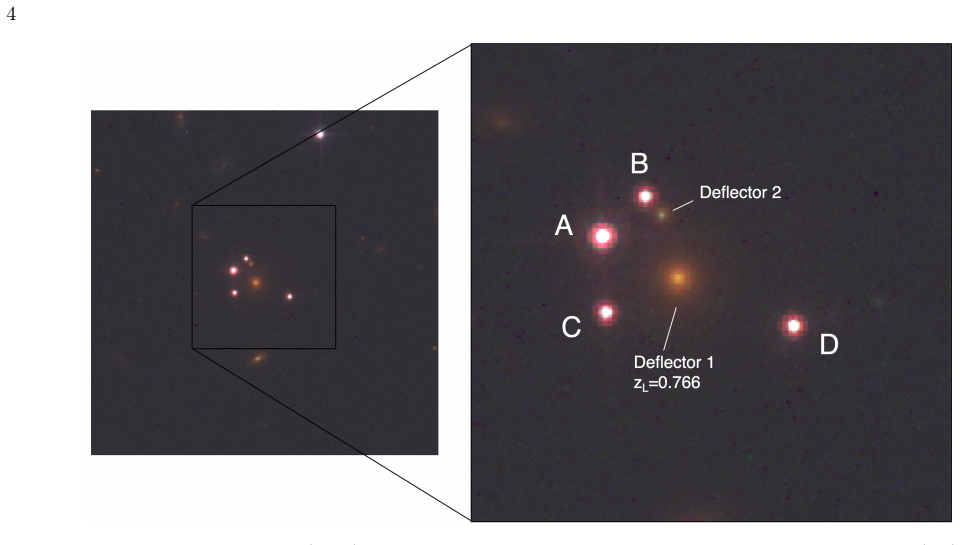
We perform milliarcsecond X-ray astrometry of the quadruply lensed radio-quiet quasar GraL J065904.1+162909 (J0659). This $z = 3.083$ quasar is lensed into four images and was discovered with the second Data Release of the $Gaia$ Space Observatory ($Gaia$ DR2). Our J0659 study exploits strong gravitational lenses as high resolution telescopes. This technique shows promise to elucidate the origin of optical and X-ray emission in distant lensed quasars at spatial scales beyond the reach of current instruments. In our study, we use $Gaia$ DR3 and $HST$ observations of J0659 to infer a mass model for the deflector. Our model reproduces the $Gaia$ DR3 quasar lensed image positions to one milliarcsecond and determines the position of the optical source in J0659 to within this precision. Next, we analyze $Chandra$ observations of J0659 and conduct a Bayesian test evaluating whether the X-ray emission region coincides with the optical source. We then constrain the origin of the X-ray emission to within a $0.''020 \times 0.''010$ ellipse centered $0.''014$ away from the optical source at the $1\sigma$ level. We demonstrate that our approach can be extended to pinpoint the distinct origins of the soft and hard X-ray emission regions in lensed quasars. We discuss the potential of upcoming broadband and spectrally resolved X-ray astrometric studies to probe complex quasar morphology and AGN multiplicity at sub-kiloparsec scales otherwise inaccessible at high redshifts.
Editorial analysis
A structured set of objections, weighed in public.
Referee Report
Summary. The paper claims to perform milliarcsecond X-ray astrometry on the quadruply lensed radio-quiet quasar GraL J065904.1+162909 at z=3.083 by modeling the deflector mass from Gaia DR3 and HST data to reproduce image positions to 1 mas and locate the optical source. Chandra observations are then analyzed via a Bayesian test to constrain the X-ray emission origin to a 0.020 × 0.010 arcsec ellipse centered 0.014 arcsec from the optical source at the 1σ level, with discussion of extensions to soft/hard X-ray separation.
Significance. If the central offset result holds after validation, the work provides a concrete demonstration of using strong lensing for sub-arcsecond astrometry of high-redshift quasar emission regions, enabling tests of AGN multiplicity and complex morphology at scales of hundreds of parsecs that are otherwise inaccessible. The approach is extensible to spectrally resolved X-ray studies and merits attention for its potential to deliver falsifiable spatial constraints.
major comments (2)
- [Lens modeling] The lens mass model section: the reproduction of Gaia DR3 image positions to 1 mas is stated but lacks explicit tabulation of residuals, covariance with mass-model parameters, or tests for unaccounted systematics (e.g., higher-order multipoles or external shear) that would propagate into the source-plane optical position and the subsequent 0.014 arcsec X-ray offset.
- [Chandra analysis and Bayesian test] The Chandra analysis and Bayesian test section: no quantitative error budget is supplied for absolute astrometric alignment between the Chandra frame and the Gaia/HST optical reference, nor for PSF convolution or source morphology assumptions; these directly determine whether the reported 1σ ellipse (0.020 × 0.010 arcsec) remains meaningful or is dominated by frame-registration uncertainty.
minor comments (1)
- [Abstract and methods] The abstract and methods would benefit from a brief statement of the number of Chandra counts and any data filtering applied before the Bayesian inference.
Simulated Author's Rebuttal
We thank the referee for their thorough review and valuable comments on our manuscript. We address each of the major comments in detail below and have revised the manuscript accordingly to incorporate the suggested improvements.
read point-by-point responses
-
Referee: The lens mass model section: the reproduction of Gaia DR3 image positions to 1 mas is stated but lacks explicit tabulation of residuals, covariance with mass-model parameters, or tests for unaccounted systematics (e.g., higher-order multipoles or external shear) that would propagate into the source-plane optical position and the subsequent 0.014 arcsec X-ray offset.
Authors: We agree that an explicit tabulation of the residuals would improve the clarity of our lens modeling results. In the revised version, we will add a table listing the observed Gaia DR3 positions, the modeled positions, and the residuals for each image. We will also include an analysis of the covariance matrix for the mass-model parameters and perform additional tests for unaccounted systematics such as higher-order multipoles and external shear. These additions will allow us to better quantify their potential impact on the derived source-plane optical position and the reported X-ray offset. revision: yes
-
Referee: The Chandra analysis and Bayesian test section: no quantitative error budget is supplied for absolute astrometric alignment between the Chandra frame and the Gaia/HST optical reference, nor for PSF convolution or source morphology assumptions; these directly determine whether the reported 1σ ellipse (0.020 × 0.010 arcsec) remains meaningful or is dominated by frame-registration uncertainty.
Authors: We recognize the need for a detailed error budget in the astrometric analysis. In the revised manuscript, we will provide a quantitative assessment of the absolute astrometric alignment uncertainty between the Chandra observations and the Gaia/HST reference frame, drawing on the known astrometric precision of Chandra and the specifics of our alignment procedure. Furthermore, we will discuss the contributions from PSF convolution and assumptions about source morphology to the overall uncertainty, and evaluate whether these dominate the reported 1σ ellipse or if the offset remains significant. revision: yes
Circularity Check
No significant circularity detected
full rationale
The derivation separates independent datasets: the lens mass model is constructed solely from Gaia DR3 and HST optical image positions (reproducing them to 1 mas), after which a Bayesian test is applied to distinct Chandra X-ray data to constrain the source-plane offset. This does not reduce any central claim to a fitted parameter defined by the same inputs, a self-citation chain, or an ansatz smuggled via prior work by the same authors. The approach is self-contained against external astrometric benchmarks and exhibits no load-bearing circular steps.
Axiom & Free-Parameter Ledger
free parameters (1)
- Deflector mass model parameters
axioms (1)
- domain assumption The gravitational lens mass model derived from Gaia DR3 and HST data places the optical source position correctly to within 1 mas.
Lean theorems connected to this paper
-
IndisputableMonolith/Foundation/AlexanderDuality.leanalexander_duality_circle_linking unclear?
unclearRelation between the paper passage and the cited Recognition theorem.
We infer a mass model for the deflector... reproduces the Gaia DR3 quasar lensed image positions to one milliarcsecond... constrain the origin of the X-ray emission to within a 0.''020 × 0.''010 ellipse
What do these tags mean?
- matches
- The paper's claim is directly supported by a theorem in the formal canon.
- supports
- The theorem supports part of the paper's argument, but the paper may add assumptions or extra steps.
- extends
- The paper goes beyond the formal theorem; the theorem is a base layer rather than the whole result.
- uses
- The paper appears to rely on the theorem as machinery.
- contradicts
- The paper's claim conflicts with a theorem or certificate in the canon.
- unclear
- Pith found a possible connection, but the passage is too broad, indirect, or ambiguous to say the theorem truly supports the claim.
Reference graph
Works this paper leans on
-
[1]
Anders, E., & Grevesse, N. 1989, GeoCoA, 53, 197, doi: 10.1016/0016-7037(89)90286-X
-
[2]
Antonucci, R. 1993, ARA&A, 31, 473, doi: 10.1146/annurev.aa.31.090193.002353
-
[3]
Antonucci, R. R. J., & Miller, J. S. 1985, ApJ, 297, 621, doi: 10.1086/163559
-
[4]
Arnaud, K. A. 1996, in Astronomical Society of the Pacific Conference Series, Vol. 101, Astronomical Data Analysis Software and Systems V, ed. G. H. Jacoby & J. Barnes, 17
work page 1996
-
[5]
A., Branduardi-Raymont, G., Culhane, J
Arnaud, K. A., Branduardi-Raymont, G., Culhane, J. L., et al. 1985, MNRAS, 217, 105, doi: 10.1093/mnras/217.1.105 Astropy Collaboration, Robitaille, T. P., Tollerud, E. J., et al. 2013, A&A, 558, A33, doi: 10.1051/0004-6361/201322068 Astropy Collaboration, Price-Whelan, A. M., Sip˝ ocz, B. M., et al. 2018, AJ, 156, 123, doi: 10.3847/1538-3881/aabc4f Astro...
-
[6]
Bambi, C., Brenneman, L. W., Dauser, T., et al. 2021, SSRv, 217, 65, doi: 10.1007/s11214-021-00841-8
-
[7]
2018, PhR, 778, 1, doi: 10.1016/j.physrep.2018.10.001
Barnacka, A. 2018, PhR, 778, 1, doi: 10.1016/j.physrep.2018.10.001
-
[8]
2006, A&A, 448, 499, doi: 10.1051/0004-6361:20054091
Bianchi, S., Guainazzi, M., & Chiaberge, M. 2006, A&A, 448, 499, doi: 10.1051/0004-6361:20054091
-
[9]
A., Pooley, D., Rappaport, S., & Schechter, P
Blackburne, J. A., Pooley, D., Rappaport, S., & Schechter, P. L. 2011, ApJ, 729, 34, doi: 10.1088/0004-637X/729/1/34
-
[10]
2025, sherpa/sherpa: Sherpa 4.17.1, 4.17.1, Zenodo, doi: 10.5281/zenodo.593753
Burke, D., Laurino, O., wmclaugh, et al. 2025, sherpa/sherpa: Sherpa 4.17.1, 4.17.1, Zenodo, doi: 10.5281/zenodo.593753
-
[11]
2018, in Astronomical Society of the Pacific Conference Series, Vol
Burke-Spolaor, S., Blecha, L., Bogdanovi´ c, T., et al. 2018, in Astronomical Society of the Pacific Conference Series, Vol. 517, Science with a Next Generation Very Large Array, ed. E. Murphy, 677 16
work page 2018
-
[12]
2009a, ApJ, 693, 174, doi: 10.1088/0004-637X/693/1/174 —
Garmire, G. 2009a, ApJ, 693, 174, doi: 10.1088/0004-637X/693/1/174 —. 2009b, ApJ, 693, 174, doi: 10.1088/0004-637X/693/1/174
-
[13]
2016, Astronomische Nachrichten, 337, 356, doi: 10.1002/asna.201612313
Chartas, G., Rhea, C., Kochanek, C., et al. 2016, Astronomische Nachrichten, 337, 356, doi: 10.1002/asna.201612313
-
[14]
2022, ApJ, 925, 162, doi: 10.3847/1538-4357/ac401b
Chen, Y.-C., Hwang, H.-C., Shen, Y., et al. 2022, ApJ, 925, 162, doi: 10.3847/1538-4357/ac401b
-
[15]
2022, ApJ, 927, 45, doi: 10.3847/1538-4357/ac4476
Connor, T., Stern, D., Krone-Martins, A., et al. 2022, ApJ, 927, 45, doi: 10.3847/1538-4357/ac4476
-
[16]
Crummy, J., Fabian, A. C., Gallo, L., & Ross, R. R. 2006, MNRAS, 365, 1067, doi: 10.1111/j.1365-2966.2005.09844.x
-
[17]
Dai, X., Kochanek, C. S., Chartas, G., et al. 2010, ApJ, 709, 278, doi: 10.1088/0004-637X/709/1/278
-
[18]
Davis, M. C., Trump, J. R., Charisi, M., et al. 2025, arXiv e-prints, arXiv:2508.05742, doi: 10.48550/arXiv.2508.05742
-
[19]
2024, MNRAS, 527, 11766, doi: 10.1093/mnras/stad3084
DeGraf, C., Chen, N., Ni, Y., et al. 2024, MNRAS, 527, 11766, doi: 10.1093/mnras/stad3084
-
[20]
2019, A&A, 622, A165, doi: 10.1051/0004-6361/201833802
Delchambre, L., Krone-Martins, A., Wertz, O., et al. 2019, A&A, 622, A165, doi: 10.1051/0004-6361/201833802
-
[21]
A radio census of lensed systems
Dobie, D., Sluse, D., Deller, A., et al. 2024, MNRAS, 528, 5880, doi: 10.1093/mnras/stad4002 D’Orazio, D. J., & Charisi, M. 2023, arXiv e-prints, arXiv:2310.16896, doi: 10.48550/arXiv.2310.16896
-
[22]
2025a, A&A, 697, A139, doi: 10.1051/0004-6361/202553807
Dux, F., Millon, M., Galan, A., et al. 2025a, A&A, 697, A139, doi: 10.1051/0004-6361/202553807
-
[23]
Dux, F., Millon, M., Lemon, C., et al. 2025b, A&A, 694, A300, doi: 10.1051/0004-6361/202452970
-
[24]
McHardy, I. M. 2014, MNRAS, 439, 3931, doi: 10.1093/mnras/stu249
-
[25]
Evans, I. N., Evans, J. D., Mart´ ınez-Galarza, J. R., et al. 2024, ApJS, 274, 22, doi: 10.3847/1538-4365/ad6319
-
[26]
2023, Low-Mass X-ray Binaries, doi: 10.1007/978-981-16-4544-0 94-1
Fabbiano, G., & Elvis, M. 2022, in Handbook of X-ray and Gamma-ray Astrophysics, ed. C. Bambi & A. Sangangelo (Springer Living Reference Work), 92, doi: 10.1007/978-981-16-4544-0 111-1
-
[27]
Fabian, A. C., Rees, M. J., Stella, L., & White, N. E. 1989, MNRAS, 238, 729, doi: 10.1093/mnras/238.3.729
-
[28]
2020, ApJ, 892, 29, doi: 10.3847/1538-4357/ab72fa
Foord, A., G¨ ultekin, K., Nevin, R., et al. 2020, ApJ, 892, 29, doi: 10.3847/1538-4357/ab72fa
-
[29]
Foord, A., G¨ ultekin, K., Reynolds, M. T., et al. 2019, ApJ, 877, 17, doi: 10.3847/1538-4357/ab18a3
-
[30]
2024, Universe, 10, 237, doi: 10.3390/universe10060237
Foord, A., Cappelluti, N., Liu, T., et al. 2024, Universe, 10, 237, doi: 10.3390/universe10060237
-
[31]
2001, in Society of Photo-Optical Instrumentation Engineers (SPIE) Conference Series, Vol
Freeman, P., Doe, S., & Siemiginowska, A. 2001, in Society of Photo-Optical Instrumentation Engineers (SPIE) Conference Series, Vol. 4477, Astronomical Data Analysis, ed. J.-L. Starck & F. D. Murtagh, 76–87, doi: 10.1117/12.447161
-
[32]
Fruscione, A., McDowell, J. C., Allen, G. E., et al. 2006, in Society of Photo-Optical Instrumentation Engineers (SPIE) Conference Series, Vol. 6270, Observatory Operations: Strategies, Processes, and Systems, ed. D. R. Silva & R. E. Doxsey, 62701V, doi: 10.1117/12.671760 Gaia Collaboration, Prusti, T., de Bruijne, J. H. J., et al. 2016, A&A, 595, A1, doi...
-
[33]
Galeev, A. A., Rosner, R., & Vaiana, G. S. 1979, ApJ, 229, 318, doi: 10.1086/156957
-
[34]
Gianolli, V. E., Kim, D. E., Bianchi, S., et al. 2023, MNRAS, 523, 4468, doi: 10.1093/mnras/stad1697
-
[35]
E., Bianchi, S., Kammoun, E., et al
Gianolli, V. E., Bianchi, S., Kammoun, E., et al. 2024, A&A, 691, A29, doi: 10.1051/0004-6361/202451645
-
[36]
2001, ApJ, 552, 508, doi: 10.1086/320581
Venturi, T. 2001, ApJ, 552, 508, doi: 10.1086/320581
-
[37]
Gordon, Y. A., Boyce, M. M., O’Dea, C. P., et al. 2020, Research Notes of the American Astronomical Society, 4, 175, doi: 10.3847/2515-5172/abbe23
-
[38]
Haardt, F., & Maraschi, L. 1991, ApJL, 380, L51, doi: 10.1086/186171 —. 1993, ApJ, 413, 507, doi: 10.1086/173020
-
[39]
Halpern, J. P. 1984, ApJ, 281, 90, doi: 10.1086/162077
-
[40]
Harris, C. R., Millman, K. J., van der Walt, S. J., et al. 2020, Nature, 585, 357, doi: 10.1038/s41586-020-2649-2
-
[41]
Harris, D. E., Biretta, J. A., Junor, W., et al. 2003, ApJL, 586, L41, doi: 10.1086/374773
-
[42]
Harris, D. E., Cheung, C. C., Biretta, J. A., et al. 2006, ApJ, 640, 211, doi: 10.1086/500081
-
[43]
Perlman, E. S. 2009, ApJ, 699, 305, doi: 10.1088/0004-637X/699/1/305 HI4PI Collaboration, Ben Bekhti, N., Fl¨ oer, L., et al. 2016, A&A, 594, A116, doi: 10.1051/0004-6361/201629178
-
[44]
Hunter, J. D. 2007, Computing in Science and Engineering, 9, 90, doi: 10.1109/MCSE.2007.55
-
[45]
Jerius, D. H., Cohen, L., Edgar, R. J., et al. 2004, in X-Ray and Gamma-Ray Instrumentation for Astronomy XIII, ed. K. A. Flanagan & O. H. W. Siegmund, Vol. 5165, International Society for Optics and Photonics (SPIE), 402 – 410, doi: 10.1117/12.509378 17
-
[46]
Joye, W. A., & Mandel, E. 2003, in Astronomical Society of the Pacific Conference Series, Vol. 295, Astronomical Data Analysis Software and Systems XII, ed. H. E
work page 2003
-
[47]
Kara, E., Alston, W. N., Fabian, A. C., et al. 2016, MNRAS, 462, 511, doi: 10.1093/mnras/stw1695
-
[48]
Keeton, C. R. 2001a, arXiv e-prints, astro, doi: 10.48550/arXiv.astro-ph/0102340 —. 2001b, arXiv e-prints, astro, doi: 10.48550/arXiv.astro-ph/0102341
work page internal anchor Pith review Pith/arXiv arXiv doi:10.48550/arxiv.astro-ph/0102340
-
[49]
Kellermann, K. I., Sramek, R., Schmidt, M., Shaffer, D. B., & Green, R. 1989, AJ, 98, 1195, doi: 10.1086/115207
-
[50]
Casey-Clyde, J. A., & Barnacka, A. 2023, ApJ, 955, 25, doi: 10.3847/1538-4357/ace16f
-
[51]
Kochanek, C. S. 2004, ApJ, 605, 58, doi: 10.1086/382180
-
[52]
Kochanek, C. S., & Dalal, N. 2004, ApJ, 610, 69, doi: 10.1086/421436
-
[53]
2012, ApJL, 746, L22, doi: 10.1088/2041-8205/746/2/L22
Koss, M., Mushotzky, R., Treister, E., et al. 2012, ApJL, 746, L22, doi: 10.1088/2041-8205/746/2/L22
-
[54]
Krolik, J. H., & Kriss, G. A. 2001, ApJ, 561, 684, doi: 10.1086/323442
-
[55]
2022, A&A, 657, A113, doi: 10.1051/0004-6361/202142138
Lemon, C., Millon, M., Sluse, D., et al. 2022, A&A, 657, A113, doi: 10.1051/0004-6361/202142138
-
[56]
150 new lenses, quasar pairs, and projected quasars
Lemon, C., Anguita, T., Auger-Williams, M. W., et al. 2023, MNRAS, 520, 3305, doi: 10.1093/mnras/stac3721
-
[57]
Lemon, C., Courbin, F., More, A., et al. 2024, SSRv, 220, 23, doi: 10.1007/s11214-024-01042-9
-
[58]
Li, J., Kastner, J. H., Prigozhin, G. Y., et al. 2004, ApJ, 610, 1204, doi: 10.1086/421866
-
[59]
Lynden-Bell, D., & Pringle, J. E. 1974, MNRAS, 168, 603, doi: 10.1093/mnras/168.3.603
-
[60]
Magdziarz, P., & Zdziarski, A. A. 1995, MNRAS, 273, 837, doi: 10.1093/mnras/273.3.837
-
[61]
Schurch, N. 2009, MNRAS, 394, 250, doi: 10.1111/j.1365-2966.2008.14255.x
-
[62]
Morgan, C. W., Kochanek, C. S., Dai, X., Morgan, N. D., & Falco, E. E. 2008, ApJ, 689, 755, doi: 10.1086/592767
-
[63]
Mosquera, A. M., & Kochanek, C. S. 2011, ApJ, 738, 96, doi: 10.1088/0004-637X/738/1/96
-
[64]
Mosquera, A. M., Kochanek, C. S., Chen, B., et al. 2013, ApJ, 769, 53, doi: 10.1088/0004-637X/769/1/53
-
[65]
Nair, S., Jin, C., & Garrett, M. A. 2005, MNRAS, 362, 1157, doi: 10.1111/j.1365-2966.2005.09355.x
-
[66]
Nandra, K., & George, I. M. 1994, MNRAS, 267, 974, doi: 10.1093/mnras/267.4.974
-
[67]
Nandra, K., & Pounds, K. A. 1994, MNRAS, 268, 405, doi: 10.1093/mnras/268.2.405
-
[68]
Nierenberg, A. M., Treu, T., Wright, S. A., Fassnacht, C. D., & Auger, M. W. 2014, MNRAS, 442, 2434, doi: 10.1093/mnras/stu862
-
[69]
1995, ApJ, 444, 567, doi: 10.1086/175631
Padovani, P., & Giommi, P. 1995, ApJ, 444, 567, doi: 10.1086/175631
-
[70]
Padovani, P., Alexander, D. M., Assef, R. J., et al. 2017, A&A Rv, 25, 2, doi: 10.1007/s00159-017-0102-9
-
[71]
S., Chatterjee, R., & Agrawal, V
Pal, I., Stalin, C. S., Chatterjee, R., & Agrawal, V. K. 2023, Journal of Astrophysics and Astronomy, 44, 87, doi: 10.1007/s12036-023-09981-5 Planck Collaboration, Aghanim, N., Akrami, Y., et al. 2020, A&A, 641, A6, doi: 10.1051/0004-6361/201833910
-
[72]
Pringle, J. E. 1981, ARA&A, 19, 137, doi: 10.1146/annurev.aa.19.090181.001033 Ramos Almeida, C., & Ricci, C. 2017, Nature Astronomy, 1, 679, doi: 10.1038/s41550-017-0232-z
-
[73]
2025, MNRAS, 542, L78, doi: 10.1093/mnrasl/slaf064
Rantala, A., & Naab, T. 2025, MNRAS, 542, L78, doi: 10.1093/mnrasl/slaf064
-
[74]
Reis, R. C., Reynolds, M. T., Miller, J. M., & Walton, D. J. 2014, Nature, 507, 207, doi: 10.1038/nature13031
-
[75]
Reynolds, C. S. 2021, ARA&A, 59, 117, doi: 10.1146/annurev-astro-112420-035022
-
[76]
Reynolds, C. S., & Fabian, A. C. 1995, MNRAS, 273, 1167, doi: 10.1093/mnras/273.4.1167
-
[77]
Reynolds, M. T., Walton, D. J., Miller, J. M., & Reis, R. C. 2014, ApJL, 792, L19, doi: 10.1088/2041-8205/792/1/L19
-
[78]
2025, ApJ, 987, 75, doi: 10.3847/1538-4357/add71a
Rogers, A., Schwartz, D., Spingola, C., & Barnacka, A. 2025, ApJ, 987, 75, doi: 10.3847/1538-4357/add71a
-
[79]
Ross, R. R., & Fabian, A. C. 1993, MNRAS, 261, 74, doi: 10.1093/mnras/261.1.74
-
[80]
Ross, R. R., Fabian, A. C., & Mineshige, S. 1992, MNRAS, 258, 189, doi: 10.1093/mnras/258.1.189
discussion (0)
Sign in with ORCID, Apple, or X to comment. Anyone can read and Pith papers without signing in.