REVIEW 3 major objections 5 minor 15 references
LLM Watermark Evasion via Bias Inversion
T0 review · 3 major / 5 minor · reviewed 2026-08-04 · deepseek-v4-flash
Pith's one-line read The paper claims that a query-free rewriting attack can defeat LLM watermarks by suppressing likely green tokens, with a theorem showing detection probability decays exponentially once the average green probability is held a small margin be
desk verdict Strong empirical watermark-evasion attack with a clean but unproven theoretical link; the proxy-set premise is asserted, not verified, and Appendix C has issues, but the paper deserves serious refereeing. read the letter →
The pith
A machine-rendered reading of the paper's core claim, the machinery that carries it, and where it could break.
The reading
What carries the argument
The key object is the empirical green-token rate p̂(y; W_k) and its detection threshold p_τ, since Theorem 1 reduces any detector of the stated form to a test 1{p̂ ≥ p_τ}. The engine of the attack is a negative logit bias applied to a proxy green set Ĝ constructed from token self-information; this inversion suppresses the very tokens the watermark was biased to produce. The proof of Theorem 2 uses a martingale difference sequence and the Azuma–Hoeffding inequality on the indicators of green-token emission.
What would settle it
Run BIRA against a watermark variant whose green tokens are the low-surprisal tokens or a random subset, and measure the average conditional true-green probability on the attacked text; if it is not at least δ below p_τ, or if the attack success rate drops materially, the paper's theoretical premise fails and the empirical guarantee would not extend.
Extended reading notes
Core claim
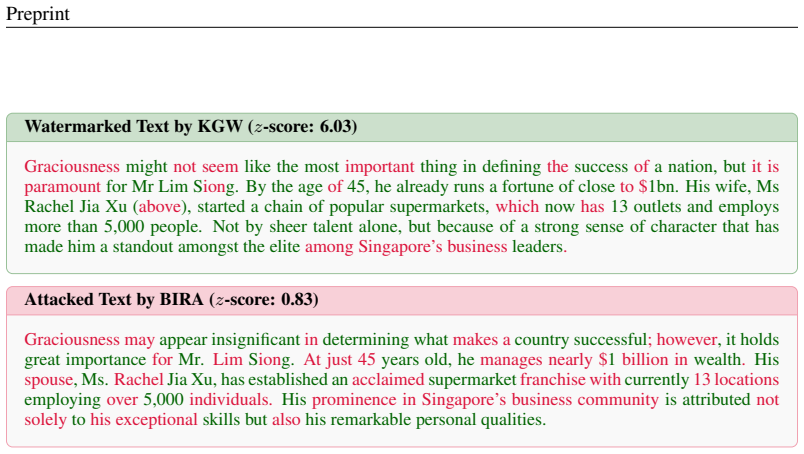
The central claim is that the watermark detection problem reduces to a monotone threshold test on the empirical green rate (Theorem 1), and that if an adversary can keep the average conditional probability of sampling a green token at least δ below the detection threshold, detection probability falls exponentially in Nδ² (Theorem 2). Guided by this, BIRA constructs a proxy green set from token self-information, then subtracts a logit bias from those tokens at each decoding step of an LLM-based paraphrase, inverting the watermark's generative bias without knowing the key. Empirically the attack evades detection in 98–100% of cases across the tested watermarking schemes, with z-scores near or
Load-bearing premise
The load-bearing premise is that the proxy green set, built by high token surprisal, is faithful enough that suppressing it also keeps the true average green probability below p_τ−δ; Appendix A.1 states this as a condition, but the paper does not prove it, and one displayed equality there should be an inequality because the proxy can contain non-green tokens.
Editorial extensions
If this is right
- Any published watermark whose detector is a monotone function of the empirical green rate is, in principle, evadable by a query-free rewriter that suppresses likely green tokens by a small average margin.
- The detection bound exp(−Nδ²/2) means the margin δ need not be large; for N=230, a margin around 0.1–0.2 already drives the detection probability below 0.32–0.01 under standard KGW thresholds.
- Because BIRA does not need the secret key or repeated queries to the watermarked model, the vulnerability is practically exploitable with an LLM that exposes logits or logit-bias APIs.
- The attack's success on schemes with different watermark constructions suggests the vulnerability is not specific to one family of green-list algorithms.
- If BIRA-style stress tests are adopted, current detection thresholds may substantially overstate robustness against rewriting attacks.
Reading between the lines
- The paper leaves open whether the proxy assumption holds; inferring from their method, a watermark that places its signal in low-surprisal tokens, or uses a two-sided test that also flags unusually low green rates, would likely defeat BIRA because the premise of Theorem 2 would no longer hold.
- The exponential bound suggests a defense-in-depth that aggregates detection statistics across many independently attacked texts; a single text's margin might be small, but accumulating z-scores over a corpus could restore detectability.
- Because BIRA relies on logit-level control during decoding, the same attack would need adaptation for closed APIs that only return text; measuring whether the proxy set transfers across tokenizers and models would be a natural next test.
- One direct testable extension is to instrument the attacker to record the true average conditional green probability, not just the proxy, on attacked outputs; if it does not stay below p_τ−δ, the theorem's premise is violated despite high empirical ASR.
Editorial analysis
A structured set of objections, weighed in public.
Referee Report
Summary. The paper proposes BIRA, a query-free watermark-evasion attack that rewrites watermarked text with an LLM while applying a negative logit bias to a proxy set of likely-green tokens selected by token surprisal. The theoretical core is Theorem 2: if the average conditional probability of sampling true green tokens is at least delta below the detection threshold p_tau, then the detection probability is at most exp(-N delta^2 / 2). The proof via a martingale-difference argument and Azuma-Hoeffding is correct. The paper then claims that this bound motivates BIRA because suppressing a surprisal-based proxy set should suppress true green tokens on average. Experiments on seven watermarking schemes and three LLMs report over 99% ASR with better LLM-judgement and NLI scores than prior query-free baselines. The main gap is that the theoretical premise is never shown to hold for the actual attack: the proxy-set conditions in Appendix A.1 are asserted, not measured, and the derivation as written contains an equality that is only an inequality.
Significance. If the theoretical claim fully covered the attack, this would be an important result: it would show formally that any detector reducible to a monotone threshold on the empirical green rate can be evaded by a query-free rewriter that lowers average conditional green probability by a modest margin, and the empirical results suggest this margin is achievable in practice. The paper also ships a large, systematic empirical study across seven watermarking schemes and three target models, with code, ablation studies, and qualitative examples. However, the advertised 'theoretically motivated' attack and the 'fundamental vulnerability' conclusion are currently stronger than what is proven. Theorem 2 itself is a clean conditional result, but the link from BIRA's proxy-based bias to the true green-set premise is the load-bearing assumption and it is left unverified.
major comments (3)
- [§4.2 and Appendix A.1] The proxy-set argument is the key connection between Theorem 2 and BIRA, and it is not established. Appendix A.1 states two sufficient conditions — an average miss-rate bound epsilon and an average proxy-suppression bound p'_tau - delta — but neither is measured or verified for any of the seven watermarking schemes or three target LMs. Moreover, the displayed derivation contains a formal error: the equality E[1_{ytilde in G}] = E[1_{ytilde in Ghat}] + E[1_{ytilde in G \ Ghat}] is false because Ghat may contain non-green tokens. The correct identity is 1_G = 1_{G∩Ghat} + 1_{G\Ghat} ≤ 1_{Ghat} + 1_{G\Ghat}, so the step holds only as an inequality. As written, Theorem 2 does not formally apply to BIRA unless the two conditions are actually verified per scheme.
- [§4.1, Theorem 1, and Table 3] Theorem 1 assumes the detector statistic Z(y;Wk) is a nondecreasing function h of the empirical green rate. This assumption is not checked for the evaluated detectors. In particular, if a detector uses a two-sided or absolute z-score, h is not nondecreasing and the reduction to a one-sided threshold p_tau fails. The observed negative z-scores in Table 3 (e.g., -0.34 for Unigram under BIRA) are only compatible with a one-sided test. The paper should state explicitly that the theory covers one-sided monotone-threshold detectors and confirm that each evaluated scheme satisfies this condition; otherwise the theoretical guarantee does not cover the reported empirical regime.
- [Appendix C and Figure 6] The 'Detection bound analysis' is presented as validation of Theorem 2, but it does not validate the proxy conditions that connect the theorem to BIRA. The appendix computes the per-sample bound using the true conditional green probability for one configuration (Unigram watermark generated by Llama-3.2-3B, attacked by Llama-3.1-8B), and it reports neither the measured average conditional green probability nor the miss rate epsilon. The figure and text also contain numerical/formatting errors: the text reports negative upper bounds (e.g., '-7.50×10^-2') although an exponential bound cannot be negative, and the axis labels are garbled. The claim that this 'validates our theorem' is overstated; it is a single-case empirical illustration, not a verification of the attack's premise.
minor comments (5)
- [Introduction and Related Work] Raffel et al. (2020) is the T5 / C4 paper, not a watermark-evasion attack; citing it alongside Cheng et al. (2025), Wu & Chandrasekaran (2024), Chen et al. (2024), and Jovanović et al. (2024) as a 'recent study' questioning watermark robustness is a citation error. It also appears again as a query-free attack in the Related Work section.
- [Appendix C] The text 'At the 90th percentile, the upper bound for BIRA is -7.50×10^-2' should presumably read 7.50×10^-2 (and similarly for the Vanilla value). Negative upper bounds are mathematically impossible and should be corrected.
- [Figure 6] The axis labels are rendered as '10 5', '10 4', etc., which likely lost superscript formatting. This makes the figure difficult to read in the current preprint.
- [Algorithm 1 and §4.2] The proxy set Ghat is defined via token ids from the paraphrase model's tokenizer, but when the auxiliary model and target model have different tokenizers (the GPT-4o-mini case), the re-tokenization step is described only in prose. A precise definition of how the proxy set is transferred between tokenizers would improve reproducibility.
- [Table 3] The header 'SIR (τ=0.2)' is unclear: SIR's test statistic is not obviously a z-score with threshold 0.2, and the table mixes different detection statistics. Clarifying what the reported values and thresholds represent would prevent misinterpretation.
Circularity Check
No significant circularity: Theorem 2 is an independent conditional bound; the proxy-set bridge in Appendix A.1 is asserted rather than verified, and the displayed equality is only an inequality—a correctness gap, not a circular reduction.
full rationale
The paper's central theoretical claim, Theorem 2, is a conditional inequality: if the average conditional probability of true-green tokens is at most p_tau - delta, then detection probability is at most exp(-N delta^2/2). The proof (Appendix A) constructs a martingale difference sequence and applies Azuma-Hoeffding; the premise is an upper bound on true-green sampling, not a restatement of the conclusion, so the theorem itself is self-contained. Theorem 1 is also a direct monotone-threshold equivalence for detectors whose statistic is a nondecreasing function of the empirical green rate—again a mathematical consequence, not circularity. The attack's proxy construction (high self-information tokens) is an additional empirical premise, not derived from Theorem 2. The bridge in Section 4.2 / Appendix A.1 asserts two sufficient conditions (average miss rate <= epsilon; average proxy suppression <= p'_tau - delta with p'_tau = p_tau - epsilon) but does not measure them for the evaluated schemes. Moreover, the display in A.1 writes E[1{G}] = E[1{Ghat}] + E[1{G\Ghat}], whereas the correct identity is 1{G} <= 1{Ghat} + 1{G\Ghat}; the step holds only as an inequality. This is a formal proof gap and a risk to the claimed black-box guarantee, but it is not a circular reduction: the theorem's premise is still about true-green membership, and the proxy conditions are not logically equivalent to the theorem's conclusion. The initialization of beta_0 on 50 C4 paraphrases is a hyperparameter choice to avoid degeneration, not a fitted input masquerading as a prediction; the reported ASR is an empirical evaluation, and Appendix C directly measures the theorem's premise for one setup using the true green set, providing independent albeit narrow support. There are no load-bearing self-citations. Accordingly, the derivation chain is not circular; the main weaknesses are unverified sufficient conditions and a minor inequality error, which are correctness concerns rather than circularity.
Assumptions & free parameters
free parameters (3)
- Initial logit bias beta_0 =
-4 (Llama-3.1-8B/70B); -11 (GPT-4o-mini)
- Proxy percentile q =
0.5
- Degeneration detection parameters (h, rho, lr, Lmax) =
h=450, rho=0.25, lr=0.125, Lmax=1500
assumptions (4)
- standard math Azuma-Hoeffding inequality for martingale difference sequences with increments bounded in [-1,1]
- domain assumption The detector statistic Z is a nondecreasing function of the empirical green token rate
- domain assumption High-surprisal tokens approximate the true green set with bounded miss rate epsilon
- domain assumption The rewriting model exposes or accepts token-level logit biases at every decoding step
Cite this review
Pith. "Pith review of LLM Watermark Evasion via Bias Inversion." pith.science (2026). https://pith.science/paper/7H7MQ5DU
@misc{pith2026250923019,
  author       = {Pith},
  title        = {Pith review of: LLM Watermark Evasion via Bias Inversion},
  year         = {2026},
  howpublished = {\url{https://pith.science/paper/7H7MQ5DU}},
  note         = {Machine review of arXiv:2509.23019}
}
abstract
Watermarking offers a promising solution for detecting LLM-generated content, yet its robustness under realistic query-free (black-box) evasion remains an open challenge. Existing query-free attacks often achieve limited success or severely distort semantic meaning. We bridge this gap by theoretically analyzing rewriting-based evasion, demonstrating that reducing the average conditional probability of sampling green tokens by a small margin causes the detection probability to decay exponentially. Guided by this insight, we propose the \emph{Bias-Inversion Rewriting Attack} (BIRA), a practical query-free method that applies a negative logit bias to a proxy suppression set identified via token surprisal. Empirically, BIRA achieves state-of-the-art evasion rates ($>99\%$) across diverse watermarking schemes while preserving semantic fidelity substantially better than prior baselines. Our findings reveal a fundamental vulnerability in current watermarking methods and highlight the need for rigorous stress tests. Our code is available at \href{https://github.com/ml-postech/LLM-Watermark-Evasion-via-Bias-Inversion}{here}.
Figures


Figures from the paper (4 more)


Reference graph
Works this paper leans on
-
[3]
Jinlan Fu, See-Kiong Ng, Zhengbao Jiang, and Pengfei Liu
URLhttps: //arxiv.org/abs/2407.21783. Jinlan Fu, See-Kiong Ng, Zhengbao Jiang, and Pengfei Liu. Gptscore: Evaluate as you desire.arXiv preprint arXiv:2302.04166,
-
[4]
Deberta: Decoding-enhanced bert with disentangled attention.arXiv preprint arXiv:2006.03654,
Pengcheng He, Xiaodong Liu, Jianfeng Gao, and Weizhu Chen. Deberta: Decoding-enhanced bert with disentangled attention.arXiv preprint arXiv:2006.03654,
arXiv 2006
-
[7]
Aiwei Liu, Leyi Pan, Xuming Hu, Shu’ang Li, Lijie Wen, Irwin King, and Philip S Yu. An unforge- able publicly verifiable watermark for large language models.arXiv preprint arXiv:2307.16230, 2023a. Aiwei Liu, Leyi Pan, Xuming Hu, Shiao Meng, and Lijie Wen. A semantic invariant robust water- mark for large language models.ICLR 2024,
arXiv 2024
-
[8]
10 Preprint Yang Liu, Dan Iter, Yichong Xu, Shuohang Wang, Ruochen Xu, and Chenguang Zhu. G-eval: Nlg evaluation using gpt-4 with better human alignment.arXiv preprint arXiv:2303.16634, 2023b. Yijian Lu, Aiwei Liu, Dianzhi Yu, Jingjing Li, and Irwin King. An entropy-based text watermarking detection method. InProceedings of the 62nd Annual Meeting of the ...
-
[9]
Large language models: A survey.arXiv preprint arXiv:2402.06196,
Shervin Minaee, Tomas Mikolov, Narjes Nikzad, Meysam Chenaghlu, Richard Socher, Xavier Am- atriain, and Jianfeng Gao. Large language models: A survey.arXiv preprint arXiv:2402.06196,
-
[10]
Gpt-4o: Multimodal and multilingual capabilities
OpenAI. Gpt-4o: Multimodal and multilingual capabilities. OpenAI website, 2024a. URLhttps: //openai.com/index/hello-gpt-4o. Accessed: 2025-09-12. OpenAI. Gpt-4o mini: Advancing cost-efficient intelligence. OpenAI Platform Documentation, 2024b. URLhttps://platform.openai.com/docs/models/gpt-4o-mini. Ac- cessed: 2025-09-12. Leyi Pan, Aiwei Liu, Zhiwei He, Z...
arXiv 2025
-
[11]
Sentence-bert: Sentence embeddings using siamese bert- networks.arXiv preprint arXiv:1908.10084,
Nils Reimers and Iryna Gurevych. Sentence-bert: Sentence embeddings using siamese bert- networks.arXiv preprint arXiv:1908.10084,
arXiv 1908
-
[12]
URLhttps: //www.reuters.com/technology/artificial-intelligence/ openai-supports-california-ai-bill-requiring-watermarking-synthetic-content-2024-08-26/. Lei Wang, Chen Ma, Xueyang Feng, Zeyu Zhang, Hao Yang, Jingsen Zhang, Zhiyuan Chen, Jiakai Tang, Xu Chen, Yankai Lin, et al. A survey on large language model based autonomous agents. Frontiers of Computer...
arXiv 2024
Show all 15 references
-
[13]
A resilient and accessible distribution-preserving watermark for large language models.arXiv preprint arXiv:2310.07710,
Yihan Wu, Zhengmian Hu, Junfeng Guo, Hongyang Zhang, and Heng Huang. A resilient and accessible distribution-preserving watermark for large language models.arXiv preprint arXiv:2310.07710,
-
[14]
I knew right away he had what we needed
The scope and specificity remain identical Fz-SCORE COMPARISON OF ATTACKS ON DIFFERENT WATERMARKING SCHEMES Table 5:z-score comparison of attacks on different watermarking methods. Watermark KGW-1 Unigram UPV EWD DIP SIR Vanilla2.40±1.32 3.04±1.52 3.24±1.23 2.08±1.32 0.16±0.52...
2008
-
[1967]
what happens after the end of the end of everything?
though there were two other pitchers who had done so before him: Tom Seaver achieved this feat before this game but also a no- table left-handed pitcher who achieved this feat before him: Sandy Koufax achieved this feat before this game; Tom Seaver actually achieved this feat ...
1993
-
[1977]
Watermark stealing in large language models
Nikola Jovanovi´c, Robin Staab, and Martin Vechev. Watermark stealing in large language models. arXiv preprint arXiv:2402.19361,
-
[2020]
Unbi- ased watermark for large language models.arXiv preprint arXiv:2310.10669,
Zhengmian Hu, Lichang Chen, Xidong Wu, Yihan Wu, Hongyang Zhang, and Heng Huang. Unbi- ased watermark for large language models.arXiv preprint arXiv:2310.10669,
-
[2023]
Ruibo Chen, Yihan Wu, Junfeng Guo, and Heng Huang
URLhttps://www.reuters.com/technology/ openai-google-others-pledge-watermark-ai-content-safety-white-house-2023-07-21/. Ruibo Chen, Yihan Wu, Junfeng Guo, and Heng Huang. De-mark: Watermark removal in large language models.arXiv preprint arXiv:2410.13808,
2023 arXiv
-
[2024]
Revealing weaknesses in text watermarking through self-information rewrite attacks.arXiv preprint arXiv:2505.05190,
Yixin Cheng, Hongcheng Guo, Yangming Li, and Leonid Sigal. Revealing weaknesses in text watermarking through self-information rewrite attacks.arXiv preprint arXiv:2505.05190,
Reviewed August 4, 2026 · model on record in the stance chip above.
Discussion (0). Sign in to comment.