REVIEW 4 major objections 4 minor 15 references
LLM reasoning can meet mobile-edge latency and accuracy targets when reasoning depth, expert routing, and transmission power are optimized together.
Reviewed by Pith at T0; open to challenge. T0 means a machine referee read the full paper against a public rubric. the ladder, T0–T4 →
2026-08-04 14:45 UTC pith:SUWOG6LF
load-bearing objection The reasoning-depth-as-resource framing is plausible, but the central quantitative claims are unsupported: the optimization is never formalized, the simulator is self-referential, and the abstract's 90%/1s numbers don't appear in the body. the 4 major comments →
Resource-Aware LLM Reasoning for Mobile Edge General Intelligence
The pith
A machine-rendered reading of the paper's core claim, the machinery that carries it, and where it could break.
Core claim
The central claim is that LLM reasoning can be made edge-deployable by modeling reasoning depth as a dynamic network resource alongside expert activation and power control. The discovery is that adaptive CoT depth—the number of intermediate reasoning steps an expert produces—can be selected per task and per device state, so simple queries get shallow, cheap reasoning while complex queries get deeper reasoning. Combined with a distributed MoE where a base station routes tokens to specialized on-device experts, this adaptive depth lets the system hit target latency and accuracy constraints at lower energy than dense, fixed-depth alternatives. The reported experiment shows the proposed configur
What carries the argument
The load-bearing mechanism is the joint optimization of three variables: (1) token-to-expert assignment via a gating network in the base station, (2) downlink/uplink transmission power, and (3) CoT reasoning depth (the number of intermediate steps). The paper treats reasoning depth as a controllable resource and solves the joint problem with Distributed Proximal Policy Optimization (DPPO), a reinforcement-learning algorithm. Each edge expert integrates a CoT module that produces one reasoning step at a time and stops once the configured depth or a task-specific quality threshold is reached, so reasoning depth becomes a schedulable network parameter.
Load-bearing premise
The framework assumes that splitting a model's MoE layers across devices, routing tokens through a base station, and prompting for extra reasoning steps preserves output quality as captured by a threshold-based accuracy reward; this is not validated end-to-end in the paper.
What would settle it
Run the same MoE+CoT configuration in a real distributed setup and measure whether the token-level outputs aggregated at the base station match the accuracy of the same model run on a single device. If end-to-end accuracy falls below the threshold used in the simulation (e.g., 90% satisfaction), the central trade-off claim fails. Alternatively, a measurement showing that adaptive CoT depth selection never exceeds fixed-depth accuracy under identical energy budgets would weaken the 'adaptive' contribution.
If this is right
- If correct, edge networks can offer LLM-based reasoning with 90% or better latency and accuracy satisfaction while adding less than one second of inference time.
- Adaptive CoT depth selection is a practical lever: it outperforms both no-CoT and fixed-depth CoT in energy-constrained edge settings.
- Distributed MoE with per-expert fine-tuning can offload heavy reasoning from a central server to edge devices without collapsing quality.
- Treating reasoning depth as a network resource means reasoning quality becomes optimizable in the same framework as radio resources.
- The local single-device results suggest that instruction-tuned small models give better accuracy/latency trade-offs than base models, informing model selection at the edge.
Where Pith is reading between the lines
- A testable extension is to apply the same joint optimization to multimodal or multi-agent reasoning, where 'depth' becomes a per-module variable; the paper lists this as future work.
- The paper's accuracy satisfaction metric is threshold-based, so a natural follow-up is to validate end-to-end output quality on real reasoning benchmarks under distributed routing, since the simulator does not model how token aggregation changes generated text.
- If reasoning steps follow diminishing returns, adaptive depth could be combined with early-exit or self-consistency voting to push accuracy higher without proportional energy growth.
- Distributed execution exposes intermediate tokens and prompts to edge devices and the base station, so the framework could be extended to include privacy-preserving aggregation, which would alter the latency/energy trade-off.
Editorial analysis
A structured set of objections, weighed in public.
Referee Report
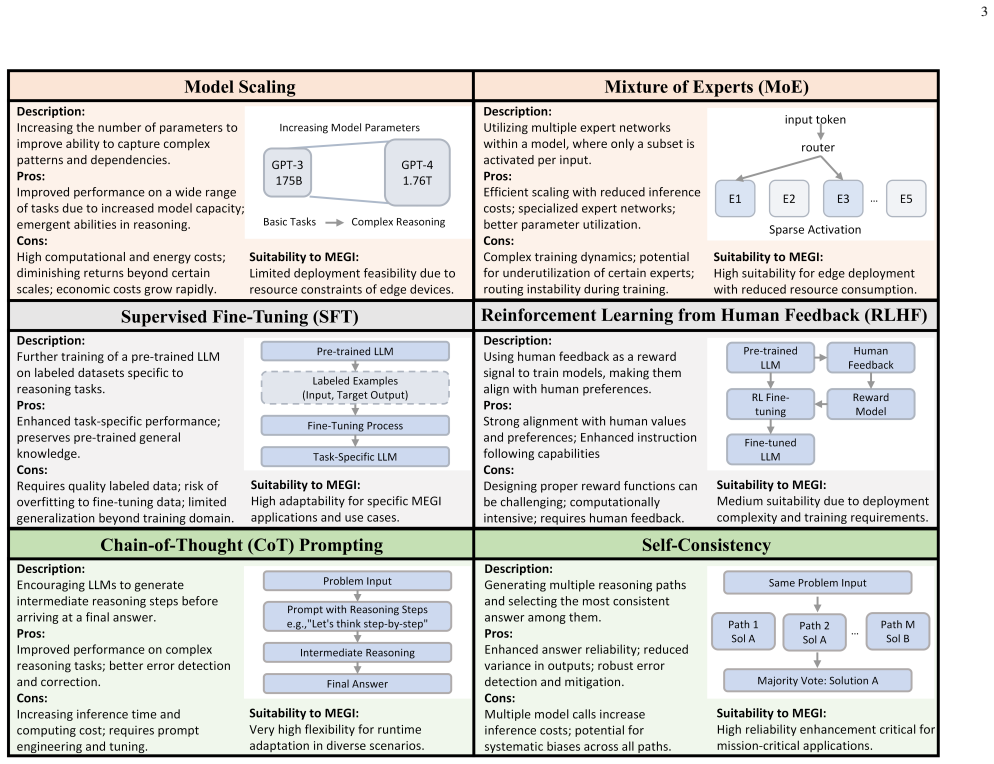
Summary. The paper proposes a joint optimization framework for deploying LLM-based agentic reasoning in Mobile Edge General Intelligence (MEGI) environments. It first provides a structured review of reasoning enhancement methods across pre-training, fine-tuning, and inference phases. It then describes a distributed Mixture-of-Experts (MoE) architecture in which a base station controls token routing, transmission power, and adaptive Chain-of-Thought (CoT) reasoning depth, with the control problem addressed by Distributed Proximal Policy Optimization (DPPO). The evaluation comprises a local Gemma-2B experiment comparing direct prompting versus CoT, and a system-level simulation comparing four configurations: dense model without CoT, MoE without CoT, MoE with fixed CoT, and the proposed MoE with dynamic CoT. The paper claims that the proposed framework balances reasoning quality, latency, and energy efficiency, with the abstract asserting that 'with less than one second of additional inference time, both accuracy and latency satisfaction rate can reach 90%.'
Significance. If the central claims were substantiated, this would be a useful practical contribution: the architectural idea of distributing MoE experts across edge devices while adapting CoT depth in a resource-aware manner is well motivated, and the literature review is broad and informative. The local Gemma-2B experiment provides a concrete illustration of the trade-offs between model variant and prompting strategy. However, the paper's core contribution is an optimization framework, and that optimization problem is never formally stated; the system-level evaluation does not validate the distributed MoE reasoning quality; and the headline quantitative claim in the abstract does not appear in the body. The significance is therefore prospective rather than demonstrated.
major comments (4)
- [Abstract / §IV-B] The abstract's load-bearing claim—'with less than one second of additional inference time, both accuracy and latency satisfaction rate can reach 90%'—is not supported by any measurement reported in the body. Section IV-B states only that 'latency constraints are met in over 90% of the cases'; it reports no additional-inference-time figure, no accuracy-satisfaction percentage, and no error bars. This quantitative claim should either be removed or replaced with the actual measured values.
- [§III-A3 and §IV-B] The distributed MoE pipeline is never validated end-to-end. The system-level simulator treats accuracy as a threshold-based reward and does not model how splitting MoE layers across devices, token-level routing through the base station, and weighted aggregation of hidden states affect actual output text. The local Gemma-2B experiment in §IV-A is single-device and therefore cannot validate the distributed architecture. If distributed expert inference degrades output quality, the claimed trade-off between reasoning quality and efficiency collapses. An end-to-end experiment with real model outputs is needed.
- [§IV-B] No formal statement of the optimization problem is given. The objective, constraints, state space, action space, and reward function are described only in prose; no equations define the energy minimization, the latency and accuracy satisfaction functions, or the 'reasoning quality threshold' used in the accuracy satisfaction rate. Without this formulation, the claimed 'joint optimization' cannot be evaluated or reproduced, and the role of DPPO is not verifiable.
- [§IV-B] The evaluation uses the same simulator on which the DPPO policy is trained, and no external baselines or independent validation are provided. Since the reward function directly includes latency and accuracy satisfaction, the reported satisfaction rates partly reflect the fitted objective rather than independent generalization. At minimum, a separate validation set or comparison with a non-RL heuristic is needed.
minor comments (4)
- [§IV-A] Figure 3 is described as a 'summary of output correctness and inference time' but the axes and numerical values are not described in the text. Please clarify what is plotted and how correctness was scored.
- [§IV-B] Figure 4 appears to lack axis labels and error bars; please add them so the reported differences among the four schemes can be assessed quantitatively.
- [Throughout] There are minor typographical issues, e.g., the author block contains 'V Y' instead of a consistent initial, and some sentences are run-on. A careful proofread would improve readability.
- [References] The survey part would benefit from references to more recent edge-LLM deployment benchmarks, especially for the claim about 3-bit quantization degrading accuracy by up to 40% (currently referenced to a preprint).
Circularity Check
The headline 90% accuracy/latency satisfaction claim is the DPPO reward itself, not an independent prediction: the same simulator and the same threshold-based satisfaction metrics are used for training and validation, so the central result reduces to the optimized objective.
specific steps
-
fitted input called prediction
[Section IV-B (System-Level Performance Evaluation), DPPO reward and evaluation metrics]
"The algorithm learns control policies through interaction with the MEGI environment, where the state space includes task parameters, current network conditions, and device capabilities. The action space jointly encodes token assignments, power allocations, and CoT reasoning steps, while the reward function balances energy consumption against latency and accuracy constraints. ... The performance is measured using three key metrics: total energy consumption, cumulative energy for all inference requests; accuracy satisfaction rate, percentage of tasks exceeding a set reasoning quality threshold;"
The DPPO policy is trained on a simulated MEGI environment with a reward function that explicitly 'balances energy consumption against latency and accuracy constraints.' The evaluation then reports success using the very same quantities—'accuracy satisfaction rate' and 'latency satisfaction rate'—computed from the same kind of simulated environment used for training. Saying that 'latency constraints are met in over 90% of the cases' and showing accuracy-satisfaction curves in Fig. 4 is therefore a report of the optimized reward, not an independent prediction or out-of-sample validation. The abstract's quantitative claim—'with less than one second of additional inference time, both accuracy and latency satisfaction rate can reach 90%'—is not supported by any separate measurement reported in
full rationale
The only substantive circularity is in the system-level evaluation: the DPPO reward is defined over accuracy and latency satisfaction, and the same threshold-based satisfaction rates are used as the evaluation metrics, both within the same simulated environment. This makes the reported >90% satisfaction a fitted/optimized objective rather than a prediction from first principles or an external benchmark. The local Gemma-2B experiment (Section IV-A) is a real, single-device measurement, but it does not validate the distributed MoE workflow, and no other independent accuracy measurement is provided. Self-citations (e.g., Refs. [2]–[5]) are contextual and not load-bearing for the main result; they define MEGI and related concepts but do not supply the experimental numbers. No uniqueness theorem or ansatz is imported from the authors' prior work. The missing end-to-end validation of distributed MoE output quality is a correctness risk, but the clearest circularity is the equivalence between the optimized reward terms and the reported validation metrics, which justifies a score of 6 rather than 0.
Axiom & Free-Parameter Ledger
free parameters (4)
- reasoning quality threshold
- DPPO reward weights
- latency constraint per task
- DPPO hyperparameters
axioms (4)
- domain assumption Distributed execution of MoE expert layers across devices preserves model accuracy
- domain assumption CoT depth is a controllable integer resource with monotonic effect on compute and quality
- domain assumption The simulated wireless and device environment is representative of MEGI
- domain assumption DPPO training converges to a policy that generalizes across tasks and network conditions
Cite this review
Pith. "Pith review of Resource-Aware LLM Reasoning for Mobile Edge General Intelligence." pith.science (2026). https://pith.science/paper/SUWOG6LF
@misc{pith2026250923248,
  author       = {Pith},
  title        = {Pith review of: Resource-Aware LLM Reasoning for Mobile Edge General Intelligence},
  year         = {2026},
  howpublished = {\url{https://pith.science/paper/SUWOG6LF}},
  note         = {Machine review of arXiv:2509.23248}
}
read the original abstract
The rapid advancement of large language models (LLMs) has enabled an emergence of agentic artificial intelligence (AI) with powerful reasoning and autonomous decision-making capabilities. This integration with edge computing has led to the development of Mobile Edge General Intelligence (MEGI), which brings real-time, privacy-preserving reasoning to the network edge. However, deploying LLM-based agentic AI reasoning in MEGI environments poses significant challenges due to the high computational demands of reasoning and the limited resources of edge devices. To address these challenges, we propose a joint optimization framework for efficient LLM reasoning deployment in MEGI. First, we systematically review enhancement methods to identify mechanisms suitable for edge adaptation. Subsequently, we present a distributed framework that synergizes reasoning enhancement via adaptive CoT prompting with scalable deployment through a distributed MoE architecture. An important innovation of this approach involves modeling reasoning depth as a dynamic network resource variable, which is optimized jointly with expert activation and transmission power. This mechanism allows the system to dynamically regulate expert networks and reasoning complexity according to task requirements and device capabilities. Experimental evaluations in mobile edge environments demonstrate that the proposed framework effectively balances reasoning quality and resource efficiency. The results show that with less than one second of additional inference time, both accuracy and latency satisfaction rate can reach 90\%, validating the practical viability of deploying sophisticated LLM reasoning in resource-constrained MEGI systems.
Figures


Reference graph
Works this paper leans on
-
[1]
Deepseek-r1 incentivizes reasoning in LLMs through reinforcement learning,
D. Guo, D. Yang, H. Zhang, J. Song, R. Zhang, R. Xu, Q. Zhu, S. Ma, P. Wanget al., “Deepseek-r1 incentivizes reasoning in LLMs through reinforcement learning,”Nature, vol. 645, pp. 633—-638, 2025
2025
-
[2]
Embodied AI-enhanced vehicular networks: An integrated vision language models and reinforcement learning method,
R. Zhang, C. Zhao, H. Du, D. Niyato, J. Wang, S. Sawadsitang, X. Shen, and D. I. Kim, “Embodied AI-enhanced vehicular networks: An integrated vision language models and reinforcement learning method,” IEEE Transactions on Mobile Computing, pp. 1–16, 2025
2025
-
[3]
Generative AI agents with large language model for satellite networks via a mixture of experts transmission,
R. Zhang, H. Du, Y . Liu, D. Niyato, J. Kang, Z. Xionget al., “Generative AI agents with large language model for satellite networks via a mixture of experts transmission,”IEEE Journal on Selected Areas in Communications, vol. 42, no. 12, pp. 3581–3596, 2024
2024
-
[4]
R. Zhang, G. Liu, Y . Liu, C. Zhao, J. Wang, Y . Xu, D. Niyato, J. Kang, Y . Li, S. Maoet al., “Toward edge general intelligence with agentic AI and agentification: Concepts, technologies, and future directions,”arXiv preprint arXiv:2508.18725, 2025
Pith/arXiv arXiv 2025
-
[5]
Toward democratized generative AI in next-generation mobile edge networks,
R. Zhang, J. He, X. Luo, D. Niyato, J. Kang, Z. Xiong, Y . Li, and B. Sikdar, “Toward democratized generative AI in next-generation mobile edge networks,”IEEE Network, pp. 1–1, 2025
2025
-
[6]
Optimizing microservice deployment in edge computing with large language models: Integrating retrieval augmented generation and chain of thought techniques,
K. Feng, L. Luo, Y . Xia, B. Luo, X. He, K. Li, Z. Zha, B. Xu, and K. Peng, “Optimizing microservice deployment in edge computing with large language models: Integrating retrieval augmented generation and chain of thought techniques,”Symmetry, vol. 16, no. 11, p. 1470, 2024
2024
-
[7]
E. J. Husom, A. Goknil, M. Astekin, L. K. Shar, A. Kåsen, S. Sen, B. A. Mithassel, and A. Soylu, “Sustainable llm inference for edge ai: Evaluating quantized llms for energy efficiency, output accuracy, and inference latency,”arXiv preprint arXiv:2504.03360, 2025
Pith/arXiv arXiv 2025
-
[8]
Self-consistency improves chain of thought reasoning in language models,
X. Wang, J. Wei, D. Schuurmans, Q. Le, E. Chi, S. Narang, A. Chowdh- ery, and D. Zhou, “Self-consistency improves chain of thought reasoning in language models,”arXiv preprint arXiv:2203.11171, 2022
Pith/arXiv arXiv 2022
-
[9]
Edgemoe: Empowering sparse large language models on mobile devices,
R. Yi, L. Guo, S. Wei, A. Zhou, S. Wang, and M. Xu, “Edgemoe: Empowering sparse large language models on mobile devices,”IEEE Transactions on Mobile Computing, 2025
2025
-
[10]
Drive like a human: Rethinking autonomous driving with large language models,
D. Fu, X. Li, L. Wen, M. Douet al., “Drive like a human: Rethinking autonomous driving with large language models,” in2024 IEEE/CVF Winter Conference on Applications of Computer Vision Workshops (WACVW), 2024, pp. 910–919
2024
-
[11]
Towards large reasoning models: A survey of reinforced reasoning with large language models,
F. Xu, Q. Hao, Z. Zong, J. Wang, Y . Zhang, J. Wanget al., “Towards large reasoning models: A survey of reinforced reasoning with large language models,”arXiv preprint arXiv:2501.09686, 2025
Pith/arXiv arXiv 2025
-
[12]
Emergent abilities of large language models,
J. Wei, Y . Tay, R. Bommasani, C. Raffel, B. Zoph, S. Borgeaud, D. Yogatama, M. Bosma, D. Zhou, D. Metzleret al., “Emergent abilities of large language models,”arXiv preprint arXiv:2206.07682, 2022
Pith/arXiv arXiv 2022
-
[13]
J. Achiam, S. Adler, S. Agarwal, L. Ahmad, I. Akkaya, F. L. Aleman, D. Almeida, J. Altenschmidt, S. Altman, S. Anadkatet al., “Gpt-4 technical report,”arXiv preprint arXiv:2303.08774, 2023
Pith/arXiv arXiv 2023
-
[14]
Large language models (llms) inference offloading and resource allocation in cloud-edge com- puting: An active inference approach,
Y . He, J. Fang, F. R. Yu, and V . C. Leung, “Large language models (llms) inference offloading and resource allocation in cloud-edge com- puting: An active inference approach,”IEEE Transactions on Mobile Computing, vol. 23, no. 12, pp. 11 253–11 264, 2024
2024
-
[15]
Gemma 2: Improving open language models at a practical size,
G. Team, M. Riviere, S. Pathak, P. G. Sessa, C. Hardin, S. Bhupatiraju et al., “Gemma 2: Improving open language models at a practical size,” arXiv preprint arXiv:2408.00118, 2024
Pith/arXiv arXiv 2024
This paper was first reviewed by deepseek-v4-flash on August 4, 2026.
discussion (0)
Sign in with ORCID, Apple, or X to comment. Anyone can read and Pith papers without signing in.