Scattering of massive particles from black holes and naked singularities
Pith reviewed 2026-05-18 12:26 UTC · model grok-4.3
The pith
Black holes channel reflected particles into a narrow band of deflection angles while naked singularities scatter them in all directions.
A machine-rendered reading of the paper's core claim, the machinery that carries it, and where it could break.
Core claim
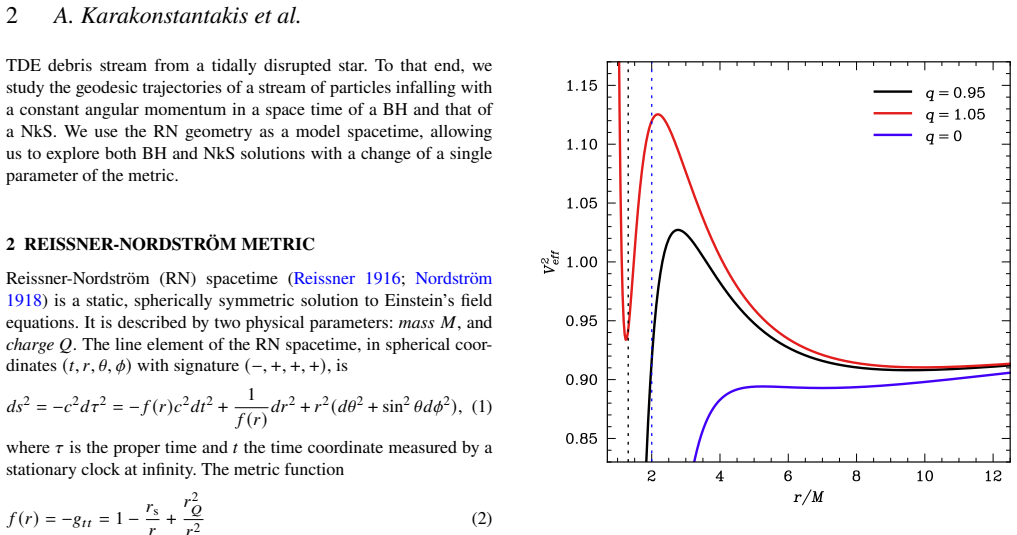
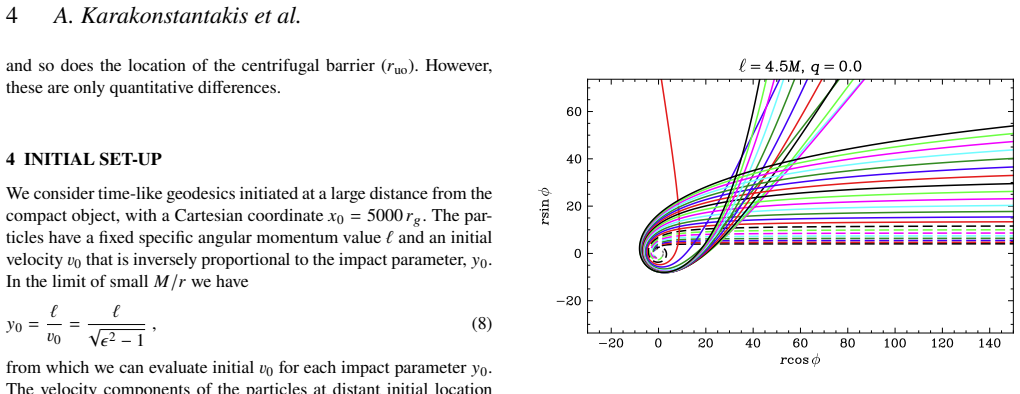
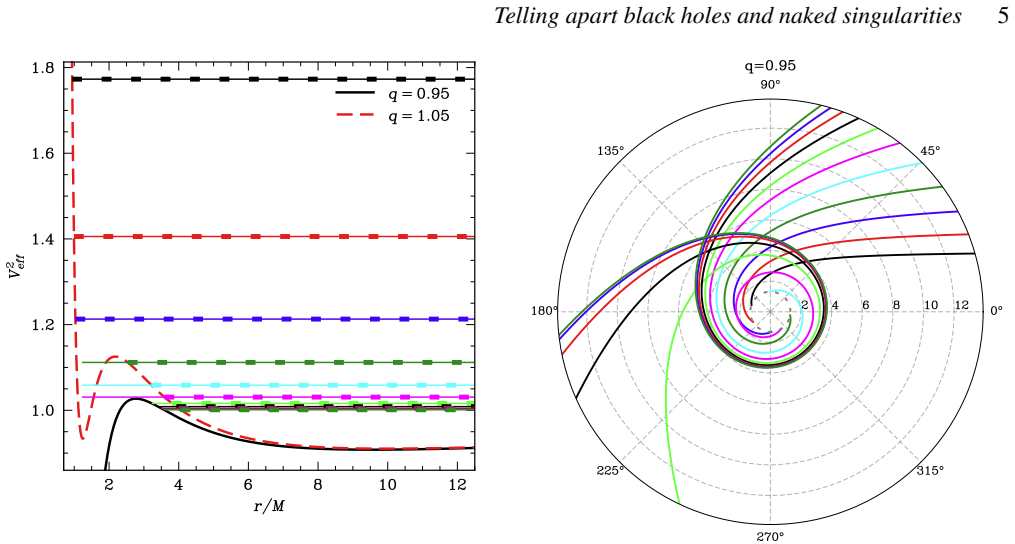
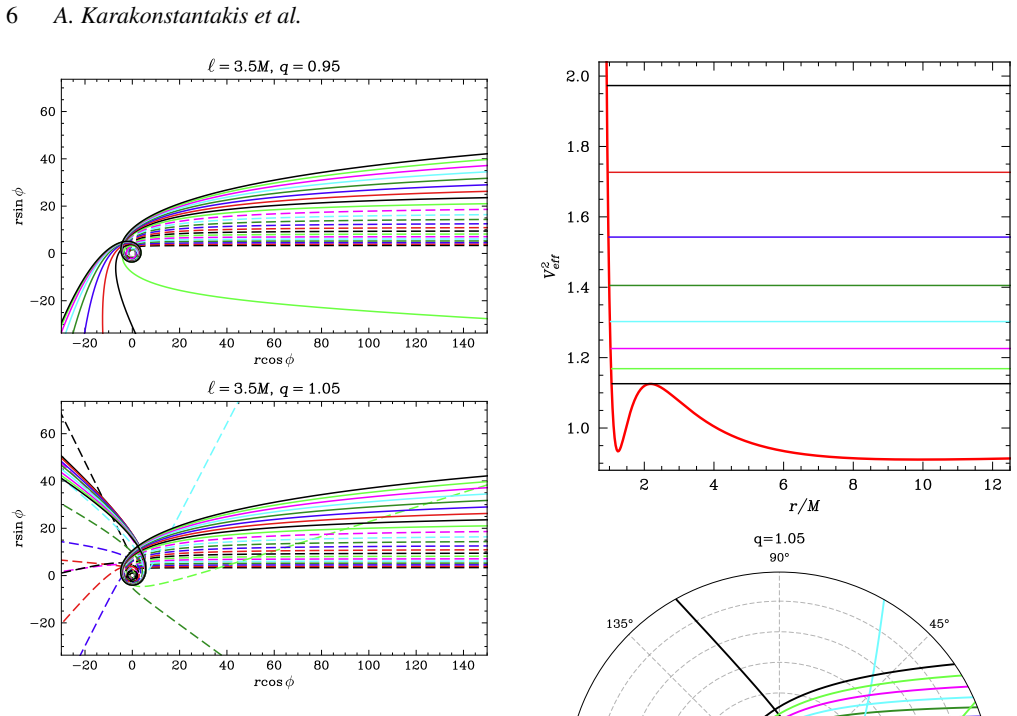
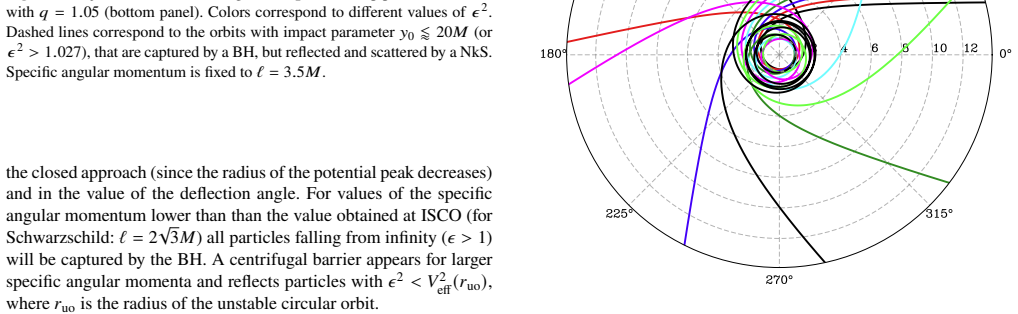
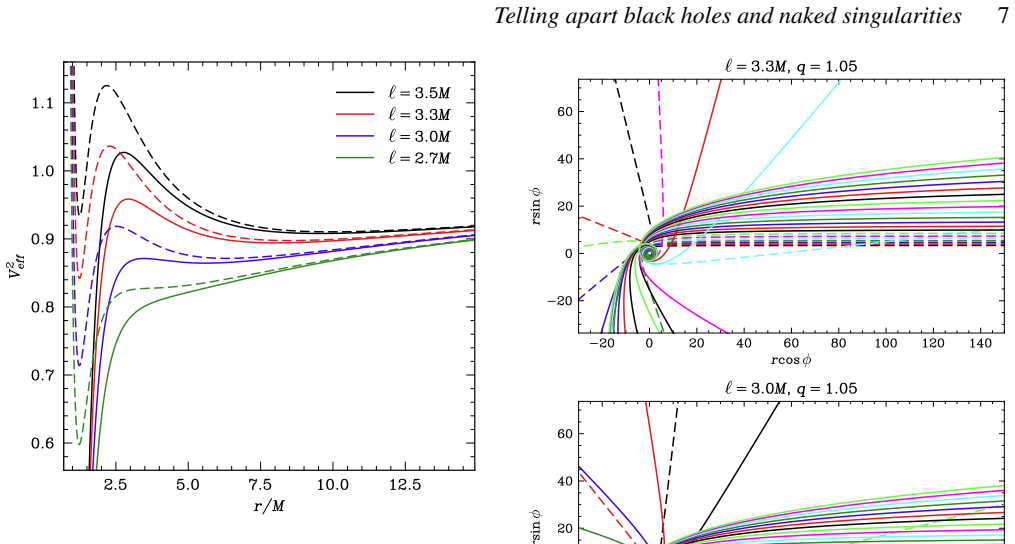
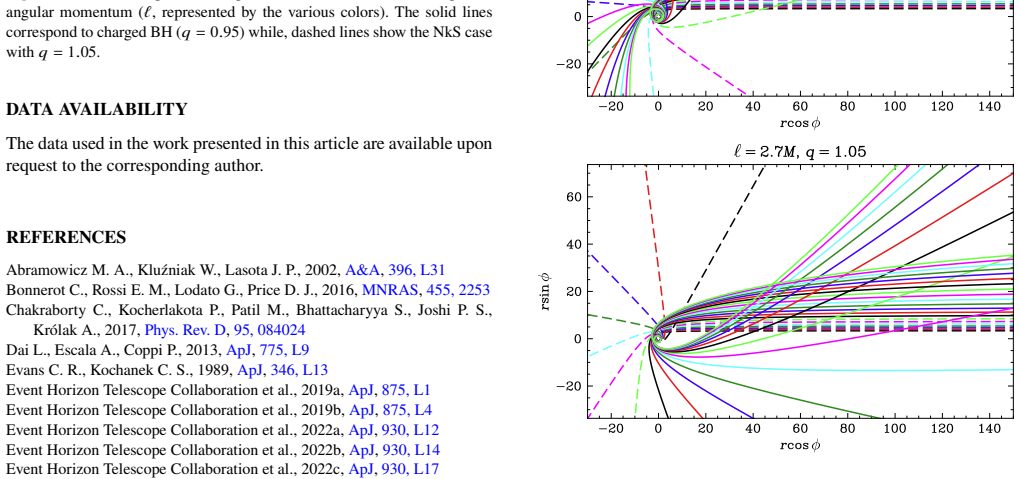
In the Reissner-Nordström geometry, a stream of massive particles with fixed angular momentum and varying energies that encounters a black hole reflects into a family of orbits confined to a narrow interval of deflection angles. The same stream encountering a naked singularity is scattered across essentially all directions in the plane of motion. The authors trace the difference to the interplay between the centrifugal barrier located at the unstable circular orbit and either an absorbing event horizon or a repulsive core.
What carries the argument
The geodesic equation for massive particles in the Reissner-Nordström metric, with the centrifugal barrier at the unstable circular orbit interacting with either an absorbing event horizon or a repulsive core.
Load-bearing premise
The particles are treated as non-interacting test particles that follow geodesics without back-reaction on the metric or energy loss to radiation.
What would settle it
High-resolution numerical simulations of tidal disruption events that measure the distribution of deflection angles for particles reflected from a charged black hole versus a naked singularity would directly test whether the narrow versus broad scattering patterns appear.
Figures



read the original abstract
We performed a numerical study of the dynamics of massive particles orbiting black holes and naked singularities in the Reissner-Nordstr\"om geometry. We modeled a stream of particles with a constant angular momentum and with a range of energies. We then solved the geodesic equation of motion and compared the trajectories around black holes and naked singularities by tuning the charge parameter of the metric. The setup {allows us to explore the orbital dynamics relevant for} astrophysical scenarios such as tidal disruption events{, particularly for deep encounters}. We discussed differences and similarities in the orbital dynamics and deflection angles. We found that particles reflected by a black hole follow a stream-like family of orbits within a narrow range of deflection angles, whereas in the case of naked singularities particles are scattered in all directions on the plane of motion. We explained this behavior as an interplay between the presence of a centrifugal barrier at the location of the unstable circular orbit and an absorbing event horizon in the case of a black hole or a {repulsive core} in the case of a naked singularity. These qualitative differences are expected to impact the observable signatures of tidal disruption events.
Editorial analysis
A structured set of objections, weighed in public.
Referee Report
Summary. The paper performs a numerical integration of the geodesic equation for massive test particles in the Reissner-Nordström spacetime, holding angular momentum L fixed while varying particle energy E. By tuning the charge parameter Q/M to cross from black-hole (horizon-present) to naked-singularity (repulsive-core) regimes, the authors compare families of trajectories and resulting deflection angles. They report that black-hole scattering produces a narrow, stream-like bundle of reflected orbits confined to a limited range of deflection angles, whereas naked-singularity scattering is essentially isotropic on the orbital plane. The difference is attributed to the centrifugal barrier at the unstable circular orbit combined with horizon absorption versus core repulsion. The study is framed as relevant to deep encounters in tidal disruption events.
Significance. If the reported contrast in deflection-angle distributions is robust, the work supplies a qualitative, potentially observable signature that could help distinguish black holes from naked singularities in astrophysical scattering events. The direct numerical approach to geodesic motion for fixed L and sampled E provides a concrete illustration of how horizon versus repulsive-core boundary conditions alter orbital families. The limitation to non-back-reacting test particles is standard for such explorations but restricts immediate application to realistic, self-gravitating encounters.
major comments (1)
- [Numerical methods and parameter selection] The manuscript selects a specific interval of energies for the fixed angular momentum L but does not locate this interval relative to the maximum of the effective potential V_eff(r;L) (or the location of the unstable circular orbit). Without this mapping it remains unclear whether the narrow deflection-angle stream for black holes is a generic feature of the horizon-plus-barrier combination or an artifact of sampling energies just above the barrier while different regimes are sampled for the naked-singularity case. This choice is load-bearing for the central qualitative claim.
minor comments (3)
- [Abstract] The abstract and introduction refer to 'a range of energies' without quoting the numerical interval or the criterion used to choose it.
- [Numerical methods] No mention is made of step-size convergence tests, integrator tolerance, or error estimates for the numerical geodesic integration.
- [Discussion] The discussion of astrophysical implications for tidal disruption events would benefit from a brief statement of the regime of validity (test-particle limit, neglect of radiation reaction).
Simulated Author's Rebuttal
We thank the referee for the careful reading and the constructive comment on our manuscript. The concern about mapping the chosen energy interval to the effective potential is well taken, and we address it directly below with a commitment to strengthen the presentation in revision.
read point-by-point responses
-
Referee: [Numerical methods and parameter selection] The manuscript selects a specific interval of energies for the fixed angular momentum L but does not locate this interval relative to the maximum of the effective potential V_eff(r;L) (or the location of the unstable circular orbit). Without this mapping it remains unclear whether the narrow deflection-angle stream for black holes is a generic feature of the horizon-plus-barrier combination or an artifact of sampling energies just above the barrier while different regimes are sampled for the naked-singularity case. This choice is load-bearing for the central qualitative claim.
Authors: We agree that an explicit mapping of the sampled energies to V_eff(r;L) and the unstable circular orbit would improve clarity. In the original work the fixed L was chosen so that an unstable circular orbit (maximum of V_eff) exists for Q/M < 1; the energy interval was selected to lie above this maximum, permitting trajectories that either scatter after passing the barrier or fall into the horizon. For Q/M > 1 the effective potential instead develops a repulsive core at small r with no horizon, so the same L produces qualitatively different turning points and deflection. To resolve the ambiguity we will add, in the revised manuscript, a dedicated figure showing V_eff(r) for the adopted L, with the location of its maximum marked and horizontal lines indicating the lower and upper bounds of the sampled E range. Annotations will distinguish the black-hole and naked-singularity regimes. This addition demonstrates that the narrow deflection stream is tied to the combination of a centrifugal barrier plus an absorbing horizon, while the isotropic scattering follows from core repulsion; the qualitative contrast therefore holds for energies above the barrier in both cases. revision: yes
Circularity Check
No significant circularity in numerical geodesic scattering study
full rationale
The paper reports results from direct numerical integration of the geodesic equation for massive test particles in the Reissner-Nordström metric, holding angular momentum fixed while varying energy and tuning the charge parameter to switch between black-hole and naked-singularity regimes. The reported contrast—narrow deflection-angle streams for black holes versus isotropic scattering for naked singularities—emerges as an output of those integrations rather than any fitted parameter, self-defined quantity, or self-citation chain. The qualitative explanation invoking the centrifugal barrier, absorbing horizon, and repulsive core follows from the standard effective-potential analysis already present in the metric and is not reduced to the numerical outputs by construction. No load-bearing self-citations, ansatzes smuggled via prior work, or renaming of known results appear in the central claims, so the derivation remains self-contained against external benchmarks.
Axiom & Free-Parameter Ledger
axioms (2)
- domain assumption Reissner-Nordström metric is the correct spacetime for a charged, non-rotating object
- domain assumption Test particles follow timelike geodesics without back-reaction
Reference graph
Works this paper leans on
-
[1]
Abramowicz M. A., Klu \'z niak W., Lasota J. P., 2002, @doi [ ] 10.1051/0004-6361:20021645 , https://ui.adsabs.harvard.edu/abs/2002A&A...396L..31A 396, L31
-
[2]
Bonnerot C., Rossi E. M., Lodato G., Price D. J., 2016, @doi [ ] 10.1093/mnras/stv2411 , https://ui.adsabs.harvard.edu/abs/2016MNRAS.455.2253B 455, 2253
-
[3]
Chakraborty C., Kocherlakota P., Patil M., Bhattacharyya S., Joshi P. S., Kr \'o lak A., 2017, @doi [ ] 10.1103/PhysRevD.95.084024 , https://ui.adsabs.harvard.edu/abs/2017PhRvD..95h4024C 95, 084024
-
[4]
Dai L., Escala A., Coppi P., 2013, @doi [ ] 10.1088/2041-8205/775/1/L9 , https://ui.adsabs.harvard.edu/abs/2013ApJ...775L...9D 775, L9
-
[5]
Evans C. R., Kochanek C. S., 1989, @doi [ ] 10.1086/185567 , https://ui.adsabs.harvard.edu/abs/1989ApJ...346L..13E 346, L13
-
[6]
Event Horizon Telescope Collaboration et al., 2019a, @doi [ ] 10.3847/2041-8213/ab0ec7 , https://ui.adsabs.harvard.edu/abs/2019ApJ...875L...1E 875, L1
-
[7]
Event Horizon Telescope Collaboration et al., 2019b, @doi [ ] 10.3847/2041-8213/ab0e85 , https://ui.adsabs.harvard.edu/abs/2019ApJ...875L...4E 875, L4
-
[8]
Event Horizon Telescope Collaboration et al., 2022a, @doi [ ] 10.3847/2041-8213/ac6674 , https://ui.adsabs.harvard.edu/abs/2022ApJ...930L..12E 930, L12
-
[9]
Event Horizon Telescope Collaboration et al., 2022b, @doi [ ] 10.3847/2041-8213/ac6429 , https://ui.adsabs.harvard.edu/abs/2022ApJ...930L..14E 930, L14
-
[10]
Event Horizon Telescope Collaboration et al., 2022c, @doi [ ] 10.3847/2041-8213/ac6756 , https://ui.adsabs.harvard.edu/abs/2022ApJ...930L..17E 930, L17
-
[11]
Gezari S., 2021, @doi [ ] 10.1146/annurev-astro-111720-030029 , https://ui.adsabs.harvard.edu/abs/2021ARA&A..59...21G 59, 21
-
[12]
Guillochon J., Ramirez-Ruiz E., 2013, @doi [ ] 10.1088/0004-637X/767/1/25 , https://ui.adsabs.harvard.edu/abs/2013ApJ...767...25G 767, 25
-
[13]
Haas R., Shcherbakov R. V., Bode T., Laguna P., 2012, @doi [ ] 10.1088/0004-637X/749/2/117 , https://ui.adsabs.harvard.edu/abs/2012ApJ...749..117H 749, 117
-
[14]
Hills J. G., 1975, @doi [ ] 10.1038/254295a0 , https://ui.adsabs.harvard.edu/abs/1975Natur.254..295H 254, 295
-
[15]
Hudson B., Gurvits L. I., Wielgus M., Paragi Z., Liu L., Zheng W., 2023, @doi [Acta Astronautica] 10.1016/j.actaastro.2023.09.035 , https://ui.adsabs.harvard.edu/abs/2023AcAau.213..681H 213, 681
-
[16]
Johnson M. D., et al., 2024, in Coyle L. E., Matsuura S., Perrin M. D., eds, Society of Photo-Optical Instrumentation Engineers (SPIE) Conference Series Vol. 13092, Space Telescopes and Instrumentation 2024: Optical, Infrared, and Millimeter Wave. p. 130922D ( @eprint arXiv 2406.12917 ), @doi 10.1117/12.3019835
-
[17]
Joshi P. S., Malafarina D., Narayan R., 2011, @doi [Classical and Quantum Gravity] 10.1088/0264-9381/28/23/235018 , https://ui.adsabs.harvard.edu/abs/2011CQGra..28w5018J 28, 235018
-
[18]
Joshi P. S., Malafarina D., Narayan R., 2014, @doi [Classical and Quantum Gravity] 10.1088/0264-9381/31/1/015002 , https://ui.adsabs.harvard.edu/abs/2014CQGra..31a5002J 31, 015002
-
[19]
Kocherlakota P., et al., 2021, @doi [ ] 10.1103/PhysRevD.103.104047 , https://ui.adsabs.harvard.edu/abs/2021PhRvD.103j4047K 103, 104047
-
[20]
Liu F. K., Cao C. Y., Abramowicz M. A., Wielgus M., Cao R., Zhou Z. Q., 2021, @doi [ ] 10.3847/1538-4357/abd2b6 , https://ui.adsabs.harvard.edu/abs/2021ApJ...908..179L 908, 179
-
[21]
Mishra R., Krajewski T., Klu \'z niak W., 2024, @doi [ ] 10.1103/PhysRevD.110.124030 , https://ui.adsabs.harvard.edu/abs/2024PhRvD.110l4030M 110, 124030
-
[22]
Mummery A., Ingram A., 2024, @doi [ ] 10.1093/mnras/stae140 , https://ui.adsabs.harvard.edu/abs/2024MNRAS.528.2015M 528, 2015
-
[23]
Nordstr \"o m G., 1918, Koninklijke Nederlandse Akademie van Wetenschappen Proceedings Series B Physical Sciences, https://ui.adsabs.harvard.edu/abs/1918KNAB...20.1238N 20, 1238
work page 1918
-
[24]
Penrose R., 1969, Nuovo Cimento Rivista Serie, https://ui.adsabs.harvard.edu/abs/1969NCimR...1..252P 1, 252
work page 1969
-
[25]
Pugliese D., Quevedo H., Ruffini R., 2011, @doi [ ] 10.1103/PhysRevD.83.024021 , https://ui.adsabs.harvard.edu/abs/2011PhRvD..83b4021P 83, 024021
-
[26]
Rees M. J., 1988, @doi [ ] 10.1038/333523a0 , https://ui.adsabs.harvard.edu/abs/1988Natur.333..523R 333, 523
-
[27]
Reissner H., 1916, @doi [Annalen der Physik] 10.1002/andp.19163550905 , https://ui.adsabs.harvard.edu/abs/1916AnP...355..106R 355, 106
-
[28]
Shaikh R., Joshi P. S., 2019, @doi [ ] 10.1088/1475-7516/2019/10/064 , https://ui.adsabs.harvard.edu/abs/2019JCAP...10..064S 2019, 064
-
[29]
Shaikh R., Kocherlakota P., Narayan R., Joshi P. S., 2019, @doi [ ] 10.1093/mnras/sty2624 , https://ui.adsabs.harvard.edu/abs/2019MNRAS.482...52S 482, 52
-
[30]
Shiokawa H., Krolik J. H., Cheng R. M., Piran T., Noble S. C., 2015, @doi [ ] 10.1088/0004-637X/804/2/85 , https://ui.adsabs.harvard.edu/abs/2015ApJ...804...85S 804, 85
-
[31]
S a dowski A., Tejeda E., Gafton E., Rosswog S., Abarca D., 2016, @doi [ ] 10.1093/mnras/stw589 , https://ui.adsabs.harvard.edu/abs/2016MNRAS.458.4250S 458, 4250
-
[32]
Stone N. C., Kesden M., Cheng R. M., van Velzen S., 2019, @doi [General Relativity and Gravitation] 10.1007/s10714-019-2510-9 , https://ui.adsabs.harvard.edu/abs/2019GReGr..51...30S 51, 30
-
[33]
Vieira R. S. S., Klu \'z niak W., 2023, @doi [ ] 10.1093/mnras/stad1718 , https://ui.adsabs.harvard.edu/abs/2023MNRAS.523.4615V 523, 4615
-
[34]
Vincent F. H., Wielgus M., Abramowicz M. A., Gourgoulhon E., Lasota J. P., Paumard T., Perrin G., 2021, @doi [ ] 10.1051/0004-6361/202037787 , https://ui.adsabs.harvard.edu/abs/2021A&A...646A..37V 646, A37
discussion (0)
Sign in with ORCID, Apple, or X to comment. Anyone can read and Pith papers without signing in.