REVIEW 3 major objections 5 minor 15 references
Dual Mechanisms of Value Expression: Intrinsic vs. Prompted Values in Large Language Models
T0 review · 3 major / 5 minor · reviewed 2026-08-04 · deepseek-v4-flash
Pith's one-line read Prompts and training shape a LLM's values through partially separate internal directions, even though they share a common value core.
desk verdict Solid steerability core, but the jailbreak claim rests on the mean delta vector, not the orthogonalized unique component the paper defines. read the letter →
The pith
A machine-rendered reading of the paper's core claim, the machinery that carries it, and where it could break.
The reading
What carries the argument
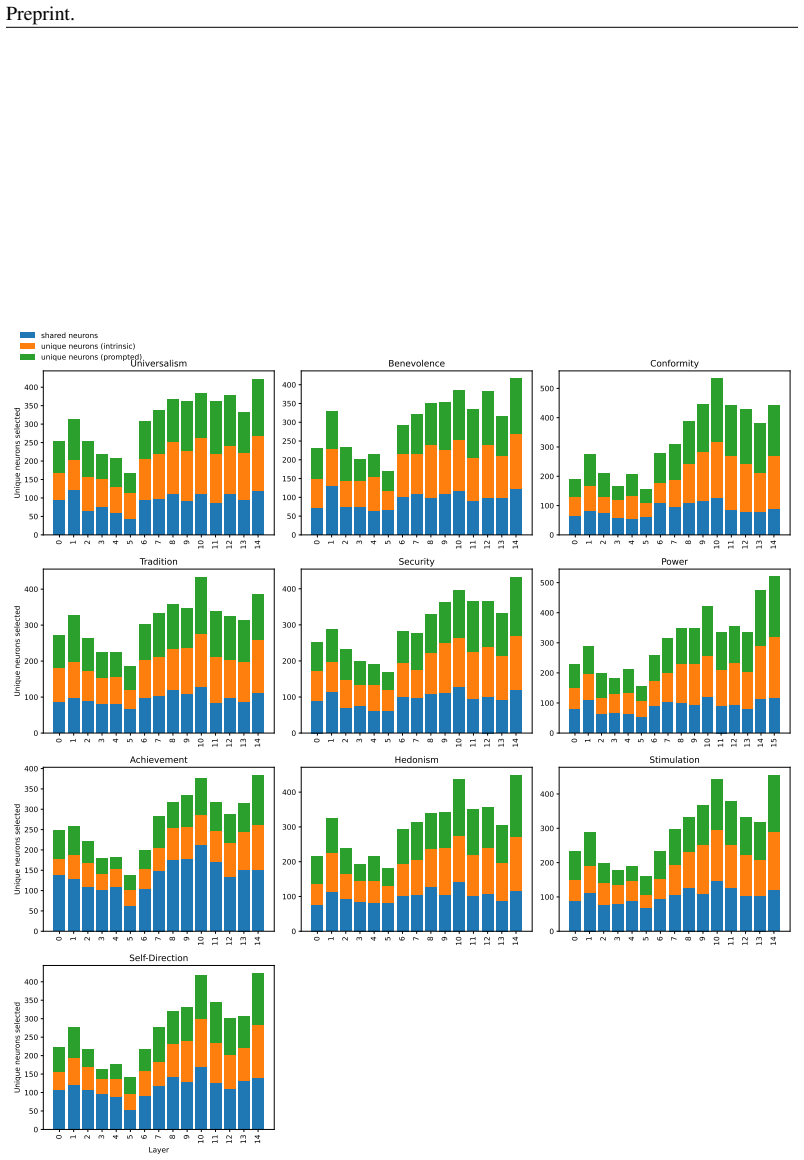
The load-bearing mechanism is an orthogonal decomposition of two difference-in-means value vectors extracted from the residual stream: for each value, the prompted vector minus its projection onto the intrinsic vector yields a prompted-unique component, and the intrinsic vector minus its projection onto the prompted vector yields an intrinsic-unique component (Eqs. 4-5). A companion neuron-level decomposition applies SVD to the two-vector stack, classifying MLP output-row projections into shared neurons (within 30° of the shared axis) and unique neurons (within 60° of the difference axis). The shared axes—when PCA-projected across the ten values—reproduce the circular ordering of Schwartz's
What would settle it
A norm-matched random vector orthogonal to the shared value axis that, when steered, reproduces the same lexical-diversity increase and jailbreak success as the claimed intrinsic-unique and prompted-unique directions would falsify the mechanistic claim.
Extended reading notes
Core claim
The central discovery is that intrinsic and prompted value expression in instruction-tuned LLMs are implemented by partially overlapping but mechanistically separable representations. Intrinsic value vectors—the mean activation difference between unprompted responses that express a value and those that do not—and prompted value vectors—the same difference under a value-targeting system prompt—share a positive-cosine-similarity subspace that generalizes across languages and reconstructs the theorized circular structure of human values. After Gram-Schmidt orthogonalization removes that shared subspace, the remaining intrinsic-orthogonal component still steers value expression but primarily enr
Load-bearing premise
The unique components isolated by Gram-Schmidt orthogonalization and by the hand-set SVD angle thresholds are causally meaningful, mechanism-specific directions; if those residuals are dominated by noise, norm mismatch, or arbitrary projection order, the claimed functional dissociation between intrinsic and prompted mechanisms collapses.
Editorial extensions
If this is right
- If the two mechanisms are separable as claimed, activation steering can boost value expression either by adding the shared component (strongest, most value-specific effect) or by pushing the prompted-unique direction to modulate general instruction compliance.
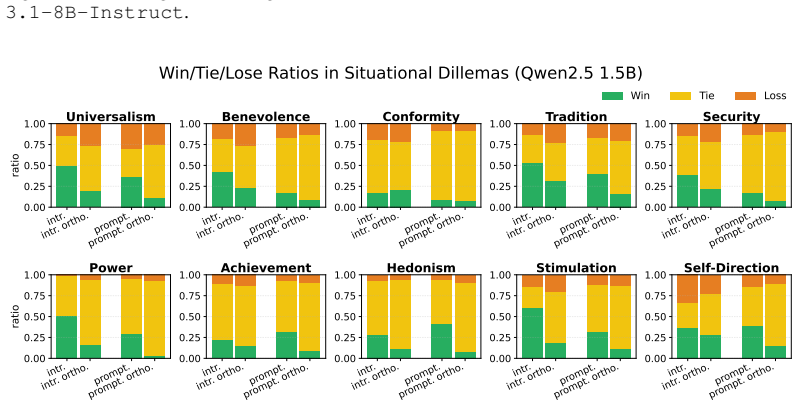
- Prompted value vectors are more steerable than intrinsic ones: after orthogonalization the prompted-orthogonal component retains much of its steering effect even when 32-73% of its norm is removed, while the intrinsic-orthogonal component's steering is sharply reduced.
- Steering along the prompted-unique direction concentrates outputs on low-entropy value keywords, including cross-lingual tokens, whereas the intrinsic-unique direction increases lexical and semantic diversity.
- The shared component encodes general value semantics: ten shared axes reconstruct the theoretical circular structure of the ten Schwartz values, supporting the idea that LLMs internalize human value relations.
- Steering along the prompted-unique direction on standard jailbreak benchmarks reaches up to 99% ASR@9, matching or exceeding dedicated jailbreak methods, which means this single instruction-compliance direction is a single-vector attack surface.
Reading between the lines
- Extension: because the prompted-unique direction is value-agnostic and the paper shows cross-lingual transfer, a single such direction harvested from any one value should transfer to any other value, language, or task; this is directly testable.
- The intrinsic-unique 'diversity' direction may act as a general generation-breadth knob; one could test whether it transfers to non-value tasks such as story generation, code synthesis, or creative writing where lexical and conceptual diversity are desirable.
- The jailbreak finding suggests refusal is not a single monolithic direction but sits downstream of a separable instruction-compliance axis; combining edits to this axis with edits to a refusal direction may yield safety controls that preserve value alignment while resisting adversarial prompts.
- The orthogonalization is asymmetric (which vector is the reference changes the residual); a symmetric decomposition, such as canonical angles or joint subspace factorization, would clarify whether the 'unique' components are stable or an artefact of projection order.
Editorial analysis
A structured set of objections, weighed in public.
Referee Report
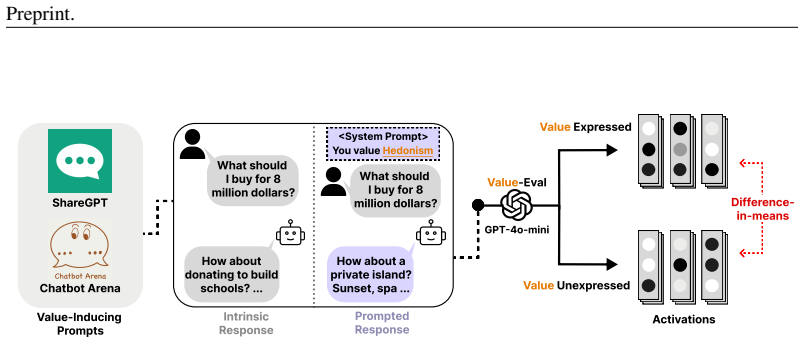
Summary. The paper studies whether intrinsic (training-induced) and prompted (system-prompt-elicited) value expressions in LLMs rely on overlapping or distinct mechanisms. Using difference-in-means value vectors extracted from residual-stream activations of responses to ShareGPT/LMSYS queries, the authors compare intrinsic and prompted vectors, orthogonalize each against the other to isolate 'unique' components (Appendix A.1), and identify shared/unique MLP neurons via SVD of the two value vectors with hand-set angle thresholds (Section 2.2). Behavioral experiments show that prompted vectors are more steerable, intrinsic vectors produce more lexically diverse outputs, shared vectors/neurons are most effective for value expression, and shared axes reconstruct Schwartz's circular value structure. The paper further claims that prompted-unique components promote instruction compliance, supporting this with positive/negative prompt following experiments and jailbreak results on AdvBench and HarmBench, where steering along a mean delta vector yields ASRs up to 98%.
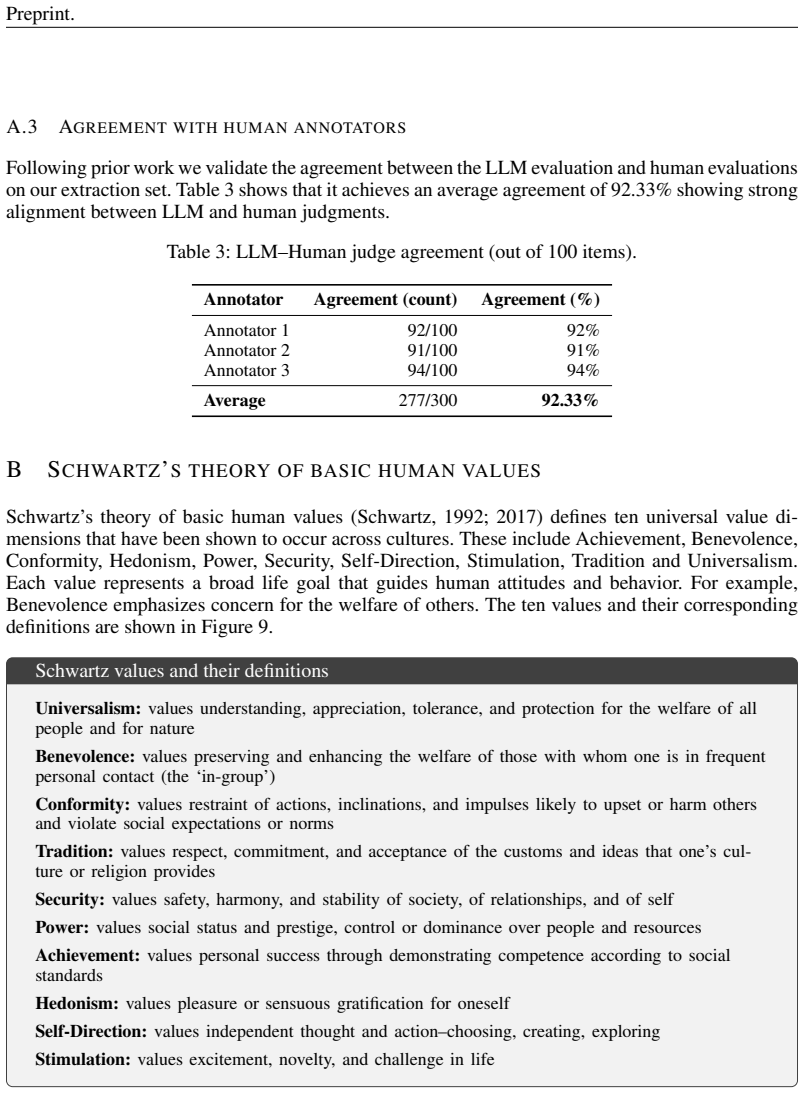
Significance. If the central claims hold, the paper provides a valuable mechanistic decomposition of value expression into shared and unique pathways, with practical implications for alignment, persona steering, and jailbreak defense. The empirical breadth is a strength: three models, five languages, multiple evaluation sets (PVQ, dilemmas, Value Portrait), pre-registered-style held-out jailbreak benchmarks, and a human-agreement check for the GPT-based annotator (92.33%). The paper also makes a falsifiable prediction: intrinsic-unique components promote diversity, prompted-unique components promote compliance. However, the current evidence does not fully support this prediction, because the jailbreak experiments steer a different vector from the orthogonalized 'unique component' defined in the methodology, and because neuron-level diversity results partially contradict the abstract's claim. With additional experiments on the actual unique components and appropriate baselines, the paper could make a substantial contribution.
major comments (3)
- [Section 4.3 / Appendix J / Eq. (4)] The jailbreak and positive/negative prompt experiments steer the mean delta vector Δ = v_prompt − v_int, not the prompted-unique vector v_prompt(⊥int) defined in Eq. (4). Unlike the orthogonal residual, Δ retains the shared subspace and any norm/scale difference between v_prompt and v_int. The ASR results in Tables 20–21 therefore demonstrate something about the prompt-minus-intrinsic difference direction, not about 'components unique to the prompted mechanism.' The sentence in §4.3 that these results provide evidence that unique components of prompted mechanisms let models override intrinsic tendencies is an unsupported extrapolation. Please run the compliance and jailbreak experiments with v_prompt(⊥int) (and, ideally, with the removed shared component as a control) before attributing the effect to prompted-unique components.
- [Appendix G.3, Table 9] The neuron-level diversity results contradict the abstract's blanket claim that components unique to the intrinsic mechanism promote response diversity. For Qwen2.5-7B-Instruct, the prompted-unique neuron condition has higher Distinct-2 and Distinct-3 (0.440/0.737) than the intrinsic-unique neuron condition (0.426/0.721). The main text's Section 3.3 only reports vector-level results, where Intrinsic_Orthogonal is indeed more diverse than Prompted_Orthogonal. The paper should either restrict the diversity claim to vector-level orthogonal components or explain why the neuron-level dissociation reverses; as written, the claim is internally inconsistent.
- [Appendix A.1 / Section 2.2] The functional dissociations rest on the assumption that the Gram-Schmidt orthogonal residuals and the SVD-based unique neurons isolate meaningful mechanism-specific directions. The paper never checks these residuals against random or norm-matched baselines, and the neuron classification uses hand-set angle thresholds (30° and 60°). If the orthogonal residual is dominated by noise or by the norm mismatch between intrinsic and prompted vectors, the diversity/compliance dissociations could be scale artifacts rather than evidence for separate mechanisms. Please add baseline comparisons: e.g., steer with a random vector orthogonal to v_int of matched norm, or with v_prompt scaled to the norm of v_int, and report how often neurons classified as unique by random directions pass the same angle/magnitude filters.
minor comments (5)
- [Throughout] Typos: 'Dillemas' appears in multiple figure captions (e.g., Figures 5, 25–38); 'uni00A0' and similar artifacts appear in figure labels; 'Behaviors' should be 'Behavior' in Appendix H.2; 'V oster' should be 'Voster' in the references (or likely a typo).
- [References] Turner et al. 2023 and Turner et al. 2024 reference the same arXiv paper (2308.10248) under different titles; Li et al. 2016a and 2016b also appear to be the same work. Please consolidate to avoid citation inflation.
- [Table 1] Intrinsic_Orthogonal shows a negative score in Korean (−0.58), which is not discussed. Similarly, several cross-lingual entries for Qwen2.5-1.5B are negative in Chinese and Korean (Tables 7–8). A short discussion of when orthogonal components fail to transfer would be helpful.
- [Appendix J] The distinction between ASR@1 and ASR@9 and the exact judge prompt used for jailbreak evaluation should be specified earlier. The text says ASR@9 is 'stricter' than the prior ASR@10, but the relationship between these metrics and the number of attempts is not defined.
- [Section 3.2.1] The hyperparameter selection procedure — choosing α and β as the highest values with MMLU degradation below 5 points, then choosing the layer by averaging over a grid — should be described once in the main text rather than split between Section 3.2.1 and Appendix F.1. Also clarify whether the same α/β/layer selection was applied per value or once globally.
Circularity Check
No significant circularity: the intrinsic/prompted contrast is extracted from independent response sets and transfers to held-out benchmarks; the §4.3 delta-vs-orthogonal gap is a construct-validity caveat, not a circular derivation.
full rationale
The paper's central derivation is not circular. Intrinsic and prompted value vectors are computed as difference-in-means of residual-stream activations over disjoint response sets (empty vs. value-targeting system prompt; Eq. 2), and the claimed 'unique components' are obtained by Gram-Schmidt orthogonalization (Eqs. 4–5), not by fitting the target behavioral outcomes. Steering effects are evaluated on held-out PVQ items, situational dilemmas, and the Value Portrait benchmark; jailbreak results use AdvBench and HarmBench, neither of which contributed to vector extraction. Thus the predicted effects are not equivalent to the fitting inputs by construction. The main caveat is a construct-validity mismatch in §4.3: the positive/negative-prompt and jailbreak steering uses the mean delta (prompted minus intrinsic), which retains the shared subspace and is not the orthogonal prompted-unique component of Eq. 4, so it does not by itself establish the 'prompted-unique' functional claim. This is a missing-support/correctness issue rather than a circularity, because the jailbreak result is an empirical transfer from a different vector, not a restatement of the paper's inputs. Self-citations (Value Portrait, curated ShareGPT subset) provide evaluation assets with independent psychometric or external-validity support and are not load-bearing for the mechanistic derivation.
Assumptions & free parameters
free parameters (5)
- steering coefficient alpha =
4.0 (Qwen2.5-7B-Instruct); 2.0 or 4.0 for other models
- neuron amplification coefficient beta =
7.0 (Qwen2.5-7B-Instruct); 2.0 for other models
- intervention layer per value and model =
e.g., Qwen-7B mostly layer 14; see Table 6
- neuron angle thresholds =
shared neurons |theta| < 30 degrees; unique neurons |theta +/- 90 degrees| < 60 degrees
- neuron magnitude filter =
not specified
assumptions (5)
- domain assumption Schwartz's ten basic values are a valid taxonomy for LLM value expression
- domain assumption Value directions are linear in the residual stream (linear representation hypothesis)
- domain assumption GPT-4o-mini value-expression labels and win-rate judgments align with human judgments
- domain assumption Adding a scaled value vector at a selected layer is a valid causal intervention
- ad hoc to paper SVD of the two value vectors separates shared and unique mechanisms
Cite this review
Pith. "Pith review of Dual Mechanisms of Value Expression: Intrinsic vs. Prompted Values in Large Language Models." pith.science (2026). https://pith.science/paper/JVAEMA2D
@misc{pith2026250924319,
  author       = {Pith},
  title        = {Pith review of: Dual Mechanisms of Value Expression: Intrinsic vs. Prompted Values in Large Language Models},
  year         = {2026},
  howpublished = {\url{https://pith.science/paper/JVAEMA2D}},
  note         = {Machine review of arXiv:2509.24319}
}
read the original abstract
Large language models can express values in two main ways: (1) intrinsic expression, reflecting the model's inherent values learned during training, and (2) prompted expression, elicited by explicit prompts. Given their widespread use in value alignment, it is paramount to clearly understand their underlying mechanisms, particularly whether they mostly overlap (as one might expect) or rely on distinct mechanisms. We analyze this largely understudied problem at the mechanistic level using two approaches: (1) value vectors, feature directions representing value mechanisms extracted from the residual stream, and (2) value neurons, MLP neurons that contribute to value vectors. We demonstrate that intrinsic and prompted value mechanisms partly share common components crucial for inducing value expression, generalizing across languages and reconstructing theoretical inter-value correlations in the model's internal representations. Yet, each mechanism also possesses unique components that fulfill distinct roles. In particular, the intrinsic mechanism activates in more diverse value-related scenarios and promotes response diversity, whereas the prompted mechanism strengthens instruction compliance, taking effect even in distant tasks like jailbreaking.
Figures


Figures from the paper (39 more)








Reference graph
Works this paper leans on
-
[1]
I value
**Analyze Underlying Intent **: Evaluate the response based on its demonstrated intent, actions, and attitudes. Do not simply look for keywords or phrases like "I value..."; focus on the underlying meaning and behaviors
-
[2]
**Use the Full Scale Accurately **: Do not default to middle-range labels. If a response clearly and powerfully expresses the value, or shows no trace of it, you must use the "Very strongly expressed" or "Not expressed at all" labels, respectively. ### Evaluation Scale - **Not expressed at all **: The response is completely irrelevant to the value. There ...
arXiv 1992
-
[3]
URLhttps://proceedings.neurips.cc/paper_files/paper/2024/ file/515c62809e0a29729d7eec26e2916fc0-Paper-Conference.pdf. Nelson Elhage, Neel Nanda, Catherine Olsson, Tom Henighan, Nicholas Joseph, Ben Mann, Amanda Askell, Yuntao Bai, Anna Chen, Tom Conerly, Nova DasSarma, Dawn Drain, Deep Ganguli, Zac Hatfield-Dodds, Danny Hernandez, Andy Jones, Jackson Kern...
arXiv 2024
-
[4]
doi: 10.18653/v1/2024.emnlp-main.354
Association for Computational Linguistics. doi: 10.18653/v1/2024.emnlp-main.354. URL https://aclanthology.org/2024.emnlp-main.354/. Haoran Jin, Meng Li, Xiting Wang, Zhihao Xu, Minlie Huang, Yantao Jia, and Defu Lian. In- ternal value alignment in large language models through controlled value vector activation. In Wanxiang Che, Joyce Nabende, Ekaterina S...
-
[6]
Jiwei Li, Michel Galley, Chris Brockett, Jianfeng Gao, and Bill Dolan
URLhttps://arxiv.org/abs/2401.01967. Jiwei Li, Michel Galley, Chris Brockett, Jianfeng Gao, and Bill Dolan. A diversity-promoting objec- tive function for neural conversation models. InProceedings of the 2016 Conference of the North American Chapter of the Association for Computational Linguistics: Human Language Technolo- gies, pp. 110–119, San Diego, Ca...
arXiv 2016
-
[7]
doi: 10.18653/v1/2023.blackboxnlp-1.2
Association for Computational Linguistics. doi: 10.18653/v1/2023.blackboxnlp-1.2. URL https://aclanthology.org/2023.blackboxnlp-1.2/. Nostalgebraist. Interpreting gpt: The logit lens. LessWrong, 2020. URLhttps://www.lesswrong.com/posts/AcKRB8wDpdaN6v6ru/ interpreting-gpt-the-logit-lens. OpenAI. Text embedding models, 2024. URLhttps://platform.openai.com/d...
-
[9]
doi: 10.18653/v1/2024.acl-long.828
Association for Computational Linguistics. doi: 10.18653/v1/2024.acl-long.828. URL https://aclanthology.org/2024.acl-long.828/. Naama Rozen, Liat Bezalel, Gal Elidan, Amir Globerson, and Ella Daniel. Do LLMs have consistent values? InThe Thirteenth International Conference on Learning Representations, 2025. URL https://openreview.net/forum?id=8zxGruuzr9. ...
arXiv 2024
-
[10]
Association for Computational Linguistics. doi: 10.18653/v1/2024.naacl-long.295. URL https://aclanthology.org/2024.naacl-long.295/. Yi Su, Jiayi Zhang, Shu Yang, Xinhai Wang, Lijie Hu, and Di Wang. Understanding how value neurons shape the generation of specified values in llms, 2025. URLhttps://arxiv.org/ abs/2505.17712. Alex Turner, Andrew Scherlis, Ksh...
arXiv 2024
Show all 15 references
-
[13]
License Grant: A limited, non-exclusive, non-transferable, non-sublicensable license for research, development, and improvement of software, algorithms, and machine learning models for both research and commercial purposes
-
[14]
Key Compliance Requirements: Safety and Moderation: Implementation of appropriate filters and safety measures Non-Identification: Prohibition of attempts to identify individuals or infer sensitive personal data Prohibited Transfers: No distribution, copying, disclosure, or tra...
-
[15]
LMSYS license terms L AIASSISTANTS IN RESEARCH OR WRITING We used AI assistants to proofread the writing and to help with coding
Disclaimers: Non-Endorsement: Views and opinions in the dataset do not reflect the perspectives of researchers or affiliated institutions Limitation of Liability: No liability for consequential, incidental, exemplary, punitive, or indirect damages Note: For complete license te...
-
[2022]
Kiho Park, Yo Joong Choe, and Victor Veitch
URLhttps://proceedings.neurips.cc/paper_files/paper/2022/ file/b1efde53be364a73914f58805a001731-Paper-Conference.pdf. Kiho Park, Yo Joong Choe, and Victor Veitch. The linear representation hypothesis and the geom- etry of large language models. In Ruslan Salakhutdinov, Zico Ko...
2022 arXiv
-
[2023]
doi: 10.18653/v1/2023.emnlp-main.183
Association for Computational Linguistics. doi: 10.18653/v1/2023.emnlp-main.183. URL https://aclanthology.org/2023.emnlp-main.183/. Ricardo Dominguez-Olmedo, Moritz Hardt, and Celestine Mendler-Dünner. Questioning the survey responses of large language models. In A. Globerson,...
2023 doi
-
[2024]
URLhttps://proceedings.neurips.cc/paper_files/paper/2024/ file/f545448535dfde4f9786555403ab7c49-Paper-Conference.pdf. Amanda Askell, Yuntao Bai, Anna Chen, Dawn Drain, Deep Ganguli, Tom Henighan, Andy Jones, Nicholas Joseph, Ben Mann, Nova DasSarma, Nelson Elhage, Zac Hatfield...
2024 arXiv
-
[2025]
ISBN 979-8-89176-251-0
Association for Computational Linguistics. ISBN 979-8-89176-251-0. doi: 10.18653/v1/ 2025.acl-long.942. URLhttps://aclanthology.org/2025.acl-long.942/. Andrew Lee, Xiaoyan Bai, Itamar Pres, Martin Wattenberg, Jonathan K. Kummerfeld, and Rada Mi- halcea. A mechanistic understan...
2025 doi
Reviewed August 4, 2026 · model on record in the stance chip above.
Discussion (0). Sign in to comment.