Measurement-induced phase transition in interacting bosons from most likely quantum trajectory
Pith reviewed 2026-05-18 13:03 UTC · model grok-4.3
The pith
The most likely quantum trajectory captures monitored boson dynamics and reveals an area-to-logarithmic entanglement transition.
A machine-rendered reading of the paper's core claim, the machinery that carries it, and where it could break.
Core claim
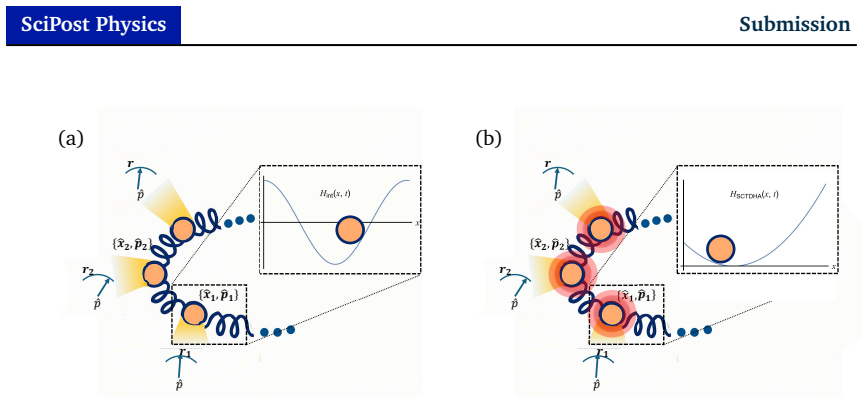
The authors establish that the most likely trajectory, identified as the measurement readout sequence with the highest probability, exactly reproduces the monitored dynamics for Gaussian theories. They extend the method to the interacting Sine-Gordon model via a self-consistent time-dependent harmonic approximation and demonstrate that the steady state exhibits an entanglement phase transition from area-law to logarithmic-law scaling.
What carries the argument
The most likely trajectory, the quantum trajectory with the highest probability among all possible measurement readouts, which carries the argument by supplying a representative path whose entanglement properties determine the steady-state phase.
If this is right
- The monitored dynamics can be studied without averaging over the entire ensemble of trajectories.
- A steady-state entanglement phase transition occurs in the Sine-Gordon model under continuous monitoring.
- The method extends to other interacting bosonic models where full trajectory ensembles are intractable.
- Steady-state properties such as entanglement scaling become accessible through a single representative path.
Where Pith is reading between the lines
- The approach could be tested against exact numerics in small systems to quantify the approximation error.
- Similar transitions may appear in monitored spin or fermion models if an analogous most-likely path can be defined.
- The logarithmic phase might imply slower information spreading under monitoring, relevant for quantum error correction protocols.
- Cold-atom experiments with site-resolved measurements could search for the predicted change in entanglement scaling.
Load-bearing premise
The self-consistent time-dependent harmonic approximation remains accurate enough to capture the essential features of the phase transition in the interacting Sine-Gordon model despite not being exact.
What would settle it
Exact numerical sampling of the full probability distribution of quantum trajectories for small boson numbers in the Sine-Gordon model, checking whether the entanglement entropy scaling crosses from area-law to logarithmic-law at the parameter values predicted by the approximation.
Figures




read the original abstract
We propose a new theoretical method to describe the monitored dynamics of bosonic many-body systems based on the concept of the most likely trajectory. We show how such trajectory can be identified from the probability distribution of quantum trajectories, i.e. measurement readouts, and how it successfully captures the monitored dynamics beyond the average state. We prove the method to be exact in the case of Gaussian theories and then extend it to the interacting Sine-Gordon model. Although no longer exact in this framework, the method captures the dynamics through a self-consistent time-dependent harmonic approximation and reveals an entanglement phase transition in the steady state from an area-law to a logarithmic-law scaling.
Editorial analysis
A structured set of objections, weighed in public.
Referee Report
Summary. The manuscript proposes a method to identify the most likely quantum trajectory from the probability distribution of measurement readouts in bosonic many-body systems under continuous monitoring. It proves the approach exact for Gaussian theories and extends it to the interacting Sine-Gordon model via a self-consistent time-dependent harmonic approximation, which is used to demonstrate an entanglement phase transition in the steady state from area-law to logarithmic-law scaling.
Significance. If the self-consistent approximation is shown to be reliable, the work supplies a computationally tractable route to measurement-induced transitions in interacting bosons that goes beyond ensemble averages. The exact Gaussian case provides a clean benchmark, and the method's focus on individual trajectories is a conceptual advance for monitored open quantum systems.
major comments (2)
- [Section IV] Section IV (extension to Sine-Gordon): the central claim of an area-to-log entanglement transition rests entirely on the self-consistent time-dependent harmonic approximation that replaces the nonlinear interaction by a quadratic term with self-consistently determined parameters. The manuscript provides no quantitative error estimate, convergence test, or comparison to exact numerics on small lattices that would bound the systematic error in the extracted scaling exponents or transition location.
- [Section V] Section V (steady-state entanglement): the reported scaling laws are obtained exclusively under the quadratic closure; any deviation of the true non-Gaussian dynamics from this closure directly impacts the phase diagram. A sensitivity analysis with respect to the self-consistency cutoff or an alternative closure scheme is needed to establish robustness.
minor comments (2)
- Notation for the time-dependent frequency and coupling parameters in the harmonic approximation should be introduced explicitly before their first use in equations.
- [Figure 3] Figure captions would benefit from stating the system size, monitoring strength, and interaction parameter values used for each curve.
Simulated Author's Rebuttal
We thank the referee for the positive evaluation of the manuscript's significance and for the constructive comments on the self-consistent approximation. We respond to each major comment below and outline the revisions we will make.
read point-by-point responses
-
Referee: [Section IV] Section IV (extension to Sine-Gordon): the central claim of an area-to-log entanglement transition rests entirely on the self-consistent time-dependent harmonic approximation that replaces the nonlinear interaction by a quadratic term with self-consistently determined parameters. The manuscript provides no quantitative error estimate, convergence test, or comparison to exact numerics on small lattices that would bound the systematic error in the extracted scaling exponents or transition location.
Authors: We agree that the absence of quantitative error bounds and direct comparisons constitutes a limitation of the current presentation. While the self-consistent harmonic approximation is a well-established closure for the Sine-Gordon model and becomes exact in the Gaussian limit demonstrated in Section III, its systematic error for the monitored dynamics is not quantified. In the revised manuscript we will add a new subsection to Section IV that includes (i) comparisons of the most-likely-trajectory entanglement entropy against exact diagonalization or matrix-product-state results for small lattices (L ≤ 8) at representative parameter values, and (ii) a convergence study with respect to the self-consistency iteration tolerance. These additions will provide explicit bounds on the uncertainty of the reported scaling exponents and the location of the transition. revision: yes
-
Referee: [Section V] Section V (steady-state entanglement): the reported scaling laws are obtained exclusively under the quadratic closure; any deviation of the true non-Gaussian dynamics from this closure directly impacts the phase diagram. A sensitivity analysis with respect to the self-consistency cutoff or an alternative closure scheme is needed to establish robustness.
Authors: We acknowledge that the phase diagram is obtained within the quadratic closure and that its robustness must be demonstrated. In the revised version we will augment Section V with a sensitivity analysis that varies the self-consistency cutoff and the frequency of parameter updates. We will also examine an alternative closure (e.g., a variational Gaussian ansatz with an additional quartic correction) on a subset of parameters to test whether the area-law to logarithmic transition persists. These results will be presented as supplementary figures and discussed in the main text to quantify the stability of the reported scaling laws. revision: yes
Circularity Check
No circularity; derivation self-contained via independent approximation
full rationale
The paper derives the most likely trajectory from the probability distribution of quantum trajectories and proves exactness for Gaussian theories as a standalone result. Extension to the Sine-Gordon model uses an explicit self-consistent time-dependent harmonic approximation that replaces the nonlinear term with a quadratic closure whose parameters are solved consistently from the dynamics; the resulting area-to-logarithmic entanglement transition is an output of this dynamical evolution rather than a redefinition or statistical fit of the inputs. No load-bearing self-citation, uniqueness theorem, or renaming of known results is present. The approximation is acknowledged as non-exact, preserving the distinction between method and prediction.
Axiom & Free-Parameter Ledger
axioms (2)
- domain assumption Gaussian theories allow exact description via most likely trajectory
- ad hoc to paper Self-consistent time-dependent harmonic approximation captures essential dynamics in Sine-Gordon
Lean theorems connected to this paper
-
IndisputableMonolith/Cost/FunctionalEquation.leanwashburn_uniqueness_aczel unclear?
unclearRelation between the paper passage and the cited Recognition theorem.
We prove the method to be exact in the case of Gaussian theories and then extend it to the interacting Sine-Gordon model... through a self-consistent time-dependent harmonic approximation
-
IndisputableMonolith/Foundation/ArithmeticFromLogic.leanembed_injective unclear?
unclearRelation between the paper passage and the cited Recognition theorem.
the most likely trajectory... r^*(t) = <R>_{ψ^*}
What do these tags mean?
- matches
- The paper's claim is directly supported by a theorem in the formal canon.
- supports
- The theorem supports part of the paper's argument, but the paper may add assumptions or extra steps.
- extends
- The paper goes beyond the formal theorem; the theorem is a base layer rather than the whole result.
- uses
- The paper appears to rely on the theorem as machinery.
- contradicts
- The paper's claim conflicts with a theorem or certificate in the canon.
- unclear
- Pith found a possible connection, but the passage is too broad, indirect, or ambiguous to say the theorem truly supports the claim.
Reference graph
Works this paper leans on
-
[1]
B. Skinner, J. Ruhman and A. Nahum, Measurement-induced phase transitions in the dynamics of entanglement, Phys. Rev. X 9, 031009 (2019), doi:10.1103/PhysRevX.9.031009
-
[2]
Y. Li, X. Chen and M. P. A. Fisher, Quantum zeno effect and the many-body entanglement transition, Phys. Rev. B 98, 205136 (2018), doi:10.1103/PhysRevB.98.205136
-
[3]
X. Cao, A. Tilloy and A. D. Luca, Entanglement in a fermion chain under continuous monitoring , SciPost Phys. 7, 024 (2019), doi:10.21468/SciPostPhys.7.2.024
-
[4]
Y. Li, X. Chen and M. P. A. Fisher, Measurement-driven entanglement transition in hybrid quantum circuits, Phys. Rev. B 100, 134306 (2019), doi:10.1103/PhysRevB.100.134306
-
[5]
K. Jacobs and D. A. Steck, A straightforward introduction to continuous quantum measurement, Contemporary Physics 47(5), 279–303 (2006), doi:10.1080/00107510601101934
-
[6]
K. Jacobs, Quantum Measurement Theory and its Applications, Cambridge University Press, Cambridge, ISBN 978-1-107-02548-6, doi:10.1017/CBO9781139179027 (2014)
-
[7]
H. M. Wiseman and G. J. Milburn, Quantum Measurement and Control, Cambridge University Press, Cambridge, ISBN 978-0-521-80442-4, doi:10.1017/CBO9780511813948 (2009)
-
[8]
H. J. Carmichael, Statistical methods in quantum optics 1: master equations and Fokker-Planck equations, Springer Science & Business Media (2013)
work page 2013
-
[9]
H. J. Carmichael, Statistical methods in quantum optics 2: Non-classical fields, Springer Science & Business Media (2007)
work page 2007
-
[10]
V. B. Bulchandani, S. Sondhi and J. Chalker, Random-matrix models of monitored quantum circuits, Journal of Statistical Physics 191(5), 55 (2024)
work page 2024
-
[11]
A. Zabalo, M. J. Gullans, J. H. Wilson, R. Vasseur, A. W. W. Ludwig, S. Gopalakrishnan, D. A. Huse and J. H. Pixley, Operator scaling dimensions and multifractality at measurement-induced transitions, Phys. Rev. Lett. 128, 050602 (2022), doi:10.1103/PhysRevLett.128.050602
-
[12]
A. Nahum, S. Roy, B. Skinner and J. Ruhman, Measurement and entanglement phase transitions in all-to-all quantum circuits, on quantum trees, and in landau-ginsburg theory, PRX Quantum 2, 010352 (2021), doi:10.1103/PRXQuantum.2.010352
-
[13]
M. Fava, L. Piroli, T. Swann, D. Bernard and A. Nahum, Nonlinear sigma models for monitored dynamics of free fermions, Phys. Rev. X 13, 041045 (2023), doi:10.1103/PhysRevX.13.041045
-
[14]
C. Y. Leung, D. Meidan and A. Romito, Theory of free fermions dynamics under partial postselected monitoring, Phys. Rev. X 15, 021020 (2025), doi:10.1103/PhysRevX.15.021020
-
[15]
G. Giachetti and A. D. Luca, Elusive phase transition in the replica limit of monitored systems (2023), 2306.12166
- [16]
-
[17]
Y. Bao, S. Choi and E. Altman, Theory of the phase transition in random unitary circuits with measurements, Phys. Rev. B 101, 104301 (2020), doi:10.1103/PhysRevB.101.104301
-
[18]
C.-M. Jian, Y.-Z. You, R. Vasseur and A. W. W. Ludwig, Measurement-induced criticality in random quantum circuits, Phys. Rev. B 101, 104302 (2020), doi:10.1103/PhysRevB.101.104302
-
[19]
M. Ippoliti and V. Khemani, Postselection-free entanglement dynamics via spacetime duality, Phys. Rev. Lett. 126, 060501 (2021), doi:10.1103/PhysRevLett.126.060501
-
[20]
S. J. Garratt and E. Altman, Probing postmeasurement entanglement without postselection, PRX Quantum 5, 030311 (2024), doi:10.1103/PRXQuantum.5.030311
-
[21]
Y. Li, Y. Zou, P. Glorioso, E. Altman and M. P. A. Fisher, Cross entropy benchmark for measurement-induced phase transitions, Phys. Rev. Lett. 130, 220404 (2023), doi:10.1103/PhysRevLett.130.220404
-
[22]
G. Passarelli, X. Turkeshi, A. Russomanno, P. Lucignano, M. Schir\`o and R. Fazio, Many-body dynamics in monitored atomic gases without postselection barrier, Phys. Rev. Lett. 132, 163401 (2024), doi:10.1103/PhysRevLett.132.163401
-
[23]
Z. Li, A. Delmonte, X. Turkeshi and R. Fazio, Monitored long-range interacting systems: spin-wave theory for quantum trajectories, Nature Communications 16(1), 1 (2025)
work page 2025
-
[24]
A. Delmonte, Z. Li, G. Passarelli, E. Y. Song, D. Barberena, A. M. Rey and R. Fazio, Measurement-induced phase transitions in monitored infinite-range interacting systems, Physical Review Research 7(2), 023082 (2025)
work page 2025
-
[25]
A. Zabalo, M. J. Gullans, J. H. Wilson, S. Gopalakrishnan, D. A. Huse and J. H. Pixley, Critical properties of the measurement-induced transition in random quantum circuits, Phys. Rev. B 101, 060301 (2020), doi:10.1103/PhysRevB.101.060301
-
[26]
P. Sierant and X. Turkeshi, Universal behavior beyond multifractality of wave functions at measurement-induced phase transitions, Phys. Rev. Lett. 128, 130605 (2022), doi:10.1103/PhysRevLett.128.130605
-
[27]
A. Lavasani, Y. Alavirad and M. Barkeshli, Measurement-induced topological entanglement transitions in symmetric random quantum circuits, Nature Physics 17(3), 342 (2021)
work page 2021
-
[28]
P. Sierant, G. Chiriac \`o , F. M. Surace, S. Sharma, X. Turkeshi, M. Dalmonte, R. Fazio and G. Pagano, Dissipative floquet dynamics: From steady state to measurement induced criticality in trapped-ion chains, Quantum 6, 638 (2022)
work page 2022
-
[29]
D. Vu, A. Lavasani, J. Y. Lee and M. P. A. Fisher, Stable measurement-induced floquet enriched topological order, Phys. Rev. Lett. 132, 070401 (2024), doi:10.1103/PhysRevLett.132.070401
-
[30]
C. Noel, P. Niroula, D. Zhu, A. Risinger, L. Egan, D. Biswas, M. Cetina, A. V. Gorshkov, M. J. Gullans, D. A. Huse et al., Measurement-induced quantum phases realized in a trapped-ion quantum computer, Nature Physics 18(7), 760 (2022)
work page 2022
-
[31]
J. M. Koh, S.-N. Sun, M. Motta and A. J. Minnich, Measurement-induced entanglement phase transition on a superconducting quantum processor with mid-circuit readout, Nature Physics 19(9), 1314 (2023)
work page 2023
-
[32]
Measurement-induced entanglement and teleportation on a noisy quantum processor, Nature 622(7983), 481 (2023)
work page 2023
-
[33]
M. Szyniszewski, A. Romito and H. Schomerus, Entanglement transition from variable-strength weak measurements, Phys. Rev. B 100, 064204 (2019), doi:10.1103/PhysRevB.100.064204
-
[34]
M. Szyniszewski, A. Romito and H. Schomerus, Universality of entanglement transitions from stroboscopic to continuous measurements, Phys. Rev. Lett. 125, 210602 (2020), doi:10.1103/PhysRevLett.125.210602
-
[35]
S.-K. Jian, C. Liu, X. Chen, B. Swingle and P. Zhang, Measurement-induced phase transition in the monitored sachdev-ye-kitaev model, Phys. Rev. Lett. 127, 140601 (2021), doi:10.1103/PhysRevLett.127.140601
-
[36]
X. Turkeshi, A. Biella, R. Fazio, M. Dalmonte and M. Schir\'o, Measurement-induced entanglement transitions in the quantum ising chain: From infinite to zero clicks, Phys. Rev. B 103, 224210 (2021), doi:10.1103/PhysRevB.103.224210
-
[37]
A. Paviglianiti and A. Silva, Multipartite entanglement in the measurement-induced phase transition of the quantum ising chain, Phys. Rev. B 108, 184302 (2023), doi:10.1103/PhysRevB.108.184302
-
[38]
E. Tirrito, A. Santini, R. Fazio and M. Collura, Full counting statistics as probe of measurement-induced transitions in the quantum ising chain, SciPost Physics 15(3), 096 (2023)
work page 2023
-
[39]
O. Alberton, M. Buchhold and S. Diehl, Entanglement transition in a monitored free-fermion chain: From extended criticality to area law, Phys. Rev. Lett. 126, 170602 (2021), doi:10.1103/PhysRevLett.126.170602
- [40]
-
[41]
I. Poboiko, P. P\"opperl, I. V. Gornyi and A. D. Mirlin, Theory of free fermions under random projective measurements, Phys. Rev. X 13, 041046 (2023), doi:10.1103/PhysRevX.13.041046
-
[42]
I. Poboiko, P. P\"opperl, I. V. Gornyi and A. D. Mirlin, Measurement-induced transitions for interacting fermions, Phys. Rev. B 111, 024204 (2025), doi:10.1103/PhysRevB.111.024204
-
[43]
M. Buchhold, Y. Minoguchi, A. Altland and S. Diehl, Effective theory for the measurement-induced phase transition of dirac fermions, Phys. Rev. X 11, 041004 (2021), doi:10.1103/PhysRevX.11.041004
-
[44]
L. Lumia, E. Tirrito, R. Fazio and M. Collura, Measurement-induced transitions beyond gaussianity: A single particle description, Phys. Rev. Res. 6, 023176 (2024), doi:10.1103/PhysRevResearch.6.023176
-
[45]
E. V. H. Doggen, Y. Gefen, I. V. Gornyi, A. D. Mirlin and D. G. Polyakov, Generalized quantum measurements with matrix product states: Entanglement phase transition and clusterization, Phys. Rev. Res. 4, 023146 (2022), doi:10.1103/PhysRevResearch.4.023146
-
[46]
Y. Fuji and Y. Ashida, Measurement-induced quantum criticality under continuous monitoring, Phys. Rev. B 102, 054302 (2020), doi:10.1103/PhysRevB.102.054302
-
[47]
K. Yokomizo and Y. Ashida, Measurement-induced phase transition in free bosons (2024), 2405.19768
-
[48]
Y. Minoguchi, P. Rabl and M. Buchhold, Continuous gaussian measurements of the free boson cft: A model for exactly solvable and detectable measurement-induced dynamics, SciPost Physics 12(1), 009 (2022), doi:10.21468/SciPostPhys.12.1.009
-
[49]
D. Boyanovsky, F. Cooper, H. J. De Vega and P. Sodano, Evolution of inhomogeneous condensates: Self-consistent variational approach, Physical Review D 58(2), 025007 (1998), doi:10.1103/PhysRevD.58.025007
-
[50]
Y. D. Van Nieuwkerk and F. H. L. Essler, Self-consistent time-dependent harmonic approximation for the sine-gordon model out of equilibrium, Journal of Statistical Mechanics: Theory and Experiment 2019(8), 084012 (2019), doi:10.1088/1742-5468/ab3579
-
[51]
A. Chantasri, J. Dressel and A. N. Jordan, Action principle for continuous quantum measurement, Physical Review A 88(4), 042110 (2013), doi:10.1103/PhysRevA.88.042110
-
[52]
A. Chantasri and A. N. Jordan, Stochastic path-integral formalism for continuous quantum measurement, Phys. Rev. A 92, 032125 (2015), doi:10.1103/PhysRevA.92.032125
-
[53]
C. M. Caves, Quantum mechanics of measurements distributed in time. a path-integral formulation, Physical Review D 33(6), 1643–1665 (1986), doi:10.1103/PhysRevD.33.1643
-
[54]
T. Karmakar, P. Lewalle and A. N. Jordan, Stochastic path-integral analysis of the continuously monitored quantum harmonic oscillator, PRX Quantum 3, 010327 (2022), doi:10.1103/PRXQuantum.3.010327
-
[55]
Serafini, Quantum continuous variables: a primer of theoretical methods, CRC press (2023)
A. Serafini, Quantum continuous variables: a primer of theoretical methods, CRC press (2023)
work page 2023
-
[56]
G. Adesso and F. Illuminati, Entanglement in continuous-variable systems: recent advances and current perspectives, Journal of Physics A: Mathematical and Theoretical 40(28), 7821 (2007), doi:10.1088/1751-8113/40/28/S01
-
[57]
K. Audenaert, J. Eisert, M. B. Plenio and R. F. Werner, Entanglement properties of the harmonic chain, Physical Review A 66(4), 042327 (2002), doi:10.1103/PhysRevA.66.042327
-
[58]
Coleman, Quantum sine-gordon equation as the massive thirring model, Phys
S. Coleman, Quantum sine-gordon equation as the massive thirring model, Phys. Rev. D 11, 2088 (1975), doi:10.1103/PhysRevD.11.2088
-
[59]
L. D. Faddeev and V. E. Korepin, Quantum theory of solitons, Physics Reports 42(1), 1 (1978)
work page 1978
-
[60]
Giamarchi, Quantum physics in one dimension, vol
T. Giamarchi, Quantum physics in one dimension, vol. 121, Clarendon press (2003)
work page 2003
-
[61]
M. Schir\'o and A. Mitra, Transport across an impurity in one-dimensional quantum liquids far from equilibrium, Phys. Rev. B 91, 235126 (2015), doi:10.1103/PhysRevB.91.235126
-
[62]
P. Calabrese, J. Cardy and E. Tonni, Entanglement negativity in quantum field theory, Physical review letters 109(13), 130502 (2012)
work page 2012
-
[63]
V. Eisler and Z. Zimbor \'a s, Entanglement negativity in the harmonic chain out of equilibrium, New Journal of Physics 16(12), 123020 (2014)
work page 2014
-
[64]
H. A. Bethe, Zur Theorie der Metalle. i. Eigenwerte und Eigenfunktionen der linearen Atomkette , Zeit. f \"u r Phys. 71 , 205 (1931), 10.1007\
work page 1931
-
[65]
It was twenty years ago today ...
P. Ginsparg, It was twenty years ago today... , http://arxiv.org/abs/1108.2700
work page internal anchor Pith review Pith/arXiv arXiv
-
[66]
, " * write output.state after.block =
ENTRY address archive author booktitle chapter doi edition editor eid eprint howpublished institution isbn journal key month note number organization pages publisher school series title type url volume year label INTEGERS output.state before.all mid.sentence after.sentence after.block FUNCTION init.state.consts #0 'before.all := #1 'mid.sentence := #2 'af...
-
[67]
" write newline "" before.all 'output.state := FUNCTION n.dashify 't := "" t empty not t #1 #1 substring "-" = t #1 #2 substring "--" = not "--" * t #2 global.max substring 't := t #1 #1 substring "-" = "-" * t #2 global.max substring 't := while if t #1 #1 substring * t #2 global.max substring 't := if while FUNCTION word.in bbl.in capitalize " " * FUNCT...
discussion (0)
Sign in with ORCID, Apple, or X to comment. Anyone can read and Pith papers without signing in.