REVIEW 1 cited by
In a Bianchi-I universe with polymer quantization of both geometry and a massless scalar, the matter polymer scale shifts the quantum bounce and alters volume and anisotropy evolution.
Reviewed by Pith at T0; open to challenge. T0 means a machine referee read the full paper against a public rubric. the ladder, T0–T4 →
T0 review · deepseek-v4-flash
2026-08-04 13:53 UTC pith:VUL2JZG2
Polymer Bianchi-I with polymer matter
The pith
A machine-rendered reading of the paper's core claim, the machinery that carries it, and where it could break.
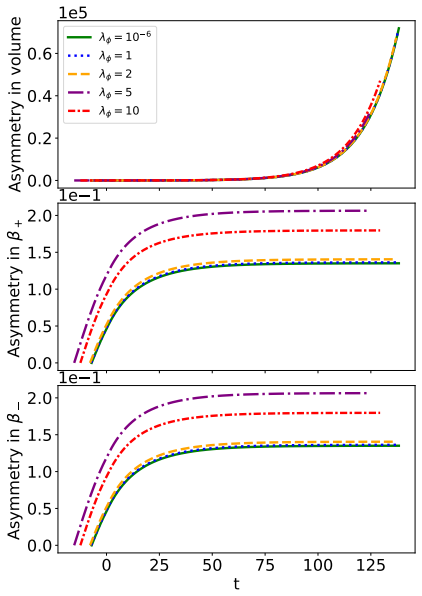
The main result is that if the scalar field is quantized with a different polymer scale, the dynamics changes visibly. The bounce, the moment when the contracting universe turns into an expanding one in this framework, happens at a different time and volume depending on that scale. The model also shows asymmetric evolution: the universe before the bounce does not mirror the universe after it. The authors derive an effective Friedmann equation for the model, although they note that this equation hides matter effects.
The work is a step toward treating matter and geometry on the same quantum footing in anisotropic cosmologies. It does not by itself connect to observations, and it relies on a particular ordering of quantization steps and on chosen parameter values, so the results are model-dependent.
Core claim
The strongest claim is stated in Sections IV.B and V: polymer quantizing the scalar field leads to significant differences in the evolution of various cosmological quantities as compared to standard quantization, and the location of the quantum bounce depends on the matter polymer scale. If correct, the effective dynamics of Bianchi-I are not determined by gravity-sector polymerization alone; matter quantization must be included.
Load-bearing premise
The construction polymerizes the anisotropies by treating them like massless scalar fields on the volume background, defining U± = exp(i λ± p± / v) and using the peaking value v in the prefactors (Eqs. 26-29). The paper justifies this by asserting that the volume has to be polymerized first because p± are densities, but this is a chosen ordering, not a proven consistency requirement. If this hybrid background treatment is not the correct quantization, the claimed dependence of the bounce and anisotropies on λφ does not follow.
Editorial analysis
A structured set of objections, weighed in public.
Axiom & Free-Parameter Ledger
free parameters (9)
- λ_v (volume polymer scale)
- λ_+ (anisotropy polymer scale)
- λ_- (anisotropy polymer scale)
- λ_φ (matter polymer scale)
- σ_v (volume state width)
- σ_+ (anisotropy state width)
- σ_- (anisotropy state width)
- σ_φ (scalar state width)
- Λ (cosmological constant)
axioms (5)
- domain assumption Polymer quantization on the Bohr compactification with variables (v, U=exp(iλ_v p_v)) and Gaussian semiclassical states yields the volume effective Hamiltonian (25).
- ad hoc to paper The anisotropies can be polymerized on the volume background by treating them like massless scalar fields, U±=exp(iλ±p±/v), with v the peaking volume.
- domain assumption The dust field provides an internal clock, and the reduced physical Hamiltonian Hp=pT is obtained by strongly solving the Hamiltonian constraint.
- domain assumption Expectation values of the Hamiltonian in Gaussian states define a valid effective Hamiltonian on the classical phase space.
- standard math Bianchi-I reduction with Misner variables and units c=ℏ=8πG=1 are adopted.
read the original abstract
We analyze the effective dynamics of a polymer quantized Bianchi-I universe coupled to a polymer quantized scalar field, with a pressureless dust field acting as an internal clock. We show that for a consistent polymer quantization of the anisotropies, the volume variable has to be polymerized first, and that a choice of different polymer scales for the two leads to substantially different dynamics. We further derive an effective Friedmann equation for this model, and compute the shear scalar. We find that polymer quantizing the scalar field leads to significant differences in the evolution of various cosmological quantities as compared to standard quantization. The amount of these variations, as well as the location of the quantum bounce, depends on the matter polymer scale.
Figures




Forward citations
Cited by 1 Pith paper
-
An effective Friedmann equation for a bouncing anisotropic universe
Derives the effective Friedmann equation and the exact parabolic shear–density relation at the bounce for polymer Bianchi-I, with constants −4, 4, 0 in the sharply peaked limit.
Reference graph
Works this paper leans on
-
[1]
I. Agullo and P. Singh, “Loop quantum cosmology.” inLoop Quantum Gravity: The First 30 Years, edited by A. Ashtekar and J. Pullin (WSP, 2017) pp. 183–240, arXiv:1612.01236 [gr-qc]
Pith/arXiv arXiv 2017
-
[2]
A. Ashtekar and P. Singh, Class. Quant. Grav.28, 213001 (2011), arXiv:1108.0893 [gr-qc]
Pith/arXiv arXiv 2011
-
[3]
B.-F. Li, P. Singh, and A. Wang, Phys. Rev. D97, 084029 (2018), arXiv:1801.07313 [gr-qc]
Pith/arXiv arXiv 2018
-
[4]
Halvorson, Studies in History and Philosophy of Science Part B: Studies in History and Philosophy of Modern Physics35, 45–56 (2004)
H. Halvorson, Studies in History and Philosophy of Science Part B: Studies in History and Philosophy of Modern Physics35, 45–56 (2004)
2004
-
[5]
A. Ashtekar, S. Fairhurst, and J. L. Willis, Class. Quant. Grav.20, 1031 (2003), arXiv:gr-qc/0207106
Pith/arXiv arXiv 2003
-
[6]
J. Ben Achour and E. R. Livine, Phys. Rev. D99, 126013 (2019), arXiv:1806.09290 [gr-qc]
Pith/arXiv arXiv 2019
-
[7]
G. Montani, C. Mantero, F. Bombacigno, F. Cianfrani, and G. Barca, Phys. Rev. D99, 063534 (2019), arXiv:1806.10364 [gr-qc]
Pith/arXiv arXiv 2019
-
[8]
E. Giovannetti, G. Montani, and S. Schiattarella, Phys. Rev. D105, 064011 (2022), arXiv:2105.00360 [gr-qc]
Pith/arXiv arXiv 2022
-
[9]
E. Giovannetti and G. Montani, Phys. Rev. D100, 104058 (2019), arXiv:1907.12083 [gr-qc]
Pith/arXiv arXiv 2019
-
[10]
G. Barca, P. Di Antonio, G. Montani, and A. Patti, Phys. Rev. D99, 123509 (2019), arXiv:1902.02128 [gr-qc]
Pith/arXiv arXiv 2019
-
[11]
E. Giovannetti, G. Barca, F. Mandini, and G. Montani, Universe8, 302 (2022), arXiv:2006.10614 [gr-qc]
Pith/arXiv arXiv 2022
-
[12]
G. Barca, E. Giovannetti, and G. Montani, Universe7, 327 (2021), arXiv:2109.08645 [gr-qc]. 26
Pith/arXiv arXiv 2021
-
[13]
A. Ashtekar, J. Lewandowski, and H. Sahlmann, Class. Quant. Grav.20, L11 (2003), arXiv:gr- qc/0211012
arXiv 2003
-
[14]
A. Corichi, T. Vukasinac, and J. A. Zapata, Phys. Rev. D76, 044016 (2007), arXiv:0704.0007 [gr-qc]
Pith/arXiv arXiv 2007
-
[15]
A. Laddha and M. Varadarajan, Class. Quant. Grav.27, 175010 (2010), arXiv:1001.3505 [gr-qc]
Pith/arXiv arXiv 2010
-
[16]
A. Kreienbuehl and T. Paw lowski, Phys. Rev. D88, 043504 (2013), arXiv:1302.6566 [gr-qc]
Pith/arXiv arXiv 2013
-
[17]
G. M. Hossain, V. Husain, and S. S. Seahra, Phys. Rev. D81, 024005 (2010), arXiv:0906.2798 [astro- ph.CO]
Pith/arXiv arXiv 2010
-
[18]
G. M. Hossain, V. Husain, and S. S. Seahra, Phys. Rev. D82, 124032 (2010), arXiv:1007.5500 [gr-qc]
Pith/arXiv arXiv 2010
-
[19]
S. M. Hassan, V. Husain, and S. S. Seahra, Phys. Rev. D91, 065006 (2015), arXiv:1409.6218 [astro- ph.CO]
Pith/arXiv arXiv 2015
-
[20]
S. M. Hassan and V. Husain, Class. Quant. Grav.34, 084003 (2017), arXiv:1705.00398 [gr-qc]
Pith/arXiv arXiv 2017
-
[21]
M. Ali and S. S. Seahra, Phys. Rev. D96, 103524 (2017), arXiv:1709.03960 [gr-qc]
Pith/arXiv arXiv 2017
- [22]
-
[23]
Husain and A
V. Husain and A. Kreienbuehl, Phys. Rev. D81, 084043 (2010)
2010
-
[24]
A. Zulfiqar and S. M. Hassan, JCAP (2025), arXiv:2502.04875 [gr-qc]
Pith/arXiv arXiv 2025
-
[25]
T. Schucker, A. Tilquin, and G. Valent, Mon. Not. Roy. Astron. Soc.444, 2820 (2014), arXiv:1405.6523 [astro-ph.CO]
Pith/arXiv arXiv 2014
-
[26]
L. Campanelli, P. Cea, and L. Tedesco, Phys. Rev. Lett.97, 131302 (2006), [Erratum: Phys.Rev.Lett. 97, 209903 (2006)], arXiv:astro-ph/0606266
Pith/arXiv arXiv 2006
-
[27]
¨O. Akarsu, S. Kumar, S. Sharma, and L. Tedesco, Phys. Rev. D100, 023532 (2019), arXiv:1905.06949 [astro-ph.CO]
Pith/arXiv arXiv 2019
-
[28]
P. K. Aluriet al., Class. Quant. Grav.40, 094001 (2023), arXiv:2207.05765 [astro-ph.CO]
Pith/arXiv arXiv 2023
-
[29]
M. P. Hertzberg and A. Loeb, Phys. Rev. D109, 083538 (2024), arXiv:2401.15782 [astro-ph.CO]
Pith/arXiv arXiv 2024
-
[30]
O. Akarsu, E. Di Valentino, S. Kumar, M. Ozyigit, and S. Sharma, Phys. Dark Univ.39, 101162 (2023), arXiv:2112.07807 [astro-ph.CO]
Pith/arXiv arXiv 2023
-
[31]
A. Ashtekar and E. Wilson-Ewing, Phys. Rev. D79, 083535 (2009), arXiv:0903.3397 [gr-qc]
Pith/arXiv arXiv 2009
-
[32]
M. de Cesare and E. Wilson-Ewing, JCAP12, 039 (2019), arXiv:1910.03616 [gr-qc]
Pith/arXiv arXiv 2019
-
[33]
T. Thiemann, Class. Quant. Grav.15, 1281 (1998), arXiv:gr-qc/9705019
Pith/arXiv arXiv 1998
-
[34]
A. Laddha and M. Varadarajan, Phys. Rev. D78, 044008 (2008), arXiv:0805.0208 [gr-qc]
Pith/arXiv arXiv 2008
-
[35]
M. Domagala, M. Dziendzikowski, and J. Lewandowski, in3rd Quantum Geometry and Quantum Gravity School(2012) arXiv:1210.0849 [gr-qc]
Pith/arXiv arXiv 2012
-
[36]
Loop quantum cosmology: Relation between theory and observations,
I. Agullo, A. Wang, and E. Wilson-Ewing, “Loop quantum cosmology: Relation between theory and observations,” inHandbook of Quantum Gravity(Springer Nature Singapore, 2023) p. 1–46
2023
-
[37]
V. Husain and O. Winkler, Phys. Rev. D75, 024014 (2007), arXiv:gr-qc/0607097. 27
Pith/arXiv arXiv 2007
-
[38]
V. Taveras, Phys. Rev. D78, 064072 (2008), arXiv:0807.3325 [gr-qc]
Pith/arXiv arXiv 2008
-
[39]
C. Rovelli and E. Wilson-Ewing, Phys. Rev. D90, 023538 (2014), arXiv:1310.8654 [gr-qc]
Pith/arXiv arXiv 2014
-
[40]
V. Husain and T. Pawlowski, Phys. Rev. Lett.108, 141301 (2012), arXiv:1108.1145 [gr-qc]
Pith/arXiv arXiv 2012
-
[41]
V. Husain and T. Pawlowski, Class. Quant. Grav.28, 225014 (2011), arXiv:1108.1147 [gr-qc]
Pith/arXiv arXiv 2011
-
[42]
M. Ali, S. M. Hassan, and V. Husain, Phys. Rev. D98, 086002 (2018), arXiv:1807.03864 [gr-qc]
Pith/arXiv arXiv 2018
-
[43]
M. Ali, S. Moeez Hassan, and V. Husain, Class. Quant. Grav.36, 234002 (2019), arXiv:1811.05047 [gr-qc]
Pith/arXiv arXiv 2019
-
[44]
M. Ali, V. Husain, S. Rahmati, and J. Ziprick, Class. Quant. Grav.33, 105012 (2016), arXiv:1512.07854 [gr-qc]
Pith/arXiv arXiv 2016
-
[45]
M. Ali and V. Husain, Phys. Rev. D96, 044032 (2017), arXiv:1707.07098 [gr-qc]
Pith/arXiv arXiv 2017
-
[46]
V. Husain, J. G. Kelly, R. Santacruz, and E. Wilson-Ewing, Phys. Rev. Lett.128, 121301 (2022), arXiv:2109.08667 [gr-qc]
Pith/arXiv arXiv 2022
-
[47]
K. Giesel, B.-F. Li, and P. Singh, Phys. Rev. D104, 023501 (2021), arXiv:2012.14443 [gr-qc]
Pith/arXiv arXiv 2021
-
[48]
Zulfiqar and S
A. Zulfiqar and S. M. Hassan,In prep(2025)
2025
-
[49]
A. M. McNamara, S. Saini, and P. Singh, Phys. Rev. D107, 026003 (2023), arXiv:2210.07257 [gr-qc]
Pith/arXiv arXiv 2023
-
[50]
M. Motaharfar, P. Singh, and E. Thareja, Phys. Rev. D109, 086013 (2024), arXiv:2311.08465 [gr-qc]
Pith/arXiv arXiv 2024
- [51]
-
[52]
G. Barca, E. Giovannetti, and G. Montani, Int. J. Geom. Meth. Mod. Phys.19, 2250097 (2022), arXiv:2112.08905 [gr-qc]
Pith/arXiv arXiv 2022
-
[53]
C. W. Misner, Phys. Rev. Lett.22, 1071 (1969)
1969
-
[54]
Kasner, American Journal of Mathematics43, 217 (1921)
E. Kasner, American Journal of Mathematics43, 217 (1921)
1921
-
[55]
C. W. Misner, Phys. Rev.186, 1319 (1969)
1969
-
[56]
M. Muzammil and V. Husain, Phys. Rev. D111, 084071 (2025), arXiv:2501.14891 [gr-qc]
Pith/arXiv arXiv 2025
-
[57]
V. A. Belinski ˘i, E. M. Lifshitz, and I. M. Khalatnikov, Soviet Physics Uspekhi13, 745 (1971)
1971
-
[58]
A. Ashtekar, W. Kaminski, and J. Lewandowski, Phys. Rev. D79, 064030 (2009), arXiv:0901.0933 [gr-qc]
Pith/arXiv arXiv 2009
-
[59]
M. Ali and S. Steinhaus, Phys. Rev. D106, 106016 (2022), arXiv:2206.04076 [gr-qc]
Pith/arXiv arXiv 2022
-
[60]
M. Han, H. Liu, D. Qu, F. Vidotto, and C. Zhang, Phys. Rev. D111, 086012 (2025), arXiv:2402.07984 [gr-qc]. 28
Pith/arXiv arXiv 2025
discussion (0)
Sign in with ORCID, Apple, or X to comment. Anyone can read and Pith papers without signing in.