REVIEW 42 references
Continuation strategies that exclude stiff designs, shift target frequencies, or delay design robustness substantially increase the probability that sound transmission loss topology optimization converges to high-performing optima.
Reviewed by Pith at T0; open to challenge. T0 means a machine referee read the full paper against a public rubric. the ladder, T0–T4 →
T0 review · deepseek-v4-flash
2026-08-04 13:51 UTC pith:4IURHHPU
Continuation strategies to mitigate convergence to low-performing local optima in topology optimization of sound transmission loss
The pith
A machine-rendered reading of the paper's core claim, the machinery that carries it, and where it could break.
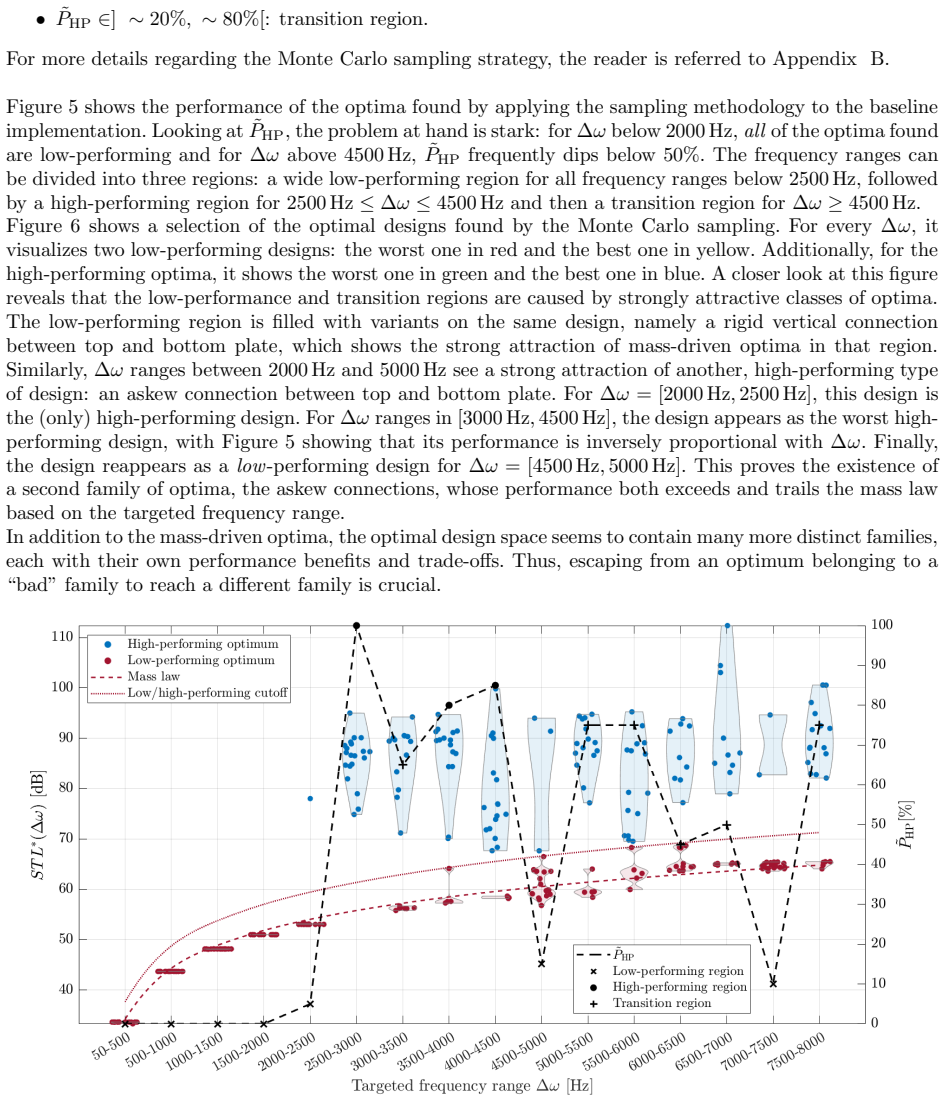
The authors quantify this failure on a benchmark sandwich panel problem. Using 20 random starting points for each of 16 target frequency ranges, they estimate the probability that the optimizer reaches a design at least 10 percent better than the mass law. Below 2500 Hz this probability is zero; above 4500 Hz it often drops below 50 percent.
They then implement and compare three strategy families. Exclusion strategies add a constraint that makes overly stiff designs infeasible. Frequency shift strategies first optimize at a higher target frequency, then gradually lower it to the desired range, transplanting high-performing solutions downward. Relaxation strategies delay the requirement that the design be robust to manufacturing variations, or replace the worst-case minmax objective with an aggregate one, before restoring the original formulation.
Monte Carlo results show all strategies improve the success probability in at least some frequency ranges, with different trade-offs. Frequency shifting is effective at low frequencies but doubles or triples computation time. Exclusion and relaxation are cheap and remove transition regions, but can bias designs toward compliance. The paper ends with practical guidance for choosing among these strategies.
Core claim
All investigated strategies demonstrate measurable benefits and trade-offs (abstract; Section 4.4). Concretely, the paper claims that frequency shift techniques can reduce the low-performing region at low frequencies until a physical limit, exclusion strategies can turn transition regions into high-performing regions, and relaxation variant R3 improves STL across the whole frequency range. If correct, these strategies provide a quantified way to raise the chance of a high-performing optimum without exhaustive reruns.
Load-bearing premise
The Monte Carlo estimate of PHP uses only N=20 random initial guesses per frequency range (Section 3.2, Appendix B), giving a standard error of about 11 percentage points at the 50 percent point. The paper classifies regions as low-performing, transition, or high-performing based on these noisy estimates, and compares strategies whose differences are sometimes smaller than this error. If these sampling errors are not representative, the ranking and the 'physical limit' conclusion (e.g., no high-performing optima below 500 Hz) could be wrong.
Editorial analysis
A structured set of objections, weighed in public.
Axiom & Free-Parameter Ledger
free parameters (7)
- Normalization constant C =
120
- High-performing threshold =
1.1 x STL_mass_law
- Connectivity constraint limit mu_sw =
15
- Exclusion bounds J_min =
-0.5, -0.05, adaptive to -0.05
- Excess frequency steps for F1-F4 =
omega* = 1000, 2000, 3000, 4000 Hz; step 100 Hz
- Robustness steps Delta_eta =
0.02 to 0.1 in four steps
- Mass law trigger criterion =
1.15 x STL_ml
axioms (5)
- domain assumption The sandwich panel is weakly periodic and the unit cell size is smaller than the acoustic wavelength, allowing exclusion of higher-order harmonics.
- standard math Bloch-Floquet boundary conditions enforce infinite periodicity of the unit cell.
- domain assumption The RAMP interpolation and artificial material properties (E_v, rho_v, etc.) adequately model intermediate densities.
- domain assumption The robust formulation with eroded, blueprint, and dilated designs is a valid proxy for manufacturability and design robustness.
- standard math MMA with the stated continuation and move-limit strategies converges to a local optimum of the discretized problem.
read the original abstract
Dynamic topology optimization problems often suffer from convergence to low-performing local optima. This typically results in stiff designs that do not exploit dynamical phenomena such as antiresonance and decoupling. To obtain better designs, researchers often repeat their optimizations with different initial guesses. However, such reruns are computationally expensive and the required number is unknown. To quantify this problem, random initial guesses are sampled and tested for different frequencies on two case studies: (1) dynamic compliance minimization of a reinforced cantilever, which exhibits poor optima for driving frequencies below the first natural frequency, and (2) sound transmission loss maximization of a sandwich panel, which additionally sees a strong tendency toward low-performing optima at high frequencies. To address this issue, the study first divides techniques to reduce the needed number of reruns into four categories: global optimization, exclusion, relaxation, and frequency shift methods. For the latter three, continuation strategies are proposed, illustrated, evaluated and compared on the sound transmission loss case, using Monte Carlo sampling to estimate success rates. All strategies show measurable benefits and trade-offs. To support broader applicability, the study concludes with practical guidelines for dealing with convergence to poor local optima in dynamic topology optimization.
Figures




Reference graph
Works this paper leans on
-
[1]
M. P. Bendsøe, N. Kikuchi, Generating optimal topologies in structural design using a homogenization method, Computer Methods in Applied Mechanics and Engineering 71 (2) (1988) 197–224. doi:https://doi.org/10.1016/0045-7825(88) 90086-2. URL https://www.sciencedirect.com/science/article/pii/0045782588900862
arXiv 1988
-
[2]
A. R. D ´ ıaaz, N. Kikuchi, Solutions to shape and topology eigenvalue optimization problems using a homogenization method, International Journal for Numerical Methods in Engineering 35 (7) (1992) 1487–1502. arXiv:https:// onlinelibrary.wiley.com/doi/pdf/10.1002/nme.1620350707, doi:https://doi.org/10.1002/nme.1620350707. URL https://onlinelibrary.wiley.co...
-
[3]
A. Lewis, M. Overton, Eigenvalue optimization, Acta Numerica 5 (1996) 149–190. doi:10.1017/S0962492900002646
-
[4]
H. S. Koh, G. H. Yoon, Large-scale topology optimization for dynamic problems using a repetitive substructuring approach, Structural and Multidisciplinary Optimization 67 (33) (2024). doi:https://doi.org/10.1007/s00158-024-03759-1
-
[5]
M. Xiao, J. Ma, X. Gao, P. Breitkopf, B. Raghavan, W. Zhang, L. Cauvin, P. Villon, Primal–dual on-the-fly reduced- order modeling for large-scale transient dynamic topology optimization, Computer Methods in Applied Mechanics and Engineering 428 (2024) 117099. doi:https://doi.org/10.1016/j.cma.2024.117099. URL https://www.sciencedirect.com/science/article/...
arXiv 2024
-
[6]
Q. Li, O. Sigmund, J. S. Jensen, N. Aage, Reduced-order methods for dynamic problems in topology optimization: A comparative study, Computer Methods in Applied Mechanics and Engineering 387 (2021) 114149. doi:https://doi.org/ 10.1016/j.cma.2021.114149. URL https://www.sciencedirect.com/science/article/pii/S0045782521004801
arXiv 2021
-
[7]
V. Cool, O. Sigmund, N. Aage, F. Naets, E. Deckers, Vibroacoustic topology optimization for sound transmission minimization through sandwich structures, J. of Sound and Vibr. 568 (2024) 117959, https://doi.org/10.1016/j.jsv. 2023.117959
arXiv 2024
-
[8]
D. Giraldo Guzman, C. Lissenden, P. Shokouhi, M. Frecker, Topology optimization design of resonant structures based on antiresonance eigenfrequency matching informed by harmonic analysis, Journal of Mechanical Design 145 (10) (2023) 101704. doi:10.1115/1.4062882. URL https://doi.org/10.1115/1.4062882
-
[9]
D. Giannini, N. Aage, F. Braghin, Topology optimization of mems resonators with target eigenfrequencies and modes, European Journal of Mechanics - A/Solids 91 (2022) 104352.doi:https://doi.org/10.1016/j.euromechsol.2021.104352. URL https://www.sciencedirect.com/science/article/pii/S0997753821001182
arXiv 2022
-
[10]
O. M. Silva, M. M. Neves, A. Lenzi, A critical analysis of using the dynamic compliance as objective function in topology optimization of one-material structures considering steady-state forced vibration problems, Journal of Sound and Vibration 444 (2019) 1–20. doi:https://doi.org/10.1016/j.jsv.2018.12.030. URL https://www.sciencedirect.com/science/articl...
-
[11]
E. Andreassen, F. Ferrari, O. Sigmund, A. R. Diaz, Frequency response as a surrogate eigenvalue problem in topology optimization, International Journal for Numerical Methods in Engineering 113 (8) (2018) 1214–1229. doi:https://doi. org/10.1002/nme.5563
-
[12]
Herrmann, O
L. Herrmann, O. Sigmund, V. M. Li, C. Vogl, S. Kollmannsberger, On neural networks for generating better local optima in topology optimization, Structural and Multidisciplinary Optimization 67 (11) (NOV 2024). doi:10.1007/ s00158-024-03908-6
2024
-
[13]
H. Assimi, A. Jamali, A hybrid algorithm coupling genetic programming and nelder-mead for topology and size optimization of trusses with static and dynamic constraints, Expert Systems with Applications 95 (2018) 127–141. doi:10.1016/j.eswa.2017.11.035
-
[14]
D. Giannini, M. Schevenels, E. P. Reynders, Rotational and multimodal local resonators for broadband sound insulation of orthotropic metamaterial plates, Journal of Sound and Vibration 547 (2023) 117453. doi:https://doi.org/10.1016/ j.jsv.2022.117453. URL https://www.sciencedirect.com/science/article/pii/S0022460X22006368
arXiv 2023
-
[15]
Zhang, J
S. Zhang, J. A. Norato, Finding better local optima in topology optimization via tunneling, in: Proceedings of the ASME International Design Engineering Technical Conferences and Computers and Information in Engineering Conference, ASME, Design Engn Div; ASME, Comp & Informat Engn Div, 2018, aSME International Design Engineering Technical Conferences (IDE...
2018
-
[16]
P. Liu, X. Zhang, Y. Luo, Topological design of freely vibrating bi-material structures to achieve the maximum band gap centering at a specified frequency, Journal of Applied Mechanics-Transaction of the ASME 88 (8) (AUG 1 2021). doi:10.1115/1.4050621
-
[17]
Dalklint, R
A. Dalklint, R. E. Christiansen, O. Sigmund, On the potential use of performance bounds based on semidefinite programs for topology optimization (2025)
2025
-
[18]
V. Cool, O. Sigmund, N. Aage, A practical review on promoting connectivity in topology optimization, Struct. and Multidiscipl. Opt. 68 (73), https://doi.org/10.1007/s00158-025-04004-z (2025)
-
[19]
C. B. Dilgen, N. Aage, Topology optimization of transient vibroacoustic problems for broadband filter design using cut elements, Finite Elements in Analysis and Design 234 (2024) 104123. doi:https://doi.org/10.1016/j.finel.2024. 104123. URL https://www.sciencedirect.com/science/article/pii/S0168874X24000179 25
-
[20]
S. Halkjær, O. Sigmund, J. S. Jensen, Maximizing band gaps in plate structures, Structural and Multidisciplinary Optimization 32 (2006) 263–275. doi:https://doi.org/10.1007/s00158-006-0037-7
-
[21]
R. Kohn, G. Allaire, Topology optimization and optimal shape design using homogenization, Kluwer, 1993, pp. 207–218
1993
-
[22]
C. Sanders, J. Norato, T. Walsh, W. Aquino, An error-in-constitutive equations strategy for topology optimization for frequency-domain dynamics, Computer Methods in Applied Mechanics and Engineering 372 (DEC 1 2020). doi:10.1016/ j.cma.2020.113330
arXiv 2020
-
[23]
X. Guo, G. Cheng, K. Yamazaki, A new approach for the solution of singular optima in truss topology optimization with stress and local buckling constraints, Structural and Multidisciplinary Optimization 22 (5) (2001) 364–372. doi: 10.1007/s00158-001-0156-0
-
[24]
N. Olhoff, J. Du, Generalized incremental frequency method for topological designof continuum structures for minimum dynamic compliance subject to forced vibration at a prescribed low or high value of the excitation frequency, Structural and Multidisciplinary Optimization 54 (5, SI) (2016) 1113–1141. doi:10.1007/s00158-016-1574-3
-
[25]
F. Meng, L. Meng, J. Wang, J. Zhu, B. P. Wang, S. Yuan, W. Zhang, Topology optimization for minimum dynamic compliance using an antiresonant frequency constraint, Structural and Multidisciplinary Optimization 67 (9) (SEP 2024). doi:10.1007/s00158-024-03878-9
-
[26]
R. F. Boukadia, E. Deckers, C. Claeys, M. Ichchou, W. Desmet, A wave-based optimization framework for 1D and 2D periodic structures, Mech. Syst. and Signal Process. 139 (2020) 106603, https://doi.org/10.1016/j.ymssp.2019.106603
arXiv 2020
-
[27]
F. Fahy, P. Gardonio, Sound and structural vibration: radiation, transmission and response, 2nd edition, Elsevier, UK, 2007
2007
-
[28]
Bloch, ¨Uber die quantenmechanik der elektronen in kristallgittern, Z
F. Bloch, ¨Uber die quantenmechanik der elektronen in kristallgittern, Z. f¨ ur Phys. 52 (7) (1929) 555–600, https://link. springer.com/article/10.1007/BF01339455
-
[29]
V. Cool, C. Claeys, H. Denayer, F. Naets, E. Deckers, Experimental validation of a topology optimized 2d sandwich panel for sound transmission minimization, Mechanical Systems and Signal Processing 211 (2024) 111197, https://doi.org/ 10.1016/j.ymssp.2024.111197
arXiv 2024
-
[30]
N. de Melo Filho, L. Van Belle, C. Claeys, E. Deckers, W. Desmet, Dynamic mass based sound transmission loss prediction of vibro-acoustic metamaterial double panels applied to the mass-air-mass resonance, J. Sound Vibr. 442 (2019) 28–44, https://doi.org/10.1016/j.jsv.2018.10.047
-
[31]
J. Jensen, A simple method for coupled acoustic-mechanical analysis with application to gradient-based topology optimization, Struct. and Multidiscipl. Opt. 59 (5) (2019) 1567–1580, https://doi.org/10.1007/s00158-018-2147-4
-
[32]
F. Wang, B. S. Lazarov, O. Sigmund, On projection methods, convergence and robust formulations in topology optimization, Struct. and Multidiscipl. Opt. 43 (6) (2011) 767–784, https://doi.org/10.1007/s00158-010-0602-y
-
[33]
R. E. Christiansen, B. S. Lazarov, J. S. Jensen, O. Sigmund, Creating geometrically robust designs for highly sensitive problems using topology optimization, Struct. and Multidiscipl. Opt. 52 (4) (2015) 737–754, https://doi.org.10.1007/ s00158-015-1265-5
2015
-
[34]
Svanberg, The method of moving asymptotes—a new method for structural optimization, Int
K. Svanberg, The method of moving asymptotes—a new method for structural optimization, Int. J. for Num. Methods in Eng. 24 (2) (1987) 359–373, https://doi.org/10.1002/nme.1620240207
-
[35]
Hoffmann, Violin plot, https://www.mathworks.com/matlabcentral/fileexchange/45134-violin-plot , accessed: 2025-03-24
H. Hoffmann, Violin plot, https://www.mathworks.com/matlabcentral/fileexchange/45134-violin-plot , accessed: 2025-03-24
2025
-
[36]
Bourdin, Filters in topology optimization, Int
B. Bourdin, Filters in topology optimization, Int. J. Num. methods Eng. 50 (9) (2001) 2143–2158, https://doi.org/10. 1002/nme.116
2001
-
[37]
J. K. Guest, J. H. Pr´ evost, T. Belytschko, Achieving minimum length scale in topology optimization using nodal design variables and projection functions, Int. J. Num. Methods Eng. 61 (2) (2004) 238–254,https://doi.org/10.1002/nme.1064
doi:10.1002/nme.1064 2004
-
[38]
M. Stolpe, K. Svanberg, An alternative interpolation scheme for minimum compliance topology optimization, Struct. and Multidiscipl. Opt. 22 (2) (2001) 116–124, https://doi.org/10.1007/s001580100129
-
[39]
M. Hussein, M. Leamy, M. Ruzzene, Dynamics of phononic materials and structures: Historical origins, recent progress, and future outlook, Appl. Mech. Rev. 66 (4) (2014) 040802, https://doi.org/10.1115/1.4026911
-
[40]
Y. Yang, B. R. Mace, M. J. Kingan, Prediction of sound transmission through, and radiation from, panels using a wave and finite element method, J. Acoust. Soc. Am. 141 (4) (2017) 2452–2460, https://doi.org/10.1121/1.4977925
-
[41]
Y. Yang, B. Mace, M. Kingan, Vibroacoustic analysis of periodic structures using a wave and finite element method, J. of Sound and Vibr. 457 (2019) 333–353, https://doi.org/10.1016/j.jsv.2019.06.009
-
[42]
K. E. Swartz, D. A. Tortorelli, D. A. White, K. A. James, Manufacturing and stiffness constraints for topology optimized periodic structures, Struct. and Multidiscipl. Opt. 65 (129), https://doi.org/10.1007/s00158-022-03222-z (2022). 26
discussion (0)
Sign in with ORCID, Apple, or X to comment. Anyone can read and Pith papers without signing in.