REVIEW 54 references
Language models contain per-query circuits using a few percent of their edges that reproduce much of their answer behavior, and paraphrase-based Best-of-N search finds them.
Reviewed by Pith at T0; open to challenge. T0 means a machine referee read the full paper against a public rubric. the ladder, T0–T4 →
2026-08-04 13:52 UTC pith:ZCSBRK7M
Query Circuits: Explaining How Language Models Answer User Prompts
The pith
A machine-rendered reading of the paper's core claim, the machinery that carries it, and where it could break.
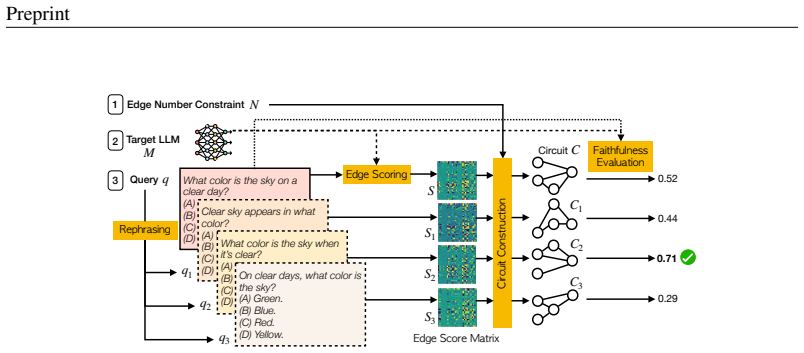
Finding it is hard. Standard scoring methods, borrowed from older 'capability circuit' research, become noisy on realistic questions: their scores swing outside the normal range and do not improve as edges are added. The authors fix the measurement with a bounded faithfulness score called NDF, and fix the search with 'Best-of-N': generate several paraphrases of the question, find a candidate circuit for each, and keep the candidate that best reproduces the model's original answer. The paraphrases act like lottery tickets; the best one wins.
On multiple-choice exams (MMLU, ARC) and on arithmetic and sentence tasks, the winners are substantial: about 5,000 edges out of roughly 387,000, about 1.3%, reproduce on average about 60% of the model's per-question behavior. Removing these circuits instead of keeping them shows the critical information really does live there. Two faster approximations, iBoN and BoN-CSM, trade some faithfulness for speed.
The caveats: the reported 60% is the best result out of ten tries, so it flatters the method somewhat. No error bars are given, no code is released, and the score measures logit differences rather than whether the model picks the correct option. The results are most convincing on the simple IOI task, where the older, more standard metric also shows the effect.
Core claim
Abstract: 'we find that there exist extremely sparse query circuits within the model that can recover much of its performance on single queries. For example, a circuit covering only 1.3% of model connections can recover about 60% of performance on an MMLU questions.' Section 6.2: 'In MMLU, a circuit with only 5k edges (1.3% of Llama-3.2-1B-Instruct's all edges) achieves an average NDF of 0.6.' If the paper is correct, sparse per-query subgraphs of a transformer exist and can be found cheaply via paraphrase-based Best-of-N search, making local, faithful model explanations a practical target.
Load-bearing premise
The NDF normalization assumes the corrupted-query baseline is a fair counterfactual for 'the model without the question-understanding signal.' For MMLU/ARC this baseline is built by replacing the stem with 'Which is the most possible answer?' while preserving options. The paper's own Table 1 shows the baseline is not empty: L(M(q'))=0.53 for Query 3 versus 0.96 for the clean query, and Appendix B.4 concedes that both clean and corrupted queries contain option-ID signals that distribute logits. If position bias or option-format artifacts give the corrupted model a non-trivial margin, then the normalization L(M(q))-L(M(q')) is contaminated, and a circuit that partially reproduces option-format tendencies can score high NDF without recovering any question-answering computation. Every MMLU/ARC NDF value, including the headline 0.6 at 5k edges, inherits this scale. The IOI results use the standard name-replacement corruption and the classic NFS metric, so they do not carry this risk.
Editorial analysis
A structured set of objections, weighed in public.
Axiom & Free-Parameter Ledger
free parameters (3)
- number of paraphrases p =
9
- IG discretization step m =
20
- MMLU category selection rule =
categories where Claude 3.5 Sonnet scores >= 95% on HELM MMLU
axioms (6)
- domain assumption Logit difference between the correct and average-incorrect tokens is a valid performance metric L for single-query faithfulness.
- domain assumption Corrupted query 'Which is the most possible answer?' provides a clean counterfactual baseline for the NDF normalization on MCQs.
- domain assumption Integrated-gradients edge scores with m=20 steps (Eq. 2) are adequate proxies for true indirect-effect scores (Eq. 1) on single queries.
- standard math The residual-rewrite abstraction of a transformer into attention-head/MLP nodes with QKV-split edges (TransformerLens) is a valid circuit representation.
- domain assumption Greedy top-N edge selection with respect to attribution scores produces circuits no worse than Dijkstra-style construction.
- domain assumption GPT-4o paraphrases of the question stem preserve meaning and do not change the query's underlying computation.
Cite this review
Pith. "Pith review of Query Circuits: Explaining How Language Models Answer User Prompts." pith.science (2026). https://pith.science/paper/ZCSBRK7M
@misc{pith2026250924808,
  author       = {Pith},
  title        = {Pith review of: Query Circuits: Explaining How Language Models Answer User Prompts},
  year         = {2026},
  howpublished = {\url{https://pith.science/paper/ZCSBRK7M}},
  note         = {Machine review of arXiv:2509.24808}
}
read the original abstract
Explaining why a language model produces a particular output requires local, input-level explanations. Existing methods uncover global capability circuits (e.g., indirect object identification), but not why the model answers a specific input query in a particular way. We introduce query circuits, which directly trace the information flow inside a model that maps a specific input to the output. Unlike surrogate-based approaches (e.g., sparse autoencoders), query circuits are identified within the model itself, resulting in more faithful and computationally accessible explanations. To make query circuits practical, we address two challenges. First, we introduce Normalized Deviation Faithfulness (NDF), a robust metric to evaluate how well a discovered circuit recovers the model's decision for a specific input, and is broadly applicable to circuit discovery beyond our setting. Second, we develop sampling-based methods to efficiently identify circuits that are sparse yet faithfully describe the model's behavior. Across benchmarks (IOI, arithmetic, MMLU, and ARC), we find that there exist extremely sparse query circuits within the model that can recover much of its performance on single queries. For example, a circuit covering only 1.3% of model connections can recover about 60% of performance on an MMLU questions. Overall, query circuits provide a step towards faithful, scalable explanations of how language models process individual inputs. The project page is at https://tony10101105.github.io/query-circuit/.
Figures




Reference graph
Works this paper leans on
-
[1]
write newline
" write newline "" before.all 'output.state := FUNCTION n.dashify 't := "" t empty not t #1 #1 substring "-" = t #1 #2 substring "--" = not "--" * t #2 global.max substring 't := t #1 #1 substring "-" = "-" * t #2 global.max substring 't := while if t #1 #1 substring * t #2 global.max substring 't := if while FUNCTION format.date year duplicate empty "emp...
-
[2]
Explainability for artificial intelligence in healthcare: a multidisciplinary perspective
Julia Amann, Alessandro Blasimme, Effy Vayena, Dietmar Frey, Vince I Madai, and Precise4Q Consortium. Explainability for artificial intelligence in healthcare: a multidisciplinary perspective. BMC Medical Informatics and Decision Making, 20: 0 1--9, 2020
2020
-
[3]
Circuit tracing: Revealing computational graphs in language models
Emmanuel Ameisen, Jack Lindsey, Adam Pearce, Wes Gurnee, Nicholas L Turner, Brian Chen, Craig Citro, David Abrahams, Shan Carter, Basil Hosmer, et al. Circuit tracing: Revealing computational graphs in language models. Transformer Circuits Thread, 2025
2025
-
[4]
Claude 3.5 sonnet
Antropic. Claude 3.5 sonnet. 2025. URL https://www.anthropic.com/news/claude-3-5-sonnet
2025
-
[5]
Mechanistic interpretability for AI safety - a review
Leonard Bereska and Stratis Gavves. Mechanistic interpretability for AI safety - a review. Transactions on Machine Learning Research (TMLR), 2024. ISSN 2835-8856
2024
-
[6]
Building and evaluating alignment auditing agents
Trenton Bricken, Rowan Wang, Sam Bowman, Euan Ong, Johannes Treutlein, Jeff Wu, Evan Hubinger, and Samuel Marks. Building and evaluating alignment auditing agents. https://alignment.anthropic.com/2025/automated-auditing/, July 2025
2025
-
[7]
How people use chatgpt
Aaron Chatterji, Thomas Cunningham, David J Deming, Zoe Hitzig, Christopher Ong, Carl Yan Shan, and Kevin Wadman. How people use chatgpt. Working Paper 34255, National Bureau of Economic Research, September 2025
2025
-
[8]
Selfie: self-interpretation of large language model embeddings
Haozhe Chen, Carl Vondrick, and Chengzhi Mao. Selfie: self-interpretation of large language model embeddings. In Proceedings of the International Conference on Machine Learning (ICML), 2024
2024
-
[9]
Think you have solved question answering? try arc, the ai2 reasoning challenge
Peter Clark, Isaac Cowhey, Oren Etzioni, Tushar Khot, Ashish Sabharwal, Carissa Schoenick, and Oyvind Tafjord. Think you have solved question answering? try arc, the ai2 reasoning challenge. arXiv:1803.05457v1, 2018
Pith/arXiv arXiv 2018
-
[10]
Towards automated circuit discovery for mechanistic interpretability
Arthur Conmy, Augustine Mavor-Parker, Aengus Lynch, Stefan Heimersheim, and Adri \`a Garriga-Alonso. Towards automated circuit discovery for mechanistic interpretability. In Proceedings of the Conference on Neural Information Processing Systems (NeurIPS), volume 36, pp.\ 16318--16352, 2023
2023
-
[11]
The llama 3 herd of models
Abhimanyu Dubey, Abhinav Jauhri, Abhinav Pandey, Abhishek Kadian, Ahmad Al-Dahle, Aiesha Letman, Akhil Mathur, Alan Schelten, Amy Yang, Angela Fan, et al. The llama 3 herd of models. arXiv e-prints, pp.\ arXiv--2407, 2024
2024
-
[12]
A mathematical framework for transformer circuits
Nelson Elhage, Neel Nanda, Catherine Olsson, Tom Henighan, Nicholas Joseph, Ben Mann, Amanda Askell, Yuntao Bai, Anna Chen, Tom Conerly, Nova DasSarma, Dawn Drain, Deep Ganguli, Zac Hatfield-Dodds, Danny Hernandez, Andy Jones, Jackson Kernion, Liane Lovitt, Kamal Ndousse, Dario Amodei, Tom Brown, Jack Clark, Jared Kaplan, Sam McCandlish, and Chris Olah. A...
2021
-
[13]
N2g: A SCALABLE APPROACH FOR QUANTIFYING INTERPRETABLE NEURON REPRESENTATION IN LLMS
Alex Foote, Neel Nanda, Esben Kran, Ioannis Konstas, and Fazl Barez. N2g: A SCALABLE APPROACH FOR QUANTIFYING INTERPRETABLE NEURON REPRESENTATION IN LLMS . In ICLR 2023 Workshop on Trustworthy and Reliable Large-Scale Machine Learning Models, 2023
2023
-
[14]
The lottery ticket hypothesis: Finding sparse, trainable neural networks
Jonathan Frankle and Michael Carbin. The lottery ticket hypothesis: Finding sparse, trainable neural networks. In Proceedings of the International Conference on Learning Representations (ICLR), 2019
2019
-
[15]
Patchscopes: A unifying framework for inspecting hidden representations of language models
Asma Ghandeharioun, Avi Caciularu, Adam Pearce, Lucas Dixon, and Mor Geva. Patchscopes: A unifying framework for inspecting hidden representations of language models. In Proceedings of the International Conference on Machine Learning (ICML), 2024
2024
-
[16]
How does GPT -2 compute greater-than?: Interpreting mathematical abilities in a pre-trained language model
Michael Hanna, Ollie Liu, and Alexandre Variengien. How does GPT -2 compute greater-than?: Interpreting mathematical abilities in a pre-trained language model. In Proceedings of the Conference on Neural Information Processing Systems (NeurIPS), 2023
2023
-
[17]
Have faith in faithfulness: Going beyond circuit overlap when finding model mechanisms
Michael Hanna, Sandro Pezzelle, and Yonatan Belinkov. Have faith in faithfulness: Going beyond circuit overlap when finding model mechanisms. In Proceedings of the Conference on Language Modeling (COLM), 2024
2024
-
[19]
Measuring massive multitask language understanding
Dan Hendrycks, Collin Burns, Steven Basart, Andy Zou, Mantas Mazeika, Dawn Song, and Jacob Steinhardt. Measuring massive multitask language understanding. In Proceedings of the International Conference on Learning Representations (ICLR), 2021
2021
-
[20]
Sparse autoencoders find highly interpretable features in language models
Robert Huben, Hoagy Cunningham, Logan Riggs Smith, Aidan Ewart, and Lee Sharkey. Sparse autoencoders find highly interpretable features in language models. In Proceedings of the International Conference on Learning Representations (ICLR), 2024
2024
-
[21]
Aaron Hurst, Adam Lerer, Adam P Goucher, Adam Perelman, Aditya Ramesh, Aidan Clark, AJ Ostrow, Akila Welihinda, Alan Hayes, Alec Radford, et al. Gpt-4o system card. arXiv preprint arXiv:2410.21276, 2024
Pith/arXiv arXiv 2024
-
[22]
Guided integrated gradients: An adaptive path method for removing noise
Andrei Kapishnikov, Subhashini Venugopalan, Besim Avci, Ben Wedin, Michael Terry, and Tolga Bolukbasi. Guided integrated gradients: An adaptive path method for removing noise. In Proceedings of the IEEE/CVF Conference on Computer Vision and Pattern Recognition (CVPR), pp.\ 5050--5058, 2021
2021
-
[23]
Scaling sparse feature circuit finding for in-context learning
Dmitrii Kharlapenko, Stepan Shabalin, Fazl Barez, Arthur Conmy, and Neel Nanda. Scaling sparse feature circuit finding for in-context learning. In Proceedings of the International Conference on Machine Learning (ICML), 2025
2025
-
[24]
Why are saliency maps noisy? cause of and solution to noisy saliency maps
Beomsu Kim, Junghoon Seo, Seunghyeon Jeon, Jamyoung Koo, Jeongyeol Choe, and Taegyun Jeon. Why are saliency maps noisy? cause of and solution to noisy saliency maps. In 2019 IEEE/CVF International Conference on Computer Vision Workshop (ICCVW), pp.\ 4149--4157, 2019
2019
-
[25]
Granular concept circuits: Toward a fine-grained circuit discovery for concept representations
Dahee Kwon, Sehyun Lee, and Jaesik Choi. Granular concept circuits: Toward a fine-grained circuit discovery for concept representations. In Proceedings of the IEEE/CVF International Conference on Computer Vision (ICCV), 2025
2025
-
[26]
Towards interpretable sequence continuation: Analyzing shared circuits in large language models
Michael Lan, Philip Torr, and Fazl Barez. Towards interpretable sequence continuation: Analyzing shared circuits in large language models. In Proceedings of the 2024 Conference on Empirical Methods in Natural Language Processing (EMNLP), pp.\ 12576--12601. Association for Computational Linguistics, November 2024
2024
-
[27]
Reddi, Ke Ye, Felix Chern, Felix Yu, Ruiqi Guo, and Sanjiv Kumar
Zonglin Li, Chong You, Srinadh Bhojanapalli, Daliang Li, Ankit Singh Rawat, Sashank J. Reddi, Ke Ye, Felix Chern, Felix Yu, Ruiqi Guo, and Sanjiv Kumar. The lazy neuron phenomenon: On emergence of activation sparsity in transformers. In Proceedings of the International Conference on Learning Representations (ICLR), 2023
2023
-
[28]
Percy Liang, Rishi Bommasani, Tony Lee, Dimitris Tsipras, Dilara Soylu, Michihiro Yasunaga, Yian Zhang, Deepak Narayanan, Yuhuai Wu, Ananya Kumar, Benjamin Newman, Binhang Yuan, Bobby Yan, Ce Zhang, Christian Alexander Cosgrove, Christopher D Manning, Christopher Re, Diana Acosta-Navas, Drew Arad Hudson, Eric Zelikman, Esin Durmus, Faisal Ladhak, Frieda R...
2023
-
[29]
Sparse crosscoders for cross-layer features and model diffing
Jack Lindsey, Adly Templeton, Jonathan Marcus, Thomas Conerly, Joshua Batson, and Christopher Olah. Sparse crosscoders for cross-layer features and model diffing. Transformer Circuits Thread, 2024
2024
-
[30]
Lundberg and Su-In Lee
Scott M. Lundberg and Su-In Lee. A unified approach to interpreting model predictions. In Proceedings of the Conference on Neural Information Processing Systems (NeurIPS), pp.\ 4768–4777, 2017
2017
-
[31]
Enhancing neural network interpretability with feature-aligned sparse autoencoders
Luke Marks, Alasdair Paren, David Krueger, and Fazl Barez. Enhancing neural network interpretability with feature-aligned sparse autoencoders. arXiv preprint arXiv:2411.01220, 2024
Pith/arXiv arXiv 2024
-
[32]
Sparse feature circuits: Discovering and editing interpretable causal graphs in language models
Samuel Marks, Can Rager, Eric J Michaud, Yonatan Belinkov, David Bau, and Aaron Mueller. Sparse feature circuits: Discovering and editing interpretable causal graphs in language models. In Proceedings of the International Conference on Learning Representations (ICLR), 2025
2025
-
[33]
Transformer circuit evaluation metrics are not robust
Joseph Miller, Bilal Chughtai, and William Saunders. Transformer circuit evaluation metrics are not robust. In Proceedings of the Conference on Language Modeling (COLM), 2024
2024
-
[34]
MIB : A mechanistic interpretability benchmark
Aaron Mueller, Atticus Geiger, Sarah Wiegreffe, Dana Arad, Iv \'a n Arcuschin, Adam Belfki, Yik Siu Chan, Jaden Fried Fiotto-Kaufman, Tal Haklay, Michael Hanna, Jing Huang, Rohan Gupta, Yaniv Nikankin, Hadas Orgad, Nikhil Prakash, Anja Reusch, Aruna Sankaranarayanan, Shun Shao, Alessandro Stolfo, Martin Tutek, Amir Zur, David Bau, and Yonatan Belinkov. MI...
2025
-
[35]
Transformerlens
Neel Nanda and Joseph Bloom. Transformerlens. https://github.com/TransformerLensOrg/TransformerLens, 2022
2022
-
[36]
A toy model of mechanistic (un)faithfulness
Chris Olah. A toy model of mechanistic (un)faithfulness. Transformer Circuits Thread, 2025
2025
-
[37]
Explanations in autonomous driving: A survey
Daniel Omeiza, Helena Webb, Marina Jirotka, and Lars Kunze. Explanations in autonomous driving: A survey. IEEE Transactions on Intelligent Transportation Systems, 23 0 (8): 0 10142--10162, 2022
2022
-
[38]
Understanding addition in transformers
Philip Quirke and Fazl Barez. Understanding addition in transformers. In In Proceedings of the International Conference on Learning Representations (ICLR), 2024
2024
-
[39]
Language models are unsupervised multitask learners
Alec Radford, Jeffrey Wu, Rewon Child, David Luan, Dario Amodei, Ilya Sutskever, et al. Language models are unsupervised multitask learners. OpenAI blog, 1 0 (8): 0 9, 2019
2019
-
[40]
A multimodal automated interpretability agent
Tamar Rott Shaham, Sarah Schwettmann, Franklin Wang, Achyuta Rajaram, Evan Hernandez, Jacob Andreas, and Antonio Torralba. A multimodal automated interpretability agent. In Proceedings of the International Conference on Machine Learning (ICML). JMLR.org, 2024
2024
-
[41]
A value for n-person games
Lloyd S Shapley. A value for n-person games. In Harold W. Kuhn and Albert W. Tucker (eds.), Contributions to the Theory of Games II, pp.\ 307--317. Princeton University Press, 1953
1953
-
[42]
Smoothgrad: removing noise by adding noise
Daniel Smilkov, Nikhil Thorat, Been Kim, Fernanda Vi \'e gas, and Martin Wattenberg. Smoothgrad: removing noise by adding noise. arXiv preprint arXiv:1706.03825, 2017
Pith/arXiv arXiv 2017
-
[43]
Axiomatic attribution for deep networks
Mukund Sundararajan, Ankur Taly, and Qiqi Yan. Axiomatic attribution for deep networks. In Proceedings of the International Conference on Machine Learning (ICML), pp.\ 3319--3328. PMLR, 2017
2017
-
[44]
Attribution patching outperforms automated circuit discovery
Aaquib Syed, Can Rager, and Arthur Conmy. Attribution patching outperforms automated circuit discovery. In Proceedings of the 7th BlackboxNLP Workshop: Analyzing and Interpreting Neural Networks for NLP, pp.\ 407--416, 2024
2024
-
[45]
Universal properties of activation sparsity in modern large language models
Filip Szatkowski, Patryk B e dkowski, Alessio Devoto, Jan Dubi \'n ski, Pasquale Minervini, Miko aj Pi \'o rczy \'n ski, Simone Scardapane, and Bartosz W \'o jcik. Universal properties of activation sparsity in modern large language models. arXiv preprint arXiv:2509.00454, 2025
arXiv 2025
-
[46]
Daniel Freeman, Theodore R
Adly Templeton, Tom Conerly, Jonathan Marcus, Jack Lindsey, Trenton Bricken, Brian Chen, Adam Pearce, Craig Citro, Emmanuel Ameisen, Andy Jones, Hoagy Cunningham, Nicholas L Turner, Callum McDougall, Monte MacDiarmid, C. Daniel Freeman, Theodore R. Sumers, Edward Rees, Joshua Batson, Adam Jermyn, Shan Carter, Chris Olah, and Tom Henighan. Scaling monosema...
2024
-
[47]
Investigating gender bias in language models using causal mediation analysis
Jesse Vig, Sebastian Gehrmann, Yonatan Belinkov, Sharon Qian, Daniel Nevo, Yaron Singer, and Stuart Shieber. Investigating gender bias in language models using causal mediation analysis. In Proceedings of the Conference on Neural Information Processing Systems (NeurIPS), volume 33, pp.\ 12388--12401, 2020
2020
-
[48]
Interpretability in the wild: a circuit for indirect object identification in GPT -2 small
Kevin Ro Wang, Alexandre Variengien, Arthur Conmy, Buck Shlegeris, and Jacob Steinhardt. Interpretability in the wild: a circuit for indirect object identification in GPT -2 small. In Proceedings of the International Conference on Learning Representations (ICLR), 2023
2023
-
[49]
Do LLM s overcome shortcut learning? an evaluation of shortcut challenges in large language models
Yu Yuan, Lili Zhao, Kai Zhang, Guangting Zheng, and Qi Liu. Do LLM s overcome shortcut learning? an evaluation of shortcut challenges in large language models. In Proceedings of the 2024 Conference on Empirical Methods in Natural Language Processing (EMNLP), pp.\ 12188--12200. Association for Computational Linguistics, 2024
2024
-
[50]
Towards best practices of activation patching in language models: Metrics and methods
Fred Zhang and Neel Nanda. Towards best practices of activation patching in language models: Metrics and methods. In Proceedings of the International Conference on Learning Representations (ICLR), 2024
2024
-
[51]
Eap-gp: Mitigating saturation effect in gradient-based automated circuit identification
Lin Zhang, Wenshuo Dong, Zhuoran Zhang, Shu Yang, Lijie Hu, Ninghao Liu, Pan Zhou, and Di Wang. Eap-gp: Mitigating saturation effect in gradient-based automated circuit identification. arXiv preprint arXiv:2502.06852, 2025
Pith/arXiv arXiv 2025
-
[52]
Large language models are not robust multiple choice selectors
Chujie Zheng, Hao Zhou, Fandong Meng, Jie Zhou, and Minlie Huang. Large language models are not robust multiple choice selectors. In Proceedings of the International Conference on Learning Representations (ICLR), 2024
2024
-
[53]
@esa (Ref
\@ifxundefined[1] #1\@undefined \@firstoftwo \@secondoftwo \@ifnum[1] #1 \@firstoftwo \@secondoftwo \@ifx[1] #1 \@firstoftwo \@secondoftwo [2] @ #1 \@temptokena #2 #1 @ \@temptokena \@ifclassloaded agu2001 natbib The agu2001 class already includes natbib coding, so you should not add it explicitly Type <Return> for now, but then later remove the command n...
-
[54]
\@lbibitem[] @bibitem@first@sw\@secondoftwo \@lbibitem[#1]#2 \@extra@b@citeb \@ifundefined br@#2\@extra@b@citeb \@namedef br@#2 \@nameuse br@#2\@extra@b@citeb \@ifundefined b@#2\@extra@b@citeb @num @parse #2 @tmp #1 NAT@b@open@#2 NAT@b@shut@#2 \@ifnum @merge>\@ne @bibitem@first@sw \@firstoftwo \@ifundefined NAT@b*@#2 \@firstoftwo @num @NAT@ctr \@secondoft...
-
[55]
Attribution Patching Outperforms Automated Circuit Discovery
@open @close @open @close and [1] URL: #1 \@ifundefined chapter * \@mkboth \@ifxundefined @sectionbib * \@mkboth * \@mkboth\@gobbletwo \@ifclassloaded amsart * \@ifclassloaded amsbook * \@ifxundefined @heading @heading NAT@ctr thebibliography [1] @ \@biblabel @NAT@ctr \@bibsetup #1 @NAT@ctr @ @openbib .11em \@plus.33em \@minus.07em 4000 4000 `\.\@m @bibit...
Pith/arXiv arXiv 2024
This paper was first reviewed by deepseek-v4-flash on August 4, 2026.
discussion (0)
Sign in with ORCID, Apple, or X to comment. Anyone can read and Pith papers without signing in.