REVIEW 4 major objections 4 minor 43 references
A fixed, retina-inspired preprocessing module improves semantic segmentation in night and adverse weather without retraining.
Reviewed by Pith at T0; open to challenge. T0 means a machine referee read the full paper against a public rubric. the ladder, T0–T4 →
T0 review · deepseek-v4-flash
2026-08-04 14:37 UTC pith:CTGN5OQK
load-bearing objection Useful grayscale-preprocessing result undermined by a misattributed contrast mechanism and an unsupported sparsity claim; deserves serious revision, not rejection. the 4 major comments →
Improved Robustness from Biologically Inspired Sparse Contrast Representations
The pith
A machine-rendered reading of the paper's core claim, the machinery that carries it, and where it could break.
Core claim
On its own terms, the paper's central discovery is that the way an image is represented before it enters a segmentation network is itself a robustness lever. The preprocessing module first maps RGB through a fixed linear color transform M, then subtracts progressively blurred versions of the transformed image (box blur applied d=5 times) to produce a local-contrast signal that discards absolute luminance. Across three architectures, this fixed transform preserves Cityscapes performance (mIoU within a few points of RGB baseline) while raising mIoU on Dark Zurich and ACDC Night from single digits to roughly 18-23, a large relative gain. Grayscale variants (with or without contrast) perform bes
What carries the argument
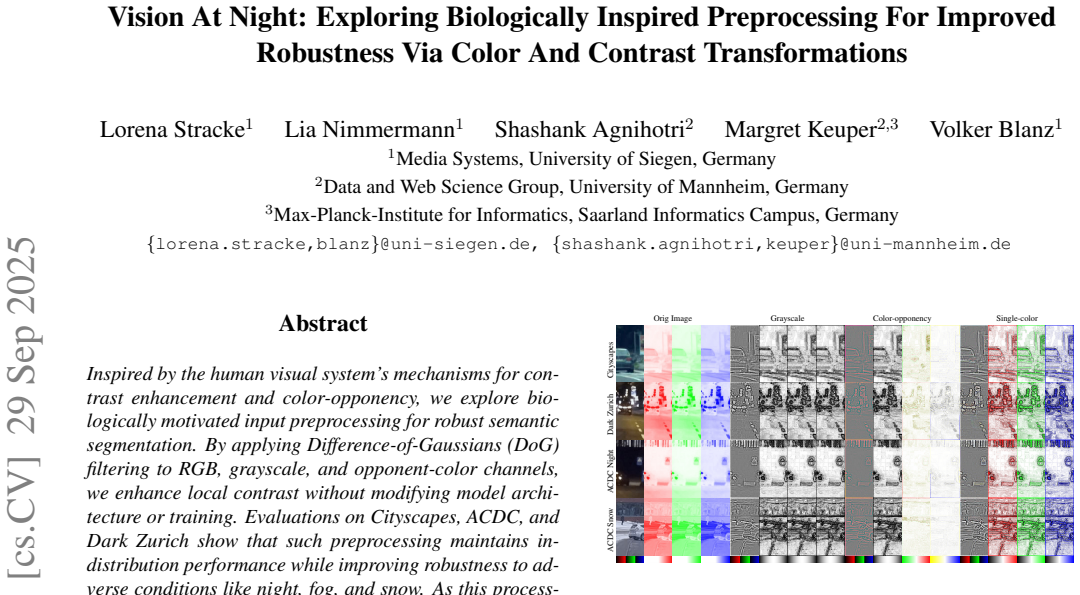
The central object is the fixed preprocessing module defined by img_contrast = M·img_original − Σ_{i=1..d} (1/d)·M·img_i, where M is a 3×3 color-reparameterization matrix (grayscale, color-opponency, or identity) and img_i are progressively box-blurred versions of the image. With d=5, the module approximates a Difference-of-Gaussians (DoG) center-surround kernel, acting like retinal center-surround cells by keeping local contrast while discarding absolute luminance. The depth d controls how much spatial context the contrast subtraction uses; d=0 removes contrast and leaves only the color transform, serving as the control. This module is what carries the argument: because it is frozen and app
Load-bearing premise
The claim stands on the assumption that the robustness gains come from the biologically inspired contrast-extraction module rather than from the simpler color-to-grayscale remapping; the paper's ablations show grayscale without contrast (d=0) often equals or beats the contrast version, and the abstract's 70% sparsity-stability figure is not backed by experiments in the visible text.
What would settle it
Reproduce the paper's Cityscapes training with grayscale d=0, grayscale d=5, and RGB on Deeplabv3+, SegFormer, and InternImage, and test on Dark Zurich and ACDC Night. If grayscale d=0 matches or beats grayscale d=5 for all three architectures on both datasets, the specific claim that contrast extraction improves nighttime robustness is falsified; also check whether any section reports the 70% sparsification result claimed in the abstract.
If this is right
- If the claim holds, robustness to night and weather can be improved by changing only the input representation, leaving architectures and training pipelines untouched.
- The preprocessing is cheap enough (two or three fixed convolutional layers) to be embedded in imaging sensors, so cameras could deliver task-ready robust inputs directly.
- Grayscale-based inputs, in particular, can serve as a strong and simple baseline for nighttime semantic segmentation, since all grayscale variants beat RGB at night across tested architectures.
- The reported tolerance to 70% sparsification suggests the contrast representation could be compressed or thresholded near acquisition, reducing transmission bandwidth in sensor networks.
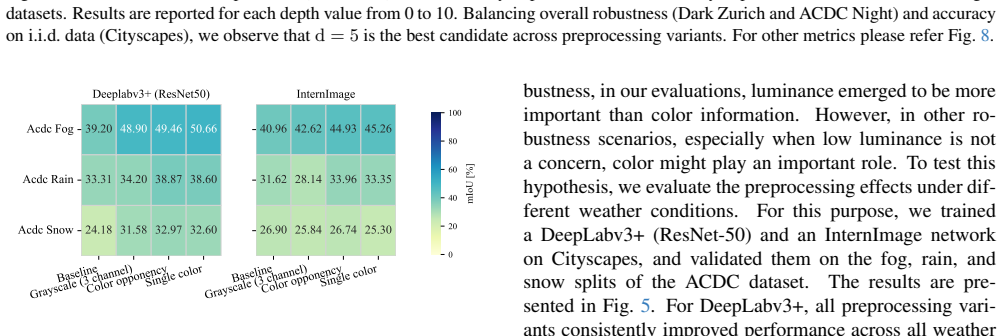
- Color-opponent contrast helps in weather conditions where low light is not the main issue, indicating that the optimal representation depends on the dominant corruption.
Where Pith is reading between the lines
- The paper's own ablation data suggest the 'contrast' component may be secondary: in Tables 2 and 3, grayscale with d=0 (no contrast) matches or beats grayscale with d=5 on Dark Zurich and ACDC Night for Deeplabv3+, SegFormer and InternImage. If that pattern generalizes, the practical takeaway would be that color removal, not center-surround contrast, drives night robustness.
- A natural testable extension is to apply the module to other dense tasks such as depth estimation and detection, where the luminance-versus-contrast attribution can be controlled more cleanly than in real datasets.
- The 70% sparsity claim appears in the abstract but not in the visible experimental sections; verifying it with explicit sparsification curves would determine whether the transmission-aware imaging-sensor story is supported.
- Because optimal depth varies with architecture and color transform, a learned or self-adaptive depth parameter seems a promising follow-up, potentially improving on the fixed d=5 choice.
Editorial analysis
A structured set of objections, weighed in public.
Referee Report
Summary. The manuscript proposes a fixed, model-agnostic input preprocessing module for semantic segmentation under adverse illumination. The preprocessing combines a color reparameterization matrix M (grayscale, color-opponency, or single-color) with approximate Difference-of-Gaussians (DoG) contrast extraction, implemented by subtracting progressively box-blurred versions of the image; a depth parameter d controls the number of blur steps (Eq. (4)). Models are trained on Cityscapes and evaluated on Dark Zurich and ACDC. Across DeepLabv3+, SegFormer, and InternImage, the paper reports large mIoU gains at night for all preprocessing variants, with grayscale the strongest, while roughly preserving in-distribution accuracy. A depth search on a smaller ResNet-18 is used to select d=5, which is then applied to the main architectures. The associated abstract additionally states that accuracy remains stable under 70% sparsification of the representation, although no sparsification experiments appear in the body or appendices.
Significance. If the central claim were established, this would be a practically attractive result: a fixed, cheap, architecture-agnostic input transform that improves real-world nighttime robustness without training modifications. The paper has genuine strengths: it uses standard benchmarks (Cityscapes, Dark Zurich, ACDC), multiple architectures, three seeds with error bars, and a transparent ablation structure. The large and replicated gains from grayscale conversion (e.g., ACDC Night mIoU from about 8 to 20-24 for DeepLabv3+) are a useful empirical contribution even if the mechanism is less exotic than claimed. However, the significance as currently framed is weakened because the paper's own data attribute the gains to color remapping rather than to the DoG contrast term, and the 'sparse' / 70%-sparsification claim has no supporting experiments. The contribution can be salvaged by reframing the headline claim around luminance-based color remapping and either demoting the contrast mechanism to a secondary analysis or providing controlled experiments where the contrast term is evaluated on equal footing.
major comments (4)
- [Sec. 4.2 / Eq. (4) / Tables 2-3] The claim that 'contrast-based preprocessing is particularly effective in nighttime scenarios' is contradicted by the paper's own ablations. With d=0, Eq. (4) reduces to color reparameterization without the spatial contrast term. On Dark Zurich (Table 2), DeepLabv3+ grayscale d=0 attains 20.79 mIoU versus 18.39 for grayscale d=5; SegFormer attains 21.47 versus 19.99; InternImage attains 18.61 versus 17.66. The same ordering holds on ACDC Night (Table 3: 21.87 vs 19.76, 23.93 vs 22.84, 18.70 vs 17.89). Appendix D explicitly concedes that d=0 surpasses d=5 in nighttime for all architectures except the small ResNet-18. Thus the robust improvement over RGB is explained by the color-to-grayscale remapping in Eq. (1), not by the DoG contrast term in Eq. (4). The abstract and Sec. 4.2 overstate the causal role of contrast; either the central claim must be revised or an ablation is needed that c
- [Sec. 4.3 / Fig. 4] The depth hyperparameter d=5 is selected using the evaluation datasets themselves. Fig. 4 and the surrounding text state that d=5 was chosen by balancing performance on Cityscapes, Dark Zurich, and ACDC Night on a DeepLabv3+-ResNet-18 model, and this configuration is then used for the headline comparisons in Fig. 2 and Tables 1-3. This makes the reported 'best' contrast configuration fitted to the test benchmarks; no held-out validation or sensitivity analysis on the main architectures is provided. The authors should report results across all depths for the main architectures or select d on a validation split, so that the reader can distinguish a tuned preprocessing choice from a robust property of the method.
- [Abstract vs. body] The abstract included with the submission claims that 'the segmentation accuracy remains stable even when the contrast-based representation is sparsified by up to 70%,' and the submission title contains 'Sparse Contrast Representations.' Neither the sparsification experiment nor any explicit sparsity operation appears in the body, appendices, or Eq. (4). As described, the preprocessing produces dense contrast signals with no thresholding or pruning mechanism. If this claim is part of the paper, the experiments and the exact sparsification protocol must be added; otherwise the 'sparse' qualifier and the 70% stability statement should be removed as unsupported.
- [Appendix D] The limitations discussion is internally inconsistent. Appendix D says the depth search was 'conducted on DeepLabv3+ (ResNetV1c-50), as shown in Fig. 8,' but Fig. 8 and Tables 7-12 are labelled DeepLabv3+ (ResNetV1c-18). For the ResNet-50 model in Tables 2-3, grayscale d=0 actually beats d=5 on Dark Zurich and ACDC Night, which is the opposite of the claimed illustration. This contradiction must be corrected; as written, it confuses the only architecture (ResNet-18) for which the depth d=5 contrast variant helps on nighttime data.
minor comments (4)
- [Fig. 2 caption] The caption refers to 'InterImage'; the architecture name throughout the paper is InternImage. Please correct this typo.
- [Eq. (4) and surrounding text] The notation in Eq. (4) should be made precise: define img_i as the image after i recursive box-blur applications, state that the coefficients sum to zero, and clarify the stacking of the original and blurred images. Currently the expression mixes matrix and index notation and is hard to reproduce from the text alone.
- [Appendix B, Tables 1-6] The table formatting for the grayscale rows is confusing: rows labeled 'grayscale 0' appear under 'grayscale green bias' blocks and vice versa. Please add explicit channel counts and row labels so it is unambiguous which row corresponds to which color matrix and depth.
- [Title / abstract consistency] The full-text title is 'Vision At Night: Exploring Biologically Inspired Preprocessing For Improved Robustness Via Color And Contrast Transformations,' while the submission-level title is 'Improved Robustness from Biologically Inspired Sparse Contrast Representations.' These should be aligned, and the 'sparse' wording should be used only if supported by experiments.
Circularity Check
No circularity: the empirical preprocessing study is self-contained; the depth choice is an explicit ablation, not a fitted prediction, and the main robustness claim does not depend on the specific d=5 configuration.
full rationale
The paper makes no formal derivation that reduces to its inputs. The preprocessing is defined explicitly by Eq. (1) and Eq. (4): a fixed color reparameterization matrix M followed by a difference-of-Gaussians subtraction of progressively blurred versions. The 'prediction' is an empirical evaluation of this fixed module on Cityscapes-trained models evaluated on Dark Zurich and ACDC. The key result that grayscale remapping improves nighttime robustness is present already at d=0 (Tables 2-3: grayscale d=0 beats or matches grayscale d=5 on Dark Zurich and ACDC Night for DeepLabv3+, SegFormer, and InternImage). Thus the central finding is not constructed by the choice of contrast depth. The depth parameter d=5 is selected in Sec. 4.3 by an explicit ablation on a small backbone (ResNet-18), and the paper transparently reports that the optimal depth varies across architectures (Appendix D). This is a hyperparameter choice, not a fitted quantity renamed as a prediction; the headline robustness claim survives at d=0, so it is not statistically forced by the d=5 selection. Self-citations appear only in the related work and are not load-bearing: no uniqueness theorem, no ansatz justification, and no derivation relies on the authors' prior results. The abstract's claim about 70% sparsification is not circular; it is an unsupported or missing result, which is a correctness/evidence concern, not a circular-logic concern. Overall, the derivation chain is self-contained and no step reduces to its own output.
Axiom & Free-Parameter Ledger
free parameters (1)
- Depth d (number of progressive blur steps) =
5
axioms (3)
- domain assumption DoG can be approximated by repeated 3x3 box blur with uniform weights 1/d.
- domain assumption Cityscapes-trained models and Dark Zurich/ACDC share the same label space and evaluation protocol, making mIoU comparisons meaningful.
- domain assumption Averaging over three seeds is sufficient to compare preprocessing variants.
read the original abstract
Deep neural networks surpass humans on many vision benchmarks, yet remain far less robust to distribution shifts such as illumination and weather changes. Existing approaches address this challenge by additional training data, extensive augmentation, architectural modifications, or test-time adaptation. In this work, we explore a complementary direction: inspired by the human retina, we propose a fixed, model-agnostic preprocessing module that extracts signals that are more stable with respect to variations of illumination. Our method combines color remapping with local contrast extraction, producing sparse representations that emphasize structural features. We study its impact on semantic segmentation by training on Cityscapes and evaluating generalization under adverse conditions on Dark Zurich and ACDC. Our results show that the biologically inspired preprocessing preserves in-distribution performance while consistently improving robustness in challenging lighting scenarios, such as nighttime, where annotated training data are scarce. Moreover, the segmentation accuracy remains stable even when the contrast-based representation is sparsified by up to 70%. These gains suggest that rethinking the input representation itself can improve robustness while also opening opportunities for lower-latency, transmission-aware imaging sensors when sparsity can be exploited close to acquisition.
Figures




Reference graph
Works this paper leans on
-
[1]
On the unreasonable vulnerability of transformers for image restoration-and an easy fix
Shashank Agnihotri, Kanchana Vaishnavi Gandikota, Julia Grabinski, Paramanand Chandramouli, and Margret Keuper. On the unreasonable vulnerability of transformers for image restoration-and an easy fix. InProceedings of the IEEE/CVF International Conference on Computer Vision, pages 3707– 3717, 2023. 1
2023
-
[2]
Shashank Agnihotri, Julia Grabinski, Janis Keuper, and Margret Keuper. Beware of aliases–signal preservation is crucial for robust image restoration.arXiv preprint arXiv:2406.07435, 2024
Pith/arXiv arXiv 2024
-
[3]
Improving feature stability during upsampling–spectral ar- tifacts and the importance of spatial context
Shashank Agnihotri, Julia Grabinski, and Margret Keuper. Improving feature stability during upsampling–spectral ar- tifacts and the importance of spatial context. InEuropean Conference on Computer Vision, pages 357–376. Springer, 2024
2024
-
[4]
CosPGD: an efficient white-box adversarial attack for pixel- wise prediction tasks
Shashank Agnihotri, Steffen Jung, and Margret Keuper. CosPGD: an efficient white-box adversarial attack for pixel- wise prediction tasks. InProc. International Conference on Machine Learning (ICML), 2024
2024
-
[5]
Roll the dice: Monte carlo downsampling as a low-cost adversarial defence, 2024
Shashank Agnihotri, Shashank Priyadarshi, Hendrik Som- merhoff, Julia Grabinski, Andreas Kolb, and Margret Keu- per. Roll the dice: Monte carlo downsampling as a low-cost adversarial defence, 2024
2024
-
[6]
Flowbench: Benchmarking optical flow estimation methods for reliability and generalization.Transactions on Machine Learning Research, 2025
Shashank Agnihotri, Julian Yuya Caspary, Luca Schwarz, Xinyan Gao, Jenny Schmalfuss, Andres Bruhn, and Margret Keuper. Flowbench: Benchmarking optical flow estimation methods for reliability and generalization.Transactions on Machine Learning Research, 2025
2025
-
[7]
Are synthetic corruptions a reliable proxy for real-world corruptions? In Synthetic Data for Computer Vision Workshop@ CVPR,
Shashank Agnihotri, David Schader, Nico Sharei, Mehmet Ege Kac ¸ar, and Margret Keuper. Are synthetic corruptions a reliable proxy for real-world corruptions? In Synthetic Data for Computer Vision Workshop@ CVPR,
-
[8]
On-off center-surround receptive fields for accurate and robust image classification.Inter- national Conference on Machine Learning, pages 478–489,
Zahra Babaiee, Ramin Hasani, Mathias Lechner, Daniela Rus, and Radu Grosu. On-off center-surround receptive fields for accurate and robust image classification.Inter- national Conference on Machine Learning, pages 478–489,
-
[9]
Explaining, fast and slow: Abstraction and refinement of provable explanations
Shahaf Bassan, Yizhak Yisrael Elboher, Tobias Ladner, Matthias Althoff, and Guy Katz. Explaining, fast and slow: Abstraction and refinement of provable explanations. In Forty-second International Conference on Machine Learn- ing, 2025. 7
2025
-
[10]
King, and Kevin W
Aman Bhatta, Domingo Mery, Haiyu Wu, Joyce Annan, Michael C. King, and Kevin W. Bowyer. What’s color got to do with it? face recognition in grayscale.IEEE Trans- actions on Biometrics, Behavior, and Identity Science, 7(3): 484–497, 2025. 2
2025
-
[11]
Hieu Minh Bui, Margaret Lech, Eva Cheng, Katrina Neville, and Ian S. Burnett. Using grayscale images for object recog- nition with convolutional-recursive neural network. In2016 IEEE Sixth International Conference on Communications and Electronics (ICCE), pages 321–325, 2016. 2
2016
-
[12]
Encoder-decoder with atrous separable convolution for semantic image segmentation
Liang-Chieh Chen, Yukun Zhu, George Papandreou, Florian Schroff, and Hartwig Adam. Encoder-decoder with atrous separable convolution for semantic image segmentation. In Proceedings of the European conference on computer vision (ECCV), pages 801–818, 2018. 3, 7
2018
-
[13]
The cityscapes dataset for semantic urban scene understanding
Marius Cordts, Mohamed Omran, Sebastian Ramos, Timo Rehfeld, Markus Enzweiler, Rodrigo Benenson, Uwe Franke, Stefan Roth, and Bernt Schiele. The cityscapes dataset for semantic urban scene understanding. In2016 IEEE Conference on Computer Vision and Pattern Recog- nition (CVPR), pages 3213–3223. IEEE, 2016. 1, 3, 7, 26, 27
2016
-
[14]
MIT PRESS, [S.l.], 2023
Dario Floreano.Bio-Inspired Artificial Intelligence: theo- ries, methods, and technologies. MIT PRESS, [S.l.], 2023. 2
2023
-
[15]
Robert Geirhos, Carlos R. M. Temme, Jonas Rauber, Heiko H. Sch ¨utt, Matthias Bethge, and Felix A. Wichmann. Generalisation in humans and deep neural networks. InAd- vances in Neural Information Processing Systems. Curran Associates, Inc, 2018. 1
2018
-
[16]
A survey of gaussian convolution algo- rithms.Image Processing On Line, 3:286–310, 2013
Pascal Getreuer. A survey of gaussian convolution algo- rithms.Image Processing On Line, 3:286–310, 2013. 3
2013
-
[17]
Optimizing the color-to-grayscale conversion for image classification.Sig- nal, Image and Video Processing, 10(5):853–860, 2016
Ali G ¨unes ¸, Habil Kalkan, and Efkan Durmus ¸. Optimizing the color-to-grayscale conversion for image classification.Sig- nal, Image and Video Processing, 10(5):853–860, 2016. 2
2016
-
[18]
Surround modulation: A bio-inspired connectivity structure for convolutional neural networks
Hosein Hasani, Mahdieh Soleymani, and Hamid Aghajan. Surround modulation: A bio-inspired connectivity structure for convolutional neural networks. InAdvances in Neural In- formation Processing Systems. Curran Associates, Inc, 2019. 2
2019
-
[19]
Bag of tricks for image classifica- tion with convolutional neural networks
Tong He, Zhi Zhang, Hang Zhang, Zhongyue Zhang, Jun- yuan Xie, and Mu Li. Bag of tricks for image classifica- tion with convolutional neural networks. In2019 IEEE/CVF Conference on Computer Vision and Pattern Recognition (CVPR), pages 558–567. IEEE, 2019. 8
2019
-
[20]
Dan Hendrycks and Thomas Dietterich. Benchmarking neu- ral network robustness to common corruptions and perturba- tions.arXiv preprint arXiv:1903.12261, 2019. 1, 2
Pith/arXiv arXiv 1903
-
[21]
Towards improving robustness of compressed cnns
J Hoffmann, S Agnihotri, Tonmoy Saikia, and Thomas Brox. Towards improving robustness of compressed cnns. InICML Workshop on Uncertainty and Robustness in Deep Learning (UDL), 2021. 2
2021
-
[22]
Chengyin Hu, Weiwen Shi, Chao Li, Jialiang Sun, Donghua Wang, Junqi Wu, and Guijian Tang. Impact of light and shadow on robustness of deep neural networks.arXiv preprint arXiv:2305.14165, 2023. 1, 2
Pith/arXiv arXiv 2023
-
[23]
L. M. Hurvich and D. Jameson. An opponent-process theory of color vision.Psychological Review, 64, Part 1(6):384– 404, 1957. 1, 2
1957
-
[24]
Sangjun, Yoonnyun Kim, and Minho Lee
Jonghong Kim, O. Sangjun, Yoonnyun Kim, and Minho Lee. Convolutional neural network with biologically inspired reti- nal structure.Procedia Computer Science, 88:145–154,
-
[25]
Deep neural networks: A new frame- work for modeling biological vision and brain information processing.Annual review of vision science, 1:417–446,
Nikolaus Kriegeskorte. Deep neural networks: A new frame- work for modeling biological vision and brain information processing.Annual review of vision science, 1:417–446,
-
[26]
Learning methods for generic object recognition with invariance to pose and lighting
Yann LeCun, Fu Jie Huang, and Leon Bottou. Learning methods for generic object recognition with invariance to pose and lighting. InProceedings of the 2004 IEEE Com- puter Society Conference on Computer Vision and Pattern Recognition, 2004. CVPR 2004., pages II–104. IEEE, 2004. 2
2004
-
[27]
Marr and E
D. Marr and E. Hildreth. Theory of edge detection.Pro- ceedings of the Royal Society of London. Series B, Biological sciences, 207(1167):187–217, 1980. 1, 2
1980
-
[28]
McCulloch and Walter Pitts
Warren S. McCulloch and Walter Pitts. A logical calculus of the ideas immanent in nervous activity.The bulletin of mathematical biophysics, 5(4):115–133, 1943. 2
1943
-
[29]
Claudio Michaelis, Benjamin Mitzkus, Robert Geirhos, Evgenia Rusak, Oliver Bringmann, Alexander S Ecker, Matthias Bethge, and Wieland Brendel. Benchmarking ro- bustness in object detection: Autonomous driving when win- ter is coming.arXiv preprint arXiv:1907.07484, 2019. 1
Pith/arXiv arXiv 1907
-
[30]
Mmsegmentation: Open- mmlab semantic segmentation toolbox and benchmark
MMSegmentation Contributors. Mmsegmentation: Open- mmlab semantic segmentation toolbox and benchmark. https://github.com/open-mmlab/mmsegmentation, 2020. 7, 8
2020
-
[31]
MIT press, 1999
Stephen Palmer.Vision Science: From Photons to Phe- nomenology. MIT press, 1999. 1, 2
1999
-
[32]
Generalizing biological surround suppression based on center surround similarity via deep neural network models.PLoS compu- tational biology, 19(9):e1011486, 2023
Xu Pan, Annie DeForge, and Odelia Schwartz. Generalizing biological surround suppression based on center surround similarity via deep neural network models.PLoS compu- tational biology, 19(9):e1011486, 2023. 2
2023
-
[33]
Classification of plant leaf diseases using deep neural networks in color and grayscale images.Journal of Decision Analytics and Intelligent Computing, 4(1):99– 110, 2024
Bui Hai Phong. Classification of plant leaf diseases using deep neural networks in color and grayscale images.Journal of Decision Analytics and Intelligent Computing, 4(1):99– 110, 2024. 2
2024
-
[34]
Guided curriculum model adaptation and uncertainty-aware evalua- tion for semantic nighttime image segmentation
Christos Sakaridis, Dengxin Dai, and Luc van Gool. Guided curriculum model adaptation and uncertainty-aware evalua- tion for semantic nighttime image segmentation. In2019 IEEE/CVF International Conference on Computer Vision (ICCV), pages 7373–7382. IEEE, 2019. 1, 3, 7, 26, 27
2019
-
[35]
Acdc: The adverse conditions dataset with correspondences for se- mantic driving scene understanding
Christos Sakaridis, Dengxin Dai, and Luc van Gool. Acdc: The adverse conditions dataset with correspondences for se- mantic driving scene understanding. In2021 IEEE/CVF In- ternational Conference on Computer Vision (ICCV), pages 10745–10755. IEEE, 2021. 1, 3, 7, 26, 27
2021
-
[36]
Jenny Schmalfuss, Victor Oei, Lukas Mehl, Madlen Bartsch, Shashank Agnihotri, Margret Keuper, and Andr ´es Bruhn. Robustspring: Benchmarking robustness to image corrup- tions for optical flow, scene flow and stereo.arXiv preprint arXiv:2505.09368, 2025
Pith/arXiv arXiv 2025
-
[37]
Object recogni- tion under lighting variations using pre-trained networks
Kalpathy Sivaraman and Abhishek Murthy. Object recogni- tion under lighting variations using pre-trained networks. In 2018 IEEE Applied Imagery Pattern Recognition Workshop (AIPR), pages 1–7, Piscataway, NJ, 2018. IEEE. 1, 2
2018
-
[38]
Task driven sensor layouts-joint optimiza- tion of pixel layout and network parameters
Hendrik Sommerhoff, Shashank Agnihotri, Mohamed Saleh, Michael Moeller, Margret Keuper, Bhaskar Choubey, and Andreas Kolb. Task driven sensor layouts-joint optimiza- tion of pixel layout and network parameters. In2024 IEEE International Conference on Computational Photography (ICCP), pages 1–10. IEEE, 2024. 2
2024
-
[39]
Thoreson and Dennis M
Wallace B. Thoreson and Dennis M. Dacey. Diverse cell types, circuits, and mechanisms for color vision in the verte- brate retina.Physiological Reviews, 99(3):1527–1573, 2019. 1, 2
2019
-
[40]
Bio-inspired presentation attack detec- tion for face biometrics.Frontiers in computational neuro- science, 13:34, 2019
Aristeidis Tsitiridis, Cristina Conde, Beatriz Gomez Ayllon, and Enrique Cabello. Bio-inspired presentation attack detec- tion for face biometrics.Frontiers in computational neuro- science, 13:34, 2019. 2
2019
-
[41]
Internim- age: Exploring large-scale vision foundation models with deformable convolutions
Wenhai Wang, Jifeng Dai, Zhe Chen, Zhenhang Huang, Zhiqi Li, Xizhou Zhu, Xiaowei Hu, Tong Lu, Lewei Lu, Hongsheng Li, Xiaogang Wang, and Yu Qiao. Internim- age: Exploring large-scale vision foundation models with deformable convolutions. In2023 IEEE/CVF Conference on Computer Vision and Pattern Recognition (CVPR), pages 14408–14419. IEEE, 2023. 3, 8
2023
-
[42]
Alvarez, and Ping Luo
Enze Xie, Wenhai Wang, Zhiding Yu, Anima Anandkumar, Jose M. Alvarez, and Ping Luo. Segformer: Simple and efficient design for semantic segmentation with transform- ers.Advances in neural information processing systems, 34: 12077–12090, 2021. 3, 8
2021
-
[43]
Chan- nels
Dmitry A. Yudin, Alexandr V . Dolzhenko, and Ekaterina O. Kapustina. The usage of grayscale or color images for facial expression recognition with deep neural networks. InAd- vances in Neural Computation, Machine Learning, and Cog- nitive Research III, pages 271–281. Springer International Publishing AG, Cham, 2020. 2 Vision At Night: Exploring Biological...
2020
discussion (0)
Sign in with ORCID, Apple, or X to comment. Anyone can read and Pith papers without signing in.