Graph-based Summary Statistics for Revealing the Stochastic Gravitational Wave Background in Pulsar Timing Arrays
Pith reviewed 2026-05-18 12:44 UTC · model grok-4.3
The pith
Graph-based statistics on pulsar timing residuals detect the stochastic gravitational wave background down to strain amplitudes of 1.2 times 10 to the minus 15.
A machine-rendered reading of the paper's core claim, the machinery that carries it, and where it could break.
Core claim
The authors construct a correlation graph from pulsar timing residuals and demonstrate that the average clustering coefficient together with edge weight fluctuation act as the most discriminative summary statistics for identifying a common signal. After an initial common-signal detection, the second cumulant of edge weights at angular separations above 40 degrees excludes non-Hellings-Downs templates. This procedure yields a lowest detectable SGWB strain amplitude of approximately 1.2 times 10 to the minus 15 at current PTA sensitivities. Fisher forecasts indicate that the logarithmic amplitude and spectral index can be recovered to 1.5 percent and 19.5 percent precision respectively at the
What carries the argument
A correlation graph whose nodes are pulsars and whose edges are weighted by the measured timing-residual correlations; the graph's topological measures isolate the quadrupolar angular dependence of the Hellings-Downs curve.
Load-bearing premise
The method assumes that an initial common-signal detection followed by template exclusion does not introduce selection biases that would mask or mimic the Hellings-Downs pattern in the graph statistics.
What would settle it
Failure to recover an injected SGWB signal of amplitude 1.2 times 10 to the minus 15 in end-to-end simulations that include realistic red noise and other common-mode processes, or a reanalysis of the NANOGrav 15-year data set that yields no evidence above 2 sigma, would falsify the claimed sensitivity and detection.
Figures


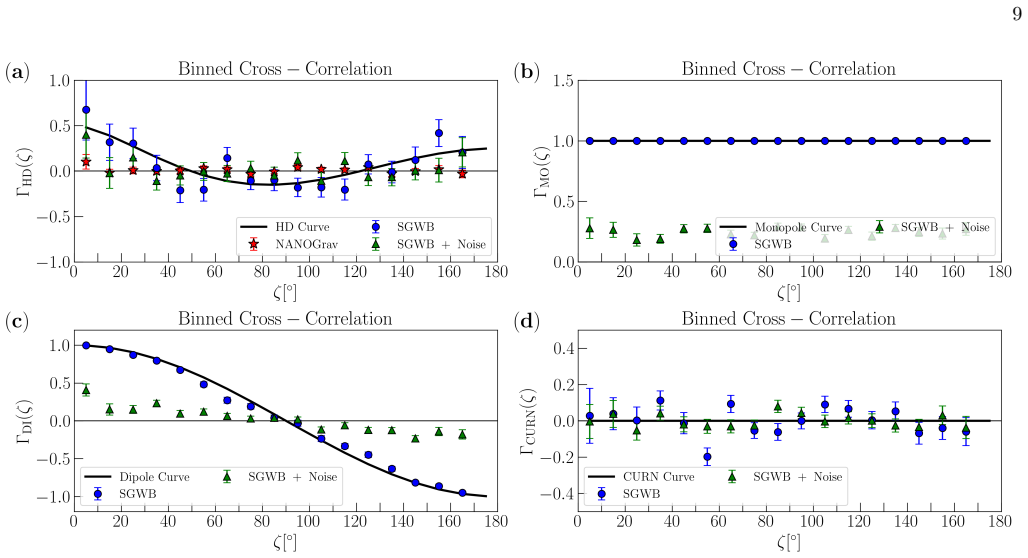
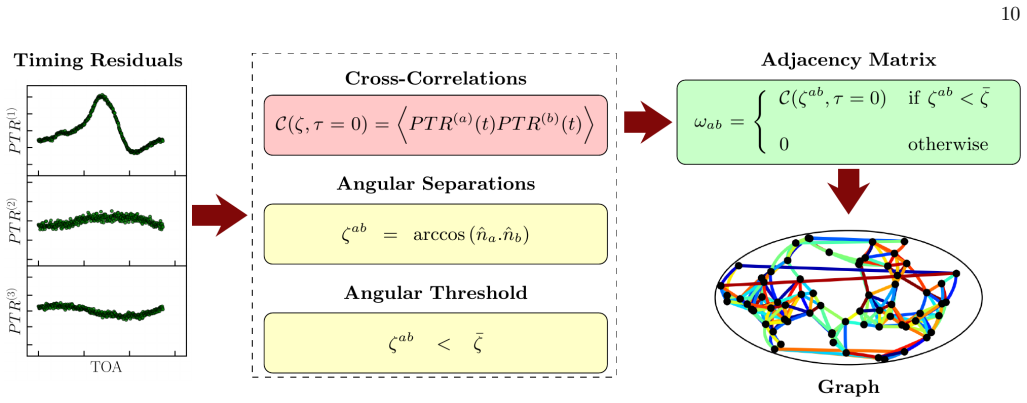


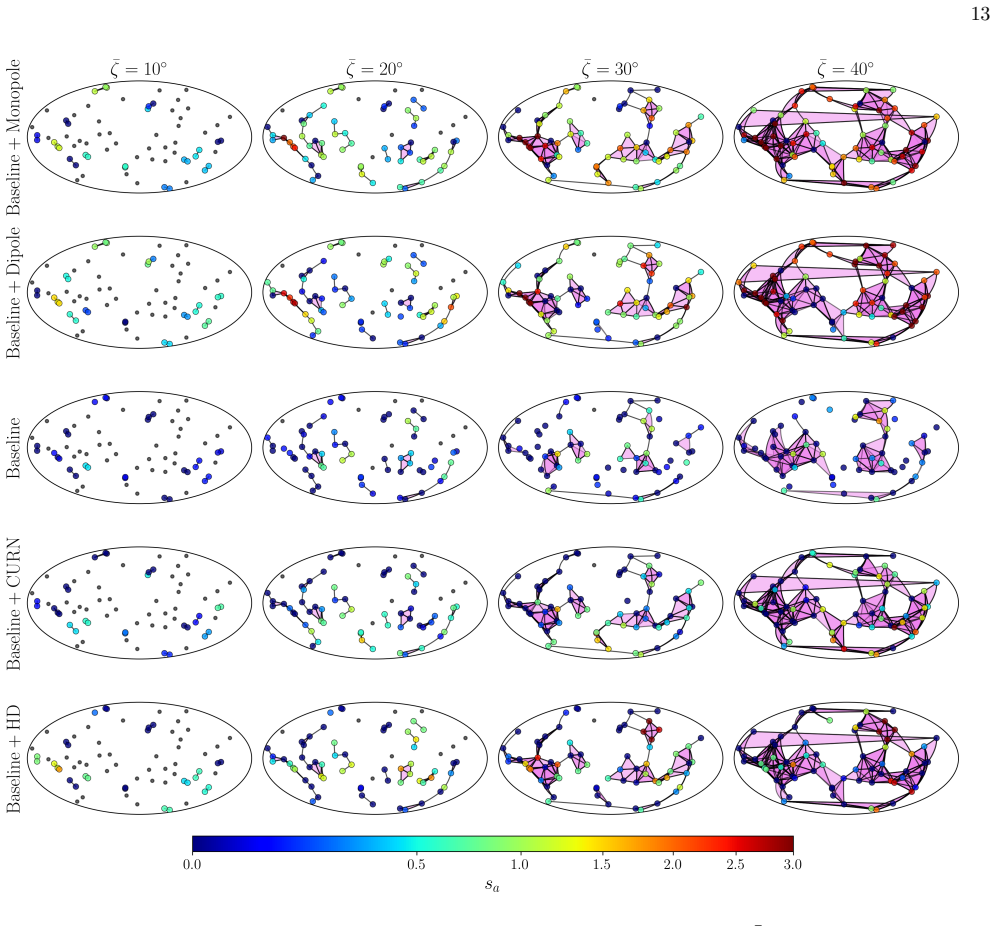




read the original abstract
In this work, we propose a graph-based method implemented on the pulsar timing residuals (PTRs) for stochastic gravitational wave background (SGWB) detection within the nano-Hertz frequency regime and examining uncertainties of its parameters. We construct a correlation graph with pulsars as its nodes, and analyze the graph-based summary statistics, including structural characteristics of complex network, for identifying SGWB in the real and synthetic datasets. The effect of the number of pulsars, the observation time span, and the strength of the SGWB on the graph-based feature vector is evaluated. Our results demonstrate that the Discriminative Summary Statistics for common signal detection consists of the average clustering coefficient and the edge weight fluctuation. The SGWB detection conducted after the observation of a common signal and then exclusion of non-Hellings \& Downs templates is performed by the second cumulant of edge weight for angular separation thresholds $\bar{\zeta}\gtrsim 40^{\circ}$. The lowest detectable value of SGWB strain amplitude utilizing our graph-based measures at the current PTAs sensitivity is $A_{\rm SGWB}\gtrsim 1.2\times 10^{-15}$. Fisher forecasts confirmed that the uncertainty levels of $\log_{10} A_{\rm SGWB}$ and spectral index reach $1.5\%$ and $19.5\%$, respectively, at $2\sigma$ confidence interval. A weak evidence for an SGWB at $\sim 2.3\sigma$ level is obtained by applying our graph-based method to the NANOGrav 15-year dataset.
Editorial analysis
A structured set of objections, weighed in public.
Referee Report
Summary. The paper proposes a graph-based method for detecting the stochastic gravitational wave background (SGWB) in pulsar timing array data by constructing correlation graphs with pulsars as nodes and extracting summary statistics such as the average clustering coefficient and edge-weight fluctuation. It evaluates these on synthetic datasets to assess dependence on number of pulsars, observation span, and SGWB amplitude, then applies a two-step pipeline (common-signal detection followed by exclusion of non-Hellings-Downs templates via the second cumulant of edge weight for angular separations ≳40°) to claim a lowest detectable strain amplitude A_SGWB ≳ 1.2×10^{-15} at current PTA sensitivities. Fisher forecasts for parameter uncertainties and a ~2.3σ weak evidence result on the NANOGrav 15-year dataset are also reported.
Significance. If validated, the graph-theoretic framing could offer a complementary visualization and summary-statistic approach to standard Hellings-Downs correlation analyses in PTA searches for nano-Hz SGWB. The reported Fisher uncertainties (1.5% on log10 A and 19.5% on spectral index at 2σ) and application to real data provide concrete benchmarks, though the method's novelty lies primarily in the network-derived discriminants rather than in fundamentally new physics.
major comments (2)
- [Abstract / detection pipeline] Abstract and detection pipeline description: the headline sensitivity A_SGWB ≳ 1.2×10^{-15} and the NANOGrav 2.3σ claim both rest on a sequential procedure that first requires detection of a common signal and then applies the second cumulant of edge weight only for angular separations ζ-bar ≳40° to reject non-HD templates. No quantification of the false-positive rate or selection bias induced by this ordering is provided, so it is unclear whether the quoted sensitivity and significance remain valid once the full pipeline is accounted for.
- [Results on synthetic and real datasets] The claim that the average clustering coefficient and edge-weight fluctuation constitute the 'Discriminative Summary Statistics' for common-signal detection is presented without an explicit ablation or ROC analysis showing that these two features remain orthogonal to the initial common-signal test and are not dominated by realistic red-noise processes or timing-model residuals that can produce correlated but non-HD signatures.
minor comments (2)
- [Methods] Notation for the angular-separation threshold is introduced as ζ-bar in the abstract but should be defined consistently in the methods section with an explicit equation or figure reference.
- [Fisher forecasts] The Fisher-forecast section would benefit from a brief statement of the assumed noise model and covariance matrix used to derive the 1.5% and 19.5% uncertainties.
Simulated Author's Rebuttal
We thank the referee for their careful and constructive review of our manuscript. We address each major comment below and have revised the manuscript to incorporate additional analyses where needed to strengthen the presentation of the detection pipeline and the role of the graph-based statistics.
read point-by-point responses
-
Referee: [Abstract / detection pipeline] Abstract and detection pipeline description: the headline sensitivity A_SGWB ≳ 1.2×10^{-15} and the NANOGrav 2.3σ claim both rest on a sequential procedure that first requires detection of a common signal and then applies the second cumulant of edge weight only for angular separations ζ-bar ≳40° to reject non-HD templates. No quantification of the false-positive rate or selection bias induced by this ordering is provided, so it is unclear whether the quoted sensitivity and significance remain valid once the full pipeline is accounted for.
Authors: We acknowledge that the sequential nature of the pipeline requires explicit validation of the combined false-positive rate. The two-step approach follows standard PTA search practice, with the graph statistics applied only after a common signal is identified to test for the Hellings-Downs pattern at large angular separations. In the revised manuscript we have added Monte Carlo results applying the full pipeline to large ensembles of noise-only realizations that include realistic red-noise spectra and timing-model residuals. These simulations quantify the false-positive rate at the quoted amplitude threshold and confirm that the reported sensitivity and the 2.3σ NANOGrav result remain stable once the ordering is taken into account. The abstract and methods section have been updated to include this quantification. revision: yes
-
Referee: [Results on synthetic and real datasets] The claim that the average clustering coefficient and edge-weight fluctuation constitute the 'Discriminative Summary Statistics' for common-signal detection is presented without an explicit ablation or ROC analysis showing that these two features remain orthogonal to the initial common-signal test and are not dominated by realistic red-noise processes or timing-model residuals that can produce correlated but non-HD signatures.
Authors: We agree that an explicit ablation study and ROC analysis would better demonstrate the added value of these two statistics. The original manuscript showed their dependence on SGWB amplitude and their superiority to other graph features, but did not include a full ROC comparison against red-noise-dominated cases. We have now performed and included such analyses: ROC curves are presented for the clustering coefficient and edge-weight fluctuation under a range of red-noise models and timing residuals, confirming that the two statistics retain discriminative power beyond the common-signal test and are not dominated by non-HD correlated noise. These results are added to the results section and supplementary material. revision: yes
Circularity Check
No significant circularity in graph-based SGWB detection method
full rationale
The paper constructs correlation graphs from pulsar timing residuals and extracts summary statistics (average clustering coefficient and edge weight fluctuation) as discriminative features for SGWB. The pipeline first identifies a common signal then applies the second cumulant of edge weight at angular separations ≳40° to exclude non-HD templates; the claimed sensitivity A_SGWB ≳ 1.2×10^{-15} and 2.3σ NANOGrav result follow from applying these statistics to synthetic and real data. No step reduces a claimed prediction or first-principles result to its own inputs by construction, no load-bearing self-citation or imported uniqueness theorem appears, and the Hellings-Downs reference is the external standard pattern rather than an internal fit. The derivation remains self-contained with independent methodological content.
Axiom & Free-Parameter Ledger
free parameters (1)
- angular separation threshold =
40 degrees
axioms (1)
- domain assumption Pulsar timing residuals exhibit correlations following the Hellings-Downs pattern in the presence of an isotropic SGWB
Lean theorems connected to this paper
-
IndisputableMonolith/Cost/FunctionalEquation.leanwashburn_uniqueness_aczel unclear?
unclearRelation between the paper passage and the cited Recognition theorem.
The merit feature vector for common signal detection consists of the average clustering coefficient and the edge weight fluctuation. ... The SGWB detection conducted after the observation of a common signal and then exclusion of non-Hellings & Downs templates is performed by the second cumulant of edge weight for angular separation thresholds ζ-bar ≳40°.
-
IndisputableMonolith/Foundation/AlexanderDuality.leanalexander_duality_circle_linking unclear?
unclearRelation between the paper passage and the cited Recognition theorem.
Fisher forecasts confirmed that the uncertainty levels of log10 A_SGWB and spectral index reach 2.2% and 28.3%, respectively, at 2σ confidence interval.
What do these tags mean?
- matches
- The paper's claim is directly supported by a theorem in the formal canon.
- supports
- The theorem supports part of the paper's argument, but the paper may add assumptions or extra steps.
- extends
- The paper goes beyond the formal theorem; the theorem is a base layer rather than the whole result.
- uses
- The paper appears to rely on the theorem as machinery.
- contradicts
- The paper's claim conflicts with a theorem or certificate in the canon.
- unclear
- Pith found a possible connection, but the passage is too broad, indirect, or ambiguous to say the theorem truly supports the claim.
Reference graph
Works this paper leans on
-
[1]
A. A. Penzias and R. W. Wilson. A Measurement of Ex- cess Antenna Temperature at 4080 Mc/s.Astrophysical Journal, 142:419–421, July 1965
work page 1965
-
[2]
Planck Collaboration. Planck 2018 results. I. Overview and the cosmological legacy of Planck.Astronomy and Astrophysics, 641:A1, September 2020
work page 2018
-
[3]
Peebles.The Large-Scale Structure of the Uni- verse
P.J.E. Peebles.The Large-Scale Structure of the Uni- verse. Princeton Series in Physics. Princeton University Press, 2020
work page 2020
-
[4]
F. Bernardeau, S. Colombi, E. Gazta˜ naga, and R. Scoc- cimarro. Large-scale structure of the universe and cosmological perturbation theory.Physics Reports, 367(1):1–248, 2002
work page 2002
-
[5]
Ray W. Klebesadel, Ian B. Strong, and Roy A. Olson. Observations of Gamma-Ray Bursts of Cosmic Origin. In E. Fenimore and M. Galassi, editors,Gamma-Ray Bursts: 30 Years of Discovery, volume 727 ofAmerican Institute of Physics Conference Series, pages 3–6. AIP, September 2004
work page 2004
-
[6]
Orlando Luongo and Marco Muccino. A Roadmap to Gamma-Ray Bursts: New Developments and Applica- tions to Cosmology.Galaxies, 9(4):77, October 2021
work page 2021
-
[7]
E. Schreier, R. Levinson, H. Gursky, E. Kellogg, H. Tananbaum, and R. Giacconi. Evidence for the Bi- nary Nature of Centaurus X-3 from UHURU X-Ray Observations.Astrophysical Journal Letters, 172:L79, March 1972
work page 1972
-
[8]
H. Schatz and K. E. Rehm. X-ray binaries.Nuclear Physics A, 777:601–622, October 2006
work page 2006
- [9]
-
[10]
A. Philippov and M. Kramer. Pulsar Magnetospheres and Their Radiation.Annual Review of Astron and As- trophys, 60:495–558, August 2022
work page 2022
-
[11]
Maarten Schmidt. Spectrum of a Stellar Object Identi- fied with the Radio Source 3c 286.Astrophysical Jour- nal, 136:684, September 1962
work page 1962
-
[12]
Albert Einstein. N¨ aherungsweise Integration der Feldgleichungen der Gravitation.Sitzungsberichte der Königlich Preussischen Akademie der Wis- senschaften, pages 688–696, January 1916
work page 1916
-
[13]
Albert Einstein. ¨Uber Gravitationswellen.Sitzungs- berichte der Königlich Preussischen Akademie der Wissenschaften, pages 154–167, January 1918
work page 1918
-
[14]
S. W. Hawking, W. Israel, and B. Dolan. Book-Review - Three Hundred Years of Gravitation.Irish Astronomical Journal, 21:161, September 1993
work page 1993
-
[15]
B. Allen. The Stochastic Gravity-Wave Background: Sources and Detection. In Jean-Alain Marck and Jean-Pierre Lasota, editors,Relativistic Gravitation and Gravitational Radiation, pages 373–417, January 1997
work page 1997
-
[16]
B. S. Sathyaprakash and Bernard F. Schutz. Physics, Astrophysics and Cosmology with Gravitational Waves. Living Reviews in Relativity, 12(1):2, December 2009
work page 2009
- [17]
-
[18]
Nelson Christensen. Stochastic gravitational wave back- grounds.Reports on Progress in Physics, 82(1):016903, January 2019
work page 2019
-
[19]
B. P. Abbott et al. Observation of Gravitational Waves from a Binary Black Hole Merger.Physical Review Let- ters, 116(6):061102, February 2016
work page 2016
- [20]
-
[21]
B. P. Abbott et al. An upper limit on the stochastic gravitational-wave background of cosmological origin. Nature, 460(7258):990–994, August 2009
work page 2009
-
[22]
Nick van Remortel, Kamiel Janssens, and Kevin Tur- bang. Stochastic gravitational wave background: Meth- ods and implications.Progress in Particle and Nuclear Physics, 128:104003, January 2023
work page 2023
-
[23]
B. Allen. Stochastic gravity-wave background in inflationary-universe models.Physical Review D, 37(8):2078–2085, April 1988
work page 2078
-
[24]
M. C. Guzzetti, N. Bartolo, M. Liguori, and S. Matar- rese. Gravitational waves from inflation.Nuovo Ci- mento Rivista Serie, 39(9):399–495, August 2016
work page 2016
-
[25]
Scalar Induced Gravitational Waves Review.Universe, 7(11):398, October 2021
Guillem Dom` enech. Scalar Induced Gravitational Waves Review.Universe, 7(11):398, October 2021
work page 2021
-
[26]
Chen Yuan and Qing-Guo Huang. A topic review on probing primordial black hole dark matter with scalar induced gravitational waves.iScience, 24(8):102860, August 2021
work page 2021
-
[27]
Gianmassimo Tasinato. Stochastic approach to grav- itational waves from inflation.Physical Review D, 105(2):023521, January 2022
work page 2022
-
[28]
Misao Sasaki. Primordial black holes and gravitational waves from inflation.General Relativity and Gravita- tion, 57(5):82, May 2025
work page 2025
-
[29]
Gravita- tional radiation from cosmic strings.Physical Review 24 D, 31(12):3052–3058, June 1985
Tanmay Vachaspati and Alexander Vilenkin. Gravita- tional radiation from cosmic strings.Physical Review 24 D, 31(12):3052–3058, June 1985
work page 1985
- [30]
-
[31]
M. B. Hindmarsh and T. W. B. Kibble. Cosmic strings. Reports on Progress in Physics, 58(5):477–562, May 1995
work page 1995
-
[32]
Thibault Damour and Alexander Vilenkin. Gravita- tional wave bursts from cusps and kinks on cosmic strings.Physical Review D, 64(6):064008, September 2001
work page 2001
-
[33]
Jose J. Blanco-Pillado, Ken D. Olum, and Benjamin Shlaer. Large parallel cosmic string simulations: New results on loop production.Physical Review D, 83(8):083514, April 2011
work page 2011
-
[34]
Christophe Ringeval and Teruaki Suyama. Stochastic gravitational waves from cosmic string loops in scal- ing.Journal of Cosmology and Astroparticle Physics, 2017(12):027, December 2017
work page 2017
-
[35]
Jose J. Blanco-Pillado and Ken D. Olum. Stochastic gravitational wave background from smoothed cosmic string loops.Physical Review D, 96(10):104046, Novem- ber 2017
work page 2017
-
[36]
Multi-messenger constraints on Abelian-Higgs cosmic string networks
Mark Hindmarsh and Jun’ya Kume. Multi-messenger constraints on Abelian-Higgs cosmic string networks. Journal of Cosmology and Astroparticle Physics, 2023(4):045, April 2023
work page 2023
-
[37]
Andrea Maselli, Stefania Marassi, Valeria Ferrari, Kostas Kokkotas, and Raffaella Schneider. Constrain- ing Modified Theories of Gravity with Gravitational- Wave Stochastic Backgrounds.Physical Review Letters, 117(9):091102, August 2016
work page 2016
- [38]
-
[39]
Laser Interferometer Space Antenna
Pau Amaro-Seoane et al. Laser Interferometer Space Antenna.arXiv e-prints, page arXiv:1702.00786, Febru- ary 2017
work page internal anchor Pith review Pith/arXiv arXiv 2017
-
[40]
R. Abbott et al. All-sky search for long-duration gravitational-wave bursts in the third Advanced LIGO and Advanced Virgo run.Physical Review D, 104(10):102001, November 2021
work page 2021
-
[41]
M. Punturo et al. The Einstein Telescope: a third- generation gravitational wave observatory.Classical and Quantum Gravity, 27(19):194002, October 2010
work page 2010
-
[42]
Current status of space grav- itational wave antenna DECIGO and B-DECIGO
Seiji Kawamura et al. Current status of space grav- itational wave antenna DECIGO and B-DECIGO. Progress of Theoretical and Experimental Physics, 2021(5):05A105, May 2021
work page 2021
-
[43]
Ballmer, Lisa Bar- sotti, Nergis Mavalvala, and Matthew Evans
Sheila Dwyer, Daniel Sigg, Stefan W. Ballmer, Lisa Bar- sotti, Nergis Mavalvala, and Matthew Evans. Gravita- tional wave detector with cosmological reach.Physical Review D, 91(8):082001, April 2015
work page 2015
-
[44]
David Reitze, LIGO Laboratory: California Institute of Technology, LIGO Laboratory: Massachusetts Institute of Technology, LIGO Hanford Observatory, and LIGO Livingston Observatory. The US Program in Ground- Based Gravitational Wave Science: Contribution from the LIGO Laboratory.Bulletin of the AAS, 51(3):141, May 2019
work page 2019
-
[45]
M. A. McLaughlin. The North American Nanohertz Ob- servatory for Gravitational Waves.Classical and Quan- tum Gravity, 30(22):224008, November 2013
work page 2013
-
[46]
P. Demorest et al. The North American Nanohertz Ob- servatory for Gravitational Waves. InAmerican As- tronomical Society Meeting Abstracts, volume 237 of American Astronomical Society Meeting Abstracts, page 101.01, January 2021
work page 2021
-
[47]
Timothy Dolch et al. The Student Teams of As- trophysics ResearcherS (STARS) Undergraduate Pro- gram in the North American Nanohertz Observatory for Gravitational Waves. InAmerican Astronomical Society Meeting #240, volume 240 ofAmerican Astronomical Society Meeting Abstracts, page 315.01, June 2022
work page 2022
-
[48]
Adeela Afzal et al. The NANOGrav 15 yr Data Set: Search for Signals from New Physics.Astrophysical Journal Letters, 951(1):L11, July 2023
work page 2023
-
[49]
George Hobbs. The Parkes Pulsar Timing Array Project.Publication of Korean Astronomical Society, 30(2):577–581, September 2015
work page 2015
-
[50]
The Parkes Pulsar Timing Array project: second data release.Publications of the Astron
Matthew Kerr et al. The Parkes Pulsar Timing Array project: second data release.Publications of the Astron. Soc. of Australia, 37:e020, June 2020
work page 2020
-
[51]
The Parkes Pulsar Timing Array third data release.Publications of the Astron
Andrew Zic et al. The Parkes Pulsar Timing Array third data release.Publications of the Astron. Soc. of Australia, 40:e049, December 2023
work page 2023
-
[52]
R. N. Manchester et al. The Parkes Pulsar Timing Array Project.Publications of the Astron. Soc. of Australia, 30:e017, January 2013
work page 2013
- [53]
-
[54]
G. Desvignes et al. High-precision timing of 42 millisec- ond pulsars with the European Pulsar Timing Array. Monthly Notices of the RAS, 458(3):3341–3380, May 2016
work page 2016
-
[55]
Bhal Chandra Joshi et al. Precision pulsar timing with the ORT and the GMRT and its applications in pulsar astrophysics.Journal of Astrophysics and Astronomy, 39(4):51, August 2018
work page 2018
-
[56]
G. Hobbs et al. The International Pulsar Timing Ar- ray project: using pulsars as a gravitational wave de- tector.Classical and Quantum Gravity, 27(8):084013, April 2010
work page 2010
-
[57]
J. P. W. Verbiest et al. The International Pulsar Timing Array: First data release.Monthly Notices of the RAS, 458(2):1267–1288, May 2016
work page 2016
-
[58]
J. M. Cordes, M. Kramer, T. J. W. Lazio, B. W. Stap- pers, D. C. Backer, and S. Johnston. Pulsars as tools for fundamental physics & astrophysics.New Astron- omy Review, 48(11-12):1413–1438, December 2004
work page 2004
-
[59]
T. J. W. Lazio. The Square Kilometre Array pul- sar timing array.Classical and Quantum Gravity, 30(22):224011, November 2013
work page 2013
-
[60]
P. E. Dewdney, P. J. Hall, R. T. Schilizzi, and T. J. L. W. Lazio. The Square Kilometre Array.IEEE Proceedings, 97(8):1482–1496, August 2009
work page 2009
-
[61]
The five-hundred-meter aper- ture spherical radio telescope (FAST) project
Rendong Nan and Di Li. The five-hundred-meter aper- ture spherical radio telescope (FAST) project. InMa- terials Science and Engineering Conference Series, vol- ume 44 ofMaterials Science and Engineering Confer- ence Series, page 012022. IOP, April 2013
work page 2013
-
[62]
Renzini, Boris Goncharov, Alexander C
Arianna I. Renzini, Boris Goncharov, Alexander C. Jenkins, and Patrick M. Meyers. Stochastic Gravitational-Wave Backgrounds: Current Detection Efforts and Future Prospects.Galaxies, 10(1):34, Febru- ary 2022
work page 2022
-
[63]
Tania Regimbau, Thomas Dent, Walter Del Pozzo, Ste- 25 fanos Giampanis, Tjonnie G. F. Li, Craig Robinson, Chris Van Den Broeck, Duncan Meacher, Carl Ro- driguez, B. S. Sathyaprakash, and Katarzyna W´ ojcik. Mock data challenge for the Einstein Gravitational- Wave Telescope.Physical Review D, 86(12):122001, De- cember 2012
work page 2012
-
[64]
Tania Regimbau, Duncan Meacher, and Michael Cough- lin. Second Einstein Telescope mock science challenge: Detection of the gravitational-wave stochastic back- ground from compact binary coalescences.Physical Re- view D, 89(8):084046, April 2014
work page 2014
-
[65]
Karl Wette. SWIGLAL: Python and Octave interfaces to the LALSuite gravitational-wave data analysis li- braries.SoftwareX, 12:100634, July 2020
work page 2020
-
[66]
Lasky, Colm Talbot, Kendall Ackley, Sylvia Biscoveanu, Qi Chu, Atul Divarkala, Paul J
Gregory Ashton, Moritz Huebner, Paul D. Lasky, Colm Talbot, Kendall Ackley, Sylvia Biscoveanu, Qi Chu, Atul Divarkala, Paul J. Easter, Boris Goncharov, Fran- cisco Hernandez Vivanco, Jan Harms, Marcus E. Lower, Grant D. Meadors, Denyz Melchor, Ethan Payne, Matthew D. Pitkin, Jade Powell, Nikhil Sarin, and Rory J. E. Smith. Bilby: A user-friendly bayesian ...
work page 2019
-
[67]
LISACode: A scientific simulator of LISA.Physical Review D, 77(2):023002, January 2008
Antoine Petiteau, G´ erard Auger, Hubert Halloin, Olivier Jeannin, Eric Plagnol, Sophie Pireaux, Tania Regimbau, and Jean-Yves Vinet. LISACode: A scientific simulator of LISA.Physical Review D, 77(2):023002, January 2008
work page 2008
-
[68]
Ellis, Michele Vallisneri, Stephen R
Justin A. Ellis, Michele Vallisneri, Stephen R. Tay- lor, and Paul T. Baker. Enterprise: Enhanced numer- ical toolbox enabling a robust pulsar inference suite, September 2020
work page 2020
-
[69]
G. B. Hobbs, R. T. Edwards, and R. N. Manch- ester. TEMPO2, a new pulsar-timing package - I. An overview.Monthly Notices of the RAS, 369(2):655–672, June 2006
work page 2006
-
[70]
Ray, Anne Archibald, Matthew Kerr, Ross J
Jing Luo, Scott Ransom, Paul Demorest, Paul S. Ray, Anne Archibald, Matthew Kerr, Ross J. Jennings, Mat- teo Bachetti, Rutger van Haasteren, Chloe A. Cham- pagne, Jonathan Colen, Camryn Phillips, Josef Zimmer- man, Kevin Stovall, Michael T. Lam, and Fredrick A. Jenet. PINT: A Modern Software Package for Pulsar Timing.Astrophysical Journal, 911(1):45, April 2021
work page 2021
-
[71]
Figueroa, and Bryan Zald´ ıvar
Androniki Dimitriou, Daniel G. Figueroa, and Bryan Zald´ ıvar. Fast likelihood-free reconstruction of gravi- tational wave backgrounds.Journal of Cosmology and Astroparticle Physics, 2024(9):032, September 2024
work page 2024
-
[72]
Nicola Bellomo, Daniele Bertacca, Alexander C. Jenk- ins, Sabino Matarrese, Alvise Raccanelli, Tania Regim- bau, Angelo Ricciardone, and Mairi Sakellariadou. CLASS GWB: robust modeling of the astrophysical gravitational wave background anisotropies.Journal of Cosmology and Astroparticle Physics, 2022(6):030, June 2022
work page 2022
-
[73]
The Gravitational Wave Universe Tool- box
Shu-Xu Yi et al. The Gravitational Wave Universe Tool- box. A software package to simulate observations of the gravitational wave universe with different detectors.As- tronomy and Astrophysics, 663:A155, July 2022
work page 2022
-
[74]
Frank L¨ offler, Joshua Faber, Eloisa Bentivegna, Tanja Bode, Peter Diener, Roland Haas, Ian Hinder, Bruno C. Mundim, Christian D. Ott, Erik Schnetter, Gabrielle Allen, Manuela Campanelli, and Pablo Laguna. The Einstein Toolkit: a community computational infras- tructure for relativistic astrophysics.Classical and Quantum Gravity, 29(11):115001, June 2012
work page 2012
-
[75]
B. F. Schutz. Determining the Hubble constant from gravitational wave observations.Nature, 323(6086):310– 311, September 1986
work page 1986
-
[76]
Daniel E. Holz and Scott A. Hughes. Using Gravitational-Wave Standard Sirens.Astrophysical Journal, 629(1):15–22, August 2005
work page 2005
-
[77]
B. P. Abbott et al. A gravitational-wave standard siren measurement of the Hubble constant.Nature, 551(7678):85–88, November 2017
work page 2017
-
[78]
Xin Zhang. Gravitational wave standard sirens and cosmological parameter measurement.Science China Physics, Mechanics, and Astronomy, 62(11):110431, November 2019
work page 2019
-
[79]
Xuan-Neng Zhang, Ling-Feng Wang, Jing-Fei Zhang, and Xin Zhang. Improving cosmological parameter es- timation with the future gravitational-wave standard siren observation from the Einstein Telescope.Physi- cal Review D, 99(6):063510, March 2019
work page 2019
-
[80]
Rachel Gray, Ignacio Maga˜ na Hernandez, Hong Qi, Ankan Sur, Patrick R. Brady, Hsin-Yu Chen, Will M. Farr, Maya Fishbach, Jonathan R. Gair, Archis- man Ghosh, Daniel E. Holz, Simone Mastrogiovanni, Christopher Messenger, Dani` ele A. Steer, and John Veitch. Cosmological inference using gravitational wave standard sirens: A mock data analysis.Physical Revi...
work page 2020
discussion (0)
Sign in with ORCID, Apple, or X to comment. Anyone can read and Pith papers without signing in.