ART-VITON: Measurement-Guided Latent Diffusion for Artifact-Free Virtual Try-On
Pith reviewed 2026-05-18 13:21 UTC · model grok-4.3
The pith
Reformulating virtual try-on as a linear inverse problem lets latent diffusion models eliminate boundary artifacts while preserving identity and background.
A machine-rendered reading of the paper's core claim, the machinery that carries it, and where it could break.
Core claim
ART-VITON reformulates VITON as a linear inverse problem and adopts trajectory-aligned solvers that progressively enforce measurement consistency. It further introduces residual prior-based initialization to reduce training-inference mismatch together with artifact-free measurement-guided sampling that interleaves data consistency, frequency-level correction, and periodic standard denoising.
What carries the argument
Artifact-free measurement-guided sampling that combines data consistency, frequency-level correction, and periodic standard denoising, initialized via residual prior to align training and inference trajectories.
If this is right
- Non-try-on regions stay closer to the original image content without abrupt transitions.
- Semantic drift is reduced during the diffusion trajectory compared with prior solvers.
- Visual quality and robustness increase over baselines on VITON-HD, DressCode, and SHHQ-1.0.
- No separate post-hoc replacement step is needed to hide boundary artifacts.
Where Pith is reading between the lines
- The same measurement-consistency loop could be tested on other region-preserving edits such as face swapping or object insertion.
- Frequency-level correction steps might stabilize long-range consistency in video try-on sequences.
- The linear-inverse framing suggests trying the sampler on tasks where only partial image observations are available.
Load-bearing premise
Treating virtual try-on as a linear inverse problem and using trajectory-aligned solvers will enforce measurement consistency without causing semantic drift in non-try-on regions.
What would settle it
If visual inspection or metrics on the VITON-HD or DressCode test sets still show boundary seams or identity changes in preserved regions after applying ART-VITON, the claim that the guided sampling removes artifacts would be false.
Figures


read the original abstract
Virtual try-on (VITON) aims to generate realistic images of a person wearing a target garment, requiring precise garment alignment in try-on regions and faithful preservation of identity and background in non-try-on regions. While latent diffusion models (LDMs) have advanced alignment and detail synthesis, preserving non-try-on regions remains challenging. A common post-hoc strategy directly replaces these regions with original content, but abrupt transitions often produce boundary artifacts. To overcome this, we reformulate VITON as a linear inverse problem and adopt trajectory-aligned solvers that progressively enforce measurement consistency, reducing abrupt changes in non-try-on regions. However, existing solvers still suffer from semantic drift during generation, leading to artifacts. We propose ART-VITON, a measurement-guided diffusion framework that ensures measurement adherence while maintaining artifact-free synthesis. Our method integrates residual prior-based initialization to mitigate training-inference mismatch and artifact-free measurement-guided sampling that combines data consistency, frequency-level correction, and periodic standard denoising. Experiments on VITON-HD, DressCode, and SHHQ-1.0 demonstrate that ART-VITON effectively preserves identity and background, eliminates boundary artifacts, and consistently improves visual fidelity and robustness over state-of-the-art baselines.
Editorial analysis
A structured set of objections, weighed in public.
Referee Report
Summary. The manuscript introduces ART-VITON, a measurement-guided latent diffusion framework for virtual try-on. It reformulates VITON as a linear inverse problem and employs trajectory-aligned solvers with residual prior-based initialization plus a sampling procedure that interleaves data consistency, frequency-level correction, and periodic standard denoising. The central claim is that this eliminates boundary artifacts while preserving identity and background, yielding consistent visual improvements over baselines on VITON-HD, DressCode, and SHHQ-1.0.
Significance. If the quantitative and ablation evidence supports the claims, the work offers a principled integration of inverse-problem constraints into diffusion sampling for partial-preservation tasks. This could influence artifact mitigation strategies in constrained generative models beyond virtual try-on.
major comments (2)
- [§4 Experiments] §4 Experiments and §3.3 Sampling: The abstract and method claim consistent improvements and artifact elimination, yet no quantitative tables, metrics, error bars, or ablation studies are referenced to substantiate the magnitude of gains or isolate the contribution of the measurement-guided components versus baselines.
- [§3.1] §3.1 Inverse-problem reformulation: The central premise that a linear measurement operator (non-try-on regions) combined with trajectory-aligned solvers will enforce consistency without semantic drift in the try-on region lacks a derivation or analysis showing why the operator captures non-linear garment-body interactions; this assumption is load-bearing for the artifact-free claim.
minor comments (2)
- [Abstract] Abstract: The phrase 'trajectory-aligned solvers' is introduced without a brief definition or citation; a short parenthetical explanation would improve accessibility.
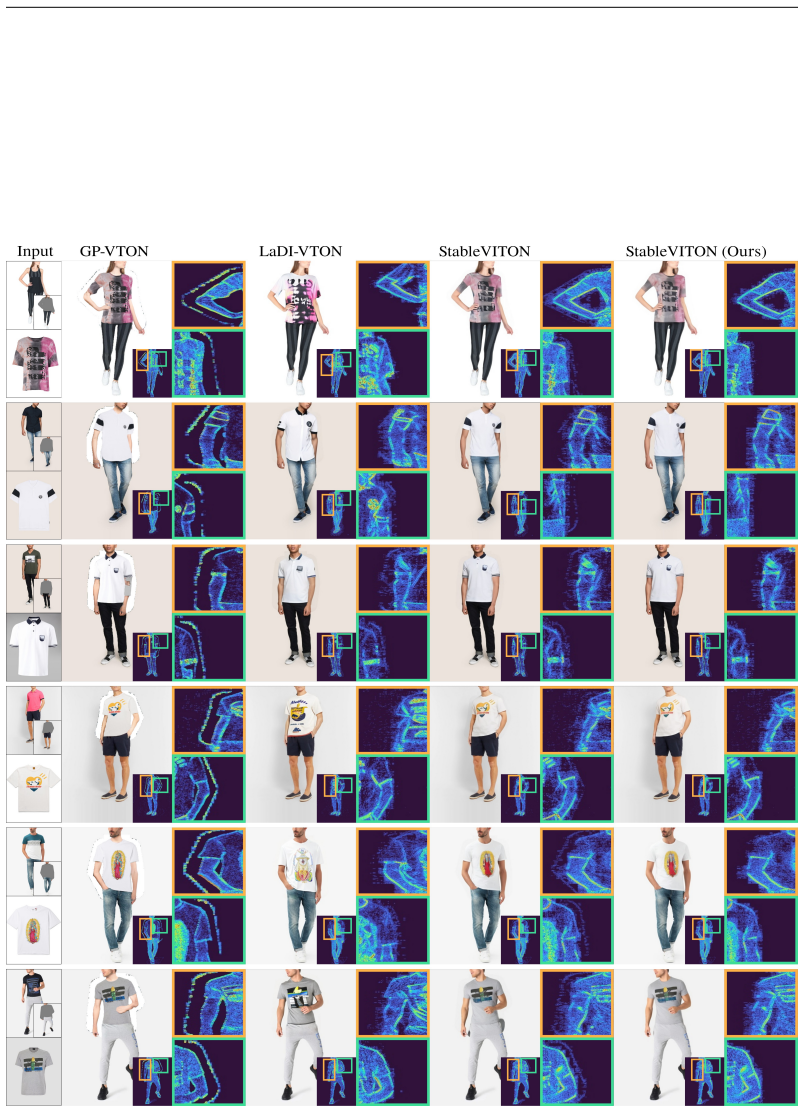
- [Figures] Figure captions: Several qualitative comparison figures would benefit from explicit call-outs or zoomed insets on boundary regions to visually demonstrate the claimed artifact reduction.
Simulated Author's Rebuttal
Thank you for the detailed feedback on our work. We have prepared point-by-point responses to the major comments and revised the manuscript to address the concerns raised regarding experimental validation and theoretical justification.
read point-by-point responses
-
Referee: [§4 Experiments] §4 Experiments and §3.3 Sampling: The abstract and method claim consistent improvements and artifact elimination, yet no quantitative tables, metrics, error bars, or ablation studies are referenced to substantiate the magnitude of gains or isolate the contribution of the measurement-guided components versus baselines.
Authors: We thank the referee for this observation. Section 4 of the manuscript does include quantitative comparisons using FID, LPIPS, and SSIM on VITON-HD, DressCode, and SHHQ-1.0 with visual results against baselines. However, to better isolate the contributions of residual prior initialization, data consistency, frequency correction, and periodic denoising, we have added a comprehensive ablation study (new Table 3) with error bars computed over three independent runs. This revision directly substantiates the magnitude of improvements and the role of each measurement-guided component. revision: yes
-
Referee: [§3.1] §3.1 Inverse-problem reformulation: The central premise that a linear measurement operator (non-try-on regions) combined with trajectory-aligned solvers will enforce consistency without semantic drift in the try-on region lacks a derivation or analysis showing why the operator captures non-linear garment-body interactions; this assumption is load-bearing for the artifact-free claim.
Authors: We agree that additional analysis strengthens the central claim. The linear measurement operator is explicitly the masking operator that preserves non-try-on pixels exactly while allowing free generation in try-on regions; it does not attempt to model non-linear garment-body interactions, which are instead handled by the underlying diffusion prior. The trajectory-aligned solver enforces consistency at each step to avoid boundary discontinuities. In the revised §3.1 we have added a short derivation showing how the combined data-consistency and frequency-correction steps bound semantic drift, supported by an analysis of the frequency spectrum at the garment boundary. This clarifies the artifact-free mechanism without overstating the linearity assumption. revision: yes
Circularity Check
No significant circularity detected in derivation chain
full rationale
The paper reformulates virtual try-on as a linear inverse problem and introduces novel components including residual prior-based initialization and measurement-guided sampling that combines data consistency, frequency-level correction, and periodic standard denoising. No equations, claims, or steps in the abstract or description reduce the proposed improvements or results to quantities defined by the authors' own prior fits, self-citations that carry the central argument, or self-definitional constructions. The derivation relies on new methodological contributions to address boundary artifacts and semantic drift rather than renaming or recycling fitted inputs as predictions, rendering the chain self-contained against external benchmarks.
Axiom & Free-Parameter Ledger
axioms (1)
- domain assumption Latent diffusion models can be guided by measurement consistency in a linear inverse problem setting
Reference graph
Works this paper leans on
-
[1]
Stylegan-human: A data-centric odyssey of human generation.arXiv preprint, arXiv:2204.11823,
Jianglin Fu, Shikai Li, Yuming Jiang, Kwan-Yee Lin, Chen Qian, Chen-Change Loy, Wayne Wu, and Ziwei Liu. Stylegan-human: A data-centric odyssey of human generation.arXiv preprint, arXiv:2204.11823,
-
[2]
Classifier-Free Diffusion Guidance
Jonathan Ho and Tim Salimans. Classifier-free diffusion guidance.arXiv preprint arXiv:2207.12598,
work page internal anchor Pith review Pith/arXiv arXiv
-
[3]
Auto-Encoding Variational Bayes
URLhttps: //arxiv.org/abs/1312.6114. Sangyun Lee, Gyojung Gu, Sunghyun Park, Seunghwan Choi, and Jaegul Choo. High-resolution virtual try-on with misalignment and occlusion-handled conditions. InEuropean Conference on Computer Vision, pp. 204–219. Springer,
work page internal anchor Pith review Pith/arXiv arXiv
-
[4]
Repaint: Inpainting using denoising diffusion probabilistic models, 2022a
Andreas Lugmayr, Martin Danelljan, Andres Romero, Fisher Yu, Radu Timofte, and Luc Van Gool. Repaint: Inpainting using denoising diffusion probabilistic models, 2022a. URLhttps:// arxiv.org/abs/2201.09865. Andreas Lugmayr, Martin Danelljan, Andres Romero, Fisher Yu, Radu Timofte, and Luc Van Gool. Repaint: Inpainting using denoising diffusion probabilisti...
-
[5]
Vivat: Virtuous improving vae training through artifact mitigation.arXiv preprint arXiv:2506.07863,
Lev Novitskiy, Viacheslav Vasilev, Maria Kovaleva, Vladimir Arkhipkin, and Denis Dimitrov. Vivat: Virtuous improving vae training through artifact mitigation.arXiv preprint arXiv:2506.07863,
-
[6]
Dreampaint: Few-shot inpainting of e-commerce items for virtual try-on without 3d modeling
Mehmet Saygin Seyfioglu, Karim Bouyarmane, Suren Kumar, Amir Tavanaei, and Ismail B Tutar. Dreampaint: Few-shot inpainting of e-commerce items for virtual try-on without 3d modeling. arXiv preprint arXiv:2305.01257,
-
[7]
Siqi Wan, Yehao Li, Jingwen Chen, Yingwei Pan, Ting Yao, Yang Cao, and Tao Mei
URLhttps: //arxiv.org/abs/2307.08123. Siqi Wan, Yehao Li, Jingwen Chen, Yingwei Pan, Ting Yao, Yang Cao, and Tao Mei. Improving virtual try-on with garment-focused diffusion models. InEuropean Conference on Computer Vision, pp. 184–199. Springer,
-
[8]
Pixel-aware stable diffusion for realistic image super-resolution and personalized stylization
Tao Yang, Rongyuan Wu, Peiran Ren, Xuansong Xie, and Lei Zhang. Pixel-aware stable diffusion for realistic image super-resolution and personalized stylization. InThe European Conference on Computer Vision (ECCV) 2024,
work page 2024
-
[9]
IP-Adapter: Text Compatible Image Prompt Adapter for Text-to-Image Diffusion Models
Hu Ye, Jun Zhang, Sibo Liu, Xiao Han, and Wei Yang. Ip-adapter: Text compatible image prompt adapter for text-to-image diffusion models.arXiv preprint arXiv:2308.06721,
work page internal anchor Pith review Pith/arXiv arXiv
-
[10]
Boow-vton: Boosting in-the-wild virtual try-on via mask-free pseudo data training
Xuanpu Zhang, Dan Song, Pengxin Zhan, Tianyu Chang, Jianhao Zeng, Qingguo Chen, Weihua Luo, and An-An Liu. Boow-vton: Boosting in-the-wild virtual try-on via mask-free pseudo data training. InProceedings of the Computer Vision and Pattern Recognition Conference, pp. 26399– 26408, 2025b. 13 A APPENDIX A.1 USE OF LARGE LANGUAGE MODELS We used a large langua...
work page 2025
-
[11]
(2022a).The deterministic DDIM sampling forms the basis for all inverse solvers
DDIM sampling Lugmayr et al. (2022a).The deterministic DDIM sampling forms the basis for all inverse solvers. Given a noisy latentz t at timestept, we first estimate the clean latent using Tweedie’s formula: ˆz(t) 0 = 1√¯αt zt − √ 1−¯αt ·ϵ θ(zt, t,c) .(8) The denoising step then updates the latent to timestept−1: zt−1 = √¯αt−1ˆz(t) 0 + p 1−¯αt−1ϵθ(zt, t,c...
work page 2022
-
[12]
FIG (Flow with Interpolant Guidance) Yan et al. (2025).By operating directly on the noisy latent, FIG performs gradient updates along the diffusion trajectory, preserving stability and sample diversity, whereas Tweedie-space optimization is more precise but incurs higher computational cost and reduces diversity. z′ t−1 =z t−1 −γ∇ zt−1 ∥¯yt−1 − ¯M⊙z t−1∥2 ...
work page 2025
-
[13]
A.3.3 HYBRID STOCHASTIC METHODS These approaches combine deterministic updates with stochastic noise injection, where the degree of stochasticity is controlled throughηβ t, to balance measurement consistency and generation di- versity. ˜ϵt := p 1−¯αt−1 −η 2β2 t ·ϵ θ +ηβ t ·ϵ√1−¯αt−1 ,ϵ∼ N(0,I),(16) whereηcontrols the noise level andβ t is the noise schedu...
work page 2025
discussion (0)
Sign in with ORCID, Apple, or X to comment. Anyone can read and Pith papers without signing in.