The Stochastic-Dissipative St\"{o}rmer Problem-Trajectories and Radiation Patterns
Pith reviewed 2026-05-18 12:36 UTC · model grok-4.3
The pith
Friction and stochastic forces in the Störmer problem produce electromagnetic radiation spectra with peaks at specific frequency intervals.
A machine-rendered reading of the paper's core claim, the machinery that carries it, and where it could break.
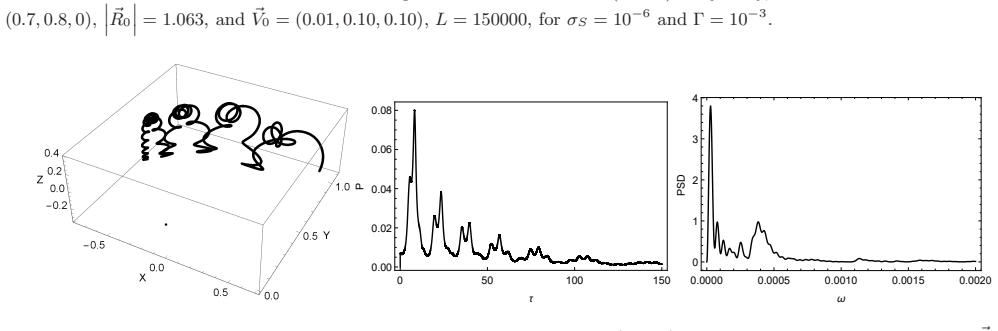
Core claim
When dissipation and stochastic forces are included, the motion of charged particles in a purely magnetic dipole field follows a generalized Langevin equation. Detailed numerical analysis of trajectories and emitted electromagnetic power shows that the power spectral density exhibits peaks in the radiation spectrum corresponding to specific frequency intervals across all considered models, yielding a full description of the spectrum and motion properties.
What carries the argument
The generalized Langevin equation that augments the Lorentz force with friction proportional to velocity and stochastic terms, followed by numerical computation of trajectories and power spectral densities of the emitted radiation.
If this is right
- Particle trajectories in the dipole field deviate from classical paths once friction and stochastic forces are active.
- The emitted electromagnetic power varies with the chosen dissipation coefficient and stochastic force amplitude.
- Peaks in the power spectral density appear at particular frequency intervals and characterize the radiation for every model.
- Numerical integration provides a complete mapping of the radiation spectrum and associated physical motion properties.
Where Pith is reading between the lines
- The same framework could be used to model radiation signatures from particles trapped in planetary or stellar magnetic dipole fields.
- Observable peaks in real astrophysical spectra might indicate the presence of dissipative processes not captured by ideal models.
- Testing the same setup with relativistic corrections would show whether the frequency locations of the peaks shift at high speeds.
Load-bearing premise
Dissipation is modeled specifically as friction proportional to velocity, with stochastic forces added through a standard Langevin extension that omits relativistic or quantum corrections.
What would settle it
Perform a laboratory experiment with charged particles in a controlled magnetic dipole field, apply measured friction and random forces, and record the emitted radiation spectrum to check for the predicted peaks at specific frequencies.
Figures






read the original abstract
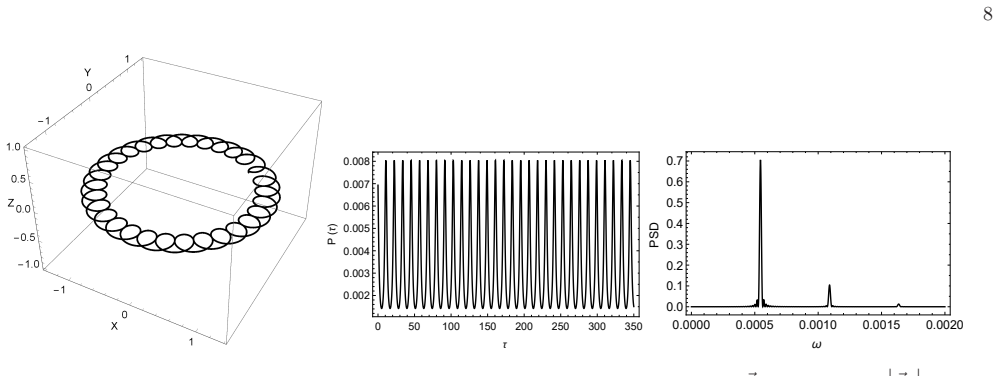
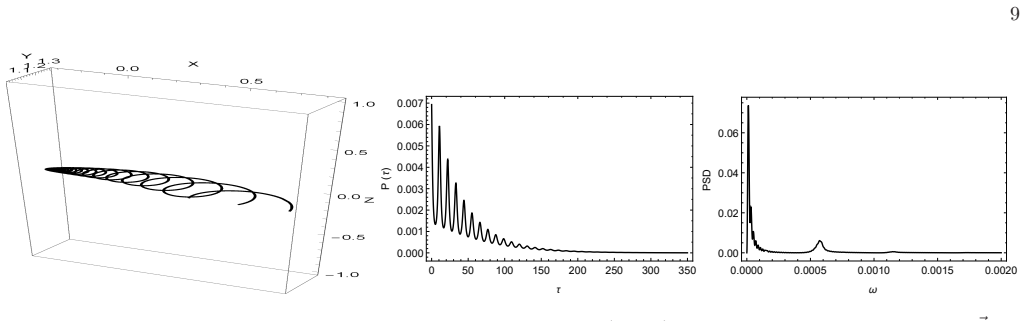
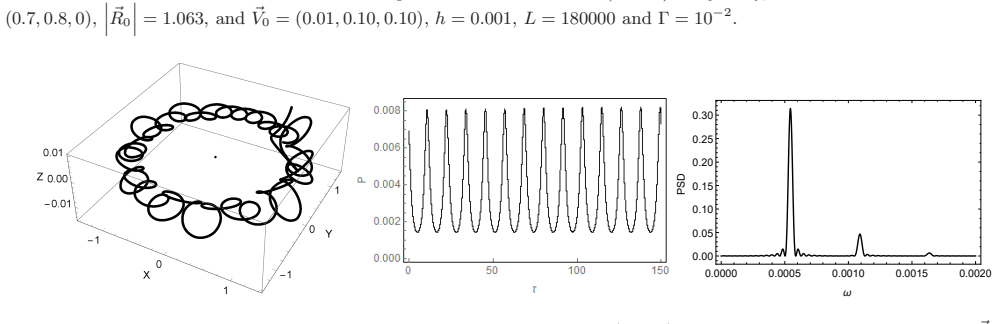
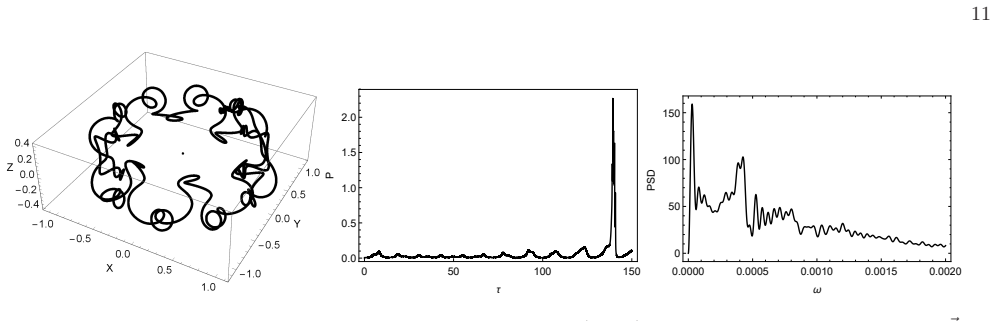
We consider a generalization of the classical nonrelativistic St\"{o}rmer problem, describing the motion of charged particles in a purely magnetic dipole field, by taking into account the effects of the dissipation, assumed to be of friction type, proportional to the velocity of the particle, and of the presence of stochastic forces. In the presence of dissipative/stochastic effects, the motion of the particle in the magnetic dipole field can be described by a generalized Langevin type equation, which generalizes the standard Lorentz force equation. We perform a detailed numerical analysis of the dynamical behavior of the particles in a magnetic dipolar field in the presence of dissipative and stochastic forces, as well as of the electromagnetic radiation patterns emitted during the motion. The effects of the dissipation coefficient and of the stochastic force on the particle motion and on the emitted electromagnetic power are investigated, and thus a full description of the spectrum of the magnetic dipole type electromagnetic radiation and of the physical properties of the motion is also obtained. The power spectral density of the emitted electromagnetic power is also obtained for each case, and, for all considered St\"{o}rmer type models, it shows the presence of peaks in the radiation spectrum, corresponding to certain intervals of the frequency.
Editorial analysis
A structured set of objections, weighed in public.
Referee Report
Summary. The manuscript generalizes the classical nonrelativistic Störmer problem for charged particles in a magnetic dipole field by adding velocity-proportional friction (dissipation) and stochastic forces, yielding a generalized Langevin equation. It reports numerical trajectories, electromagnetic radiation patterns, and power spectral densities, claiming that PSD peaks appear at specific frequency intervals for all considered Störmer-type models.
Significance. If the numerical results hold after verification, the work would extend classical charged-particle dynamics to include dissipative and stochastic effects, potentially informing models of radiation in astrophysical magnetospheres. The explicit computation of spectra under varying dissipation and stochastic strengths provides a concrete parameter study.
major comments (2)
- [Numerical methods] The integration procedure for the generalized Langevin equation (integrator type, time step, ensemble size, and convergence tests) is not described. Because the central claim—that PSD peaks exist for all models—rests entirely on these trajectories, the absence of such checks leaves open the possibility that reported peaks arise from aliasing of stochastic noise rather than the underlying dynamics.
- [Results (PSD analysis)] PSD results are presented without error bars, comparison to the deterministic (zero-stochastic) baseline, or quantitative measures of peak significance. This weakens the assertion that the peaks are robust features corresponding to distinct frequency intervals.
minor comments (1)
- [Abstract and introduction] Notation for the dissipation coefficient and stochastic force amplitude should be introduced once with explicit symbols and then used consistently when discussing their effects on trajectories and spectra.
Simulated Author's Rebuttal
We thank the referee for the careful reading of our manuscript and the constructive comments, which will help improve the clarity and robustness of our results. We address each major comment below.
read point-by-point responses
-
Referee: [Numerical methods] The integration procedure for the generalized Langevin equation (integrator type, time step, ensemble size, and convergence tests) is not described. Because the central claim—that PSD peaks exist for all models—rests entirely on these trajectories, the absence of such checks leaves open the possibility that reported peaks arise from aliasing of stochastic noise rather than the underlying dynamics.
Authors: We agree that the description of the numerical integration procedure was incomplete in the original submission. In the revised manuscript we will add a dedicated subsection specifying the integrator employed for the stochastic differential equation (an adapted stochastic Runge-Kutta scheme), the fixed time step, the number of independent realizations used for ensemble averaging, and the convergence tests performed with respect to time step and ensemble size. These additions will allow readers to assess the reliability of the trajectories and to exclude numerical artifacts such as aliasing in the computed power spectral densities. revision: yes
-
Referee: [Results (PSD analysis)] PSD results are presented without error bars, comparison to the deterministic (zero-stochastic) baseline, or quantitative measures of peak significance. This weakens the assertion that the peaks are robust features corresponding to distinct frequency intervals.
Authors: We acknowledge that the PSD figures would be strengthened by the inclusion of statistical measures. In the revision we will augment the PSD plots with error bars obtained from the standard deviation across the ensemble, add direct overlays of the deterministic (zero-stochastic-force) spectra for comparison, and report quantitative indicators of peak significance such as peak-to-background ratios. These changes will better substantiate that the reported spectral peaks are robust features of the radiation emitted in all considered Störmer-type models. revision: yes
Circularity Check
No circularity: results follow from direct numerical integration of the stated generalized Langevin equation
full rationale
The paper defines a generalized Langevin equation that augments the Lorentz force with a velocity-proportional friction term and a stochastic force, then integrates the resulting ODE numerically to generate trajectories and compute the power spectral density of the emitted radiation. The reported peaks in the PSD for all considered Störmer-type models are direct numerical outputs of this integration; no parameters are fitted to a subset of data and then relabeled as predictions, no self-definitional loops exist between inputs and outputs, and no load-bearing self-citations or uniqueness theorems are invoked to force the result. The derivation chain remains self-contained as a straightforward numerical exploration of the explicitly stated dynamical system.
Axiom & Free-Parameter Ledger
free parameters (2)
- dissipation coefficient
- stochastic force strength
axioms (2)
- domain assumption Dissipation is friction-type and strictly proportional to velocity
- domain assumption Stochastic forces admit a standard additive Langevin representation
Lean theorems connected to this paper
-
IndisputableMonolith/Foundation/RealityFromDistinction.leanreality_from_one_distinction unclear?
unclearRelation between the paper passage and the cited Recognition theorem.
generalized Langevin type equation... Milstein scheme... power spectral density of the emitted electromagnetic power shows the presence of peaks
What do these tags mean?
- matches
- The paper's claim is directly supported by a theorem in the formal canon.
- supports
- The theorem supports part of the paper's argument, but the paper may add assumptions or extra steps.
- extends
- The paper goes beyond the formal theorem; the theorem is a base layer rather than the whole result.
- uses
- The paper appears to rely on the theorem as machinery.
- contradicts
- The paper's claim conflicts with a theorem or certificate in the canon.
- unclear
- Pith found a possible connection, but the passage is too broad, indirect, or ambiguous to say the theorem truly supports the claim.
Reference graph
Works this paper leans on
-
[1]
Classical Dissipative St¨ ormer Problem - CDSP (friction, and no Brownian Motion) 7 C
Numerical results 7 B. Classical Dissipative St¨ ormer Problem - CDSP (friction, and no Brownian Motion) 7 C. Brownian motion in the Stochastic-Dissipative St¨ ormer Problem - SDSP-dissipation and stochastic effects 8
- [2]
-
[3]
The numerical algorithm for the escape rate. 12 IV. Conclusions 12 Acknowledgements 14 Conflict of interest 14 ∗ tiberiu.harko@aira.astro.ro † gabriela.mocanu@aira.astro.ro Keywords 14 References 14 I. INTRODUCTION Magnetic fields are a common occurrence on all as- trophysical, and even cosmological scales, their presence being detected from the galactic or...
work page internal anchor Pith review Pith/arXiv arXiv 2025
-
[4]
Numerical results In our numerical simulations the particle is injected into the dipole field from an initial position ⃗R0 = (X0,Y 0,Z 0), with initial velocities ⃗V0 = (Vx0,V y0,V z0). The solution for two CSP cases was obtained and it was verified by the K1 − 0 method of [49] that one case is not chaotic, and one is chaotic. The solutions differ only by th...
-
[5]
Numerical results In the case of the periodic motion, the combined ef- fects of the presence of dissipative and stochastic forces is represented in Figs. 5-7. The effects of the increase of the dissipation coefficient, generally leading to a decrease in the radiation intensity, and periodic motion patterns are compensated by the presence of the stochastic fo...
work page 2000
-
[6]
The algorithm H used is as follows: We ran each tra- jectory for L = 150000 timesteps
The numerical algorithm for the escape rate. The algorithm H used is as follows: We ran each tra- jectory for L = 150000 timesteps. We considered the last L1 = 10000 steps of each trajectory and asked if this ar- ray is well fitted by a straight line distance vs. time. If the R2 of the fit is ≥ 0. 9, then the trajectory is being counted an escape trajectory...
- [7]
-
[8]
R. Wielebinski, R. Beck R. (Eds.), Cosmic Magnetic Fields, Lect. Notes Phys. 664, Springer, Berlin, Heidel- berg, 2005
work page 2005
- [9]
-
[10]
C. C. Finlay et al., Geophysical Journal International 2010 183, 1216
work page 2010
- [11]
- [12]
- [13]
-
[14]
St¨ ormer,Astrophysical Journal 1913, 38, 311
C. St¨ ormer,Astrophysical Journal 1913, 38, 311
work page 1913
-
[15]
St”ormer, Geofys ´ ısk Publikationer1921, 1, 269
C. St”ormer, Geofys ´ ısk Publikationer1921, 1, 269
-
[16]
St¨ ormer, Terrestrial Magnetism and Atmospheric Electricity 1917, 22, 97
C. St¨ ormer, Terrestrial Magnetism and Atmospheric Electricity 1917, 22, 97
work page 1917
-
[17]
St¨ ormer,Astrophysica Norvegica 1934, 1, 1
C. St¨ ormer,Astrophysica Norvegica 1934, 1, 1
work page 1934
-
[18]
St¨ ormer,The Polar Aurora, Clarendon Press, Oxford, UK, 1955
C. St¨ ormer,The Polar Aurora, Clarendon Press, Oxford, UK, 1955
work page 1955
- [19]
- [20]
-
[21]
M. A. Almeida, I. C. Moreira, and H. Yoshida, J. Phys. A Math. Gen. 1992, 25, L227
work page 1992
-
[22]
F. J. Pav´ on-Carrasco and A. De Santis, Frontiers in Earth Science 2016, 4, 40
work page 2016
-
[23]
R. Schuster and K. O. Thielheim, J. Phys. A: Math. Gen. 1987, 20, 5511
work page 1987
-
[24]
J. E. Howard, M. Hor´ anyi, and G. R. Stewart, Phys. Rev. Lett. 1999, 83, 3993
work page 1999
-
[25]
H. R. Dullin, M. Hor´ anyi, J. E. Howard, Physica D 2002, 171, 178
work page 2002
- [26]
-
[27]
et al., Chaos, Solitons and Fractals 2009, 42, 155
I˜ narrea M. et al., Chaos, Solitons and Fractals 2009, 42, 155
work page 2009
-
[28]
V. Epp, M. A. Masterova, Astrophysics and Space Sci- ence 2014, 353, 473
work page 2014
-
[29]
V. Epp, O. N. Pervukhina, Monthly Notices of the Royal Astronomical Society 2018, 474, 5330
work page 2018
- [30]
-
[31]
E. K. Kolesnikov, Geomagnetism and Aeronomy 2017, 57, 137
work page 2017
-
[32]
A. Leghmouche, N. Mebarki, A. Benslama, New Astron- omy 2023, 98, 101931
work page 2023
-
[33]
S. Ershkov, E. Prosviryakov, D. Leshchenko, N. Bur- masheva, Mathematical Methods in the Applied Sciences 2023, 46, 19364
work page 2023
-
[34]
S. V. Ershkov, J. Appl. Comput. Mech. 2025, in press, https://doi.org/10.22055/jacm.2025.48054.4946
-
[35]
Balescu, Statistical dynamics: Matter out of equilib- rium, Imperial College Press, London, 1997
R. Balescu, Statistical dynamics: Matter out of equilib- rium, Imperial College Press, London, 1997
work page 1997
-
[36]
D. S Lemons, D. L Kaufman, IEEE Transactions on Plasma Science 1999, 27, 1288
work page 1999
-
[37]
R. Balescu, Aspects of Anomalous Transport in Plasmas , Series in Plasma Physics, Institute of Physics Publishing, Bristol and Philadelphia, 2005
work page 2005
-
[38]
W. T. Coffey, Yu. P. Kalmykov, J. T. Waldron, The Langevin Equation, with Applications to Stochastic Prob- lems in Physics, Chemistry, and Electrical Engineering , World Scientific, Singapore, 2005
work page 2005
- [39]
- [40]
- [41]
- [42]
-
[43]
G. R. Mocanu, Romanian Astronomical Journal 2019, 29, 41
work page 2019
-
[44]
G. R. Mocanu, Rom. Rep. Phys. 2020, 72, 105
work page 2020
-
[45]
G. R. Mocanu, IEEE Transactions on Plasma Science 2021, 49, 1527
work page 2021
-
[46]
I. N. Toptygin, G. D. Fleishman, Astrophys. Space Sci- ence 1987, 132, 213
work page 1987
- [47]
-
[48]
S. R. Kelner, F. A. Aharonian, D. Khangulyan, Astro- phys. J. 2013, 774, 61
work page 2013
-
[49]
R. Dil˜ ao, R. Alves-Pires R., Chaos in the St¨ ormer prob- lem, in Progress in Nonlinear Differential Equations and Their Applications , Vol. 75, 175-194, Birkh¨ auser Verlag, Basel, Switzerland, 2007
work page 2007
-
[50]
L. D. Landau, E. M. Lifshitz, The classical theory of fields, Oxford, Pergamon Press, 1971
work page 1971
-
[51]
Huang, Lectures on Statistical Physics and Protein Folding, World Scientific Publishing Company Pte
K. Huang, Lectures on Statistical Physics and Protein Folding, World Scientific Publishing Company Pte. Ltd., Singapore, 2005
work page 2005
- [52]
-
[53]
J. Larsen, Correlation Functions and Power Spectra, Sec- tion for Cognitive Systems, Informatics and Mathemati- cal Modelling , Technical University of Denmark, Copen- hagen, Eighth Edition, 2009
work page 2009
-
[54]
S. V. Vaseghi, Advanced Digital Signal Processing and Noise Reduction , Second Edition, John Wiley & Sons Ltd, New York, Singapore, 2000
work page 2000
-
[55]
G. A. Gottwald, I. Melbourne, Proceedings of the Royal Society A 2004, 460, 603
work page 2004
-
[56]
Chandrasekhar, Reviews of Modern Physics 1943, 15, 1
S. Chandrasekhar, Reviews of Modern Physics 1943, 15, 1
work page 1943
-
[57]
A. A. Tikhonov, K. G. Petrov, Cosmic Research 2002, 40, 203
work page 2002
-
[58]
W. D. Gonzalez et al., J. Geophys. Res. 1994, 99, 5771
work page 1994
-
[59]
Zhao et al., Solar Physics 2021, 296, 66
M.-X. Zhao et al., Solar Physics 2021, 296, 66
work page 2021
-
[60]
T. Yokoyama, H. Shinagawa, H. Jin, J. Geophys. Res. Space Physics 2014, 119, 10474
work page 2014
- [61]
-
[62]
K. S. Thorne, Astrophysical Journal Supplement 1963, 8, 1
work page 1963
-
[63]
D. B. Papadopoulos, I. Contopoulos, K. D. Kokkotas, N. Stergioulas, General Relativity and Gravitation 2015, 47, 49
work page 2015
-
[64]
T. M. Burinskaya, M. M. Shevelev, Plasma Physics Re- ports 2016, 42, 929
work page 2016
-
[65]
T. M. Burinskaya, M. M. Shevelev, Plasma Physics Re- ports 2017, 43, 910
work page 2017
discussion (0)
Sign in with ORCID, Apple, or X to comment. Anyone can read and Pith papers without signing in.