REVIEW 4 major objections 6 minor 151 references
Higher-order spacings in the superposed spectra of random matrices with comparison to spacing ratios and application to complex systems
T0 review · 4 major / 6 minor · reviewed 2026-08-04 · deepseek-v4-flash
Pith's one-line read This paper argues that the higher-order spacing statistics of spectra formed by superposing m independent random-matrix blocks can be collapsed onto a single effective parameter, the modified Dyson index β′, and that the resulting β′ sequen
desk verdict New numerical tables of higher-order spacings in superposed circular spectra, but the uniqueness conjecture rests on a fitting procedure with no error bars and poor resolving power at large beta'; worth refereeing as a numerical study, not as a proof. read the letter →
The pith
A machine-rendered reading of the paper's core claim, the machinery that carries it, and where it could break.
The reading
What carries the argument
The load-bearing tool is the D(β′) statistic: the sum of absolute differences between the observed cumulative distribution of k-th order spacings or ratios and the cumulative distribution of the one-parameter family P(s, β′) or P(r, β′), evaluated over 200 histogram bins. By scanning β′ and taking the minimum of D(β′), the paper converts each histogram into a single effective index. The underlying Wigner-Dyson scaling relation β′ = k(k+1)/2 β + (k−1), already known for single spectra, serves as the reference expectation against which the superposed-spectrum β′ values are compared.
What would settle it
A concrete check: regenerate the m = 5, COE, k = 2 case (tabulated β′ = 0.8) with fresh random seeds, a finer β′ grid, and many more realizations; if the best-fit β′ shifts by more than about 0.1 or D(β′) has no sharp unique minimum, uniqueness is not established. A stronger test is to compute the full superposed k-th order spacing distribution at high statistics and test goodness-of-fit against P(s, β′): rejection of the one-parameter family would collapse the reduction itself.
Extended reading notes
Core claim
On the paper's own terms: the k-th order spacing distribution P_k(s, β, m) of the m-superposed spectra of circular random matrices equals the nearest-neighbor Wigner-Dyson distribution P(s, β′) with a modified Dyson index β′. For each ensemble (β = 1, 2, 4) and each m = 2 to 7, the paper tabulates β′(k) up to k = 20 and finds that the sequence decreases with m for fixed k and increases with k for fixed m, tending toward Poisson statistics as m grows. The centerpiece is the conjecture that for given m (or k) and β, the sequence β′(k) (or β′(m)) obtained by minimizing D(β′) is unique. The claim is tested against the quantum kicked top, which reproduces the m = 2 COE results up to k = 8, with ±
Load-bearing premise
The claim rests on the assumption that the measured higher-order spacing histogram is truly a one-parameter Wigner-Dyson curve and that the D(β′) minimum picks out a sharp, unique β′ for each (m, k, β); the paper itself records poor fits at low k, nearly indistinguishable curves at large β′, and random-number dependence at high k.
Editorial extensions
If this is right
- If the uniqueness conjecture holds, the tabulated β′ sequences become a symmetry meter: measuring higher-order spacings of a composite spectrum gives the symmetry class and the number of equal-size blocks without desymmetrization.
- The numerical equivalence of COE and GOE higher-order statistics in the large-dimension limit means circular-ensemble tables can be applied to Hamiltonian systems with time-reversal symmetry.
- Spacing and ratio statistics agree within one ensemble only up to moderate k and deviate beyond it, so the two measures are not interchangeable as effective-index diagnostics.
- For a fixed total number of eigenvalues, a large matrix dimension with few realizations is preferable to many realizations of small matrices for stabilizing β′.
- The convergence to Poisson statistics as m → ∞, already analytically known for k = 1 ratios, is observed numerically for higher-order spacings in all three circular ensembles, with ratios converging faster.
Reading between the lines
- The most practical consequence left implicit is that the low-k part of the β′ sequence, roughly k ≤ 4, is the robust fingerprint; high-k values are hard to resolve because Wigner-Dyson distributions become nearly indistinguishable at large β, so applications should weight small-k entries.
- The random-number dependence found in the intermediate map suggests an alternative diagnostic: uniqueness may hold for true random-matrix superpositions but not for deterministic unitary maps, so the method carries an implicit ergodicity or chaos assumption.
- A natural extension, flagged as future work, is mixed-size and mixed-symmetry block superpositions; if uniqueness survives that generalization, the technique moves from counting equal blocks toward fuller symmetry tomography.
- The observation that GOE spacing ratios drift with dimension toward COE values hints that ratio-based β′ carries stronger finite-size contamination than spacing-based β′, a testable prediction for other physical systems.
Editorial analysis
A structured set of objections, weighed in public.
Referee Report
Summary. The paper studies higher-order spacing (HOS) distributions in superposed spectra of circular random matrices (COE, CUE, CSE) for m=2,...,7 and k up to 20. For each case, the HOS distribution is fitted to the one-parameter Wigner–Dyson form P(s,beta') using the L1 distance between cumulative distribution functions D(beta') defined in Eq. (13), and the resulting beta'(k,m,beta) values are tabulated. The central claim is a conjecture that these beta' sequences are unique for fixed (m,k,beta), making them universal fingerprints of the symmetry class and number of blocks, usable without desymmetrization. The manuscript also compares HOS with higher-order spacing ratios for COE and GOE, studies dependence on matrix dimension and number of realizations, verifies the m=2 COE predictions on the quantum kicked top, analyzes the intermediate map, and reproduces the COE–CUE correspondence of Gunson.
Significance. If the uniqueness conjecture holds, the paper offers a practical and novel tool for identifying symmetry structure from superposed spectra, a gap noted in the introduction. The manuscript contains an extensive numerical dataset (Tables I–III, IV–XIV, XV–XVIII) and several genuinely useful external checks: the QKT verification (Sec. VI B), the COE–CUE correspondence (Sec. VII B), and the systematic GOE/COE comparison (Sec. V). These strengthen the empirical basis of the work. However, the central conjecture is supported only by a single fitting procedure with no statistical characterization, and the paper itself documents regimes where the fits are poor or the beta' values are unstable. As it stands, the uniqueness claim is an interpretation of a fitting output rather than an established property of the underlying distributions.
major comments (4)
- [Section IV, Eq. (13)] The D(beta') minimization uses a fixed 200-bin histogram and reports a single best-fit beta' to two decimals, with no confidence intervals, no binning sensitivity check, and no goodness-of-fit statistic. The uniqueness conjecture (Abstract, Sec. VIII) requires that this minimum be sharp and stable; the paper does not demonstrate that. At minimum, bootstrap or similar resampling estimates of beta' and a bin-count sensitivity analysis are needed for representative (m,k) values.
- [Section VIIC vs. Tables I–III] Section VIIC explicitly states that for large beta' the distributions P(s,beta) and P(r,beta) become nearly indistinguishable and that 'it is difficult for any numerical approach to find the accurate best fit.' Yet Tables I–III report integer beta' at the largest k values, e.g., Table I, k=20: beta'=120,86,68,57,50,45. These entries are presented with the same precision as small-beta' entries even though the fit has the least resolving power there. The tables should either be restricted to the resolvable range or accompanied by uncertainty estimates that reflect the broadness of D(beta').
- [Table XVI] Table XVI shows that for the intermediate map m=1, beta=2, with N=6000, n=80, and fixed gamma, the fitted beta' varies by up to ~10 depending on the random-number set (e.g., k=17: HOS 328, 332, 329; HOSR 287, 289, 287). Since the intermediate map is a concrete instance of the CUE class, this directly conflicts with the claim that beta' is a unique fingerprint for given (m,k,beta). The authors must either explain this variability as a finite-sample fluctuation with quantified error bars, or qualify the uniqueness conjecture to exclude this regime.
- [Section VI B, Table XVII] The QKT verification is presented as a central external benchmark, but Table XVII shows agreement with m=2 COE only up to k=8; for k>8 the differences are ±1 or ±2, which is acknowledged in the text. This is not a peripheral issue: the uniqueness conjecture is strongest when beta' can be used to determine symmetry structure, but the published sequence is not reproduced outside the lower-k range. The authors should show that the lower-k subset (e.g., k<=8) is sufficient for the proposed symmetry-determination application, or strengthen the benchmarks to higher k.
minor comments (6)
- [Eq. (13)] The symbol n is used both for the number of realizations (e.g., in Table I) and as the running bin index in Eq. (13). Use a different symbol for bins to avoid ambiguity.
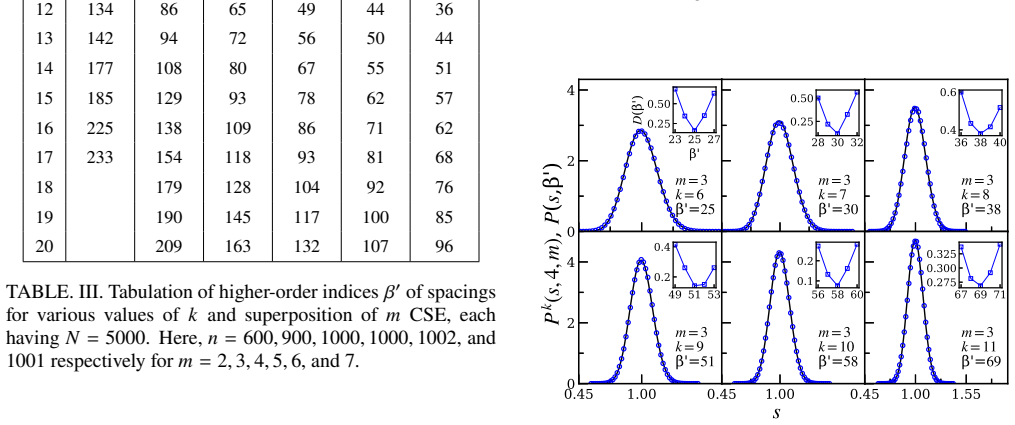
- [Table III] Rows for k=18,19,20 have blank entries in the m=2 column. Either these cases were not computed or the table is incomplete; please clarify in the caption or fill in the values.
- [Fig. 39 caption] The caption contains corrupted text: '/uni03B2/uni2032= 0' and 'P 1(r′ 4′ m )'. This should be fixed to 'beta'=0' and 'P_1(r,4,m)'.
- [Fig. 40 caption] The caption repeats 'β= 2' in multiple subplot labels; clarify whether this indicates CUE with beta=2 and the fitted beta' values.
- [Introduction] The relations in Refs. [15], [94], [95] are used throughout; citing them explicitly at the points where Eqs. (6)–(11) are introduced would improve readability.
- [Abstract] The abstract states that the quantum kicked top verifies the m=2 COE results; in fact the verification holds only up to k=8 with deviations beyond. Please soften the claim accordingly.
Circularity Check
No hard circularity: β′ is by construction a best fit to the distribution it characterizes, so the uniqueness conjecture is a claim about fit outputs that the paper's own data show is not robust at high k; but QKT, intermediate-map, Gunson-correspondence, and m=1 scaling-relation checks are genuine external benchmarks.
-
fitted input called prediction
[Abstract; Sec. VIII; Eqs. (11) and (13); Tables I–III]
"We conjecture that for given m (or order k) and β, the sequence of modified Dyson index β′(k) (or β′(m)) obtained using the sum of absolute differences between the cumulative distribution functions method (denoted as D(β′)) is unique."
β′ is defined by Eqs. (11)+(13) as the argmin of D(β′) between the empirical k-th order spacing CDF and the Wigner-Dyson family P(s,β′), so Tables I–III are by construction the outputs of that fit, and the asserted trends (β′ increases with k, decreases with m) are summaries of fit outputs rather than independent predictions. Sec. VIII then validates the method by the uniqueness of these same outputs ("It is possible from our results... to characterize the system correctly by adopting our numerical method D(β′). Because... the sequences of obtained β′ are unique"), a self-referential justification. The circle is only partial: the QKT (up to k=8), intermediate-map, and COE–CUE (Gunson) checks use independent data, and the paper's own Sec. VIIC and Table XVI show the fit loses resolving powe
full rationale
This is an empirical parameterization study rather than a derivation: the central quantity β′ is, per Eqs. (11) and (13), the best-fit Wigner-Dyson index for the numerically computed k-th order spacing distribution, so the tabulated sequences (Tables I–III) and trend statements built on them are summaries of the fitting procedure's outputs, and the uniqueness conjecture is a claim about those same outputs. The paper's own limitation passages weaken that conjecture: Sec. VIIC states that for large β′ the distributions become nearly indistinguishable and "it is difficult for any numerical approach to find the accurate best fit", and Table XVI shows intermediate-map β′ values changing by up to ~10 across random-number sets at high k, while no error bars or binning-dependence tests accompany the D(β′) minima. These are genuine identifiability/robustness problems, but they are not circular reductions: no equation equals another by construction, and the reported β′ values are honestly labeled as best fits. Most importantly, the paper is checked against external benchmarks that give the central claim independent content: the QKT model (an independent physical system with two superposed COE blocks) reproduces the m=2 COE sequence up to k=8; the intermediate map is an independent CUE-type system; Table XVIII verifies Gunson's theorem (CUE ≅ m=2 COE) from independent spectra; and the m=1 fits are compared with the analytically derived scaling relation Eq. (7)/(9). The self-citations to [94] and [95] (same author) originate the uniqueness idea and the D(β′) method, but the paper re-states the conjecture and validates it externally rather than citing those works as proof, so the self-citation is not load-bearing. Overall, the circularity is mild and self-limiting; the honest verdict is a low score, with the real concern being correctness/identifiability of the fits, not circularity.
Assumptions & free parameters
free parameters (2)
- β′(k,m,β) — modified Dyson index for each tabulated case =
Tables I–III (COE/CUE/CSE) and Tables IV–XVIII (COE/GOE, QKT, intermediate map); e.g., β′(k=2,m=2,β=1)=2, β′(k=3,m=2,β=1
- Histogram bin count =
200
assumptions (6)
- ad hoc to paper P_k(s,β,m) for superposed spectra has the Wigner-Dyson form P(s,β′) for some scalar β′
- domain assumption Superposition of m equal-dimensional spectra from the same circular ensemble represents m equal-sized symmetry blocks
- standard math Circular ensembles are generated with Mezzadri's algorithm, sampling the jpdf in Eq. (12)
- domain assumption QKT desymmetrized blocks obey COE statistics in the chaotic regime
- standard math The m=1 scaling relation Eq. (7), β′=k(k+1)β/2+(k−1), is valid
- domain assumption COE and GOE have the same bulk spectral fluctuations in the large-N limit
Cite this review
Pith. "Pith review of Higher-order spacings in the superposed spectra of random matrices with comparison to spacing ratios and application to complex systems." pith.science (2026). https://pith.science/paper/QW6ASZNG
@misc{pith2026251000503,
  author       = {Pith},
  title        = {Pith review of: Higher-order spacings in the superposed spectra of random matrices with comparison to spacing ratios and application to complex systems},
  year         = {2026},
  howpublished = {\url{https://pith.science/paper/QW6ASZNG}},
  note         = {Machine review of arXiv:2510.00503}
}
abstract
Higher-order spacing statistics in the $m$ superposed spectra of circular random matrices of the same class are studied numerically. We conjecture that for given $m$ (or order $k$) and $\beta$, the sequence of modified Dyson index $\beta'(k)$ (or $\beta'(m)$) obtained using the sum of absolute differences between the cumulative distribution functions method (denoted as $D(\beta')$) is unique. Also, for a given $k$, the distribution tends to the corresponding $k$-th order Poisson statistics in the limit $m\rightarrow \infty$. The quantum chaotic kicked top model for various Hilbert space dimensions is studied, and it is found to satisfy our conjecture. This involves the numerical verification of $m=2$ case of COE results. Our result can be used as a tool for the characterization of a system and to determine the symmetry structure of the system without desymmetrization of the spectra. Additionally, the comparative study of the higher-order spacing and ratio distributions in both $m=1$ and $m=2$ cases of COE as well as GOE is performed within and across these ensembles numerically using the $D(\beta')$ method. This study is carried out both by varying the dimension and keeping the number of realizations constant, and vice-versa. The same asymptotic higher-order statistics are observed across COE and GOE in terms of a given spectral fluctuation measure. But, within a given ensemble of COE or GOE, the results of higher-order spacing and ratio distributions agree with each other only up to some lower $k$, and beyond that, they start deviating from each other. Further, the spectral fluctuations of the intermediate map of various dimensions are studied. Various important observations and discussions from the analysis of our extensive numerical computations are presented.
Figures


Figures from the paper (30 more)






Reference graph
Works this paper leans on
-
[1]
18) remain almost the same except in some cases, where they differ by±1, both for spacings and spacing ratios as we increase𝑁
The case of COE and𝑚=2: Inthe𝑚=2caseofCOE,theobservedvaluesofthe𝛽 ′ (refer to Table IV and Fig. 18) remain almost the same except in some cases, where they differ by±1, both for spacings and spacing ratios as we increase𝑁. Here, we increase𝑁from 1000to55000,𝑛=300for each𝑁and given𝑘. Also, from Tables IV and VIII, comparing both spacings and spacing ratios...
-
[2]
Here, we increase𝑁from1000to55000, 𝑛=300for each𝑁and given𝑘(refer to Table V and Fig
The case of GOE and𝑚=2: In the𝑚=2case of GOE, the observed values of the𝛽 ′ for spacings remain almost the same, except in some cases, where they differ by±1, but for spacing ratios, increases as we increase𝑁. Here, we increase𝑁from1000to55000, 𝑛=300for each𝑁and given𝑘(refer to Table V and Fig. 18). For a given𝑘, except for a few cases, the value of𝛽′ bec...
-
[3]
The case of COE and𝑚=1: In the case of COE without superposition, it can be observed from Table VI and Fig. 19 that the observed values of𝛽′ for both spacings and spacing ratios remain almost the same, except for some cases, where they differ by±1, or in some rare cases±2, as we increase𝑁. Here, we increase𝑁from 1000to55000,𝑛=300for each𝑁and given𝑘. From ...
-
[4]
19 that the observed values of𝛽 ′ for spacings remain almost the same, except for some cases where they differ by±1or in some rare cases±2as we increase𝑁from1000to55000for a given𝑘
The case of GOE and𝑚=1: In the case of GOE without superposition, it can be observed from Tables VII, IX, and Fig. 19 that the observed values of𝛽 ′ for spacings remain almost the same, except for some cases where they differ by±1or in some rare cases±2as we increase𝑁from1000to55000for a given𝑘. Here,𝑛=300 for each𝑁and given𝑘. For the corresponding case o...
-
[5]
T. Guhr, A. Müller-Groeling, and H. A. Weidenmüller, Phys. Rep.299, 189 (1998)
1998
-
[6]
F.Haake,QuantumSignaturesofChaos(Springer,3rdEdition, Berlin, 2010). 25
2010
-
[7]
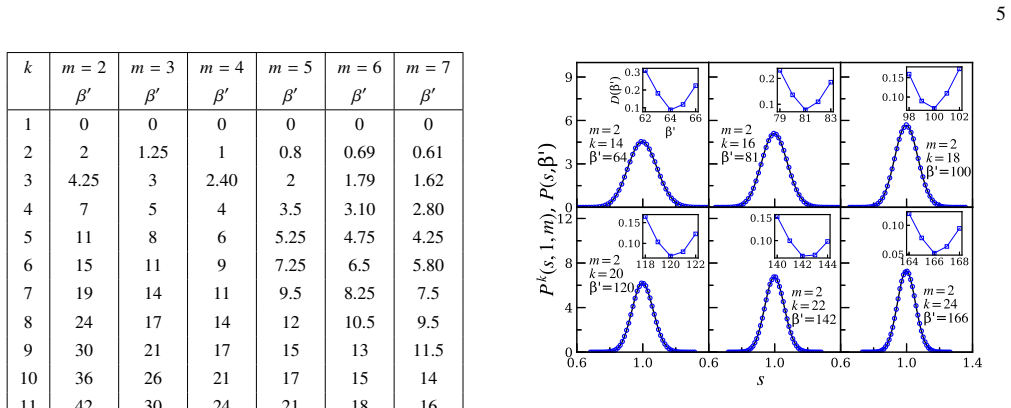
In figures, the insets show the variation of𝐷(𝛽′)with𝛽 ′, the minimum of which gives the values of𝛽′ for which both the distributions fit very well with each other
More results are illustrated in the supplementary material. In figures, the insets show the variation of𝐷(𝛽′)with𝛽 ′, the minimum of which gives the values of𝛽′ for which both the distributions fit very well with each other. 5 𝑘 𝑚=2 𝑚=3 𝑚=4 𝑚=5 𝑚=6 𝑚=7 𝛽′ 𝛽′ 𝛽′ 𝛽′ 𝛽′ 𝛽′ 1 0 0 0 0 0 0 2 2 1.25 1 0.8 0.69 0.61 3 4.25 3 2.40 2 1.79 1.62 4 7 5 4 3.5 3.10 2.80...
-
[8]
We have studied HOS and HOSR up to𝑘=17for each𝑁
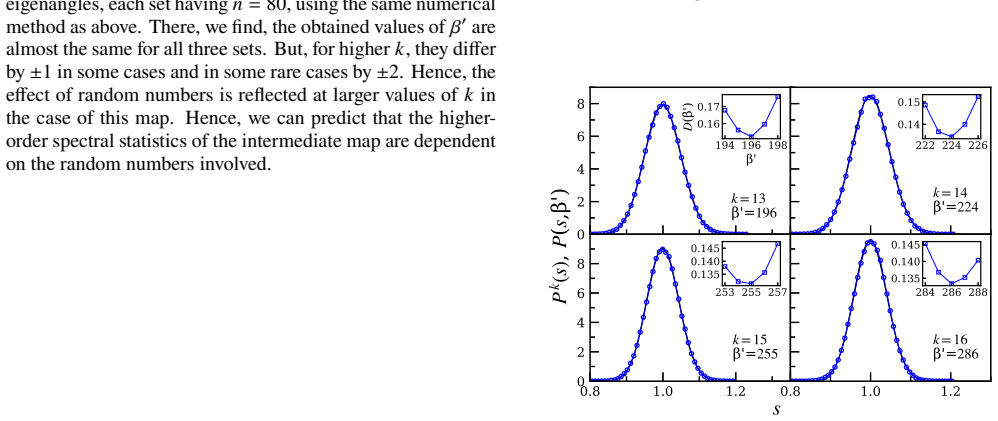
Here, for each𝑁,𝑛=80. We have studied HOS and HOSR up to𝑘=17for each𝑁. The obtained values of𝛽′ are tabulated in Table XV, and some of the representative figures for spacings and spacing ratios are 15 Order 𝑛=500 𝑛=1000 𝑛=1500 𝑛=2000 𝑛=2500 𝑛=3000 𝑛=3500 HOS HOSR HOS HOSR HOS HOSR HOS HOSR HOS HOSR HOS HOSR HOS HOSR 𝑘 𝛽′ 𝛽′ 𝛽′ 𝛽′ 𝛽′ 𝛽′ 𝛽′ 𝛽′ 𝛽′ 𝛽′ 𝛽′ 𝛽′ 𝛽...
2000
Show all 151 references
-
[9]
Here, we can see thatforsmaller𝑘,theobtainedvaluesof𝛽 ′ arefoundtobethe same for all four sets
The obtained results are tabulated in Tables XV and XVI. Here, we can see thatforsmaller𝑘,theobtainedvaluesof𝛽 ′ arefoundtobethe same for all four sets. But, for higher𝑘, they are different for each set, and the difference varies from one to ten. One of the interestingthingswe...
2001
-
[10]
C.E.Porter,StatisticalTheoriesofSpectra: Fluctuations(Aca- demic, New York, 1965)
1965
-
[11]
M. L. Mehta,Random matrices(Elsevier, 2004)
2004
-
[12]
Akemann, J
G. Akemann, J. Baik, and P. Di Francesco,The Oxford hand- bookofrandommatrixtheory(OxfordUniversityPress,2011)
2011
-
[13]
P. J. Forrester,Log-gases and random matrices (LMS-34) (Princeton university press, 2010)
2010
-
[14]
Alhassid, Rev
Y. Alhassid, Rev. Mod. Phy.72, 895 (2000)
2000
-
[15]
Weidenmüller and G
H. Weidenmüller and G. Mitchell, Rev. Mod. Phy.81, 539 (2009)
2009
-
[16]
Phy.82, 2845 (2010)
G.E.Mitchell,A.Richter,andH.A.Weidenmüller,Rev.Mod. Phy.82, 2845 (2010)
2010
-
[17]
More results are plotted in the supplementary material. 8 𝑘 𝑚=2 𝑚=3 𝑚=4 𝑚=5 𝑚=6 𝑚=7 𝛽′ 𝛽′ 𝛽′ 𝛽′ 𝛽′ 𝛽′ 1 0 0 0 0 0 0 2 5.5 2.4 1.5 1 0.82 0.71 3 8.66 7.20 4.5 3 2.40 2 4 19 10 9 6.5 4.93 3.97 5 23.5 15.75 12 11 8.55 6.85 6 39 25 16 14 13 10.59 7 45 30 23 17.5 16 15 8 65 38 31 2...
-
[18]
Gómez, K
J. Gómez, K. Kar, V. Kota, R. A. Molina, A. Relaño, and J. Retamosa, Phys. Rep.499, 103 (2011)
2011
-
[19]
Rosenzweig and C
N. Rosenzweig and C. E. Porter, Phys. Rev.120, 1698 (1960)
1960
-
[20]
Camarda and P
H. Camarda and P. Georgopulos, Phys. Rev. Lett.50, 492 (1983)
1983
-
[21]
H.-J.Stöckmann,Quantumchaos: AnIntroduction(University Press, Cambridge, 1999)
1999
-
[22]
C. W. J. Beenakker, Rev. Mod. Phys.69, 731 (1997)
1997
-
[23]
Rao, Phys
W.-J. Rao, Phys. Rev. B102, 054202 (2020)
2020
-
[24]
Kwapień and S
J. Kwapień and S. Drożdż, Phys. Rep.515, 115 (2012)
2012
-
[25]
M.SanthanamandP.K.Patra,Phys.Rev.E64,016102(2001)
2001
-
[26]
Laloux, P
L. Laloux, P. Cizeau, J.-P. Bouchaud, and M. Potters, Phys. Rev. Lett.83, 1467 (1999)
1999
-
[27]
V.Plerou,P.Gopikrishnan,B.Rosenow,L.A.N.Amaral,and H. E. Stanley, Phys. Rev. Lett.83, 1471 (1999)
1999
-
[28]
Couillet and M
R. Couillet and M. Debbah,Random Matrix Methods for WirelessCommunications(CambridgeUniversityPress,Cam- bridge, UK, 2011)
2011
-
[29]
Jalan and J
S. Jalan and J. N. Bandyopadhyay, Phys. Rev. E76, 046107 (2007)
2007
-
[30]
A. M. Tulino, S. Verdú,et al., Found. Trends Commun. Inf. Theory1, 1 (2004)
2004
-
[31]
A.MishraandK.H.Cheong,Phys.Rev.E109,014218(2024)
2024
-
[32]
Lawrence, arXiv preprint arXiv:2502.14878 (2025)
K. Lawrence, arXiv preprint arXiv:2502.14878 (2025)
2025 arXiv
-
[33]
L. E. Reichl,The Transition to Chaos, 2nd edition(Springer, New York, 2004)
2004
-
[34]
Haake, M
F. Haake, M. Kuś, and R. Scharf, Z. Phys. B65, 381 (1987)
1987
-
[35]
Atkins and G
K. Atkins and G. Ezra, Phys. Rev. E51, 1822 (1995)
1995
-
[36]
Bohigas, M
O. Bohigas, M. J. Giannoni, and C. Schmit, Phys. Rev. Lett. 52, 1 (1984)
1984
-
[37]
N. E. Hurt,Quantum chaos and mesoscopic systems: mathe- matical methods in the quantum signatures of chaos, Vol. 397 (Springer Science & Business Media, 2013)
2013
-
[38]
J. A. Kjäll, Phys. Rev. B97, 035163 (2018)
2018
-
[39]
Canovi and et al., New J
E. Canovi and et al., New J. Phys.14, 095020 (2012)
2012
-
[40]
R. Vosk, D. A. Huse, and E. Altman, Phys. Rev. X5, 031032 (2015)
2015
-
[41]
V. K. Varma, A. Lerose, F. Pietracaprina, J. Goold, and A. Scardicchio, J. Stat. Mech. , 053101 (2017)
2017
-
[42]
Sierant, D
P. Sierant, D. Delande, and J. Zakrzewski, Phys. Rev. A95, 021601 (2017)
2017
-
[43]
Imai and N
S. Imai and N. Tsuji, Phys. Rev. Res.7, 013064 (2025)
2025
-
[44]
F. M. Izrailev, Phys. Rep.196, 299 (1990)
1990
-
[45]
H.-J.StöckmannandJ.Stein,Phys.Rev.Lett.64,2215(1990)
1990
-
[46]
Delande and J
D. Delande and J. Gay, Phys. Rev. Lett.57, 2006 (1986)
2006
-
[47]
884 (Springer, Heidelberg, 2014)
V.K.B.Kota,EmbeddedRandomMatrixEnsemblesinQuan- tum Physics, Vol. 884 (Springer, Heidelberg, 2014)
2014
-
[48]
Friedrich and H
H. Friedrich and H. Wintgen, Phys. Rep.183, 37 (1989)
1989
-
[49]
H.HasegawaandY.Sakamoto,Prog.Theor.Phys.Suppl.139, 112 (2000)
2000
-
[50]
S. M. Nishigaki, Phys. Rev. E59, 2853 (1999)
1999
-
[51]
Zhong, U
J. Zhong, U. Grimm, R. A. Roemer, and M. Schreiber, Phys. Rev. Lett.80, 3996 (1998)
1998
-
[52]
Siringo and G
F. Siringo and G. Piccitto, J. Phys A: Math. Gen.31, 5981 (1998)
1998
-
[53]
S. D. Geraedts, R. Nandkishore, and N. Regnault, Phys. Rev. B93, 174202 (2016)
2016
-
[54]
W.-J. Rao, J. Phys. A: Math. Theor.54, 105001 (2021)
2021
-
[55]
Rao, Physica A590, 126689 (2022)
W.-J. Rao, Physica A590, 126689 (2022)
2022
-
[56]
V.OganesyanandD.A.Huse,Phys.Rev.B75,155111(2007)
2007
-
[57]
Modak, S
R. Modak, S. Mukerjee, and S. Ramaswamy, Phys. Rev. B90, 075152 (2014)
2014
-
[58]
Serbyn and J
M. Serbyn and J. E. Moore, Phys. Rev. B93, 041424 (2016)
2016
-
[59]
Riddell and N
J. Riddell and N. Pagliaroli, J. Stat. Phys.191, 1 (2024)
2024
-
[60]
C.Ellegaard,T.Guhr,K.Lindemann,J.Nygård,andM.Oxbor- row, Phys. Rev. Lett.77, 4918 (1996)
1996
-
[61]
H.U.BarangerandP.A.Mello,Phys.Rev.Lett.73,142(1994)
1994
-
[62]
89, 060402 (2002)
J.N.BandyopadhyayandA.Lakshminarayan,Phys.Rev.Lett. 89, 060402 (2002)
2002
-
[63]
Jacquod, H
P. Jacquod, H. Schomerus, and C. Beenakker, Phys. Rev. Lett. 90, 207004 (2003)
2003
-
[64]
S.Müller,S.Heusler,P.Braun,F.Haake,andA.Altland,Phys. Rev. Lett.93, 014103 (2004)
2004
-
[65]
S.Müller,S.Heusler,P.Braun,F.Haake,andA.Altland,Phys. Rev. E72, 046207 (2005)
2005
-
[66]
M. V. Berry, Proc. R. Soc. A400, 229 (1985)
1985
-
[67]
Sieber and K
M. Sieber and K. Richter, Phys. Scr.2001, 128 (2001)
2001
-
[68]
Phys.11, 103025 (2009)
S.Müller,S.Heusler,A.Altland,P.Braun,andF.Haake,New J. Phys.11, 103025 (2009)
2009
-
[69]
S. H. Tekur and M. Santhanam, Phys. Rev. Res.2, 032063 (2020)
2020
-
[70]
F. J. Dyson, J. Math. Phys.3, 166 (1962)
1962
-
[71]
Gunson, J
J. Gunson, J. Math. Phys.3, 752 (1962)
1962
-
[72]
G.W.Anderson,A.Guionnet,andO.Zeitouni,Anintroduction to random matrices, 118 (Cambridge university press, 2010)
2010
-
[73]
Giraud, N
O. Giraud, N. Macé, É. Vernier, and F. Alet, Phys. Rev. X12, 011006 (2022)
2022
-
[74]
L. F. Santos and M. Rigol, Phys. Rev. E82, 031130 (2010)
2010
-
[75]
Gubin and L
A. Gubin and L. F Santos, Am. J. Phys.80, 246 (2012)
2012
-
[76]
Tkocz, M
T. Tkocz, M. Smaczyński, M. Kuś, O. Zeitouni, and K. Ży- czkowski,RandomMatrices: Theor.Appl.1,1250009(2012)
2012
-
[77]
Smaczyński, T
M. Smaczyński, T. Tkocz, M. Kuś, and K. Życzkowski, Phys. Rev. E88, 052902 (2013)
2013
-
[78]
Tkocz, Electron
T. Tkocz, Electron. Commun. Probab.18, 1 (2013)
2013
-
[79]
M. V. Berry and M. Tabor, Proc. R. Soc. Lond. A.356, 375 (1977)
1977
-
[80]
Brading and E
K. Brading and E. Castellani,Symmetries in physics: Philo- sophical reflections(Cambridge University Press, 2003)
2003
-
[81]
Corry,Symmetry and quantum mechanics(Chapman and Hall/CRC, 2016)
S. Corry,Symmetry and quantum mechanics(Chapman and Hall/CRC, 2016)
2016
-
[82]
D. J. Gross, Proc. Natl. Acad. Sci.93, 14256 (1996)
1996
-
[83]
J.Rosen,Symmetryrules: Howscienceandnaturearefounded on symmetry(Springer Science & Business Media, 2008)
2008
-
[84]
Tapp,Symmetry: A Mathematical Exploration(Springer Science & Business Media, 2011)
K. Tapp,Symmetry: A Mathematical Exploration(Springer Science & Business Media, 2011)
2011
-
[85]
Longo and M
G. Longo and M. Montévil,Perspectives On Organisms: Bio- logical Time, Symmetries and Singularities(Springer, Berlin, 2014)
2014
-
[86]
Sardanashvily,Noether’s Theorems
G. Sardanashvily,Noether’s Theorems. Applications in Me- chanics and Field Theory(Springer-Verlag, 2016)
2016
-
[87]
Y.Kosmann-Schwarzbach,TheNoetherTheorems,55(2011)
2011
-
[88]
Dumitriu and A
I. Dumitriu and A. Edelman, J. Math. Phys.43, 5830 (2002)
2002
-
[89]
F. J. Dyson, J. Math. Phys.3, 140 (1962)
1962
-
[90]
F. J. Dyson, J. Math. Phys.3, 157 (1962)
1962
-
[91]
T. A. Brody, J. Flores, J. B. French, P. A. Mello, A. Pandey, and S. S. Wong, Rev. Mod. Phy.53, 385 (1981)
1981
- [92]
-
[93]
Mezzadri, Notices of the AMS54, 592 (2007)
F. Mezzadri, Notices of the AMS54, 592 (2007)
2007
-
[94]
M. L. Mehta and F. J. Dyson, J. Math. Phys.4, 713 (1963)
1963
-
[95]
C. E. Porter, Nucl. Phys.40, 167 (1963)
1963
-
[96]
P. B. Kahn and C. E. Porter, Nucl. Phys.48, 385 (1963)
1963
-
[97]
Guhr and H
T. Guhr and H. Weidenmuller, Chem. Phys.146, 21 (1990). 26
1990
-
[98]
Lett.56, 2449 (1986)
L.Leviandier,M.Lombardi,R.Jost,andJ.P.Pique,Phys.Rev. Lett.56, 2449 (1986)
1986
-
[99]
French, V
J. French, V. Kota, A. Pandey, and S. Tomsovic, Ann. Phys. 181, 198 (1988)
1988
-
[100]
R. A. Molina, J. Retamosa, L. Muñoz, A. Relaño, and E. Faleiro, Phys. Lett. B644, 25 (2007)
2007
-
[101]
L. F. Santos, F. Pérez-Bernal, and E. J. Torres-Herrera, Phys. Rev. Res.2, 043034 (2020)
2020
-
[102]
U. T. Bhosale, Phys. Rev. B104, 054204 (2021)
2021
-
[103]
S. H. Tekur, U. T. Bhosale, and M. Santhanam, Phys. Rev. B 98, 104305 (2018)
2018
-
[104]
U. T. Bhosale, Phys. Rev. E107, 024132 (2023)
2023
-
[105]
Bruus and J.-C
H. Bruus and J.-C. Angles d’Auriac, Phys. Rev. B55, 9142 (1997)
1997
-
[106]
A. A. Abul-Magd and A. Y. Abul-Magd, Physica A396, 185 (2014)
2014
-
[107]
V.Oganesyan,A.Pal,andD.A.Huse,Phys.Rev.B80,115104 (2009)
2009
-
[108]
Gómez, R
J. Gómez, R. A. Molina, A. Relaño, and J. Retamosa, Phys. Rev. E66, 036209 (2002)
2002
-
[109]
Lett.110, 084101 (2013)
Y.Y.Atas,E.Bogomolny,O.Giraud,andG.Roux,Phys.Rev. Lett.110, 084101 (2013)
2013
-
[110]
Y. Atas, E. Bogomolny, O. Giraud, P. Vivo, and E. Vivo, J. Phys. A46, 355204 (2013)
2013
-
[111]
Buijsman, V
W. Buijsman, V. Cheianov, and V. Gritsev, Phys. Rev. Lett. 122, 180601 (2019)
2019
-
[112]
Pal and D
A. Pal and D. A. Huse, Phys. Rev. B—Condensed Matter and Materials Physics82, 174411 (2010)
2010
-
[113]
S. Iyer, V. Oganesyan, G. Refael, and D. A. Huse, Phys. Rev. B87, 134202 (2013)
2013
-
[114]
Regnault and R
N. Regnault and R. Nandkishore, Physical Review B93, 104203 (2016)
2016
-
[115]
Sun and J
F. Sun and J. Ye, Phys. Rev. Lett.124, 244101 (2020)
2020
-
[116]
F. Sun, Y. Yi-Xiang, J. Ye, and W.-M. Liu, Phys. Rev. D101, 026009 (2020)
2020
-
[117]
Nosaka and T
T. Nosaka and T. Numasawa, Journal of High Energy Physics 2020, 1 (2020)
2020
-
[118]
Lozej, G
Č. Lozej, G. Casati, and T. Prosen, Physical Review Research 4, 013138 (2022)
2022
-
[119]
N. P. Baskerville, D. Granziol, and J. P. Keating, Physica A 590, 126742 (2022)
2022
-
[120]
Sierant and J
P. Sierant and J. Zakrzewski, Phys. Rev. B99, 104205 (2019)
2019
-
[121]
Agarwal, E
K. Agarwal, E. Altman, E. Demler, S. Gopalakrishnan, D. A. Huse,andM.Knap,Ann.Phys.(Berlin)529,1600326(2017)
2017
-
[122]
D.Engel,J.Main,andG.Wunner,J.Phys.A31,6965(1998)
1998
-
[123]
Abul-Magd and M
A. Abul-Magd and M. Simbel, Phys. Rev. E60, 5371 (1999)
1999
-
[124]
Sakhr and J
J. Sakhr and J. M. Nieminen, Phys. Rev. E73, 047202 (2006)
2006
-
[125]
P.SierantandJ.Zakrzewski,Phys.Rev.B101,104201(2020)
2020
-
[126]
S. H. Tekur, S. Kumar, and M. Santhanam, Phys. Rev. E97, 062212 (2018)
2018
-
[127]
A.F.AstanehandN.Vardian,arXivpreprintarXiv:2504.14362 (2025)
2025 arXiv
-
[128]
Akhshani, M
A. Akhshani, M. Białous, and L. Sirko, Phys. Rev. E112, 014201 (2025)
2025
-
[129]
U. T. Bhosale, S. H. Tekur, and M. Santhanam, Phys. Rev. E 98, 052133 (2018)
2018
-
[130]
K. Zyczkowski, inChaos—The Interplay Between Stochastic andDeterministicBehaviour: ProceedingsoftheXXXIstWin- ter School of Theoretical Physics Held in Karpacz, Poland 13–24 February 1995(Springer, 2005) pp. 565–571
1995
-
[131]
Dubertrand, I
R. Dubertrand, I. Garcia-Mata, B. Georgeot, O. Giraud, G. Lemarié, and J. Martin, Phys. Rev. E92, 032914 (2015)
2015
-
[132]
420, 189 (2018)
V.Madhok,S.Dogra,andA.Lakshminarayan,Opt.Commun. 420, 189 (2018)
2018
-
[133]
Dogra, V
S. Dogra, V. Madhok, and A. Lakshminarayan, Phys. Rev. E 99, 062217 (2019)
2019
-
[134]
E. J. Meier, J. Ang’Ong’A, F. A. An, and B. Gadway, Phys. Rev. A100, 013623 (2019)
2019
-
[135]
M. H. Munoz-Arias, P. M. Poggi, P. S. Jessen, and I. H. Deutsch, Phys. Rev. Lett.124, 110503 (2020)
2020
-
[136]
Kumar, Phys
S. Kumar, Phys. Rev. A102, 012405 (2020)
2020
-
[137]
T. Xu, T. Scaffidi, and X. Cao, Phys. Rev. Lett.124, 140602 (2020)
2020
-
[138]
U. T. Bhosale and M. Santhanam, Phys. Rev. E95, 012216 (2017)
2017
-
[139]
U. T. Bhosale and M. Santhanam, Phys. Rev. E98, 052228 (2018)
2018
-
[140]
Krithika, V
V. Krithika, V. Anjusha, U. T. Bhosale, and T. Mahesh, Phys. Rev. E99, 032219 (2019)
2019
-
[141]
J. B. Ruebeck, J. Lin, and A. K. Pattanayak, Phys. Rev. E95, 062222 (2017)
2017
-
[142]
Neill, P
C. Neill, P. Roushan, M. Fang, Y. Chen, M. Kolodrubetz, Z. Chen, A. Megrant, R. Barends, B. Campbell, B. Chiaro, et al., Nature Physics12, 1037 (2016)
2016
-
[143]
Zakrzewski and M
J. Zakrzewski and M. Kuś, Phys. Rev. Lett.67, 2749 (1991)
1991
-
[144]
77, 838 (1996)
R.Alicki,D.Makowiec,andW.Miklaszewski,Phys.Rev.Lett. 77, 838 (1996)
1996
-
[145]
Y. S. Weinstein, S. Lloyd, and C. Tsallis, Phys. Rev. Lett.89, 214101 (2002)
2002
-
[146]
M.LombardiandA.Matzkin,Phys.Rev.E83,016207(2011)
2011
-
[147]
Puchała, Ł
Z. Puchała, Ł. Pawela, and K. Życzkowski, Phys. Rev. A93, 062112 (2016)
2016
-
[148]
Chaudhury, A
S. Chaudhury, A. Smith, B. Anderson, S. Ghose, and P. S. Jessen, Nature461, 768 (2009)
2009
-
[149]
Demkowicz-Dobrzański and M
R. Demkowicz-Dobrzański and M. Kuś, Phys. Rev. E70, 066216 (2004)
2004
-
[150]
P. A. Miller and S. Sarkar, Phys. Rev. E60, 1542 (1999)
1999
-
[151]
Higher-order spacings in the superposed spectra of random matrices with comparison to spacing ratios and application to complex systems
H. Yan, Phys. Rev. E111, 054213 (2025). 27 Supplementary Material for “Higher-order spacings in the superposed spectra of random matrices with comparison to spacing ratios and application to complex systems” Contents SI Introduction 27 SII Illustration of our results through s...
2025
Reviewed August 4, 2026 · model on record in the stance chip above.
Discussion (0). Continue with ORCID to comment.