REVIEW 4 major objections 5 minor 48 references
Panorama: Fast-Track Nearest Neighbors
T0 review · 4 major / 5 minor · reviewed 2026-08-04 · deepseek-v4-flash
Pith's one-line read This paper establishes that the verification bottleneck in approximate nearest-neighbor search can be cut by a factor proportional to the spectral decay of the data, using a learned orthogonal transform and incremental Cauchy-Schwarz bounds
desk verdict Strong systems contribution with real speedups, but the theory proof has a concrete bug and the flagship IVFPQ variance-shaping step is missing from the text. read the letter →
The pith
A machine-rendered reading of the paper's core claim, the machinery that carries it, and where it could break.
The reading
What carries the argument
The key object is a learned orthogonal matrix T on the Stiefel manifold, parameterized via the Cayley transform of a skew-symmetric matrix, which is trained to make normalized tail energies R_Tx^(ℓ,d)/R_Tx^(0,d) decay like e^{-αℓ/d}. Carrying the argument is the Cauchy-Schwarz bound on the uncomputed tail inner product, which yields a monotone lower bound LB_ℓ on the squared L2 distance after ℓ dimensions; comparing LB_ℓ against the running k-th distance threshold d_k is what allows early pruning. The explicit exponential-decay assumption on tail energies is what converts pruning into the O(N·d/α) complexity statement.
What would settle it
Measure the normalized tail energy of a learned transform on a held-out embedding set with heavy-tailed or isotropic energy (e.g., random Gaussian vectors). If the empirical exponent α is at or below 1, Theorem 2 predicts no speedup over brute force; observing this would falsify the claim that the method universally accelerates verification. Alternatively, run PANORAMA on such a set and check whether the fraction of dimensions processed per candidate approaches 1 at high recall.
Extended reading notes
Core claim
The paper's central claim is that the cost of verifying candidates in ANNS can be made to scale inversely with the dataset's spectral decay: E[Cost] ~ C·N·d/α, where α>1 is the exponent of the tail-energy decay achieved by a learned orthogonal transform. The transform, a Cayley-type rotation on the Stiefel manifold warm-started with PCA, is trained so that residual energies decay quasi-exponentially; the algorithm then accumulates partial inner products and uses Cauchy-Schwarz tail-energy products to maintain monotone lower bounds on the full distance, pruning the moment the bound exceeds the running k-th nearest distance. Because the bounds are strict and pruning does not remove true neares
Load-bearing premise
The speedup guarantee rests on the premise that, after the learned orthogonal transform, the tail energy of every vector decays exponentially with a rate α>1; if real embeddings or out-of-distribution queries violate this, the lower bounds loosen and pruning may save little or nothing.
Editorial extensions
If this is right
- Any ANNS index with a separate refinement phase can be accelerated without modifying the index or sacrificing recall, across contiguous and non-contiguous memory layouts.
- The expected verification cost becomes N·d/α, so datasets with stronger spectral decay yield proportionally larger speedups; the learned transform makes α tunable.
- Quantized indexes such as product-quantization-based ones remain compatible: a variance-shaping step redistributes energy so the uniform-variance assumption of PQ holds after the transform.
- Out-of-distribution queries degrade gracefully: with query compaction α_q and database compaction α_x, the effective speedup factor is the arithmetic mean (α_q+α_x)/2, so even α_q=0 keeps half the database-only benefit.
- The system-level memory-layout redesign (level-major storage, SIMD bulk pruning, buffered PQ codes) contributes additional speedups beyond pruning, especially for contiguous-layout indexes.
Reading between the lines
- A testable extension: use the learned transform's α as a quality–latency dial by deliberately under-training, trading a bounded recall drop for a larger speedup; the paper's truncation-vs-PANORAMA ablation suggests adaptive pruning dominates naive truncation at equal speedup.
- The same incremental Cauchy-Schwarz bounding scheme could transfer to inner-product or cosine search by replacing the L2 decomposition; the paper only treats Euclidean distance.
- The OOD robustness theorem suggests a practical monitoring rule: measure a query's empirical tail-energy decay online, and fall back to brute force when the effective α drops below a threshold.
- Because the transform is data-adaptive, its benefit likely grows with intrinsic low-dimensionality of embeddings; datasets with isotropic or heavy-tailed energy may not exhibit α>1 and would need the fallback path.
Editorial analysis
A structured set of objections, weighed in public.
Referee Report
Summary. The paper proposes PANORAMA, a refinement-stage accelerator for ANNS. It applies a learned orthogonal transform to compact energy into leading dimensions, then computes Euclidean distances incrementally with Cauchy–Schwarz lower bounds, pruning candidates once the lower bound exceeds the running k-th nearest-neighbor threshold. The authors integrate this pruning scheme into IVFFlat, IVFPQ, HNSW, Annoy, and MRPT, report end-to-end speedups of 2–40x, and claim a provable complexity of E[Cost] ~ C·N·d/α, where α is the energy-compaction parameter. The core algorithm is simple and the empirical evaluation is broad, but the theoretical proof contains a concrete algebraic error, and the abstract promises a variance-shaping step for PQ that is nowhere described.
Significance. If correct, the paper would make a useful contribution: the incremental lower-bound pruning scheme is exact with respect to a fixed candidate set, the systems co-design (level-major layouts, SIMD batching, buffering for PQ codes) is non-trivial, and the open-source release and integration with Faiss are concrete strengths. The empirical speedup-vs-recall results are plausible and the datasets are diverse. However, the central complexity claim is not established by the provided proof, and the PQ-specific mechanism that is load-bearing for the flagship IVFPQ results is missing from the manuscript. These issues affect the paper's main theoretical and practical claims, so the current version cannot be accepted as-is.
major comments (4)
- [Appendix A, Theorem 9 (proof of Theorem 2)] The argument that C can be made arbitrarily close to 1 by scaling is algebraically invalid. First, scaling all vectors by β scales squared distances by β², not β; the proof instead writes σ → βσ. With the correct scaling, the expression log C0 + 2logβ − (lnσ + 2logβ) − ζ is invariant under scaling, so no choice of β can force the coefficient to be 1. Second, even under the paper's own substitution σ → βσ, the chosen value β = e^{lnσ−logC0+ζ} makes logC0 + logβ − lnσ − ζ = 0, so the leading bracket becomes 0, not 1. Thus Theorem 2's 'C ≈ 1' and Section 6.2's claim that C≈1 is confirmed by Table 2 are unsupported. The complexity constant is data-dependent and not normalized away.
- [Abstract / §5.1 / Appendix E] The abstract promises a 'variance-shaping step that redistributes energy across subvectors, rendering accretive refinement compatible with quantized indexes.' This step is load-bearing for the IVFPQ results, because the learned orthogonal transform compacts energy into leading dimensions and thereby creates heterogeneous subvector variances that are incompatible with PQ's uniform-variance assumption. However, no variance-shaping step appears anywhere in the main text, Algorithm 3, Eq. (6), §5.1, or Appendix E. Without a description of this mechanism, a reader cannot verify that the transform+PQ composition preserves recall, that the step is non-trivial, or that the implementation matches the theory. This is a missing support in the manuscript itself.
- [§3, Assumption A1; §6.2, Eq. (6)] The claimed theorem E[Cost] ∼ N·d/α is not a parameter-free prediction about arbitrary embeddings. It relies on Assumption A1, which postulates exponential tail-energy decay with parameter α. That α is simultaneously a hyperparameter in the training loss (Eq. (6)) and a value measured from the already-transformed data (Section 6.2). Table 2's 'expected' ratios are computed from measured α values, so the close match in that table is an internal consistency check, not an external validation of the theorem. The paper should clearly state that the complexity guarantee is conditional on the exponential-decay model, and should separate the algorithmic claim (lower bounds are exact) from the data-distribution assumption.
- [§6.3, IVFPQ paragraph] The paper's 'no recall loss' claim is not established for IVFPQ. The text says that 'as product quantization does not preserve norms, the recall of the PANORAMA IVFPQ version applying PQ on transformed data differs from that of the standard version for the same setting,' and that the authors therefore interpolate recall–QPS curves. That makes the reported speedup a matched-recall comparison, not a demonstration that the modified index has no recall loss. The claim should be restated precisely (e.g., exactness with respect to a fixed candidate set), and the missing variance-shaping step from the previous comment should be specified before the IVFPQ results can be interpreted.
minor comments (5)
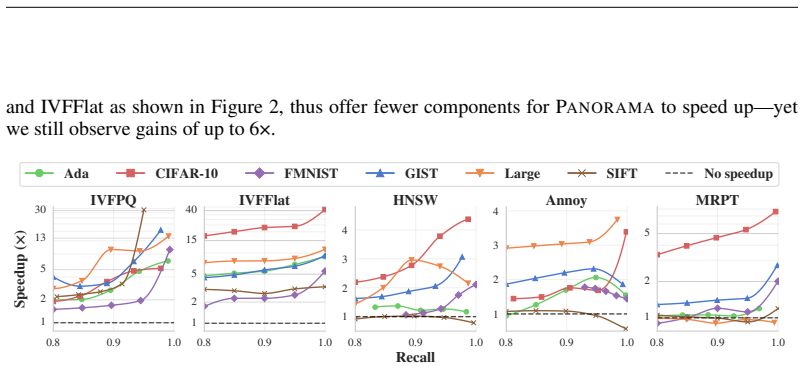
- [Abstract vs. §6.3/Fig. 7] The abstract says 'up to 28.9x', but Section 6.3 and Figure 7 report IVFFlat speedups of 2–40x. The numbers should be reconciled.
- [Appendix C.3] The text describes Batch-noUB as batch size greater than one with π=0, but the summary line says 'Batch-noUB (B<1, π=1)'. This is a typo that should be corrected.
- [Section 2] Algorithm 4 is referenced in the main text before it appears in the appendices; the manuscript should either number the algorithms consistently or refer to the appendix explicitly.
- [Appendix A, Notation] The asymptotic notation f(n)∼c·g(n) is defined twice (main text and appendix). One definition suffices, and the notation should be used consistently, especially since the '∼' symbol is also used in Eq. (1) for an approximation.
- [References] The two Jääsaari et al. entries (2019a and 2019b) appear to be the same paper; please merge or disambiguate.
Circularity Check
No load-bearing circularity; the speedup claim is a conditional complexity bound under an explicit energy-decay assumption and is benchmarked end-to-end, though the C=1 normalization is a proof gap and the promised variance-shaping step is absent.
full rationale
The central derivation is conditional rather than circular. Theorem 2 assumes A1, that transformed tail energies decay as R_x^(m,d) ≈ ||x||^2 e^{-αm/d}, and then derives the pruning depth and expected cost from the Cauchy–Schwarz bound, giving E[Cost] ~ C·Nd/α. That is a substantive derivation from the stated assumption, not an identity: if the exponential-decay premise failed, the pruning bound would not tighten at rate α and the measured cost would not match. The same symbol α appears as the target rate in the training loss (Eq. 6) and as a value measured from transformed data in Section 6.2, which is terminologically confusing, but the experiments measure actual QPS against Faiss baselines and compare the measured feature-processing fraction with the α-derived expectation; this is a consistency check with independent empirical content, not a fitted parameter renamed as a prediction. The appendix's attempt to force C=1 by scaling all vectors by β is not a valid derivation: C0 = 4R^2 and the margin Δ both scale by β^2, so C0/Δ is invariant and β cannot set the prefactor to 1. This is a proof gap in the claimed normalization, not circularity. Separately, the abstract's load-bearing 'variance-shaping step' that is supposed to reconcile the learned transform with PQ is not described in Sections 4, 5.1, or Appendix E, and Section 6.3 concedes that PQ on transformed data changes recall; this is missing support for the IVFPQ no-recall-loss claim, but again it is not a circular reduction. The only self-citation, Kashyap & Karras (2011), supplies the STEPWISE bounding idea that is re-derived in Eqs. (1)–(4) and is not load-bearing. Overall, the paper's main speedup result has independent content and is validated against external baselines, so no significant circularity is present.
Assumptions & free parameters
free parameters (3)
- energy compaction parameter α =
Measured per dataset: ~11 for Large, ~8 for SIFT (Table 2); also a user-set target in the loss (Section 4.2)
- vector scaling β =
β = exp(ln σ − log C0 + ζ) (Appendix A, Theorem 9)
- number of refinement levels L =
32–64 optimal on GIST/IVFPQ (Fig. 15)
assumptions (6)
- domain assumption A1: Tail energies after the learned transform decay exponentially: R^(m,d)_x ≈ ||x||^2 e^{-α m/d}, α > 1.
- ad hoc to paper A2: Levels are single dimensions (m_ℓ = ℓ) in the analysis.
- domain assumption A3: Squared distances from a query are i.i.d. Gaussian random variables.
- domain assumption A4: Vector norms are uniformly bounded by a constant R.
- standard math Cauchy-Schwarz inequality
- standard math Dvoretzky–Kiefer–Wolfowitz inequality
Cite this review
Pith. "Pith review of Panorama: Fast-Track Nearest Neighbors." pith.science (2026). https://pith.science/paper/X6JYF3OJ
@misc{pith2026251000566,
  author       = {Pith},
  title        = {Pith review of: Panorama: Fast-Track Nearest Neighbors},
  year         = {2026},
  howpublished = {\url{https://pith.science/paper/X6JYF3OJ}},
  note         = {Machine review of arXiv:2510.00566}
}
read the original abstract
Approximate Nearest-Neighbor Search (ANNS) pipelines for high-dimensional neural embeddings spend the bulk of their query time in candidate verification, making it the primary bottleneck in the search process. In this paper, we present PANORAMA, a state-of-the-art refinement technique that accelerates verification by exploiting the inherent spectral decay of these embeddings. Using PCA to compact signal energy, PANORAMA evaluates candidate distances incrementally, computing at each step a strict lower bound on the full-vector distance and dynamically pruning candidates the moment this bound exceeds the running k-th nearest neighbor distance. While PCA's concentration of variance facilitates pruning, it breaks the uniform-variance assumption required by Product Quantization (PQ); we resolve this with a variance-shaping step that redistributes energy across subvectors, rendering accretive refinement compatible with quantized indexes. Optimized for modern memory hierarchies via vectorized bulk-pruning and cache-conscious data layouts, PANORAMA has been upstreamed into the FAISS library across major index families (IVFPQ/Flat, HNSW, and Refine). PANORAMA achieves higher QPS at any target recall with a cost that provably scales inversely with dataset spectral decay, delivering end-to-end speedups of up to 28.9x and outperforming probabilistic methods across all recall bands.
Figures


Figures from the paper (12 more)




Reference graph
Works this paper leans on
-
[1]
write newline
" write newline "" before.all 'output.state := FUNCTION n.dashify 't := "" t empty not t #1 #1 substring "-" = t #1 #2 substring "--" = not "--" * t #2 global.max substring 't := t #1 #1 substring "-" = "-" * t #2 global.max substring 't := while if t #1 #1 substring * t #2 global.max substring 't := if while FUNCTION format.date year duplicate empty "emp...
-
[2]
Absil, R
P.-A. Absil, R. Mahony, and R. Sepulchre. Optimization Algorithms on Matrix Manifolds. Princeton University Press, USA, 2007. ISBN 0691132984
2007
-
[3]
DeWitt, Mark D
Anastassia Ailamaki, David J. DeWitt, Mark D. Hill, and Marios Skounakis. Weaving relations for cache performance. In Proceedings of the 27th International Conference on Very Large Data Bases, VLDB '01, pp.\ 169–180, San Francisco, CA, USA, 2001. Morgan Kaufmann Publishers Inc. ISBN 1558608044
2001
-
[4]
Basic local alignment search tool
Stephen F Altschul, Warren Gish, Webb Miller, Eugene W Myers, and David J Lipman. Basic local alignment search tool. Journal of molecular biology, 215 0 (3): 0 403--410, 1990
1990
-
[5]
Gene M. Amdahl. Validity of the single processor approach to achieving large scale computing capabilities. In AFIPS '67 (Spring): Proceedings of the April 18--20, 1967, Spring Joint Computer Conference, pp.\ 483--485, New York, NY, USA, 1967. Association for Computing Machinery. ISBN 9781450378956
1967
-
[6]
Near-optimal hashing algorithms for approximate nearest neighbor in high dimensions
Alexandr Andoni and Piotr Indyk. Near-optimal hashing algorithms for approximate nearest neighbor in high dimensions. In Proceedings of the 47th Annual IEEE Symposium on Foundations of Computer Science (FOCS), pp.\ 459--468. IEEE, 2006
2006
-
[7]
Ann-benchmarks: A benchmarking tool for approximate nearest neighbor algorithms
Martin Aum \"u ller, Erik Bernhardsson, and Alexander Faithfull. Ann-benchmarks: A benchmarking tool for approximate nearest neighbor algorithms. Information Systems, 87: 0 101374, 2020. doi:10.1016/j.is.2019.02.006
-
[8]
Efficient indexing of billion-scale datasets of deep descriptors
Artem Babenko and Victor Lempitsky. Efficient indexing of billion-scale datasets of deep descriptors. In Proceedings of the IEEE Conference on Computer Vision and Pattern Recognition (CVPR), pp.\ 2055--2063, 2016
Show all 48 references
-
[9]
Multidimensional binary search trees used for associative searching
Jon Louis Bentley. Multidimensional binary search trees used for associative searching. Communications of the ACM, 18 0 (9): 0 509--517, 1975
1975
-
[10]
Annoy: Approximate nearest neighbors oh yeah, 2013
Erik Bernhardsson. Annoy: Approximate nearest neighbors oh yeah, 2013. URL https://github.com/spotify/annoy
2013
-
[11]
Evaluating and generating query workloads for high dimensional vector similarity search
Matteo Ceccarello, Alexandra Levchenko, Ioana Ileana, and Themis Palpanas. Evaluating and generating query workloads for high dimensional vector similarity search. In Proceedings of the 29th ACM SIGKDD Conference on Knowledge Discovery and Data Mining, KDD '25, pp.\ 5299–5310,...
2025
-
[12]
J. W. Cooley and J. W. Tukey. An algorithm for the machine calculation of complex fourier series. Mathematics of Computation, 19 0 (90): 0 297--301, 1965. doi:10.1090/S0025-5718-1965-0178586-1. URL https://web.stanford.edu/class/cme324/classics/cooley-tukey.pdf
1965 doi
-
[13]
The faiss library
Matthijs Douze, Alexandr Guzhva, Chengqi Deng, Jeff Johnson, Gergely Szilvasy, Pierre-Emmanuel Mazaré, Maria Lomeli, Lucas Hosseini, and Hervé Jégou. The faiss library. arXiv preprint arXiv:2401.08281, 2024
2024 arXiv
-
[14]
Alan Edelman, T. A. Arias, and Steven T. Smith. The geometry of algorithms with orthogonality constraints, 1998. URL https://arxiv.org/abs/physics/9806030
1998 arXiv
-
[15]
Byteslice: Pushing the envelop of main memory data processing with a new storage layout
Ziqiang Feng, Eric Lo, Ben Kao, and Wenjian Xu. Byteslice: Pushing the envelop of main memory data processing with a new storage layout. In Proceedings of the 2015 ACM SIGMOD International Conference on Management of Data, SIGMOD '15, pp.\ 31–46, New York, NY, USA, 2015. Assoc...
2015
-
[16]
High-dimensional approximate nearest neighbor search: with reliable and efficient distance comparison operations
Jianyang Gao and Cheng Long. High-dimensional approximate nearest neighbor search: with reliable and efficient distance comparison operations. Proc. ACM Manag. Data , 1 0 (2): 0 137:1--137:27, 2023
2023
-
[17]
Retrieval-augmented generation for large language models: A survey
Yunfan Gao, Yun Xiong, Xinyu Gao, Kangxiang Jia, Jinliu Pan, Yuxi Bi, Yi Dai, Jiawei Sun, and Haofen Wang. Retrieval-augmented generation for large language models: A survey. arXiv preprint arXiv:2312.10997, 2023
2023 arXiv
-
[18]
W. Givens. Computation of plane unitary rotations transforming a general matrix to triangular form. Journal of the Society for Industrial and Applied Mathematics, 6 0 (1): 0 26--50, 1958. doi:10.1137/0106004. URL https://epubs.siam.org/doi/10.1137/0106004
1958 doi
-
[19]
Accelerating large-scale inference with anisotropic vector quantization
Ruiqi Guo, Philip Sun, Erik Lindgren, Quan Geng, David Simcha, Felix Chern, and Sanjiv Kumar. Accelerating large-scale inference with anisotropic vector quantization. Proceedings of the 37th International Conference on Machine Learning (ICML), pp.\ 3887--3896, 2020
2020
-
[20]
Hadjidimos and M
A. Hadjidimos and M. Tzoumas. On the optimal complex extrapolation of the complex Cayley transform. Linear Algebra and its Applications, 430 0 (2): 0 619--632, 2009. ISSN 0024-3795. doi:https://doi.org/10.1016/j.laa.2008.08.010. URL https://www.sciencedirect.com/science/articl...
2009 doi
-
[21]
Brian C. Hall. Lie Groups, Lie Algebras, and Representations, pp.\ 333--366. Springer New York, New York, NY, 2013. ISBN 978-1-4614-7116-5. doi:10.1007/978-1-4614-7116-5_16. URL https://doi.org/10.1007/978-1-4614-7116-5_16
2013 doi
-
[22]
A comprehensive survey on vector database: Storage and retrieval technique, challenge
Yikun Han, Chunjiang Liu, and Pengfei Wang. A comprehensive survey on vector database: Storage and retrieval technique, challenge. ArXiv, abs/2310.11703, 2023. URL https://api.semanticscholar.org/CorpusID:264289073
2023
-
[23]
Harris, K
Charles R. Harris, K. Jarrod Millman, St \' e fan J. van der Walt, Ralf Gommers, Pauli Virtanen, David Cournapeau, Eric Wieser, Julian Taylor, Sebastian Berg, Nathaniel J. Smith, Robert Kern, Matti Picus, Stephan Hoyer, Marten H. van Kerkwijk, Matthew Brett, Allan Haldane, Jai...
2020
-
[24]
Horn and Charles R
Roger A. Horn and Charles R. Johnson. Matrix Analysis. Cambridge University Press, 2nd edition, 2012
2012
-
[25]
A. S. Householder. Unitary triangularization of a nonsymmetric matrix. Journal of the Association for Computing Machinery, 5 0 (4): 0 339--342, 1958. doi:10.1145/320941.320947. URL https://doi.org/10.1145/320941.320947
1958
-
[26]
o nen, Teemu Pitk \
Ville Hyv \"o nen, Teemu Pitk \"a nen, Sotiris Tasoulis, Elias J \"a \"a saari, Risto Tuomainen, Liang Wang, Jukka Corander, and Teemu Roos. Fast nearest neighbor search through sparse random projections and voting. In Big Data (Big Data), 2016 IEEE International Conference on...
2016
-
[27]
MRPT : Multi-resolution hashing for proximity search
Ville Hyvönen, Teemu Pitkänen, Sasu Tarkoma, Elias Jääsaari, Teemu Roos, and Alex Yao. MRPT : Multi-resolution hashing for proximity search. https://github.com/vioshyvo/mrpt, 2016
2016
-
[28]
Approximate nearest neighbors: towards removing the curse of dimensionality
Piotr Indyk and Rajeev Motwani. Approximate nearest neighbors: towards removing the curse of dimensionality. In Proceedings of the Thirtieth Annual ACM Symposium on Theory of Computing (STOC), pp.\ 604--613. ACM, 1998
1998
-
[29]
a \"a saari, Ville Hyv \
Elias J \"a \"a saari, Ville Hyv \"o nen, and Teemu Roos. Efficient autotuning of hyperparameters in approximate nearest neighbor search. In Pacific-Asia Conference on Knowledge Discovery and Data Mining, pp.\ In press. Springer, 2019 a
2019
-
[30]
a \"a saari, Ville Hyv \
Elias J \"a \"a saari, Ville Hyv \"o nen, and Teemu Roos. Efficient autotuning of hyperparameters in approximate nearest neighbor search. In Pacific-Asia Conference on Knowledge Discovery and Data Mining, pp.\ In press. Springer, 2019 b
2019
-
[31]
Jégou, M
H. Jégou, M. Douze, and C. Schmid. Product quantization for nearest neighbor search. IEEE Transactions on Pattern Analysis and Machine Intelligence, 33 0 (1): 0 117--128, 2011
2011
-
[32]
Hamming embedding and weak geometric consistency for large scale image search
Hervé Jégou, Matthijs Douze, and Cordelia Schmid. Hamming embedding and weak geometric consistency for large scale image search. In European Conference on Computer Vision (ECCV), pp.\ 304--317. Springer, 2008
2008
-
[33]
Scalable k NN search on vertically stored time series
Shrikant Kashyap and Panagiotis Karras. Scalable k NN search on vertically stored time series. In Proceedings of the 17th ACM SIGKDD International Conference on Knowledge Discovery and Data Mining, pp.\ 1334–1342, 2011. ISBN 9781450308137. URL https://doi.org/10.1145/2020408.2020607
2011
-
[34]
Matrix factorization techniques for recommender systems
Yehuda Koren, Robert Bell, and Chris Volinsky. Matrix factorization techniques for recommender systems. Computer, 42 0 (8): 0 30--37, 2009
2009
-
[35]
Kuffo, Elena Krippner, and Peter A
Leonardo X. Kuffo, Elena Krippner, and Peter A. Boncz. PDX: A data layout for vector similarity search. Proc. ACM Manag. Data , 3 0 (3): 0 196:1--196:26, 2025. doi:10.1145/3725333. URL https://doi.org/10.1145/3725333
2025 doi
-
[36]
u ttler, Mike Lewis, Wen-tau Yih, Tim Rockt \
Patrick Lewis, Ethan Perez, Aleksandra Piktus, Fabio Petroni, Vladimir Karpukhin, Naman Goyal, Heinrich K \"u ttler, Mike Lewis, Wen-tau Yih, Tim Rockt \"a schel, et al. Retrieval-augmented generation for knowledge-intensive nlp tasks. Advances in neural information processing...
2020
-
[37]
Yinan Li and Jignesh M. Patel. Bitweaving: fast scans for main memory data processing. In Proceedings of the 2013 ACM SIGMOD International Conference on Management of Data, SIGMOD '13, pp.\ 289–300, New York, NY, USA, 2013. Association for Computing Machinery. ISBN 97814503203...
2013
-
[38]
Distinctive image features from scale-invariant keypoints
David G Lowe. Distinctive image features from scale-invariant keypoints. International journal of computer vision, 60 0 (2): 0 91--110, 2004
2004
-
[39]
Multi-probe LSH : efficient indexing for high-dimensional similarity search
Qin Lv, William Josephson, Zhe Wang, Moses Charikar, and Kai Li. Multi-probe LSH : efficient indexing for high-dimensional similarity search. In Proceedings of the 33rd International Conference on Very Large Data Bases (VLDB), pp.\ 950--961. VLDB Endowment, 2007
2007
-
[40]
Malkov and Dmitry A
Yu A. Malkov and Dmitry A. Yashunin. Efficient and robust approximate nearest neighbor search using hierarchical navigable small world graphs. IEEE Transactions on Pattern Analysis and Machine Intelligence, 42 0 (4): 0 824--836, 2020
2020
-
[41]
A Wavelet Tour of Signal Processing
Stéphane Mallat. A Wavelet Tour of Signal Processing. Academic Press, 2nd edition, 1999
1999
-
[42]
The tight constant in the dvoretzky–kiefer–wolfowitz inequality
Pascal Massart. The tight constant in the dvoretzky–kiefer–wolfowitz inequality. The Annals of Probability, 18 0 (3): 0 1269--1283, July 1990. doi:10.1214/aop/1176990746. URL https://projecteuclid.org/journals/annals-of-probability/volume-18/issue-3/The-Tight-Constant-in-the-D...
1990
-
[43]
Marius Muja and David G. Lowe. Scalable nearest neighbor algorithms for high dimensional data. IEEE Transactions on Pattern Analysis and Machine Intelligence, 36 0 (11): 0 2227--2240, 2014
2014
-
[44]
Text and code embeddings by contrastive pre-training, 2022
Arvind Neelakantan, Tao Xu, Raul Puri, Alec Radford, Jesse Michael Han, Jerry Tworek, Qiming Yuan, Nikolas Tezak, Jong Wook Kim, Chris Hallacy, Johannes Heidecke, Pranav Shyam, Boris Power, Tyna Eloundou Nekoul, Girish Sastry, Gretchen Krueger, David Schnurr, Felipe Petroski S...
2022 arXiv
-
[45]
Diskann: Fast accurate billion-point nearest neighbor search on a single node
Suhas Jayaram Subramanya, Fnu Devvrit, Harsha Vardhan Simhadri, Ravishankar Krishnaswamy, and Rohan Kadekodi. Diskann: Fast accurate billion-point nearest neighbor search on a single node. In Advances in Neural Information Processing Systems (NeurIPS), volume 32, 2019
2019
-
[46]
Smoothing non-stationary time series using the Discrete Cosine Transform
Dimitrios Thomakos. Smoothing non-stationary time series using the Discrete Cosine Transform . Journal of Systems Science and Complexity, 29, 08 2015. doi:10.1007/s11424-015-4071-7
2015 doi
-
[47]
Dvoretzky–kiefer–wolfowitz inequality
Wikipedia contributors . Dvoretzky–kiefer–wolfowitz inequality. https://en.wikipedia.org/wiki/Dvoretzky 2025. Accessed 2025-09-23
2025
-
[48]
Effective and general distance computation for approximate nearest neighbor search
Mingyu Yang, Wentao Li, Jiabao Jin, Xiaoyao Zhong, Xiangyu Wang, Zhitao Shen, Wei Jia, and Wei Wang. Effective and general distance computation for approximate nearest neighbor search. In 41st IEEE International Conference on Data Engineering, ICDE 2025 , pp.\ 1098--1110, 2025
2025
Reviewed August 4, 2026 · model on record in the stance chip above.
Discussion (0). Continue with ORCID to comment.