REVIEW 3 major objections 6 minor 46 references
ReTabAD: A Benchmark for Restoring Semantic Context in Tabular Anomaly Detection
T0 review · 3 major / 6 minor · reviewed 2026-08-04 · deepseek-v4-flash
Pith's one-line read This paper claims that restoring textual metadata to tabular anomaly detection lets a zero-shot LLM reach accuracy comparable to trained state-of-the-art detectors, without any task-specific training.
desk verdict Real benchmark resource, but the headline gain conflates semantic context with telling the LLM which class is anomalous — the label-leakage control is missing. read the letter →
The pith
A machine-rendered reading of the paper's core claim, the machinery that carries it, and where it could break.
The reading
What carries the argument
The carrying object is the ReTabAD metadata file: a structured JSON per dataset containing a dataset-level description, per-column descriptions with logical types and units, and a label-level description stating which classes are normal and which are anomalous. This metadata is injected into a prompt template alongside per-column normal ranges (5th-95th percentiles) and analysis guidelines, and the LLM outputs anomaly scores, key features, and reasoning. The label-level description is the piece that lets the model map raw values directly onto anomaly semantics, and the paper also preserves raw numerical scales and restores categorical features to their original text values rather than arbitr
What would settle it
Run the zero-shot LLM in the full-description prompt with the label definition removed—keeping only dataset background, column semantics, and normal statistics—and compare AUROC. If removing the label definition on datasets like census or vertebral erases most of the reported gain, the result is driven by the told rule rather than by context-aware reasoning. A complementary test is to create a synthetic tabular dataset whose anomaly class is a rare pattern the metadata does not mention; the framework would predict only a small gain.
Extended reading notes
Core claim
The central discovery is that the definition of an anomaly is often carried by text, not just numbers, and a language model can use that text directly. The paper's zero-shot framework serializes each row with feature names and supplies three kinds of context—domain knowledge, feature descriptions, and normal statistics derived from the training data—then asks the LLM for an anomaly score, key features, and reasoning. With full metadata, the best-performing evaluator LLM reaches an average AUROC of 0.847 and an average rank of 4.08 among the 17 compared models, while the same model without descriptions scores 0.691. Ablations show that combining all three context types gives the highest win r
Load-bearing premise
The load-bearing premise is that the label-level descriptions in the metadata—which explicitly say which classes are normal and which are anomalous—are legitimate semantic context rather than leakage of the ground-truth anomaly rule; if that premise fails, the measured gains reflect rule-following, not context-aware detection.
Editorial extensions
If this is right
- Semantic context can be treated as a first-class input in tabular anomaly detection, opening a benchmark standard for context-aware evaluation rather than purely numeric comparison.
- A zero-shot LLM baseline becomes a strong reference point without task-specific training, lowering the cost of obtaining competitive detection baselines on new datasets.
- Feature descriptions deliver large gains on categorical-heavy domains where raw integer codes are meaningless, so restoring textual categorical values can unlock performance that numeric-only pipelines miss.
- Reasoning quality can be measured, and high-quality reasoning texts can be re-injected as few-shot examples to improve detection, giving an evaluation pathway for interpretability.
- Anomaly definitions in benchmarks should be verified against original source documentation; several datasets in this benchmark differ from earlier processed versions after such verification.
Reading between the lines
- The label-level description in the prompt states the anomaly rule outright (e.g., high income is anomalous, or the original 'normal' class is anomalous). A fair reading is that the +7.6 AUROC gain measures how well LLMs apply a told rule; whether they can discover an anomaly rule from feature semantics alone is a testable open question.
- If metadata becomes the bottleneck, automatic generation of column descriptions or retrieval from documentation could extend this style of context-aware detection to larger, uncurated datasets.
- The framework points toward hybrid systems where statistical detectors flag candidates and LLMs re-rank or explain them using semantic context, rather than replacing trained detectors entirely.
- The reasoning-alignment metric uses supervised attributions as ground truth; because those attributions come from a model trained on the same labels, high alignment could partly reflect agreement with the label rule rather than independent domain reasoning.
Editorial analysis
A structured set of objections, weighed in public.
Referee Report
Summary. ReTabAD introduces a benchmark of 20 tabular datasets enriched with structured textual metadata (dataset-level, column-level, and label-level descriptions), together with implementations of classical, deep, and LLM-based detectors and a zero-shot LLM baseline. The paper reports that adding semantic context to LLM prompts improves average AUROC by +7.6 points, that the zero-shot LLM achieves performance comparable to state-of-the-art training-based methods, and that metadata improves feature-attribution alignment and reasoning quality. The benchmark and code are publicly released.
Significance. If the central empirical claim were cleanly established, ReTabAD would be a useful community resource: it ships a metadata schema, baseline implementations, and a reproducible evaluation pipeline, and the idea of using feature/domain semantics in tabular AD is timely. However, the headline result is currently confounded because the 'Full Desc.' prompt contains the ground-truth anomaly rule through Label-Level Descriptions, so the zero-shot LLM is effectively told which class is anomalous. This moves the comparison from unsupervised context-aware AD toward rule application, and the interpretability analysis has an additional name-matching confound. With a proper control and appropriately narrowed claims, the benchmark could still be valuable; in its current form the main empirical claims are not yet supported.
major comments (3)
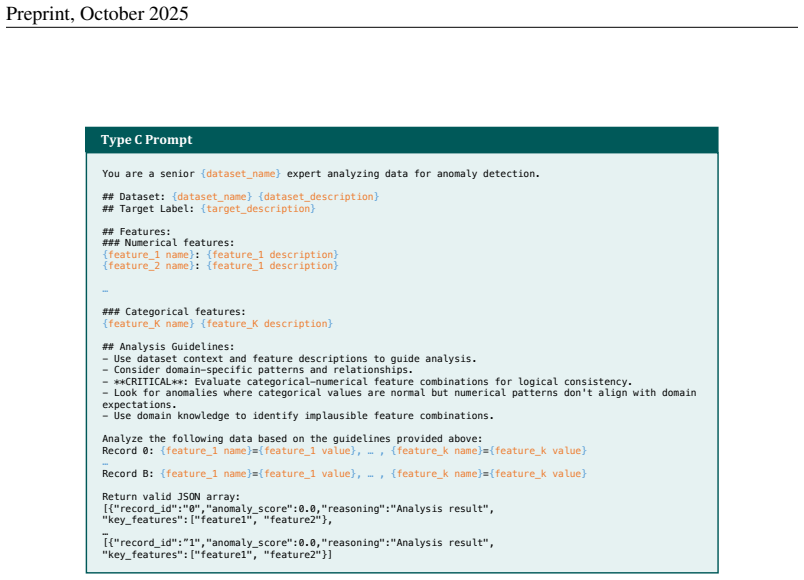
- [§3.1, Figure 8, Tables 4–5] The central empirical claim is confounded by label leakage. §3.1 defines Label-Level Descriptions as specifying 'which classes are considered normal and which are treated as anomalies,' and the Type D prompt (Figure 8) includes 'Target Label: {target_description}' plus the instruction 'Leverage target label definition.' Thus the +7.6 AUROC gain (Table 4) and Type D win rates (Table 5) may measure the LLM's ability to apply a told rule, not the contribution of feature/domain semantics. Training-based unsupervised baselines in Table 3 never see this rule, making the comparison inequitable. Please add a control that compares Full Description with versus without the label description / target instruction, and report whether the gains persist without the label rule.
- [§4.3, Appendix G, Table 6] The reasoning-alignment comparison is invalid as presented. Type A anonymizes column names (AA, AB, ...) while the SHAP reference set uses original feature names, and the paper does not describe any mapping between them. The near-zero F1@1/F1@3 values for Type A are therefore largely an artifact of name mismatch rather than missing semantics. Please either map predicted anonymized names back to original columns or evaluate Type A against anonymized references. Additionally, since Type D includes the target label definition, the reported F1 gains may again reflect rule following rather than improved semantic reasoning.
- [§3.1, Table 8, Appendix A.1] The claim of 'faithful anomaly definitions' is undercut by several curation choices. Vertebral treats the original Normal class as anomalous and pathological classes as normal; census defines high income (>$50K) as anomalous; wine/glass select rare or less common classes. These are class-imbalance/rarity selections rather than domain-faithful anomalies. The criteria in §3.1 — discarding 'too easy' datasets and capping anomaly ratio at 1/3 — further distort representativeness. Please relabel these as 'class-defined evaluation labels' and provide robustness analyses, such as label-inversion sensitivity or anomaly-ratio sensitivity, to show that the benchmark's conclusions are not artifacts of these choices.
minor comments (6)
- [Abstract, §3.2, Table 1] The manuscript inconsistently states 16 or 17 algorithms. Clarify whether the zero-shot LLM baseline is counted among the implemented algorithms or presented separately.
- [Table 4] 'No Desc.' is a misnomer: Type A still provides statistical context (normal ranges/values). Rename it 'Statistical only' or 'No Metadata' to avoid implying that no textual information is used.
- [Figure 2] The prompt structure explicitly shows 'Label 0 means Normal, 1 means Suspect/Pathologic.' If this label mapping is intentionally part of the semantic context, it should be disclosed and discussed as a source of supervision; if not, it should be removed from the baseline prompt.
- [Tables 4–5, Appendix E] No statistical significance tests or confidence intervals are reported for average AUROC differences or win rates, despite multiple seeds and multiple LLMs. Add paired tests or bootstrap intervals for the headline +7.6 comparison.
- [§4.2, Table 5] Type C includes the target label description, so the 'domain knowledge alone' condition is not clean. For the ablation to isolate domain knowledge, a variant without the label/target instruction is required; otherwise the Type A→D decomposition is uninterpretable.
- [Title, Appendix D.3] Minor typos: 'Forrestoring' in the title, and '5th-9th percentile' in prompt templates appears to be a typo for '5th-95th percentile.' Also check consistency of hyphenation and spacing in 'Normal Ranges'.
Circularity Check
Zero-shot LLM 'semantic context' includes Label-Level Descriptions that encode the ground-truth anomaly class; the reported gains reduce, in part, to reading the told rule from the prompt.
-
self definitional
[Section 3.1 (Label-Level Descriptions); Appendix D.3 Type D prompt (Figure 8); Table 8]
"Label-Level Descriptions: For each dataset, ReTabAD clearly specifies which classes are considered normal and which are treated as anomalies. These anomaly definitions are derived directly from the original dataset documentation... ## Target Label: {target_description} ... Leverage target label definition"
The 'semantic context' supplied to the zero-shot LLM includes Label-Level Descriptions, which are nothing other than the benchmark's ground-truth anomaly rule. The Type D prompt then presents 'Target Label: {target_description}' and explicitly instructs the model to 'Leverage target label definition.' Thus the LLM's anomaly score is, by construction, a function of the target label definition: the model is told which class is anomalous before it scores. The +7.6 AUROC improvement in Table 4 and the parity claim in Table 3 therefore measure rule-following from the prompt rather than context-aware anomaly detection. The comparison with training-based unsupervised methods is also inequitable, because those methods never see the target definition. A control with Full Desc. minus the label descr
full rationale
The paper's derivation chain for its central claim is: ReTabAD adds textual metadata -> zero-shot LLMs use that metadata -> semantic context improves detection performance and interpretability. The load-bearing step breaks because the metadata includes Label-Level Descriptions, defined as 'which classes are considered normal and which are treated as anomalies.' These same definitions are placed directly in the prompt as 'Target Label: {target_description}' with the instruction 'Leverage target label definition.' The LLM is therefore told the ground-truth anomaly class before producing scores. On datasets such as census, quasar, and vertebral, the anomaly rule is a simple class assertion (e.g., 'High-income individuals (>$50K) are considered anomalies,' 'Quasars (QSO) are considered anomalies,' 'Original Normal class samples are considered anomalies'), so the zero-shot LLM can solve the task by literal rule application. This makes the reported performance gains and comparisons partially circular: the input contains the answer by construction. The paper is not fully circular: the benchmark resource, feature-description-only ablations, and interpretability analyses have independent value, and there is no load-bearing self-citation chain. But the central empirical claim that 'semantic context improves detection performance' is confounded with label-rule leakage, warranting a score of 6 rather than 0 or 2.
Assumptions & free parameters
assumptions (4)
- domain assumption The definition of an anomaly is context-dependent and can be restored from textual documentation.
- ad hoc to paper Label descriptions are valid semantic context rather than leakage of the ground-truth target.
- domain assumption XGBoost + SHAP trained on ground-truth labels is a valid reference for LLM reasoning quality.
- ad hoc to paper Curation choices (discard 'too easy' datasets, cap anomaly ratio at 1/3, select classes as anomalies) preserve representative AD difficulty.
Cite this review
Pith. "Pith review of ReTabAD: A Benchmark for Restoring Semantic Context in Tabular Anomaly Detection." pith.science (2026). https://pith.science/paper/3VXZ573E
@misc{pith2026251002060,
  author       = {Pith},
  title        = {Pith review of: ReTabAD: A Benchmark for Restoring Semantic Context in Tabular Anomaly Detection},
  year         = {2026},
  howpublished = {\url{https://pith.science/paper/3VXZ573E}},
  note         = {Machine review of arXiv:2510.02060}
}
read the original abstract
In tabular anomaly detection (AD), textual semantics often carry critical signals, as the definition of an anomaly is closely tied to domain-specific context. However, existing benchmarks provide only raw data points without semantic context, overlooking rich textual metadata such as feature descriptions and domain knowledge that experts rely on in practice. This limitation restricts research flexibility and prevents models from fully leveraging domain knowledge for detection. ReTabAD addresses this gap by restoring textual semantics to enable context-aware tabular AD research. We provide (1) 20 carefully curated tabular datasets enriched with structured textual metadata, together with implementations of state-of-the-art AD algorithms including classical, deep learning, and LLM-based approaches, and (2) a zero-shot LLM framework that leverages semantic context without task-specific training, establishing a strong baseline for future research. Furthermore, this work provides insights into the role and utility of textual metadata in AD through experiments and analysis. Results show that semantic context improves detection performance and enhances interpretability by supporting domain-aware reasoning. These findings establish ReTabAD as a benchmark for systematic exploration of context-aware AD.
Figures


Figures from the paper (5 more)



Reference graph
Works this paper leans on
-
[1]
write newline
" write newline "" before.all 'output.state := FUNCTION n.dashify 't := "" t empty not t #1 #1 substring "-" = t #1 #2 substring "--" = not "--" * t #2 global.max substring 't := t #1 #1 substring "-" = "-" * t #2 global.max substring 't := while if t #1 #1 substring * t #2 global.max substring 't := if while FUNCTION format.date year duplicate empty "emp...
-
[2]
Financial fraud detection applying data mining techniques: A comprehensive review from 2009 to 2019
Khaled Gubran Al-Hashedi and Pritheega Magalingam. Financial fraud detection applying data mining techniques: A comprehensive review from 2009 to 2019. Computer Science Review, 40: 0 100402, 2021
2009
-
[3]
Claude opus 4.1
Anthropic. Claude opus 4.1. https://www.anthropic.com/news/claude-opus-4-1, August 2025. Accessed: 2025-08-20
2025
-
[4]
Classification-based anomaly detection for general data
Liron Bergman and Yedid Hoshen. Classification-based anomaly detection for general data. arXiv preprint arXiv:2005.02359, 2020
arXiv 2005
-
[5]
Lof: identifying density-based local outliers
Markus M Breunig, Hans-Peter Kriegel, Raymond T Ng, and J \"o rg Sander. Lof: identifying density-based local outliers. In Proceedings of the 2000 ACM SIGMOD international conference on Management of data, pp.\ 93--104, 2000
2000
-
[6]
D. Campos and J. Bernardes. Cardiotocography . UCI Machine Learning Repository, 2000. DOI : https://doi.org/10.24432/C51S4N
doi:10.24432/c51s4n 2000
-
[7]
On the evaluation of unsupervised outlier detection: measures, datasets, and an empirical study
Guilherme O Campos, Arthur Zimek, J \"o rg Sander, Ricardo JGB Campello, Barbora Micenkov \'a , Erich Schubert, Ira Assent, and Michael E Houle. On the evaluation of unsupervised outlier detection: measures, datasets, and an empirical study. Data mining and knowledge discovery, 30 0 (4): 0 891--927, 2016
2016
-
[8]
Anomaly detection: A survey
Varun Chandola, Arindam Banerjee, and Vipin Kumar. Anomaly detection: A survey. ACM computing surveys (CSUR), 41 0 (3): 0 1--58, 2009
2009
Show all 46 references
-
[9]
Xgboost: A scalable tree boosting system
Tianqi Chen and Carlos Guestrin. Xgboost: A scalable tree boosting system. In Proceedings of the 22nd acm sigkdd international conference on knowledge discovery and data mining, pp.\ 785--794, 2016
2016
-
[10]
Gemini 2.5: Pushing the frontier with advanced reasoning, multimodality, long context, and next generation agentic capabilities
Gheorghe Comanici, Eric Bieber, Mike Schaekermann, Ice Pasupat, Noveen Sachdeva, Inderjit Dhillon, Marcel Blistein, Ori Ram, Dan Zhang, Evan Rosen, et al. Gemini 2.5: Pushing the frontier with advanced reasoning, multimodality, long context, and next generation agentic capabil...
2025 arXiv
-
[11]
Gpt-4.1 sets the standard in automated experiment design using novel python libraries
Nuno Fachada, Daniel Fernandes, Carlos M Fernandes, Bruno D Ferreira-Saraiva, and Jo \ a o P Matos-Carvalho. Gpt-4.1 sets the standard in automated experiment design using novel python libraries. arXiv preprint arXiv:2508.00033, 2025
2025
-
[12]
Deep learning for medical anomaly detection--a survey
Tharindu Fernando, Harshala Gammulle, Simon Denman, Sridha Sridharan, and Clinton Fookes. Deep learning for medical anomaly detection--a survey. ACM Computing Surveys (CSUR), 54 0 (7): 0 1--37, 2021
2021
-
[13]
Evaluating large language models on time series feature understanding: A comprehensive taxonomy and benchmark
Elizabeth Fons, Rachneet Kaur, Soham Palande, Zhen Zeng, Tucker Balch, Manuela Veloso, and Svitlana Vyetrenko. Evaluating large language models on time series feature understanding: A comprehensive taxonomy and benchmark. arXiv preprint arXiv:2404.16563, 2024
2024 arXiv
-
[14]
A comparative evaluation of unsupervised anomaly detection algorithms for multivariate data
Markus Goldstein and Seiichi Uchida. A comparative evaluation of unsupervised anomaly detection algorithms for multivariate data. PloS one, 11 0 (4): 0 e0152173, 2016
2016
-
[15]
Adbench: Anomaly detection benchmark
Songqiao Han, Xiyang Hu, Hailiang Huang, Minqi Jiang, and Yue Zhao. Adbench: Anomaly detection benchmark. Advances in neural information processing systems, 35: 0 32142--32159, 2022
2022
-
[16]
Tabllm: Few-shot classification of tabular data with large language models
Stefan Hegselmann, Alejandro Buendia, Hunter Lang, Monica Agrawal, Xiaoyi Jiang, and David Sontag. Tabllm: Few-shot classification of tabular data with large language models. In International conference on artificial intelligence and statistics, pp.\ 5549--5581. PMLR, 2023
2023
-
[17]
Comparative analysis of machine learning models for anomaly detection in manufacturing
Andrey Kharitonov, Abdulrahman Nahhas, Matthias Pohl, and Klaus Turowski. Comparative analysis of machine learning models for anomaly detection in manufacturing. Procedia Computer Science, 200: 0 1288--1297, 2022
2022
-
[18]
Large language models are zero-shot reasoners
Takeshi Kojima, Shixiang Shane Gu, Machel Reid, Yutaka Matsuo, and Yusuke Iwasawa. Large language models are zero-shot reasoners. Advances in neural information processing systems, 35: 0 22199--22213, 2022
2022
-
[19]
Deep learning for anomaly detection in log data: A survey
Max Landauer, Sebastian Onder, Florian Skopik, and Markus Wurzenberger. Deep learning for anomaly detection in log data: A survey. Machine Learning with Applications, 12: 0 100470, 2023
2023
-
[20]
Rca: A deep collaborative autoencoder approach for anomaly detection
Boyang Liu, Ding Wang, Kaixiang Lin, Pang-Ning Tan, and Jiayu Zhou. Rca: A deep collaborative autoencoder approach for anomaly detection. In IJCAI: proceedings of the conference, volume 2021, pp.\ 1505, 2021
2021
-
[21]
Isolation forest
Fei Tony Liu, Kai Ming Ting, and Zhi-Hua Zhou. Isolation forest. In 2008 eighth ieee international conference on data mining, pp.\ 413--422. IEEE, 2008
2008
-
[22]
On diffusion modeling for anomaly detection
Victor Livernoche, Vineet Jain, Yashar Hezaveh, and Siamak Ravanbakhsh. On diffusion modeling for anomaly detection. arXiv preprint arXiv:2305.18593, 2023
2023 arXiv
-
[23]
Lundberg and Su - In Lee
Scott M. Lundberg and Su - In Lee. A unified approach to interpreting model predictions. In Proc. the Advances in Neural Information Processing Systems (NeurIPS), 2017
2017
-
[24]
Gpt-4o mini: Advancing cost-efficient intelligence
OpenAI . Gpt-4o mini: Advancing cost-efficient intelligence. https://openai.com/index/gpt-4o-mini-advancing-cost-efficient-intelligence/, 2024. Accessed: 2024-08-13
2024
-
[25]
Learning representations of ultrahigh-dimensional data for random distance-based outlier detection
Guansong Pang, Longbing Cao, Ling Chen, and Huan Liu. Learning representations of ultrahigh-dimensional data for random distance-based outlier detection. In Proceedings of the 24th ACM SIGKDD international conference on knowledge discovery & data mining, pp.\ 2041--2050, 2018
-
[26]
Deep learning for anomaly detection: A review
Guansong Pang, Chunhua Shen, Longbing Cao, and Anton Van Den Hengel. Deep learning for anomaly detection: A review. ACM computing surveys (CSUR), 54 0 (2): 0 1--38, 2021
2021
-
[27]
Neural transformation learning for deep anomaly detection beyond images
Chen Qiu, Timo Pfrommer, Marius Kloft, Stephan Mandt, and Maja Rudolph. Neural transformation learning for deep anomaly detection beyond images. In International conference on machine learning, pp.\ 8703--8714. PMLR, 2021
2021
-
[28]
Efficient algorithms for mining outliers from large data sets
Sridhar Ramaswamy, Rajeev Rastogi, and Kyuseok Shim. Efficient algorithms for mining outliers from large data sets. In Proceedings of the 2000 ACM SIGMOD international conference on Management of data, pp.\ 427--438, 2000
2000
-
[29]
Deep one-class classification
Lukas Ruff, Robert Vandermeulen, Nico Goernitz, Lucas Deecke, Shoaib Ahmed Siddiqui, Alexander Binder, Emmanuel M \"u ller, and Marius Kloft. Deep one-class classification. In International conference on machine learning, pp.\ 4393--4402. PMLR, 2018
2018
-
[30]
Kauffmann, Robert A
Lukas Ruff, Jacob R. Kauffmann, Robert A. Vandermeulen, Gr \' e goire Montavon, Wojciech Samek, Marius Kloft, Thomas G. Dietterich, and Klaus - Robert M \" u ller. A unifying review of deep and shallow anomaly detection. Proc. IEEE , 109 0 (5): 0 756--795, 2021 a
2021
-
[31]
A unifying review of deep and shallow anomaly detection
Lukas Ruff, Jacob R Kauffmann, Robert A Vandermeulen, Gr \'e goire Montavon, Wojciech Samek, Marius Kloft, Thomas G Dietterich, and Klaus-Robert M \"u ller. A unifying review of deep and shallow anomaly detection. Proceedings of the IEEE, 109 0 (5): 0 756--795, 2021 b
2021
-
[32]
The precision-recall plot is more informative than the roc plot when evaluating binary classifiers on imbalanced datasets
Takaya Saito and Marc Rehmsmeier. The precision-recall plot is more informative than the roc plot when evaluating binary classifiers on imbalanced datasets. PloS one, 10 0 (3): 0 e0118432, 2015
2015
-
[33]
Support vector method for novelty detection
Bernhard Sch \"o lkopf, Robert C Williamson, Alex Smola, John Shawe-Taylor, and John Platt. Support vector method for novelty detection. Advances in neural information processing systems, 12, 1999
1999
-
[34]
Estimating the support of a high-dimensional distribution
Bernhard Sch \"o lkopf, John C Platt, John Shawe-Taylor, Alex J Smola, and Robert C Williamson. Estimating the support of a high-dimensional distribution. Neural computation, 13 0 (7): 0 1443--1471, 2001
2001
-
[35]
A novel anomaly detection scheme based on principal component classifier
Mei-Ling Shyu, Shu-Ching Chen, Kanoksri Sarinnapakorn, and LiWu Chang. A novel anomaly detection scheme based on principal component classifier. Technical report, University of Miami, Department of Electrical and Computer Engineering, 2003
2003
-
[36]
Ano LLM : Large language models for tabular anomaly detection
Che-Ping Tsai, Ganyu Teng, Phillip Wallis, and Wei Ding. Ano LLM : Large language models for tabular anomaly detection. In The Thirteenth International Conference on Learning Representations, 2025. URL https://openreview.net/forum?id=7VkHffT5X2
2025
-
[37]
Unsupervised representation learning by predicting random distances
Hu Wang, Guansong Pang, Chunhua Shen, and Congbo Ma. Unsupervised representation learning by predicting random distances. arXiv preprint arXiv:1912.12186, 2019
1912 arXiv
-
[38]
Deep isolation forest for anomaly detection
Hongzuo Xu, Guansong Pang, Yijie Wang, and Yongjun Wang. Deep isolation forest for anomaly detection. IEEE Transactions on Knowledge and Data Engineering, 35 0 (12): 0 12591--12604, 2023 a . doi:10.1109/TKDE.2023.3270293
2023
-
[39]
Fascinating supervisory signals and where to find them: Deep anomaly detection with scale learning
Hongzuo Xu, Yijie Wang, Juhui Wei, Songlei Jian, Yizhou Li, and Ning Liu. Fascinating supervisory signals and where to find them: Deep anomaly detection with scale learning. In International Conference on Machine Learning, pp.\ 38655--38673. PMLR, 2023 b
2023
-
[40]
Qwen3 technical report
An Yang, Anfeng Li, Baosong Yang, Beichen Zhang, Binyuan Hui, Bo Zheng, Bowen Yu, Chang Gao, Chengen Huang, Chenxu Lv, et al. Qwen3 technical report. arXiv preprint arXiv:2505.09388, 2025
2025 arXiv
-
[41]
Drl: Decomposed representation learning for tabular anomaly detection
Hangting Ye, He Zhao, Wei Fan, Mingyuan Zhou, Dan dan Guo, and Yi Chang. Drl: Decomposed representation learning for tabular anomaly detection. In The Thirteenth International Conference on Learning Representations, 2025
2025
-
[42]
Mcm: Masked cell modeling for anomaly detection in tabular data
Jiaxin Yin, Yuanyuan Qiao, Zitang Zhou, Xiangchao Wang, and Jie Yang. Mcm: Masked cell modeling for anomaly detection in tabular data. In The Twelfth International Conference on Learning Representations, 2024
2024
-
[43]
Pyod: A python toolbox for scalable outlier detection
Yue Zhao, Zain Nasrullah, and Zheng Li. Pyod: A python toolbox for scalable outlier detection. Journal of machine learning research, 20 0 (96): 0 1--7, 2019
2019
-
[44]
@esa (Ref
\@ifxundefined[1] #1\@undefined \@firstoftwo \@secondoftwo \@ifnum[1] #1 \@firstoftwo \@secondoftwo \@ifx[1] #1 \@firstoftwo \@secondoftwo [2] @ #1 \@temptokena #2 #1 @ \@temptokena \@ifclassloaded agu2001 natbib The agu2001 class already includes natbib coding, so you should ...
-
[45]
\@lbibitem[] @bibitem@first@sw\@secondoftwo \@lbibitem[#1]#2 \@extra@b@citeb \@ifundefined br@#2\@extra@b@citeb \@namedef br@#2 \@nameuse br@#2\@extra@b@citeb \@ifundefined b@#2\@extra@b@citeb @num @parse #2 @tmp #1 NAT@b@open@#2 NAT@b@shut@#2 \@ifnum @merge>\@ne @bibitem@firs...
-
[46]
Record i : [feature\_name\_1=value\_1], [feature\_name\_2=value\_2],
@open @close @open @close and [1] URL: #1 \@ifundefined chapter * \@mkboth \@ifxundefined @sectionbib * \@mkboth * \@mkboth\@gobbletwo \@ifclassloaded amsart * \@ifclassloaded amsbook * \@ifxundefined @heading @heading NAT@ctr thebibliography [1] @ \@biblabel @NAT@ctr \@bibset...
1985
Reviewed August 4, 2026 · model on record in the stance chip above.
Discussion (0). Sign in to comment.