Effective-medium theory for elastic systems with correlated disorder
Pith reviewed 2026-05-18 10:21 UTC · model grok-4.3
The pith
A generalized coherent potential approximation incorporates spatial correlations into effective-medium theory for elastic networks.
A machine-rendered reading of the paper's core claim, the machinery that carries it, and where it could break.
Core claim
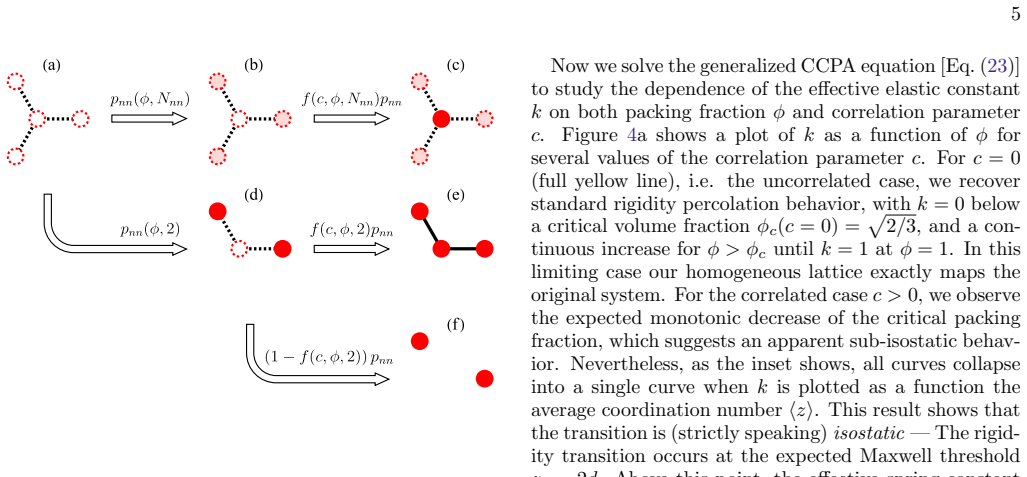
We propose a multi-purpose generalization of the coherent potential approximation to describe the mechanical behavior of elastic networks with spatially-correlated disorder. We apply our theory to a simple rigidity-percolation model for colloidal gels and study the effects of correlations in both the critical point and the overall scaling behavior. We find that although the presence of spatial correlations (mimicking attractive interactions of gels) shifts the critical packing fraction to lower values, suggesting sub-isostatic behavior, the critical coordination number of the associated network remains isostatic.
What carries the argument
A generalization of the coherent potential approximation that folds spatial correlations of the disorder into the self-consistent effective-medium equations.
If this is right
- Correlations that mimic attractions move the rigidity onset to lower packing fractions.
- The critical coordination number remains isostatic regardless of correlation strength.
- Scaling of elastic moduli near the transition can be extracted for correlated cases.
- The same framework applies to bio-polymer networks and suspensions near shear jamming.
Where Pith is reading between the lines
- The method could be used to tune material rigidity by controlling the length scale of attractive correlations during fabrication.
- Extensions to time-dependent or finite-frequency mechanical responses would connect to viscoelastic measurements in gels.
- The preserved isostaticity suggests a deeper structural reason that might appear in other effective-medium treatments of jamming.
Load-bearing premise
Spatial correlations can be built into the self-consistent effective-medium framework without invalidating the core approximation or introducing new uncontrolled approximations for the disorder statistics.
What would settle it
Direct comparison of the theory's predicted critical packing fraction versus correlation strength against numerical simulations of the rigidity-percolation model on finite networks.
Figures




read the original abstract
Correlated structures are intimately connected to intriguing phenomena exhibited by a variety of disordered systems such as soft colloidal gels, bio-polymer networks and colloidal suspensions near a shear jamming transition. The universal critical behavior of these systems near the onset of rigidity is often described by traditional approaches as the coherent potential approximation - a versatile version of effective-medium theory that nevertheless have hitherto lacked key ingredients to describe disorder spatial correlations. Here we propose a multi-purpose generalization of the coherent potential approximation to describe the mechanical behavior of elastic networks with spatially-correlated disorder. We apply our theory to a simple rigidity-percolation model for colloidal gels and study the effects of correlations in both the critical point and the overall scaling behavior. We find that although the presence of spatial correlations (mimicking attractive interactions of gels) shifts the critical packing fraction to lower values, suggesting sub-isostatic behavior, the critical coordination number of the associated network remains isostatic. More importantly, we discuss how our theory can be employed to describe a large variety of systems with spatially-correlated disorder.
Editorial analysis
A structured set of objections, weighed in public.
Referee Report
Summary. The manuscript proposes a generalization of the coherent potential approximation (CPA) for elastic networks with spatially correlated disorder. The central construction replaces the single-site self-consistency condition with an effective-medium equation that incorporates the pair-correlation function of the disorder. Applied to a rigidity-percolation model for colloidal gels, the theory predicts that spatial correlations (mimicking attractive interactions) shift the critical packing fraction to lower values while the critical coordination number remains isostatic. The work presents the approach as a multi-purpose tool for a variety of disordered elastic systems.
Significance. If controlled, the generalization supplies a practical route to include spatial correlations within effective-medium theory, which is relevant for modeling rigidity onset in colloidal gels, biopolymer networks, and shear-jammed suspensions. The observation that isostaticity is preserved at the shifted critical point offers a concrete prediction that could be tested against simulations or experiments on attractive colloids. The multi-purpose framing, if substantiated, would extend CPA utility beyond uncorrelated disorder.
major comments (2)
- [§III, Eq. (10)] §III, Eq. (10): the effective-medium self-consistency condition that folds in the pair-correlation function assumes local strain fluctuations remain screened by the same effective medium as in the uncorrelated CPA. No explicit error bound or validity criterion is derived for correlation lengths comparable to elastic wavelengths; this assumption is load-bearing for the quantitative reliability of the reported shift in critical packing fraction.
- [§IV, Fig. 4] §IV, Fig. 4 and surrounding text: the critical packing fractions and coordination numbers obtained for varying correlation strengths are shown without direct comparison to independent Monte Carlo or molecular-dynamics simulations of the same correlated network model. This omission leaves open whether the predicted sub-isostatic shift remains accurate beyond the weak-correlation regime.
minor comments (2)
- [Abstract] The abstract states that correlations suggest 'sub-isostatic behavior' while simultaneously reporting an isostatic critical coordination number; a brief clarifying sentence would avoid potential misreading.
- [§II] Notation for the effective Lamé parameters and the disorder correlation function is introduced piecemeal; a consolidated table of symbols would improve readability.
Simulated Author's Rebuttal
We thank the referee for the careful reading and constructive comments. We address each major point below and indicate the changes we will make to the manuscript.
read point-by-point responses
-
Referee: [§III, Eq. (10)] §III, Eq. (10): the effective-medium self-consistency condition that folds in the pair-correlation function assumes local strain fluctuations remain screened by the same effective medium as in the uncorrelated CPA. No explicit error bound or validity criterion is derived for correlation lengths comparable to elastic wavelengths; this assumption is load-bearing for the quantitative reliability of the reported shift in critical packing fraction.
Authors: We agree that the screening assumption underlying Eq. (10) requires explicit discussion. This assumption is the direct extension of the standard CPA closure and is expected to remain accurate when the spatial correlation length of the disorder is short compared with the wavelength of the relevant elastic modes. Deriving a rigorous, quantitative error bound valid for arbitrary correlation lengths would require a separate, technically involved analysis that lies beyond the scope of the present work. In the revised manuscript we will add a new paragraph immediately after Eq. (10) that states the scaling argument for the validity regime and explicitly notes that the correlation lengths considered in our colloidal-gel application fall well inside this regime. revision: yes
-
Referee: [§IV, Fig. 4] §IV, Fig. 4 and surrounding text: the critical packing fractions and coordination numbers obtained for varying correlation strengths are shown without direct comparison to independent Monte Carlo or molecular-dynamics simulations of the same correlated network model. This omission leaves open whether the predicted sub-isostatic shift remains accurate beyond the weak-correlation regime.
Authors: We acknowledge that a direct numerical benchmark would be desirable. Generating statistically independent realizations of large correlated networks and performing finite-size scaling analysis near the rigidity threshold is, however, a substantial computational undertaking that is outside the scope of this theoretical paper. In the revised manuscript we will expand the discussion of Fig. 4 to include (i) explicit comparison of the zero-correlation limit with existing Monte Carlo results for uncorrelated rigidity percolation and (ii) qualitative consistency checks against published simulation trends for attractive colloidal gels. We view a full, dedicated simulation study of the correlated model as valuable future work rather than a prerequisite for the present analytic contribution. revision: partial
Circularity Check
CPA generalization for correlated disorder is an independent ansatz extension with no reduction to inputs by construction
full rationale
The paper extends the coherent potential approximation by incorporating the pair-correlation function of the disorder into the self-consistency condition for the effective medium. This is presented as a controlled approximation for elastic networks, and the reported shift in critical packing fraction (while preserving isostatic coordination) follows from solving the modified equations on a specific rigidity-percolation model. No equations reduce the output quantities to fitted inputs or prior self-citations by definition; the central construction is a new effective-medium equation rather than a renaming or tautological fit. The derivation is self-contained against the model's assumptions and does not rely on load-bearing self-citations or uniqueness theorems from the authors' prior work.
Axiom & Free-Parameter Ledger
axioms (1)
- domain assumption The effective-medium approximation remains valid when spatial correlations are introduced via a modified self-consistency condition.
Lean theorems connected to this paper
-
IndisputableMonolith/Cost/FunctionalEquation.leanwashburn_uniqueness_aczel unclear?
unclearRelation between the paper passage and the cited Recognition theorem.
the generalized self-consistent condition ⟨T⟩=0 yields ⟨F⟩=0 ... Hii = d/zNN
-
IndisputableMonolith/Foundation/AlexanderDuality.leanalexander_duality_circle_linking unclear?
unclearRelation between the paper passage and the cited Recognition theorem.
rigidity transition occurs at the Maxwell threshold zc=4
What do these tags mean?
- matches
- The paper's claim is directly supported by a theorem in the formal canon.
- supports
- The theorem supports part of the paper's argument, but the paper may add assumptions or extra steps.
- extends
- The paper goes beyond the formal theorem; the theorem is a base layer rather than the whole result.
- uses
- The paper appears to rely on the theorem as machinery.
- contradicts
- The paper's claim conflicts with a theorem or certificate in the canon.
- unclear
- Pith found a possible connection, but the passage is too broad, indirect, or ambiguous to say the theorem truly supports the claim.
Reference graph
Works this paper leans on
-
[1]
C. P. Broedersz and F. C. MacKintosh,Modeling semi- flexible polymer networks, Rev. Mod. Phys.86, 995 (2014)
work page 2014
-
[2]
A. J. Liu and S. R. Nagel,Jamming is not just cool any more, Nature396, 21 (1998)
work page 1998
-
[3]
A. J. Liu and S. R. Nagel,The jamming transition and the marginally jammed solid, Annu. Rev. Condens. Mat- ter Phys.1, 347 (2010)
work page 2010
-
[4]
Wyart,On the rigidity of amorphous solids, Ann
M. Wyart,On the rigidity of amorphous solids, Ann. Phys. Fr.30, 1 (2005)
work page 2005
-
[5]
D. Bi, J. Lopez, J. M. Schwarz, and M. L. Manning,A density-independent rigidity transition in biological tis- sues, Nature Physics11, 1074 (2015)
work page 2015
-
[6]
A. V. Tkachenko and T. A. Witten,Stress propagation through frictionless granular material, Phys. Rev. E60, 687 (1999)
work page 1999
-
[7]
S. F. Edwards and D. V. Grinev,Statistical mechanics of stress transmission in disordered granular arrays, Phys. Rev. Lett.82, 5397 (1999)
work page 1999
- [8]
-
[9]
G. Tsekenis, N. Goldenfeld, and K. A. Dahmen,Disloca- tions jam at any density, Phys. Rev. Lett.106, 105501 (2011)
work page 2011
-
[10]
D. B. Liarte, S. J. Thornton, E. Schwen, I. Cohen, D. Chowdhury, and J. P. Sethna,Universal scaling for disordered viscoelastic matter near the onset of rigidity, Phys. Rev. E106, L052601 (2022)
work page 2022
-
[11]
S. J. Thornton, D. B. Liarte, P. Abbamonte, J. P. Sethna, and D. Chowdhury,Jamming and unusual charge density fluctuations of strange metals, Nature Communciations 14, 3919 (2023)
work page 2023
-
[12]
V. K. de Souza and P. Harrowell,Rigidity Percolation and the spatial heterogeneity of soft modes in disordered ma- terials, Proc. Natl. Acad. Sci. U.S.A.106, 15136 (2009)
work page 2009
-
[13]
S. Feng and P. N. Sen,Percolation on elastic networks: New exponent and threshold, Phys. Rev. Lett.52, 216 (1984)
work page 1984
-
[14]
A. Souslov, A. J. Liu, and T. C. Lubensky,Elasticity and response in nearly isostatic periodic lattices, Phys. Rev. Lett.103, 205503 (2009)
work page 2009
- [15]
-
[16]
C. P. Goodrich, A. J. Liu, and S. R. Nagel,The principle of independent bond-level response: Tuning by pruning to exploit disorder for global behavior, Phys. Rev. Lett.114, 225501 (2015)
work page 2015
-
[17]
D. B. Liarte, X. Mao, O. Stenull, and T. C. Lubensky, Jamming as a multicritical point, Phys. Rev. Lett.122, 128006 (2019)
work page 2019
-
[18]
S. Feng, M. F. Thorpe, and E. Garboczi,Effective- medium theory of percolation on central-force elastic net- works, Phys. Rev. B31, 276 (1985)
work page 1985
-
[19]
M. M´ ezard, G. Parisi, and M. A. Virasoro,Spin glass the- ory and beyond: An Introduction to the Replica Method and Its Applications, Vol. 9 (World Scientific Publishing Company, 1987)
work page 1987
- [20]
-
[21]
P. L. Leath,Self-consistent-field approximations in dis- ordered alloys, Phys. Rev.171, 725 (1968)
work page 1968
-
[22]
D. J. Jacobs and M. F. Thorpe,Generic rigidity percola- tion: The pebble game, Phys. Rev. Lett.75, 4051 (1995)
work page 1995
-
[23]
D. J. Jacobs and M. F. Thorpe,Generic rigidity percola- tion in two dimensions, Phys. Rev. E53, 3682 (1996)
work page 1996
-
[24]
D. B. Liarte, O. Stenull, and T. C. Lubensky,Multi- functional twisted kagome lattices: Tuning by pruning mechanical metamaterials, Phys. Rev. E101, 063001 (2020)
work page 2020
-
[25]
G. D¨ uring, E. Lerner, and M. Wyart,Phonon gap and localization lengths in floppy materials, Soft Matter9, 146 (2013)
work page 2013
-
[26]
M. G. Yucht, M. Sheinman, and C. P. Broedersz,Dynam- ical behavior of disordered spring networks, Soft Matter 9, 7000 (2013)
work page 2013
-
[27]
M. Das, F. C. MacKintosh, and A. J. Levine,Effec- tive medium theory of semiflexible filamentous networks, Phys. Rev. Lett.99, 038101 (2007)
work page 2007
-
[28]
X. Mao, O. Stenull, and T. C. Lubensky,Effective- 9 medium theory of a filamentous triangular lattice, Phys. Rev. E87, 042601 (2013)
work page 2013
-
[29]
X. Mao, O. Stenull, and T. C. Lubensky,Elasticity of a filamentous kagome lattice, Phys. Rev. E87, 042602 (2013)
work page 2013
-
[30]
D. B. Liarte, O. Stenull, X. Mao, and T. C. Lubensky, Elasticity of randomly diluted honeycomb and diamond lattices with bending forces, Journal of Physics: Con- densed Matter28, 165402 (2016)
work page 2016
-
[31]
T. W. Jackson, J. Michel, P. Lwin, L. A. Fortier, M. Das, L. J. Bonassar, and I. Co- hen,Structural origins of cartilage shear me- chanics, Science Advances8, eabk2805 (2022), https://www.science.org/doi/pdf/10.1126/sciadv.abk2805
-
[32]
R. P. Behringer and B. Chakraborty,The physics of jamming for granular materials: a review, Reports on Progress in Physics82, 012601 (2018)
work page 2018
-
[33]
D. Bi, J. Zhang, B. Chakraborty, and R. P. Behringer, Jamming by shear, Nature480, 355 (2011)
work page 2011
-
[34]
M. Ramaswamy, I. Griniasty, D. B. Liarte, A. Shetty, E. Katifori, E. Del Gado, J. P. Sethna, B. Chakraborty, and I. Cohen,Universal scaling of shear thickening tran- sitions, Journal of Rheology67, 1189 (2023)
work page 2023
-
[35]
W. Y. Wang, S. J. Thornton, B. Chakraborty, A. R. Barth, N. Singh, J. Omonira, J. A. Michel, M. Das, J. P. Sethna, and I. Cohen,Rigidity transitions in anisotropic networks: a crossover scaling analysis, Soft Matter21, 3278 (2025)
work page 2025
-
[36]
M. Kleman and O. D. Lavrentovich, eds.,Soft Matter Physics: An Introduction, 1st ed. (Springer, New York, NY, 2002)
work page 2002
-
[37]
W. Richtering and B. R. Saunders,Gel architectures and their complexity, Soft Matter10, 3695 (2014)
work page 2014
-
[38]
M. Bouzid and E. Del Gado,Network topology in soft gels: Hardening and softening materials, Langmuir34, 773 (2018)
work page 2018
-
[39]
K. A. Whitaker, Z. Varga, L. C. Hsiao, M. J. Solomon, J. W. Swan, and E. M. Furst,Colloidal gel elasticity arises from the packing of locally glassy clusters, Nat. Commun.10, 2237 (2019)
work page 2019
-
[40]
J. C. Maxwell,L. on the calculation of the equilibrium and stiffness of frames, Phil. Mag.27, 294 (1864)
-
[41]
Although we focus on the particular case of a triangular lattice, our results can be easily generalized and applied to other types of network structures
-
[42]
Notice that we have chosen the units ofEso that the lattice spacing is the unit for lengths andg ij is unit-less
-
[43]
R. J. Elliott, J. A. Krumhansl, and P. L. Leath,The theory and properties of randomly disordered crystals and related physical systems, Rev. Mod. Phys.46, 465 (1974)
work page 1974
-
[44]
M. Bantawa, B. Keshavarz, M. Geri, M. Bouzid, T. Di- voux, G. H. McKinley, and E. Del Gado,The hidden hi- erarchical nature of soft particulate gels, Nature Physics 19, 1178 (2023)
work page 2023
- [45]
-
[46]
S. J. Thornton, I. Cohen, J. P. Sethna, and D. B. Liarte,Universal scaling solution for a rigidity transi- tion: Renormalization group flows near the upper critical dimension, Phys. Rev. E111, 045508 (2025)
work page 2025
discussion (0)
Sign in with ORCID, Apple, or X to comment. Anyone can read and Pith papers without signing in.