REVIEW 4 major objections 5 minor 39 references
One supervised data point converts a wildly wrong PINN into a sub-1% oxide-film simulator.
Reviewed by Pith at T0; open to challenge. T0 means a machine referee read the full paper against a public rubric. the ladder, T0–T4 →
A hybrid PINN anchored by one FEM data point reproduces point-defect-model film thicknesses to about 1% error, while the pure PINN overpredicts by 2,400-5,700%.
T0 review reviewed 2026-08-04 challenge →
load-bearing objection A useful failure-mode study of PINNs for the point defect model, but the headline accuracy claim is overstated and the validation is too thin to take the central claim at face value. the 4 major comments →
A physics-informed neural network approach to the point defect model for electrochemical oxide film growth
The pith
A machine-rendered reading of the paper's core claim, the machinery that carries it, and where it could break.
The reading
Core claim
The paper claims that a segregated, nondimensionalized, NTK-weighted PINN learns the correct Point Defect Model physics but lands on a physically meaningless branch of a non-unique solution manifold. A single supervised data point from a validated FEM solution (e.g., t=150,000 s, E=0.1 V, L=1.27 nm) acts as an anchor, bringing final-thickness relative errors from 2,412–5,708% down to 0.32–2.18% across 0.1–1.8 V. The authors interpret this as under-constraint rather than mis-training, and report robustness across five random anchor selections with <10% variation.
What carries the argument
The load-bearing mechanism is the hybrid training anchor: one supervised data point from a validated FEM solution acts as a branch selector on the non-unique solution manifold of the PDM equations. Supporting machinery includes nondimensionalization with characteristic scales (1 nm length, diffusive time, thermal voltage) to bring all variables to order one; Neural Tangent Kernel (NTK)-based adaptive weighting, where the trace of the NTK matrix of each loss component is computed every 100 steps to rebalance losses spanning 4–6 orders of magnitude; and a segregated network architecture with separate nets for potential, cation vacancies, anion vacancies, and film thickness, with the thickness
Load-bearing premise
The entire result rests on the assumption that one supervised data point at (150,000 s, 0.1 V, 1.27 nm)—selected at random from the FEM solution—is enough to pull the PINN onto the physically correct solution branch for all voltages from 0.1 to 1.8 V across 250 hours of simulated time, a generalization tested with only five random selections.
What would settle it
Run the hybrid training with a single anchor at a higher voltage (e.g., 1.0 V) or evaluate the trained hybrid PINN at an untrained voltage (e.g., 0.2 V or 1.2 V) against FEM; if the relative error jumps well above a few percent, the single-anchor generalization fails. Also reproduce the 1.6 V case: Table 1 reports 2.18% error, so the 'sub 1%' claim must be amended to 'sub 3%' or shown to be an average.
If this is right
- If the single-anchor result holds, PINNs can reproduce validated FEM film-growth predictions to roughly 1–2% relative error, meaning electrochemical parameter sweeps and inverse problems could be run with minimal data.
- The authors claim the methodological fixes—nondimensionalization, NTK weighting, segregated networks, and hybrid anchoring—are general to any multiphysics problem with coupled PDEs and a moving boundary, such as solidification fronts, fluid–structure interaction, or phase-change modeling.
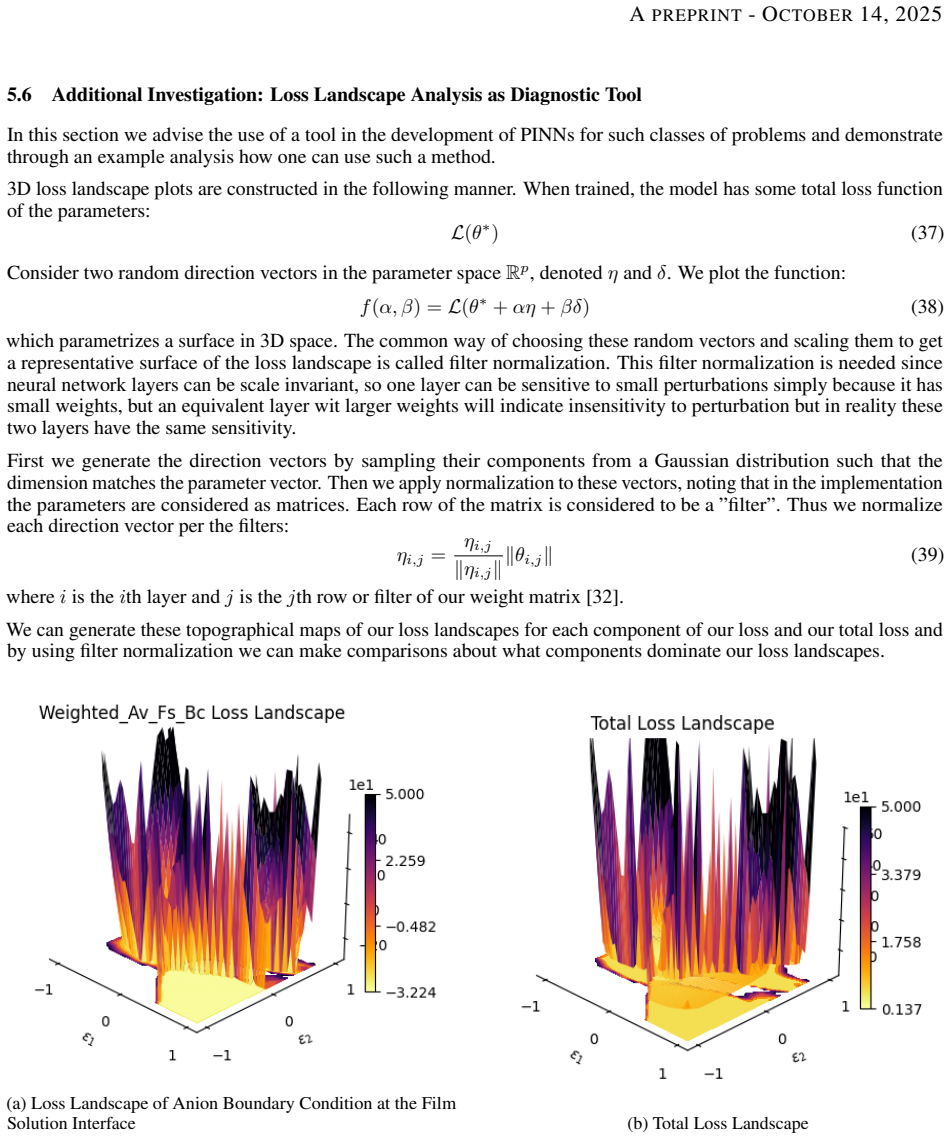
- The pure-PINN failure demonstrates that low training loss is not evidence of physical correctness; loss landscape analysis is proposed as a diagnostic to identify poorly satisfied constraints.
- The robustness check with five random anchor selections (<10% relative-error variation) suggests the hybrid method does not depend on a hand-picked anchor point, supporting the under-constraint interpretation.
- The paper recommends PINNs for sparse-data and inverse-problem settings and frames hybrid training as the practical near-term pathway until fully autonomous PINNs become possible.
Where Pith is reading between the lines
- If one anchor at 0.1 V suffices across 0.1–1.8 V, an active-learning strategy that picks the single most informative measurement could generalize the method to untested regimes or other materials, potentially eliminating the need for any FEM benchmark.
- The paper's own Table 1 lists 2.18% relative error at 1.6 V, contradicting the abstract's blanket 'sub 1%' claim; resolving this discrepancy (as an outlier or an average) would determine how the headline result should be quoted.
- The anchor's success hints that a global physical constraint (strict positivity of concentrations, or an integral charge balance) might tame the solution manifold and make the hybrid model fully autonomous.
- Pure-PINN overprediction grows with voltage (2,412% at 0.1 V to 5,708% at 1.0 V), suggesting the unconstrained network's preferred branch scales differently with potential; testing an anchor at higher voltage could reveal whether the low-voltage anchor is optimal or merely adequate.
Editorial analysis
A structured set of objections, weighed in public.
Referee Report
Summary. The manuscript develops a physics-informed neural network (PINN) approach to the Refined Point Defect Model (R-PDM) for electrochemical oxide film growth on iron in halide-free solutions. The authors identify four failure modes: imbalanced loss components, scale disparities, boundary-condition enforcement difficulties, and convergence to unphysical solution branches. They propose nondimensionalization, Neural Tangent Kernel (NTK)-based loss balancing, segregated network architectures, and hybrid training that adds a single supervised data point drawn from a finite-element (FEM) solution. The central claim is that pure PINNs overpredict film thickness by roughly 2,400–5,700%, while the hybrid PINN achieves 'sub 1%' relative error against FEM benchmarks across 0.1–1.8 V. The paper also documents unsuccessful attempts with Augmented Lagrangian methods, residual connections, and positivity-preserving output transformations, and recommends loss-landscape analysis as a diagnostic tool.
Significance. If fully supported, the result would be a valuable demonstration that a PINN with one data anchor can reproduce moving-boundary electrochemical film growth to engineering accuracy, and the paper gives a useful, systematic catalog of practical failure modes and mitigation strategies. The methodological contributions—nondimensionalization to extend stable simulation to 250 h, NTK-based loss rebalancing, and the single-anchor hybrid concept—are credible and worth pursuing. The authors also provide code via GitHub and promise organized supplementary materials. However, the current evidence does not fully support the headline claim. The abstract/conclusion assertion of 'sub 1%' errors is directly contradicted by the paper's own Table 1 (2.18% at 1.6 V). More importantly, the claim that one low-voltage anchor selects the correct physical branch across the entire voltage range is not established: the paper validates only the film thickness L(t), not the full concentration and potential fields, and the robustness check is a vague 'N=5' statement. The validation also relies exclusively on FEM data from a co-author's solver, which is the same source that supplied the anchor. These issues are
major comments (4)
- [Abstract and §6 (Conclusion), vs. §5.1 Table 1] The abstract claims 'sub 1% relative error' and the conclusion repeats 'errors below 1% across all tested voltages,' but Table 1 reports a Hybrid PINN error of 2.18% at 1.6 V. This is not a typographical nuance: the central quantitative claim of the paper depends on this bound. Please either correct the claim (e.g., 'below 2.2%') or specify the exact error metric and show how 2.18% is consistent with 'sub 1%'.
- [§5.1, Table 1, Fig. 4] A single anchor point (t=150000 s, E=0.1 V, L=1.27 nm) is claimed to select the physically correct solution branch across 0.1–1.8 V and 250 h. The pure-PINN overprediction factors vary strongly and nonlinearly with voltage (2412% at 0.1 V, 5708% at 1.0 V, 5001% at 1.8 V), so a low-voltage point does not trivially rescale all voltages. The reported robustness check ('N=5 random selections with relative error varying by less than 10%') gives no anchor locations, no uncertainty bounds, and no full-field comparison. Since Fig. 2 and §5.5.1 admit that the pure network has negative cation concentrations and non-linear potential profiles, the paper does not establish that the anchored network actually selects the physically realizable branch rather than merely matching L(t). Please provide full-field comparisons (potential and vacancy concentrations vs. FEM) and a more systematic anchor-sensiti
- [§5.1 and §6] The accuracy evaluation is performed against FEM benchmarks from Bösing's solver, which is the same source that provided the single supervised anchor. This is not strictly circular because only one point is used for training and the comparison is over full time traces, but the validation is not independent. Moreover, §3 states that the primary experimental metric is the polarization curve, yet no comparison to experimental polarization data is presented. Please report errors on withheld FEM runs/voltages (e.g., leave-one-voltage-out) and, if possible, compare predicted polarization curves to experimental data. Otherwise the 'prediction' claim is hard to separate from 'fitting the reference solver.'
- [§5.1, §5.5.1] The pure PINN solution is repeatedly described as 'mathematically valid' and the phrase 'successfully learning the physics' is used to motivate the single-anchor approach. However, the paper itself reports negative cation concentrations and non-linear potential profiles for the pure model, which are physically inadmissible, and no PDE-residual verification is shown for either the pure or hybrid solutions. The authors should either demonstrate pointwise PDE satisfaction (e.g., residual norms) or soften the 'mathematically valid' characterization. This distinction matters because the argument that one anchor suffices rests on the premise that the physics is already correctly encoded in the pure PINN.
minor comments (5)
- [Throughout] Typos and grammatical slips: 'necesary' (abstract), 'preditions' (§5.1), 'prescence' (§6.2), 'V oltage' (Table 1 header), and the duplicated 'the the' in §4.6. These should be corrected.
- [Eq. (27)] The NTK weight update formula as written, w_j = (1/µXj) Σ µXj, appears to give the same value for every j unless the sum is over j and the expression is meant to be normalized differently. Please clarify the normalization.
- [Fig. 2] The axis descriptions ('time evolution on y-axis, space on x-axis') are ambiguous. It would help to specify which field is shown and at which slices (constant time or constant potential) are plotted.
- [§5.1] The sentence 'This indicates that choosing the specific data point does dictate the level of accuracy' appears to contradict the preceding robustness claim that the result is not sensitive to the chosen point. Likely the intended meaning is 'does not dictate'; please rephrase.
- [Declarations] The data/code availability statements are inconsistent: 'Data and code will be made available' vs. 'Python implementation available at https://github.com/Feugmo-Group/PINNACLE'. Please state clearly what is available now, including a version/commit identifier.
Circularity Check
The 0.1 V hybrid result is partly a trained-on-the-benchmark fit; the cross-voltage generalization retains independent content.
specific steps
-
fitted input called prediction
[Section 5.1, Table 1; final Conclusion paragraph]
"To test this hypothesis and address catastrophic overprediction, we implemented hybrid training by augmenting the physics-informed losses with a single supervised data point from the FEM solution. The data point, selected at point (t= 150000s, E= 0.1V, L= 1.27nm). ... By incorporating a single supervised data point from validated FEM solutions, we achieved remarkable accuracy with errors below 1% across all tested voltages."
The single supervised anchor is drawn from the same FEM benchmark family against which the hybrid model is scored, so the comparison is not fully independent. At 0.1 V the paper itself observes that "almost no film growth is observed"; with L(t) nearly flat, the t=150000s, L=1.27nm anchor essentially fixes the 0.1 V thickness trajectory, making the reported 0.32% final-thickness error at 0.1 V a measure of how well the model retained its training anchor rather than an extrapolated prediction. The other voltage rows are not directly fitted, so the circularity is partial, but the headline 'sub 1% relative error as compared to Finite Element Benchmarks' is stated for the whole tested voltage set and thus depends in part on an anchor taken from the reference it is compared with.
full rationale
The core methodology—segregated PINN architecture, non-dimensionalization, NTK-based loss balancing, and the stated PDM equations—is not circular: NTK weighting is imported from an external source (Chen et al. [29]), the R-PDM is formulated in the cited Bosing work [10] and solved independently by FEM, and no uniqueness theorem is imported from the authors' own prior work. The main reduction to inputs is the hybrid anchor: one supervised point from the FEM solution is used in training, and the same FEM benchmark family is used for evaluation. This is most consequential at 0.1 V, where the paper notes that almost no film growth is observed, so the anchor at t=150000s, L=1.27nm effectively sets the flat thickness curve and the 0.32% error is not an independent prediction. For 0.4–1.8 V, the data are not directly fitted, and the N=5 random-anchor robustness test mitigates cherry-picking, so those results retain genuine predictive content. Separately, the conclusion's 'errors below 1% across all tested voltages' is inconsistent with Table 1's 2.18% at 1.6 V; that is a correctness/consistency issue rather than circularity. Overall, the central cross-voltage claim is not forced by construction, but the 0.1 V prediction and the blanket sub-1% headline are partially anchored to the reference they claim to reproduce.
Axiom & Free-Parameter Ledger
free parameters (2)
- Characteristic concentration scales c_c,cv and c_c,av =
1e-5 mol/m^3
- Single FEM anchor data point for hybrid training =
(t=150000 s, E=0.1 V, L=1.27 nm)
axioms (4)
- domain assumption R-PDM governing equations (Nernst-Planck, Poisson, Butler-Volmer, film-growth ODE) adequately model halide-free iron passivation.
- domain assumption The FEM solution by Bosing et al. is the correct reference solution.
- domain assumption The PINN architecture with NTK weighting can approximate the PDM solution sufficiently well when anchored.
- standard math Central Limit Theorem justifies the sampled NTK weight estimates.
Cite this review
Pith. "Pith review of A physics-informed neural network approach to the point defect model for electrochemical oxide film growth." pith.science (2026). https://pith.science/paper/SZ2XYKCF
@misc{pith2026251002872,
  author       = {Pith},
  title        = {Pith review of: A physics-informed neural network approach to the point defect model for electrochemical oxide film growth},
  year         = {2026},
  howpublished = {\url{https://pith.science/paper/SZ2XYKCF}},
  note         = {Machine review of arXiv:2510.02872}
}
abstract
Physics-informed neural networks (PINNs) offer a novel AI-driven framework for integrating physical laws directly into neural network models, facilitating the solution of complex multiphysics problems in materials engineering. This study systematically explores the application of PINNs to simulate oxide film layer growth in halide-free solutions using the point defect model (PDM). We identify and analyze four key failure modes in this context: imbalanced loss components across different physical processes, numerical instabilities due to variable scale disparities, challenges in enforcing boundary conditions within multiphysics systems, and convergence to mathematically valid but physically meaningless solutions. To overcome these challenges, we implement and validate established techniques including nondimensionalization for training stabilization, Neural Tangent Kernel-based adaptive loss balancing, robust enforcement of boundary conditions and hybrid training with sparse data. Our results demonstrate the effectiveness of these strategies in enhancing the reliability and physical fidelity of PINNs, achieving sub $1\%$ relative error as compared to Finite Element Benchmarks with the hybrid model. Thereby showing that PINNs can be used for high fidelity electrochemical simulations with minimal data requirements and highlight necesary factors for fully autonomous PINN simulations.
Figures


Reference graph
Works this paper leans on
-
[1]
Iannuzzi and G
M. Iannuzzi and G. S. Frankel. The carbon footprint of steel corrosion.npj Materials Degradation, 6:101, 2022
2022
-
[2]
Sustainable corrosion inhibitors: A key step towards environmentally responsible corrosion control.Ain Shams Engineering Journal, 15(5):102672, 2024
Ahmed Al-Amiery, Wan Nor Roslam Wan Isahak, and Waleed Khalid Al-Azzawi. Sustainable corrosion inhibitors: A key step towards environmentally responsible corrosion control.Ain Shams Engineering Journal, 15(5):102672, 2024
2024
-
[3]
Singh and E
T. Singh and E. Kohn. Harsh Environment Materials. InReference Module in Materials Science and Materials Engineering. Elsevier, January 2016
2016
-
[4]
Fu, Pakpoom Buabthong, Zachary Philip Ifkovits, Weilai Yu, Bruce S
Harold J. Fu, Pakpoom Buabthong, Zachary Philip Ifkovits, Weilai Yu, Bruce S. Brunschwig, and Nathan S. Lewis. Catalytic open-circuit passivation by thin metal oxide films of p-si anodes in aqueous alkaline electrolytes. Energy & Environmental Science, 15(1):334–345, 2021
2021
-
[5]
Origin of nanoscale heterogeneity in the surface oxide film protecting stainless steel against corrosion.npj Materials Degradation, 3(1):29, 2019
Li Ma, Fr´ed´eric Wiame, Vincent Maurice, and Philippe Marcus. Origin of nanoscale heterogeneity in the surface oxide film protecting stainless steel against corrosion.npj Materials Degradation, 3(1):29, 2019
2019
-
[6]
Current developments of nanoscale insight into corrosion protection by passive oxide films.Current Opinion in Solid State and Materials Science, 22(4):156–167, 2018
Vincent Maurice and Philippe Marcus. Current developments of nanoscale insight into corrosion protection by passive oxide films.Current Opinion in Solid State and Materials Science, 22(4):156–167, 2018
2018
-
[7]
Macdonald
Digby D. Macdonald. The history of the Point Defect Model for the passive state: A brief review of film growth aspects.Electrochimica Acta, 56(4):1761–1772, January 2011
2011
-
[8]
Oxide Film Growth Kinetics on Metals and Alloys: I
Antoine Seyeux, Vincent Maurice, and Philippe Marcus. Oxide Film Growth Kinetics on Metals and Alloys: I. Physical Model.Journal of The Electrochemical Society, 160(6):C189–C196, 2013
2013
-
[9]
Oxide Film Growth Kinetics on Metals and Alloys: II
Kirsten Leistner, Charles Toulemonde, Boubakar Diawara, Antoine Seyeux, and Philippe Marcus. Oxide Film Growth Kinetics on Metals and Alloys: II. Numerical Simulation of Transient Behavior.Journal of The Electrochemical Society, 160(6):C197–C205, 2013
2013
-
[10]
Modeling electrochemical oxide film growth—passive and transpassive behavior of iron electrodes in halide-free solution.npj Materials Degradation, 7(1):53, June 2023
Ingmar B¨osing. Modeling electrochemical oxide film growth—passive and transpassive behavior of iron electrodes in halide-free solution.npj Materials Degradation, 7(1):53, June 2023
2023
-
[11]
Modeling and simulation of passive film formation and breakdown in chloride ion containing electrolytes – a point defect model extension.Corrosion Science, 256:113166, 2025
Nikos Alexiadis, Alexander Fuchs, Torsten Troßmann, Ingmar B ¨osing, Jorg Th ¨oming, and Fabio La Mantia. Modeling and simulation of passive film formation and breakdown in chloride ion containing electrolytes – a point defect model extension.Corrosion Science, 256:113166, 2025
2025
-
[12]
Macdonald, Jie Yang, Jie Qiu, and Shuzhong Wang
Yanhui Li, Digby D. Macdonald, Jie Yang, Jie Qiu, and Shuzhong Wang. Point defect model for the corrosion of steels in supercritical water: Part I, film growth kinetics.Corrosion Science, 163:108280, 2020
2020
-
[13]
Kolotinskii, V .S
D.A. Kolotinskii, V .S. Nikolaev, V .V . Stegailov, and A.V . Timofeev. Point Defect Model for the kinetics of oxide film growth on the surface of T91 steel in contact with lead–bismuth eutectic.Corrosion Science, 211:110829, 2023
2023
-
[14]
Modeling of a growing oxide film: The iron/iron oxide system.Journal of The Electrochemical Society, 142(5):1423–1430, 1995
Vincent Battaglia and John Newman. Modeling of a growing oxide film: The iron/iron oxide system.Journal of The Electrochemical Society, 142(5):1423–1430, 1995
1995
-
[15]
Engelhardt, Dihao Chen, Chaofang Dong, and Digby D
George R. Engelhardt, Dihao Chen, Chaofang Dong, and Digby D. Macdonald. Estimation of some parameters in the point defect model (PDM) for the passivity of metals.Journal of The Electrochemical Society, 171(3):031503, 2024
2024
-
[16]
Bataillon, F
C. Bataillon, F. Bouchon, C. Chainais-Hillairet, J. Fuhrmann, E. Hoarau, and R. Touzani. Numerical methods for the simulation of a corrosion model with moving oxide layer.Journal of Computational Physics, 231(18):6213– 6231, 2012
2012
-
[17]
Macdonald
Li Sun, Tianyu Zhao, Jie Qiu, Yangting Sun, Kuijiao Li, Haibing Zheng, Yiming Jiang, Yanhui Li, Jin Li, Weihua Li, and Digby D. Macdonald. Point defect model for passivity breakdown on hyper-duplex stainless steel 2707 in solutions containing bromide at different temperatures.Corrosion Science, 194:109959, 2022. 21 APREPRINT- OCTOBER14, 2025
2022
-
[18]
Raissi, P
M. Raissi, P. Perdikaris, and G. E. Karniadakis. Physics-informed neural networks: A deep learning framework for solving forward and inverse problems involving nonlinear partial differential equations.Journal of Computational Physics, 378:686–707, February 2019
2019
-
[19]
Reyhaneh Taj. Physics-Informed Neural Networks for Electrical Circuit Analysis: Applications in Dielectric Material Modeling, November 2024. arXiv:2411.10483 [cs]
Pith/arXiv arXiv 2024
-
[20]
PF-PINNs: Physics-informed neural networks for solving coupled allen-cahn and cahn-hilliard phase field equations.Journal of Computational Physics, 529:113843, 2025
Nanxi Chen, Sergio Lucarini, Rujin Ma, Airong Chen, and Chuanjie Cui. PF-PINNs: Physics-informed neural networks for solving coupled allen-cahn and cahn-hilliard phase field equations.Journal of Computational Physics, 529:113843, 2025
2025
-
[21]
Predicting voltammetry using physics-informed neural networks.The Journal of Physical Chemistry Letters, 13(2):536–543, 2022
Haotian Chen, Enno K¨atelh¨on, and Richard G Compton. Predicting voltammetry using physics-informed neural networks.The Journal of Physical Chemistry Letters, 13(2):536–543, 2022
2022
-
[22]
Haotian Chen, Enno K¨atelh¨on, and Richard G. Compton. The application of physics-informed neural networks to hydrodynamic voltammetry.Analyst, 147:1881–1891, 2022
2022
-
[23]
Nair, Sepehr Maleki, and Senthil K
Afila Ajithkumar Sophiya, Akarsh K. Nair, Sepehr Maleki, and Senthil K. Krishnababu. A comprehensive analysis of PINNs: Variants, Applications, and Challenges, May 2025. arXiv:2505.22761 [cs]
Pith/arXiv arXiv 2025
-
[24]
A physics- informed neural network framework for multi-physics coupling microfluidic problems.Computers & Fluids, 284:106421, November 2024
Runze Sun, Hyogu Jeong, Jiachen Zhao, Yixing Gou, Emilie Sauret, Zirui Li, and Yuantong Gu. A physics- informed neural network framework for multi-physics coupling microfluidic problems.Computers & Fluids, 284:106421, November 2024
2024
-
[25]
Shivprasad Kathane and Shyamprasad Karagadde. A Physics Informed Neural Network (PINN) Methodology for Coupled Moving Boundary PDEs, September 2024. arXiv:2409.10910 [cs]
Pith/arXiv arXiv 2024
-
[26]
Ali Al-Safwan, Chao Song, and Umair bin Waheed. Is it time to swish? Comparing activation functions in solving the Helmholtz equation using physics-informed neural networks, October 2021. arXiv:2110.07721 [physics]
Pith/arXiv arXiv 2021
-
[27]
A comparative study of dimensional and non-dimensional inputs in physics-informed and data-driven neural networks for single-droplet evaporation
Narjes Malekjani, Abdolreza Kharaghani, and Evangelos Tsotsas. A comparative study of dimensional and non-dimensional inputs in physics-informed and data-driven neural networks for single-droplet evaporation. Chemical Engineering Science, 306:121214, 2025
2025
-
[28]
Neural Tangent Kernel: Convergence and Generalization in Neural Networks, February 2020
Arthur Jacot, Franck Gabriel, and Cl´ement Hongler. Neural Tangent Kernel: Convergence and Generalization in Neural Networks, February 2020. arXiv:1806.07572 [cs]
Pith/arXiv arXiv 2020
-
[29]
PF-PINNs: Physics-informed neural networks for solving coupled Allen-Cahn and Cahn-Hilliard phase field equations.Journal of Computational Physics, 529:113843, May 2025
Nanxi Chen, Sergio Lucarini, Rujin Ma, Airong Chen, and Chuanjie Cui. PF-PINNs: Physics-informed neural networks for solving coupled Allen-Cahn and Cahn-Hilliard phase field equations.Journal of Computational Physics, 529:113843, May 2025
2025
-
[30]
Hwijae Son, Sung Woong Cho, and Hyung Ju Hwang. Enhanced Physics-Informed Neural Networks with Augmented Lagrangian Relaxation Method (AL-PINNs), May 2023. arXiv:2205.01059 [cs]
Pith/arXiv arXiv 2023
-
[31]
PHYSICS-INFORMED NEURAL NETWORKS WITH CURRICULUM TRAINING FOR POROELASTIC FLOW AND DEFORMATION PROCESSES
Yared W Bekele. PHYSICS-INFORMED NEURAL NETWORKS WITH CURRICULUM TRAINING FOR POROELASTIC FLOW AND DEFORMATION PROCESSES. 2024
2024
-
[32]
Visualizing the Loss Landscape of Neural Nets, November 2018
Hao Li, Zheng Xu, Gavin Taylor, Christoph Studer, and Tom Goldstein. Visualizing the Loss Landscape of Neural Nets, November 2018. arXiv:1712.09913 [cs]
Pith/arXiv arXiv 2018
-
[33]
Deep Residual Learning for Image Recognition, December 2015
Kaiming He, Xiangyu Zhang, Shaoqing Ren, and Jian Sun. Deep Residual Learning for Image Recognition, December 2015. arXiv:1512.03385 [cs]
Pith/arXiv arXiv 2015
-
[34]
Investigating and Mitigating Failure Modes in Physics-informed Neural Networks (PINNs)
Shamsulhaq Basir. Investigating and Mitigating Failure Modes in Physics-informed Neural Networks (PINNs). Communications in Computational Physics, 33(5):1240–1269, January 2023. arXiv:2209.09988 [cs]
Pith/arXiv arXiv 2023
-
[35]
Achieving High Accuracy with PINNs via Energy Natural Gradients, August 2023
Johannes M¨uller and Marius Zeinhofer. Achieving High Accuracy with PINNs via Energy Natural Gradients, August 2023. arXiv:2302.13163 [cs]
Pith/arXiv arXiv 2023
-
[36]
Improving Energy Natural Gradient Descent through Woodbury, Momentum, and Randomization, May 2025
Andr´es Guzm´an-Cordero, Felix Dangel, Gil Goldshlager, and Marius Zeinhofer. Improving Energy Natural Gradient Descent through Woodbury, Momentum, and Randomization, May 2025. arXiv:2505.12149 [cs]
arXiv 2025
-
[37]
Zhaoyang Zhang, Qingwang Wang, Yinxing Zhang, Tao Shen, and Weiyi Zhang. Physics-informed neural networks with hybrid Kolmogorov-Arnold network and augmented Lagrangian function for solving partial differential equations.Scientific Reports, 15(1):10523, March 2025. Publisher: Nature Publishing Group
2025
-
[38]
From PINNs to PIKANs: Recent Advances in Physics-Informed Machine Learning, October 2024
Juan Diego Toscano, Vivek Oommen, Alan John Varghese, Zongren Zou, Nazanin Ahmadi Daryakenari, Chenxi Wu, and George Em Karniadakis. From PINNs to PIKANs: Recent Advances in Physics-Informed Machine Learning, October 2024. arXiv:2410.13228 [cs]
Pith/arXiv arXiv 2024
-
[39]
Ben Moseley, Andrew Markham, and Tarje Nissen-Meyer. Finite Basis Physics-Informed Neural Networks (FBPINNs): a scalable domain decomposition approach for solving differential equations.Advances in Computa- tional Mathematics, 49(4), August 2023. arXiv:2107.07871 [physics]. 22
Pith/arXiv arXiv 2023
This paper was first reviewed by deepseek-v4-flash on August 4, 2026.
discussion (0)
Sign in with ORCID, Apple, or X to comment. Anyone can read and Pith papers without signing in.