REVIEW 4 major objections 4 minor 60 references
Curvature-aware noise correlations improve DP-SGD accuracy by 1–4% at the same privacy budget.
Reviewed by Pith at T0; open to challenge. T0 means a machine referee read the full paper against a public rubric. the ladder, T0–T4 →
T0 review · deepseek-v4-flash
2026-08-04 11:19 UTC pith:DZE5M26N
load-bearing objection Genuinely new curvature-aware DP-MF objective with a clean quadratic theorem, but the reported privacy budget ignores the cost of tuning on a private validation split, so the equal-privacy comparison is optimistic. the 4 major comments →
Correlating Cross-Iteration Noise for DP-SGD using Model Curvature
The pith
A machine-rendered reading of the paper's core claim, the machinery that carries it, and where it could break.
Core claim
The paper's central claim is that cross-iteration noise correlation for DP-SGD should minimize a curvature-aware trace objective rather than the data-independent energy objective used by prior DP-MF methods. For a quadratic loss the paper proves E[L(w̃_T)] − E[L(w_T)] = (η²/2) Tr(X⁻¹(Vᵀ M V)), where X is the Gram matrix of the noise-mixing matrix, M is the diagonal matrix of Hessian eigenvalues, and V encodes the powers (1−ηµᵢ)^{T−j−1}. Minimizing this trace over diagonal-one, positive-definite, banded X yields the mixing matrix C. The paper then argues a single representative Hessian—estimated from public unlabeled data after self-supervised pretraining, with negative eigenvalues zeroed and
What carries the argument
The load-bearing object is the identity of Theorem 1: E[L(w̃_T)] − E[L(w_T)] = (η²/2) Tr(X⁻¹(Vᵀ M V)). Here X = CᵀC is the Gram matrix of the noise-mixing matrix, M = Diag(µ₀,…,µ_{p−1}) holds the Hessian eigenvalues, and V[i,j] = (1−ηµᵢ)^{T−j−1} propagates earlier noise through the iterates. This identity reduces the design of noise correlations to a convex trace-minimization problem with banded, diagonal-one, positive-definite constraints, and it is why only Hessian eigenvalues, not the full Hessian, are needed. The supporting machinery makes this practical: pretraining on public data yields a stable representative spectrum, zeroing negative eigenvalues restores convexity, and a power-law c
Load-bearing premise
The Hessian eigenvalue spectrum estimated once from public data after pretraining remains representative of the spectra seen during private training; the paper gives empirical support but no formal analysis, and its own limitations section says it is unclear whether this holds beyond vision.
What would settle it
Measure the actual Hessian spectra along the private training trajectory on a language or tabular task and compare the accuracy of correlations optimized from the public-data spectrum against the previous data-independent objective; if spectra drift markedly or the accuracy gain disappears, the central claim fails.
If this is right
- Using NoiseCurve as the objective inside the DP-MF framework yields 1–4% higher test accuracy than DP-SGD and the previous banded-MF baseline across every privacy budget tested, with no additional privacy loss.
- Curvature information from public unlabeled data—even from a different domain, such as a general vision dataset for chest X-rays—remains informative enough to improve noise correlations.
- The method works across convex last-layer finetuning, small non-convex CNNs, full VGG training, and LoRA finetuning of a vision transformer, indicating it is not tied to one architecture.
- Because the change is only in the objective and the feasible set is unchanged, NoiseCurve can be dropped into existing DP-MF implementations and privacy accounting.
- The eigenvalue curve-fitting approximation extends the method to models where full Hessian eigen-decomposition is infeasible, at a small accuracy cost compared to using the true spectrum.
Where Pith is reading between the lines
- Inference: If the Hessian spectrum is indeed governed mostly by architecture rather than data, the same optimized correlation matrix could be reused across tasks for a fixed architecture, turning the one-time public-data computation into a reusable artifact.
- Inference: The quadratic derivation suggests the curvature-weighted trace objective could also improve other correlated-noise mechanisms, not only the banded form tested here.
- Inference: The paper's stability evidence is short-horizon; a natural extension is to re-estimate the spectrum periodically during training and check whether adaptive correlation matrices beat the fixed one.
- Inference: The power-law tail fit, treated by the authors as an orthogonal contribution, could serve other applications that need Hessian spectral information; its main risk is sensitivity to the chosen endpoint (p₊, µ_p₊).
Editorial analysis
A structured set of objections, weighed in public.
Referee Report
Summary. The paper proposes NoiseCurve, a method for improving DP-SGD by correlating the privacy noise across iterations using Hessian curvature information. In the idealized quadratic-loss case, Theorem 1 derives the expected loss gap between correlated-noise gradient descent and noise-free gradient descent in terms of the Hessian eigenvalues and the matrix X = C^T C, yielding Problem P1: minimize Tr((V^T M V)X^{-1}) subject to diag(X)=1, X positive definite, and b-banded. The authors then propose practical solutions for using public unlabeled data to estimate eigenvalues, coping with non-constant Hessians, zeroing negative eigenvalues, and approximating spectra via curve fitting. Experiments on CIFAR-10 and ChestX-ray14 with various models and privacy budgets report consistent accuracy improvements over DP-SGD and DP-BandMF. The paper explicitly acknowledges limitations regarding public-data dependence and eigenvalue approximation.
Significance. If the empirical comparisons are at the claimed privacy level, this is a useful contribution: the quadratic derivation is clean and the proposed objective is a natural, principled replacement for the DP-MF heuristic. The paper also includes a self-contained proof of Theorem 1, a drop-in integration with the DP-BandMF framework, and a range of experiments. However, the central equal-privacy-budget claim is currently undermined by validation-set hyperparameter tuning on private data that is not charged to the privacy budget. The representative-spectrum assumption is also load-bearing and is only empirically supported in a limited vision setting, as the limitations section itself concedes. With corrections to the privacy accounting and a sensitivity analysis of the spectrum assumption, the contribution would be significant.
major comments (4)
- [§5, §D.1] The privacy accounting for hyperparameter selection is missing. The paper states 'we split 10% of data samples from training sets as validation sets and tune hyperparameters on validation sets' and Appendix D.1 says Optuna searches learning rate, clip norm, and band size (and, in effect, p+ and mu_p+). These validation data are drawn from the private training set. The reported (epsilon,delta) guarantee is computed for the final training run only; the selection of hyperparameters is a data-dependent computation on private data with no privacy charge. Therefore the claim that NoiseCurve improves over DP-SGD and DP-BandMF at the same privacy budget is not currently supported. The fact that all baselines are tuned the same way does not restore the absolute guarantee. Please either (a) include the selection procedure in the privacy analysis and report the total epsilon, (b) tune on public dat
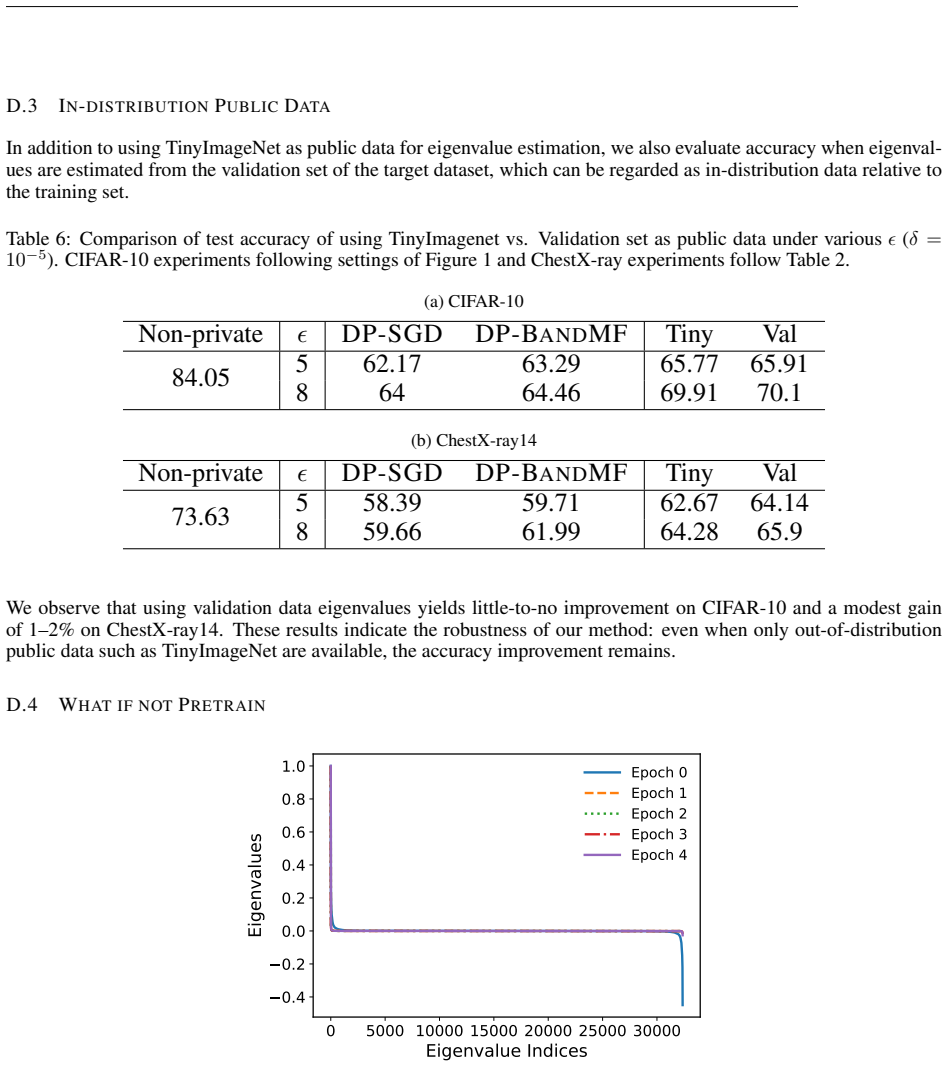
- [§4.2, §6] The load-bearing premise that a single Hessian eigenspectrum computed once from public data after SimCLR pretraining is representative along the private training trajectory is supported only by Figure 3 for one small CNN, and the limitations section explicitly states there is no formal analysis and it is unclear whether it holds outside vision. Since Problem P1 fixes M, an unrepresentative spectrum will miscalibrate C. I ask for a sensitivity analysis: vary the spectrum (e.g., using spectra taken at different training epochs, or perturbing the eigenvalues) and report the resulting accuracy. This is a correctness-risk concern, not a circularity objection, but it is central to the claim that NoiseCurve is a generally applicable drop-in replacement.
- [§4.4, Table 3] The curve-fitting validation in Table 3 is not convincing as presented. The 'Fit' row values (122, 5.59, 479, 20, 140, 285 for k=100,...,3000) are non-monotone in k, and no error bars, standard deviations, or number of runs are given. Some entries make it appear that more eigenvalues can hurt the fitted solution. Please clarify what these numbers represent (one run? mean over runs?), report variance, and explain the non-monotonicity. This matters because S4 is the scalability contribution for large models.
- [§4.3] Replacing negative eigenvalues with zero is justified empirically by the observation that they are small after pretraining, but Problem P1 is derived for a positive semidefinite Hessian. The paper should state explicitly that clamping negative eigenvalues to zero is a heuristic modification of the quadratic-loss objective, and provide evidence on how sensitive P1's solution is to the exact truncation. An ablation with different thresholds or with small positive floors would clarify whether the convexification step introduces a significant gap between Theorem 1 and the algorithm used in practice.
minor comments (4)
- [Table 3 / Appendix C] The row entries in Table 3 lack column separators, and the introductory sentence 'reduction-in-objective of different with respect to k' is garbled. Please reformat and rephrase.
- [Eq. (2)] State the domain of alpha (presumably negative) and clarify that C and alpha are fitted constants. Note that at i = p+, the formula is independent of C and alpha, so the endpoint mu_p+ is a free parameter.
- [Figure 3] The caption 'epoch 0 and epoch 1' is ambiguous; clarify whether these are checkpoints at initialization and after one epoch of training, and whether pretraining is included.
- [Appendix D.2] Table 5, which tunes on the test set, is explicitly acknowledged as bad practice. Please add a sentence noting that these results are not comparable to the main tables and should not be used to support the central equal-privacy claim.
Circularity Check
No material circularity: closed-form objective, public-data curvature, and external accuracy benchmarks; only a minor non-load-bearing self-citation.
full rationale
The paper's central derivation is self-contained rather than circular. Theorem 1 is a closed-form computation of expected excess loss for quadratic losses with correlated noise; it does not assume the accuracy improvements it is later used to motivate. Problem P1 is then obtained by substituting this exact expression into the DP-BandMF feasibility constraints, so the objective is not defined in terms of the accuracy numbers it is claimed to predict. The curvature input M is estimated from unlabeled public data (TinyImageNet) and not fit to test accuracy; the spectrum curve-fitting in Section 4.4 fits only eigenvalue tails and is validated separately in Table 3 by objective reduction, not by circular reuse of the target result. The accuracy comparisons in Section 5 are external benchmark measurements, so the central claim does not reduce to its inputs. The only overlapping self-citation is Gu et al. (2025), used in Appendix D.1 as a recommendation to finetune parameters on public data first; this is not load-bearing because the paper supplies independent empirical support for pretraining (Figures 3 and 5, Table 7) and because it does not justify the core curvature-correlation claim. The paper's stated limitations—no formal analysis of public-data dependence and limited validation of the eigenvalue approximation—are empirical-validity gaps, not circularity. A separate privacy-accounting concern (validation-set hyperparameter tuning not charged to epsilon) is a correctness risk rather than a derivation-equivalence or circularity issue, so it does not raise the circularity score.
Axiom & Free-Parameter Ledger
free parameters (7)
- Hessian eigenvalues μ_i =
estimated from public TinyImageNet
- Top-k count k =
300–2000
- Curve-fit coefficients C and α =
not reported
- Tail endpoint index p+ =
100k–200k (range)
- Tail endpoint eigenvalue μp+ =
10^-5–10^-6
- Learning rate η =
searched [0.1, 1.0]
- Band size b =
searched [1, 20]
axioms (5)
- domain assumption Quadratic loss with fixed PSD Hessian is an adequate proxy for designing C in real DNN training.
- domain assumption Hessian eigenspectrum estimated from public data after SimCLR pretraining is representative of the private training trajectory and is stable.
- domain assumption Negative Hessian eigenvalues can be replaced by zero without materially changing the quality of C.
- standard math DP-BandMF privacy amplification and Opacus accounting remain valid when X is optimized with the new objective.
- ad hoc to paper Tuning hyperparameters on a validation set split from private training data does not consume the privacy budget.
read the original abstract
Differentially private stochastic gradient descent (DP-SGD) offers the promise of training deep learning models while mitigating many privacy risks. However, there is currently a large accuracy gap between DP-SGD and normal SGD training. This has resulted in different lines of research investigating orthogonal ways of improving privacy-preserving training. One such line of work, known as DP-MF, correlates the privacy noise across different iterations of stochastic gradient descent -- allowing later iterations to cancel out some of the noise added to earlier iterations. In this paper, we study how to improve this noise correlation. We propose a technique called NoiseCurve that uses model curvature, estimated from public unlabeled data, to improve the quality of this cross-iteration noise correlation. Our experiments on various datasets, models, and privacy parameters show that the noise correlations computed by NoiseCurve offer consistent and significant improvements in accuracy over the correlation scheme used by DP-MF.
Figures


Reference graph
Works this paper leans on
-
[1]
write newline
" write newline "" before.all 'output.state := FUNCTION n.dashify 't := "" t empty not t #1 #1 substring "-" = t #1 #2 substring "--" = not "--" * t #2 global.max substring 't := t #1 #1 substring "-" = "-" * t #2 global.max substring 't := while if t #1 #1 substring * t #2 global.max substring 't := if while FUNCTION format.date year duplicate empty "emp...
-
[2]
@esa (Ref
\@ifxundefined[1] #1\@undefined \@firstoftwo \@secondoftwo \@ifnum[1] #1 \@firstoftwo \@secondoftwo \@ifx[1] #1 \@firstoftwo \@secondoftwo [2] @ #1 \@temptokena #2 #1 @ \@temptokena \@ifclassloaded agu2001 natbib The agu2001 class already includes natbib coding, so you should not add it explicitly Type <Return> for now, but then later remove the command n...
-
[3]
\@lbibitem[] @bibitem@first@sw\@secondoftwo \@lbibitem[#1]#2 \@extra@b@citeb \@ifundefined br@#2\@extra@b@citeb \@namedef br@#2 \@nameuse br@#2\@extra@b@citeb \@ifundefined b@#2\@extra@b@citeb @num @parse #2 @tmp #1 NAT@b@open@#2 NAT@b@shut@#2 \@ifnum @merge>\@ne @bibitem@first@sw \@firstoftwo \@ifundefined NAT@b*@#2 \@firstoftwo @num @NAT@ctr \@secondoft...
-
[4]
@open @close @open @close and [1] URL: #1 \@ifundefined chapter * \@mkboth \@ifxundefined @sectionbib * \@mkboth * \@mkboth\@gobbletwo \@ifclassloaded amsart * \@ifclassloaded amsbook * \@ifxundefined @heading @heading NAT@ctr thebibliography [1] @ \@biblabel @NAT@ctr \@bibsetup #1 @NAT@ctr @ @openbib .11em \@plus.33em \@minus.07em 4000 4000 `\.\@m @bibit...
2026
-
[5]
Brendan McMahan, Ilya Mironov, Kunal Talwar, and Li Zhang
Martin Abadi, Andy Chu, Ian Goodfellow, H. Brendan McMahan, Ilya Mironov, Kunal Talwar, and Li Zhang. Deep learning with differential privacy. In Proceedings of the 2016 ACM SIGSAC Conference on Computer and Communications Security, CCS '16, pp.\ 308–318, New York, NY, USA, 2016. Association for Computing Machinery. ISBN 9781450341394. doi:10.1145/2976749...
arXiv 2016
-
[6]
Optuna: A next-generation hyperparameter optimization framework
Takuya Akiba, Shotaro Sano, Toshihiko Yanase, Takeru Ohta, and Masanori Koyama. Optuna: A next-generation hyperparameter optimization framework. In Proceedings of the 25th ACM SIGKDD International Conference on Knowledge Discovery and Data Mining , 2019
2019
-
[7]
Privacy amplification via random check-ins
Borja Balle, Peter Kairouz, Brendan McMahan, Om Thakkar, and Abhradeep Guha Thakurta. Privacy amplification via random check-ins. Advances in neural information processing systems, 33: 0 4623--4634, 2020
2020
-
[8]
Automatic clipping: Differentially private deep learning made easier and stronger
Zhiqi Bu, Yu-Xiang Wang, Sheng Zha, and George Karypis. Automatic clipping: Differentially private deep learning made easier and stronger. Advances in Neural Information Processing Systems, 36: 0 41727--41764, 2023 a
2023
-
[9]
Differentially private optimization on large model at small cost
Zhiqi Bu, Yu-Xiang Wang, Sheng Zha, and George Karypis. Differentially private optimization on large model at small cost. In International Conference on Machine Learning, pp.\ 3192--3218. PMLR, 2023 b
2023
-
[10]
A simple framework for contrastive learning of visual representations
Ting Chen, Simon Kornblith, Mohammad Norouzi, and Geoffrey Hinton. A simple framework for contrastive learning of visual representations. In Hal Daumé III and Aarti Singh (eds.), Proceedings of the 37th International Conference on Machine Learning, volume 119 of Proceedings of Machine Learning Research, pp.\ 1597--1607. PMLR, 13--18 Jul 2020. URL https://...
2020
-
[11]
Choquette-Choo, Arun Ganesh, Ryan McKenna, Hugh Brendan McMahan, J Keith Rush, Abhradeep Guha Thakurta, and Zheng Xu
Christopher A. Choquette-Choo, Arun Ganesh, Ryan McKenna, Hugh Brendan McMahan, J Keith Rush, Abhradeep Guha Thakurta, and Zheng Xu. (amplified) banded matrix factorization: A unified approach to private training. In Thirty-seventh Conference on Neural Information Processing Systems, 2023 a . URL https://openreview.net/forum?id=zEm6hF97Pz
2023
-
[12]
Choquette-Choo, H
Christopher A. Choquette-Choo, H. Brendan McMahan, Keith Rush, and Abhradeep Thakurta. Multi-epoch matrix factorization mechanisms for private machine learning. In Proceedings of the 40th International Conference on Machine Learning, ICML'23. JMLR.org, 2023 b
2023
-
[13]
Mind the privacy unit! user-level differential privacy for language model fine-tuning
Lynn Chua, Badih Ghazi, Yangsibo Huang, Pritish Kamath, Ravi Kumar, Daogao Liu, Pasin Manurangsi, Amer Sinha, and Chiyuan Zhang. Mind the privacy unit! user-level differential privacy for language model fine-tuning. arXiv preprint arXiv:2406.14322, 2024 a
Pith/arXiv arXiv 2024
-
[14]
Scalable DP - SGD : Shuffling vs
Lynn Chua, Badih Ghazi, Pritish Kamath, Ravi Kumar, Pasin Manurangsi, Amer Sinha, and Chiyuan Zhang. Scalable DP - SGD : Shuffling vs. poisson subsampling. In The Thirty-eighth Annual Conference on Neural Information Processing Systems, 2024 b . URL https://openreview.net/forum?id=6gMnj9oc6d
2024
-
[15]
Unlocking high-accuracy differentially private image classification through scale
Soham De, Leonard Berrada, Jamie Hayes, Samuel L Smith, and Borja Balle. Unlocking high-accuracy differentially private image classification through scale. arXiv preprint arXiv:2204.13650, 2022
Pith/arXiv arXiv 2022
-
[16]
Brendan McMahan, John Rush, Adam Smith, and Abhradeep Guha Thakurta
Sergey Denisov, H. Brendan McMahan, John Rush, Adam Smith, and Abhradeep Guha Thakurta. Improved differential privacy for sgd via optimal private linear operators on adaptive streams. In S. Koyejo, S. Mohamed, A. Agarwal, D. Belgrave, K. Cho, and A. Oh (eds.), Advances in Neural Information Processing Systems, volume 35, pp.\ 5910--5924. Curran Associates...
2022
-
[17]
An image is worth 16x16 words: Transformers for image recognition at scale
Alexey Dosovitskiy, Lucas Beyer, Alexander Kolesnikov, Dirk Weissenborn, Xiaohua Zhai, Thomas Unterthiner, Mostafa Dehghani, Matthias Minderer, Georg Heigold, Sylvain Gelly, Jakob Uszkoreit, and Neil Houlsby. An image is worth 16x16 words: Transformers for image recognition at scale. CoRR, abs/2010.11929, 2020. URL https://arxiv.org/abs/2010.11929
Pith/arXiv arXiv 2010
-
[18]
Brendan McMahan, Krishna Pillutla, Thomas Steinke, and Abhradeep Thakurta
Krishnamurthy Dj Dvijotham, H. Brendan McMahan, Krishna Pillutla, Thomas Steinke, and Abhradeep Thakurta. Efficient and near-optimal noise generation for streaming differential privacy. In 2024 IEEE 65th Annual Symposium on Foundations of Computer Science (FOCS), pp.\ 2306--2317, 2024. doi:10.1109/FOCS61266.2024.00135
arXiv 2024
-
[19]
Our data, ourselves: privacy via distributed noise generation
Cynthia Dwork, Krishnaram Kenthapadi, Frank McSherry, Ilya Mironov, and Moni Naor. Our data, ourselves: privacy via distributed noise generation. In Proceedings of the 24th Annual International Conference on The Theory and Applications of Cryptographic Techniques, EUROCRYPT'06, pp.\ 486–503, Berlin, Heidelberg, 2006 a . Springer-Verlag. ISBN 3540345469. d...
-
[20]
Calibrating noise to sensitivity in private data analysis
Cynthia Dwork, Frank McSherry, Kobbi Nissim, and Adam Smith. Calibrating noise to sensitivity in private data analysis. In Shai Halevi and Tal Rabin (eds.), Theory of Cryptography, pp.\ 265--284, Berlin, Heidelberg, 2006 b . Springer Berlin Heidelberg. ISBN 978-3-540-32732-5
2006
-
[21]
Privacy amplification by random allocation, 2025
Vitaly Feldman and Moshe Shenfeld. Privacy amplification by random allocation, 2025. URL https://arxiv.org/abs/2502.08202
arXiv 2025
-
[22]
Tighter privacy analysis for truncated poisson sampling
Arun Ganesh. Tighter privacy analysis for truncated poisson sampling. arXiv preprint arXiv:2508.15089, 2025
Pith/arXiv arXiv 2025
-
[23]
Faster differentially private convex optimization via second-order methods
Arun Ganesh, Mahdi Haghifam, Thomas Steinke, and Abhradeep Thakurta. Faster differentially private convex optimization via second-order methods. In Proceedings of the 37th International Conference on Neural Information Processing Systems, NIPS '23, Red Hook, NY, USA, 2023. Curran Associates Inc
2023
-
[24]
On design principles for private adaptive optimizers, 2025
Arun Ganesh, Brendan McMahan, and Abhradeep Thakurta. On design principles for private adaptive optimizers, 2025. URL https://arxiv.org/abs/2507.01129
Pith/arXiv arXiv 2025
-
[25]
An investigation into neural net optimization via hessian eigenvalue density
Behrooz Ghorbani, Shankar Krishnan, and Ying Xiao. An investigation into neural net optimization via hessian eigenvalue density. In Kamalika Chaudhuri and Ruslan Salakhutdinov (eds.), Proceedings of the 36th International Conference on Machine Learning, volume 97 of Proceedings of Machine Learning Research, pp.\ 2232--2241. PMLR, 09--15 Jun 2019. URL http...
2019
-
[26]
Understanding the difficulty of training deep feedforward neural networks
Xavier Glorot and Yoshua Bengio. Understanding the difficulty of training deep feedforward neural networks. In Yee Whye Teh and Mike Titterington (eds.), Proceedings of the Thirteenth International Conference on Artificial Intelligence and Statistics, volume 9 of Proceedings of Machine Learning Research, pp.\ 249--256, Chia Laguna Resort, Sardinia, Italy,...
2010
-
[27]
G rammarly: F ree A I W riting A ssistance --- grammarly.com
Grammarly. G rammarly: F ree A I W riting A ssistance --- grammarly.com. www.grammarly.com. [Accessed 24-09-2025]
2025
-
[28]
pfl-research: simulation framework for accelerating research in Private Federated Learning
Filip Granqvist, Congzheng Song, Áine Cahill, Rogier van Dalen, Martin Pelikan, Yi Sheng Chan, Xiaojun Feng, Natarajan Krishnaswami, Vojta Jina, and Mona Chitnis. pfl-research: simulation framework for accelerating research in Private Federated Learning . arXiv preprint arXiv:2404.06430, April 2024. doi:10.48550/arXiv.2404.06430
work page internal anchor Pith review Pith/arXiv arXiv doi:10.48550/arxiv.2404.06430 2024
-
[29]
Choosing public datasets for private machine learning via gradient subspace distance
Xin Gu, Gautam Kamath, and Zhiwei Steven Wu. Choosing public datasets for private machine learning via gradient subspace distance. In IEEE Conference on Secure and Trustworthy Machine Learning, SaTML 2025, Copenhagen, Denmark, April 9-11, 2025 , pp.\ 879--900. IEEE , 2025. doi:10.1109/SATML64287.2025.00054. URL https://doi.org/10.1109/SaTML64287.2025.00054
arXiv 2025
-
[30]
Guy Gur - Ari, Daniel A. Roberts, and Ethan Dyer. Gradient descent happens in a tiny subspace. CoRR, abs/1812.04754, 2018. URL http://arxiv.org/abs/1812.04754
Pith/arXiv arXiv 2018
-
[31]
Delving deep into rectifiers: Surpassing human-level performance on imagenet classification, 2015
Kaiming He, Xiangyu Zhang, Shaoqing Ren, and Jian Sun. Delving deep into rectifiers: Surpassing human-level performance on imagenet classification, 2015. URL https://arxiv.org/abs/1502.01852
Pith/arXiv arXiv 2015
-
[32]
Deep residual learning for image recognition
Kaiming He, Xiangyu Zhang, Shaoqing Ren, and Jian Sun. Deep residual learning for image recognition. In 2016 IEEE Conference on Computer Vision and Pattern Recognition, CVPR 2016, Las Vegas, NV, USA, June 27-30, 2016 , pp.\ 770--778. IEEE Computer Society, 2016. doi:10.1109/CVPR.2016.90. URL https://doi.org/10.1109/CVPR.2016.90
-
[33]
Lo RA : Low-rank adaptation of large language models
Edward J Hu, yelong shen, Phillip Wallis, Zeyuan Allen-Zhu, Yuanzhi Li, Shean Wang, Lu Wang, and Weizhu Chen. Lo RA : Low-rank adaptation of large language models. In International Conference on Learning Representations, 2022. URL https://openreview.net/forum?id=nZeVKeeFYf9
2022
-
[34]
Practical and private (deep) learning without sampling or shuffling
Peter Kairouz, Brendan Mcmahan, Shuang Song, Om Thakkar, Abhradeep Thakurta, and Zheng Xu. Practical and private (deep) learning without sampling or shuffling. In Marina Meila and Tong Zhang (eds.), Proceedings of the 38th International Conference on Machine Learning, volume 139 of Proceedings of Machine Learning Research, pp.\ 5213--5225. PMLR, 18--24 Ju...
2021
-
[35]
Nikita P Kalinin, Ryan McKenna, Jalaj Upadhyay, and Christoph H Lampert. Back to square roots: An optimal bound on the matrix factorization error for multi-epoch differentially private sgd. arXiv preprint arXiv:2505.12128, 2025
arXiv 2025
-
[36]
Kingma and Jimmy Ba
Diederik P. Kingma and Jimmy Ba. Adam: A method for stochastic optimization. In ICLR, 2017
2017
-
[37]
Gradient descent with linearly correlated noise: theory and applications to differential privacy
Anastasia Koloskova, Ryan McKenna, Zachary Charles, Keith Rush, and Brendan McMahan. Gradient descent with linearly correlated noise: theory and applications to differential privacy. In Proceedings of the 37th International Conference on Neural Information Processing Systems, NIPS '23, Red Hook, NY, USA, 2023. Curran Associates Inc
2023
-
[38]
Learning multiple layers of features from tiny images
Alex Krizhevsky, Geoffrey Hinton, et al. Learning multiple layers of features from tiny images. 2009
2009
-
[39]
Toward training at imagenet scale with differential privacy
Alexey Kurakin, Shuang Song, Steve Chien, Roxana Geambasu, Andreas Terzis, and Abhradeep Thakurta. Toward training at imagenet scale with differential privacy. arXiv preprint arXiv:2201.12328, 2022
Pith/arXiv arXiv 2022
-
[40]
Cornelius Lanczos. An iteration method for the solution of the eigenvalue problem of linear differential and integral operators. Journal of Research of the National Bureau of Standards, 45 0 (4): 0 255--282, 1950. doi:10.6028/jres.045.019
-
[41]
Tiny imagenet visual recognition challenge
Yann Le and Xuan Yang. Tiny imagenet visual recognition challenge. CS 231N, 7 0 (7): 0 3, 2015
2015
-
[42]
Jaewoo Lee and Daniel Kifer. Concentrated differentially private gradient descent with adaptive per-iteration privacy budget, 2018. URL https://arxiv.org/abs/1808.09501
Pith/arXiv arXiv 2018
-
[43]
Scaling up differentially private deep learning with fast per-example gradient clipping
Jaewoo Lee and Daniel Kifer. Scaling up differentially private deep learning with fast per-example gradient clipping. Proceedings on Privacy Enhancing Technologies, 2021
2021
-
[44]
Reddi, Hugh Brendan McMahan, and Virginia Smith
Tian Li, Manzil Zaheer, Ken Liu, Sashank J. Reddi, Hugh Brendan McMahan, and Virginia Smith. Differentially private adaptive optimization with delayed preconditioners. In The Eleventh International Conference on Learning Representations, 2023. URL https://openreview.net/forum?id=j1zQGmQQOX1
2023
-
[45]
Large language models can be strong differentially private learners
Xuechen Li, Florian Tram\`er, Percy Liang, and Tatsunori Hashimoto. Large language models can be strong differentially private learners. In Proceedings of the 10th International Conference on Learning Representations, ICLR '22, 2022 a
2022
-
[46]
Large language models can be strong differentially private learners
Xuechen Li, Florian Tram \` e r, Percy Liang, and Tatsunori Hashimoto. Large language models can be strong differentially private learners. In The Tenth International Conference on Learning Representations, ICLR 2022, Virtual Event, April 25-29, 2022 . OpenReview.net, 2022 b . URL https://openreview.net/forum?id=bVuP3ltATMz
2022
-
[47]
H Brendan McMahan and Krishna Pillutla. An inversion theorem for buffered linear toeplitz (blt) matrices and applications to streaming differential privacy. arXiv preprint arXiv:2504.21413, 2025
Pith/arXiv arXiv 2025
-
[48]
Yuval Netzer, Tao Wang, Adam Coates, Alessandro Bissacco, Bo Wu, and Andrew Y. Ng. Reading digits in natural images with unsupervised feature learning. In NIPS Workshop on Deep Learning and Unsupervised Feature Learning 2011, 2011. URL http://ufldl.stanford.edu/housenumbers/nips2011_housenumbers.pdf
2011
-
[49]
Updating quasi-newton matrices with limited storage
Jorge Nocedal. Updating quasi-newton matrices with limited storage. Mathematics of computation, 35 0 (151): 0 773--782, 1980
1980
-
[50]
The full spectrum of deepnet hessians at scale: Dynamics with sgd training and sample size, 2019
Vardan Papyan. The full spectrum of deepnet hessians at scale: Dynamics with sgd training and sample size, 2019. URL https://arxiv.org/abs/1811.07062
Pith/arXiv arXiv 2019
-
[51]
PyTorch: an imperative style, high-performance deep learning library
Adam Paszke, Sam Gross, Francisco Massa, Adam Lerer, James Bradbury, Gregory Chanan, Trevor Killeen, Zeming Lin, Natalia Gimelshein, Luca Antiga, Alban Desmaison, Andreas K\" o pf, Edward Yang, Zach DeVito, Martin Raison, Alykhan Tejani, Sasank Chilamkurthy, Benoit Steiner, Lu Fang, Junjie Bai, and Soumith Chintala. PyTorch: an imperative style, high-perf...
2019
-
[52]
Correlated noise mechanisms for differentially private learning
Krishna Pillutla, Jalaj Upadhyay, Christopher A Choquette-Choo, Krishnamurthy Dvijotham, Arun Ganesh, Monika Henzinger, Jonathan Katz, Ryan McKenna, H Brendan McMahan, Keith Rush, et al. Correlated noise mechanisms for differentially private learning. arXiv preprint arXiv:2506.08201, 2025
Pith/arXiv arXiv 2025
-
[53]
Eigenvalues of the hessian in deep learning: Singularity and beyond
Levent Sagun, Leon Bottou, and Yann LeCun. Eigenvalues of the hessian in deep learning: Singularity and beyond. arXiv preprint arXiv:1611.07476, 2016
Pith/arXiv arXiv 2016
-
[54]
Very deep convolutional networks for large-scale image recognition, 2015
Karen Simonyan and Andrew Zisserman. Very deep convolutional networks for large-scale image recognition, 2015. URL https://arxiv.org/abs/1409.1556
Pith/arXiv arXiv 2015
-
[55]
Deep image prior
Dmitry Ulyanov, Andrea Vedaldi, and Victor Lempitsky. Deep image prior. In CVPR, 2018
2018
-
[56]
Chestx-ray8: Hospital-scale chest x-ray database and benchmarks on weakly-supervised classification and localization of common thorax diseases
Xiaosong Wang, Yifan Peng, Le Lu, Zhiyong Lu, Mohammadhadi Bagheri, and Ronald Summers. Chestx-ray8: Hospital-scale chest x-ray database and benchmarks on weakly-supervised classification and localization of common thorax diseases. In 2017 IEEE Conference on Computer Vision and Pattern Recognition(CVPR), pp.\ 3462--3471, 2017
2017
-
[57]
Opacus: U ser-friendly differential privacy library in PyTorch
Ashkan Yousefpour, Igor Shilov, Alexandre Sablayrolles, Davide Testuggine, Karthik Prasad, Mani Malek, John Nguyen, Sayan Ghosh, Akash Bharadwaj, Jessica Zhao, Graham Cormode, and Ilya Mironov. Opacus: U ser-friendly differential privacy library in PyTorch . arXiv preprint arXiv:2109.12298, 2021
Pith/arXiv arXiv 2021
-
[58]
Do not let privacy overbill utility: Gradient embedding perturbation for private learning
Da Yu, Huishuai Zhang, Wei Chen, and Tie - Yan Liu. Do not let privacy overbill utility: Gradient embedding perturbation for private learning. In 9th International Conference on Learning Representations, ICLR 2021, Virtual Event, Austria, May 3-7, 2021 . OpenReview.net, 2021. URL https://openreview.net/forum?id=7aogOj\_VYO0
2021
-
[59]
Differentially private fine-tuning of language models
Da Yu, Saurabh Naik, Arturs Backurs, Sivakanth Gopi, Huseyin A Inan, Gautam Kamath, Janardhan Kulkarni, Yin Tat Lee, Andre Manoel, Lukas Wutschitz, Sergey Yekhanin, and Huishuai Zhang. Differentially private fine-tuning of language models. In Proceedings of the 10th International Conference on Learning Representations, ICLR '22, 2022
2022
-
[60]
Bypassing the ambient dimension: Private \ sgd \ with gradient subspace identification
Yingxue Zhou, Steven Wu, and Arindam Banerjee. Bypassing the ambient dimension: Private \ sgd \ with gradient subspace identification. In International Conference on Learning Representations, 2021. URL https://openreview.net/forum?id=7dpmlkBuJFC
2021
discussion (0)
Sign in with ORCID, Apple, or X to comment. Anyone can read and Pith papers without signing in.