REVIEW 4 major objections 5 minor 66 references
A neural-architecture-searched encoder plus taxonomy metadata classifies insects at 96.81% accuracy.
Reviewed by Pith at T0; open to challenge. T0 means a machine referee read the full paper against a public rubric. the ladder, T0–T4 →
T0 review · deepseek-v4-flash
2026-08-04 11:13 UTC pith:JZFL3MW4
load-bearing objection The headline result is explained by label leakage: the metadata encoder consumes the order-level label that is the target, so the 96.81% is not a real result. the 4 major comments →
BioAutoML-NAS: An End-to-End AutoML Framework for Multimodal Insect Classification via Neural Architecture Search on Large-Scale Biodiversity Data
The pith
A machine-rendered reading of the paper's core claim, the machinery that carries it, and where it could break.
Core claim
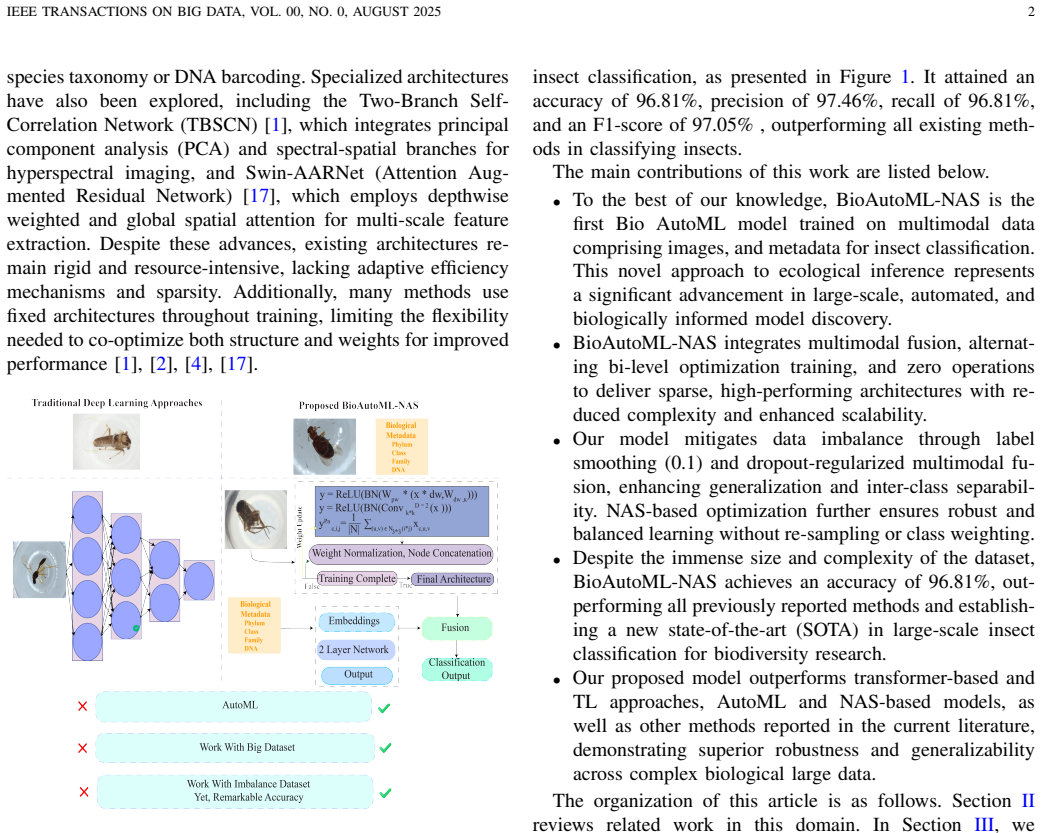
The central discovery is that a computational cell whose edges are softmax-weighted mixtures of ten primitive operations — depthwise and dilated convolutions, squeeze-and-excitation, pooling, skip, and zero — can be trained by alternating updates of network weights and architecture parameters (bi-level optimization) to discover a sparse, high-performing image encoder for insects. Fusing those image embeddings through a two-layer feedforward projection with embedded metadata fields (DNA barcode, taxonomy ranks, order-level labels) yields the reported accuracy. Zero operations prune weak connections, and threshold pruning keeps only operations above 1e-6 weight, giving efficiency without loss.
What carries the argument
The load-bearing mechanism is the differentiable NAS cell: each edge is a softmax-weighted sum of candidate operations, and architecture parameters are updated on odd-numbered batches while network weights are updated on even-numbered batches. This alternation lets the network co-adapt its structure and weights, while zero operations and threshold pruning convert the continuous search into a sparse discrete architecture at the end.
Load-bearing premise
The result depends on the metadata field the paper calls the order-level label not being the same order label the model predicts; if they coincide, the 96.81% accuracy is trivial and the NAS image encoder is never actually tested.
What would settle it
Inspect the exact metadata columns fed into the metadata encoder (Equation 10) in the code, and rerun the BIOSCAN-5M experiment with the order-level label omitted; if accuracy falls toward the 85–88% range of the transformer and AutoML baselines, the headline gain comes from the label itself, not from architecture search.
If this is right
- If the reported numbers hold, NAS-discovered architectures can beat hand-designed CNNs and transformers on large-scale biodiversity data by roughly 16 to 20 accuracy points.
- The framework suggests that adding biological metadata such as DNA barcode and taxonomy to images materially improves classification beyond what vision alone provides.
- The sparse, low-cost profile (2.95 GFLOPs, 40 MB memory, 7.42 ms GPU inference) implies the searched model can run on modest hardware, which matters for field deployment.
- The cross-dataset result on Insects-1M (93.25% accuracy) indicates the searched architecture transfers to a different large insect dataset without retraining the search.
Where Pith is reading between the lines
- If the “orders-level label” metadata field equals the order label the model is trained to predict, the reported accuracy could reflect label leakage rather than visual learning; a clean test would exclude that field from the metadata encoder and re-measure accuracy.
- The claimed gain over baselines is likely inflated by metadata fusion, since most compared models see images only; rerunning baselines with the same metadata would give a fairer comparison.
- The cross-dataset comparison assumes the 21 BIOSCAN order classes and 39 Insects-1M order classes share the same semantic label space; if they do not, the 93.25% figure is not a direct transfer measurement.
- A natural next experiment is to fix the searched architecture and vary metadata inputs (DNA bin alone, taxonomy alone, none) to isolate how much each modality contributes.
Editorial analysis
A structured set of objections, weighed in public.
Referee Report
Summary. The paper presents BioAutoML-NAS, an end-to-end AutoML framework that combines gradient-based neural architecture search (NAS) for an image encoder with a metadata encoder and a fusion module for insect classification. The authors report 96.81% accuracy, 97.46% precision, 96.81% recall, and 97.05% F1 on BIOSCAN-5M, and 93.25% accuracy on Insects-1M, claiming large improvements over transfer-learning, transformer, AutoML, and NAS baselines. The method uses a ten-operation NAS cell, alternating bi-level optimization, and zero-operation pruning. The paper's central empirical claim, however, is invalidated by a target-label leakage: the metadata encoder consumes the order-level label, which is exactly the classification target.
Significance. If the results held, this would be a meaningful contribution to automated biodiversity monitoring and AutoML, with a detailed NAS formulation and a large-scale multimodal evaluation. The formalization of the NAS cell, the alternating bi-level update, and the breadth of baselines are useful. However, the load-bearing result is not sound: Section III-A.2 lists 'orders-level label' as a metadata input, while Section IV-B defines the task as order classification. Eq. (10) embeds that label and Eq. (11) feeds it into the classification head. A classifier can read the target directly from the metadata embedding, so the reported 96.81% and 93.25% accuracies do not validate either the NAS image encoder or the fusion mechanism. All rows of the ablation table share the same leaked metadata, and no modality-decomposition experiment is provided. As written, the central claim is unsupported.
major comments (4)
- [III-A.2, Eqs. (10)-(11); IV-B] The target label is used as an input feature. Section IV-B defines the task as classifying insects by order, with 21 orders after consolidation. Section III-A.2 lists the metadata fields embedded in Eq. (10) as 'DNA barcoding bin, orders-level label, hierarchical taxonomic rank.' Eq. (11) then feeds the concatenated image and metadata representations into the classification head H. Thus the model receives the correct order label as an input. A linear readout from the metadata embedding alone can achieve near-perfect accuracy while ignoring the image encoder. The 96.81% result on BIOSCAN-5M and the 93.25% result on Insects-1M therefore do not support the NAS contribution or the claimed state of the art. The same leak applies to every configuration in Table I.
- [Table I; Section V-B] No ablation removes the leaked metadata field. Table I compares fusion strategies and search strategies, but every row uses the same metadata encoder that includes the order-level label. There is no image-only baseline, no metadata-only baseline with the order field removed, and no quantification of how much the image branch contributes. Because every reported result can exploit the leaked target from the metadata branch, the ablation cannot identify any benefit from NAS or from visual features.
- [IV-B; Section VII] The cross-dataset evaluation is not well defined. BIOSCAN-5M is consolidated to 21 orders, while Insects-1M is consolidated to 39 orders after 'Other' grouping. The paper does not describe how the label spaces are aligned, how the 'Other' categories relate, or whether the model is retrained or evaluated zero-shot. If the model is trained on 21 classes and evaluated on 39, the accuracy numbers are not directly comparable; if it is retrained, the label spaces and metadata vocabularies differ. The generalization claim in Section VII is therefore not supported by the reported numbers.
- [V-C, Tables II, III, V; IV-C] The baseline comparisons lack a stated protocol. No information is given about the train/validation/test split, preprocessing, number of epochs, or whether baselines use metadata. No standard deviations or repeated runs are reported, so the claimed margins (approximately 16%, 10%, and 8%) are not statistically grounded. Additionally, E009 is reported to train in 10 hours on a single RTX 3060 on a dataset of approximately 5 million images, but the paper omits image resolution, batch size, number of epochs, and total number of steps, making the timing and the feasibility of the comparison difficult to verify.
minor comments (5)
- [Section II] The heading 'Lagre Data-Driven Approach' contains a typo; it should be 'Large Data-Driven Approach.'
- [Section V-C] 'Comparision' is misspelled; it should be 'Comparison.'
- [Figure 5] The caption says 'ROC curve and confusion matrix,' but the text sometimes refers to 'Figure 5' for both the confusion matrix and the ROC curves. The figure panels and their referenced numbers should be aligned.
- [Reference [34]] The citation for the two-node computational cell points to a blockchain authentication paper. A NAS cell reference, such as DARTS or a similar differentiable NAS source, would be more appropriate.
- [Abstract] 'Outperforming ... by approximately 16%, 10%, and 8% respectively' is ambiguous because the comparison groups are not specified. Clarify against which model families each margin is measured.
Circularity Check
The order-level label is both a metadata input (Eq. 10) and the classification target (Eq. 11, Sec. IV-B), so the reported 96.81% accuracy reduces to label leakage and does not validate the NAS image encoder.
specific steps
-
self definitional
[Section III-A.2, Eqs. (10)-(11); Section IV-B (data preprocessing)]
"Each categorical field m(f) (DNA barcoding bin, orders-level label, hierarchical taxonomic rank) is first embedded into a fixed-dimensional vector space... Xmeta = Fmeta(Concat[E(1)[m(1)], E(2)[m(2)], ..., E(F)[m(F)]]) ... (10) ... ŷ = H(Concat[Ximg, Xmeta]) ... (11) ... For the BIOSCAN-5M training dataset, we classified the insects by order. After this consolidation, the dataset includes 21 orders."
Eq. (10) embeds the orders-level label into Xmeta. Eq. (11) concatenates Xmeta with image features and feeds them to H, which predicts the order classes defined in Sec. IV-B. Therefore the target label is one of the input fields by construction. A classifier can read the answer directly from the metadata embedding and ignore the NAS image encoder, so the reported 96.81% accuracy does not validate the searched architecture. The ablation in Table I varies fusion and search strategy while keeping the same leaky metadata input, so no row isolates the image-encoder contribution; no image-only ablation is offered. This is label leakage built into the stated equations, not an inference from the results.
full rationale
The paper's derivation chain is internally inconsistent. The task is defined as classifying insects by order (Sec. IV-B), and the metadata encoder (Eq. 10) explicitly consumes 'orders-level label' as one of the categorical fields. The fusion module then concatenates this metadata vector with the image embedding and feeds both to the classification head (Eq. 11) that predicts the target classes. Thus the exact target label is present in the model's input. The claimed 96.81% on BIOSCAN-5M cannot be attributed to the NAS-searched image encoder or to multimodal fusion in any meaningful sense; a simple linear readout from the one-hot order embedding in Xmeta would achieve near-perfect accuracy. The 93.25% on Insects-1M suffers from the same issue because the paper says the same processing was applied and the model's metadata fields include the order-level hierarchy. All comparisons in Tables I-III and V are confounded: baseline models do not receive the order label as input, while BioAutoML-NAS does, so the reported SOTA margins are not evidence of architectural superiority. This is a fundamental circularity in the data-construction sense: the output reduces to the input by construction. I do not see additional self-citation or ansatz-based circularity in the NAS formulation itself; the NAS equations (1)-(9) and bilevel optimization (12)-(13) are independent methodological content. But the central empirical claim is invalidated by the target-label leakage. A score of 9 reflects that the headline result is forced by the definition of the metadata input rather than by any learned representation.
Axiom & Free-Parameter Ledger
free parameters (4)
- Other-class grouping threshold =
500 instances
- Label smoothing coefficient =
0.1
- Operation pruning threshold =
1e-6
- Architecture parameter initialization std =
1e-3
axioms (4)
- domain assumption The metadata input fields in Eq. (10) do not contain the target class label
- domain assumption BIOSCAN-5M and Insects-1M label spaces are compatible for cross-dataset evaluation
- standard math DARTS-style softmax relaxation and alternating gradient updates converge to a high-performing architecture
- domain assumption A single RTX 3060 can complete training on millions of images within claimed hours
read the original abstract
Insect classification is important for agricultural management and ecological research, as it directly affects crop health and production. However, this task remains challenging due to the complex characteristics of insects, class imbalance, and large-scale datasets. To address these issues, we propose BioAutoML-NAS, the first BioAutoML model using multimodal data, including images, and metadata, which applies neural architecture search (NAS) for images to automatically learn the best operations for each connection within each cell. Multiple cells are stacked to form the full network, each extracting detailed image feature representations. A multimodal fusion module combines image embeddings with metadata, allowing the model to use both visual and categorical biological information to classify insects. An alternating bi-level optimization training strategy jointly updates network weights and architecture parameters, while zero operations remove less important connections, producing sparse, efficient, and high-performing architectures. Extensive evaluation on the BIOSCAN-5M dataset demonstrates that BioAutoML-NAS achieves 96.81% accuracy, 97.46% precision, 96.81% recall, and a 97.05% F1 score, outperforming state-of-the-art transfer learning, transformer, AutoML, and NAS methods by approximately 16%, 10%, and 8% respectively. Further validation on the Insects-1M dataset obtains 93.25% accuracy, 93.71% precision, 92.74% recall, and a 93.22% F1 score. These results demonstrate that BioAutoML-NAS provides accurate, confident insect classification that supports modern sustainable farming.
Figures


Reference graph
Works this paper leans on
-
[1]
Leveraging hyperspectral images for accurate insect classification with a novel two- branch self-correlation approach,
S. Tan, S. Hu, S. He, L. Zhu, Y . Qian, and Y . Deng, “Leveraging hyperspectral images for accurate insect classification with a novel two- branch self-correlation approach,”Agronomy, vol. 14, no. 4, p. 863, 2024
2024
-
[2]
Ensemble of efficient vision transformers for insect classification,
M. A. Dinca, D. Popescu, L. Ichim, and N. Angelescu, “Ensemble of efficient vision transformers for insect classification,”Applied Sciences, vol. 15, no. 13, p. 7610, 2025
2025
-
[3]
Deep- wide learning assistance for insect pest classification,
T. Nguyen, H. Nguyen, H. Ung, H. Ung, and B. Nguyen, “Deep- wide learning assistance for insect pest classification,”arXiv preprint arXiv:2409.10445, 2024
Pith/arXiv arXiv 2024
-
[4]
Edge-optimized deep learn- ing architectures for classification of agricultural insects with mobile deployment,
M. H. Akhtar, I. Eksheir, and T. Shanableh, “Edge-optimized deep learn- ing architectures for classification of agricultural insects with mobile deployment,”Information, vol. 16, no. 5, p. 348, 2025
2025
-
[5]
Insect-foundation: A foundation model and large multimodal dataset for vision-language insect understanding,
T.-D. Truong, H.-Q. Nguyen, X.-B. Nguyen, A. Dowling, X. Li, and K. Luu, “Insect-foundation: A foundation model and large multimodal dataset for vision-language insect understanding,”International Journal of Computer Vision, pp. 1–26, 2025
2025
-
[6]
Improving classification performance by addressing dataset imbalance: A case study for pest management,
A. Longo, M. Rizzi, and C. Guaragnella, “Improving classification performance by addressing dataset imbalance: A case study for pest management,”Applied Sciences, vol. 15, no. 10, p. 5385, 2025
2025
-
[7]
J. Orsholm, J. Quinto, H. Autto, G. Banelyte, N. Chazot, J. deWaard, S. deWaard, A. Farrell, B. Furneaux, B. Hardwicket al., “A multi- modal dataset for insect biodiversity with imagery and dna at the trap and individual level,”arXiv preprint arXiv:2507.06972, 2025
Pith/arXiv arXiv 2025
-
[8]
Fruit classification system with deep learning and neural architecture search,
C. Dewi, D. Thiruvady, and N. Zaidi, “Fruit classification system with deep learning and neural architecture search,”arXiv preprint arXiv:2406.01869, 2024
Pith/arXiv arXiv 2024
-
[9]
Deep learning,
Y . LeCun, Y . Bengio, and G. Hinton, “Deep learning,”nature, vol. 521, no. 7553, pp. 436–444, 2015
2015
-
[10]
A decade survey of transfer learning (2010–2020),
S. Niu, Y . Liu, J. Wang, and H. Song, “A decade survey of transfer learning (2010–2020),”IEEE Transactions on Artificial Intelligence, vol. 1, no. 2, pp. 151–166, 2021
2010
-
[11]
Next generation insect taxonomic clas- sification by comparing different deep learning algorithms,
S.-Q. Ong and S. A. Hamid, “Next generation insect taxonomic clas- sification by comparing different deep learning algorithms,”PloS one, vol. 17, no. 12, p. e0279094, 2022
2022
-
[12]
A blockchain and automl approach for open and automated customer service,
Z. Li, H. Guo, W. M. Wang, Y . Guan, A. V . Barenji, G. Q. Huang, K. S. McFall, and X. Chen, “A blockchain and automl approach for open and automated customer service,”IEEE Transactions on Industrial Informatics, vol. 15, no. 6, pp. 3642–3651, 2019
2019
-
[13]
Enhancing crop productivity and sustainability through dis- ease identification in maize leaves: Exploiting a large dataset with an advanced vision transformer model,
I. Pacal, “Enhancing crop productivity and sustainability through dis- ease identification in maize leaves: Exploiting a large dataset with an advanced vision transformer model,”Expert Systems with Applications, vol. 238, p. 122099, 2024
2024
-
[14]
Deep learning enables satellite-based monitoring of large populations of terrestrial mammals across heterogeneous landscape,
Z. Wu, C. Zhang, X. Gu, I. Duporge, L. F. Hughey, J. A. Stabach, A. K. Skidmore, J. G. C. Hopcraft, S. J. Lee, P. M. Atkinsonet al., “Deep learning enables satellite-based monitoring of large populations of terrestrial mammals across heterogeneous landscape,”Nature com- munications, vol. 14, no. 1, p. 3072, 2023
2023
-
[15]
Sam 2: Segment anything in images and videos,
N. Ravi, V . Gabeur, Y .-T. Hu, R. Hu, C. Ryali, T. Ma, H. Khedr, R. R¨adle, C. Rolland, L. Gustafsonet al., “Sam 2: Segment anything in images and videos,”arXiv preprint arXiv:2408.00714, 2024
Pith/arXiv arXiv 2024
-
[16]
Application of a multi-layer convolutional neural network model to classify major insect pests in stored rice detected by an acoustic device,
C. B. Balingbing, S. Kirchner, H. Siebald, H.-H. Kaufmann, M. Gum- mert, N. Van Hung, and O. Hensel, “Application of a multi-layer convolutional neural network model to classify major insect pests in stored rice detected by an acoustic device,”Computers and Electronics in Agriculture, vol. 225, p. 109297, 2024
2024
-
[17]
Swin attention augmented residual network: a fine-grained pest image recognition method,
X. Wang, Z. Xiao, and Z. Deng, “Swin attention augmented residual network: a fine-grained pest image recognition method,”Frontiers in Plant Science, vol. 16, p. 1619551, 2025
2025
-
[18]
Bioscan- 5m: a multimodal dataset for insect biodiversity,
Z. Gharaee, S. C. Lowe, Z. Gong, P. Millan Arias, N. Pellegrino, A. T. Wang, J. B. Haurum, I. Eyriay, L. Kari, D. Steinkeet al., “Bioscan- 5m: a multimodal dataset for insect biodiversity,”Advances in Neural Information Processing Systems, vol. 37, pp. 36 285–36 313, 2024
2024
-
[19]
Insect-foundation: A foundation model and large-scale 1m dataset for visual insect understanding,
H.-Q. Nguyen, T.-D. Truong, X. B. Nguyen, A. Dowling, X. Li, and K. Luu, “Insect-foundation: A foundation model and large-scale 1m dataset for visual insect understanding,” inProceedings of the IEEE/CVF Conference on Computer Vision and Pattern Recognition, 2024, pp. 21 945–21 955
2024
-
[20]
A new optimization approach based on neural architecture search to enhance deep u-net for efficient road segmentation,
N. Saeedizadeh, S. M. J. Jalali, B. Khan, P. M. Kebria, and S. Mohamed, “A new optimization approach based on neural architecture search to enhance deep u-net for efficient road segmentation,”Knowledge-Based Systems, vol. 296, p. 111966, 2024
2024
-
[21]
3d neural architecture search to optimize segmentation of plant parts,
F. Saeed, C. Tan, T. Liu, and C. Li, “3d neural architecture search to optimize segmentation of plant parts,”Smart Agricultural Technology, vol. 10, p. 100776, 2025
2025
-
[22]
Unsupervised domain adap- tation architecture search with self-training for land cover mapping,
C. Broni-Bediako, J. Xia, and N. Yokoya, “Unsupervised domain adap- tation architecture search with self-training for land cover mapping,” inProceedings of the IEEE/CVF Conference on Computer Vision and Pattern Recognition, 2024, pp. 543–553
2024
-
[23]
Evolutionary neural architecture search for remote sensing image classification,
J. Liang, G. Liu, Y . Bi, M. Yu, M. Liu, and Y . Jin, “Evolutionary neural architecture search for remote sensing image classification,”IEEE Transactions on Neural Networks and Learning Systems, 2025
2025
-
[24]
Champ: A large- scale dataset for skeleton-based composite human motion prediction,
W. Zhang, M. Liu, X. Wang, S. Zhao, and C. Wang, “Champ: A large- scale dataset for skeleton-based composite human motion prediction,” IEEE TRANSACTIONS ON BIG DATA, VOL. 00, NO. 0, AUGUST 2025 13 IEEE Transactions on Circuits and Systems for Video Technology, vol. 34, no. 10, pp. 10 063–10 076, 2024
2025
-
[25]
Deep learning based agri- cultural pest monitoring and classification,
S. M. Venkateswara and J. Padmanabhan, “Deep learning based agri- cultural pest monitoring and classification,”Scientific Reports, vol. 15, no. 1, p. 8684, 2025
2025
-
[26]
Optimizing depthwise separable convolution operations on gpus,
G. Lu, W. Zhang, and Z. Wang, “Optimizing depthwise separable convolution operations on gpus,”IEEE Transactions on Parallel and Distributed Systems, vol. 33, no. 1, pp. 70–87, 2021
2021
-
[27]
Ddconv: Dynamic dilated convolution,
H. Hu, C. Yu, Q. Zhou, Q. Guan, and T. Zhou, “Ddconv: Dynamic dilated convolution,”IEEE Transactions on Artificial Intelligence, 2025
2025
-
[28]
Convolution in convolution for network in network,
Y . Pang, M. Sun, X. Jiang, and X. Li, “Convolution in convolution for network in network,”IEEE transactions on neural networks and learning systems, vol. 29, no. 5, pp. 1587–1597, 2017
2017
-
[29]
Expansion-squeeze-excitation fusion network for elderly activity recognition,
X. Shu, J. Yang, R. Yan, and Y . Song, “Expansion-squeeze-excitation fusion network for elderly activity recognition,”IEEE Transactions on Circuits and Systems for Video Technology, vol. 32, no. 8, pp. 5281– 5292, 2022
2022
-
[30]
Learning relu networks on linearly separable data: Algorithm, optimality, and generalization,
G. Wang, G. B. Giannakis, and J. Chen, “Learning relu networks on linearly separable data: Algorithm, optimality, and generalization,”IEEE Transactions on Signal Processing, vol. 67, no. 9, pp. 2357–2370, 2019
2019
-
[31]
Ampnet: Average-and max-pool networks for salient object detection,
L. Sun, Z. Chen, Q. J. Wu, H. Zhao, W. He, and X. Yan, “Ampnet: Average-and max-pool networks for salient object detection,”IEEE Transactions on Circuits and Systems for Video Technology, vol. 31, no. 11, pp. 4321–4333, 2021
2021
-
[32]
Unet++: Redesigning skip connections to exploit multiscale features in image segmentation,
Z. Zhou, M. M. R. Siddiquee, N. Tajbakhsh, and J. Liang, “Unet++: Redesigning skip connections to exploit multiscale features in image segmentation,”IEEE transactions on medical imaging, vol. 39, no. 6, pp. 1856–1867, 2019
2019
-
[33]
Approximate softmax functions for energy-efficient deep neural networks,
K. Chen, Y . Gao, H. Waris, W. Liu, and F. Lombardi, “Approximate softmax functions for energy-efficient deep neural networks,”IEEE Transactions on Very Large Scale Integration (VLSI) Systems, vol. 31, no. 1, pp. 4–16, 2022
2022
-
[34]
Blockchain meets edge computing: A distributed and trusted authentication system,
S. Guo, X. Hu, S. Guo, X. Qiu, and F. Qi, “Blockchain meets edge computing: A distributed and trusted authentication system,”IEEE Transactions on Industrial Informatics, vol. 16, no. 3, pp. 1972–1983, 2019
1972
-
[35]
A distributed framework for ea-based nas,
Q. Ye, Y . Sun, J. Zhang, and J. Lv, “A distributed framework for ea-based nas,”IEEE Transactions on Parallel and Distributed Systems, vol. 32, no. 7, pp. 1753–1764, 2020
2020
-
[36]
Investigating bi- level optimization for learning and vision from a unified perspective: A survey and beyond,
R. Liu, J. Gao, J. Zhang, D. Meng, and Z. Lin, “Investigating bi- level optimization for learning and vision from a unified perspective: A survey and beyond,”IEEE Transactions on Pattern Analysis and Machine Intelligence, vol. 44, no. 12, pp. 10 045–10 067, 2021
2021
-
[37]
A survey on evolutionary neural architecture search,
Y . Liu, Y . Sun, B. Xue, M. Zhang, G. G. Yen, and K. C. Tan, “A survey on evolutionary neural architecture search,”IEEE transactions on neural networks and learning systems, vol. 34, no. 2, pp. 550–570, 2021
2021
-
[38]
Toponas: Boosting search efficiency of gradient-based nas via topological simplification,
D. Zhao, Z. Liu, and B. Yuan, “Toponas: Boosting search efficiency of gradient-based nas via topological simplification,”arXiv preprint arXiv:2408.01311, 2024
Pith/arXiv arXiv 2024
-
[39]
Micronas for memory and latency constrained hardware aware neural architecture search in time series classification on microcontrollers,
T. King, Y . Zhou, T. R ¨oddiger, and M. Beigl, “Micronas for memory and latency constrained hardware aware neural architecture search in time series classification on microcontrollers,”Scientific Reports, vol. 15, no. 1, p. 7575, 2025
2025
-
[40]
A lightweight model of vgg-16 for remote sensing image classification,
M. Ye, N. Ruiwen, Z. Chang, G. He, H. Tianli, L. Shijun, S. Yu, Z. Tong, and G. Ying, “A lightweight model of vgg-16 for remote sensing image classification,”IEEE Journal of Selected Topics in Applied Earth Observations and Remote Sensing, vol. 14, pp. 6916–6922, 2021
2021
-
[41]
A vgg-19 model with transfer learning and image segmentation for classification of tomato leaf disease,
T.-H. Nguyen, T.-N. Nguyen, and B.-V . Ngo, “A vgg-19 model with transfer learning and image segmentation for classification of tomato leaf disease,”AgriEngineering, vol. 4, no. 4, pp. 871–887, 2022
2022
-
[42]
Mobilenetv2: Inverted residuals and linear bottlenecks,
M. Sandler, A. Howard, M. Zhu, A. Zhmoginov, and L.-C. Chen, “Mobilenetv2: Inverted residuals and linear bottlenecks,” inProceedings of the IEEE conference on computer vision and pattern recognition, 2018, pp. 4510–4520
2018
-
[43]
Resnet18dnn: prediction approach of drug-induced liver in- jury by deep neural network with resnet18,
Z. Chen, Y . Jiang, X. Zhang, R. Zheng, R. Qiu, Y . Sun, C. Zhao, and H. Shang, “Resnet18dnn: prediction approach of drug-induced liver in- jury by deep neural network with resnet18,”Briefings in bioinformatics, vol. 23, no. 1, p. bbab503, 2022
2022
-
[44]
An automatic plant leaf disease identification using densenet-121 architecture with a mutation-based henry gas solubility optimization algorithm,
S. Nandhini and K. Ashokkumar, “An automatic plant leaf disease identification using densenet-121 architecture with a mutation-based henry gas solubility optimization algorithm,”Neural Computing and Applications, vol. 34, no. 7, pp. 5513–5534, 2022
2022
-
[45]
Densenet-201-based deep neural net- work with composite learning factor and precomputation for multiple sclerosis classification,
S.-H. Wang and Y .-D. Zhang, “Densenet-201-based deep neural net- work with composite learning factor and precomputation for multiple sclerosis classification,”ACM Transactions on Multimedia Computing, Communications, and Applications (TOMM), vol. 16, no. 2s, pp. 1–19, 2020
2020
-
[46]
A robust gan- generated face detection method based on dual-color spaces and an improved xception,
B. Chen, X. Liu, Y . Zheng, G. Zhao, and Y .-Q. Shi, “A robust gan- generated face detection method based on dual-color spaces and an improved xception,”IEEE Transactions on Circuits and Systems for Video Technology, vol. 32, no. 6, pp. 3527–3538, 2021
2021
-
[47]
Elucidating the novel frame- work of liver tumour segmentation and classification using improved optimization-assisted efficientnet b7 learning model,
S. Dharaneswar and B. S. Kumar, “Elucidating the novel frame- work of liver tumour segmentation and classification using improved optimization-assisted efficientnet b7 learning model,”Biomedical Signal Processing and Control, vol. 100, p. 107045, 2025
2025
-
[48]
Big transfer (bit): General visual representation learning,
A. Kolesnikov, L. Beyer, X. Zhai, J. Puigcerver, J. Yung, S. Gelly, and N. Houlsby, “Big transfer (bit): General visual representation learning,” inEuropean conference on computer vision. Springer, 2020, pp. 491– 507
2020
-
[49]
Application of convnext with transfer learning and data augmentation for malaria par- asite detection in resource-limited settings using microscopic images,
O. P. Mmileng, A. Whata, M. Olusanya, and S. Mhlongo, “Application of convnext with transfer learning and data augmentation for malaria par- asite detection in resource-limited settings using microscopic images,” PloS one, vol. 20, no. 6, p. e0313734, 2025
2025
-
[50]
Cnn and vit efficiency study on tiny imagenet and dermamnist datasets,
A. Amangeldi, A. Taigonyrov, M. H. Jawad, and C. E. Mbonu, “Cnn and vit efficiency study on tiny imagenet and dermamnist datasets,”arXiv preprint arXiv:2505.08259, 2025
arXiv 2025
-
[51]
Mobilevit: light-weight, general- purpose, and mobile-friendly vision transformer,
S. Mehta and M. Rastegari, “Mobilevit: light-weight, general- purpose, and mobile-friendly vision transformer,”arXiv preprint arXiv:2110.02178, 2021
Pith/arXiv arXiv 2021
-
[52]
Joint token pruning and squeezing towards more aggressive compression of vision transformers,
S. Wei, T. Ye, S. Zhang, Y . Tang, and J. Liang, “Joint token pruning and squeezing towards more aggressive compression of vision transformers,” inProceedings of the IEEE/CVF conference on computer vision and pattern recognition, 2023, pp. 2092–2101
2023
-
[53]
Knowledge distillation vulnerability of deit through cnn adversarial attack,
I. Hong and C. Choi, “Knowledge distillation vulnerability of deit through cnn adversarial attack,”Neural Computing and Applications, vol. 37, no. 12, pp. 7721–7731, 2025
2025
-
[54]
Levit: a vision transformer in convnet’s clothing for faster inference,
B. Graham, A. El-Nouby, H. Touvron, P. Stock, A. Joulin, H. J ´egou, and M. Douze, “Levit: a vision transformer in convnet’s clothing for faster inference,” inProceedings of the IEEE/CVF international conference on computer vision, 2021, pp. 12 259–12 269
2021
-
[55]
Image as a foreign language: Beit pretraining for vision and vision-language tasks,
W. Wang, H. Bao, L. Dong, J. Bjorck, Z. Peng, Q. Liu, K. Aggarwal, O. K. Mohammed, S. Singhal, S. Somet al., “Image as a foreign language: Beit pretraining for vision and vision-language tasks,” in Proceedings of the IEEE/CVF Conference on Computer Vision and Pattern Recognition, 2023, pp. 19 175–19 186
2023
-
[56]
Deep learning models for automatic identification of plant-parasitic nematode,
N. H. Shabrina, R. A. Lika, and S. Indarti, “Deep learning models for automatic identification of plant-parasitic nematode,”Artificial Intelli- gence in Agriculture, vol. 7, pp. 1–12, 2023
2023
-
[57]
A swin transformer-based model for mosquito species identification,
D.-z. Zhao, X.-k. Wang, T. Zhao, H. Li, D. Xing, H.-t. Gao, F. Song, G.-h. Chen, and C.-x. Li, “A swin transformer-based model for mosquito species identification,”Scientific Reports, vol. 12, no. 1, p. 18664, 2022
2022
-
[58]
Efficient mae towards large-scale vision transformers,
Q. Han, G. Zhang, J. Huang, P. Gao, Z. Wei, and S. Lu, “Efficient mae towards large-scale vision transformers,” inProceedings of the IEEE/CVF Winter Conference on Applications of Computer Vision, 2024, pp. 606–615
2024
-
[59]
Efficientformer: Vision transformers at mobilenet speed,
Y . Li, G. Yuan, Y . Wen, J. Hu, G. Evangelidis, S. Tulyakov, Y . Wang, and J. Ren, “Efficientformer: Vision transformers at mobilenet speed,”Ad- vances in Neural Information Processing Systems, vol. 35, pp. 12 934– 12 949, 2022
2022
-
[60]
Tpot: A tree-based pipeline optimization tool for automating machine learning,
R. S. Olson and J. H. Moore, “Tpot: A tree-based pipeline optimization tool for automating machine learning,” inWorkshop on automatic machine learning. PMLR, 2016, pp. 66–74
2016
-
[61]
Autogluon-multimodal (automm): Supercharg- ing multimodal automl with foundation models,
Z. Tang, H. Fang, S. Zhou, T. Yang, Z. Zhong, T. Hu, K. Kirch- hoff, and G. Karypis, “Autogluon-multimodal (automm): Supercharg- ing multimodal automl with foundation models,”arXiv preprint arXiv:2404.16233, 2024
Pith/arXiv arXiv 2024
-
[62]
Auto-keras: An efficient neural architecture search system,
H. Jin, Q. Song, and X. Hu, “Auto-keras: An efficient neural architecture search system,” inProceedings of the 25th ACM SIGKDD international conference on knowledge discovery & data mining, 2019, pp. 1946– 1956
2019
-
[63]
Optuna: A next- generation hyperparameter optimization framework,
T. Akiba, S. Sano, T. Yanase, T. Ohta, and M. Koyama, “Optuna: A next- generation hyperparameter optimization framework,” inProceedings of the 25th ACM SIGKDD international conference on knowledge discovery & data mining, 2019, pp. 2623–2631
2019
-
[64]
Smac3: A versatile bayesian optimization package for hyperparameter optimization,
M. Lindauer, K. Eggensperger, M. Feurer, A. Biedenkapp, D. Deng, C. Benjamins, T. Ruhkopf, R. Sass, and F. Hutter, “Smac3: A versatile bayesian optimization package for hyperparameter optimization,”Jour- nal of Machine Learning Research, vol. 23, no. 54, pp. 1–9, 2022
2022
-
[65]
Efficient neural architecture search via parameters sharing,
H. Pham, M. Guan, B. Zoph, Q. Le, and J. Dean, “Efficient neural architecture search via parameters sharing,” inInternational conference on machine learning. PMLR, 2018, pp. 4095–4104
2018
-
[66]
Neural architecture op- timization,
R. Luo, F. Tian, T. Qin, E. Chen, and T.-Y . Liu, “Neural architecture op- timization,”Advances in neural information processing systems, vol. 31
discussion (0)
Sign in with ORCID, Apple, or X to comment. Anyone can read and Pith papers without signing in.