REVIEW 3 major objections 4 minor 58 references
City-scale traffic flow optimization can be encoded as a QUBO and solved by a hybrid quantum annealer within about 1% of an exact mixed-integer solver, with congestion cost cuts up to 24%.
Reviewed by Pith at T0; open to challenge. T0 means a machine referee read the full paper against a public rubric. the ladder, T0–T4 →
T0 review · deepseek-v4-flash
2026-08-04 11:14 UTC pith:NDT64BKM
load-bearing objection Solid empirical pipeline and large-scale QAHS-vs-Gurobi benchmarks, but the one-hot penalty guarantee is not actually proven and the headline 'within 1%' is on QUBO energies rather than the congestion cost. the 3 major comments →
Quantum Annealing for Realistic Traffic Flow Optimization: Clustering and Data-Driven QUBO
The pith
A machine-rendered reading of the paper's core claim, the machinery that carries it, and where it could break.
Core claim
The central claim is that Traffic Flow Optimization—choose exactly one of several precomputed routes per vehicle—can be written as a QUBO whose pairwise terms are congestion weights derived from time-resolved leader–follower interactions, and that solving this QUBO with a hybrid quantum annealer, after partitioning vehicles into dense communities, yields solutions within roughly 1% of the exact solver's objective on large scenarios while keeping runtimes stable. Both the hybrid-quantum and exact approaches reduce the paper's congestion cost by up to 24.4% and 29.4% respectively when compared with shortest-duration routing, and the relative performance of the hybrid solver depends on the QUBO
What carries the argument
The central object is the QUBO Q(x)=q(x)+p(x): q(x) accumulates pairwise congestion costs w_{i,j,a_i,a_j}—cumulative leader–follower interaction scores over 10-second route samples—plus per-route duration penalties, while p(x) enforces exactly one route per vehicle with a penalty λ set equal to the maximum interaction strength any vehicle-route pair can have, which guarantees feasible assignments without manual penalty tuning. The companion mechanism is community-detection clustering on the congestion graph, which turns an O(n^2 k^2) interaction tensor into independent subproblems and is what makes 25,000-vehicle instances tractable for today's solvers.
Load-bearing premise
The load-bearing premise is that the paper's own congestion score—computed from simulated vehicle spacings and speeds on shared road segments—faithfully represents real congestion and travel-time impact, because every headline congestion-reduction number is measured on that score, not on observed traffic data.
What would settle it
Take one of the tested city maps and demand patterns, compute the hybrid-quantum and shortest-route assignments exactly as described, then run both assignments in an independent microscopic traffic simulator with realistic link capacities and signal timings; if the optimized assignment does not reduce measured average travel time, queue length, or delay relative to shortest routing—or if the paper's congestion score correlates poorly with those simulator metrics—the central congestion-reduction claim fails, even though the solver-comparison result may stand.
If this is right
- If correct, a navigation layer can precompute a few route alternatives per vehicle, cluster the congestion graph, and reassign routes near-real-time with a hybrid quantum annealer, complementing systems that only minimize individual trip time.
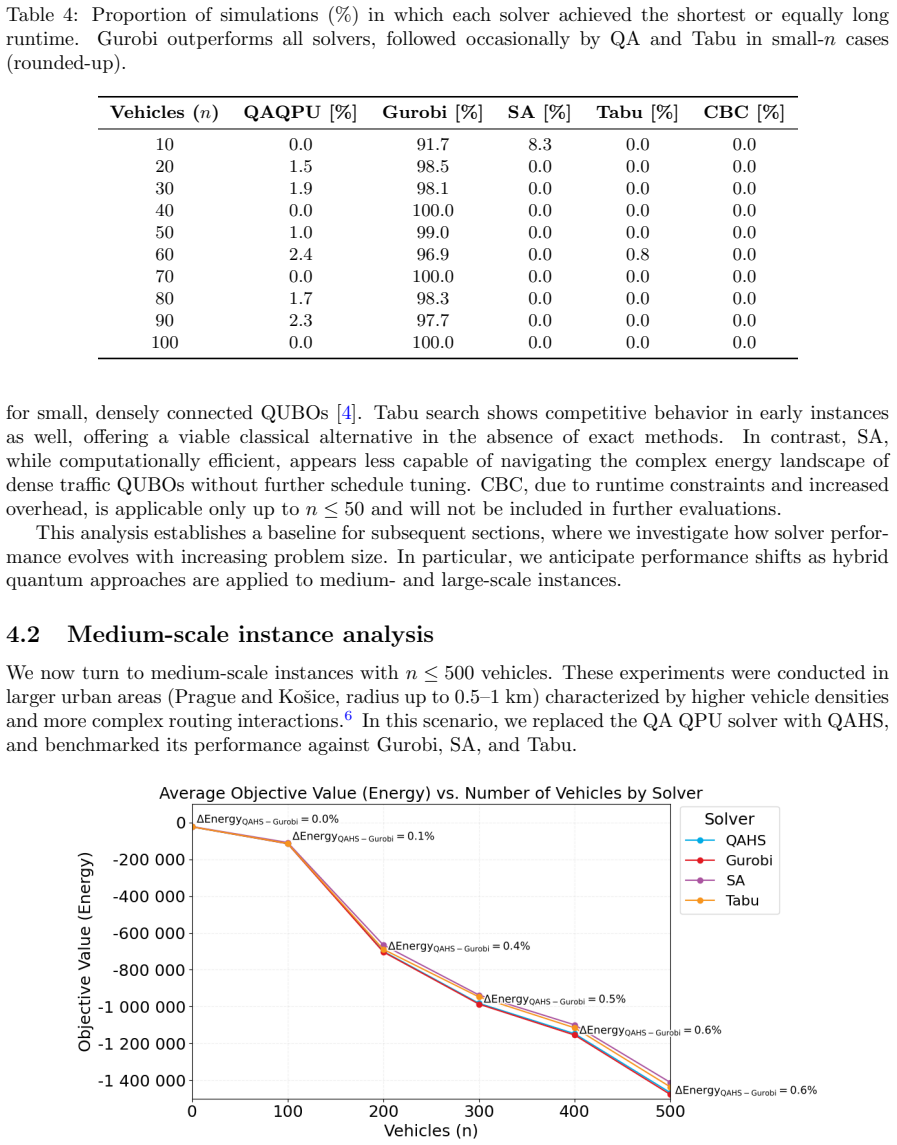
- The hybrid quantum solver becomes a practical near-optimal engine for large route-assignment subproblems: average objective gap below 1% versus exact solving, feasibility above 99.9%, and runtime that grows nearly linearly with vehicle count.
- The reported congestion reduction of up to 24–29% over shortest-duration routing would mean that system-level route assignment materially reduces congestion hotspots, especially when many vehicles converge on a single destination.
- Solver performance is map-dependent: grid-like road networks allow the hybrid approach to stay very close to exact solutions, while irregular networks widen the gap, so deployments should expect topology-specific behavior.
- Clustering on the congestion graph reduces the pairwise interaction burden by roughly an order of magnitude, keeping both quantum and classical solvers within hardware and licensing limits.
Where Pith is reading between the lines
- Editorial inference: the solver-comparison result—quantum-hybrid within about 1% of exact—is likely the robust part of the paper; the congestion-reduction numbers inherit all the uncertainty of the self-defined congestion score and should be re-tested against observed travel times or an independent traffic simulation before being quoted as real-world savings.
- Editorial inference: the analytic one-hot penalty, derived as the maximum interaction strength, is a transferable design pattern for assignment-style QUBOs beyond traffic, since it removes the usual penalty-tuning fragility.
- Editorial inference: the stable near-linear runtime of the hybrid solver is dominated by classical orchestration and model preparation rather than quantum processing time, so future hardware improvements may shift the bottleneck and shrink the gap on sparse instances.
- Editorial inference: the same clustering-plus-QUBO pipeline could apply to other spatiotemporal conflict problems such as evacuation route planning, ride-pooling assignments, or delivery-fleet coordination, because the cost structure is defined by pairwise conflicts in time and space.
Editorial analysis
A structured set of objections, weighed in public.
Referee Report
Summary. The paper proposes a data-driven QUBO formulation for city-scale traffic flow optimization. Routes are generated with Valhalla from OSM maps, sampled at fixed intervals, and pairwise leader–follower congestion weights are aggregated over time. The QUBO includes duration penalties and a one-hot route-selection penalty claimed to be derived analytically. To scale to tens of thousands of vehicles, the authors use Leiden clustering on the congestion graph and solve the cluster subproblems with D-Wave's hybrid BQM solver, Gurobi, and classical heuristics. Benchmarking on small, medium, and large instances (up to 25,000 vehicles) reports that the hybrid quantum annealer stays within roughly 1% of Gurobi's objective values with stable runtimes and near-universal feasibility, and that both solvers reduce the proposed congestion score by up to 24.4% and 29.4%, respectively, relative to a shortest-route baseline.
Significance. If the central claims hold, the paper provides a useful benchmark of current hybrid quantum hardware on realistic, data-driven traffic QUBOs: a reproducible pipeline from OSM/Valhalla to cluster-based QUBO instances, a fair same-time-budget comparison with a commercial MILP solver, and evidence that QUBO density and city topology affect the QAHS–Gurobi gap. The multi-city comparison and the large-scale feasibility statistics are informative. However, the headline 'analytically derived penalty parameter' guarantee is mathematically unsupported as written, and the congestion-reduction claims rest on an unvalidated surrogate score. These issues are fixable, but they currently limit the strength of the practical conclusions.
major comments (3)
- [Section 2 (Eqs. 10–12) and Appendix B (Algorithm 2)] The claimed analytical guarantee of one-hot feasibility is not established. Eq. (10) defines λ as the maximum interaction sum Λ_{i,a}, which bounds only the quadratic congestion terms in q(x). It does not account for the duration penalties π_{i,a} that appear in the same cost term. In the matrix construction of Algorithm 2, selecting no route for vehicle i contributes 0, whereas selecting route a contributes π_{i,a}−λ+Σ_{j,b} w_{ijab}x_{jb}; when π_{i,a}+Λ_{i,a}>λ, the all-zero assignment is strictly preferred for that vehicle. A concrete case is any sparse instance with λ=0 and positive π: the QUBO minimum then assigns no route. Moreover, Algorithm 2 places λ on same-vehicle off-diagonal entries, whereas expanding Eq. (12) yields 2λ for those entries; as a result, selecting two routes with π=0 ties a valid one-hot assignment. The empirical 99.98% feasibility (Table 5) may hold on the te
- [Section 3.5, Eq. (16) and Appendix D] The global objective used for the large-scale comparison is not the full TFO objective. Eq. (16) defines Cost(x) as the sum of q(x) over clusters only, omitting cross-cluster congestion terms and excluding vehicles outside the clusters. This contradicts the statement in Section 3.5 that the global objective is 'recomputed from the combined assignments of all vehicles' and the Appendix D statement that congestion is 'recomputed across the full city network.' If Eq. (16) is the metric actually reported, then the 'within 1% of Gurobi' claim (Table 5) and the congestion reductions (Table 6, Fig. 6) are measured on intra-cluster interactions only and do not establish city-wide performance. The discrepancy must be resolved and the reported metric made unambiguous.
- [Section 2, Eq. (3), and Section 4.3, Table 6] The practical claim of congestion reduction rests on an unvalidated surrogate. All improvements are evaluated with the score defined in Eq. (3) with γ=4 s, computed from Valhalla route points sampled every 10 s (Eq. 1). The paper provides no comparison of this score with observed travel times, detector data, or an independent traffic simulator, and no sensitivity analysis for γ, α, or w. A perfect solver can only minimize this self-defined score; whether the reported 24.4%/29.4% reductions correspond to real-world travel-time improvements is not established. The solver-to-solver benchmark is unaffected, but the abstract's 'congestion reduction' claim should be qualified as reduction in the proposed surrogate cost.
minor comments (4)
- [Section 4.3 / Table 6] Minor typographical and formatting issues: '24,4%' should be '24.4%' for consistency, and Section 4.2 contains 'futher dicsussed'.
- [Section 4.1, Fig. 2] The sentence 'objective values decrease due to the growing number of pairwise vehicle interactions' is confusing: adding vehicles normally increases the sum of pairwise terms. Clarify whether the plotted quantity is normalized or per-vehicle.
- [Appendix E] The sampling notation t=0, α, 2α, …, T_{i,a} should be stated more precisely, and the summation range in Eq. (4) uses the set expression t∈min(...) , which is mathematically imprecise.
- [Code availability] The reproducibility claim would be strengthened by making the code and instance-generation scripts public; the current private-repository statement limits independent verification.
Circularity Check
No circular derivation; the core benchmark is externally grounded. The one-hot penalty guarantee is mathematically flawed and the congestion metric is self-defined, but neither reduces by construction to its own inputs.
full rationale
The central quantitative claim is an empirical benchmark: QAHS and Gurobi are given the same QUBO instances, and the energy gap is measured directly (Eq. 17); no parameter is fitted to Gurobi's output, and lambda is computed from the congestion weights by a row-sum bound (Eqs. 9-10), not calibrated to the target comparison. The clustering decomposition is also fair: the global objective is recomputed from the combined assignments (Sec. 3.5), and both solvers are evaluated on identical cluster subproblems. The 'congestion reduction' headline (Table 6) is measured on Eq. 16, which is the same cost q(x) that the solvers minimize; this is an explicit 'proposed congestion-cost objective' and a comparison against a fixed baseline, so it is a legitimate optimization benchmark rather than a circular prediction. Its external validity is limited by the fact that the congestion proxy (Eq. 3) is not validated against observed traffic data, but that is a modeling/validity concern, not a circular reduction. The paper's analytical penalty claim is the closest to a 'first-principles derivation', and it is problematic: Eq. 10 defines lambda from the congestion interactions Lambda only, while the QUBO diagonal in Algorithm 2 is -lambda + pi_i,a, so if pi_i,a > lambda the no-route infeasible assignment is preferred; moreover, the off-diagonal penalty is lambda in Algorithm 2 rather than the 2lambda obtained by expanding Eq. 12. These are mathematical errors in a stated guarantee, not cases where the result is equivalent to its inputs. Appendix D also notes that invalid solver assignments are replaced by the shortest route, which may affect the reported 99.98% feasibility, but this is a reporting/repair issue rather than circularity. There are no load-bearing self-citations and no uniqueness or ansatz smuggled in by citation. Overall, no step in the derivation reduces by construction to its own inputs; score 1 reflects the self-referential nature of the congestion metric and the unverified penalty guarantee, not a circular derivation.
Axiom & Free-Parameter Ledger
free parameters (7)
- γ (overlap sensitivity) =
4.0 s
- α (route sampling interval) =
10 s
- w (simulation window) =
600 s
- k (route alternatives per vehicle) =
2
- ρ (Leiden resolution) =
4.0
- m (minimum vehicles per cluster) =
1000
- L (maximum clusters solved) =
5 (varied to 20-21 in Figs. 7-8)
axioms (5)
- standard math λ = max row sum (Eq. 10) is a valid penalty bound for the one-hot constraint
- domain assumption 10-s sampled Valhalla trajectories (speed, direction, edge) approximate real traffic
- ad hoc to paper Eq. 3 leader-follower score with γ=4 s defines 'congestion'
- domain assumption Leiden clustering preserves the congestion-critical structure
- domain assumption D-Wave LeapHybridBQMSampler and time-limited Gurobi outputs are meaningful solution benchmarks
read the original abstract
This article presents a scalable, data-driven formulation of city-wide Traffic Flow Optimization as a Quadratic Unconstrained Binary Optimization problem and evaluates its performance using quantum annealing and classical solvers on realistic urban networks. The framework builds a time-resolved congestion model from simulated mobility data by sampling vehicle trajectories at fixed intervals, identifying leader-follower interactions on shared road segments. In addition to congestion, the model incorporates route-duration penalties and an analytically derived penalty parameter that enforces one-hot route selection, ensuring feasible assignments while balancing network-wide congestion reduction and individual travel times. To mitigate the combinatorial growth of interactions in large-scale instances, the approach employs Leiden clustering to partition vehicles into dense communities that can be optimized independently. The resulting subproblems are solved using D-Wave's quantum annealer, exact mixed-integer programming via Gurobi, and several classical metaheuristics, and are evaluated on multiple city maps with up to 25,000 vehicles. Across large scenarios, the hybrid quantum annealing approach consistently produces feasible solutions within approximately 1% of Gurobi's objective values, while maintaining stable runtimes. Both methods outperform shortest-route baselines, achieving reductions in the proposed congestion-cost objective of up to 24.4% for the hybrid quantum approach and 29.4% for Gurobi. Finally, the study highlights the critical role of the underlying city map, showing that network structure directly influences interaction density, problem formulation, and the efficiency of embedding and solving on current quantum annealing hardware.
Figures




Reference graph
Works this paper leans on
-
[1]
From louvain to leiden: guaranteeing well-connected communities,
V. A. Traag, L. Waltman, and N. J. van Eck, “From louvain to leiden: guaranteeing well-connected communities,”Scientific Reports, vol. 9, p. 5233, 2019
2019
-
[2]
Valhalla: Open source routing engine,
Mapbox, “Valhalla: Open source routing engine,” https://valhalla.readthedocs.io, 2025, accessed: 2025-08-27
2025
-
[3]
Review of the application of quantum annealing- related technologies in transportation optimization,
M. Q. Mohammed, H. Meeß, and M. Otte, “Review of the application of quantum annealing- related technologies in transportation optimization,”Quantum Information Processing, vol. 24, no. 9, p. 296, 2025
2025
-
[4]
Traffic flow optimization using a quantum annealer,
F. Neukart, G. Compostella, T. Seidel, D. von Dollen, S. Yarkoni, and B. Parney, “Traffic flow optimization using a quantum annealer,”Frontiers in ICT, vol. 4, no. 29, p. 29, 2017
2017
-
[5]
Quantum shuttle: traffic navigation with quantum computing,
S. Yarkoni, F. Neukart, E. M. Gomez Tagle, N. Magiera, B. Mehta, K. Hire, S. Narkhede, and M. Hofmann, “Quantum shuttle: traffic navigation with quantum computing,” inProceedings of the 1st ACM SIGSOFT International Workshop on Architectures and Paradigms for Engineering Quantum Software (APEQS 2020), 2020, pp. 22–30
2020
-
[6]
Hybrid quantum optimization in the context of minimizing traffic congestion,
J. Villanueva, G. J. Mooney, B. R. Bardhan, J. Ghosh, C. D. Hill, and L. C. L. Hollenberg, “Hybrid quantum optimization in the context of minimizing traffic congestion,” 2025, preprint at https://arxiv.org/abs/2504.08275
Pith/arXiv arXiv 2025
-
[7]
An optimization case study for solving a transport robot scheduling problem on quantum-hybrid and quantum-inspired hardware,
M. Leib, F. Neukartet al., “An optimization case study for solving a transport robot scheduling problem on quantum-hybrid and quantum-inspired hardware,”Scientific Reports, vol. 13, no. 1, p. 20602, 2023
2023
-
[8]
Optimal control of traffic signals using quantum annealing,
H. Hussain, M. B. Javaid, F. S. Khan, A. Dalal, and A. Khalique, “Optimal control of traffic signals using quantum annealing,”Quantum Information Processing, vol. 19, no. 9, p. 312, 2020
2020
-
[9]
Quantum annealing approach for the optimal real-time traffic control using qubo,
A. Singh, C.-Y. Lin, C.-I. Huang, and F.-P. Lin, “Quantum annealing approach for the optimal real-time traffic control using qubo,” in22nd International Conference on Software Engineering, Artificial Intelligence, Networking and Parallel/Distributed Computing (SNPD), 2021, pp. 85–92
2021
-
[10]
Mini-scale traffic flow optimization: an iterative qubos approach converting from hybrid solver to pure quantum processing unit,
H. Salloum, S. Zhanalin, A. A. Badr, and Y. Kholodov, “Mini-scale traffic flow optimization: an iterative qubos approach converting from hybrid solver to pure quantum processing unit,” Scientific Reports, vol. 15, no. 1, p. 22904, 2025
2025
-
[11]
Quantum annealing for vehicle routing problem with weighted segment,
T. Tambunan, A. Suksmono, I. Edward, and R. Mulyawan, “Quantum annealing for vehicle routing problem with weighted segment,” 2022, preprint at https://arxiv.org/abs/2203.13469
Pith/arXiv arXiv 2022
-
[12]
Solving vehicle routing problem using quantum approximate optimization algorithm,
U. Azad, B. K. Behera, E. A. Ahmed, P. K. Panigrahi, and A. Farouk, “Solving vehicle routing problem using quantum approximate optimization algorithm,”IEEE Transactions on Intelligent Transportation Systems, vol. 24, no. 7, pp. 7564–7573, 2023
2023
-
[13]
Modeling routing problems in qubo with application to ride-hailing,
M. Cattelan and S. Yarkoni, “Modeling routing problems in qubo with application to ride-hailing,” Scientific Reports, vol. 14, no. 1, p. 19768, 2024
2024
-
[14]
Applying a quantum annealer to the traffic assignment problem,
D. Chitty, J. Charles, A. Moraglio, and E. Keedwell, “Applying a quantum annealer to the traffic assignment problem,” inProceedings of the Genetic and Evolutionary Computation Conference (GECCO ’24), 2024, pp. 814–822
2024
-
[15]
Project green light: Google using ai for sustainability,
K. Wheeler, “Project green light: Google using ai for sustainability,” https://aimagazine.com/ articles/project-green-light-google-using-ai-for-sustainability, 2023
2023
-
[16]
Google maps 101: How ai helps predict traffic and determine routes,
J. Lau, “Google maps 101: How ai helps predict traffic and determine routes,” https://blog. google/products/maps/google-maps-101-how-ai-helps-predict-traffic-and-determine-routes/, 2021
2021
-
[17]
Evaluating the reliability, coverage, and added value of crowdsourced traffic incident reports from waze,
S. Amin-Naseri, P. Chakraborty, A. Sharma, G. Kar, and P. Kumar, “Evaluating the reliability, coverage, and added value of crowdsourced traffic incident reports from waze,”Transp. Res. Part A Policy Pract., vol. 158, pp. 84–102, 2022. 26
2022
-
[18]
D. S. Johnson and C. H. Papadimitriou,Computational Complexity, ser. Prentice Hall Series in Computer Science. Reading, MA: Addison-Wesley, 1990
1990
-
[19]
Complexity of traffic assignment problems,
T. Koch and M. Skutella, “Complexity of traffic assignment problems,” inHandbooks in Oper- ations Research and Management Science: Transportation, C. Barnhart and G. Laporte, Eds. Amsterdam: Elsevier, 2009, vol. 12, pp. 473–518
2009
-
[20]
Some theoretical aspects of road traffic research,
J. G. Wardrop, “Some theoretical aspects of road traffic research,”Proceedings of the Institution of Civil Engineers, vol. 1, no. 36, pp. 325–362, 1952
1952
-
[21]
D-wave advantage system overview,
D-Wave Systems Inc., “D-wave advantage system overview,” https://www.dwavesys.com/ quantum-computing/, 2024, accessed: 2025-08-22
2024
-
[22]
Ocean sdk documentation,
D-Wave Quantum Inc., “Ocean sdk documentation,” https://docs.dwavequantum.com/en/latest/ ocean/, 2025, accessed: 2025-08-22
2025
-
[23]
Gurobi Optimization, LLC,Gurobi Optimizer Reference Manual, https://www.gurobi.com, 2024, accessed: 2025-08-22
2024
-
[24]
An automatic method for solving discrete programming problems,
A. H. Land and A. G. Doig, “An automatic method for solving discrete programming problems,” in50 Years of Integer Programming 1958–2008: From the Early Years to the State-of-the-Art, M. J¨ unger, T. M. Liebling, D. Naddef, G. L. Nemhauser, W. R. Pulleyblank, G. Reinelt, G. Ri- naldi, and L. A. Wolsey, Eds. Berlin, Heidelberg: Springer, 2010, pp. 105–132
1958
-
[25]
gurobipy: Python interface for the gurobi optimizer,
Gurobi Optimization, LLC, “gurobipy: Python interface for the gurobi optimizer,” https://pypi. org/project/gurobipy/, 2024, accessed: 2025-08-22
2024
-
[26]
Coin-or branch and cut (cbc) solver,
COIN-OR Foundation, “Coin-or branch and cut (cbc) solver,” https://github.com/coin-or/Cbc, 2025, accessed: 2025-08-22
2025
-
[27]
Pulp: A python linear programming api for python,
S. Mitchell and contributors, “Pulp: A python linear programming api for python,” https://coin- or.github.io/pulp/, 2025, accessed: 2025-08-22
2025
-
[28]
Optimization by simulated annealing,
S. Kirkpatrick, C. D. Gelatt, and M. P. Vecchi, “Optimization by simulated annealing,”Science, vol. 220, no. 4598, pp. 671–680, 1983
1983
-
[29]
neal: Simulated annealing sampler documentation,
D-Wave Systems Inc., “neal: Simulated annealing sampler documentation,” https://dwave-neal- docs.readthedocs.io/en/latest/reference/generated/neal.sampler.SimulatedAnnealingSampler. sample.html, 2025, accessed: 2025-08-22
2025
-
[30]
Glover and M
F. Glover and M. Laguna,Tabu Search. Boston, MA: Springer, 1997
1997
-
[31]
Tabu sampler documentation,
D-Wave Systems Inc., “Tabu sampler documentation,” https://docs.dwavequantum.com/en/ latest/ocean/api ref samplers/index.html#tabu, 2025, accessed: 2025-08-22
2025
-
[32]
Multistart tabu search strategies for the unconstrained binary quadratic opti- mization problem,
G. Palubeckis, “Multistart tabu search strategies for the unconstrained binary quadratic opti- mization problem,”Annals of Operations Research, vol. 131, pp. 259–282, 2004
2004
-
[33]
Hybrid solvers for quadratic optimization,
D-Wave Systems Inc., “Hybrid solvers for quadratic optimization,” D-Wave Systems, Tech. Rep., 2023, https://www.dwavequantum.com/media/soxph512/hybrid-solvers-for-quadratic- optimization.pdf (Accessed: 2025-08-24)
2023
-
[34]
Quantum annealing applications, challenges and limitations for optimisation problems compared to classical solvers,
F. A. Quinton, P. A. S. Myhr, M. Barani, P. Crespo del Granado, and H. Zhang, “Quantum annealing applications, challenges and limitations for optimisation problems compared to classical solvers,”Scientific Reports, vol. 15, no. 1, p. 12733, 2025
2025
-
[35]
Quantum annealing for combinatorial optimization: a benchmarking study,
S. Kim, S. W. Ahn, I. S. Suh, A. W. Dowling, E. Lee, and T. Luo, “Quantum annealing for combinatorial optimization: a benchmarking study,”npj Quantum Information, vol. 11, no. 1, p. 77, 2025
2025
-
[36]
Mapping a logical representation of TSP to quantum annealing,
C. Silva, A. Aguiar, P. M. V. Lima, and I. Dutra, “Mapping a logical representation of TSP to quantum annealing,”Quantum Information Processing, vol. 20, no. 12, p. 386, 2021. 27
2021
-
[37]
Scaling law of real traffic jams under varying travel demand,
R. Chen, Y. Lin, H. Yan, J. Liu, Y. Liu, and Y. Li, “Scaling law of real traffic jams under varying travel demand,”EPJ Data Science, vol. 13, p. 17, 2024
2024
-
[38]
Hybrid quantum annealing for larger-than-qpu lattice-structured problems,
J. Raymond, R. Stevanovic, W. Bernoudy, K. Boothby, C. C. McGeoch, A. J. Berkley, P. Farr´ e, J. Pasvolsky, and A. D. King, “Hybrid quantum annealing for larger-than-qpu lattice-structured problems,”ACM Transactions on Quantum Computing, vol. 4, no. 3, p. 17, 2023
2023
-
[39]
Operation and Timing — Quantum Research Documentation,
D-Wave Systems, “Operation and Timing — Quantum Research Documentation,” https://docs. dwavequantum.com/en/latest/quantum research/operation timing.html, 2025, accessed: 2025- 09-23
2025
-
[40]
Benchmarking quantum(-inspired) annealing hardware on practical use cases,
T. Huang, J. Xu, T. Luo, X. Gu, R. Goh, and W.-F. Wong, “Benchmarking quantum(-inspired) annealing hardware on practical use cases,”IEEE Transactions on Computers, vol. 72, no. 6, pp. 1692–1705, 2023
2023
-
[41]
Analyzing the behaviour of d-wave quantum an- nealer: fine-tuning parameterization and tests with restrictive hamiltonian formulations,
E. Villar-Rodriguez, E. Osaba, and I. Oregi, “Analyzing the behaviour of d-wave quantum an- nealer: fine-tuning parameterization and tests with restrictive hamiltonian formulations,” inPro- ceedings of the 2022 IEEE Symposium Series on Computational Intelligence (SSCI), 2022, pp. 938–946
2022
-
[42]
The unconstrained binary quadratic programming problem: a survey,
G. Kochenberger, J. K. Hao, F. Gloveret al., “The unconstrained binary quadratic programming problem: a survey,”Journal of Combinatorial Optimization, vol. 28, pp. 58–81, 2014
2014
-
[43]
Exact and sequential penalty weights in quadratic unconstrained binary optimisation with a digital annealer,
M. Diez Garc ´ ıa, M. Ayodele, and A. Moraglio, “Exact and sequential penalty weights in quadratic unconstrained binary optimisation with a digital annealer,” inProceedings of the Genetic and Evolutionary Computation Conference Companion (GECCO ’22), 2022, pp. 253–254
2022
-
[44]
Penalty and partitioning techniques to improve performance of qubo solvers,
A. Verma and M. Lewis, “Penalty and partitioning techniques to improve performance of qubo solvers,”Discrete Optimization, vol. 44, p. 100594, 2022
2022
-
[45]
Congested traffic states in empirical observations and microscopic simulations,
M. Treiber, A. Hennecke, and D. Helbing, “Congested traffic states in empirical observations and microscopic simulations,”Physical Review E, vol. 62, no. 2, pp. 1805–1824, 2000
2000
-
[46]
Car-following: a historical review,
M. Brackstone and M. McDonald, “Car-following: a historical review,”Transportation Research Part F: Traffic Psychology and Behaviour, vol. 2, no. 4, pp. 181–196, 1999
1999
-
[47]
London: TSO (The Stationery Office), 2022
UK Department for Transport,The Official Highway Code. London: TSO (The Stationery Office), 2022
2022
-
[48]
Minor-embedding in adiabatic quantum computation: I. the parameter setting prob- lem,
V. Choi, “Minor-embedding in adiabatic quantum computation: I. the parameter setting prob- lem,”Quantum Inf. Process., vol. 7, pp. 193–209, 2008
2008
-
[49]
Next-generation topology of d-wave quantum processors,
K. Boothby, P. Bunyk, J. Raymond, and A. Roy, “Next-generation topology of d-wave quantum processors,” 2020, preprint at https://arxiv.org/abs/2003.00133
Pith/arXiv arXiv 2020
-
[50]
The advantage system: Performance update,
C. McGeoch and P. Farr´ e, “The advantage system: Performance update,” D-Wave Systems Inc., Tech. Rep., 2021, technical Report 14-1054A-A, https://www.dwavesys.com/media/kjtlcemb/14- 1054a-a advantage system performance update.pdf
2021
-
[51]
C. C. McGeoch,Adiabatic Quantum Computation and Quantum Annealing: Theory and Practice. Cham: Springer, 2014
2014
-
[52]
Advantage2 4400q quantum computer: Technology overview,
D-Wave Systems Inc., “Advantage2 4400q quantum computer: Technology overview,” https:// www.dwavequantum.com/media/wakjcpsf/adv2 4400q whitepaper-1.pdf, 2025, whitepaper, ac- cessed 2025-08-27
2025
-
[53]
Leap service hybrid solvers,
D-Wave Quantum Inc., “Leap service hybrid solvers,” https://docs.dwavequantum.com/en/ latest/industrial optimization/leap hybrid.html, 2025, accessed: 2025-08-22
2025
-
[54]
Gurobi web license service (wls),
Gurobi Optimization, LLC, “Gurobi web license service (wls),” https://www.gurobi.com/ features/web-license-service/, 2024, accessed: 2025-08-22. 28
2024
-
[55]
Guided hybrid modified simulated annealing algorithm for solving constrained global optimization problems,
K. Alnowibet, S. Mahdi, M. El-Alem, M. Abdelawwad, and A. Wagdy, “Guided hybrid modified simulated annealing algorithm for solving constrained global optimization problems,”Mathemat- ics, vol. 10, no. 8, p. 1312, 2022
2022
-
[56]
An efficient tabu search algorithm for the linear ordering problem,
M. Sakabe and M. Yagiura, “An efficient tabu search algorithm for the linear ordering problem,” Journal of Advanced Mechanical Design, Systems, and Manufacturing, vol. 16, p. JAMDSM0041, 2022
2022
-
[57]
A hybrid solution method for the capacitated vehicle routing problem using a quantum annealer,
S. Feld, C. Roch, T. Gabor, C. Seidel, F. Neukart, I. Galter, W. Mauerer, and C. Linnhoff-Popien, “A hybrid solution method for the capacitated vehicle routing problem using a quantum annealer,” Frontiers in ICT, vol. 6, p. 13, 2019
2019
-
[58]
New hybrid quantum annealing algorithms for solving vehicle routing problem,
M. Borowski, P. Gora, K. Karnas, M. B lajda, K. Kr´ ol, A. Matyjasek, D. Burczyk, M. Szewczyk, and M. Kutwin, “New hybrid quantum annealing algorithms for solving vehicle routing problem,” inComputational Science – ICCS 2020, V. V. Krzhizhanovskaya, G. Z´ avodszky, M. H. Lees, J. J. Dongarra, P. M. A. Sloot, S. Brissos, and J. Teixeira, Eds. Cham: Springe...
2020
discussion (0)
Sign in with ORCID, Apple, or X to comment. Anyone can read and Pith papers without signing in.