REVIEW 3 major objections 5 minor 3 cited by
In linear systems with feedback cycles, one anomalous sample pinpoints a short list of root causes even when the causal graph is unknown.
Reviewed by Pith at T0; open to challenge. T0 means a machine referee read the full paper against a public rubric. the ladder, T0–T4 →
Applying the inverse covariance (precision) matrix of normal data to one anomalous sample exposes the root cause plus its cycle-involved parents in linear cyclic systems, without knowing the graph.
T0 review reviewed 2026-08-04 challenge →
load-bearing objection New graph-free single-sample root-cause shortlisting for cyclic linear SEMs; the core theory is sound, but the e-value FDR lemma is wrong as stated and the practical guarantees are still loose. the 3 major comments →
Root Cause Analysis of Outliers in Unknown Cyclic Graphs
The pith
A machine-rendered reading of the paper's core claim, the machinery that carries it, and where it could break.
The reading
Core claim
Under a linear cyclic SEM, the precision matrix ΘXX = (I−A)^T ΘNN (I−A). For an anomalous sample x̃ with sparse additive perturbation Δ at root causes R, the transformed vector ξ = ΘXX x̃ is (I−A)^T ΘNN Δ plus a term distributed as ΘXX X. Since the r-th column of (I−A)^T is non-zero only at r and its parents, the deterministic term is supported on R ∪ pa(R). Hence, for strong perturbations, the nodes whose ξ_i deviates from its normal distribution satisfy R ⊆ {i : ξ_i not equal in distribution to Ξ_i} ⊆ R ∪ pa(R) (Theorem 3.1); requiring the node itself anomalous gives R ∪ (pa(R) ∩ de(R)) (Theorem 3.2). With latent variables marginalized out, the projected SEM has correlated noise with spars
What carries the argument
The central object is the precision matrix ΘXX of the normal distribution, used through the identity ΘXX (I−A)^{-1} = (I−A)^T ΘNN. In the causally sufficient case ΘNN is diagonal, so applying ΘXX to an anomalous sample leaves a signal whose support is exactly the root causes and their parents; no graph knowledge is needed because ΘXX is estimated from normal data. For the latent-variable extension, the Schur complement S = AXX + AXL(I−ALL)^{-1}ALX defines a projected SEM over observed variables; the sparsity pattern of the projected noise precision matrix is governed by zig-zag structures—sequences of paths that alternate between observed nodes and purely latent paths—and these structure the
Load-bearing premise
The load-bearing assumption is that the anomaly acts as an additive push added to the noise at the root cause, while every causal coefficient stays the same as in the normal regime; if a root cause instead changes an edge weight or a functional relationship, the shortlist guarantee can fail.
What would settle it
Take two nodes X1 ↔ X2 with known coefficients and Gaussian noise; generate normal samples, then generate an anomalous sample by changing the coefficient for X2 ← X1 (keeping noise unchanged) instead of adding a shift to X1. Compute ξ = ΘXX x̃ with the true precision matrix. If any coordinate outside {X1, X2} is extreme—or if the score at X1 is not elevated—the support-concentration claim is false. Footnote 2 of the paper already notes that such mechanism changes cannot generally be represented as a sparse additive Δ.
If this is right
- Root cause analysis becomes viable with a single anomalous sample and no causal graph, as long as normal-regime data are available to estimate the precision matrix.
- In acyclic graphs the extra filter of Theorem 3.2 identifies the root cause uniquely, since parents of the root cannot be descendants; in cyclic graphs the irreducible ambiguity is exactly the parents that lie on a cycle with the root cause.
- The latent-variable version locates 'observable root causes' (the earliest observed nodes reached by the perturbation) and can be iterated to trace the routes along which the anomaly propagated.
- Because the method only needs the precision matrix, it can leverage any sparse covariance-inversion estimator; the paper demonstrates this with Graphical Lasso on graphs up to 100 nodes, with a computational cost dominated by precision estimation.
Where Pith is reading between the lines
- The same support-concentration algebra provides a model-check: if precision-transformed anomalous samples are not sparse, the additive-shift assumption is suspect; this could be used to detect mechanism-level interventions.
- The conditional-independence viewpoint sketched in the appendix hints that a nonparametric version of the score might work by bootstrapping null residuals, although the theory would need new arguments for nonlinear cyclic systems.
- A practical extension would be online monitoring: update a running precision-matrix estimate from normal traffic, then flag a new sample's extreme ξ entries as potential root causes without waiting for labeled incidents.
- The paper's real-data experiments suggest that when the true root cause is not yet anomalous at the start of an incident, the method's shortlist can be empty; a robust deployment should combine it with a separate anomaly detector per node.
Editorial analysis
A structured set of objections, weighed in public.
Referee Report
Summary. The paper considers root cause analysis in linear cyclic structural equation models when only one anomalous sample is available and the graph is unknown. It shows that under the model \tilde{x}=A\tilde{x}+n+\Delta with sparse \Delta, applying the precision matrix \Theta_{XX} of the normal distribution to \tilde{x} concentrates the anomaly signal: the entries whose distribution changes are confined to the root causes and their parents (Theorem 3.1); requiring the observed node itself to be anomalous further restricts the set to roots and parents that are also descendants (Theorem 3.2). For latent variables, a projection argument gives a zig-zag characterization (Theorem 3.5). Section 4 proposes an e-value based FDR control procedure, and Section 5 reports simulations and a PetShop case study.
Significance. If the results stand, the support theorems are a clean and useful extension of Li et al. (2024) from DAGs to unknown cyclic graphs, and the latent-variable projection is nontrivial. The paper is also careful to state genericity assumptions and to provide proofs in the appendix. The main theoretical contribution, Theorem 3.1, is rigorously derived from the SEM. However, the practical FDR-control layer in Section 4 is currently broken: Lemma 4.1 is false as stated, and Algorithm 1 does not implement the e-BH procedure whose guarantee is claimed. With that repaired, the paper would make a solid contribution to single-sample RCA without a known graph.
major comments (3)
- [Section 4, Lemma 4.1] Lemma 4.1 is false as stated. The e-BH procedure of Wang and Ramdas (2022) rejects the k* largest e-values with k* the largest k satisfying k e_[k] >= p/alpha, not k e_[k] >= 1/alpha. The factor p is missing. To see the failure, take p=100 null e-values all equal to 1, which is allowed under E[e_i]<=1, and alpha=0.05. The stated rule gives k*=100, so every node is selected and FDR=1, while the correct rule gives k*=0. Thus the FDR guarantee claimed in Lemma 4.1 and used to support candidate selection in Section 4 is unsupported.
- [Section 4, Algorithm 1] The implemented algorithm does not run the e-BH procedure. It computes squared Z-scores against the empirical baseline (lines 4-6) and then zeroes out scores below an ad hoc threshold tau (line 7). No e-values e_i=xi_i^2/(Theta_XX)_ii are formed, no ordering by e-values is used, and the parameter alpha from Lemma 4.1 does not appear. Moreover, the e-value validity argument assumes the true precision matrix Theta_XX and the exact null distribution; once Theta is estimated by Graphical Lasso and the baseline Xi is estimated from data, the FDR proof does not transfer. The Section 4 title's FDRC claim therefore does not cover the procedure that is actually evaluated.
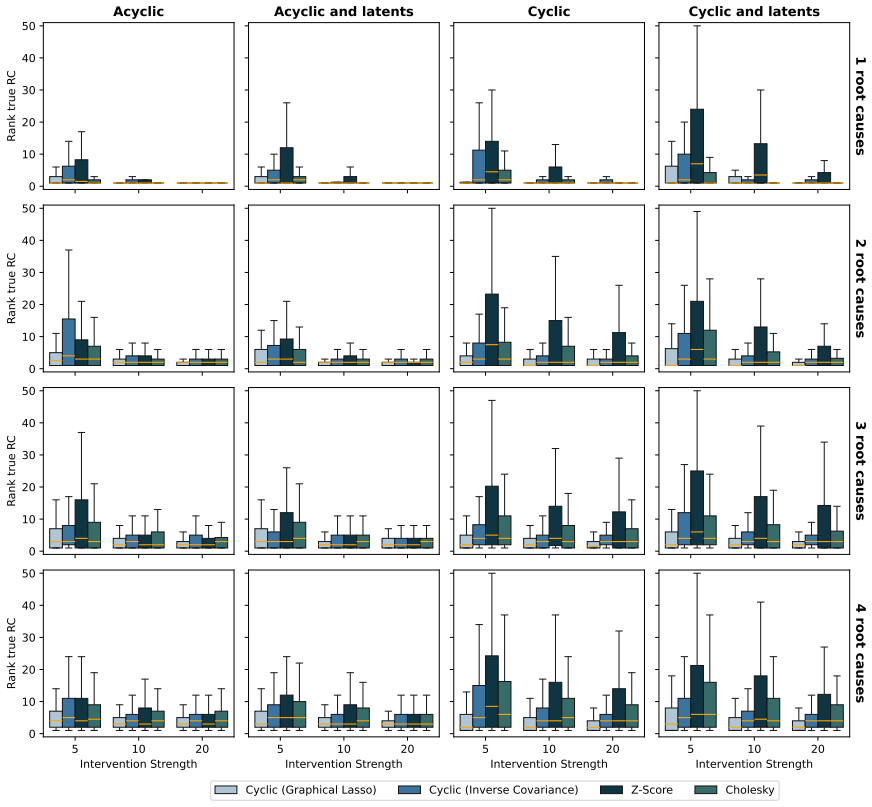
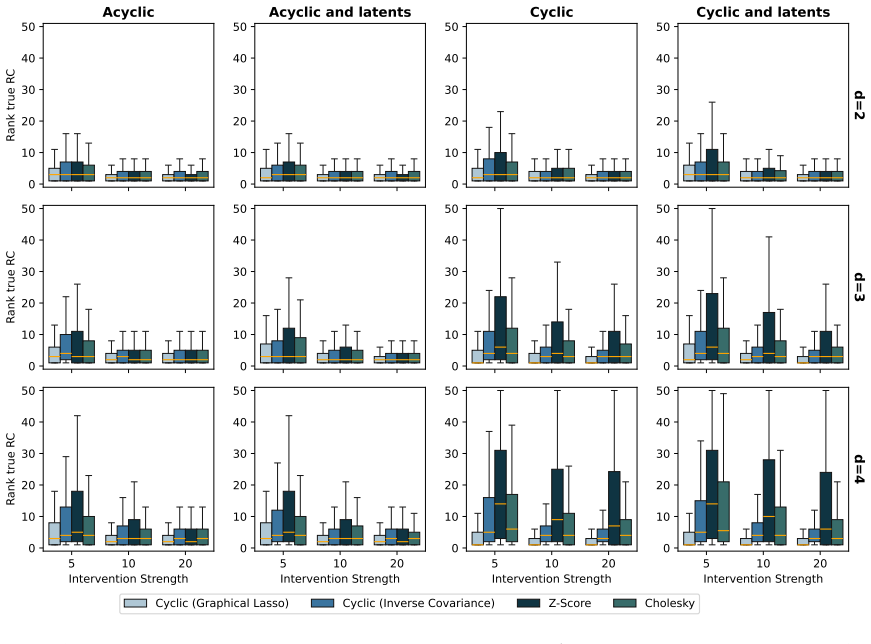
- [Section 3.1 and Section 5] The paper repeatedly relies on the perturbation being 'sufficiently strong' but never quantifies this. Theorems 3.1, 3.2, and 3.5 are distributional-support statements, not finite-sample or effect-size guarantees. The simulation and real-data protocols use estimated precision matrices, m=10p normal samples, and regularization choices, but no theorem connects these to the support results. This is a gap between the theoretical identifiability claim and the practical performance claims. Please state a minimal signal-to-noise condition or prove a consistency result as m and delta grow, or clearly mark the practical layer as heuristic.
minor comments (5)
- [Theorem 3.5] The zig-zag notation Xi Xj is used in the statement of Theorem 3.5 but is only informally introduced in Lemma 3.4. Define the symbol explicitly in the main text before Theorem 3.5.
- [Algorithm 1] Algorithm 1 has no input alpha, even though Lemma 4.1 defines k* in terms of alpha. This is consistent with the algorithm not implementing e-BH, but it should be acknowledged.
- [Section 4, Lemma 4.1] The sample size notation is inconsistent: the data matrix is X in R^{m x p}, but Lemma 4.1 writes X^(1),...,X^(n). Use m throughout.
- [Section 5.2] The real-data evaluation reduces the original 41 services to around 20 features and can merge the true root cause with another feature via PCA. This is only described in Appendix D.4; the main text should state this limitation prominently when interpreting Figure 3.
- [Abstract and Conclusion] The phrase 'yields encouraging results on real data' is stronger than what Figure 3 shows: at the beginning and end of incidents, ranks are often poor for all methods. This is acknowledged in the text, but the abstract/ conclusion should be tempered or accompanied by the Z-score caveat.
Circularity Check
No circular derivation: the support theorems follow algebraically from the stated SEM, and self-citations are terminological/background.
full rationale
The central claim (Theorems 3.1/3.2/3.5) is derived, not assumed: Eq. (4) expands ΘXX(I−A)^−1Δ = (I−A)^T ΘNN Δ, and Theorem 3.1's support statement is read off from the column support of (I−A)^T; Theorem 3.2 adds the distributional anomaly of x~, and the latent extension is proved by the self-contained projection Lemma 3.3 and sparse-precision Lemma 3.4 (with proof in A.4). The root-cause set R is an input only in the sense that Δ's support is defined as R; the shortlist is a nontrivial superset (R ∪ pa(R)) obtained without using the graph. The precision matrix is estimated from normal samples, not from the anomalous target, so no fitted parameter is renamed a prediction. The citation to Boege et al. (2025), which shares an author, supplies only the term 'zig-zag-structure' and is not load-bearing; the accompanying lemma is proven in the appendix. Footnote 2 and the conclusion openly state the model's limitation to additive shifts, which is a modeling assumption rather than a circular import of the conclusion. The paper's FDR lemma (Lemma 4.1) appears to omit the factor p relative to e-BH and the implemented algorithm thresholds Z-scores rather than using e-BH, but this is a statistical-correctness gap, not a circularity: selecting candidates does not define the claimed support result. Hence no step reduces by construction to its inputs.
Axiom & Free-Parameter Ledger
free parameters (2)
- outlier threshold τ =
0.25
- Graphical Lasso regularization α =
0.1 (fallback to 1.0, 10.0, then inverse covariance)
axioms (7)
- domain assumption I−A is invertible
- domain assumption Noise vector N has mean zero and uncorrelated components (diagonal ΣNN)
- domain assumption Anomalous sample follows the same linear SEM with sparse additive perturbation Δ
- domain assumption Genericity of A and ΣNN (no Lebesgue-measure-zero cancellations)
- domain assumption Perturbation is sufficiently strong that the deterministic shift dominates baseline noise
- domain assumption Precision matrix is known or reliably estimated from normal samples
- domain assumption Latent variables follow a linear SEM and the projected noise precision has the zig-zag sparsity pattern
Cite this review
Pith. "Pith review of Root Cause Analysis of Outliers in Unknown Cyclic Graphs." pith.science (2026). https://pith.science/paper/MNXAXAGT
@misc{pith2026251006995,
  author       = {Pith},
  title        = {Pith review of: Root Cause Analysis of Outliers in Unknown Cyclic Graphs},
  year         = {2026},
  howpublished = {\url{https://pith.science/paper/MNXAXAGT}},
  note         = {Machine review of arXiv:2510.06995}
}
read the original abstract
We study the propagation of outliers in cyclic causal graphs with linear structural equations, tracing them back to one or several "root cause" nodes. We show that it is possible to identify a short list of potential root causes provided that the perturbation is sufficiently strong and propagates according to the same structural equations as in the normal mode. This shortlist consists of the true root causes together with those of its parents lying on a cycle with the root cause. Notably, our method does not require prior knowledge of the causal graph and yields encouraging results on simulated data and real data from biology and cloud computing.
Figures




Forward citations
Cited by 3 Pith papers
-
PRIM: Meta-Learned Bayesian Root Cause Analysis
PRIM is a meta-learned Bayesian RCA method that marginalizes structural uncertainty via a MACE transformer neural process for zero-shot inference on systems up to 100 variables.
-
PRIM: Meta-Learned Bayesian Root Cause Analysis
PRIM meta-learns a Model-Averaged Causal Estimation transformer to perform Bayesian RCA by marginalizing structural uncertainty over synthetic causal priors, achieving 17ms inference on systems up to 100 variables.
-
PRIM: Meta-Learned Bayesian Root Cause Analysis
PRIM is a meta-learned Bayesian RCA method that identifies root causes by averaging over many possible causal structures via a prior-fitted neural process, achieving 17 ms inference on systems up to 100 variables.
Reference graph
Works this paper leans on
-
[1]
Structure learning for cyclic linear causal models
Carlos Amendola, Philipp Dettling, Mathias Drton, Federica Onori, and Jun Wu. Structure learning for cyclic linear causal models. In Jonas Peters and David Sontag, editors, Proceedings of the 36th Conference on Uncertainty in Artificial Intelligence (UAI), volume 124 of Proceedings of Machine Learning Research, pages 999--1008. PMLR, 03--06 Aug 2020
2020
-
[2]
Assaad, Imad Ez-Zejjari, and Lei Zan
Charles K. Assaad, Imad Ez-Zejjari, and Lei Zan. Root cause identification for collective anomalies in time series given an acyclic summary causal graph with loops. In Francisco Ruiz, Jennifer Dy, and Jan-Willem van de Meent, editors, Proceedings of the 26th International Conference on Artificial Intelligence and Statistics, volume 206 of Proceedings of M...
2023
-
[3]
o baum, Peter G \
Patrick Bl \"o baum, Peter G \"o tz, Kailash Budhathoki, Atalanti A. Mastakouri, and Dominik Janzing. Dowhy-gcm: An extension of dowhy for causal inference in graphical causal models. Journal of Machine Learning Research, 25 0 (147): 0 1--7, 2024. URL http://jmlr.org/papers/v25/22-1258.html
2024
-
[4]
Conditional independence in stationary distributions of diffusions
Tobias Boege, Mathias Drton, Benjamin Hollering, Sarah Lumpp, Pratik Misra, and Daniela Schkoda. Conditional independence in stationary distributions of diffusions. Stochastic Processes and their Applications, 184: 0 104604, 2025
2025
-
[5]
Stephan Bongers, Patrick Forr \'e , Jonas Peters, and Joris M. Mooij. Foundations of structural causal models with cycles and latent variables . The Annals of Statistics, 49 0 (5): 0 2885 -- 2915, 2021
2021
-
[6]
Decision-theoretic foundations for statistical causality
Philip Dawid. Decision-theoretic foundations for statistical causality. Journal of Causal Inference, 9 0 (1): 0 39--77, 2021
2021
-
[7]
Sparse inverse covariance estimation with the graphical lasso
Jerome Friedman, Trevor Hastie, and Robert Tibshirani. Sparse inverse covariance estimation with the graphical lasso. Biostatistics, 9 0 (3): 0 432--441, 2008
2008
-
[8]
Identifying domain-based cyclic dependencies in microservice API s using source code detectors
Patric Genfer and Uwe Zdun. Identifying domain-based cyclic dependencies in microservice API s using source code detectors. In Stefan Biffl, Elena Navarro, Welf L \"o we, Marjan Sirjani, Raffaela Mirandola, and Danny Weyns, editors, Software Architecture, pages 207--222, Cham, 2021. Springer International Publishing
2021
-
[9]
Direct learning with guarantees of the difference DAG between structural equation models
Asish Ghoshal, Kevin Bello, and Jean Honorio. Direct learning with guarantees of the difference DAG between structural equation models. arXiv preprint arXiv:1906.12024, 2019
Pith/arXiv arXiv 1906
-
[10]
Safe testing
Peter Grünwald, Rianne de Heide, and Wouter Koolen. Safe testing. Journal of the Royal Statistical Society Series B: Statistical Methodology, 86 0 (5): 0 1091--1128, 03 2024
2024
-
[11]
The petshop dataset — finding causes of performance issues across microservices
Michaela Hardt, William Roy Orchard, Patrick Blöbaum, Elke Kirschbaum, and Shiva Kasiviswanathan. The petshop dataset — finding causes of performance issues across microservices. In Proceedings of the Third Conference on Causal Learning and Reasoning (CLeaR), volume 236 of Proceedings of Machine Learning Research, pages 957--978. PMLR, 2024
2024
-
[12]
Root cause analysis of failures in microservices through causal discovery
Azam Ikram, Sarthak Chakraborty, Subrata Mitra, Shiv Kumar Saini, Saurabh Bagchi, and Murat Kocaoglu. Root cause analysis of failures in microservices through causal discovery. In Advances in Neural Information Processing Systems, 2022
2022
-
[13]
Causal discovery from soft interventions with unknown targets: Characterization and learning
Amin Jaber, Murat Kocaoglu, Karthikeyan Shanmugam, and Elias Bareinboim. Causal discovery from soft interventions with unknown targets: Characterization and learning. In H. Larochelle, M. Ranzato, R. Hadsell, M.F. Balcan, and H. Lin, editors, Advances in Neural Information Processing Systems, volume 33, pages 9551--9561. Curran Associates, Inc., 2020. URL...
2020
-
[14]
Root cause detection in a service-oriented architecture
Myunghwan Kim, Roshan Sumbaly, and Sam Shah. Root cause detection in a service-oriented architecture. In Proceedings of the ACM SIGMETRICS/International Conference on Measurement and Modeling of Computer Systems, SIGMETRICS '13, page 93–104, New York, NY, USA, 2013. Association for Computing Machinery
2013
-
[15]
Characterization and learning of causal graphs with latent variables from soft interventions
Murat Kocaoglu, Amin Jaber, Karthikeyan Shanmugam, and Elias Bareinboim. Characterization and learning of causal graphs with latent variables from soft interventions. In Proceedings of the 33rd International Conference on Neural Information Processing Systems, Red Hook, NY, USA, 2019. Curran Associates Inc
2019
-
[16]
Jinzhou Li, Benjamin B. Chu, Ines F. Scheller, Julien Gagneur, and Marloes H. Maathuis. Root cause discovery via permutations and Cholesky decomposition , 2024. URL https://arxiv.org/abs/2410.12151
arXiv 2024
-
[17]
Identifying causal changes between linear structural equation models
Vineet Malik, Kevin Bello, Asish Ghoshal, and Jean Honorio. Identifying causal changes between linear structural equation models. In Negar Kiyavash and Joris M. Mooij, editors, Proceedings of the 40th Conference on Uncertainty in Artificial Intelligence, volume 244 of Proceedings of Machine Learning Research, pages 2383--2398. PMLR, 15--19 Jul 2024
2024
-
[18]
Mooij, Sara Magliacane, and Tom Claassen
Joris M. Mooij, Sara Magliacane, and Tom Claassen. Joint causal inference from multiple contexts. Journal of Machine Learning Research, 21 0 (99): 0 1--108, 2020. URL http://jmlr.org/papers/v21/17-123.html
2020
-
[19]
Root cause analysis of outliers with missing structural knowledge
Nastaran Okati, Sergio Garrido Mejia, William Roy Orchard, Patrick Blöbaum, and Dominik Janzing. Root cause analysis of outliers with missing structural knowledge. In Advances in Neural Information Processing Systems, volume 39. Curran Associates, Inc., 2025. URL https://neurips.cc/virtual/2025/poster/119709
2025
-
[20]
A discovery algorithm for directed cyclic graphs
Thomas Richardson. A discovery algorithm for directed cyclic graphs. In Proceedings of the Twelfth International Conference on Uncertainty in Artificial Intelligence, UAI'96, page 454–461, San Francisco, CA, USA, 1996. Morgan Kaufmann Publishers Inc
1996
-
[21]
J. Schur. Über Potenzreihen, die im Innern des Einheitskreises beschränkt sind. Journal für die reine und angewandte Mathematik, 147: 0 205--232, 1917. URL http://eudml.org/doc/149467
1917
-
[22]
Schmerl, Cristian Klein, and Johan Tordsson
Mohammad Reza Saleh Sedghpour, David Garlan, Bradley R. Schmerl, Cristian Klein, and Johan Tordsson. Breaking the vicious circle: Self-adaptive microservice circuit breaking and retry. In IC2E, pages 32--42, 2023
2023
-
[23]
-diagnosis: Unsupervised and real-time diagnosis of small-window long-tail latency in large-scale microservice platforms
Huasong Shan, Yuan Chen, Haifeng Liu, Yunpeng Zhang, Xiao Xiao, Xiaofeng He, Min Li, and Wei Ding. -diagnosis: Unsupervised and real-time diagnosis of small-window long-tail latency in large-scale microservice platforms. In Proceedings of The World Wide Web Conference, pages 3215--3222, New York, NY, USA, 2019. Association for Computing Machinery
2019
-
[24]
Dowhy: An end-to-end library for causal inference
Amit Sharma and Emre Kiciman. Dowhy: An end-to-end library for causal inference. arXiv preprint arXiv:2011.04216, 2020
Pith/arXiv arXiv 2011
-
[25]
Causation, Prediction, and Search
Peter Spirtes, Clark Glymour, and Richard Scheines. Causation, Prediction, and Search. The MIT Press, 01 2001
2001
-
[26]
DeepITE: D esigning variational graph autoencoders for intervention target estimation
Hongyuan Tao, Hang Yu, and Jianguo Li. DeepITE: D esigning variational graph autoencoders for intervention target estimation. In A. Globerson, L. Mackey, D. Belgrave, A. Fan, U. Paquet, J. Tomczak, and C. Zhang, editors, Advances in Neural Information Processing Systems, volume 37, pages 89978--90008. Curran Associates, Inc., 2024
2024
-
[27]
RADICE: C ausal graph based root cause analysis for system performance diagnostic
Andrea Tonon, Meng Zhang, Bora Caglayan, Fei Shen, Tong Gui, MingXue Wang, and Rong Zhou. RADICE: C ausal graph based root cause analysis for system performance diagnostic. In 2025 IEEE International Conference on Software Analysis, Evolution and Reengineering (SANER), pages 465--475, 2025. doi:10.1109/SANER64311.2025.00050
arXiv 2025
-
[28]
Scalable intervention target estimation in linear models
Burak Varici, Karthikeyan Shanmugam, Prasanna Sattigeri, and Ali Tajer. Scalable intervention target estimation in linear models. In M. Ranzato, A. Beygelzimer, Y. Dauphin, P.S. Liang, and J. Wortman Vaughan, editors, Advances in Neural Information Processing Systems, volume 34, pages 1494--1505. Curran Associates, Inc., 2021
2021
-
[29]
Intervention target estimation in the presence of latent variables
Burak Varici, Karthikeyan Shanmugam, Prasanna Sattigeri, and Ali Tajer. Intervention target estimation in the presence of latent variables. In James Cussens and Kun Zhang, editors, Proceedings of the Thirty-Eighth Conference on Uncertainty in Artificial Intelligence, volume 180 of Proceedings of Machine Learning Research, pages 2013--2023. PMLR, 01--05 Aug 2022
2013
-
[30]
Backtracking counterfactuals
Julius Von K\"ugelgen, Abdirisak Mohamed, and Sander Beckers. Backtracking counterfactuals. In Mihaela van der Schaar, Cheng Zhang, and Dominik Janzing, editors, Proceedings of the Second Conference on Causal Learning and Reasoning, volume 213 of Proceedings of Machine Learning Research, pages 177--196. PMLR, 11--14 Apr 2023
2023
-
[31]
E-values: Calibration, combination and applications
Vladimir Vovk and Ruodu Wang. E-values: Calibration, combination and applications . The Annals of Statistics, 49 0 (3): 0 1736 -- 1754, 2021
2021
-
[32]
False discovery rate control with e-values
Ruodu Wang and Aaditya Ramdas. False discovery rate control with e-values. Journal of the Royal Statistical Society Series B: Statistical Methodology, 84 0 (3): 0 822--852, 01 2022
2022
-
[33]
Direct estimation of differences in causal graphs
Yuhao Wang, Chandler Squires, Anastasiya Belyaeva, and Caroline Uhler. Direct estimation of differences in causal graphs. In S. Bengio, H. Wallach, H. Larochelle, K. Grauman, N. Cesa-Bianchi, and R. Garnett, editors, Advances in Neural Information Processing Systems, volume 31. Curran Associates, Inc., 2018. URL https://proceedings.neurips.cc/paper/2018/f...
2018
-
[34]
Zhiqiang Xie, Yujia Zheng, Lizi Ottens, Kun Zhang, Christos Kozyrakis, and Jonathan Mace. Cloud atlas: Efficient fault localization for cloud systems using language models and causal insight, 2024. URL https://arxiv.org/abs/2407.08694
Pith/arXiv arXiv 2024
-
[35]
Learning unknown intervention targets in structural causal models from heterogeneous data
Yuqin Yang, Saber Salehkaleybar, and Negar Kiyavash. Learning unknown intervention targets in structural causal models from heterogeneous data. In Sanjoy Dasgupta, Stephan Mandt, and Yingzhen Li, editors, Proceedings of The 27th International Conference on Artificial Intelligence and Statistics, volume 238 of Proceedings of Machine Learning Research, page...
2024
This paper was first reviewed by deepseek-v4-flash on August 4, 2026.
discussion (0)
Sign in with ORCID, Apple, or X to comment. Anyone can read and Pith papers without signing in.