REVIEW 4 major objections 6 minor 39 references
LuxInstruct: A Cross-Lingual Instruction Tuning Dataset For Luxembourgish
T0 review · 4 major / 6 minor · reviewed 2026-08-04 · deepseek-v4-flash
Pith's one-line read Cross-lingual instruction tuning with English or French prompts outperforms monolingual Luxembourgish tuning for low-resource language models.
desk verdict Useful new dataset for Luxembourgish; the resource is solid, but the headline empirical claim is undercut by a machine-translated monolingual control. read the letter →
The pith
A machine-rendered reading of the paper's core claim, the machinery that carries it, and where it could break.
The reading
What carries the argument
The central object is LuxInstruct, a cross-lingual instruction-tuning dataset in which instructions are written in English, French, or German and outputs are in Luxembourgish. It is created by prompting an LLM to generate English instructions directly from Luxembourgish source documents, avoiding translation into Luxembourgish, then optionally translating the instructions into the other two languages. The experimental design keeps outputs in Luxembourgish while varying only the instruction language, and measures alignment with a kernel-based similarity metric and generation quality with LLM-as-judge scoring.
What would settle it
A controlled experiment using natively written (or human-verified) Luxembourgish instructions as the monolingual control in both the alignment and generation evaluations; if LB-LB matches or exceeds EN-LB performance, the cross-lingual advantage claim collapses. Alternatively, take the same English instructions, machine-translate them into Luxembourgish, and compare against the original English versions under identical conditions; if English still wins, the effect is translationese, not cross-lingual transfer.
Extended reading notes
Core claim
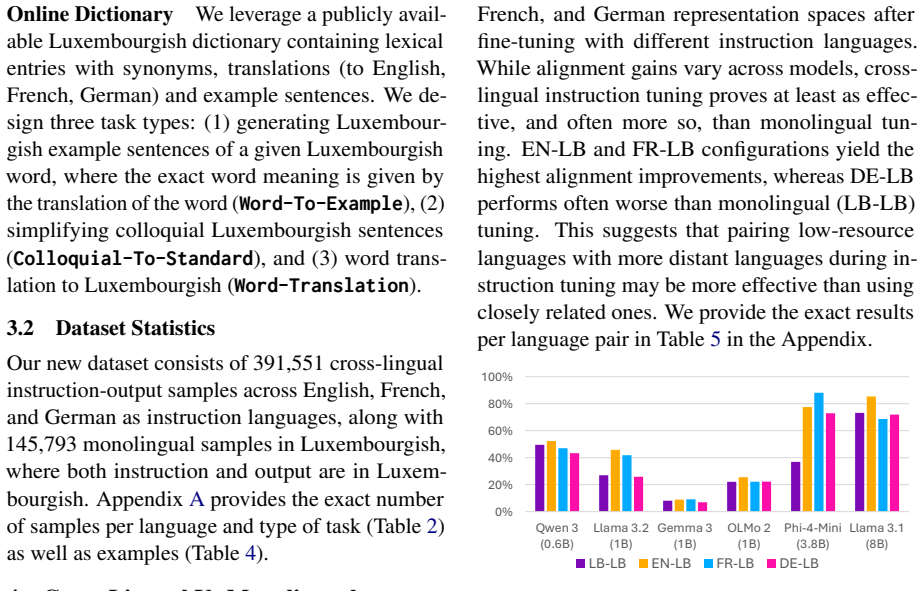
Fine-tuning six open instruction-tuned models on data where instructions are in English or French and responses are in Luxembourgish raises the representation-alignment score between Luxembourgish and other languages more than tuning on Luxembourgish-only data does; the same pattern appears in few-shot generation, where English few-shot instructions produce higher judge-rated clarity, coherence, fluency, and relevance scores for 12B and 27B models than Luxembourgish few-shot instructions. The dataset itself contains 391,551 cross-lingual and 145,793 monolingual samples, built from Luxembourgish Wikipedia, news articles, and dictionary entries, with outputs extracted from native Luxembourgish
Load-bearing premise
The headline comparison assumes the Luxembourgish-only condition is a genuine monolingual control; in the experiments, those Luxembourgish instructions were machine-translated (as disclosed in the experimental setup), so the cross-lingual advantage could be an effect of instruction originality rather than of cross-lingual tuning per se.
Editorial extensions
If this is right
- Low-resource languages can adopt cross-lingual tuning by pairing high-resource instruction languages with native outputs, even when native instruction data is scarce.
- Models tuned this way show higher cross-lingual representation alignment, a property associated with better transfer across languages.
- English few-shot examples drawn from such a dataset improve Luxembourgish generation quality compared to Luxembourgish few-shot examples, giving practical prompt guidance.
- The dataset provides a native-output resource for Luxembourgish, supporting grammar, orthography, and cultural grounding in model outputs.
- The finding that more distant languages (English, French) yield larger gains than the closely related German suggests language distance may be an asset rather than a barrier.
Reading between the lines
- The disclosed use of machine-translated Luxembourgish instructions in the control condition means the advantage attributed to cross-lingual tuning may actually be an advantage of original over translated instructions; a control with natively written Luxembourgish instructions would isolate the language effect.
- The dataset construction recipe—generate instructions in a high-resource language from native text and keep outputs native—is portable to other low-resource languages that possess any body of native text, such as other regional European languages or under-resourced dialects.
- The pattern that instruction language, not output language, drives the gains hints that multilingual models already encode Luxembourgish well enough; cross-lingual tuning may work by teaching the model to connect those spaces, which could be tested by measuring alignment before and after tuning on unrelated languages.
Editorial analysis
A structured set of objections, weighed in public.
Referee Report
Summary. The paper introduces LuxInstruct, a 537,344-sample instruction-tuning dataset for Luxembourgish, with cross-lingual instructions in English, French, and German and Luxembourgish outputs, built from Wikipedia, RTL news articles, and the Luxembourg Online Dictionary without machine translation into Luxembourgish in the released resource. The authors fine-tune six open LLMs with LoRA on EN-LB, FR-LB, DE-LB, and LB-LB subsets, measure cross-lingual representation alignment via CKA on FLORES-200, and run few-shot in-context learning G-Eval on Gemma 3 12B/27B with different instruction languages. They conclude that cross-lingual instruction tuning is at least as effective as, and often better than, monolingual Luxembourgish instruction tuning.
Significance. LuxInstruct is a useful, first-of-its-kind resource for Luxembourgish instruction tuning: it is public, constructed with a detailed and reproducible pipeline, and combines reverse-instruction generation with aligned news and dictionary tasks. If the empirical claim were established, it would support cross-lingual instruction tuning as a superior strategy for low-resource languages and validate the dataset's no-MT design. The paper deserves credit for anchoring measurements on FLORES-200 parallel data, using three independent LLM judges plus human annotation for G-Eval, and releasing the dataset publicly. The central empirical claim, however, is weakened by a confounded monolingual control, as detailed below.
major comments (4)
- [§4, Appendix B] The monolingual Luxembourgish control is machine-translated. §4 states that the Open-Ended portion 'contains parallel English, French, and German instructions, further extended to Luxembourgish via gpt-4.5 translations,' and Appendix B confirms that 'we additionally translate these instructions into Luxembourgish using gpt-4.5.' Thus, in both the CKA and few-shot experiments, LB instructions are gpt-4.5 translations of the English instructions, while EN instructions are the original gpt-4.1-mini generations. The paper's own thesis is that machine translation degrades instruction quality, so the observed EN-over-LB advantage (e.g., Llama 3.2 LB-EN CKA 0.3222 vs LB-LB 0.2759; Gemma 27B 8-shot Clarity 81.3 vs 78.9) may reflect instruction-quality differences rather than a cross-lingual-versus-monolingual contrast. The headline claim is not established unless the LB condition uses native Lux
- [Table 5, Figure 1] The CKA results are reported as point estimates with no variance or significance testing. Each condition appears to correspond to a single LoRA fine-tuning run, and several differences are small (e.g., Gemma 3 1B: EN-LB 0.2570 vs LB-LB 0.2490). Without multiple seeds or confidence intervals, the ranking of instruction languages could be noise. Please provide repeated runs and a statistical comparison, or explicitly frame the results as descriptive.
- [Appendix B.3.5] The human calibration of G-Eval samples only output pairs on which all three LLM judges agreed, and then excludes human tie cases from the Cohen's κ calculation. This preselection guarantees higher agreement than on contested pairs and does not validate the judge for the cases that actually matter. Please sample without preselection, include ties in the analysis, and report the number of pairs annotated.
- [Appendix A.1.1, Appendix A.2] The dataset is released under CC BY-NC 4.0, but the Open-Ended component uses verbatim excerpts from Luxembourgish Wikipedia, which is licensed CC BY-SA 4.0. A derivative work under ShareAlike cannot be relicensed under a more restrictive, non-commercial-only license. This incompatibility affects the dataset's legal usability and should be clarified or corrected before publication.
minor comments (6)
- [Table 1, Table 6] The few-shot G-Eval results are averages over five seeds, but no standard deviations are reported. Given the small gaps between conditions (1–3 points), include variability measures or at least note the range across seeds.
- [Figure 1] The figure caption and extracted text contain garbled tokens ('00,20,40,6', 'LLama…'); the version for review should be cleaned and all model names spelled consistently.
- [§4.2] The model identifier 'GPT-5 mini' is used without a version or API identifier. Please specify the exact model name and provider so that the evaluation is reproducible.
- [Table 5 vs §B.1.1] Phi-4-Mini is described as 3.84B parameters in B.1.1 but listed as 1.8B in Table 5 and in Figure 1. Correct the inconsistency.
- [Abstract, §1] The abstract says 'human-generated, rather than synthetic,' but the Wikipedia instructions are generated by gpt-4.1-mini. The paper should clarify that 'human-generated' refers to the seed outputs (Wikipedia text, news articles, dictionary entries), not to all instructions.
- [Appendix B.3.2] The 50 test instructions are referenced by a footnote saying they are 'provided here,' but no URL appears in the manuscript. Include a stable link or appendix listing.
Circularity Check
No significant circularity: headline result is empirical and anchored to external evaluation; the monolingual-control MT confound is a validity issue, not a circular reduction.
full rationale
The paper's central claims are empirical comparisons, not derivations from their own definitions. Section 4.1 fine-tunes six models on single-language instruction subsets and measures representational alignment on the external FLORES-200 parallel set with CKA; the evaluation input is disjoint from the training subsets, and no parameter is fitted to make the reported LB-EN vs LB-LB differences come out. Section 4.2 evaluates Gemma 3 12B/27B in few-shot in-context learning on 50 separately curated Luxembourgish test instructions, judged by three external LLM APIs with a human-agreement calibration; these judged models are not fine-tuned on LuxInstruct, and the same excerpt subset is used across instruction-language settings. The only notable weakness is a confound: Appendix B discloses 'we additionally translate these instructions into Luxembourgish using gpt-4.5,' so the LB-LB control and the LB few-shot examples are machine translations of the English-origin instructions, while the EN condition uses the original gpt-4.1-mini instructions. That threatens the internal validity of the 'cross-lingual vs monolingual' comparison, but it does not make the EN-over-LB result equivalent to the experimental inputs by construction. The self-citations, e.g., Philippy et al. (2025) for LUXALIGN, are used as externally available data resources, not as load-bearing justification of the headline claim, and therefore do not raise the circularity score.
Assumptions & free parameters
free parameters (6)
- article-pairing cosine similarity threshold =
0.65
- Wikipedia sample size =
20,000 of ~64,000 articles
- heuristic quality filters =
min 10 words; output must end with full stop; no question mark; not starting lowercase; must be Luxembourgish; fuzzy-mat
- LoRA/fine-tuning hyperparameters =
rank 8, alpha 16, lr 2e-5, 500 steps, batch 16, 128-token context
- native-speaker test instruction set =
50 instructions
- prompt template sets =
50 templates per language for news tasks; 20/50 per language for dictionary tasks
assumptions (6)
- standard math CKA computed on mean-pooled final-layer embeddings of FLORES-200 parallel sentences is a valid measure of cross-lingual alignment relevant to transfer.
- domain assumption LLM-as-a-judge (G-Eval via three API models) approximates human judgments of Luxembourgish output quality.
- domain assumption Verbatim excerpts from Luxembourgish Wikipedia are natural, high-quality instruction-following outputs.
- domain assumption gpt-4.1-mini's generated English instructions are semantically aligned with the Luxembourgish source spans, and its DE/FR translations plus gpt-4.5 LB translations preserve that alignment.
- domain assumption RTL articles paired by embedding cosine similarity >= 0.65 are cross-lingual versions of the same story.
- domain assumption The 50 native-speaker-curated test instructions are a representative benchmark of Luxembourgish instruction following.
Cite this review
Pith. "Pith review of LuxInstruct: A Cross-Lingual Instruction Tuning Dataset For Luxembourgish." pith.science (2026). https://pith.science/paper/DAT2LIWC
@misc{pith2026251007074,
  author       = {Pith},
  title        = {Pith review of: LuxInstruct: A Cross-Lingual Instruction Tuning Dataset For Luxembourgish},
  year         = {2026},
  howpublished = {\url{https://pith.science/paper/DAT2LIWC}},
  note         = {Machine review of arXiv:2510.07074}
}
read the original abstract
Instruction tuning has become a key technique for enhancing the performance of large language models, enabling them to better follow human prompts. However, low-resource languages such as Luxembourgish face severe limitations due to the lack of high-quality instruction datasets. Traditional reliance on machine translation often introduces semantic misalignment and cultural inaccuracies. In this work, we address these challenges by creating a cross-lingual instruction tuning dataset for Luxembourgish, without resorting to machine-generated translations into it. Instead, by leveraging aligned data from English, French, and German, we build a high-quality dataset that preserves linguistic and cultural nuances. We provide evidence that cross-lingual instruction tuning not only improves representational alignment across languages but also the model's generative capabilities in Luxembourgish. This highlights how cross-lingual data curation can avoid the common pitfalls of machine-translated data and directly benefit low-resource language development.
Figures
Reference graph
Works this paper leans on
-
[1]
Israel Abebe Azime, Atnafu Lambebo Tonja, Tadesse Destaw Belay, Mitiku Yohannes Fuge, Aman Kassahun Wassie, Eyasu Shiferaw Jada, Yonas Chanie, Walelign Tewabe Sewunetie, and Seid Muhie Yimam. 2024. https://doi.org/10.18653/v1/2024.findings-emnlp.25 Walia- LLM : Enhancing A mharic- LL a MA by integrating task-specific and generative datasets . In Findings ...
-
[2]
Laura Bernardy. 2022. A luxembourgish gpt-2 approach based on transfer learning. Master's thesis, University of Trier, Trier, Germany
2022
-
[3]
Yuri Bizzoni, Tom S Juzek, Cristina Espa \ n a-Bonet, Koel Dutta Chowdhury, Josef van Genabith, and Elke Teich. 2020. https://doi.org/10.18653/v1/2020.iwslt-1.34 How human is machine translationese? comparing human and machine translations of text and speech . In Proceedings of the 17th International Conference on Spoken Language Translation, pages 280--2...
-
[4]
Linzheng Chai, Jian Yang, Tao Sun, Hongcheng Guo, Jiaheng Liu, Bing Wang, Xinnian Liang, Jiaqi Bai, Tongliang Li, Qiyao Peng, and Zhoujun Li. 2025. https://doi.org/10.1609/aaai.v39i22.34524 xcot: cross-lingual instruction timing for cross-lingual chain-of-thought reasoning . In Proceedings of the Thirty-Ninth AAAI Conference on Artificial Intelligence and...
-
[5]
Gheorghe Comanici, Eric Bieber, Mike Schaekermann, Ice Pasupat, Noveen Sachdeva, Inderjit Dhillon, Marcel Blistein, Ori Ram, Dan Zhang, Evan Rosen, Luke Marris, Sam Petulla, Colin Gaffney, Asaf Aharoni, Nathan Lintz, Tiago Cardal Pais, Henrik Jacobsson, Idan Szpektor, Nan-Jiang Jiang, and 3290 others. 2025. https://arxiv.org/abs/2507.06261 Gemini 2.5: Pus...
arXiv 2025
-
[6]
DeepSeek-AI, Aixin Liu, Bei Feng, Bing Xue, Bingxuan Wang, Bochao Wu, Chengda Lu, Chenggang Zhao, Chengqi Deng, Chenyu Zhang, Chong Ruan, Damai Dai, Daya Guo, Dejian Yang, Deli Chen, Dongjie Ji, Erhang Li, Fangyun Lin, Fucong Dai, and 181 others. 2025. https://arxiv.org/abs/2412.19437 Deepseek-v3 technical report . Preprint, arXiv:2412.19437
arXiv 2025
-
[7]
https://dumps.wikimedia.org Wikimedia downloads
Wikimedia Foundation. https://dumps.wikimedia.org Wikimedia downloads
-
[8]
Felix Gaschi, Patricio Cerda, Parisa Rastin, and Yannick Toussaint. 2023. https://doi.org/10.18653/v1/2023.findings-acl.189 Exploring the relationship between alignment and cross-lingual transfer in multilingual transformers . In Findings of the Association for Computational Linguistics: ACL 2023, pages 3020--3042, Toronto, Canada. Association for Computa...
Show all 39 references
-
[9]
Aaron Grattafiori, Abhimanyu Dubey, Abhinav Jauhri, Abhinav Pandey, Abhishek Kadian, Ahmad Al-Dahle, Aiesha Letman, Akhil Mathur, Alan Schelten, Alex Vaughan, Amy Yang, Angela Fan, Anirudh Goyal, Anthony Hartshorn, Aobo Yang, Archi Mitra, Archie Sravankumar, Artem Korenev, Art...
2024 arXiv
-
[10]
Oskar Holmstr \"o m and Ehsan Doostmohammadi. 2023. https://aclanthology.org/2023.nodalida-1.62/ Making instruction finetuning accessible to non- E nglish languages: A case study on S wedish models . In Proceedings of the 24th Nordic Conference on Computational Linguistics (No...
2023
-
[11]
Hu, Yelong Shen, Phillip Wallis, Zeyuan Allen-Zhu, Yuanzhi Li, Shean Wang, Lu Wang, and Weizhu Chen
Edward J. Hu, Yelong Shen, Phillip Wallis, Zeyuan Allen-Zhu, Yuanzhi Li, Shean Wang, Lu Wang, and Weizhu Chen. 2021. https://arxiv.org/abs/2106.09685 Lora: Low-rank adaptation of large language models . Preprint, arXiv:2106.09685
2021 arXiv
-
[12]
Jeffrey Ip and Kritin Vongthongsri. 2025. https://confident-ai.com deepeval . The Open-Source LLM Evaluation Framework
2025
-
[13]
Abdullatif K \"o ksal, Timo Schick, Anna Korhonen, and Hinrich Schuetze. 2024. https://doi.org/10.18653/v1/2024.findings-emnlp.414 L ong F orm: Effective instruction tuning with reverse instructions . In Findings of the Association for Computational Linguistics: EMNLP 2024, pa...
2024 doi
-
[14]
Simon Kornblith, Mohammad Norouzi, Honglak Lee, and Geoffrey Hinton. 2019. https://arxiv.org/abs/1905.00414 Similarity of neural network representations revisited . Preprint, arXiv:1905.00414
2019 arXiv
-
[15]
Abdullatif Köksal, Marion Thaler, Ayyoob Imani, Ahmet Üstün, Anna Korhonen, and Hinrich Schütze. 2024. https://arxiv.org/abs/2409.12958 Muri: High-quality instruction tuning datasets for low-resource languages via reverse instructions . Preprint, arXiv:2409.12958
2024 arXiv
-
[16]
Nurkhan Laiyk, Daniil Orel, Rituraj Joshi, Maiya Goloburda, Yuxia Wang, Preslav Nakov, and Fajri Koto. 2025. https://doi.org/10.18653/v1/2025.acl-long.706 Instruction tuning on public government and cultural data for low-resource language: a case study in K azakh . In Proceedi...
2025 doi
-
[17]
Chong Li, Wen Yang, Jiajun Zhang, Jinliang Lu, Shaonan Wang, and Chengqing Zong. 2024. https://doi.org/10.18653/v1/2024.findings-acl.30 X -instruction: Aligning language model in low-resource languages with self-curated cross-lingual instructions . In Findings of the Associati...
2024 doi
-
[18]
Haonan Li, Fajri Koto, Minghao Wu, Alham Fikri Aji, and Timothy Baldwin. 2023. https://arxiv.org/abs/2305.15011 Bactrian-x: Multilingual replicable instruction-following models with low-rank adaptation . Preprint, arXiv:2305.15011
2023 arXiv
-
[19]
Geyu Lin, Bin Wang, Zhengyuan Liu, and Nancy F. Chen. 2025. https://aclanthology.org/2025.sumeval-2.2/ C ross I n: An efficient instruction tuning approach for cross-lingual knowledge alignment . In Proceedings of the Second Workshop on Scaling Up Multilingual & Multi-Cultural...
2025
-
[20]
Yang Liu, Dan Iter, Yichong Xu, Shuohang Wang, Ruochen Xu, and Chenguang Zhu. 2023. https://doi.org/10.18653/v1/2023.emnlp-main.153 G -eval: NLG evaluation using gpt-4 with better human alignment . In Proceedings of the 2023 Conference on Empirical Methods in Natural Language ...
2023 doi
-
[21]
Cedric Lothritz and Jordi Cabot. 2025. https://arxiv.org/abs/2504.01667 Testing low-resource language support in llms using language proficiency exams: the case of luxembourgish . Preprint, arXiv:2504.01667
2025
-
[22]
Cedric Lothritz, Bertrand Lebichot, Kevin Allix, Lisa Veiber, Tegawende Bissyande, Jacques Klein, Andrey Boytsov, Clément Lefebvre, and Anne Goujon. 2022. https://aclanthology.org/2022.lrec-1.543 LuxemBERT : Simple and Practical Data Augmentation in Language Model Pre - Traini...
2022
-
[23]
Microsoft, :, Abdelrahman Abouelenin, Atabak Ashfaq, Adam Atkinson, Hany Awadalla, Nguyen Bach, Jianmin Bao, Alon Benhaim, Martin Cai, Vishrav Chaudhary, Congcong Chen, Dong Chen, Dongdong Chen, Junkun Chen, Weizhu Chen, Yen-Chun Chen, Yi ling Chen, Qi Dai, and 57 others. 2025...
2025 arXiv
-
[24]
Niklas Muennighoff, Thomas Wang, Lintang Sutawika, Adam Roberts, Stella Biderman, Teven Le Scao, M Saiful Bari, Sheng Shen, Zheng Xin Yong, Hailey Schoelkopf, Xiangru Tang, Dragomir Radev, Alham Fikri Aji, Khalid Almubarak, Samuel Albanie, Zaid Alyafeai, Albert Webson, Edward ...
2023 doi
-
[25]
Team OLMo, Pete Walsh, Luca Soldaini, Dirk Groeneveld, Kyle Lo, Shane Arora, Akshita Bhagia, Yuling Gu, Shengyi Huang, Matt Jordan, Nathan Lambert, Dustin Schwenk, Oyvind Tafjord, Taira Anderson, David Atkinson, Faeze Brahman, Christopher Clark, Pradeep Dasigi, Nouha Dziri, an...
2025 arXiv
-
[26]
Long Ouyang, Jeffrey Wu, Xu Jiang, Diogo Almeida, Carroll Wainwright, Pamela Mishkin, Chong Zhang, Sandhini Agarwal, Katarina Slama, Alex Ray, John Schulman, Jacob Hilton, Fraser Kelton, Luke Miller, Maddie Simens, Amanda Askell, Peter Welinder, Paul F Christiano, Jan Leike, a...
2022
-
[27]
Fred Philippy, Siwen Guo, Jacques Klein, and Tegawende Bissyande. 2025. https://aclanthology.org/2025.coling-main.753/ L ux E mbedder: A cross-lingual approach to enhanced L uxembourgish sentence embeddings . In Proceedings of the 31st International Conference on Computational...
2025
-
[28]
Alistair Plum, Tharindu Ranasinghe, and Christoph Purschke. 2025. https://aclanthology.org/2025.vardial-1.7/ Text generation models for L uxembourgish with limited data: A balanced multilingual strategy . In Proceedings of the 12th Workshop on NLP for Similar Languages, Variet...
2025
-
[29]
Uri Shaham, Jonathan Herzig, Roee Aharoni, Idan Szpektor, Reut Tsarfaty, and Matan Eyal. 2024. https://doi.org/10.18653/v1/2024.findings-acl.136 Multilingual instruction tuning with just a pinch of multilinguality . In Findings of the Association for Computational Linguistics:...
2024 doi
-
[30]
Guokan Shang, Hadi Abdine, Yousef Khoubrane, Amr Mohamed, Yassine Abbahaddou, Sofiane Ennadir, Imane Momayiz, Xuguang Ren, Eric Moulines, Preslav Nakov, Michalis Vazirgiannis, and Eric Xing. 2025. https://aclanthology.org/2025.loreslm-1.2/ Atlas-chat: Adapting large language m...
2025
-
[31]
Masahiro Suzuki, Masanori Hirano, and Hiroki Sakaji. 2023. https://doi.org/10.1109/BigData59044.2023.10386605 From Base to Conversational: Japanese Instruction Dataset and Tuning Large Language Models . In 2023 IEEE International Conference on Big Data (BigData), pages 5684--5...
2023
-
[32]
Gemma Team, Aishwarya Kamath, Johan Ferret, Shreya Pathak, Nino Vieillard, Ramona Merhej, Sarah Perrin, Tatiana Matejovicova, Alexandre Ramé, Morgane Rivière, Louis Rouillard, Thomas Mesnard, Geoffrey Cideron, Jean bastien Grill, Sabela Ramos, Edouard Yvinec, Michelle Casbon, ...
2025 arXiv
-
[33]
NLLB Team, Marta R. Costa-jussà, James Cross, Onur Çelebi, Maha Elbayad, Kenneth Heafield, Kevin Heffernan, Elahe Kalbassi, Janice Lam, Daniel Licht, Jean Maillard, Anna Sun, Skyler Wang, Guillaume Wenzek, Al Youngblood, Bapi Akula, Loic Barrault, Gabriel Mejia Gonzalez, Prang...
2022 arXiv
-
[34]
Hetong Wang, Pasquale Minervini, and Edoardo Ponti. 2024. https://doi.org/10.18653/v1/2024.findings-acl.724 Probing the emergence of cross-lingual alignment during LLM training . In Findings of the Association for Computational Linguistics: ACL 2024, pages 12159--12173, Bangko...
2024 doi
-
[35]
Alexander Arno Weber, Klaudia Thellmann, Jan Ebert, Nicolas Flores-Herr, Jens Lehmann, Michael Fromm, and Mehdi Ali. 2024. https://doi.org/10.18653/v1/2024.emnlp-main.1159 Investigating multilingual instruction-tuning: Do polyglot models demand for multilingual instructions? I...
2024 doi
-
[36]
An Yang, Anfeng Li, Baosong Yang, Beichen Zhang, Binyuan Hui, Bo Zheng, Bowen Yu, Chang Gao, Chengen Huang, Chenxu Lv, Chujie Zheng, Dayiheng Liu, Fan Zhou, Fei Huang, Feng Hu, Hao Ge, Haoran Wei, Huan Lin, Jialong Tang, and 41 others. 2025. https://arxiv.org/abs/2505.09388 Qw...
2025 arXiv
-
[37]
Sicheng Yu, Qianru Sun, Hao Zhang, and Jing Jiang. 2022. https://doi.org/10.18653/v1/2022.acl-short.40 Translate-train embracing translationese artifacts . In Proceedings of the 60th Annual Meeting of the Association for Computational Linguistics (Volume 2: Short Papers), page...
2022 doi
-
[38]
online" 'onlinestring :=
ENTRY address archivePrefix author booktitle chapter edition editor eid eprint eprinttype howpublished institution journal key month note number organization pages publisher school series title type volume year doi pubmed url lastchecked label extra.label sort.label short.list...
-
[39]
write newline
" write newline "" before.all 'output.state := FUNCTION n.dashify 't := "" t empty not t #1 #1 substring "-" = t #1 #2 substring "--" = not "--" * t #2 global.max substring 't := t #1 #1 substring "-" = "-" * t #2 global.max substring 't := while if t #1 #1 substring * t #2 gl...
Reviewed August 4, 2026 · model on record in the stance chip above.
Discussion (0). Sign in to comment.