Dimension- and Facet-Dependent Altermagnetic Biferroics and Ferromagnetic Biferroics and Triferroics in CrSb
Pith reviewed 2026-05-18 09:28 UTC · model grok-4.3
The pith
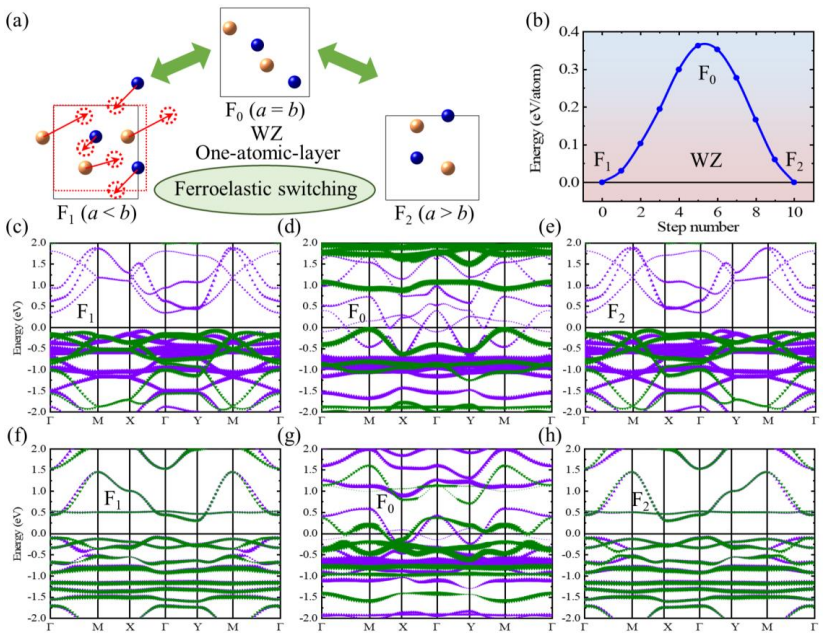
CrSb in wurtzite phase on (110) facets forms triferroics where ferroelectric and ferroelastic switching reverses altermagnetic spin splitting.
A machine-rendered reading of the paper's core claim, the machinery that carries it, and where it could break.
Core claim
The paper identifies the wurtzite-phase (110) facets of CrSb as FM/AM-FE-FC triferroics with moderate energy barriers of 0.129 eV atom-1 for ferroelectric switching and 0.363 eV atom-1 for ferroelastic switching. Both switching processes reverse the altermagnetic spin splitting in antiferromagnetic configurations while preserving high spin polarization in ferromagnetic states. NiAs- and MnP-phase (110) facets are altermagnetic-ferroelastic biferroics, and wurtzite bulk and (001) facets host ferromagnetic or altermagnetic-ferroelectric biferroics. Magnetic anisotropy is tunable between uniaxial and in-plane depending on phase, dimension, and facet.
What carries the argument
Polymorphic phase selection and facet orientation in CrSb that couples altermagnetism or ferromagnetism with ferroelectric and ferroelastic orders, with the wurtzite (110) surface serving as the triferroic example.
If this is right
- Ferroelectric switching reverses the direction of altermagnetic spin splitting in antiferromagnetic states.
- Ferroelastic switching produces the same reversal of spin splitting without destroying ferromagnetic spin polarization.
- Magnetic anisotropy switches between uniaxial and in-plane forms when phase or facet is changed.
- This polymorphic and facet-based approach supplies a general route to multifunctional spintronic materials.
Where Pith is reading between the lines
- The same phase-and-facet engineering could be tried in other transition-metal pnictides to find additional altermagnetic triferroics.
- Device integration might allow electric or strain control of spin currents in heterostructures without external magnets.
- Room-temperature stability of the switched states would need separate checks because the reported barriers are moderate.
Load-bearing premise
First-principles calculations give the correct relative stability among the NiAs, MnP, and wurtzite phases of CrSb and reliable energy barriers for ferroelectric and ferroelastic switching without large errors from the choice of exchange-correlation functional or from ignoring temperature and defect effects.
What would settle it
Experimental measurement showing that an applied electric field or uniaxial strain on wurtzite CrSb (110) films reverses the sign of momentum-dependent spin splitting while keeping high spin polarization in the ferromagnetic configuration.
Figures



read the original abstract
Altermagnets have recently garnered significant interest due to their vanishing net magnetic moment and non-relativistic momentum-dependent spin splitting. However, altermagnetic (AM) multiferroics especially triferroics remain scarce. We investigate the experimentally synthesized non-van der Waals CrSb as a model system to explore the effects of dimensionality and facet orientation on its ferroic properties. NiAs, MnP, wurtzite (WZ), zincblende (ZB), and rocksalt (RS) phases are considered. Using first-principles calculations, we predict the altermagnetism of CrSb in MnP phase which has comparable stability with experimental NiAs phase. Both NiAs- and MnP-phase (110) facets exhibit AM-ferroelastic (FC) biferroics, while the WZ-phase bulk and (001) facets host ferromagnetic (FM) or AM-ferroelectric (FE) biferroics. Notably, the WZ-phase (110) facets are identified as FM/AM-FE-FC triferroics, with moderate energy barriers of 0.129 and 0.363 eV atom-1 for FE and FC switching, respectively. Both FE and FC switching can reverse the AM spin splitting in antiferromagnetic (AFM) configurations while preserving the high spin polarization in FM states. The magnetic anisotropy is highly tunable, exhibiting either uniaxial or in-plane behavior depending on the phase, dimension, and facet. This work establishes a framework for designing AM multiferroics through polymorphic, dimensional, and facet engineering, offering promising avenues for multifunctional spintronic applications.
Editorial analysis
A structured set of objections, weighed in public.
Referee Report
Summary. The manuscript investigates CrSb across NiAs, MnP, wurtzite (WZ), zincblende, and rocksalt phases using first-principles calculations, focusing on dimensionality and facet effects. It predicts altermagnetism in the MnP phase (comparable in stability to the experimental NiAs phase), identifies AM-FC biferroics in NiAs- and MnP-phase (110) facets, FM or AM-FE biferroics in WZ bulk and (001) facets, and FM/AM-FE-FC triferroics in WZ-phase (110) facets with reported switching barriers of 0.129 eV/atom (FE) and 0.363 eV/atom (FC). These switching processes are claimed to reverse AM spin splitting in AFM configurations while preserving high spin polarization in FM states, with highly tunable magnetic anisotropy.
Significance. If the quantitative DFT results hold, the work provides a concrete framework for realizing altermagnetic multiferroics and triferroics in a non-van-der-Waals material via polymorphic, dimensional, and facet engineering. The identification of moderate-barrier switching that couples to spin splitting is potentially useful for spintronic applications, and the explicit prediction of facet-specific triferroic behavior adds a new design handle beyond bulk symmetry arguments.
major comments (2)
- [Abstract and switching-barrier results] The central claim that WZ-phase (110) facets constitute FM/AM-FE-FC triferroics with 'moderate' and 'feasible' switching rests on the reported barriers of 0.129 eV atom^{-1} (FE) and 0.363 eV atom^{-1} (FC). No information is given on the exchange-correlation functional, k-point sampling, slab thickness, or vacuum spacing used for these facet calculations; because these quantities are known to shift barriers by several hundred meV/atom, the 'moderate' qualifier and the practical-promising assessment cannot be evaluated without this data.
- [Phase-stability discussion] The assertion that the MnP phase has 'comparable stability with experimental NiAs phase' and hosts altermagnetism is load-bearing for the broader claim of phase-tunable AM multiferroics, yet the manuscript provides neither the computed energy difference per atom nor convergence tests that would confirm the ordering is robust to functional choice or cell-size effects.
minor comments (2)
- [Notation and terminology] Define all acronyms (AM, FM, FE, FC, etc.) at first use and maintain consistent notation for spin-splitting quantities across text and figures.
- [Methods] Include at least one table or supplementary section listing the key computational parameters (cutoff, k-mesh, slab thickness) so that the energy values can be reproduced.
Simulated Author's Rebuttal
We thank the referee for their careful reading of our manuscript and for the constructive comments, which help clarify the presentation of our results on polymorphic and facet-dependent multiferroic behavior in CrSb. We address each major comment below and will revise the manuscript to incorporate the requested details.
read point-by-point responses
-
Referee: [Abstract and switching-barrier results] The central claim that WZ-phase (110) facets constitute FM/AM-FE-FC triferroics with 'moderate' and 'feasible' switching rests on the reported barriers of 0.129 eV atom^{-1} (FE) and 0.363 eV atom^{-1} (FC). No information is given on the exchange-correlation functional, k-point sampling, slab thickness, or vacuum spacing used for these facet calculations; because these quantities are known to shift barriers by several hundred meV/atom, the 'moderate' qualifier and the practical-promising assessment cannot be evaluated without this data.
Authors: We agree that the computational parameters for the facet calculations must be specified to allow proper evaluation of the switching barriers. The manuscript does not currently include these details in the main text or Methods. In the revised version we will add the exchange-correlation functional, k-point sampling, slab thickness, and vacuum spacing used for the WZ-phase (110) facet models, together with a brief account of convergence tests performed with respect to these settings. These tests show that the reported barriers remain stable and support the description of the switching as moderate and feasible within the chosen methodology. revision: yes
-
Referee: [Phase-stability discussion] The assertion that the MnP phase has 'comparable stability with experimental NiAs phase' and hosts altermagnetism is load-bearing for the broader claim of phase-tunable AM multiferroics, yet the manuscript provides neither the computed energy difference per atom nor convergence tests that would confirm the ordering is robust to functional choice or cell-size effects.
Authors: We acknowledge that an explicit energy difference and convergence information would strengthen the discussion of phase stability. The current manuscript states only that the MnP phase has comparable stability without providing the numerical value or convergence details. In the revised manuscript we will report the computed energy difference per atom between the MnP and NiAs phases and include a short discussion of convergence tests with respect to functional choice and supercell size. These tests confirm that the relative stability ordering is robust, thereby supporting the claim that the MnP phase can host altermagnetism in a manner comparable to the experimental NiAs phase. revision: yes
Circularity Check
No significant circularity; claims rest on independent DFT computations
full rationale
The paper derives its predictions of altermagnetism, biferroic/triferroic behavior, spin splitting reversal, and switching barriers (0.129/0.363 eV/atom) directly from first-principles calculations on NiAs, MnP, WZ, ZB, and RS phases and their facets. These quantities are computed outputs rather than quantities defined by or fitted to the target results inside the paper. No self-definitional relations, fitted inputs renamed as predictions, or load-bearing self-citations appear in the derivation chain. The work is self-contained against external benchmarks via standard electronic-structure methods.
Axiom & Free-Parameter Ledger
axioms (2)
- domain assumption Born-Oppenheimer approximation and chosen exchange-correlation functional accurately describe CrSb electronic and structural properties
- domain assumption The considered phases (NiAs, MnP, WZ, ZB, RS) and facets are accessible and representative of possible experimental realizations
Reference graph
Works this paper leans on
-
[1]
L. Šmejkal, J. Sinova, T. Jungwirth, Beyond Conventional Ferromagnetism and Antiferromagnetism: A Phase with Nonrelativistic Spin and Crystal Rotation Symmetry, Phys. Rev. X 2022, 12, 031042
work page 2022
- [2]
-
[3]
L. Bai, W. Feng, S. Liu, L. Šmejkal, Y . Mokrousov, Y . Yao, Altermagnetism: Exploring New Frontiers in Magnetism and Spintronics, Adv. Funct. Mater. 2024, 34, 2409327
work page 2024
- [4]
-
[5]
L. Cao, Y . S. Ang, Q. Wu, L. K. Ang, Electronic properties and spintronic applications of carbon phosphide nanoribbons, Phys. Rev. B 2020, 101, 035422
work page 2020
- [6]
-
[7]
D. Bezzerga, I. Khan, J. Hong, High Performance Room Temperature Multiferroic Properties of w‐ MnSe Altermagnet, Adv. Funct. Mater. 2025, 35, 2505813
work page 2025
-
[8]
T. M. Ashani, A. Ashani, J. Hong, Giant spin Seebeck effect in two-dimensional V2S2O altermagnet, Energy Mater. 2025, 5, 500111
work page 2025
-
[9]
I. Khan, D. Bezzerga, B. Marfoua, J. Hong, Altermagnetism, piezo valley, and ferroelectricity in two-dimensional Cr2SeO altermagnet, npj 2D Mater. Appl. 2025, 9, 18
work page 2025
-
[10]
C. Liu, X. Li, X. Li, J. Yang, Realizing Abundant Two -Dimensional Altermagnets with Anisotropic Spin Current Via Spatial Inversion Symmetry Breaking, Nano Lett. 2025, 25, 9197
work page 2025
-
[11]
H. -Y . Ma, M. Hu, N. Li, J. Liu, W. Yao, J. -F. Jia, J. Liu, Multifunctional antiferromagnetic materials with giant piezomagnetism and noncollinear spin current, Nat. Commun. 2021, 12, 2846
work page 2021
-
[12]
S. Chai, Q. Wu, T. Zhang, G. Z hang, Y . Dai, B. Huang, Y . Ma, Semiconducting triferroic multiferroics in van der Waals bilayer lattice, Phys. Rev. Appl. 2024, 22, 024052
work page 2024
- [13]
-
[14]
R. Dong, R. Cao, D. Tan, R. Fei, Crystal symmetry selected pure spin photocurrent in altermagnetic insulators, Phys. Rev. B 2025, 111, 195210
work page 2025
-
[15]
W. Sun, C. Yang, W. Wang, Y . Liu, X. Wang, S. Huang, Z. Cheng, Proposing Altermagnetic-Ferroelectric Type-III Multiferroics with Robust Magnetoelectric Coupling, Adv. Mater. 2025, 37, 2502575
work page 2025
-
[16]
X. Duan, J. Zhang, Z. Zhu, Y . Liu, Z. Zhang, I. Žutić, T. Zhou, Antiferroelectric Altermagnets: Antiferroelectricity Alters Magnets, Phys. Rev. Lett. 2025, 134, 106801
work page 2025
-
[17]
D. Guo, J. Dai, R. Wang, C. Wang, W. Ji, Mechanically and electrically switch able triferroic altermagnet in a pentagonal FeO2 monolayer, Phys. Rev. B 2025, 112, 195410
work page 2025
-
[18]
S. Reimers, L. Odenbreit, L. Šmejkal, V . N. Strocov, P. Constantinou, A. B. Hellenes, R. Jaeschke Ubiergo, W. H. Campos, V . K. Bharadwaj, A. Chakraborty, T. De nneulin, W. Shi, R. E. Dunin-Borkowski, S. Das, M. Kläui, J. Sinova, M. Jourdan, Direct observation of altermagnetic band splitting in CrSb thin films, Nat. Commun. 2024, 15, 2116
work page 2024
-
[19]
J. H. Zhao, F. Matsukura, K. Takamura, E. Abe, D. Chiba, H. Ohno, Room -temperature ferromagnetism in zincblende CrSb grown by molecular -beam epitaxy, Appl. Phys. Lett. 2001, 79, 2776
work page 2001
-
[20]
I. Galanakis, P. Mavropoulos, Zinc-blende compounds of transition elements with N, P, As, Sb, S, Se, and Te as half-metallic systems, Phys. Rev. B 2003, 67, 104417
work page 2003
-
[21]
W.-H. Xie, B. -G. Liu, D. G. Pettifor, Half -metallic ferromagnetism in transition metal pnictides and chalcogenides with wurtzite structure, Phys. Rev. B 2003, 68, 134407
work page 2003
-
[22]
Z. Charifi, D. Guendouz, H. Baaziz, F. Soyalp, B. Hamad, Ab-initio investigations of the structural, electronic, magnetic and mechanical properties of CrX (X = As, Sb, Se, and Te) transition metal pnictides and chalcogenides, Phys. Scr. 2019, 94, 015701
work page 2019
-
[23]
M. J. Grzybowski, C. Autieri, J. Domagala, C. Krasucki, A. Kaleta, S. Kret, K. Gas, M. Sawicki, R. Bożek, J. Suffczyński, W. Pacuski, Wurtzite vs. rock -salt MnSe epitaxy: electronic and altermagnetic properties, Nanoscale 2024, 16, 6259
work page 2024
-
[24]
C. H. Leung, L. H. Van Vlack, Solubility Limits in Binary (Ca,Mn) Chalcogenides, J. Am. Ceram. Soc. 1979, 62, 613
work page 1979
-
[25]
F. Yin, T. Shigematsut, N. Nakanishi, Y . Osawa, A. Sato, Mechanical milling induced phase transformation in orthorhombic nanocrystalline MnP compound, Nanostruct. Mater. 1997, 8, 587
work page 1997
-
[26]
S. S. Fender, O. Gonzalez, D. K. Bediako, Altermagnetism: A Chemical Perspective, J. Am. Chem. Soc. 2025, 147, 2257
work page 2025
-
[27]
J. Ding, Z. Jiang, X. Chen, Z. Tao, Z. Liu, T. Li, J. Liu, J. Sun, J. Cheng, J. Liu, Y . Yang, R. Zhang, L. Deng, W. Jing, Y . Huang, Y . Shi, M. Ye, S. Qiao, Y . Wang, Y . Guo, D. Feng, D. Shen, Large Band Splitting in g-Wave Altermagnet CrSb, Phys. Rev. Lett. 2024, 133, 206401
work page 2024
-
[28]
Q. Liu, J. Kang, P. Wang, W. Gao, Y . Qi, J. Zhao, X. Jiang, Inverse Magnetocaloric Effect in Altermagnetic 2D No n‐van der Waals FeX (X = S and Se) Semiconductors, Adv. Funct. Mater. 2024, 34, 2402080
work page 2024
-
[29]
N. Devaraj, A. Bose, A. Narayan, Interplay of altermagnetism and pressure in hexagonal and orthorhombic MnTe, Phys. Rev. Mater. 2024, 8, 104407
work page 2024
-
[30]
Q. Xiao, W. Zhai, C. X. Hu, Y . Huo, X. Y . Li, Q. Wang, H. Zhang, H. L. Zhang, Liquid‐Phase Exfoliation of Non‐Van Der Waals Crystals Into Nanoflakes for Energy Applications, Adv. Funct. Mater . 2025, e09987. 22
work page 2025
-
[31]
M. Yang, L. M. Schoop, Friends not Foes: Exfoliation of Non-van der Waals Materials, Acc. Chem. Res. 2024, 57, 2490
work page 2024
-
[32]
Z. Sun, Y . Su, A. Zhi, Z. Gao, X. Han, K. Wu, L. Bao, Y . Huang, Y . Shi, X. Bai, P . Cheng, L. Chen, K. Wu, X. Tian, C. Wu, B. Feng, Evidence for multiferroicity in single -layer CuCrSe2, Nat. Commun. 2024, 15, 4252
work page 2024
-
[33]
Y . Wang, P. Wang, H. Wang, B. Xu, H. Li, M. Cheng, W. Feng, R. Du, L. Song, X. Wen, X. Li, J. Yang, Y . Cai, J. He, Z. Wang, J. Shi, Room‐Temperature Magnetoelectric Coupling in Atomically Thin ε‐Fe2O3, Adv. Mater. 2023, 35, 2209465
work page 2023
-
[34]
L. Song, Y . Zhao, B. Xu, R. Du, H. Li, W. Feng, J. Yang, X. Li, Z. Liu, X. Wen, Y . Peng, Y . Wang, H. Sun, L. Huang, Y . Jiang, Y . Cai, X. Jiang, J. Shi, J. He, Robust multiferroic in interfacial modulation synthesized wafer-scale one-unit-cell of chromium sulfide, Nat. Commun. 2024, 15, 721
work page 2024
-
[35]
H. Liu, Y . Wang, J. Wu, G. Zhang, Y . Yan, Oxygen vacancy assisted multiferroic property of Cu doped ZnO films, Phys. Chem. Chem. Phys. 2015, 17, 9098
work page 2015
-
[36]
S. Santhosh, P. Corbae, W. J. Yánez‐Parreño, S. Ghosh, C. J. Jensen, A. V . Fedorov, M. Hashimoto, D. Lu, J. A. Borchers, A. J. Grutter, T. R. Charlton, S. Islam, D. Golovanova, Y . Zhao, A. Tauraso, A. Richardella, B. Yan, K. A. Mkhoyan, C. J. Palmstrøm, Y . Ou, N. Samarth, Altermagnetic Band Splitting in 10 nm Epitaxial CrSb Thin Films, Adv. Mater. 2025, e08977
work page 2025
-
[37]
S. Aota, M. Tanaka, Epitaxial growth and transport properties of a metallic altermagnet CrSb on a GaAs (001) substrate, Phys. Rev. Mater. 2025, 9, 074410
work page 2025
-
[38]
G. Yang, Z. Li , S. Yang, J. Li, H. Zheng, W. Zhu, Z. Pan, Y . Xu, S. Cao, W. Zhao, A. Jana, J. Zhang, M. Ye, Y . Song, L.-H. Hu, L. Yang, J. Fujii, I. V obornik, M. Shi, H. Yuan, Y . Zhang, Y . Xu, Y . Liu, Three-dimensional mapping of the altermagnetic spin splitting in CrSb , Nat. Commun. 2025, 16, 1442
work page 2025
-
[39]
J. E. Pask, L. H. Yang, C. Y . Fong, W. E. Pickett, S. Dag, Six low -strain zinc-blende half metals: An ab initio investigation, Phys. Rev. B 2003, 67, 224420
work page 2003
- [40]
-
[41]
G. J. Martyna, M. L. Klein, M. Tuckerman, Nosé –Hoover chains: The canonical ensemble via continuous dynamics, J. Chem. Phys. 1992, 97, 2635
work page 1992
-
[42]
J. Bai, T. Yang, Z. Guo, Y . Liu, Y . Jiao, W. Meng, Z. Cheng, Controllable topological phase transition via ferroelectric –paraelectric switching in a ferromagnetic single -layer MIMIIGe2X6 family, Mater. Horiz. 2025, 12, 2248
work page 2025
-
[43]
S. Song, H. M. Jan g, N.-S. Lee, J. Y . Son, R. Gupta, A. Garg, J. Ratanapreechachai, J. F. Scott, Ferroelectric polarization switching with a remarkably high activation energy in orthorhombic GaFeO 3 thin films, NPG Asia Mater. 2016, 8, e242
work page 2016
-
[44]
H. Wang, X. Li, J. Sun, Z. Liu, J. Yang, BP5 monolayer with multiferroicity and negative Poisson’s ratio: a prediction by global optimization method, 2D Mater. 2017, 4, 045020
work page 2017
-
[45]
Z. Tu, M. Wu, Ultrahigh -strain ferroelasticity in two -dimensional honeycomb monolayers: from covalent to metallic bonding, Sci. Bull. 2020, 65, 147
work page 2020
-
[46]
Y . Feng, R. Peng, Y . Dai, B. Huang, L. Duan, Y . Ma, Antiferromagnetic ferroelastic multiferroics in single-layer VOX (X = Cl, Br) predicted from first-principles, Appl. Phys. Lett. 2021, 119, 173103
work page 2021
-
[47]
Z. Ma, J. Jiang, G. Wang, P. Zhang, Y . Sun, Z. Qian, J. Zheng, W. Xiong, F. Wang, X. Zhang, P. Huang, Switchable hidden spin polarization and negative Poisson's ratio in two -dimensional antiferroelectric wurtzite crystals, J. Semicond. 2023, 44, 122101. 23
work page 2023
-
[48]
M. Wu, X. C. Zeng, Intrinsic Ferroelasticity and/or Multiferroicity in Two -Dimensional Phosphorene and Phosphorene Analogues, Nano Lett. 2016, 16, 3236
work page 2016
- [49]
-
[50]
J. P. Perdew, K. Burke, M. Ernzerhof, Generalized Gradient Approximation Made Simple, Phys. Rev. Lett. 1996, 77, 3865
work page 1996
- [51]
-
[52]
G. Henkelman, B. P. Uberuaga, H. Jónsson, A climbing image nudged elastic band method for finding saddle points and minimum energy paths, J. Chem. Phys. 2000, 113, 9901. 24 Figures and Tables Figure 1. Crystal structures of bulk CrSb in the NiAs (a), wurtzite (WZ) (b), zincblende (ZB) (c), rocksalt (RS) (d), and MnP (e) phases. Relative energies of the an...
work page 2000
discussion (0)
Sign in with ORCID, Apple, or X to comment. Anyone can read and Pith papers without signing in.