REVIEW 3 major objections 5 minor 5 cited by
Maximizing higher-spin couplings forces resonance spectra onto straight lines.
Reviewed by Pith at T0; open to challenge. T0 means a machine referee read the full paper against a public rubric. the ladder, T0–T4 →
T0 review · deepseek-v4-flash
2026-08-04 10:50 UTC pith:Q2MEJEFC
load-bearing objection Numerically compelling evidence that linear Regge trajectories emerge from the S-matrix bootstrap — but the abstract overstates the gravity case, which is a tree-level/narrow-width result. the 3 major comments →
The Rise of Linear Trajectories
The pith
A machine-rendered reading of the paper's core claim, the machinery that carries it, and where it could break.
Core claim
The paper's central claim is the 'linear trajectory conjecture': in the narrow-width approximation, maximizing the leading couplings of higher-spin resonances produces spectra lying on a linear trajectory, m² = a(ℓ−ℓ₀). Concretely, in the 0-subtracted (half-maximal SUSY) setup, maximizing the spin-2 coupling λ₂,₂ with two resonances below a cutoff yields extremal spectra that are linear and extend into the UV, and the coupling drops sharply when linearity would force a spin-4 state above the cutoff. In the three-resonance system, the maximum of the spin-4 coupling λ₃,₄ sits at the midpoint m₂² = (m₁²+m₃²)/2—exactly the linear assignment—with the peak nearly unchanged when the cutoff permits
What carries the argument
The engine is a semidefinite-programming bootstrap on dispersion relations with improved subtractions (0 subtractions for half-maximal SUSY, −2 for maximal SUSY), applied to an ansatz with one or two narrow resonances below a cutoff and an agnostic UV region. The spectral density must satisfy a tower of 'null constraints' that enforce the dual-resonance (tree-level, narrow-width) description; these are what make the bounds quantitative. The key structural inequality is m₁² ≤ 2m₂² − M², which states whether a putative linear trajectory with spin-0, spin-2, and spin-4 states at m₁², m₂², and ≥M² can fit below the cutoff; the sharp drops and peaks in the optimized couplings occur exactly at sat
Load-bearing premise
The load-bearing premise is that the null constraints of Eq. (8) hold exactly for the entire spectral density, including the unmodeled high-energy region; the paper concedes in a footnote that in the presence of massless-particle loops only some of these constraints survive, so the extremal spectra are guaranteed only in the zero-width, tree-level idealization.
What would settle it
Compute, for the same three-resonance system, the maximal spin-4 coupling under the same constraints but with m₂² deliberately set far from (m₁²+m₃²)/2; if an off-linear spectrum beats the midpoint value, the conjecture fails. Alternatively, include the surviving null constraints of the loop-corrected theory and check whether the optimum remains on the linear/graviton trajectory, or push the null-constraint order well beyond n=18 and look for the sharp peaks and drops to move or disappear.
If this is right
- If the conjecture holds, linear trajectories are not assumed but emerge from IR consistency plus coupling maximization, placing Regge behavior on a bootstrap footing.
- The sharp drops near the linearity threshold mean that any theory with significant higher-spin couplings must have its low-lying states aligned on or very near a linear trajectory; off-linear spectra are strongly suppressed.
- In gravitational theories, the graviton pole fixes the optimal line, so the bootstrap singles out the trajectory through the graviton and the lightest spin-4 state, matching the structure of the standard closed-string amplitude.
- The results are framed in D=10 maximal/half-maximal SUSY, but the authors expect the qualitative conclusion to extend to twice-subtracted non-SUSY theories, with the spin-4 state playing the role of the spin-0 resonance.
- The finite-null-constraint computations show convergence of the peaks while the tails move with increasing constraint order, so the qualitative selection is robust even if precise positions may shift with more constraints.
Where Pith is reading between the lines
- An implicit consequence the authors do not spell out: if maximizing higher-spin couplings is the operative principle, linearity can be used as a diagnostic—scanning spectra for near-maximal couplings should automatically reveal whether a theory is 'string-like'.
- The same optimization could be run with only the surviving null constraints that hold in the presence of massless-particle loops; if the linear selection persists, the conjecture would survive loop corrections, and if not, the zero-width idealization is the load-bearing part.
- The result suggests a possible route to a bootstrap derivation of string amplitudes: combine maximal-coupling linear trajectories with the known ultra-soft UV assumptions—the linear spectrum may be the IR half of the input needed to pin down string-like amplitudes uniquely.
- A natural extension is to study daughter trajectories: since a single linear trajectory is inconsistent, the present framework should also organize sub-leading trajectories, an open problem the authors explicitly flag.
Editorial analysis
A structured set of objections, weighed in public.
Referee Report
Summary. The paper studies 2→2 scattering of massless scalars in D=10 with N=1 and N=2 supersymmetry, assuming meromorphic narrow-resonance amplitudes with improved super-convergent UV behavior. Imposing unitarity, crossing, and the null constraints of Eq. (8), it maximizes the couplings of the leading spin-2 and spin-4 resonances in spectra with two or three low-lying massive levels below a cutoff M. The numerical bounds show plateaus, peaks, and sharp drops that align with the kinematic condition for a linear trajectory in the (m^2, ℓ) plane; in the maximally supersymmetric case the optimum is associated with the graviton pole. The authors conjecture that, in the narrow-width approximation, maximizing higher-spin couplings generically selects linear Regge trajectories.
Significance. If correct, this is a valuable step toward deriving string-like spectra from bootstrap principles without assuming an infinite tower. The paper contains substantial numerical work: explicit SDP formulations, high-precision sdpb runs, large spin truncations, convergence checks in Figs. 6 and 9, and primal spectrum extraction in Figs. 2 and 7. The linear-trajectory conditions are not imposed by hand; they emerge from the optimization and are visible in the extracted spectra, which mitigates circularity concerns. The main limitations are the zero-width/tree-level domain of the null constraints (footnote 3) and the finite-n truncation of the quantitative tails.
major comments (3)
- [II, Eq. (8); IV; abstract] The null constraints ⟨χ_{n,k}⟩=0 in Eq. (8) are imposed as exact equalities on the full spectral density, including the unmodeled UV region above M. Footnote 3 concedes that in the presence of massless-particle loops only some of these constraints survive, with references [45–48]. Since the gravitational S-matrix of Sec. IV necessarily contains such loops, the abstract's claim 'for gravitational theories, the optimal spectrum is the linear trajectory...' is not established beyond the zero-width/tree-level dual-resonance approximation. The abstract and Sec. IV should either carry this restriction explicitly or present the result as the conjecture of Sec. V.
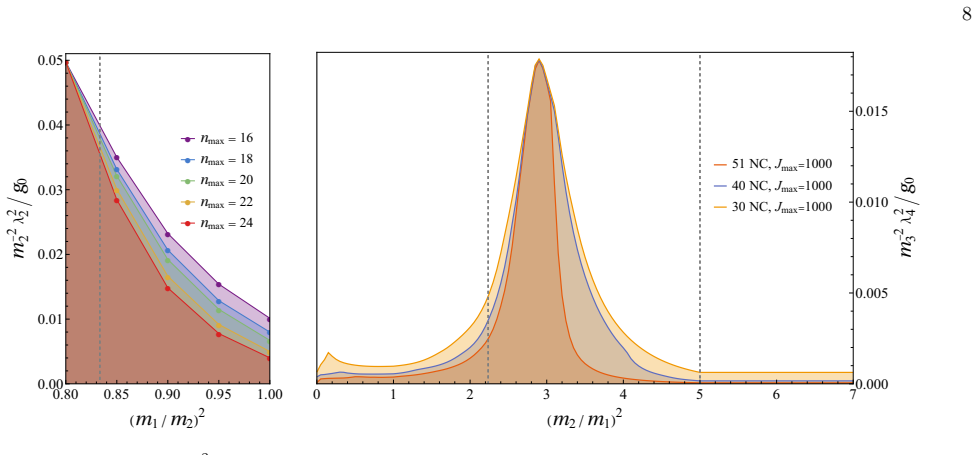
- [App. A2, Fig. 6] Figure 6 shows that the tails of the bounds decrease monotonically as the null-constraint order nmax is increased (16→24 in the 2-state case; 30/40/51 NC in the 3-state case). Thus the quantitative 'sharp drops to zero' and the numerical values in the suppressed regions are not fully converged at finite null-constraint order. The critical endpoint of the plateau and the midpoint peak are stable, so the qualitative conclusion is likely unaffected; nevertheless, the paper should either push the convergence further or explicitly label these as finite-n bounds rather than converged results.
- [Sec. IV B; abstract] The term 'graviton trajectory' is used in different ways: the abstract defines it via the graviton and the lightest spin-4 resonance, while Sec. IV A defines it via the graviton pole and (m1^2, ℓ=0). In the 3-state gravity analysis, the peak condition m2^2=(m1^2+M^2)/2 is stated to lie on the graviton trajectory, but with the fixed m3^2=3m1^2 the three massive states (m1,0), (m2,2), (m3,4) are not collinear for M^2>3m1^2. Please give a precise, unambiguous definition of 'graviton trajectory' and explain how it relates to the states whose couplings are actually maximized.
minor comments (5)
- [Sec. V, p.6] The sentence 'we do not assume the existence of an entire Regge tower apriori, do we assume any extraordinary UV softness' is ungrammatical; it should read 'nor do we assume,' and 'apriori' should be 'a priori.'
- [App. A1] 'programspectrumfrom thesdpbrepository' lacks spaces; should be 'program spectrum from the sdpb repository.' The 10^-5 threshold for detecting zeros in the primal solution should be described as a numerical criterion whose effect on the extracted UV spectra is worth a brief comment.
- [Fig. 6] The right panel legend '51 NC, Jmax=1000' etc. should define 'NC' (number of null constraints) in the caption. The axis label 'λ4 2' appears to be a typesetting artifact for λ3,4/g0.
- [II, Eq. (8)] The average ⟨·⟩ is used in Eq. (8) before its definition via the spectral density in Eq. (7); consider introducing the notation explicitly before first use.
- [III A] The title 'Two-states system' is slightly misleading: the ansatz in Eq. (12) contains two massive levels plus the massless external states, and each massive level has multiple spins. Consider 'two-mass-level system' for clarity.
Circularity Check
No significant circularity: the linear-trajectory maxima are not imposed but emerge from the bootstrap, and they are benchmarked against independent DBI/Virasoro–Shapiro points.
full rationale
The central derivation is a numerical SDP over spectral densities subject to unitarity (Eq. 2), dispersion relations (Eqs. 6–7), null constraints (Eq. 8), and fixed low-lying masses. The maximization variables are λ2,2 and λ3,4; the linear-trajectory condition is not among the constraints. Eq. (13) is only a necessary condition derived from the hypothesis that a linear trajectory (m1²,0), (m2²,2), (m3²≥M²,4) exists, and it is used predictively: the numerically observed drops/peaks align with it, while the extracted primal spectra (Figs. 2, 7) show towers with slopes determined by the two lighter states, not imposed. The DBI and Virasoro–Shapiro amplitudes serve as independent external benchmarks rather than inputs; the optimization does not assume them. The load-bearing null constraints are imported from [4,10,43], not from the authors' prior work; self-citations such as [8] and [28] appear as background or as UV-completion examples and do not carry the central argument. The main weakness is not circularity: footnote 3 concedes that loop effects modify the null constraints, and Sec. V explicitly frames the result as a conjecture in the narrow-width approximation; App. A2 shows finite-n convergence tails. These are robustness/domain limitations, not a reduction of the conclusion to its own inputs.
Axiom & Free-Parameter Ledger
free parameters (4)
- UV cutoff M² (scan parameter) =
scanned: e.g., 1.2, 1.5, 5/3 × m2² (Fig. 1); 6, 7, 8 × m1² (Fig. 3); 1.0–1.75 × m2² (Fig. 4)
- Mass scan variables m1², m2², m3² =
scanned over ranges (e.g., m2² ∈ [m1², m3²] with m3² = 5m1² in Fig. 3; m3² = 3m1² in Fig. 5)
- Spectrum-extraction threshold =
10⁻⁵ (× g0 m1²)
- Numerical truncations (Jmax, Jhuge, mmax, bmax, nmax, kmax) =
40, 5000, 10, 80, 13, 10 (App. B)
axioms (6)
- domain assumption Unitarity/positivity: λ_{i,ℓ} ≥ 0 and spectral density ρℓ(s) ≥ 0
- domain assumption Tree-level, narrow-width (zero-width) approximation: amplitude is a sum of simple poles with stable resonances
- domain assumption Dual-resonance description implies exact null constraints ⟨χ_{n,k}⟩ = 0 on the spectral density
- domain assumption Super-convergent UV behavior: lim_{s→∞} f_N(s,t) s^{2(N−1)} = 0 (Eq. 5)
- domain assumption D=10, even-spin exchange, N=1/2 SUSY kinematics
- domain assumption Agnostic UV above M (positivity only)
read the original abstract
In this letter, we consider constraints on the low-energy spectrum of amplitudes with higher-spin exchange. Assuming unitarity, crossing symmetry, and super-convergent high energy behavior, reminiscent of the scattering of spin-1 and spin-2 massless helicity states, we demonstrate that the spectrum that maximizes the leading higher spin couplings of the second and third resonances is consistently given by a linear trajectory. Furthermore, for gravitational theories, the optimal spectrum is the linear trajectory defined by the mass and spin of the graviton and the lightest spin-4 resonance.
Figures




Forward citations
Cited by 5 Pith papers
-
Full positivity bounds for anomalous quartic gauge couplings in SMEFT
Complete positivity bounds for the 22 aQGC coefficients in SMEFT restrict the viable parameter space to approximately 0.0313% of the naive total.
-
Positivity with Long-Range Interactions
Defines IR-finite amplitudes M_E that preserve analyticity and unitarity to derive positivity bounds on EFTs including electromagnetism and gravity in D=4.
-
Multipositivity Constrains the Chiral Lagrangian
Multipositivity bounds derived from planar tree-level scattering amplitudes constrain Wilson coefficients of the chiral Lagrangian from below by the chiral anomaly.
-
The Equivalence Principle at High Energies Completes the Spectrum
Tree-level gravitational scattering under the equivalence principle mandates single-particle states in all irreducible representations constructible from a single seed charge, with equal interaction strengths.
-
Sampling the Graviton Pole and Deprojecting the Swampland
A sampling-based bootstrap for graviton poles in EFTs yields non-projective bounds that fix the EFT cutoff scale relative to the Planck mass, with M/M_P ≲ 7.8 in D=5.
Reference graph
Works this paper leans on
-
[1]
Note that Refs
The approximate linear trajectories persist in the UV. Note that Refs. [30, 38] found analytic constraints on meromorphic spectra from studying dispersion relations withn→∞subtractions. In our setup, these would read (M/m1)2 ≤(m 3/m1)2 ≤(m 2/m1)4, or concretelym2 1 ≤ m2 1,a ≡(5/6,2/3,0.6)m 2 2 forM 2 = (1.2,1.5,5/3)m 2 2. One might wonder if the sharp fal...
-
[2]
Lines are plotted with slopes fixed by the two lighter states
For this value ofM, the solid yellow line is extremalm 2 1 =m 2 1,c = 0.8m2 2, and has linear trajectories that emerge and persist in the UV, just like the sub-extremal light and dark blue lines atm 2 1 < m2 1,c. Lines are plotted with slopes fixed by the two lighter states. In red,m1 > m1,c for which the linear trajectory is not allowed by the largeM, an...
-
[3]
The result is shown in Fig. 4. Compared to the 0-subtraction analysis in Fig. 1, we see that here there is no plateau atm2 1 < m2 2/2, indepen- dently ofM 2. Moreover, forM 2 <3m 2 2/2, the curves peak atm 2 1 =m 2 2/2and are followed by a slow-roll slope atm 2 2/2≤m 2 1 ≤m 2 1,c. Instead, forM 2 >3m 2 2/2, the coupling is drastically suppressed. We inter...
-
[4]
The result form 2 3 = 3m 2 1 is shown in Fig
and maximizeλ3,4 with respect tom2 2. The result form 2 3 = 3m 2 1 is shown in Fig. 5. A narrow peak emerges at the critical valuem 2 2 = (m 2 1 +M 2)/2 which satisfies Eq. (13), and also lies on the graviton trajectory. WhenM 2 falls below4m 2 1, the graviton tra- jectory is no longer viable, and the peak drastically de- creases. 6 ● ● ● ● ● ● ● ● ● ● ● ...
-
[5]
3, we bound the ratiom−2 3 λ3,4/g0 as a function ofm 2
Semidefinite Optimisation In Fig. 3, we bound the ratiom−2 3 λ3,4/g0 as a function ofm 2. We use the dispersion relations (7) atp2 = 0to derive the bound, starting from the following equality forg0, ag0 = X i,ℓ λi,ℓ 2a m2 i +b·χ m2 i , ℓ + 2a s +b·χ(s, ℓ) ,(A1) where the sum runs over the states below threshold in the ansatz Eq. (12),χis a vector containi...
-
[6]
1 and Fig
Convergence In Fig. 1 and Fig. 3, we see tails that extend beyond the analytic constraints from Refs. [30, 38]. We study this in more detail in Fig. 6. The left panel shows convergence of the tail on theM2 = 1.2m 2 2 curve from Fig. 1, by increasing the number of null constraints, for fixed spin truncation. We see that the critical point is stable, while ...
-
[7]
7 shows the optimal spectra for a selection of points taken on the purple curve in Fig
Spectra for the 3-state Problem Fig. 7 shows the optimal spectra for a selection of points taken on the purple curve in Fig. 3. For values ofm2 2 above the peak, and up to the kink, we observe that all states—with the exception ofm2 1—lie on linear trajectories, 8 ● ● ● ● ● ● ● ● ● ● ● ● ● ● ● ● ● ● ● ● ● ● ● ● ● ● nmax 16 ● nmax 18 ● nmax 20 ● nmax...
2000
-
[8]
8, we show the same bound computed for different slopes
In Fig. 8, we show the same bound computed for different slopes. The height of the peak is not significantly affected by this choice. The position of the peak falls very close tom 2 2 = (m2 1 +m 2 3)/2for each of the curves, indicating that the results found in Fig. 3 are generic and that the bounds exhibit no particular preference for the slope, as long ...
-
[9]
R. Rattazzi, V. S. Rychkov, E. Tonni, and A. Vichi, JHEP12, 031 (2008), arXiv:0807.0004 [hep-th]
Pith/arXiv arXiv 2008
-
[10]
M. F. Paulos, J. Penedones, J. Toledo, B. C. van Rees, and P. Vieira, JHEP12, 040 (2019), arXiv:1708.06765 [hep-th]
Pith/arXiv arXiv 2019
-
[11]
A. Hebbar, D. Karateev, and J. Penedones, JHEP01, 060 (2022), arXiv:2011.11708 [hep-th]
Pith/arXiv arXiv 2022
-
[12]
S. Caron-Huot and V. Van Duong, JHEP05, 280 (2021), arXiv:2011.02957 [hep-th]
Pith/arXiv arXiv 2021
-
[13]
S. Caron-Huot, D. Mazac, L. Rastelli, and D. Simmons- Duffin, JHEP07, 110 (2021), arXiv:2102.08951 [hep-th]
Pith/arXiv arXiv 2021
-
[14]
J. Albert and L. Rastelli, JHEP08, 151 (2022), arXiv:2203.11950 [hep-th]
Pith/arXiv arXiv 2022
- [15]
-
[16]
N. Arkani-Hamed, T.-C. Huang, and Y.-t. Huang, JHEP 05, 259 (2021), arXiv:2012.15849 [hep-th]
Pith/arXiv arXiv 2021
-
[17]
B. Bellazzini, J. Elias Miró, R. Rattazzi, M. Riem- bau, and F. Riva, Phys. Rev. D104, 036006 (2021), arXiv:2011.00037 [hep-th]
Pith/arXiv arXiv 2021
-
[18]
A. J. Tolley, Z.-Y. Wang, and S.-Y. Zhou, JHEP05, 255 (2021), arXiv:2011.02400 [hep-th]
Pith/arXiv arXiv 2021
-
[19]
C. Cheung and G. N. Remmen, JHEP04, 002 (2016), arXiv:1601.04068 [hep-th]
Pith/arXiv arXiv 2016
-
[20]
C. de Rham, S. Melville, A. J. Tolley, and S.-Y. Zhou, JHEP03, 182 (2019), arXiv:1804.10624 [hep-th]
Pith/arXiv arXiv 2019
-
[21]
C. Zhang and S.-Y. Zhou, Phys. Rev. D100, 095003 (2019), arXiv:1808.00010 [hep-ph]
Pith/arXiv arXiv 2019
-
[22]
C.Englert, G.F.Giudice, A.Greljo, andM.Mccullough, JHEP09, 041 (2019), arXiv:1903.07725 [hep-ph]
Pith/arXiv arXiv 2019
-
[23]
B. Bellazzini, F. Riva, J. Serra, and F. Sgarlata, JHEP 10, 189 (2019), arXiv:1903.08664 [hep-th]
Pith/arXiv arXiv 2019
-
[24]
G. N. Remmen and N. L. Rodd, JHEP12, 032 (2019), arXiv:1908.09845 [hep-ph]
Pith/arXiv arXiv 2019
-
[25]
Y.-t. Huang, J.-Y. Liu, L. Rodina, and Y. Wang, JHEP 04, 195 (2021), arXiv:2008.02293 [hep-th]
Pith/arXiv arXiv 2021
-
[26]
A. Sinha and A. Zahed, Phys. Rev. Lett.126, 181601 (2021), arXiv:2012.04877 [hep-th]
Pith/arXiv arXiv 2021
-
[27]
Z. Bern, D. Kosmopoulos, and A. Zhiboedov, J. Phys. A54, 344002 (2021), arXiv:2103.12728 [hep-th]
Pith/arXiv arXiv 2021
-
[28]
L.-Y. Chiang, Y.-t. Huang, W. Li, L. Rodina, and H.-C. Weng, JHEP03, 063 (2022), arXiv:2105.02862 [hep-th]
Pith/arXiv arXiv 2022
-
[29]
J.Henriksson, B.McPeak, F.Russo, andA.Vichi,JHEP 06, 158 (2022), arXiv:2107.13009 [hep-th]
Pith/arXiv arXiv 2022
-
[30]
S. Caron-Huot, Y.-Z. Li, J. Parra-Martinez, and D. Simmons-Duffin, JHEP05, 122 (2023), arXiv:2201.06602 [hep-th]
Pith/arXiv arXiv 2023
-
[31]
T. Ma, A. Pomarol, and F. Sciotti, JHEP11, 176 (2023), arXiv:2307.04729 [hep-th]
Pith/arXiv arXiv 2023
-
[32]
Li, JHEP01, 072 (2024), arXiv:2310.09698 [hep- th]
Y.-Z. Li, JHEP01, 072 (2024), arXiv:2310.09698 [hep- th]
Pith/arXiv arXiv 2024
-
[33]
J. Albert, J. Henriksson, L. Rastelli, and A. Vichi, JHEP 09, 172 (2024), arXiv:2312.15013 [hep-th]
Pith/arXiv arXiv 2024
-
[34]
J. Albert, W. Knop, and L. Rastelli, JHEP02, 157 (2025), arXiv:2406.12959 [hep-th]
Pith/arXiv arXiv 2025
-
[35]
C. Fernandez, A. Pomarol, F. Riva, and F. Sciotti, JHEP 06, 094 (2023), arXiv:2211.12488 [hep-th]
Pith/arXiv arXiv 2023
-
[36]
B. Bellazzini, G. Isabella, S. Ricossa, and F. Riva, Phys. Rev. D109, 024051 (2024), arXiv:2304.02550 [hep-th]
Pith/arXiv arXiv 2024
-
[37]
F. Bertucci, J. Henriksson, B. McPeak, S. Ricossa, F. Riva, and A. Vichi, (2024), arXiv:2402.13327 [hep- th]
Pith/arXiv arXiv 2024
-
[38]
Berman, JHEP08, 066 (2025), arXiv:2410.01914 [hep- th]
J. Berman, JHEP08, 066 (2025), arXiv:2410.01914 [hep- th]
Pith/arXiv arXiv 2025
-
[39]
Z.-Y. Dong, T. Ma, A. Pomarol, and F. Sciotti, JHEP 05, 114 (2025), arXiv:2411.14422 [hep-th]
Pith/arXiv arXiv 2025
-
[40]
J. Berman and H. Elvang, JHEP09, 076 (2024), b arXiv:2406.03543 [hep-th]
Pith/arXiv arXiv 2024
-
[41]
J. Berman, H. Elvang, N. Geiser, and L. L. Lin, (2024), arXiv:2412.13368 [hep-th]
Pith/arXiv arXiv 2024
-
[42]
Pasiecznik, (2025), arXiv:2506.09884 [hep-th]
C. Pasiecznik, (2025), arXiv:2506.09884 [hep-th]
Pith/arXiv arXiv 2025
-
[43]
B. Bellazzini, A. Pomarol, M. Romano, and F. Sciotti, (2025), arXiv:2507.12535 [hep-th]
Pith/arXiv arXiv 2025
-
[44]
Veneziano, Nuovo Cim
G. Veneziano, Nuovo Cim. A57, 190 (1968)
1968
-
[45]
Dolen, D
R. Dolen, D. Horn, and C. Schmid, Phys. Rev.166, 1768 (1968)
1968
-
[46]
J. Berman and N. Geiser, JHEP06, 168 (2025), arXiv:2412.17902 [hep-th]
Pith/arXiv arXiv 2025
-
[47]
K. Häring and A. Zhiboedov, SciPost Phys.16, 034 (2024), arXiv:2202.08280 [hep-th]
Pith/arXiv arXiv 2024
-
[48]
C. Cheung, G. N. Remmen, F. Sciotti, and M. Tarquini, (2025), arXiv:2508.09246 [hep-th]
Pith/arXiv arXiv 2025
-
[49]
K. Häring and A. Zhiboedov, JHEP10, 075 (2024), arXiv:2311.13631 [hep-th]
Pith/arXiv arXiv 2024
- [50]
-
[51]
J. Albert and L. Rastelli, JHEP09, 039 (2024), arXiv:2307.01246 [hep-th]
Pith/arXiv arXiv 2024
-
[52]
C. Eckner, F. Figueroa, and P. Tourkine, JHEP02, 103 (2025), arXiv:2405.21057 [hep-th]
Pith/arXiv arXiv 2025
-
[53]
B. Bellazzini, M. Riembau, and F. Riva, Phys. Rev. D 106, 105008 (2022), arXiv:2112.12561 [hep-th]
Pith/arXiv arXiv 2022
- [54]
-
[55]
C. Beadle, G. Isabella, D. Perrone, S. Ricossa, F. Riva, and F. Serra, JHEP06, 209 (2025), arXiv:2501.18465 [hep-th]
Pith/arXiv arXiv 2025
-
[56]
C.-H. Chang and J. Parra-Martinez, JHEP08, 175 (2025), arXiv:2501.17949 [hep-th]
Pith/arXiv arXiv 2025
-
[57]
R. R. Metsaev, M. Rakhmanov, and A. A. Tseytlin, Phys. Lett. B193, 207 (1987)
1987
-
[58]
Simmons-Duffin, JHEP03, 086 (2017), arXiv:1612.08471 [hep-th]
D. Simmons-Duffin, JHEP03, 086 (2017), arXiv:1612.08471 [hep-th]
Pith/arXiv arXiv 2017
discussion (0)
Sign in with ORCID, Apple, or X to comment. Anyone can read and Pith papers without signing in.