REVIEW 2 major objections 4 minor 103 references
A first dedicated search for dark matter produced with bottom quarks and a Z boson at a hadron collider finds no signal and sets cross-section limits down to 10^-3 pb.
Reviewed by Pith at T0; open to challenge. T0 means a machine referee read the full paper against a public rubric. the ladder, T0–T4 →
T0 review · deepseek-v4-flash
2026-08-04 09:55 UTC pith:WQ6IXJHK
load-bearing objection First dedicated CMS probe of the bb+Z(ll)+MET channel: a solid, careful search whose main soft spot is a validation gap in the DY pTmiss correction. the 2 major comments →
Search for dark matter production in association with bottom quarks and a lepton pair in proton-proton collisions at sqrt{s} = 13 TeV
The pith
A machine-rendered reading of the paper's core claim, the machinery that carries it, and where it could break.
Core claim
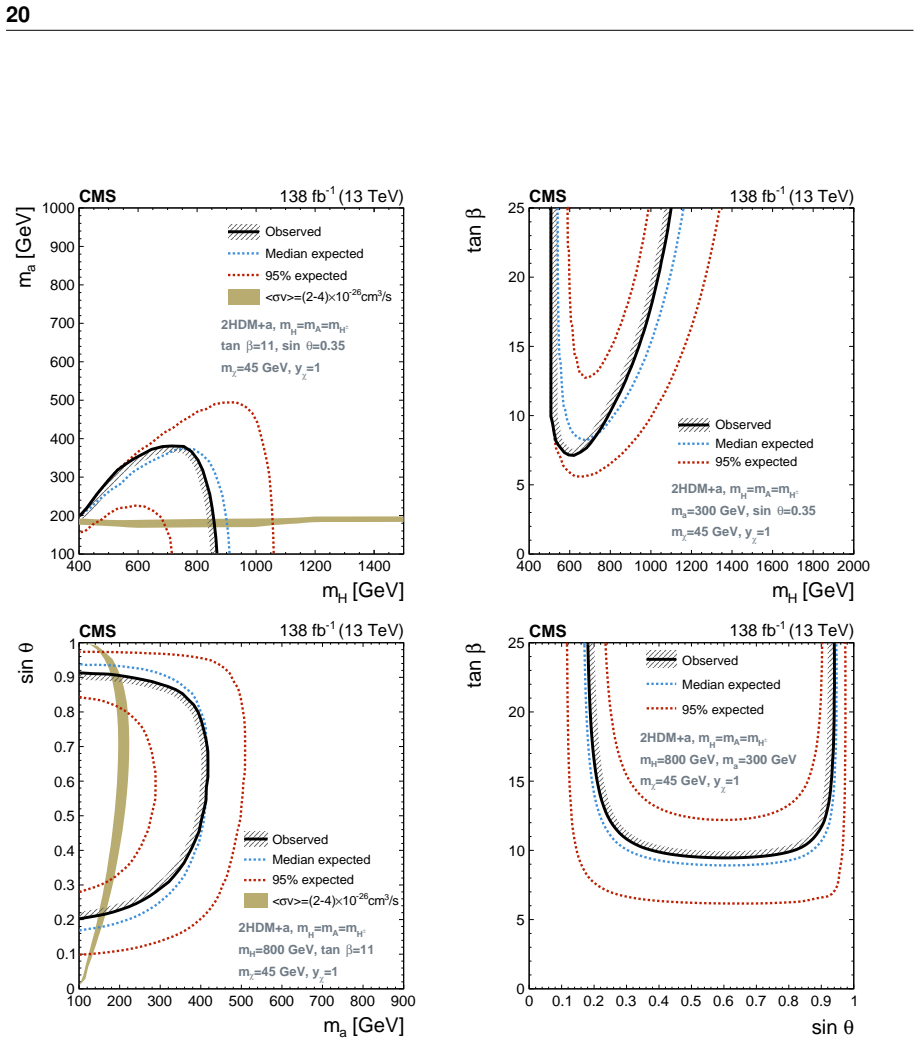
The discovery claim is a null result: in proton-proton collisions at 13 TeV, events with an opposite-sign same-flavor lepton pair near the Z mass, at least one b-tagged jet, and large missing transverse momentum agree with standard model predictions. The paper establishes the first dedicated collider search for this final state and reports observed 95% CL upper limits on sigma(pp->bbH) B(H->Za) B(Z->ll) B(a->chi chi) ranging from about 10^-2 pb at mH = 400 GeV to about 10^-3 pb at mH = 2000 GeV. In the benchmark 2HDM+a interpretation, the results exclude heavy scalar masses up to about 900 GeV for small pseudoscalar masses, and up to about 1.1 TeV for tan-beta near 25, covering a meaningful
What carries the argument
The central machinery is the event-selection plus multivariate discriminant: a loose requirement of at least one b-tagged jet is combined with a Z-mass window on an opposite-sign same-flavor dilepton pair and a missing-transverse-momentum threshold, and then a fully connected neural network (the MLP, binned into 17 MLP4 score intervals) combines kinematic variables such as pT^miss, the transverse mass mT, and mT2 to separate signal from background. Backgrounds are controlled with four single-bin control regions for Drell-Yan, top-quark pair, WZ, and ZZ production, an analytical kinematic solver vetoes dileptonic top-quark events, and the Drell-Yan missing-momentum scale and resolution are co
Load-bearing premise
The analysis assumes that the data-driven correction to the Drell-Yan missing-momentum scale and resolution, derived at low missing momentum and checked in a region without b jets, remains valid in the signal region where missing momentum is large and at least one b jet is present.
What would settle it
The central null result would be weakened if, in a dedicated validation region requiring at least one b-tagged jet, a Z-like dilepton pair, no extra leptons, and 300 < pT^miss < 500 GeV, the ratio of observed events to the corrected prediction deviated from unity by more than the quoted uncertainty.
If this is right
- The quoted upper limits provide the first model-independent cross-section bounds for the bb + Z + missing-momentum final state, applicable to any model with a heavy scalar decaying to Z plus invisible particles in association with bottom quarks.
- In the benchmark 2HDM+a scenario, heavy scalar masses up to about 900 GeV are excluded for small pseudoscalar masses, closing part of the parameter space favored by dark-matter relic-density calculations.
- The analysis excludes low mediator masses over a broad range of the mixing angle sin(theta), leaving only very small and very large values of sin(theta) uncovered.
- The search is most sensitive to semi-boosted topologies with mH - ma near 1 TeV, while compressed mass configurations and configurations with very large mass splittings remain less constrained.
Where Pith is reading between the lines
- An extension the paper leaves implicit is that including final states where the Z decays to tau leptons, or where the dilepton pair arises from a non-resonant spectrum, could cover configurations where the present lepton selection loses efficiency.
- Because the dominant limitations come from the normalization uncertainties of the WZ and ZZ backgrounds, a future analysis could improve sensitivity with a dedicated diboson-enriched control region or by exploiting jet substructure for more boosted topologies.
- The tabulated model-independent results allow reinterpretation in other pseudoscalar-mediator or two-Higgs-doublet scenarios beyond the benchmark, which is a natural follow-up given the cosmological motivation.
Editorial analysis
A structured set of objections, weighed in public.
Referee Report
Summary. This paper presents a search for dark matter produced in association with b quarks and a lepton pair in 138 fb^-1 of 13 TeV CMS data, using the 2HDM+a model with the process pp -> bbH, H -> Za, Z -> ll, a -> chichi. A multivariate MLP discriminant is trained on simulated signal and background events, and a profile-likelihood fit combines a 17-bin signal region with four control regions (DY, tt, WZ, ZZ) to constrain background normalizations. A data-driven correction to the DY pTmiss scale and resolution is derived in a low-pTmiss sideband and applied to the signal region. The observations are consistent with the standard-model expectation, and 95% CL upper limits are set on sigma(pp->bbH) B(H->Za) B(Z->ll) B(a->chichi) in the range 10^-2 to 10^-3 pb for mH = 400-2000 GeV. The results are interpreted as constraints on the 2HDM+a parameter space and compared with the region favored by the relic-density calculation.
Significance. If the result holds, this is the first dedicated experimental search for this specific bbZ(ll)+pTmiss signature, and it probes regions of the 2HDM+a parameter space (in particular high tan(beta)) that are motivated by the gamma-ray galactic center excess and are not directly covered by earlier mono-Z or mono-H searches. The analysis is careful and thorough: it uses the full Run 2 dataset, applies a multivariate discriminant, enumerates systematic uncertainties in detail, provides control-region validation plots, and makes tabulated results available in HEPData. The main strengths are the explicit signal model, the use of data-driven background normalizations with cross-checked control regions, and the public record of the results.
major comments (2)
- [Section 6] The data-driven correction to the DY pTmiss scale and resolution is derived in a sideband with pTmiss < 65 GeV and then extrapolated to the signal region. The only stated verification is in a region with no b jets and pTmiss < 300 GeV (Section 6). This does not directly validate the correction in the SR phase space, which requires Nb >= 1 and extends to pTmiss values well above 300 GeV. Because the MLP discriminant uses pTmiss and mT(ell,ell,pTmiss) as leading inputs (Section 5.3), a miscalibration of the DY tail would directly reshape the SR templates and thereby shift the derived limits, especially for low-mH signals that populate the lower MLP4 bins. Please either provide a validation in a b-enriched region with higher pTmiss, or quantify the uncertainty from this extrapolation and show its effect on the final limits.
- [Section 8] The background-only fit changes the WZ and ZZ normalizations by +101% and +113%, respectively. These processes populate the high-MLP4 (signal-like) bins, and the paper states that their normalization uncertainties are among the most important systematics. The WZ and ZZ control regions are single-bin, so they constrain the overall normalization but not the shape of the MLP4 distribution in the SR. Given the very large correction factors, additional validation is needed to demonstrate that the shape modeling in the b-enriched phase space is reliable. Please show pre-fit and post-fit comparisons in finer-grained b-enriched CRs, or otherwise discuss how the large k-factors are constrained by the data.
minor comments (4)
- [Section 5.3] The definition of the MLP4 score in Eq. (4) appears to contain a typographical issue: the floor function is not explicitly written. Please clarify the transformation.
- [Section 8.1 / Figure 7] The y-axis of Figure 7 is described as the upper limit on sigmaB but the scaling by arbitrary factors (x10^-n) is only noted in the caption. It would be clearer to label each panel with the absolute scale or indicate the scaling directly on the axis.
- [References] The benchmark parameters in Eq. (1) are cited to Refs. [3,52], but readers may benefit from a direct reference to the specific 2HDM+a parameter scan in which this benchmark was first used. Please check whether a more precise citation is available.
- [Section 6] The validation of the DY Nb=0/Nb>=1 normalization consistency is described only in words. A figure or table showing the compatibility of the ratios in the two categories would strengthen this cross-check.
Circularity Check
No circularity found: the search derives limits from an externally defined 2HDM+a model, with backgrounds normalized in disjoint control regions and the only data-driven correction being a standard auxiliary measurement.
full rationale
The analysis is a search for a BSM signal in an externally defined 2HDM+a model. The benchmark signal parameters (Eq. 1) are taken from prior literature (Refs. [3], [51], [52]), not fitted to the data; the signal is simulated with MG5 at fixed masses and couplings. Background normalizations are fitted in control regions that are disjoint from the signal region (DY CR requires Nb=0 and pTmiss<140 GeV; tt, WZ, ZZ CRs have different final-state requirements), so the SR counts are not equal to the fit by construction. The one data-driven calibration, the DY pTmiss recoil correction, is derived in a sideband with pTmiss<65 GeV and propagated to the SR; this is a standard auxiliary measurement and the SR is not used to derive it, so it is not a fitted-input-called-prediction step. The paper explicitly notes the extrapolation is verified only in a region with no b jets and pTmiss<300 GeV; this is a validation gap (a robustness risk), not a circularity, because the correction is not an ansatz that already contains the SR result. The relic-density comparison uses an independent MadDM calculation. No uniqueness theorem or load-bearing self-citation is invoked: the only comparison to a prior CMS search [28] is an external cross-check of the excluded mass range. Therefore the derivation chain is self-contained with respect to the final limits.
Axiom & Free-Parameter Ledger
free parameters (3)
- 2HDM+a benchmark parameters =
m_chi=45 GeV, tan(beta)=11, sin(theta)=0.35, lambda_3=lambda_P1=lambda_P2=0.25, y_chi=1
- Background normalization parameters (DY, tt, WZ, ZZ) =
DY +10%, tt +8%, WZ +101%, ZZ +113% relative to pre-fit predictions
- DY pTmiss correction parameters (double Gaussian) =
not public; derived in sideband with pTmiss<65 GeV
axioms (6)
- domain assumption The Standard Model is the correct low-energy description of background processes.
- domain assumption The 2HDM+a model correctly describes signal production and decay kinematics.
- domain assumption The GEANT4-based CMS detector simulation, after data-to-simulation corrections, accurately models the detector response.
- domain assumption The narrow-width approximation for the H and a resonances is valid in the considered parameter space.
- standard math The asymptotic CLs method yields valid 95% confidence intervals.
- domain assumption NNPDF3.1 NNLO PDFs and the PYTHIA CP5 tune adequately model initial-state partons and hadronization.
read the original abstract
A search is performed for dark matter produced in association with bottom quarks and a pair of electrons or muons in data collected with the CMS detector at the LHC, corresponding to 138 fb$^{-1}$ of integrated luminosity of proton-proton collisions at a center-of-mass energy of 13 TeV. For the first time at the LHC, the associated production of a bottom quark-antiquark pair and a new heavy neutral Higgs boson (H) that subsequently decays into a leptonically decaying Z boson and a pseudoscalar (a) is explored. The latter acts as a dark matter mediator in the context of the two Higgs doublet model plus a pseudoscalar (2HDM+a). Multivariate techniques that target a wide range of mass configurations for the H and a particles are used. The observations are consistent with the expectations from standard model processes. Upper limits at 95% confidence level are set on the product of cross section and branching fraction of the new particles, ranging from 10$^{-2}$ pb for an H mass of 400 GeV to 10$^{-3}$ pb for an H mass of 2000 GeV. Constraints on the parameter space of a benchmark 2HDM+a model are derived and compared with expectations in the context of cosmological predictions.
Figures


Reference graph
Works this paper leans on
-
[1]
Cosmological constraints on the properties of weakly interacting massive particles
G. Steigman and M. S. Turner, “Cosmological constraints on the properties of weakly interacting massive particles”,Nucl. Phys. B253(1985) 375, doi:10.1016/0550-3213(85)90537-1
-
[2]
WIMP dark matter candidates and searches — current status and future prospects
L. Roszkowski, E. M. Sessolo, and S. Trojanowski, “WIMP dark matter candidates and searches — current status and future prospects”,Rept. Prog. Phys.81(2018) 066201, doi:10.1088/1361-6633/aab913,arXiv:1707.06277
Pith/arXiv arXiv 2018
-
[3]
P . Tunney, J. M. No, and M. Fairbairn, “Probing the pseudoscalar portal to dark matter via ¯bbZ(→ℓℓ)+̸E T : From the LHC to the galactic center excess”,Phys. Rev. D96(2017) 095020,doi:10.1103/PhysRevD.96.095020,arXiv:1705.09670
Pith/arXiv arXiv 2017
-
[4]
Particle dark matter: Evidence, candidates and constraints
G. Bertone, D. Hooper, and J. Silk, “Particle dark matter: Evidence, candidates and constraints”,Phys. Rept.405(2005) 279,doi:10.1016/j.physrep.2004.08.031, arXiv:hep-ph/0404175
Pith/arXiv arXiv 2005
-
[5]
Dark sector searches with the CMS experiment
CMS Collaboration, “Dark sector searches with the CMS experiment”,Phys. Rep.(2024) 448,doi:10.1016/j.physrep.2024.09.013,arXiv:2405.13778. References 23
Pith/arXiv arXiv 2024
-
[6]
Dark matter searches at accelerators
A. De Roeck, “Dark matter searches at accelerators”,Nucl. Phys. B1003(2024) 116480, doi:10.1016/j.nuclphysb.2024.116480
arXiv 2024
-
[7]
ATLAS Collaboration, “Constraints on simplified dark matter models involving an s-channel mediator with the ATLAS detector in pp collisions at √s=13 TeV”,Eur. Phys. J. C84(2024) 1102,doi:10.1140/epjc/s10052-024-13215-5, arXiv:2404.15930
Pith/arXiv arXiv 2024
-
[8]
ATLAS Collaboration, “Combination and summary of ATLAS dark matter searches interpreted in a 2HDM with a pseudo-scalar mediator using 139 fb−1 of √s=13 TeV pp collision data”,Sci. Bull.69(2024) 3005,doi:10.1016/j.scib.2024.06.003, arXiv:2306.00641
Pith/arXiv arXiv 2024
-
[9]
FERMI-LAT observations of high-energyγ-ray emission toward the galatic center
Fermi-LAT Collaboration, “FERMI-LAT observations of high-energyγ-ray emission toward the galatic center”,Astrophys. J.819(2016) 44, doi:10.3847/0004-637X/819/1/44,arXiv:1511.02938
Pith/arXiv arXiv 2016
-
[10]
MAGIC Collaboration, “Limits to dark matter annihilation cross-section from a combined analysis of MAGIC and Fermi-LAT observations of dwarf satellite galaxies”, JCAP02(2016) 039,doi:10.1088/1475-7516/2016/02/039, arXiv:1601.06590
Pith/arXiv arXiv 2016
-
[11]
Dark matter annihilation in the galactic center as seen by the Fermi gamma ray space telescope
D. Hooper and L. Goodenough, “Dark matter annihilation in the galactic center as seen by the Fermi gamma ray space telescope”,Phys. Lett. B697(2011) 412, doi:10.1016/j.physletb.2011.02.029,arXiv:1010.2752
Pith/arXiv arXiv 2011
-
[12]
Origin of the gamma rays from the galactic center
D. Hooper and T. Linden, “Origin of the gamma rays from the galactic center”,Phys. Rev. D84(2011) 123005,doi:10.1103/PhysRevD.84.123005,arXiv:1110.0006
Pith/arXiv arXiv 2011
-
[13]
K. N. Abazajian and M. Kaplinghat, “Detection of a gamma-ray source in the galactic center consistent with extended emission from dark matter annihilation and concentrated astrophysical emission”,Phys. Rev. D86(2012) 083511, doi:10.1103/PhysRevD.86.083511,arXiv:1207.6047. [Erratum: doi:10.1103/PhysRevD.87.129902]
Pith/arXiv arXiv 2012
-
[14]
Dark matter interpretation of the Fermi-LAT observation toward the galactic center
C. Karwin et al., “Dark matter interpretation of the Fermi-LAT observation toward the galactic center”,Phys. Rev. D95(2017) 103005, doi:10.1103/PhysRevD.95.103005,arXiv:1612.05687
Pith/arXiv arXiv 2017
-
[15]
Extended gamma-ray emission from coy dark matter
C. Boehm et al., “Extended gamma-ray emission from coy dark matter”,JCAP05 (2014) 009,doi:10.1088/1475-7516/2014/05/009,arXiv:1401.6458
Pith/arXiv arXiv 2014
-
[16]
Bottom-up approach to the galactic center excess
E. Izaguirre, G. Krnjaic, and B. Shuve, “Bottom-up approach to the galactic center excess”,Phys. Rev. D90(2014) 055002,doi:10.1103/PhysRevD.90.055002, arXiv:1404.2018
Pith/arXiv arXiv 2014
-
[17]
Renormalizable model for the galactic center gamma-ray excess from dark matter annihilation
S. Ipek, D. McKeen, and A. E. Nelson, “Renormalizable model for the galactic center gamma-ray excess from dark matter annihilation”,Phys. Rev. D90(2014) 055021, doi:10.1103/PhysRevD.90.055021,arXiv:1404.3716
Pith/arXiv arXiv 2014
-
[18]
Simplified dark matter models for the galactic center gamma-ray excess
A. Berlin, D. Hooper, and S. D. McDermott, “Simplified dark matter models for the galactic center gamma-ray excess”,Phys. Rev. D89(2014) 115022, doi:10.1103/PhysRevD.89.115022,arXiv:1404.0022. 24
Pith/arXiv arXiv 2014
-
[19]
C. Arina, E. Del Nobile, and P . Panci, “Dark matter with pseudoscalar-mediated interactions explains the DAMA Signal and the galactic center excess”,Phys. Rev. Lett. 114(2015) 011301,doi:10.1103/PhysRevLett.114.011301,arXiv:1406.5542
Pith/arXiv arXiv 2015
-
[20]
Constraining the spin-dependent WIMP-nucleon cross sections with XENON1T
XENON Collaboration, “Constraining the spin-dependent WIMP-nucleon cross sections with XENON1T”,Phys. Rev. Lett.122(2019) 141301, doi:10.1103/PhysRevLett.122.141301,arXiv:1902.03234
Pith/arXiv arXiv 2019
-
[21]
A. Boveia et al., “Recommendations on presenting LHC searches for missing transverse energy signals using simplifieds-channel models of dark matter”,Phys. Dark Univ.27 (2020) 100365,doi:10.1016/j.dark.2019.100365,arXiv:1603.04156
arXiv 2020
-
[22]
Pseudoscalar portal dark matter
A. Berlin, S. Gori, T. Lin, and L.-T. Wang, “Pseudoscalar portal dark matter”,Phys. Rev. D92(2015) 015005,doi:10.1103/PhysRevD.92.015005,arXiv:1502.06000
Pith/arXiv arXiv 2015
-
[23]
ATLAS Collaboration, “Search for new phenomena in events with an energetic jet and missing transverse momentum in pp collisions at √s=13 TeV with the ATLAS detector”,Phys. Rev. D103(2021) 112006,doi:10.1103/PhysRevD.103.112006, arXiv:2102.10874
Pith/arXiv arXiv 2021
-
[24]
CMS Collaboration, “Search for new particles in events with energetic jets and large missing transverse momentum in proton-proton collisions at √s=13 TeV”,JHEP11 (2021) 153,doi:10.1007/JHEP11(2021)153,arXiv:2107.13021
Pith/arXiv arXiv 2021
-
[25]
ATLAS Collaboration, “Search for dark matter in association with an energetic photon in pp collisions at √s=13 TeV with the ATLAS detector”,JHEP02(2021) 226, doi:10.1007/JHEP02(2021)226,arXiv:2011.05259
Pith/arXiv arXiv 2021
-
[26]
CMS Collaboration, “Search for new physics in final states with a single photon and missing transverse momentum in proton-proton collisions at √s=13 TeV”,JHEP02 (2019) 074,doi:10.1007/JHEP02(2019)074,arXiv:1810.00196
Pith/arXiv arXiv 2019
-
[27]
ATLAS Collaboration, “Search for associated production of aZboson with an invisibly decaying Higgs boson or dark matter candidates at √s=13 TeV with the ATLAS detector”,Phys. Lett. B829(2022) 137066, doi:10.1016/j.physletb.2022.137066,arXiv:2111.08372
arXiv 2022
-
[28]
CMS Collaboration, “Search for dark matter produced in association with a leptonically decaying Z boson in proton-proton collisions at √s=13 TeV”,Eur. Phys. J. C81(2021) 13,doi:10.1140/epjc/s10052-020-08739-5,arXiv:2008.04735. [Erratum: doi:10.1140/epjc/s10052-021-08959-3]
Pith/arXiv arXiv 2021
-
[29]
ATLAS Collaboration, “Search for dark matter produced in association with a standard model Higgs boson decaying into b-quarks using the full run 2 dataset from the ATLAS detector”,JHEP11(2021) 209,doi:10.1007/JHEP11(2021)209, arXiv:2108.13391
Pith/arXiv arXiv 2021
-
[30]
ATLAS Collaboration, “Search for dark matter in events with missing transverse momentum and a Higgs boson decaying into two photons in pp collisions at√s=13 TeV with the ATLAS detector”,JHEP10(2021) 013, doi:10.1007/JHEP10(2021)013,arXiv:2104.13240
Pith/arXiv arXiv 2021
-
[31]
CMS Collaboration, “Search for dark matter particles produced in association with a Higgs boson in proton-proton collisions at √s=13 TeV”,JHEP03(2020) 025, doi:10.1007/JHEP03(2020)025,arXiv:1908.01713. References 25
Pith/arXiv arXiv 2020
-
[32]
CMS Collaboration, “Search for dark matter produced in association with a Higgs boson decaying to a pair of bottom quarks in proton–proton collisions at √s=13 TeV”,Eur. Phys. J. C79(2019) 280,doi:10.1140/epjc/s10052-019-6730-7, arXiv:1811.06562
Pith/arXiv arXiv 2019
-
[33]
Search for dark matter produced in association with a Higgs boson decaying toγγorτ +τ− at √s=13 TeV
CMS Collaboration, “Search for dark matter produced in association with a Higgs boson decaying toγγorτ +τ− at √s=13 TeV”,JHEP09(2018) 046, doi:10.1007/JHEP09(2018)046,arXiv:1806.04771
Pith/arXiv arXiv 2018
-
[34]
ATLAS Collaboration, “Search for dark matter produced in association with a dark Higgs boson decaying into W+W− in the one-lepton final state at √s=13 TeV using 139 fb−1 of pp collisions recorded with the ATLAS detector”,JHEP07(2023) 116, doi:10.1007/JHEP07(2023)116,arXiv:2211.07175
Pith/arXiv arXiv 2023
-
[35]
ATLAS Collaboration, “Search for dark matter produced in association with a dark Higgs boson decaying into W±W∓ or ZZ in fully hadronic final states from√s=13 TeV pp collisions recorded with the ATLAS detector”,Phys. Rev. Lett.126 (2021) 121802,doi:10.1103/PhysRevLett.126.121802,arXiv:2010.06548
Pith/arXiv arXiv 2021
-
[36]
ATLAS Collaboration, “Search for dark matter produced in association with a single top quark and an energetic W boson in √s=13 TeV pp collisions with the ATLAS detector”,Eur. Phys. J. C83(2023) 603,doi:10.1140/epjc/s10052-023-11582-z, arXiv:2211.13138
Pith/arXiv arXiv 2023
-
[37]
ATLAS Collaboration, “Search for dark matter produced in association with a single top quark in √s=13 TeV pp collisions with the ATLAS detector”,Eur. Phys. J. C81(2021) 860,doi:10.1140/epjc/s10052-021-09566-y,arXiv:2011.09308
Pith/arXiv arXiv 2021
-
[38]
Search for dark matter particles produced in association with a top quark pair at √s=13 TeV
CMS Collaboration, “Search for dark matter particles produced in association with a top quark pair at √s=13 TeV”,Phys. Rev. Lett.122(2019) 011803, doi:10.1103/PhysRevLett.122.011803,arXiv:1807.06522
Pith/arXiv arXiv 2019
-
[39]
CMS Collaboration, “Search for dark matter produced in association with a single top quark or a top quark pair in proton-proton collisions at √s=13 TeV”,JHEP03(2019) 141,doi:10.1007/JHEP03(2019)141,arXiv:1901.01553
Pith/arXiv arXiv 2019
-
[40]
CMS Collaboration, “Measurement of the B 0 S→µ+µ− decay properties and search for the B0→µ+µ− decay in proton-proton collisions at √s=13 TeV”,Phys. Lett. B842(2023) 137955,doi:10.1016/j.physletb.2023.137955,arXiv:2212.10311
arXiv 2023
-
[41]
ATLAS Collaboration, “Study of the rare decays ofB 0 s andB 0 mesons into muon pairs using data collected during 2015 and 2016 with the ATLAS detector”,JHEP04(2019) 098,doi:10.1007/JHEP04(2019)098,arXiv:1812.03017
Pith/arXiv arXiv 2015
-
[42]
Weak radiative decays of the B meson and bounds on MH± in the two-Higgs-doublet model
M. Misiak and M. Steinhauser, “Weak radiative decays of the B meson and bounds on MH± in the two-Higgs-doublet model”,Eur. Phys. J. C77(2017) 201, doi:10.1140/epjc/s10052-017-4776-y,arXiv:1702.04571
Pith/arXiv arXiv 2017
-
[43]
Measurement of the inclusiveB→X s+d γ branching fraction, photon energy spectrum and HQE parameters
Belle Collaboration, A. Abdesselam et al., “Measurement of the inclusiveB→X s+d γ branching fraction, photon energy spectrum and HQE parameters”, in38th International Conference on High Energy Physics. 8, 2016.arXiv:1608.02344
Pith/arXiv arXiv 2016
-
[44]
B s,d →ℓ +ℓ− in a two Higgs doublet model
H. E. Logan and U. Nierste, “B s,d →ℓ +ℓ− in a two Higgs doublet model”,Nucl. Phys. B 586(2000) 39,doi:10.1016/S0550-3213(00)00417-X,arXiv:hep-ph/0004139. 26
Pith/arXiv arXiv 2000
-
[45]
Updated NNLO QCD predictions for the weak radiative B-meson decays
M. Misiak et al., “Updated NNLO QCD predictions for the weak radiative B-meson decays”,Phys. Rev. Lett.114(2015) 221801, doi:10.1103/PhysRevLett.114.221801,arXiv:1503.01789
Pith/arXiv arXiv 2015
-
[46]
Measurement of theB 0 s →µ +µ− branching fraction and search for B0 →µ +µ− with the CMS experiment
CMS Collaboration, “Measurement of theB 0 s →µ +µ− branching fraction and search for B0 →µ +µ− with the CMS experiment”,Phys. Rev. Lett.111(2013) 101804, doi:10.1103/PhysRevLett.111.101804,arXiv:1307.5025
Pith/arXiv arXiv 2013
-
[47]
Dark matter through the axion portal
Y. Nomura and J. Thaler, “Dark matter through the axion portal”,Phys. Rev. D79(2009) 075008,doi:10.1103/PhysRevD.79.075008,arXiv:0810.5397
Pith/arXiv arXiv 2009
-
[48]
Simplified models for dark matter face their consistent completions
D. Goncalves, P . A. N. Machado, and J. M. No, “Simplified models for dark matter face their consistent completions”,Phys. Rev. D95(2017) 055027, doi:10.1103/PhysRevD.95.055027,arXiv:1611.04593
Pith/arXiv arXiv 2017
-
[49]
J. M. No, “Looking through the pseudoscalar portal into dark matter: Novel mono-Higgs and mono-Z signatures at the LHC”,Phys. Rev. D93(2016) 031701, doi:10.1103/PhysRevD.93.031701,arXiv:1509.01110
Pith/arXiv arXiv 2016
-
[50]
Theory and phenomenology of two-Higgs-doublet models
G. C. Branco et al., “Theory and phenomenology of two-Higgs-doublet models”,Phys. Rept.516(2012) 1,doi:10.1016/j.physrep.2012.02.002,arXiv:1106.0034
Pith/arXiv arXiv 2012
-
[51]
Simplified dark matter models with two Higgs doublets: I. Pseudoscalar mediators
M. Bauer, U. Haisch, and F. Kahlhoefer, “Simplified dark matter models with two Higgs doublets: I. Pseudoscalar mediators”,JHEP05(2017) 138, doi:10.1007/JHEP05(2017)138,arXiv:1701.07427
Pith/arXiv arXiv 2017
-
[52]
Next-generation spin-0 dark matter models
LHC Dark Matter Working Group, “Next-generation spin-0 dark matter models”,Phys. Dark Univ.27(2020) 100351,doi:10.1016/j.dark.2019.100351, arXiv:1810.09420
arXiv 2020
-
[53]
HEPData record for this analysis, 2025.doi:10.17182/hepdata.157541
-
[54]
The CMS experiment at the CERN LHC
CMS Collaboration, “The CMS experiment at the CERN LHC”,JINST3(2008) S08004, doi:10.1088/1748-0221/3/08/S08004
-
[55]
Performance of the CMS level-1 trigger in proton-proton collisions at √s=13 TeV
CMS Collaboration, “Performance of the CMS level-1 trigger in proton-proton collisions at √s=13 TeV”,JINST15(2020) P10017, doi:10.1088/1748-0221/15/10/P10017,arXiv:2006.10165
Pith/arXiv arXiv 2020
-
[56]
CMS Collaboration, “The CMS trigger system”,JINST12(2017) P01020, doi:10.1088/1748-0221/12/01/P01020,arXiv:1609.02366
Pith/arXiv arXiv 2017
-
[57]
J. Alwall et al., “The automated computation of tree-level and next-to-leading order differential cross sections, and their matching to parton shower simulations”,JHEP07 (2014) 079,doi:10.1007/JHEP07(2014)079,arXiv:1405.0301
Pith/arXiv arXiv 2014
-
[58]
Merging meets matching in MC@NLO
R. Frederix and S. Frixione, “Merging meets matching in MC@NLO”,JHEP12(2012) 061,doi:10.1007/JHEP12(2012)061,arXiv:1209.6215
Pith/arXiv arXiv 2012
-
[59]
Matching NLO QCD computations with Parton Shower simulations: The POWHEG method
S. Frixione, P . Nason, and C. Oleari, “Matching NLO QCD computations with Parton Shower simulations: The POWHEG method”,JHEP11(2007) 070, doi:10.1088/1126-6708/2007/11/070,arXiv:0709.2092
Pith/arXiv arXiv 2007
-
[60]
A general framework for implementing NLO calculations in shower Monte Carlo programs: The POWHEG BOX
S. Alioli, P . Nason, C. Oleari, and E. Re, “A general framework for implementing NLO calculations in shower Monte Carlo programs: The POWHEG BOX”,JHEP06(2010) 043,doi:10.1007/JHEP06(2010)043,arXiv:1002.2581. References 27
Pith/arXiv arXiv 2010
-
[61]
Combining QCD and electroweak corrections to dilepton production in FEWZ
Y. Li and F. Petriello, “Combining QCD and electroweak corrections to dilepton production in FEWZ”,Phys. Rev. D86(2012) 094034, doi:10.1103/PhysRevD.86.094034,arXiv:1208.5967
Pith/arXiv arXiv 2012
-
[62]
Top++: A program for the calculation of the top-pair cross-section at hadron colliders
M. Czakon and A. Mitov, “Top++: A program for the calculation of the top-pair cross-section at hadron colliders”,Comput. Phys. Commun.185(2014) 2930, doi:10.1016/j.cpc.2014.06.021,arXiv:1112.5675
Pith/arXiv arXiv 2014
-
[63]
Two-loop soft anomalous dimensions for single top quark associated production with a W− or H−
N. Kidonakis, “Two-loop soft anomalous dimensions for single top quark associated production with a W− or H−”,Phys. Rev. D82(2010) 054018, doi:10.1103/PhysRevD.82.054018,arXiv:1005.4451
Pith/arXiv arXiv 2010
-
[64]
Vector boson pair production at the LHC
J. M. Campbell, R. K. Ellis, and C. Williams, “Vector boson pair production at the LHC”, JHEP07(2011) 018,doi:10.1007/JHEP07(2011)018,arXiv:1105.0020
Pith/arXiv arXiv 2011
-
[65]
Top-pair production at the LHC through NNLO QCD and NLO EW
M. Czakon et al., “Top-pair production at the LHC through NNLO QCD and NLO EW”,JHEP10(2017) 186,doi:10.1007/JHEP10(2017)186,arXiv:1705.04105
Pith/arXiv arXiv 2017
-
[66]
Fully differential NNLO computations with MATRIX
M. Grazzini, S. Kallweit, and M. Wiesemann, “Fully differential NNLO computations with MATRIX”,Eur. Phys. J. C78(2018) 537, doi:10.1140/epjc/s10052-018-5771-7,arXiv:1711.06631
Pith/arXiv arXiv 2018
-
[67]
CMS Collaboration, “Measurement of the inclusive and differential WZ production cross sections, polarization angles, and triple gauge couplings in pp collisions at√s=13 TeV”,JHEP07(2022) 032,doi:10.1007/JHEP07(2022)032, arXiv:2110.11231
Pith/arXiv arXiv 2022
-
[68]
Parton distributions from high-precision collider data
NNPDF Collaboration, “Parton distributions from high-precision collider data”,Eur. Phys. J. C77(2017) 663,doi:10.1140/epjc/s10052-017-5199-5, arXiv:1706.00428
Pith/arXiv arXiv 2017
-
[69]
T. Sj ¨ostrand et al., “An introduction to pythia 8.2”,Comput. Phys. Commun.191(2015) 159,doi:10.1016/j.cpc.2015.01.024,arXiv:1410.3012
Pith/arXiv arXiv 2015
-
[70]
Extraction and validation of a new set of CMSPYTHIA8 tunes from underlying-event measurements
CMS Collaboration, “Extraction and validation of a new set of CMSPYTHIA8 tunes from underlying-event measurements”,Eur. Phys. J. C80(2020) 4, doi:10.1140/epjc/s10052-019-7499-4,arXiv:1903.12179
Pith/arXiv arXiv 2020
-
[71]
GEANT4 Collaboration, “GEANT4–a simulation toolkit”,Nucl. Instrum. Meth. A506 (2003) 250,doi:10.1016/S0168-9002(03)01368-8
-
[72]
Particle-flow reconstruction and global event description with the CMS detector
CMS Collaboration, “Particle-flow reconstruction and global event description with the CMS detector”,JINST12(2017) P10003,doi:10.1088/1748-0221/12/10/P10003, arXiv:1706.04965
Pith/arXiv arXiv 2017
-
[73]
Technical proposal for the phase-II upgrade of the CMS detector
CMS Collaboration, “Technical proposal for the phase-II upgrade of the CMS detector”, technical report, 2015.doi:10.17181/CERN.VU8I.D59J
-
[74]
Electron and photon reconstruction and identification with the CMS experiment at the CERN LHC
CMS Collaboration, “Electron and photon reconstruction and identification with the CMS experiment at the CERN LHC”,JINST16(2021) P05014, doi:10.1088/1748-0221/16/05/P05014,arXiv:2012.06888
Pith/arXiv arXiv 2021
-
[75]
CMS Collaboration, “Performance of the CMS muon detector and muon reconstruction with proton-proton collisions at √s=13 TeV”,JINST13(2018) P06015, doi:10.1088/1748-0221/13/06/P06015,arXiv:1804.04528. 28
Pith/arXiv arXiv 2018
-
[76]
The anti-kT jet clustering algorithm
M. Cacciari, G. P . Salam, and G. Soyez, “The anti-kT jet clustering algorithm”,JHEP04 (2008) 063,doi:10.1088/1126-6708/2008/04/063,arXiv:0802.1189
Pith/arXiv arXiv 2008
-
[77]
M. Cacciari, G. P . Salam, and G. Soyez, “FastJet user manual”,Eur. Phys. J. C72(2012) 1896,doi:10.1140/epjc/s10052-012-1896-2,arXiv:1111.6097
Pith/arXiv arXiv 2012
-
[78]
Dispelling theN 3 myth for thek T jet-finder
M. Cacciari and G. P . Salam, “Dispelling theN 3 myth for thek T jet-finder”,Phys. Lett. B 641(2006) 57,doi:10.1016/j.physletb.2006.08.037, arXiv:hep-ph/0512210
Pith/arXiv arXiv 2006
-
[79]
Jet energy scale and resolution in the CMS experiment in pp collisions at 8 TeV
CMS Collaboration, “Jet energy scale and resolution in the CMS experiment in pp collisions at 8 TeV”,JINST12(2017) P02014, doi:10.1088/1748-0221/12/02/P02014,arXiv:1607.03663
Pith/arXiv arXiv 2017
-
[80]
Pileup mitigation at CMS in 13 TeV data
CMS Collaboration, “Pileup mitigation at CMS in 13 TeV data”,JINST15(2020) P09018, doi:10.1088/1748-0221/15/09/P09018,arXiv:2003.00503
Pith/arXiv arXiv 2020
discussion (0)
Sign in with ORCID, Apple, or X to comment. Anyone can read and Pith papers without signing in.