Green's function expansion for multiple coupled optical resonators with finite retardation using quasinormal modes
Pith reviewed 2026-05-18 07:55 UTC · model grok-4.3
The pith
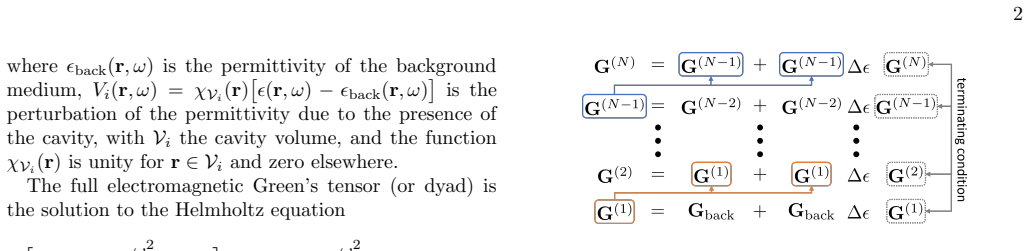
A Dyson scattering equation builds the Green's function for coupled open resonators from individual quasinormal modes in few iterations without nested integrals.
A machine-rendered reading of the paper's core claim, the machinery that carries it, and where it could break.
Core claim
The scattered electromagnetic Green's function of a multi-cavity system with spatially separated open cavities can be constructed from the quasinormal modes of the individual resonators within a few-mode approximation and a finite number of iteration steps of the Dyson scattering equation without requiring nested integrals.
What carries the argument
Dyson scattering equation applied iteratively to quasinormal modes of individual resonators to build the coupled Green's function.
If this is right
- The framework extends directly to arbitrarily large numbers of cavities and separations.
- It handles cavities with arbitrary shapes, dispersion, and losses.
- It provides an efficient alternative to full numerical computation of the Green's function for photonic devices.
- Excellent agreement holds for the tested case of two coupled dipoles in metal dimer gaps.
Where Pith is reading between the lines
- This iterative construction could enable efficient simulations of large resonator arrays in nanophotonic circuits.
- The method may adapt to other retarded wave scattering problems such as acoustic or quantum systems.
- Rapid iteration convergence suggests utility in iterative design loops for optical devices.
Load-bearing premise
The few-mode approximation for each separate resonator stays valid when the resonators interact through fields that propagate with finite delay.
What would settle it
Compare the iteratively constructed Green's function against a full numerical solution for three or more resonators at larger separations and check whether agreement remains excellent without extra correction terms.
Figures


read the original abstract
The electromagnetic Green's function is a crucial ingredient for the theoretical study of modern photonic quantum devices, but is often difficult or even impossible to calculate directly. We present a numerically efficient framework for calculating the scattered electromagnetic Green's function of a multi-cavity system with spatially separated open cavities (with arbitrary shape, dispersion and loss) and finite retardation times. The framework is based on a Dyson scattering equation that enables the construction of the Green's function from the quasinormal modes of the individual resonators within a few-mode approximation and a finite number of iteration steps without requiring nested integrals. The approach shows excellent agreement with the full numerical Green's function for the example of two coupled dipoles located in the gaps of two metal dimers serving as quasinormal mode cavities, and is easily extended to arbitrarily large separations and multiple cavities.
Editorial analysis
A structured set of objections, weighed in public.
Referee Report
Summary. The paper presents a framework for computing the scattered electromagnetic Green's function in systems of multiple spatially separated open optical resonators with arbitrary shapes, dispersion, loss, and finite retardation. It employs a Dyson scattering equation to construct the Green's function from the quasinormal modes of the individual isolated resonators within a few-mode approximation, using a finite number of iteration steps with the background retarded Green's function and without nested integrals. The approach is validated by direct comparison to full numerical results for a specific test case of two coupled dipoles embedded in the gaps of metal dimer cavities, with the claim that it extends readily to larger separations and multiple cavities.
Significance. If the few-mode truncation and iteration convergence hold more generally, the method would provide a computationally efficient route to Green's functions for complex multi-resonator photonic systems where direct full-wave calculations become prohibitive, supporting theoretical modeling of quantum devices. Strengths include grounding in established quasinormal-mode theory, use of the Dyson equation from prior literature, direct validation against independent full-wave numerics rather than self-referential fitting, and the absence of free parameters or ad-hoc entities in the central construction.
major comments (2)
- [Numerical results / validation section] The central claim that the isolated few-mode QNM basis remains sufficient when the driving field includes retarded contributions from other resonators (the weakest assumption) is load-bearing for the no-additional-corrections assertion. The manuscript validates this only for the two metal-dimer case with embedded dipoles; quantitative assessment of truncation error growth for higher-Q modes, stronger coupling, or different shapes is needed to confirm the approximation does not require further terms.
- [Abstract and results] Abstract and results: the reported 'excellent agreement' with the full numerical Green's function lacks accompanying quantitative metrics such as relative L2 error, maximum pointwise deviation, or explicit convergence data versus number of retained modes and Dyson iterations. This makes it difficult to judge how tightly the few-mode truncation error was controlled for the reported separations and losses.
minor comments (2)
- [Method] Clarify in the method section how the background retarded Green's function is evaluated numerically during the finite Dyson iterations to ensure reproducibility.
- [Abstract] The abstract would benefit from stating the specific number of QNMs retained per resonator and the number of Dyson iterations used in the two-cavity demonstration.
Simulated Author's Rebuttal
We thank the referee for the careful reading, positive overall assessment, and recommendation for minor revision. We address the two major comments below and have revised the manuscript to incorporate quantitative metrics and additional discussion on the validation case. Our responses aim to clarify the scope and strengthen the presentation without altering the core claims.
read point-by-point responses
-
Referee: [Numerical results / validation section] The central claim that the isolated few-mode QNM basis remains sufficient when the driving field includes retarded contributions from other resonators (the weakest assumption) is load-bearing for the no-additional-corrections assertion. The manuscript validates this only for the two metal-dimer case with embedded dipoles; quantitative assessment of truncation error growth for higher-Q modes, stronger coupling, or different shapes is needed to confirm the approximation does not require further terms.
Authors: We agree that the validation is shown explicitly for the two metal-dimer system with embedded dipoles, chosen because it permits direct comparison against independent full-wave numerics while incorporating finite retardation. The framework itself is constructed from the Dyson equation applied to the isolated QNMs and does not introduce additional corrections by design. In the revised manuscript we have added a dedicated paragraph in the numerical results section discussing the range of validity of the few-mode truncation under retarded driving, together with convergence plots of the truncation error versus retained modes for the reported geometry and losses. A full parametric study across higher-Q resonators, stronger coupling strengths, and arbitrary shapes lies outside the scope of the present work, which focuses on establishing the method and demonstrating its accuracy for a representative multi-cavity configuration; such an extended survey is noted as future work. revision: partial
-
Referee: [Abstract and results] Abstract and results: the reported 'excellent agreement' with the full numerical Green's function lacks accompanying quantitative metrics such as relative L2 error, maximum pointwise deviation, or explicit convergence data versus number of retained modes and Dyson iterations. This makes it difficult to judge how tightly the few-mode truncation error was controlled for the reported separations and losses.
Authors: We accept that the phrase 'excellent agreement' would benefit from quantitative support. The revised manuscript now includes, in both the abstract and the results section, explicit metrics: the relative L2-norm error between the few-mode Dyson approximation and the full numerical Green's function, the maximum pointwise deviation at representative locations, and convergence curves showing the error reduction with increasing number of retained quasinormal modes and with successive Dyson iterations. These additions allow readers to assess the tightness of the truncation for the separations and material losses considered in the example. revision: yes
- A systematic quantitative assessment of truncation-error growth for higher-Q modes, stronger inter-resonator coupling, or qualitatively different cavity shapes would require a separate, computationally intensive study that exceeds the scope and resources of the current manuscript.
Circularity Check
Derivation uses established QNM theory and Dyson equation from prior literature, with numerical validation against independent full-wave results
full rationale
The framework constructs the Green's function via a Dyson scattering equation applied to few-mode quasinormal modes of isolated individual resonators, followed by finite iterations. This builds directly on standard non-Hermitian QNM formalism and the Dyson equation as referenced from prior literature rather than deriving them anew. The central claim is tested by direct comparison to full numerical Green's functions for the two-dimer example, providing external validation instead of self-referential fitting or redefinition. No step reduces a prediction to a fitted input or renames a result by construction; self-citations support background theory but are not load-bearing for the new multi-cavity finite-retardation extension.
Axiom & Free-Parameter Ledger
axioms (2)
- domain assumption Quasinormal modes of individual open resonators form a sufficient basis for constructing the multi-cavity scattered field under the few-mode approximation.
- domain assumption The Dyson scattering equation accurately captures finite-retardation coupling between spatially separated cavities.
Reference graph
Works this paper leans on
-
[1]
K. An, J. J. Childs, R. R. Dasari, and M. S. Feld, Mi- crolaser: A laser with one atom in an optical resonator, Physical Review Letters73, 3375 (1994)
work page 1994
-
[2]
A. Pscherer, M. Meierhofer, D. Wang, H. Kelkar, D. Mart´ ın-Cano, T. Utikal, S. G¨ otzinger, and V. San- doghdar, Single-molecule vacuum Rabi splitting: Four- wave mixing and optical switching at the single-photon level, Physical Review Letters127, 133603 (2021)
work page 2021
-
[3]
J. D. Rivero, M. Pan, K. G. Makris, L. Feng, and L. Ge, Non-Hermiticity-governed active photonic reso- nances, Physical Review Letters126, 163901 (2021)
work page 2021
- [4]
-
[5]
C. Lee, B. Lawrie, R. Pooser, K.-G. Lee, C. Rockstuhl, and M. Tame, Quantum plasmonic sensors, Chemical Re- views121, 4743 (2021)
work page 2021
-
[6]
T. Pellizzari, S. A. Gardiner, J. I. Cirac, and P. Zoller, Decoherence, continuous observation, and quantum com- puting: A cavity QED model, Physical Review Letters 75, 3788 (1995)
work page 1995
-
[7]
A. Blais, R.-S. Huang, A. Wallraff, S. M. Girvin, and R. J. Schoelkopf, Cavity quantum electrodynamics for superconducting electrical circuits: An architecture for quantum computation, Physical Review A69, 062320 (2004)
work page 2004
- [8]
-
[9]
F. Borjans, X. Croot, X. Mi, M. Gullans, and J. Petta, Resonant microwave-mediated interactions between dis- tant electron spins, Nature577, 195 (2020)
work page 2020
-
[10]
J. I. Cirac, P. Zoller, H. J. Kimble, and H. Mabuchi, Quantum state transfer and entanglement distribution among distant nodes in a quantum network, Physical Re- view Letters78, 3221 (1997)
work page 1997
-
[11]
Pellizzari, Quantum networking with optical fibres, Physical Review Letters79, 5242 (1997)
T. Pellizzari, Quantum networking with optical fibres, Physical Review Letters79, 5242 (1997)
work page 1997
-
[12]
L.-M. Duan, M. D. Lukin, J. I. Cirac, and P. Zoller, Long- distance quantum communication with atomic ensembles and linear optics, Nature414, 413 (2001)
work page 2001
-
[13]
H. Pichler and P. Zoller, Photonic circuits with time delays and quantum feedback, Physical Review Letters 116, 093601 (2016)
work page 2016
- [14]
-
[15]
C. Sauvan, J.-P. Hugonin, I. S. Maksymov, and P. Lalanne, Theory of the spontaneous optical emission of nanosize photonic and plasmon resonators, Physical Review Letters110, 237401 (2013)
work page 2013
- [16]
-
[17]
J. Ren, S. Franke, and S. Hughes, Quasinormal modes, lo- cal density of states, and classical purcell factors for cou- pled loss-gain resonators, Physical Review X11, 041020 (2021)
work page 2021
-
[18]
K. Ho, P. Leung, A. M. van den Brink, and K. Young, Second quantization of open systems using quasinormal modes, Physical Review E58, 2965 (1998)
work page 1998
-
[19]
H. T. Dung, L. Kn¨ oll, and D.-G. Welsch, Three- dimensional quantization of the electromagnetic field in dispersive and absorbing inhomogeneous dielectrics, Physical Review A57, 3931 (1998)
work page 1998
-
[20]
L. Suttorp and M. Wubs, Field quantization in inho- mogeneous absorptive dielectrics, Physical Review A70, 013816 (2004)
work page 2004
-
[21]
T. G. Philbin, Canonical quantization of macroscopic electromagnetism, New Journal of Physics12, 123008 (2010)
work page 2010
- [22]
- [23]
- [24]
- [25]
-
[26]
E. A. Muljarov, W. Langbein, and R. Zimmermann, Brillouin-wigner perturbation theory in open electro- magnetic systems, EPL (Europhysics Letters)92, 50010 (2011)
work page 2011
-
[27]
P. T. Kristensen, C. Van Vlack, and S. Hughes, Gener- alized effective mode volume for leaky optical cavities, Optics Letters37, 1649 (2012)
work page 2012
-
[28]
R.-C. Ge, P. T. Kristensen, J. F. Young, and S. Hughes, Quasinormal mode approach to modelling light-emission and propagation in nanoplasmonics, New Journal of Physics16, 113048 (2014)
work page 2014
-
[29]
P. T. Kristensen, K. Herrmann, F. Intravaia, and K. Busch, Modeling electromagnetic resonators using quasinormal modes, Advances in Optics and Photonics 12, 612 (2020)
work page 2020
-
[30]
M. I. Abdelrahman and B. Gralak, Completeness and divergence-free behavior of the quasi-normal modes using 6 causality principle, OSA Continuum1, 340 (2018)
work page 2018
-
[31]
Z. Sztranyovszky, W. Langbein, and E. A. Muljarov, Extending completeness of the eigenmodes of an open system beyond its boundary, for Green’s function and scattering-matrix calculations, Physical Review Research 7, L012035 (2025)
work page 2025
-
[32]
J. Ren, S. Franke, A. Knorr, M. Richter, and S. Hughes, Near-field to far-field transformations of optical quasinor- mal modes and efficient calculation of quantized quasi- normal modes for open cavities and plasmonic resonators, Physical Review B101, 205402 (2020)
work page 2020
-
[33]
C. Tao, J. Zhu, Y. Zhong, and H. Liu, Coupling theory of quasinormal modes for lossy and dispersive plasmonic nanoresonators, Physical Review B102, 045430 (2020)
work page 2020
-
[34]
J. Ren, S. Franke, and S. Hughes, Connecting classical and quantum mode theories for coupled lossy cavity res- onators using quasinormal modes, ACS Photonics9, 138 (2022)
work page 2022
-
[35]
C. M¨ uller, Die Grundz¨ uge einer mathematischen Theo- rie elektromagnetischer Schwingungen, Archiv der Math- ematik1, 296 (1948)
work page 1948
-
[36]
Silver,Microwave antenna theory and design, 19 (Iet, 1984)
S. Silver,Microwave antenna theory and design, 19 (Iet, 1984)
work page 1984
-
[37]
E. Muljarov, Rigorous theory of coupled resonators, arXiv preprint arXiv:2506.04413 https://doi.org/10.48550/arXiv.2506.04413 (2025)
-
[38]
P. T. Kristensen, J. R. de Lasson, and N. Gregersen, Cal- culation, normalization, and perturbation of quasinormal modes in coupled cavity-waveguide systems, Optics Let- ters39, 6359 (2014)
work page 2014
-
[39]
P. T. Kristensen and S. Hughes, Modes and mode vol- umes of leaky optical cavities and plasmonic nanores- onators, ACS Photonics1, 2 (2014)
work page 2014
- [40]
-
[41]
(7), or (iii) if neitherr ′ norrare inV k inserting the transpose of Eq
For any fixedn=k, either (i)r ′ ∈ V k, or (ii) since G(r,r ′, ω) = [G(r ′,r, ω)] T alternativelyr∈ V k will re- cover case (i) by using the transpose of Eq. (7), or (iii) if neitherr ′ norrare inV k inserting the transpose of Eq. (7) on the RHS of Eq. (7) again recovers case (i)
-
[42]
S. G. Johnson, M. Ibanescu, M. A. Skorobogatiy, O. Weisberg, J. D. Joannopoulos, and Y. Fink, Perturba- tion theory for Maxwell’s equations with shifting material boundaries, Phys. Rev. E65, 066611 (2002)
work page 2002
-
[43]
S. G. Johnson, M. Povinelli, M. Soljaˇ ci´ c, A. Karalis, S. Jacobs, and J. Joannopoulos, Roughness losses and volume-current methods in photonic-crystal waveguides, Applied Physics B81, 283 (2005)
work page 2005
-
[44]
M. Patterson and S. Hughes, Interplay between disorder- induced scattering and local field effects in photonic crys- tal waveguides, Physical Review B81, 245321 (2010)
work page 2010
-
[45]
W. Yan, P. Lalanne, and M. Qiu, Shape deformation of nanoresonator: A quasinormal-mode perturbation the- ory, Physical Review Letters125, 013901 (2020)
work page 2020
-
[46]
See Supplemental Material at [URL will be inserted by publisher] for details on the numerical calculation of the QNMs and full Green’s function as well as further infor- mation on theN 21 parameter and results for additional distances between the metal dimers
-
[47]
S. Franke, J. Ren, S. Hughes, and M. Richter, Fluctuation-dissipation theorem and fundamental pho- ton commutation relations in lossy nanostructures using quasinormal modes, Physical Review Research2, 033332 (2020). 7 END MA TTER Appendix A: Derivation of the multi-cavity Green’s function.—Using the Helmholtz equation (2) with ϵ(n)(r, ω) for the Green’s f...
work page 2020
discussion (0)
Sign in with ORCID, Apple, or X to comment. Anyone can read and Pith papers without signing in.