Target Controllability Scores for Actuation-Constrained Network Intervention
Pith reviewed 2026-05-18 07:50 UTC · model grok-4.3
The pith
Target controllability scores assess node importance for specific targets under actuator constraints using convex optimization on virtual system Gramians.
A machine-rendered reading of the paper's core claim, the machinery that carries it, and where it could break.
Core claim
The central claim is that the target volumetric controllability score and the target average energy controllability score are well-defined as the unique optimal solutions to convex programs involving the output controllability Gramian in a virtual system, and that these scores can differ qualitatively from their full-state analogs precisely because restricting attention to target nodes modifies the Gramian. The work further shows that a target-only reduced virtual system yields non-asymptotic error bounds for these scores when cross terms are small and the logarithmic norm of the dynamics matrix is low or negative, with particular accuracy at short or moderate time horizons.
What carries the argument
The output controllability Gramian of the virtual system, which encodes the reachable energy to the targets and serves as the basis for convex optimization problems that define the target VCS and AECS.
Load-bearing premise
The virtual system formulation and the associated output controllability Gramian correctly model the impact of actuator constraints and the restriction to designated target nodes.
What would settle it
A numerical counterexample in which the target scores fail to differ from full-state scores despite a nontrivial projection onto the targets, or an experiment where the reduced-system approximation errors violate the stated non-asymptotic bounds.
Figures


read the original abstract
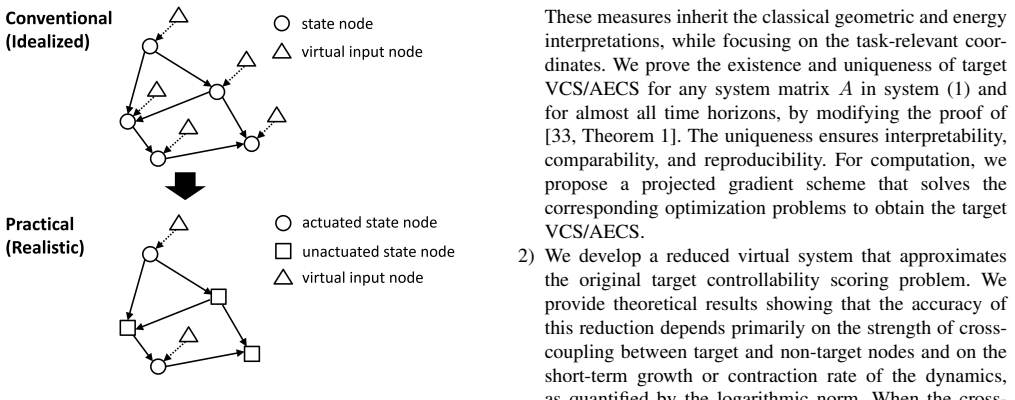
We introduce the target controllability score (TCS), a concept for evaluating node importance under actuator constraints and designated target objectives, formulated within a virtual system setting. The TCS consists of the target volumetric controllability score (VCS) and the target average energy controllability score (AECS), each defined as an optimal solution to a convex optimization problem associated with the output controllability Gramian. We establish existence and uniqueness (for almost all time horizons), develop a projected gradient method for computation, and show that target VCS/AECS can behave qualitatively differently from their standard full-state counterparts because projection onto the target nodes changes the underlying Gramian structure. To enable scalability, we construct a target-only reduced virtual system and derive non-asymptotic bounds showing that weak cross-coupling and a low or negative logarithmic norm of the system matrix yield accurate approximations of target VCS/AECS, particularly over short or moderate time horizons. Experiments on human brain networks reveal a clear trade-off: at short horizons, both target VCS and target AECS are well approximated by their reduced formulations, while at long horizons, target AECS remains robust but target VCS deteriorates.
Editorial analysis
A structured set of objections, weighed in public.
Referee Report
Summary. The manuscript introduces target controllability scores (TCS) for actuation-constrained network intervention, consisting of the target volumetric controllability score (VCS) and target average energy controllability score (AECS). These are defined as optimal solutions to convex optimization problems involving the output controllability Gramian within a virtual system setting that incorporates designated target nodes and actuator constraints. The authors prove existence and uniqueness for almost all time horizons, develop a projected gradient method for computation, derive non-asymptotic error bounds for a target-only reduced virtual system under weak cross-coupling and logarithmic-norm conditions, and demonstrate via experiments on human brain networks that the target scores can differ qualitatively from full-state counterparts due to the Gramian projection while exhibiting horizon-dependent approximation quality.
Significance. If the central claims hold, the paper provides a scalable, theoretically supported framework for assessing node importance in targeted control problems with actuator constraints. Strengths include the explicit non-asymptotic bounds that enable reduced-order approximations, the projected gradient solver, and the clear attribution of qualitative differences to changes in the underlying Gramian structure induced by target projection. These elements, together with the brain-network experiments, offer practical value for applications in complex networked systems such as neuroscience.
major comments (1)
- [Target-only Reduced Virtual System] Target-only Reduced Virtual System section: the non-asymptotic error bounds for approximating target VCS/AECS rely on stated conditions of weak cross-coupling and low/negative logarithmic norm of the system matrix; while these yield accurate short-to-moderate horizon approximations, the manuscript does not provide a sharpness analysis or counterexamples when the conditions are violated, which bears on the generality of the scalability claims.
minor comments (2)
- [Existence and Uniqueness] The statement of existence and uniqueness 'for almost all time horizons' is standard but would benefit from a brief remark on the exceptional set (e.g., its measure-zero character) to aid readers unfamiliar with generic controllability results.
- [Experiments] In the brain-network experiments, reporting the specific network dimensions, number of target nodes, and actuator constraint sets used would improve reproducibility and allow readers to assess how the observed trade-offs scale with problem size.
Simulated Author's Rebuttal
We thank the referee for their careful review and supportive recommendation for minor revision. We address the major comment below.
read point-by-point responses
-
Referee: [Target-only Reduced Virtual System] Target-only Reduced Virtual System section: the non-asymptotic error bounds for approximating target VCS/AECS rely on stated conditions of weak cross-coupling and low/negative logarithmic norm of the system matrix; while these yield accurate short-to-moderate horizon approximations, the manuscript does not provide a sharpness analysis or counterexamples when the conditions are violated, which bears on the generality of the scalability claims.
Authors: We appreciate the referee's observation on the conditional nature of the error bounds. These non-asymptotic bounds are derived explicitly under the assumptions of weak cross-coupling and low or negative logarithmic norm, which permit precise quantification of the approximation error between the full target VCS/AECS and their target-only reduced counterparts, particularly for short-to-moderate horizons. The conditions are clearly stated and are motivated by structural properties that hold in the brain-network examples where the reduced approximations are shown to perform well. While a dedicated sharpness analysis or counterexamples outside these regimes would provide additional insight into bound tightness, the manuscript's contribution centers on establishing sufficient conditions together with explicit, computable error estimates that support practical scalability. To clarify the scope of the scalability claims, we will add a concise discussion in the revised manuscript noting the dependence on the stated conditions and the potential for degraded approximation quality when they are violated. revision: partial
Circularity Check
No significant circularity in derivation chain
full rationale
The paper defines target VCS and AECS directly as optimal solutions to convex optimization problems using the output controllability Gramian in a virtual system. It then proves existence/uniqueness for almost all horizons via standard arguments, supplies a projected gradient solver, and derives explicit non-asymptotic bounds for the target-only reduction from stated conditions on cross-coupling and logarithmic norm. These steps constitute an independent derivation chain grounded in control theory definitions and explicit mathematical reductions; the qualitative difference from full-state scores is attributed to the direct effect of target projection on the Gramian structure, with no reduction to fitted parameters, self-definitional loops, or load-bearing self-citations.
Axiom & Free-Parameter Ledger
Lean theorems connected to this paper
-
IndisputableMonolith/Cost/FunctionalEquation.leanwashburn_uniqueness_aczel unclear?
unclearRelation between the paper passage and the cited Recognition theorem.
target VCS/AECS defined as optimal solutions to convex optimization problems associated with the output controllability Gramian W(p,T)=∑pi Wi(T)
-
IndisputableMonolith/Foundation/DimensionForcing.leanalexander_duality_circle_linking unclear?
unclearRelation between the paper passage and the cited Recognition theorem.
error bound ∥ΔWi(T)∥ ≤ Φμ(A)(T)∥A12∥ with Φ involving e^{μ(A)T} and logarithmic norm μ(A)
What do these tags mean?
- matches
- The paper's claim is directly supported by a theorem in the formal canon.
- supports
- The theorem supports part of the paper's argument, but the paper may add assumptions or extra steps.
- extends
- The paper goes beyond the formal theorem; the theorem is a base layer rather than the whole result.
- uses
- The paper appears to rely on the theorem as machinery.
- contradicts
- The paper's claim conflicts with a theorem or certificate in the canon.
- unclear
- Pith found a possible connection, but the passage is too broad, indirect, or ambiguous to say the theorem truly supports the claim.
Forward citations
Cited by 1 Pith paper
-
Relationship Between Controllability Scoring and Optimal Experimental Design
Finite-time controllability scoring matches approximate OED, with VCS corresponding to D-optimality and AECS to A-optimality, plus a unique optimizer and long-horizon node downweighting.
Reference graph
Works this paper leans on
-
[1]
Social diversity reduces the complexity and cost of fostering fairness,
T. Cimpeanu, A. Di Stefano, C. Perret, and T. A. Han, “Social diversity reduces the complexity and cost of fostering fairness,”Chaos, Solitons & Fractals, vol. 167, p. 113051, 2023
work page 2023
-
[2]
Resilience-based component im- portance measures for critical infrastructure network systems,
Y .-P. Fang, N. Pedroni, and E. Zio, “Resilience-based component im- portance measures for critical infrastructure network systems,”IEEE Transactions on Reliability, vol. 65, no. 2, pp. 502–512, 2016
work page 2016
-
[3]
Multi-criteria node criticality assessment framework for critical infrastructure networks,
L. Faramondi, G. Oliva, and R. Setola, “Multi-criteria node criticality assessment framework for critical infrastructure networks,”International Journal of Critical Infrastructure Protection, vol. 28, p. 100338, 2020
work page 2020
-
[4]
Influence of the first- mover advantage on the gender disparities in physics citations,
H. Kong, S. Martin-Gutierrez, and F. Karimi, “Influence of the first- mover advantage on the gender disparities in physics citations,”Com- munications Physics, vol. 5, no. 1, p. 243, 2022
work page 2022
- [5]
-
[6]
Network hubs in the human brain,
M. P. Van den Heuvel and O. Sporns, “Network hubs in the human brain,”Trends in cognitive sciences, vol. 17, no. 12, pp. 683–696, 2013
work page 2013
-
[7]
Centrality measures in networks,
F. Bloch, M. O. Jackson, and P. Tebaldi, “Centrality measures in networks,”Social Choice and Welfare, pp. 1–41, 2023
work page 2023
-
[8]
Network centrality: an introduction,
F. A. Rodrigues, “Network centrality: an introduction,”A mathematical modeling approach from nonlinear dynamics to complex systems, pp. 177–196, 2019
work page 2019
-
[9]
Controllability of complex networks,
Y .-Y . Liu, J.-J. Slotine, and A.-L. Barab´asi, “Controllability of complex networks,”Nature, vol. 473, no. 7346, pp. 167–173, 2011
work page 2011
-
[10]
Vital nodes identification in complex networks,
L. L ¨u, D. Chen, X.-L. Ren, Q.-M. Zhang, Y .-C. Zhang, and T. Zhou, “Vital nodes identification in complex networks,”Physics reports, vol. 650, pp. 1–63, 2016
work page 2016
-
[11]
R. Tang, Z. Yong, S. Jiang, X. Chen, Y . Liu, Y .-C. Zhang, G.-Q. Sun, and W. Wang, “Network alignment,”Physics Reports, vol. 1107, pp. 1–45, 2025
work page 2025
-
[12]
On the general theory of control systems,
R. E. Kalman, “On the general theory of control systems,” inPro- ceedings First International Conference on Automatic Control, Moscow, USSR, 1960, pp. 481–492
work page 1960
-
[13]
Mathematical description of linear dynamical systems,
R. E. Kalman, “Mathematical description of linear dynamical systems,” Journal of the Society for Industrial and Applied Mathematics, Series A: Control, vol. 1, no. 2, pp. 152–192, 1963
work page 1963
-
[14]
C.-T. Lin, “Structural controllability,”IEEE Transactions on Automatic Control, vol. 19, no. 3, pp. 201–208, 1974
work page 1974
-
[15]
Dilation choice sets, dulmage– mendelsohn decomposition, and structural controllability,
C. Commault and J. van der Woude, “Dilation choice sets, dulmage– mendelsohn decomposition, and structural controllability,”IEEE Trans- actions on Control of Network Systems, vol. 11, no. 2, pp. 1046–1055, 2024
work page 2024
-
[16]
Minimal controllability problems,
A. Olshevsky, “Minimal controllability problems,”IEEE Transactions on Control of Network Systems, vol. 1, no. 3, pp. 249–258, 2014
work page 2014
-
[17]
A framework for structural input/output and control configuration selection in large-scale systems,
S. Pequito, S. Kar, and A. P. Aguiar, “A framework for structural input/output and control configuration selection in large-scale systems,” IEEE Transactions on Automatic Control, vol. 61, no. 2, pp. 303–318, 2015
work page 2015
-
[18]
An overview of structural systems theory,
G. Ramos, A. P. Aguiar, and S. Pequito, “An overview of structural systems theory,”Automatica, vol. 140, p. 110229, 2022
work page 2022
-
[19]
Minimal controllability problems on linear structural descriptor systems,
S. Terasaki and K. Sato, “Minimal controllability problems on linear structural descriptor systems,”IEEE Transactions on Automatic Control, vol. 11, no. 5, pp. 2522–2528, 2022
work page 2022
-
[20]
Minimal controllability problem on linear structural descriptor systems with forbidden nodes,
S. Terasaki and K. Sato, “Minimal controllability problem on linear structural descriptor systems with forbidden nodes,”IEEE Transactions on Automatic Control, vol. 69, no. 1, pp. 527–534, 2024
work page 2024
-
[21]
Controllability of large-scale networks: The control energy exponents,
G. Baggio and S. Zampieri, “Controllability of large-scale networks: The control energy exponents,”IEEE Transactions on Control of Network Systems, vol. 11, no. 2, pp. 808–820, 2023
work page 2023
-
[22]
Controllability metrics, limitations and algorithms for complex networks,
F. Pasqualetti, S. Zampieri, and F. Bullo, “Controllability metrics, limitations and algorithms for complex networks,”IEEE Transactions on Control of Network Systems, vol. 1, no. 1, pp. 40–52, 2014
work page 2014
-
[23]
On submodularity and controllability in complex dynamical networks,
T. H. Summers, F. L. Cortesi, and J. Lygeros, “On submodularity and controllability in complex dynamical networks,”IEEE Transactions on Control of Network Systems, vol. 3, no. 1, pp. 91–101, 2016
work page 2016
-
[24]
Energy-aware controlla- bility of complex networks,
G. Baggio, F. Pasqualetti, and S. Zampieri, “Energy-aware controlla- bility of complex networks,”Annual Review of Control, Robotics, and Autonomous Systems, vol. 5, no. 1, pp. 465–489, 2022
work page 2022
-
[25]
On the role of network centrality in the controllability of complex networks,
N. Bof, G. Baggio, and S. Zampieri, “On the role of network centrality in the controllability of complex networks,”IEEE Transactions on Control of Network Systems, vol. 4, no. 3, pp. 643–653, 2017
work page 2017
-
[26]
Controllability maximization of large-scale sys- tems using projected gradient method,
K. Sato and A. Takeda, “Controllability maximization of large-scale sys- tems using projected gradient method,”IEEE Control Systems Letters, vol. 4, no. 4, pp. 821–826, 2020
work page 2020
-
[27]
Centrality measures and the role of non- normality for network control energy reduction,
G. Lindmark and C. Altafini, “Centrality measures and the role of non- normality for network control energy reduction,”IEEE Control Systems Letters, vol. 5, no. 3, pp. 1013–1018, 2021
work page 2021
-
[28]
Eigenvalue clustering, control energy, and logarithmic capacity,
A. Olshevsky, “Eigenvalue clustering, control energy, and logarithmic capacity,”Systems & Control Letters, vol. 96, pp. 45–50, 2016
work page 2016
-
[29]
Re: Warnings and caveats in brain controllability,
F. Pasqualetti, S. Gu, and D. S. Bassett, “Re: Warnings and caveats in brain controllability,”NeuroImage, vol. 197, pp. 586–588, 2019
work page 2019
-
[30]
Brain controllability: Not a slam dunk yet,
S. Suweis, C. Tu, R. P. Rocha, S. Zampieri, M. Zorzi, and M. Corbetta, “Brain controllability: Not a slam dunk yet,”NeuroImage, vol. 200, pp. 552–555, 2019
work page 2019
-
[31]
Warnings and caveats in brain controllability,
C. Tu, R. P. Rocha, M. Corbetta, S. Zampieri, M. Zorzi, and S. Suweis, “Warnings and caveats in brain controllability,”NeuroImage, vol. 176, pp. 83–91, 2018
work page 2018
-
[32]
Controllability scores for selecting control nodes of large-scale network systems,
K. Sato and S. Terasaki, “Controllability scores for selecting control nodes of large-scale network systems,”IEEE Transactions on Automatic Control, vol. 69, no. 7, pp. 4673–4680, 2024
work page 2024
-
[33]
Uniqueness Analysis of Controllability Scores and Their Application to Brain Networks,
K. Sato and R. Kawamura, “Uniqueness Analysis of Controllability Scores and Their Application to Brain Networks,”IEEE Transactions on Control of Network Systems, 2025 (accepted)
work page 2025
-
[34]
Energy scaling of targeted optimal control of complex networks,
I. Klickstein, A. Shirin, and F. Sorrentino, “Energy scaling of targeted optimal control of complex networks,”Nature communications, vol. 8, no. 1, p. 15145, 2017
work page 2017
-
[35]
Target control of complex networks,
J. Gao, Y .-Y . Liu, R. M. D’souza, and A.-L. Barab ´asi, “Target control of complex networks,”Nature communications, vol. 5, no. 1, pp. 1–8, 2014
work page 2014
-
[36]
W.-F. Guo, S.-W. Zhang, Q.-Q. Shi, C.-M. Zhang, T. Zeng, and L. Chen, “A novel algorithm for finding optimal driver nodes to target control complex networks and its applications for drug targets identification,” Bmc Genomics, vol. 19, no. Suppl 1, p. 924, 2018
work page 2018
-
[37]
Controlling target brain regions by optimal selection of input nodes,
K. K. H. Manjunatha, G. Baron, D. Benozzo, E. Silvestri, M. Corbetta, A. Chiuso, A. Bertoldo, S. Suweis, and M. Allegra, “Controlling target brain regions by optimal selection of input nodes,”PLOS Computational Biology, vol. 20, no. 1, p. e1011274, 2024
work page 2024
-
[38]
On the concepts of controllability and observability of linear systems,
E. Kreindler and P. Sarachik, “On the concepts of controllability and observability of linear systems,”IEEE Transactions on Automatic Control, vol. 9, no. 2, pp. 129–136, 1964
work page 1964
-
[39]
Fast projection onto the simplex and theL 1 ball,
L. Condat, “Fast projection onto the simplex and theL 1 ball,”Mathe- matical Programming, vol. 158, no. 1, pp. 575–585, 2016
work page 2016
-
[40]
D. P. Bertsekas,Nonlinear Programming, Third Edition. Athena Scientific, 2016
work page 2016
-
[41]
R. A. Horn and C. R. Johnson,Matrix analysis. Cambridge university press, 2012
work page 2012
-
[42]
Distributed control strategies for microgrids: An overview,
E. Espina, J. Llanos, C. Burgos-Mellado, R. Cardenas-Dobson, M. Martinez-Gomez, and D. Saez, “Distributed control strategies for microgrids: An overview,”IEEe Access, vol. 8, pp. 193 412–193 448, 2020
work page 2020
-
[43]
Modular and hierarchi- cally modular organization of brain networks,
D. Meunier, R. Lambiotte, and E. T. Bullmore, “Modular and hierarchi- cally modular organization of brain networks,”Frontiers in neuroscience, vol. 4, p. 200, 2010
work page 2010
-
[44]
Hierarchical organization of modularity in metabolic networks,
E. Ravasz, A. L. Somera, D. A. Mongru, Z. N. Oltvai, and A.- L. Barab ´asi, “Hierarchical organization of modularity in metabolic networks,”science, vol. 297, no. 5586, pp. 1551–1555, 2002
work page 2002
-
[45]
Model reduction based approximation of the output controllability gramian in large-scale networks,
G. Casadei, C. Canudas-de Wit, and S. Zampieri, “Model reduction based approximation of the output controllability gramian in large-scale networks,”IEEE Transactions on Control of Network Systems, vol. 7, no. 4, pp. 1778–1788, 2020
work page 2020
-
[46]
Beck,First-order methods in optimization
A. Beck,First-order methods in optimization. SIAM, 2017
work page 2017
-
[47]
Human brain structural connec- tivity matrices–ready for modelling,
A. ˇSkoch, B. Reh ´ak Bu ˇckov´a, J. Mare ˇs, J. Tint ˇera, P. Sanda, L. Jajcay, J. Hor ´aˇcek, F. ˇSpaniel, and J. Hlinka, “Human brain structural connec- tivity matrices–ready for modelling,”Scientific Data, vol. 9, no. 1, p. 486, 2022
work page 2022
-
[48]
Nonlinear responses in fMRI: the Balloon model, V olterra kernels, and other hemodynamics,
K. J. Friston, A. Mechelli, R. Turner, and C. J. Price, “Nonlinear responses in fMRI: the Balloon model, V olterra kernels, and other hemodynamics,”NeuroImage, vol. 12, no. 4, pp. 466–477, 2000
work page 2000
-
[49]
A guide to group effective connectivity analysis, part 1: First level analysis with DCM for fMRI,
P. Zeidman, A. Jafarian, N. Corbin, M. L. Seghier, A. Razi, C. J. Price, and K. J. Friston, “A guide to group effective connectivity analysis, part 1: First level analysis with DCM for fMRI,”NeuroImage, vol. 200, pp. 174–190, 2019
work page 2019
-
[50]
F. Abdelnour, H. U. V oss, and A. Raj, “Network diffusion accurately models the relationship between structural and functional brain connec- tivity networks,”Neuroimage, vol. 90, pp. 335–347, 2014
work page 2014
-
[51]
Controllability of structural brain networks,
S. Gu, F. Pasqualetti, M. Cieslak, Q. K. Telesford, B. Y . Alfred, A. E. Kahn, J. D. Medaglia, J. M. Vettel, M. B. Miller, S. T. Grafton, and D. S. Bassett, “Controllability of structural brain networks,”Nature communications, vol. 6, no. 1, pp. 1–10, 2015
work page 2015
discussion (0)
Sign in with ORCID, Apple, or X to comment. Anyone can read and Pith papers without signing in.