REVIEW 4 major objections 7 minor 24 references
A probabilistic placeability metric scores 6D placement poses directly from partial point clouds, jointly evaluating stability, graspability, and clearance to enable model-free unified pick-and-place reasoning.
Reviewed by Pith at T0; open to challenge. T0 means a machine referee read the full paper against a public rubric. the ladder, T0–T4 →
T0 review · deepseek-v4-flash
2026-08-04 09:31 UTC pith:DBT2Z63B
load-bearing objection Solid model-free placeability core with honest stability validation, but the abstract oversells the end-to-end results and the CoM-from-surface proxy needs more evidence before the 'unseen objects' claim holds. the 4 major comments →
A Robust Placeability Metric for Model-Free Unified Pick-and-Place Reasoning
The pith
A machine-rendered reading of the paper's core claim, the machinery that carries it, and where it could break.
Core claim
The central claim is that placement stability for previously unseen objects can be computed directly from raw sensed point cloud geometry by treating the object's center of mass as a set of hypotheses sampled from an ellipsoidal Gaussian fitted to the observed surface, then scoring a candidate pose by the fraction of these hypotheses whose vertical projections fall inside the support polygon defined by the contact points. The paper shows this stability score declines sharply at the real-world tipping offset for objects near table edges and at critical inclination angles, matching or beating a CAD-based center-of-mass baseline, and that fusing it with placement-conditioned graspability and cl
What carries the argument
The load-bearing object is the point-cloud stability score f_st, a logistic-normalized function of the inlier fraction p_in of center-of-mass hypothesis samples that project inside the support polygon. The CoM hypotheses come from an ellipsoidal Gaussian fitted to the observed surface points, with ellipsoid size determined by the object's boundary extents. This score is multiplied with placement-conditioned graspability f_pcg (grasp quality, reachability, and collision after rigid transform to the placement pose) and an altitude clearance term f_alt to form the placeability metric, and the unified grasp-place score v_gp = ω_g v_g · ω_p v_p · C_p couples grasp candidates to placement candidat
Load-bearing premise
The stability term assumes an object's center of mass can be inferred from the shape of its observed outer surface — surface point clouds carry no information about internal mass distribution, so objects with heavily displaced weight (like a drill with a missing battery) could be scored stable when they would actually tip.
What would settle it
Take an object whose visible geometry is symmetric but whose mass is concentrated off-center (e.g., a hollow box with a heavy brick taped inside one corner, or a power drill with the battery removed before scanning). Place it at the edge of a table with the support polygon centered under the observed shape; the metric predicts a high stability score, while the real object tips at a much larger footprint fraction. The measured tipping threshold would deviate from the metric's predicted sharp transition.
If this is right
- Robots can plan stable placements for objects they have never seen, without CAD models or templates, using only partial point clouds from a depth camera.
- The unified scoring lets grasp selection be conditioned on downstream placement, reducing re-grasping and avoiding collisions early; the reasoning step itself adds roughly half a millisecond.
- The stability term extends beyond planar tabletops: it predicts tipping thresholds near edges and on inclined supports, where learned predictors and planar baselines fail.
- Task preferences such as dense or sparse packing can be injected as multiplicative heuristics without changing the core metric.
- The formulation is agnostic to the grasp generation method, so any grasp predictor producing SE(3) candidates can slot into the pipeline.
Where Pith is reading between the lines
- Because the metric is purely geometric, it should transfer across grippers and robots with no retraining; the reachability map and collision mesh are the only robot-specific inputs.
- A testable extension is to replace the ellipsoidal-Gaussian CoM proxy with a learned or tactile mass estimate for objects with strongly displaced internal mass; the steepness of the tipping curves suggests the stability score would benefit from better CoM priors.
- The tipping-threshold experiments hint at a broader use: the same score could serve as a reward signal for pushing or reorienting objects until stable, or for verifying placements after execution.
- The paper's comparison to UOP-Net focuses on stability; a direct head-to-head of end-to-end pick-and-place success with learned methods remains open.
Editorial analysis
A structured set of objections, weighed in public.
Referee Report
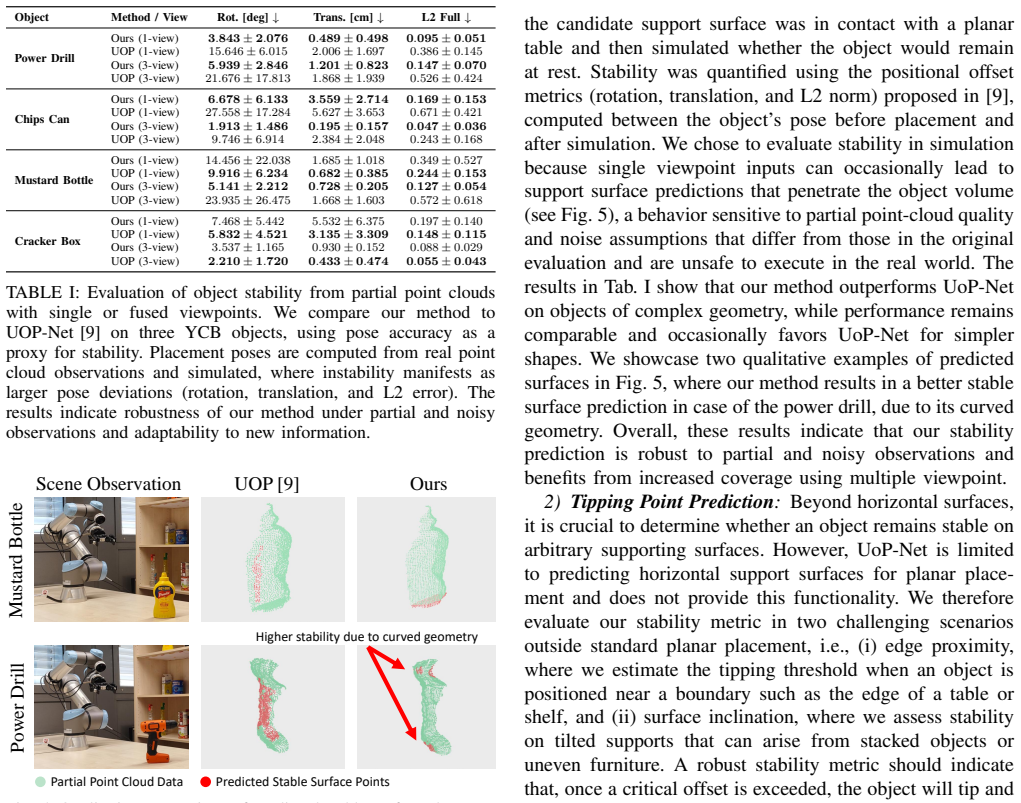
Summary. The paper presents a 'generalized placeability metric' that scores 6-DoF object placements from partial point clouds without CAD models. The metric is a multiplicative combination of a geometric stability score (fraction of center-of-mass hypotheses projecting into the support polygon), a placement-conditioned graspability score, and an altitude-based clearance score, optionally multiplied by task-driven heuristics. The authors integrate this into a unified pick-and-place pipeline by scoring grasps in the object frame and then mapping them onto placement poses. Experiments compare the stability term to UOP-Net on four YCB objects, measure real-world tipping thresholds on edge and inclined supports for three objects, report runtimes, and give a qualitative real-robot demonstration.
Significance. The contribution is potentially valuable: a model-free, online, shape-prior-free placeability metric that works on noisy partial clouds and handles edge proximity and inclined surfaces would be a practical tool for manipulation. The authors wisely evaluate the stability term against real-world tipping thresholds and include an honest comparison with UOP-Net, acknowledging that UOP-Net sometimes wins on simpler shapes. The runtime breakdown is useful. However, the core stability estimate relies on an ellipsoidal Gaussian fitted to surface points as a proxy for the center of mass, an approximation that is not physically justified and is validated on only a few YCB objects. Furthermore, key logistic parameters are not reported, and the promised quantitative system-level evaluation is absent. These issues currently prevent the strong claims in the abstract from being fully supported.
major comments (4)
- [Sec. III-B.1, Eq. (1)] The stability score f_st is computed from p_in, the fraction of samples drawn from an ellipsoidal Gaussian N(µ,Σ) fitted to the observed surface point cloud. This is a pure surface-geometry proxy: µ is the mean of surface points and Σ is derived from boundary extrema. It does not model internal mass distribution. The validation in Sec. IV-A.2 covers three YCB objects whose mass is mostly reflected by outer shape; the power drill's displaced mass is captured only because the shape asymmetry happens to be visible. For unseen objects with hidden mass (e.g., a closed container with internal weight, a drink bottle, a wrench), the proxy may be arbitrarily wrong. Since the abstract claims 'accurate stability predictions' for unseen objects, this approximation is load-bearing. I ask for either (i) additional experiments with objects whose COM is deliberately decoupled from their visible shape, c
- [Eq. (1), Eq. (4), Eq. (6), Eq. (10)] The logistic parameters k and c in Eq. (1), the clearance parameters k, z_mid, z_start, z_end, w_min, w_max in Eq. (4), the heuristic decay k and τ in Eq. (6), and the weights ω_g, ω_p in Eq. (10) are never specified. The sharp transition near the real tipping thresholds in Fig. 6 is directly controlled by these parameters; without knowing the values, it is impossible to tell whether the agreement is a genuine prediction or a result of tuning on the same objects. Please report the exact values used in all experiments, and include a sensitivity analysis (e.g., varying k and c over a reasonable range) or a hold-out object experiment to show the parameter choices generalize.
- [Sec. IV (intro) and Sec. IV-D] The second paragraph of Sec. IV promises: 'Third, we assess system-level performance through success rate, runtime, and ablations isolating the stability component.' The actual Sec. IV-D reports a qualitative real-robot demonstration with two runs, and no success-rate numbers or ablation results appear anywhere in the paper. This is an internal inconsistency. The abstract's assertion that the method 'consistently improves end-to-end pick-and-place success' is not supported by any quantitative experiment. Please either add the promised success-rate and ablation data, or remove the claim from the abstract and clearly label Sec. IV-D as a qualitative pilot.
- [Conclusion, second paragraph] The conclusion states: 'Compared to UOP-Net [9] and CAD-based baselines, it achieved higher accuracy with lower rotational and translational errors.' This is contradicted by Table I. For Cracker Box (1-view), UOP-Net has lower rotation error (5.832 vs 7.468 deg), lower translation error (3.135 vs 5.532 cm), and lower L2 (0.148 vs 0.197). For Mustard Bottle (1-view), UOP-Net also wins on all three metrics. The main text in Sec. IV-A.1 acknowledges this condition ('performance remains comparable and occasionally favors UoP-Net for simpler shapes'), so the conclusion should be revised to carry the same qualifier and to discuss the failure mode of the geometric metric for simple planar-symmetric objects.
minor comments (7)
- [Eq. (1), Fig. 3] The normalization in Eq. (1) makes f_st negative for p_in < 0.5, although the caption of Fig. 3 describes the unstable case as a 'near-zero score.' Please specify whether negative scores are intended and how they interact with the multiplicative fusion in Eq. (7).
- [Throughout] The method name is spelled both 'UoP-Net' and 'UOP-Net' (e.g., Sec. IV-A.1 vs. Table I). Use one spelling consistently.
- [Table II] The column header 'Placability' should be 'Placeability.'
- [Sec. III-B.4] Typographical errors: 'archived' should be 'achieved'; 'closer to other objects then threshold τ' should be 'than threshold τ.'
- [Sec. III-B.1] The support polygon SP(o_i) is described as 'the 2D convex hull of contact points,' but the contact points themselves are never defined or computed. Please specify how contacts are derived from the object mesh and the candidate pose.
- [Figs. 6 and 7] These figures appear to show single trials; adding error bars or multiple runs would help assess the variability of the tipping-threshold estimates.
- [Availability] The paper states 'The code of our complete pipeline will be made available upon publication' but no repository or supplementary artifact is provided for review. A reproducible implementation would strengthen the contribution.
Circularity Check
No significant circularity: the stability metric is derived from an independent geometric equilibrium model and validated against external real-world and simulated tipping benchmarks.
full rationale
The paper's central derivation is the placeability metric, whose stability term (Eq. 1) maps a geometric quantity—the fraction p_in of center-of-mass hypotheses projected inside the support polygon—through a logistic curve. This is not defined in terms of the experimental outcomes it is claimed to predict: the real-world tipping thresholds, simulated inclination limits, and UOP-Net comparisons are external measurements not used to construct p_in. The CoM hypotheses are drawn from an ellipsoidal Gaussian fitted to the observed surface point cloud; this is a modeling assumption about internal mass distribution from outer geometry, and it is indeed a load-bearing physical approximation. However, it does not reduce to the target predictions by construction, and the paper does not report fitting the logistic parameters k,c to the tipping data. The paper contains no author self-citations, so no self-citation chain is load-bearing. The closest concern to circularity is that the absence of reported values for k,c and the ad hoc CoM proxy makes the agreement with tipping thresholds difficult to assess independently; this is a reproducibility and validity risk, not a circularity under the required standard of exhibiting an equation that is equivalent to its input by construction. On the evidence quotable from the paper, the derivation chain is self-contained and externally benchmarked, so the circularity score is 0.
Axiom & Free-Parameter Ledger
free parameters (4)
- stability logistic steepness k and center c (Eq. 1)
- altitude-clearance logistic parameters k, z_mid, z_start, z_end, w_min, w_max (Eq. 4)
- dense-packing heuristic decay k and distance threshold τ (Eq. 6)
- unified scoring weights ω_g and ω_p (Eq. 10)
axioms (6)
- domain assumption The target object can be sufficiently observed to obtain a partial object point cloud (Sec. III-A).
- domain assumption The support surface is locally planar (Sec. III-B.1).
- domain assumption CoM hypotheses drawn from an ellipsoidal Gaussian fitted to the observed surface point cloud approximate the true mass distribution (Sec. III-B.1).
- domain assumption GPD grasp scores provide a valid ranking of grasp quality (Sec. III-C.1).
- ad hoc to paper Multiplicative fusion of stability, PCG, clearance, and heuristics (Eq. 7) is an appropriate model of pick-and-place success.
- domain assumption Convex-hull collision checks and TSDF reconstruction are accurate enough for feasibility reasoning (Sec. III-A, III-C.2).
Cite this review
Pith. "Pith review of A Robust Placeability Metric for Model-Free Unified Pick-and-Place Reasoning." pith.science (2026). https://pith.science/paper/DBT2Z63B
@misc{pith2026251014584,
  author       = {Pith},
  title        = {Pith review of: A Robust Placeability Metric for Model-Free Unified Pick-and-Place Reasoning},
  year         = {2026},
  howpublished = {\url{https://pith.science/paper/DBT2Z63B}},
  note         = {Machine review of arXiv:2510.14584}
}
read the original abstract
Reliable manipulation of previously unseen objects remains a fundamental challenge for autonomous robotic systems operating in unstructured environments. In particular, robust pick-and-place planning directly from noisy and only partial real-world observations, where object surfaces are inherently incomplete due to occlusions (e.g., bottom faces on a tabletop), is difficult. As a result, many existing methods rely on strong object priors (e.g., CAD models) or to assume placement on continuous, flat support surfaces such as planar tabletops, without explicitly accounting for edge proximity or inclined supports. In this work, we introduce a robust probabilistic placeability metric that evaluates 6D object placement poses from partial observations by jointly scoring object stability and graspability from raw point cloud geometry. Using this metric, we generate diverse multi-orientation placement candidates and condition grasp scoring on these placements, enabling model-free unified pick-and-place reasoning. Simulation and real-robot experiments on unseen objects and challenging support geometries confirm that our metric yields accurate stability predictions and consistently improves end-to-end pick-and-place success by producing stable, collision-free grasp-place pairs directly from partial point clouds.
Figures




Reference graph
Works this paper leans on
-
[1]
A comprehensive review of robot intelligent grasping based on tactile perception,
T. Li, Y . Yan, C. Yu, J. An, Y . Wang, and G. Chen, “A comprehensive review of robot intelligent grasping based on tactile perception,” Robotics and Computer-Integrated Manufacturing, vol. 90, 2024
2024
-
[2]
Robotic grasping from classical to modern: A survey,
H. Zhang, J. Tang, S. Sun, and X. Lan, “Robotic grasping from classical to modern: A survey,”arXiv preprint arXiv:2202.03631, 2022
Pith/arXiv arXiv 2022
-
[3]
Pick and place planning is better than pick planning then place planning,
M. D. Shanthi and T. Hermans, “Pick and place planning is better than pick planning then place planning,”IEEE Robotics and Automa- tion Letters (RA-L), vol. 9, no. 3, 2024
2024
-
[4]
Placement aware grasp planning for ef- ficient sequential manipulation,
J. Park, D. Jin, and K. Lee, “Placement aware grasp planning for ef- ficient sequential manipulation,” inFrontiers in Artificial Intelligence and Applications (FAIA), vol. 392, IOS Press, 2024
2024
-
[5]
Pick2place: Task-aware 6dof grasp estimation via object-centric perspective af- fordance,
Z. He, N. Chavan-Dafle, J. Huh, S. Song, and V . Isler, “Pick2place: Task-aware 6dof grasp estimation via object-centric perspective af- fordance,” inProc. of the IEEE Intl. Conf. on Robotics & Automation (ICRA), 2023
2023
-
[6]
Object placement planning and optimization for robot manipulators,
J. A. Haustein, K. Hang, J. Stork, and D. Kragic, “Object placement planning and optimization for robot manipulators,” inProc. of the IEEE/RSJ Intl. Conf. on Intelligent Robots and Systems (IROS), 2019
2019
-
[7]
Validating an object placement planner for robotic pick-and-place tasks,
K. Harada, T. Tsuji, K. Nagata, N. Yamanobe, and H. Onda, “Validating an object placement planner for robotic pick-and-place tasks,”Robotics and Autonomous Systems, vol. 62, no. 10, 2014
2014
-
[8]
B. H. Leebron, K. Ren, Y . Chen, and K. Hang, “B4p: Simultaneous grasp and motion planning for object placement via parallelized bidi- rectional forests and path repair,”arXiv preprint arXiv:2504.04598, 2025
Pith/arXiv arXiv 2025
-
[9]
Learning to place unseen objects stably using a large-scale simulation,
S. Noh, R. Kang, T. Kim, S. Back, S. Bak, and K. Lee, “Learning to place unseen objects stably using a large-scale simulation,”IEEE Robotics and Automation Letters (RA-L), 2024
2024
-
[10]
Ob- ject placement as inverse motion planning,
A. Holladay, J. Barry, L. P. Kaelbling, and T. Lozano-P ´erez, “Ob- ject placement as inverse motion planning,” inProc. of the IEEE Intl. Conf. on Robotics & Automation (ICRA), 2013. Environment Representation Target Area P Source Area S Placement Stability Scoring High Score Low Score PCG Scoring Low Feasibility High Feasibility Re-Orientation Placing Sa...
2013
-
[11]
Spots: Stable place- ment of objects with reasoning in semi-autonomous teleoperation systems,
J. Lee, S. Park, J. Park, K. Lee, and S. Choi, “Spots: Stable place- ment of objects with reasoning in semi-autonomous teleoperation systems,” inProc. of the IEEE Intl. Conf. on Robotics & Automation (ICRA), 2024
2024
-
[12]
Think before placement: Common sense enhanced transformer for object placement,
Y . Qin, J. Xu, R. Wang, and X. Chen, “Think before placement: Common sense enhanced transformer for object placement,” in Proc. of the Europ. Conf. on Computer Vision (ECCV), Springer, 2024
2024
-
[13]
Anyplace: Learning gen- eralized object placement for robot manipulation,
Y . Zhao, M. Bogdanovic, C. Luo, S. Tohme, K. Darvish, A. Aspuru-Guzik, F. Shkurti, and A. Garg, “Anyplace: Learning gen- eralized object placement for robot manipulation,”arXiv preprint arXiv:2502.04531, 2025
arXiv 2025
-
[14]
Predicting stable configurations for semantic placement of novel objects,
C. Paxton, C. Xie, T. Hermans, and D. Fox, “Predicting stable configurations for semantic placement of novel objects,” inProc. of Conf. on Robot Learning (CoRL), PMLR, 2022
2022
-
[15]
Reinforcement learning for pick and place operations in robotics: A survey,
A. Lobbezoo, Y . Qian, and H.-J. Kwon, “Reinforcement learning for pick and place operations in robotics: A survey,”Robotics, vol. 10, no. 3, 2021
2021
-
[16]
A survey of robot manipulation in contact,
M. Suomalainen, Y . Karayiannidis, and V . Kyrki, “A survey of robot manipulation in contact,”Journal on Robotics and Autonomous Systems (RAS), vol. 156, 2022
2022
-
[17]
Capability-based frameworks for industrial robot skills: A survey,
M. Pantano, T. Eiband, and D. Lee, “Capability-based frameworks for industrial robot skills: A survey,” inProc. of IEEE Intl. Conf. on Automation Science and Engineering (CASE), IEEE, 2022
2022
-
[18]
En- abling grasp synthesis approaches to task-oriented grasping consid- ering the end-state comfort and confidence effects,
E. Maranci, S. D’Avella, P. Tripicchio, and C. A. Avizzano, “En- abling grasp synthesis approaches to task-oriented grasping consid- ering the end-state comfort and confidence effects,”IEEE Robotics and Automation Letters (RA-L), vol. 9, no. 6, 2024
2024
-
[19]
Learning from planned data to improve robotic pick-and- place planning efficiency,
L. Qin, W. Wan, J. Takahashi, R. Negishi, M. Matsushita, and K. Harada, “Learning from planned data to improve robotic pick-and- place planning efficiency,”arXiv preprint arXiv:2506.15920, 2025
Pith/arXiv arXiv 2025
-
[20]
On the overconfidence problem in semantic 3d mapping,
J. M. C. Marques, A. J. Zhai, S. Wang, and K. Hauser, “On the overconfidence problem in semantic 3d mapping,” inProc. of the IEEE Intl. Conf. on Robotics & Automation (ICRA), 2024
2024
-
[21]
Marching cubes: A high resolution 3d surface construction algorithm,
W. E. Lorensen and H. E. Cline, “Marching cubes: A high resolution 3d surface construction algorithm,” inSeminal graphics: pioneering efforts that shaped the field, 1998
1998
-
[22]
Capturing robot workspace struc- ture: Representing robot capabilities,
Zacharias, Borst, and Hirzinger, “Capturing robot workspace struc- ture: Representing robot capabilities,” inProc. of the IEEE/RSJ Intl. Conf. on Intelligent Robots and Systems (IROS), 2007
2007
-
[23]
Grasp pose detection in point clouds,
A. Ten Pas, M. Gualtieri, K. Saenko, and R. Platt, “Grasp pose detection in point clouds,”Intl. Journal of Robotics Research (IJRR), vol. 36, no. 13-14, 2017
2017
-
[24]
The ycb object and model set: Towards common benchmarks for manipulation research,
B. Calli, A. Singh, A. Walsman, S. Srinivasa, P. Abbeel, and A. M. Dollar, “The ycb object and model set: Towards common benchmarks for manipulation research,” inProc. of the Intl. Conf. on Advanced Robotics (ICAR), IEEE, 2015
2015
discussion (0)
Sign in with ORCID, Apple, or X to comment. Anyone can read and Pith papers without signing in.