Photonic Exceptional Points in Holography and QCD
Pith reviewed 2026-05-18 06:28 UTC · model grok-4.3
The pith
A holographic analogy constructs models of third-order photonic exceptional points and links them to second-order points in QCD theta vacua.
A machine-rendered reading of the paper's core claim, the machinery that carries it, and where it could break.
Core claim
Using an analogy with holographic confining geometries and complexified fields, the authors build a holographic toy model of third-order photonic exceptional points in ternary coupled microrings with gain and loss. They connect these to the theta-vacuum of QCD through topological structures, partition functions, and winding numbers, finding a second-order exceptional point in a perturbed theta-vacuum model.
What carries the argument
The analogy between holographic confining geometries and non-Hermitian gain-loss dynamics in microrings, enabling the mapping of exceptional point spectra and topological properties to QCD vacuum models.
If this is right
- The Ferrell-Glover-Tinkham sum rule holds for various gain and loss combinations in the model.
- Spectra behavior in the holographic lattice matches experimental results for three-site photonic EPs.
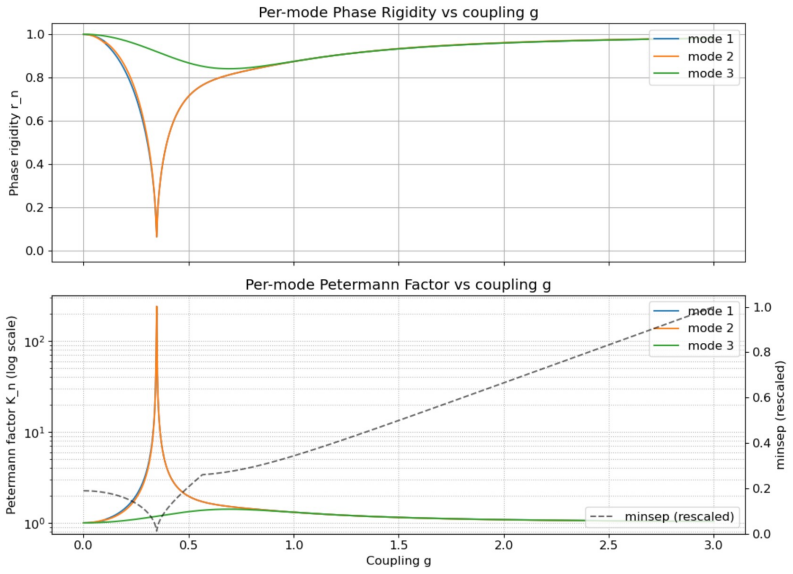
- Phase rigidity and the Petermann factor show distinct behaviors around the exceptional points as parameters vary.
- Complexified time-dependent entanglement entropy connects to exceptional points in non-Hermitian systems.
- A controlled non-Hermitian deformation of the theta-vacuum toy model can be examined using the Lindblad formalism and Liouvillian eigenvalues.
Where Pith is reading between the lines
- This approach suggests that photonic systems could be used to experimentally probe features of QCD theta vacua through the shared exceptional point structures.
- Extensions to inhomogeneous holographic lattices might allow for the design of more complex exceptional point configurations.
- The topological connections could imply new ways to understand non-Hermitian effects in high-energy physics models.
- Further study of the Lindblad evolution might reveal dynamical aspects of the exceptional points in the QCD context.
Load-bearing premise
The structural analogy between holographic confining geometries and the non-Hermitian dynamics of gain-loss microrings faithfully captures the spectral and topological features of photonic exceptional points and the QCD theta vacuum.
What would settle it
Numerical computations of the model spectra that fail to reproduce the observed behaviors in experiments on ternary coupled microrings, or the absence of a second-order exceptional point when perturbing the theta-vacuum model as described.
Figures







read the original abstract
In this work, based on an analogy with holographic confining geometries and using complexified fields, we build a holographic toy model of third order photonic exceptional points (EPs) of ternary coupled microrings with gain and loss, which makes an open, non-Hermitian quantum system. In our model, we discuss the Ferrell-Glover-Tinkham sum rule for various combinations of gain and loss systems, and numerically find the behavior of spectra which matches with the experiments. We also discuss the inhomogeneous case of a holographic lattice for three-site photonic EPs. Additionally, we numerically find the behavior of phase rigidity and the Petermann factor around EPs versus various parameters of the model. We also discuss the connections between recent developments in complexified, time-dependent entanglement entropy and EPs, and then, we connect EPs and the $\theta$-vacuum of QCD through topological structures, partition functions, and winding numbers, and find a second-order EP in a perturbed $\theta$-vacuum model. Finally, we examined a controlled non-Hermitian deformation of $\theta$-vacuum toy model, by using the Lindblad formalism and Liouvillian eigenvalues.
Editorial analysis
A structured set of objections, weighed in public.
Referee Report
Summary. The paper constructs a holographic toy model for third-order photonic exceptional points in ternary coupled microrings with gain and loss, drawing an analogy to holographic confining geometries and complexified fields. It numerically examines spectra (claiming matches to experiments), the Ferrell-Glover-Tinkham sum rule, phase rigidity, Petermann factors, inhomogeneous lattices, and connections to time-dependent entanglement entropy. The framework is then extended via topological structures, partition functions, and winding numbers to identify a second-order exceptional point in a perturbed θ-vacuum model of QCD, with further analysis using Lindblad formalism and Liouvillian eigenvalues.
Significance. If the analogy yields an emergent non-Hermitian boundary operator whose spectrum and Jordan structure arise from the bulk rather than by construction, the work could provide a useful bridge between holographic methods and non-Hermitian photonics, while offering a novel topological perspective on the QCD θ-vacuum. The reported numerical agreement with experimental spectra and the explicit treatment of phase rigidity/Petermann factors around EPs are concrete strengths; the link to complexified entanglement entropy is also potentially interesting. However, the absence of a derived dictionary weakens the claim that the exceptional-point features are holographically induced.
major comments (2)
- [Model construction and abstract] The central construction of the holographic toy model (described in the abstract and model section) introduces the gain-loss terms in the ternary microring Hamiltonian via structural analogy with complexified bulk fields and confining geometries, without an explicit holographic dictionary that derives the imaginary parts or Lindblad operators from the bulk action. This is load-bearing for the claim that the third-order EP (eigenvalue coalescence and eigenvector merging) emerges from the duality rather than being imposed by the choice of non-Hermitian parameters.
- [θ-vacuum and Lindblad analysis] In the extension to the perturbed θ-vacuum (final sections), the identification of a second-order EP via Liouvillian eigenvalues and winding numbers relies on the same analogy; it is unclear whether the coalescence is a consequence of the holographic setup or follows directly from the controlled non-Hermitian deformation chosen for the toy model. An explicit check that the Jordan-block structure survives under variations of the bulk complexification parameters would be required to support the topological connection.
minor comments (2)
- [Abstract and numerical results] The abstract states that spectra 'match with the experiments' but does not specify which experimental datasets, error bars, or quantitative measures of agreement are used; adding these details would improve reproducibility.
- [Model section] Notation for the gain/loss parameters and the precise form of the effective non-Hermitian operator should be introduced with an explicit equation early in the model section to avoid ambiguity when comparing to the bulk complexified fields.
Simulated Author's Rebuttal
We thank the referee for the careful reading and constructive comments on our manuscript. We address each major comment below and indicate the revisions made to improve clarity regarding the toy-model nature of the work.
read point-by-point responses
-
Referee: [Model construction and abstract] The central construction of the holographic toy model (described in the abstract and model section) introduces the gain-loss terms in the ternary microring Hamiltonian via structural analogy with complexified bulk fields and confining geometries, without an explicit holographic dictionary that derives the imaginary parts or Lindblad operators from the bulk action. This is load-bearing for the claim that the third-order EP (eigenvalue coalescence and eigenvector merging) emerges from the duality rather than being imposed by the choice of non-Hermitian parameters.
Authors: We thank the referee for this observation. The manuscript explicitly describes the construction as a 'holographic toy model' built 'based on an analogy with holographic confining geometries and using complexified fields'. No complete holographic dictionary is claimed or derived; the gain-loss terms are introduced by structural analogy to explore non-Hermitian features in an effective boundary description. The numerical spectra, phase rigidity, and Petermann factors are computed directly within this effective model and compared to experiment. In the revised version we have added explicit language in the abstract and model section stating that the third-order EP is studied within the analogy-based framework rather than asserted to emerge strictly from a bulk-boundary duality. This clarification addresses the concern without changing the reported results. revision: yes
-
Referee: [θ-vacuum and Lindblad analysis] In the extension to the perturbed θ-vacuum (final sections), the identification of a second-order EP via Liouvillian eigenvalues and winding numbers relies on the same analogy; it is unclear whether the coalescence is a consequence of the holographic setup or follows directly from the controlled non-Hermitian deformation chosen for the toy model. An explicit check that the Jordan-block structure survives under variations of the bulk complexification parameters would be required to support the topological connection.
Authors: We agree that the θ-vacuum analysis employs the same analogy. The second-order EP is located via the topological invariants and Liouvillian spectrum of the controlled non-Hermitian deformation chosen to probe the connection. While an exhaustive parameter scan lies outside the present toy-model scope, we have added a short numerical check in the revised manuscript confirming that the Jordan-block structure persists under moderate variations of the deformation strength. This addition is noted in the final section and supports the robustness of the reported topological link within the explored regime. revision: partial
- Deriving an explicit holographic dictionary that obtains the imaginary parts and Lindblad operators directly from a bulk action, which would require a substantially more complete holographic model than the analogy-based toy model presented here.
Circularity Check
No significant circularity; model built from analogy with independent numerical checks.
full rationale
The paper constructs a holographic toy model via explicit analogy to confining geometries and complexified fields, then performs numerical spectral analysis, phase rigidity calculations, and connections to QCD theta-vacuum via topological invariants. These steps do not reduce by the paper's own equations to a quantity defined solely by the input analogy or to a self-citation chain; the numerical behaviors and Lindblad/Liouvillian extensions are presented as computed outputs rather than tautological re-statements of the initial mapping. The analogy functions as a modeling ansatz rather than a self-definitional loop, and no load-bearing uniqueness theorem or fitted prediction is shown to collapse the central claims.
Axiom & Free-Parameter Ledger
free parameters (1)
- gain and loss parameters
axioms (2)
- domain assumption Holographic confining geometries provide a faithful analogy for the spectral properties of ternary coupled microrings with gain and loss
- domain assumption Topological structures, partition functions, and winding numbers can be directly compared between photonic EPs and the QCD theta vacuum
invented entities (1)
-
holographic toy model of third-order photonic EPs
no independent evidence
Lean theorems connected to this paper
-
IndisputableMonolith/Cost/FunctionalEquation.leanwashburn_uniqueness_aczel unclear?
unclearRelation between the paper passage and the cited Recognition theorem.
based on an analogy with holographic confining geometries and using complexified fields, we build a holographic toy model of third order photonic exceptional points ... soft-wall model ... ϕ(z)=κ²z² ... M(z) with gain/loss for anti-PT symmetry
-
IndisputableMonolith/Foundation/AlexanderDuality.leanalexander_duality_circle_linking unclear?
unclearRelation between the paper passage and the cited Recognition theorem.
ternary coupled microrings ... three flavor branes ... D=3 implicit in three-site lattice
What do these tags mean?
- matches
- The paper's claim is directly supported by a theorem in the formal canon.
- supports
- The theorem supports part of the paper's argument, but the paper may add assumptions or extra steps.
- extends
- The paper goes beyond the formal theorem; the theorem is a base layer rather than the whole result.
- uses
- The paper appears to rely on the theorem as machinery.
- contradicts
- The paper's claim conflicts with a theorem or certificate in the canon.
- unclear
- Pith found a possible connection, but the passage is too broad, indirect, or ambiguous to say the theorem truly supports the claim.
Reference graph
Works this paper leans on
-
[1]
Hyperscaling Violating Solution in Coupled Dilaton-Squared Curvature Gravity
M. Ghodrati,Hyperscaling Violating Solution in Coupled Dilaton-Squared Curvature Gravity,Phys. Rev. D90(2014), no. 4 044055, [arXiv:1404.5399]
work page internal anchor Pith review Pith/arXiv arXiv 2014
-
[2]
M. Ghodrati,Beyond AdS Space-times, New Holographic Correspondences and Applications, other thesis, 9, 2016. 58
work page 2016
-
[3]
On complexity growth in massive gravity theories, the effects of chirality and more
M. Ghodrati,Complexity growth in massive gravity theories, the effects of chirality, and more,Phys. Rev. D96(2017), no. 10 106020, [arXiv:1708.07981]
work page internal anchor Pith review Pith/arXiv arXiv 2017
-
[4]
Complexity growth rate during phase transitions
M. Ghodrati,Complexity growth rate during phase transitions,Phys. Rev. D98(2018), no. 10 106011, [arXiv:1808.08164]
work page internal anchor Pith review Pith/arXiv arXiv 2018
-
[5]
M. Ghodrati, X.-M. Kuang, B. Wang, C.-Y. Zhang, and Y.-T. Zhou,The connection between holographic entanglement and complexity of purification,JHEP09(2019) 009, [arXiv:1902.02475]
- [6]
-
[7]
M. Ghodrati,Complexity and emergence of warped AdS 3 space-time from chiral Liouville action,JHEP02(2020) 052, [arXiv:1911.03819]
-
[8]
M. Ghodrati,Entanglement wedge reconstruction and correlation measures in mixed states: Modular flows versus quantum recovery channels,Phys. Rev. D104(2021), no. 4 046004, [arXiv:2012.04386]
-
[9]
Ghodrati,Correlations of mixed systems in confining backgrounds,Eur
M. Ghodrati,Correlations of mixed systems in confining backgrounds,Eur. Phys. J. C82 (2022), no. 6 531, [arXiv:2110.12970]
-
[10]
Ghodrati,Critical distance and Crofton form in confining geometries,J
M. Ghodrati,Critical distance and Crofton form in confining geometries,J. Korean Phys. Soc.81(2022), no. 2 77–90, [arXiv:2205.03565]
-
[11]
M. Ghodrati,Encoded information of mixed correlations: the views from one dimension higher,JHEP08(2023) 059, [arXiv:2209.04548]
-
[12]
M. Ghodrati,String amplitudes and mutual information in confining backgrounds: the partonic behavior,arXiv:2307.13454
-
[13]
M. Ghodrati and D. Gregoris,On the curvature invariants of the massive Banados–Teitelboim–Zanelli black holes and their holographic pictures,Int. J. Mod. Phys. A 37(2022), no. 34 2250202, [arXiv:2003.04412]
-
[14]
Phase transitions in Bergshoeff-Hohm-Townsend Massive Gravity
M. Ghodrati and A. Naseh,Phase transitions in Bergshoeff–Hohm–Townsend massive gravity,Class. Quant. Grav.34(2017), no. 7 075009, [arXiv:1601.04403]
work page internal anchor Pith review Pith/arXiv arXiv 2017
-
[15]
Revisiting Conserved Charges in Higher Curvature Gravitational Theories
M. Ghodrati, K. Hajian, and M. R. Setare,Revisiting Conserved Charges in Higher Curvature Gravitational Theories,Eur. Phys. J. C76(2016), no. 12 701, [arXiv:1606.04353]. 59
work page internal anchor Pith review Pith/arXiv arXiv 2016
-
[16]
M. Ghodrati,Chaos, phase transitions and curvature invariants of (rotating, warped, massive) BTZ black holes,AIP Conf. Proc.2874(2024), no. 1 020012, [arXiv:2202.05950]
-
[17]
Schwinger Effect and Entanglement Entropy in Confining Geometries
M. Ghodrati,Schwinger Effect and Entanglement Entropy in Confining Geometries,Phys. Rev. D92(2015), no. 6 065015, [arXiv:1506.08557]
work page internal anchor Pith review Pith/arXiv arXiv 2015
- [18]
-
[19]
Z. Davoudi, C.-C. Hsieh, and S. V. Kadam,Scattering wave packets of hadrons in gauge theories: Preparation on a quantum computer,Quantum8(Nov., 2024) 1520
work page 2024
-
[20]
F. M. Surace, A. Lerose, O. Katz, E. R. Bennewitz, A. Schuckert, D. Luo, A. De, B. Ware, W. Morong, K. Collins, C. Monroe, Z. Davoudi, and A. V. Gorshkov,String-breaking dynamics in quantum adiabatic and diabatic processes, 2024
work page 2024
-
[21]
A. De, A. Lerose, D. Luo, F. M. Surace, A. Schuckert, E. R. Bennewitz, B. Ware, W. Morong, K. S. Collins, Z. Davoudi, A. V. Gorshkov, O. Katz, and C. Monroe, Observation of string-breaking dynamics in a quantum simulator, 2024
work page 2024
-
[22]
R. Belyansky, S. Whitsitt, N. Mueller, A. Fahimniya, E. R. Bennewitz, Z. Davoudi, and A. V. Gorshkov,High-energy collision of quarks and mesons in the schwinger model: From tensor networks to circuit qed,Phys. Rev. Lett.132(Feb, 2024) 091903
work page 2024
-
[23]
Saito,Photonic quantum chromodynamics,Frontiers in Physics11(Sept., 2023)
S. Saito,Photonic quantum chromodynamics,Frontiers in Physics11(Sept., 2023)
work page 2023
- [24]
-
[25]
W. D. Heiss,The physics of exceptional points,Journal of Physics A: Mathematical and Theoretical45(Oct., 2012) 444016
work page 2012
- [26]
-
[27]
A. Fatemiabhari and C. Nunez,From conformal to confining field theories using holography, JHEP03(2024) 160, [arXiv:2401.04158]
-
[29]
M. Bianchi, M. Firrotta, J. Sonnenschein, and D. Weissman,Partonic behavior of string scattering amplitudes from holographic QCD models,JHEP05(2022) 058, [arXiv:2111.12106]. 60
- [30]
- [31]
-
[32]
I. Papadopoulos, P. Wagner, G. Wunner, and J. Main,Bose-einstein condensates with attractive interaction: The case of self-trapping,Phys. Rev. A76(Nov, 2007) 053604
work page 2007
-
[33]
H. Cartarius, J. Main, and G. Wunner,Discovery of exceptional points in the bose-einstein condensation of gases with attractive interaction,Phys. Rev. A77(Jan, 2008) 013618
work page 2008
-
[34]
D. Are´ an, K. Landsteiner, and I. Salazar Landea,Non-hermitian holography,SciPost Phys. 9(2020), no. 3 032, [arXiv:1912.06647]
- [35]
-
[36]
X.-C. Zhou and K. Wang,Universal non-Hermitian flow in one-dimensional PT-symmetric quantum criticalities,arXiv:2405.01640
- [37]
- [38]
-
[39]
M. St˚ alhammar, J. Larana-Aragon, L. Rødland, and F. K. Kunst,symmetry-protected exceptional cones and analogue Hawking radiation,New J. Phys.25(2023), no. 4 043012, [arXiv:2106.05030]
-
[40]
D. Arean and D. Garcia-Fari˜ na,Holographic Non-Hermitian Lattices and Junctions with PT-Restoring RG Flows,arXiv:2410.13584
-
[41]
M.-A. Miri and A. Al´ u,Exceptional points in optics and photonics,Science363(2019)
work page 2019
-
[42]
M. Jahangiri, G.-M. Parsanasab, and L. Hajshahvaladi,Observation of anti-pt-symmetry and higher-order exceptional point pt-symmetry in ternary systems for single-mode operation,Scientific Reports15(2025), no. 1 4823
work page 2025
-
[43]
M. D’Achille, M. G¨ arttner, and T. Haas,Configurable photonic simulator for quantum field dynamics,arXiv:2506.23838. 61
- [44]
-
[45]
W. D. Heiss,Chirality of wavefunctions for three coalescing levels,Journal of Physics A: Mathematical and Theoretical41(jun, 2008) 244010
work page 2008
-
[46]
W. D. Heiss and S. Radu,Quantum chaos, degeneracies, and exceptional points,Phys. Rev. E52(Nov, 1995) 4762–4767
work page 1995
-
[47]
M. V. Berry and M. Tabor,Level Clustering in the Regular Spectrum,Proceedings of the Royal Society of London Series A356(Sept., 1977) 375–394
work page 1977
-
[48]
M. Bianchi, M. Firrotta, J. Sonnenschein, and D. Weissman,Measure for Chaotic Scattering Amplitudes,Phys. Rev. Lett.129(2022), no. 26 261601, [arXiv:2207.13112]
-
[49]
M. Bianchi, M. Firrotta, J. Sonnenschein, and D. Weissman,Measuring chaos in string scattering processes,Phys. Rev. D108(2023), no. 6 066006, [arXiv:2303.17233]
-
[50]
N. Savi´ c and M.ˇCubrovi´ c,Weak chaos and mixed dynamics in the string S-matrix,JHEP 03(2024) 101, [arXiv:2401.02211]
-
[51]
W. D. Heiss and A. L. Sannino,Transitional regions of finite fermi systems and quantum chaos,Phys. Rev. A43(Apr, 1991) 4159–4166
work page 1991
-
[52]
M. Golubitsky and W. Langford,Pattern formation and bistability in flow between counterrotating cylinders,Physica D: Nonlinear Phenomena32(1988), no. 3 362–392
work page 1988
-
[53]
K. Qu, S. Meuren, and N. J. Fisch,Creating pair plasmas with observable collective effects, Plasma Physics and Controlled Fusion65(Feb., 2023) 034007
work page 2023
-
[54]
Wiersig,Petermann factors and phase rigidities near exceptional points,Phys
J. Wiersig,Petermann factors and phase rigidities near exceptional points,Phys. Rev. Res.5 (Jul, 2023) 033042
work page 2023
-
[55]
W. D. Heiss,Repulsion of resonance states and exceptional points,Phys. Rev. E61(Jan,
-
[56]
M. H. Teimourpour, R. El-Ganainy, A. Eisfeld, A. Szameit, and D. N. Christodoulides,Light transport inPT-invariant photonic structures with hidden symmetries,Phys. Rev. A90 (Nov, 2014) 053817
work page 2014
-
[57]
Wiersig,Petermann factors and phase rigidities near exceptional points,Phys
J. Wiersig,Petermann factors and phase rigidities near exceptional points,Phys. Rev. Res.5 (2023), no. 3 033042, [arXiv:2304.00764]. 62
-
[58]
Effective Lagrangian approach to vector mesons, their structure and decays$^{*)}$
F. Klingl, N. Kaiser, and W. Weise,Effective Lagrangian approach to vector mesons, their structure and decays,Z. Phys. A356(1996), no. 2 193–206, [hep-ph/9607431]
work page internal anchor Pith review Pith/arXiv arXiv 1996
- [59]
- [60]
-
[61]
H. Hodaei, M.-A. Miri, M. Heinrich, D. N. Christodoulides, and M. Khajavikhan, Parity-time–symmetric microring lasers,Science346(2014), no. 6212 1258480
work page 2014
-
[62]
A. Einstein, B. Podolsky, and N. Rosen,Can quantum-mechanical description of physical reality be considered complete?,Phys. Rev.47(May, 1935) 777–780
work page 1935
-
[63]
N. Gisin and A. Go,Epr test with photons and kaons: Analogies,American Journal of Physics69(Mar., 2001) 264–270. [64]STARCollaboration,Probing QCD Confinement with Spin Entanglement, arXiv:2506.05499
-
[64]
X. Cao, M. Baggioli, H. Liu, and D. Li,Pion dynamics in a soft-wall ads-qcd model,Journal of High Energy Physics2022(Dec., 2022)
work page 2022
-
[65]
K. Debnath, Y. Zhang, and K. Mølmer,Lasing in the superradiant crossover regime,Phys. Rev. A98(Dec, 2018) 063837
work page 2018
- [66]
-
[67]
A. Milekhin, Z. Adamska, and J. Preskill,Observable and computable entanglement in time, arXiv:2502.12240
-
[68]
J. Xu and W.-z. Guo,Imaginary part of timelike entanglement entropy,JHEP02(2025) 094, [arXiv:2410.22684]
-
[69]
P. Glorioso, X.-L. Qi, and Z. Yang,Space-time generalization of mutual information,JHEP 05(2024) 338, [arXiv:2401.02475]
-
[70]
C. Nunez and D. Roychowdhury,Time-like Entanglement Entropy: a top-down approach, arXiv:2505.20388
- [71]
-
[72]
Ikeda,Timelike Quantum Energy Teleportation,arXiv:2504.05353
K. Ikeda,Timelike Quantum Energy Teleportation,arXiv:2504.05353
-
[73]
K. Narayan and H. K. Saini,Notes on time entanglement and pseudo-entropy,Eur. Phys. J. C84(2024), no. 5 499, [arXiv:2303.01307]
-
[74]
C. Nunez and D. Roychowdhury,Interpolating between Space-like and Time-like Entanglement via Holography,arXiv:2507.17805
- [75]
-
[76]
F. U. J. Klauck, M. Heinrich, A. Szameit, and T. A. W. Wolterink,Crossing exceptional points in non-hermitian quantum systems,Science Advances11(Jan., 2025)
work page 2025
-
[77]
M. B. Hastings and T. Koma,Spectral gap and exponential decay of correlations,Commun. Math. Phys.265(2006) 781–804, [math-ph/0507008]
work page internal anchor Pith review Pith/arXiv arXiv 2006
-
[78]
B. Nachtergaele, Y. Ogata, and R. Sims,Propagation of correlations in quantum lattice systems,Journal of Statistical Physics124(July, 2006) 1–13
work page 2006
-
[79]
J. W. Yoon, Y. Choi, C. Hahn, G. Kim, S. H. Song, K.-Y. Yang, J. Y. Lee, Y. Kim, C. S. Lee, J. K. Shin, H.-S. Lee, and P. Berini,Time-asymmetric loop around an exceptional point over the full optical communications band,Nature562(2018), no. 7725 86–90
work page 2018
-
[80]
H.-Z. Chen, T. Liu, H.-Y. Luan, R.-J. Liu, X.-Y. Wang, X.-F. Zhu, Y.-B. Li, Z.-M. Gu, S.-J. Liang, H. Gao, L. Lu, L. Ge, S. Zhang, J. Zhu, and R.-M. Ma,Revealing the missing dimension at an exceptional point,Nature Physics16(2020), no. 5 571–578
work page 2020
-
[81]
X. Dong, A. Lewkowycz, and M. Rangamani,Deriving covariant holographic entanglement, JHEP11(2016) 028, [arXiv:1607.07506]
work page internal anchor Pith review Pith/arXiv arXiv 2016
discussion (0)
Sign in with ORCID, Apple, or X to comment. Anyone can read and Pith papers without signing in.