REVIEW 5 major objections 5 minor 22 references
A meta-bandit model reproduces individual bees' decisions, with an optimal memory window around seven trials.
Reviewed by Pith at T0; open to challenge. T0 means a machine referee read the full paper against a public rubric. the ladder, T0–T4 →
MAYA reproduces individual bee left/right choices by matching regret trajectories to four bandit policies with a memory window fixed at tau=7, but the tau value and best metric are selected on the same data used for evaluation.
T0 review reviewed 2026-08-04 challenge →
load-bearing objection MAYA is a plausible descriptive model, but the memory and forecasting claims are not supported by the experiments; the paper needs a proper out-of-sample evaluation before those claims can stand. the 5 major comments →
Buzz, Choose, Forget: A Meta-Bandit Framework for Bee-Like Decision Making
The pith
A machine-rendered reading of the paper's core claim, the machinery that carries it, and where it could break.
The reading
Core claim
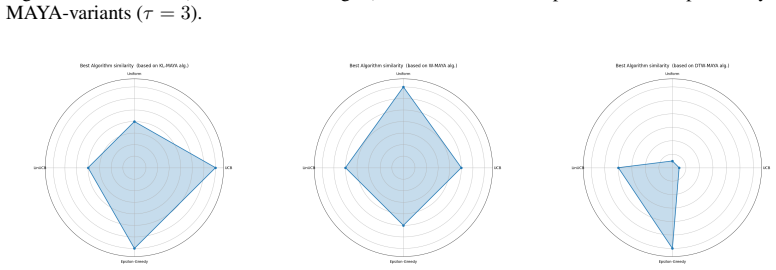
MAYA works by comparing the bee's cumulative regret trajectory, computed within a sliding window of size tau, to the regret trajectories of candidate bandit policies, and at each trial switching to the policy whose windowed regret is most similar under a chosen distance (Wasserstein, KL, or DTW). Across five bee datasets and a complementary mouse dataset, the paper finds that tau around 7 trials minimizes imitation error, and that MAYA with the Wasserstein distance consistently achieves the best performance. It also reports that alignment rates with LinUCB explain the choices of low-regret (fast-learning) bees, while epsilon-greedy alignment dominates for high-regret (slow-learning) bees. Th
What carries the argument
The central mechanism is windowed regret-trajectory matching. A sliding window tau truncates each policy's history, and a similarity metric — 1-Wasserstein distance, KL divergence, or dynamic time warping — compares the bee's cumulative regret sequence to those of four candidate bandit policies. MAYA chooses the candidate with the smallest distance, then mimics its action, enabling online adaptation to policy shifts and providing per-trial explanations in terms of which bandit the bee's behavior currently resembles.
Load-bearing premise
The model assumes that a bee's next choice depends only on the current stimulus context and the last tau outcomes, and that this behavior is expressible as a mixture of the four specific bandit policies.
What would settle it
Fit MAYA to data from a Y-maze experiment where the reward pattern is systematically linked to a side bias (e.g., left wins but is rewarded only after a delay) or where the correct side depends on a stimulus shown more than tau trials earlier; if MAYA with tau=7 fails to predict choices and a larger window improves accuracy, the seven-trial memory claim is falsified.
If this is right
- If tau around 7 is biologically real, it gives a concrete, testable bound on the memory horizon of bees in visual quantity-discrimination tasks, equivalent to roughly 15–30 minutes of the protocol.
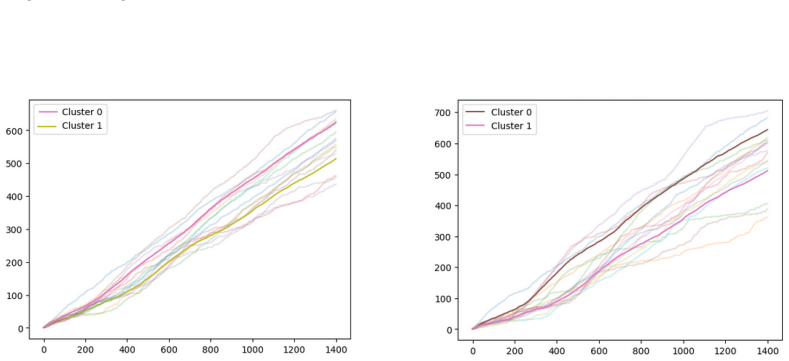
- MAYA's mixture-of-bandits representation can generate synthetic bee trajectories that cluster with real ones, supporting ecological simulations of pollinator behavior under different weather or resource scenarios.
- Alignment rates provide a quantitative phenotype for individual bees, potentially allowing researchers to classify fast versus slow learners without hand-crafted metrics.
- The transfer to mouse data suggests the method could be applied to other species' decision-making tasks where behavior is heterogeneous and non-optimal.
Where Pith is reading between the lines
- The tau ~7 value may be partly an artifact of the four-policy library: if the true decision process involves strategies outside the library (e.g., side-alternation or inter-trial timing), the fitted window could simply be the one that best mimics the library's limitations rather than a direct measure of memory.
- A testable extension would manipulate the inter-trial interval or insert distractor trials; if tau remains constant, it suggests a trial-count-based memory, while a shift would indicate time-based forgetting.
- The weather-dependent shift in optimal tau might reflect lower attention or motivation, but it could also stem from changes in the bees' visiting rhythm, which the current model does not explicitly represent.
Editorial analysis
A structured set of objections, weighed in public.
Referee Report
Summary. The paper introduces MAYA, a meta-bandit imitation algorithm for modeling individual bee decisions in a two-alternative Y-maze. MAYA compares the bee's cumulative regret trajectory against four candidate bandit policies (Epsilon-Greedy, UCB, LinUCB, Uniform), selects the closest policy at each trial under a windowed distance (KL, Wasserstein, or DTW), and reports MSE/MAE of the reproduced actions. The paper claims that MAYA can predict individual bee choices, that the optimal memory window is approximately τ=7 with a mild weather dependence, that MAYA outperforms established imitation-learning and statistical baselines on five bee datasets and a mice dataset, and it presents worst-case regret bounds in Appendix 14.
Significance. If the claims were supported, MAYA would be a valuable interpretable tool for behavioral ecology, and the open dataset of 80 tracked bees across five weather/location conditions is a genuine asset. The in-sample imitation comparisons are internally consistent, and the mice extension is a useful robustness probe. However, the paper's headline contributions — forecasting individual decisions and identifying a biologically meaningful memory horizon near seven trials — are not established by the current experimental protocol. The evaluation is in-sample, τ is a fitted hyperparameter, and the mathematical appendix rests on unproved assumptions.
major comments (5)
- [§4.1, Algorithm 1, Tables 4–8] There is no train/validation split. In Algorithm 1, at trial t the method observes R(π_bee,1,t−1), selects ξ_t by minimizing the regret distance, and only then samples an action at t. The MSE/MAE curves in Figure 2 and Tables 4–8 therefore measure one-step in-sample imitation on the same trajectories used to select τ and the distance metric. The abstract's claim to 'predict individual bees' decisions' and the headline 'optimal τ around 7' are not supported; τ=7 is the best-fitting window on the training data, not a validated forecasting horizon. A held-out suffix or a forward-simulation protocol with τ fixed on a training set is required.
- [§2, Algorithm 1, §5] The paper presents τ as 'the memory of the animal' that 'truncates the observation history,' but the candidate policies (UCB, LinUCB, Epsilon-Greedy) maintain full-history estimates of Q_t(a), N_t(a), or Θ̂. τ only truncates the interval used to compute the regret-matching distance; it does not truncate the fitted policy's memory. Therefore the biological reading of τ≈7 as a bee's memory span (abstract, §5) is not justified by the mechanism; at most τ is the length of recent regret history used for policy selection.
- [Appendix 14, Eqs. (1), (10), (12)] The theoretical bounds rely on the unproved assertion P[ε_t = ε*_t] = 0.5 in the stationary worst case and on the claim that distances are 'well defined' in cyclic regimes. Neither statement is derived; the 0.5 probability in particular appears to be an assumption about tie-breaking that is not established. Moreover the bounds concern regret gaps under an idealized switching process and do not imply forecast accuracy or validate the τ≈7 recommendation. Eq. (12) also appears to contain an algebraic typo ('−2ST' should likely be '−2S').
- [§4.2, Table 1] AIRL is reported with MSE=0±0 and MAE=0±0 on every dataset. The authors interpret this as 'full copy-paste' with no generalization, but reporting a memorizing baseline with zero error in a table headlined as a comparative performance evaluation is misleading, especially without a held-out test set. Either remove AIRL from the comparison or report its out-of-sample generalization error; as presented, the zero-error entries obscure the comparison.
- [§12] The mice experiment is described as containing '19 rats' and then 'we reduce the number of individual at 100.' This is internally inconsistent and suggests a data-processing error or a missing explanation. Also, the abstract mentions experiments on 'simulated' datasets, but no externally generated simulated benchmark is described; the simulated trajectories in §4.4 are MAYA's own outputs used for clustering, not a ground-truth simulated dataset.
minor comments (5)
- [Algorithm 1, §2] The notation R(π, τ, 1, t−1) is inconsistent with the definition R(π, τ, 1, T) = Σ_{t=τ}^T Δ_{π,t}. In the windowed phase the algorithm intends the sliding-window sum over [t−τ, t−1], not a sum starting at index τ. Please redefine the notation.
- [§4.1] The statement that 'the optimal window length decreases under adverse weather conditions' is imprecise: the reported ranges are cold τ∈[5,7], moderate τ∈[6,8], hot τ∈[7,10]. Please clarify what 'adverse' means and whether the trend is supported by significance testing or only by point estimates.
- [§12] The section is titled 'Mice Dataset' but describes rats from Ashwood et al. (2020). Please correct the terminology throughout.
- [Throughout] The algorithm name is typeset inconsistently as 'MAYA', 'MAY A', and 'MAY A-Wass'. Please standardize.
- [§8] The GLM baseline description says it models the regret trajectory R(π,1,T) as a function of time, but the evaluation in Table 1 compares MSE/MAE of reproduced actions. Clarify whether the GLM is fit to actions or to regret, and how its predictions are converted to actions.
Circularity Check
The reported τ≈7 memory horizon and action-level accuracy are in-sample fits: τ is selected by minimizing the same MSE/MAE used for headline performance, and Algorithm 1 evaluates one-step imitation on logged regret, so the 'prediction' and 'memory' claims reduce to the fitting protocol.
specific steps
-
fitted input called prediction
[Section 4.1 'Best window size and distance metrics']
"Across all datasets, the results confirm the trend that for τ∈[5,10] the losses decrease. ... According to this observation, we suggest fixing τ=7 to handle multiple weather conditions. Then, we fix τ=7 for the rest of the paper. With this window, MAY A–Wass provides the best results across all datasets."
The abstract's claim that 'the optimal value [of τ] is around 7 trials' is obtained by minimizing the same MSE/MAE loss on the same logged bee trajectories later used to report performance. There is no held-out split, no forward-simulation checkpoint, and no independent behavioral measure of memory. The 'optimal τ' is the argmin of the reported in-sample loss, so the headline memory horizon is a fitted hyperparameter restated as a finding, not an independently predicted property.
-
fitted input called prediction
[Algorithm 1, App. 11, and Section 4 'Experimental Evaluation']
"for t∈ {2, . . . , τ−1} do ... Observe R(π bee,1, t−1) ... ξ t = argmin π∈P δ(πbee, π, t) ... Select A t ∼π θ(at|st−1)"
At every trial the algorithm reads the bee's regret up to t−1, selects the candidate policy whose regret trajectory is closest to the bee's on that logged prefix, and then samples the action used in the MSE/MAE evaluation. The evaluation compares this sampled action with the bee's action at the same trial on the same dataset, with no train/test suffix and no future simulation. The reported 'prediction' of individual bees' decisions is therefore a one-step in-sample imitation score, not an out-of-sample forecast.
-
self definitional
[Section 2 'Preliminaries' and Section 5 'Discussion']
"we define here the memory of the animal by a parameter, τ, that truncates the observation history to the τ most recent observations. This parameter needs to be optimized in the imitation learning. ... a memory window of (τ=7) consistently yielded the best fit; this choice is corroborated by complementary experiments and corresponds roughly to 15–30 minutes in our protocol"
The paper defines 'memory' as the window τ, optimizes τ against the behavioral data, and then presents the optimized value as a biologically meaningful result ('bees' limited memory'). In Algorithm 1, τ does not truncate the candidate policies' internal memory: UCB, LinUCB, and Epsilon-Greedy keep full-history reward counts and estimates, while τ only truncates the regret interval used for policy selection. The biological 'memory horizon' is thus the fitted alignment window by definition, not an independently measured cognitive limit.
full rationale
The derivation chain is not externally circular via self-citation: the self-citation to Besse et al. (2015) is only a literature pointer, and no uniqueness theorem is imported from the authors' prior work. The central circularity is internal and methodological. The paper's two headline outcomes—'τ≈7 trials' and 'MAYA predicts individual bees' decisions'—are both generated by the same fitting loop. Section 4.1 chooses τ by minimizing MSE/MAE on the five datasets, then reports that value as the optimal memory window and fixes it for all subsequent comparisons; the same data then appear in Tables 1 and 2 as evidence of predictive quality. Algorithm 1 confirms the in-sample nature of the fit: each trial uses the bee's logged regret up to t−1 to select the closest policy from a four-policy library, and the reported error is computed by comparing the next sampled action with the bee's actual action on that same logged trial. There is no held-out suffix, no temporal forecast, and no simulation forward in time, so the abstract's 'predict individual bees' decisions' claim is not tested. Finally, the interpretation of τ as a memory parameter is self-definitional: the paper defines animal memory as τ, fits τ, and then reports the fitted value as a discovered biological constraint, even though the candidate policies themselves retain full-history estimates. These issues make the central memory claim and the action-prediction claim partially circular, warranting a score of 6 rather than a higher score, because the model and comparisons to baselines still contain substantial independent algorithmic content.
Axiom & Free-Parameter Ledger
free parameters (3)
- memory window tau =
7 (per-dataset best in [3,30])
- similarity metric =
Wasserstein
- MAB hyperparameters =
not reported (epsilon for epsilon-greedy, lambda/ridge for LinUCB)
axioms (6)
- domain assumption Reward at trial t does not depend on state s_{t-1}; the task is a 2-armed bandit, not a general MDP
- domain assumption Bee learning strategies are covered by Epsilon-Greedy, UCB, LinUCB, and Uniform bandits
- domain assumption Regret-trajectory distance is a valid proxy for behavioral similarity
- standard math Ross et al. bound applies: if the learned policy is epsilon-close to the expert, expected cost is at most epsilon*T
- ad hoc to paper In the stationary worst case, P[epsilon_t = epsilon*_t] = 0.5 because no best agent is better than the other
- ad hoc to paper In cyclic cases, the distance is 'well defined' in the sense that MAYA selects the closest agent except during explicitly modeled lag phases
Cite this review
Pith. "Pith review of Buzz, Choose, Forget: A Meta-Bandit Framework for Bee-Like Decision Making." pith.science (2026). https://pith.science/paper/XNEL2A2N
@misc{pith2026251016462,
  author       = {Pith},
  title        = {Pith review of: Buzz, Choose, Forget: A Meta-Bandit Framework for Bee-Like Decision Making},
  year         = {2026},
  howpublished = {\url{https://pith.science/paper/XNEL2A2N}},
  note         = {Machine review of arXiv:2510.16462}
}
read the original abstract
This work introduces MAYA, a sequential imitation learning model based on multi-armed bandits, designed to reproduce and predict individual bees' decisions in contextualized foraging tasks. The model accounts for bees' limited memory through a temporal window $\tau$, whose optimal value is around 7 trials, with a slight dependence on weather conditions. Experimental results on real, simulated, and complementary (mice) datasets show that MAYA (particularly with the Wasserstein distance) outperforms imitation baselines and classical statistical models, while providing interpretability of individual learning strategies and enabling the inference of realistic trajectories for prospective ecological applications.
Figures






Reference graph
Works this paper leans on
-
[1]
Zoe C. Ashwood, Nicholas A. Roy, Ji Hyun Bak, The International Brain Laboratory, and Jonathan W. Pillow. Inferring learning rules from animal decision-making. InProceedings of the 34th International Conference on Neural Information Processing Systems, NIPS ’20, Red Hook, NY , USA, 2020a. Curran Associates Inc. ISBN 9781713829546. Zoe C. Ashwood, Nicholas...
-
[7]
Red range correspond to±σ(standard deviation)
predictions and real trajectories (R(πMAYA,1, t)−R(π mice1, t)) (z-axis) for Euclidean (I) Clustering according 0 and 1 Cluster. Red range correspond to±σ(standard deviation). 25 13 COMPLEMENTARY INFORMATION ABOUT THE BIOLOGY INTEREST We share with other vertebrates a basic ability for abstract number representation, thenumber senseDehaene (2011). As earl...
2011
-
[8]
Marco Fiandri, Alberto Maria Metelli, and Francesco Trov `o
URL https://arxiv.org/abs/2311.14115. Marco Fiandri, Alberto Maria Metelli, and Francesco Trov `o. Sliding-window thompson sampling for non-stationary settings.CoRR, abs/2409.05181,
-
[9]
Sliding-Window Thompson Sampling for Non-Stationary Settings
doi: 10.48550/ARXIV .2409.05181. URLhttps://doi.org/10.48550/arXiv.2409.05181. Dylan J. Foster, Adam Block, and Dipendra Misra. Is behavior cloning all you need? understanding horizon in imitation learning,
work page internal anchor Pith review Pith/arXiv arXiv doi:10.48550/arxiv.2409.05181
-
[10]
Justin Fu, Katie Luo, and Sergey Levine
URLhttps://arxiv.org/abs/2407.15007. Justin Fu, Katie Luo, and Sergey Levine. Learning robust rewards with adversarial inverse rein- forcement learning,
-
[15]
Scarlett R Howard, Aurore Avargu `es-Weber, Jair E Garcia, Andrew D Greentree, and Adrian G Dyer
Publisher: American Association for the Advancement of Science. Scarlett R Howard, Aurore Avargu `es-Weber, Jair E Garcia, Andrew D Greentree, and Adrian G Dyer. Symbolic representation of numerosity by honeybees (Apis mellifera): matching characters to small quantities.Proceedings of the Royal Society B, 286(1904):20190238,
1904
-
[17]
11 Peter McCullagh and John Ashworth Nelder.Generalized Linear Models
URLhttps://arxiv.org/abs/2406.01501. 11 Peter McCullagh and John Ashworth Nelder.Generalized Linear Models. Chapman and Hall/CRC, 2nd edition,
-
[23]
doi: 10.1109/SSCI47803.2020.9308468. 12 6 APPENDIX 6.1 DATASET DESCRIPTION In this dataset, bees are confronted to a numerical discrimination task. Bees first enter the maze in an entrance chamber before flying in a hole and facing two images located at the end of each arm. The image has different number of dots : for example in dataset 1 and 2, one of th...
arXiv 2020
-
[24]
This encourages the policy to imitate the demonstrations, and to simultaneously avoid states not seen in the demonstrations Reddy et al. (2020). • GLM : A Generalized Linear Model (GLM) is a statistical framework that extends linear regression to response variables with non-Gaussian distributions. In our setting, the regret trajectoryR(π,1, T)is modeled a...
2020
-
[1960]
Wenshuai Zhao, Jorge Pe ˜na Queralta, and Tomi Westerlund
doi: 10.1080/17470216008416717. Wenshuai Zhao, Jorge Pe ˜na Queralta, and Tomi Westerlund. Sim-to-real transfer in deep rein- forcement learning for robotics: a survey. In2020 IEEE Symposium Series on Computational Intelligence (SSCI), pp. 737–744,
-
[1972]
doi: 10.2307/2344614. Andreas Nieder. The neuronal code for number.Nature Reviews Neuroscience, 17(6):366–382,
-
[2002]
Philippe Besse, Brendan Guillouet, Jean-Michel Loubes, and Royer Franc ¸ois
doi: 10.1023/A:1013689704352. Philippe Besse, Brendan Guillouet, Jean-Michel Loubes, and Royer Franc ¸ois. Review and perspec- tive for distance based trajectory clustering,
-
[2006]
doi: 10.1111/j.1467-9280. 2006.01719.x. PMID: 16683927. Nuno Capela, Xiaodong Duan, El ˙zbieta M. Zi ´ołkowska, and Christopher John Topping. Mod- elling foraging strategies of honey bees as agents in a dynamic landscape representation.F ood and Ecological Systems Modelling Journal, 5:e99103,
Pith/arXiv arXiv 2006
-
[2009]
URLhttp://www.jstor.org/stable/ 10.1086/603629
ISSN 00030147, 15375323. URLhttp://www.jstor.org/stable/ 10.1086/603629. Jessica F. Cantlon and Elizabeth M. Brannon. Shared system for ordering small and large numbers in monkeys and humans.Psychological Science, 17(5):401–406,
-
[2010]
Stephan Lochner, Daniel Honerkamp, Abhinav Valada, and Andrew D
doi: 10.1145/1772690.1772758. Stephan Lochner, Daniel Honerkamp, Abhinav Valada, and Andrew D. Straw. Reinforcement learn- ing as a robotics-inspired framework for insect navigation: From spatial representations to neural implementation,
-
[2011]
URLhttps://arxiv.org/abs/ 1011.0686. Richard S. Sutton and Andrew G. Barto.Reinforcement Learning: An Introduction. MIT Press, Cambridge, MA,
-
[2015]
ISSN 1476-4687. doi: 10.1038/nature14422. URLhttp://dx.doi.org/10.1038/nature14422. Marie Dacke and Mandyam V Srinivasan. Evidence for counting in insects.Animal cognition, 11: 683–689,
-
[2016]
Scarlett R Howard, Aurore Avargu `es-Weber, Jair E Garcia, Andrew D Greentree, and Adrian G Dyer
URLhttps: //arxiv.org/abs/1606.03476. Scarlett R Howard, Aurore Avargu `es-Weber, Jair E Garcia, Andrew D Greentree, and Adrian G Dyer. Numerical ordering of zero in honey bees.Science, 360(6393):1124–1126,
-
[2018]
Maxence G ´erard, Anahit Amiri, B ´er´enice Cariou, and Emily Baird
URLhttps://arxiv.org/abs/1710.11248. Maxence G ´erard, Anahit Amiri, B ´er´enice Cariou, and Emily Baird. Short-term exposure to heatwave-like temperatures affects learning and memory in bumblebees.Global Change Biol- ogy, 28(14):4251–4259,
-
[2022]
Hans J Gross, Mario Pahl, Aung Si, Hong Zhu, J ¨urgen Tautz, and Shaowu Zhang
URLhttps://arxiv.org/ abs/2211.11972. Hans J Gross, Mario Pahl, Aung Si, Hong Zhu, J ¨urgen Tautz, and Shaowu Zhang. Number-based visual generalisation in the honeybee.PloS one, 4(1):e4263,
-
[2023]
Antoine Cully, Jeff Clune, Danesh Tarapore, and Jean-Baptiste Mouret
URLhttps://arxiv.org/abs/ 1706.03741. Antoine Cully, Jeff Clune, Danesh Tarapore, and Jean-Baptiste Mouret. Robots that can adapt like animals.Nature, 521(7553):503–507, May
-
[2024]
URL https://doi.org/10.3897/fmj.5.99103
doi: 10.3897/fmj.5.99103. URL https://doi.org/10.3897/fmj.5.99103. Paul Christiano, Jan Leike, Tom B. Brown, Miljan Martic, Shane Legg, and Dario Amodei. Deep reinforcement learning from human preferences,
This paper was first reviewed by deepseek-v4-flash on August 4, 2026.
discussion (0)
Sign in with ORCID, Apple, or X to comment. Anyone can read and Pith papers without signing in.