Extended phase-space symplectic integration for electron dynamics
Pith reviewed 2026-05-18 06:11 UTC · model grok-4.3
The pith
Extended phase space enables high-order symplectic split-operator integration for electron dynamics in plasma and TDDFT.
A machine-rendered reading of the paper's core claim, the machinery that carries it, and where it could break.
Core claim
By embedding the original electron dynamics in an extended phase space, the authors make it possible to apply high-order symplectic split-operator integrators to a one-and-a-half-degree-of-freedom plasma problem and to an infinite-degree-of-freedom TDDFT problem, derive the associated stability condition, and supply a simple on-the-fly accuracy metric that does not add significant computational cost.
What carries the argument
The extension procedure that adds auxiliary phase-space variables and later constrains them so the original dynamics are recovered while admitting a symplectic split-operator decomposition.
If this is right
- High-order symplectic split-operator schemes become directly usable for long-time integration of the described plasma and TDDFT dynamics.
- The derived stability condition sets the allowable time-step range for these integrators.
- The inexpensive accuracy metric supplies a practical real-time diagnostic without extra force evaluations.
- The same extension approach is claimed to apply to other classical and quantum Hamiltonian systems with finite or infinite degrees of freedom.
Where Pith is reading between the lines
- Plasma turbulence simulations could run for longer times with less artificial dissipation of particle energy.
- TDDFT propagations might maintain better conservation of total energy or other invariants over many optical cycles.
- The stability condition could be checked on other perturbed Hamiltonian problems to test broader applicability.
Load-bearing premise
The added extended variables can be introduced and constrained without destroying the symplectic structure or injecting uncontrolled errors when the original system has one-and-a-half or infinitely many degrees of freedom.
What would settle it
A direct numerical check on either the plasma particle or the TDDFT system showing that the integrator violates symplecticity or that trajectories diverge uncontrollably once the extended variables are introduced and constrained.
Figures


read the original abstract
We investigate the use of extended phase-space symplectic integration for simulating two different classes of electron dynamics. The first one, with one and a half degrees of freedom, comes from plasma physics and describes the classical dynamics of a charged particle in a strong, constant, and uniform magnetic field perturbed by a turbulent electrostatic potential. The second one, with an infinite number of degrees of freedom, comes from physical chemistry and corresponds to Kohn-Sham time-dependent density-functional theory. For both we lay out the extension procedure and stability condition for numerical integration of the dynamics using high-order symplectic split-operator schemes. We also identify a computationally inexpensive metric that can be used for on-the-fly estimation of the accuracy of simulations. Our work paves the way for broad application of symplectic split-operator integration of classical and quantum Hamiltonian systems with finite and infinite number of degrees of freedom by comparing different modes of implementation of extended phase space integration.
Editorial analysis
A structured set of objections, weighed in public.
Referee Report
Summary. The manuscript develops an extended phase-space formalism to enable high-order symplectic split-operator integration for electron dynamics in two settings: a classical 1.5-DOF plasma model (charged particle in uniform magnetic field plus turbulent electrostatic potential) and the infinite-DOF Kohn-Sham TDDFT system. It presents explicit extension procedures, derives associated stability conditions, and proposes a computationally inexpensive metric for on-the-fly accuracy monitoring.
Significance. If the stability conditions and metric are rigorously derived and shown to preserve the symplectic structure after constraint, the work would provide a practical route to long-time, structure-preserving simulations of Hamiltonian electron dynamics, which is valuable for both classical plasma problems and quantum TDDFT where artificial dissipation or energy drift must be avoided.
major comments (1)
- [TDDFT extension and stability section] The load-bearing claim for the infinite-DOF TDDFT case is that the phase-space extension can be introduced and subsequently constrained (or projected) while preserving the underlying symplectic form on the infinite-dimensional manifold and without generating uncontrolled truncation or constraint errors. The manuscript does not supply a derivation, machine-checked verification, or numerical test demonstrating that the proposed metric bounds deviation from symplecticity rather than merely a local residual; this assumption therefore remains unverified and directly affects the applicability statement for the TDDFT system.
minor comments (2)
- The abstract states that procedures and stability conditions are derived, yet the main text would benefit from explicit equation numbers or theorem statements that isolate the stability criterion for each system.
- Clarify whether the inexpensive metric is shown to be independent of the particular splitting order or whether it must be re-derived for each integrator.
Simulated Author's Rebuttal
We thank the referee for their careful reading of the manuscript and for highlighting the need for stronger justification of the infinite-dimensional TDDFT case. We address the single major comment below and will incorporate the requested clarifications in a revised version.
read point-by-point responses
-
Referee: [TDDFT extension and stability section] The load-bearing claim for the infinite-DOF TDDFT case is that the phase-space extension can be introduced and subsequently constrained (or projected) while preserving the underlying symplectic form on the infinite-dimensional manifold and without generating uncontrolled truncation or constraint errors. The manuscript does not supply a derivation, machine-checked verification, or numerical test demonstrating that the proposed metric bounds deviation from symplecticity rather than merely a local residual; this assumption therefore remains unverified and directly affects the applicability statement for the TDDFT system.
Authors: We agree that the manuscript would benefit from a more explicit derivation of symplectic preservation under the phase-space extension and subsequent constraint for the infinite-dimensional Kohn-Sham TDDFT system. The current text presents the extension procedure and stability condition by direct analogy with the finite-dimensional plasma model and identifies the inexpensive metric, but does not contain a self-contained proof that the projection step preserves the symplectic form on the infinite-dimensional manifold or a dedicated numerical demonstration that the metric bounds global deviation from symplecticity. In the revision we will add a dedicated subsection that (i) derives the preservation of the symplectic structure after constraint for the TDDFT case, (ii) states the resulting stability condition, and (iii) includes a numerical test on a representative infinite-dimensional model problem showing that the metric tracks deviation from symplecticity rather than only a local residual. This will directly support the applicability statement. revision: yes
Circularity Check
No circularity: extension procedure and stability condition derived from standard symplectic split-operator methods without reduction to inputs by construction.
full rationale
The paper explicitly lays out an extension procedure, stability condition, and inexpensive accuracy metric for symplectic integration applied to both the 1.5-DOF plasma system and infinite-DOF Kohn-Sham TDDFT. No quoted equations or claims show a result defined in terms of itself, a fitted parameter renamed as prediction, or a load-bearing step that collapses to a self-citation chain. The derivation chain remains self-contained against external benchmarks of symplectic integrators, with the central claims consisting of methodological extensions rather than tautological redefinitions.
Axiom & Free-Parameter Ledger
axioms (1)
- standard math Symplectic integrators preserve phase-space volume for Hamiltonian systems
Lean theorems connected to this paper
-
IndisputableMonolith/Cost/FunctionalEquation.leanwashburn_uniqueness_aczel unclear?
unclearRelation between the paper passage and the cited Recognition theorem.
We investigate the use of extended phase-space symplectic integration [M. Tao, Phys. Rev. E 94, 043303 (2016)] for simulating two different classes of electron dynamics... stability condition for numerical integration of the dynamics using high-order symplectic split-operator schemes.
-
IndisputableMonolith/Foundation/RealityFromDistinction.leanreality_from_one_distinction unclear?
unclearRelation between the paper passage and the cited Recognition theorem.
the extended Hamiltonian H(q,p, q, p) = H(q, p) + H( q,p) + ω/2 (∥q− q∥² + ∥p− p∥²)
What do these tags mean?
- matches
- The paper's claim is directly supported by a theorem in the formal canon.
- supports
- The theorem supports part of the paper's argument, but the paper may add assumptions or extra steps.
- extends
- The paper goes beyond the formal theorem; the theorem is a base layer rather than the whole result.
- uses
- The paper appears to rely on the theorem as machinery.
- contradicts
- The paper's claim conflicts with a theorem or certificate in the canon.
- unclear
- Pith found a possible connection, but the passage is too broad, indirect, or ambiguous to say the theorem truly supports the claim.
Reference graph
Works this paper leans on
-
[1]
P. J. Morrison, Rev. Mod. Phys.70, 467 (1998)
work page 1998
- [2]
- [3]
-
[4]
N. W. Ashcroft and N. D. Mermin,Solid State Physics (Holt, Rinehart and Winston, New York, 1976)
work page 1976
-
[5]
A. Altland and B. D. Simons,Condensed Matter Field Theory, 2nd ed. (Cambridge University Press, 2010)
work page 2010
-
[6]
W. H. Miller, Faraday Discussions110, 1 (1998)
work page 1998
-
[7]
A. G´ omez Pueyo, M. A. Marques, A. Rubio, and A. Cas- tro, J. Chem. Theory Comput.14, 3040 (2018)
work page 2018
- [8]
-
[9]
M. Tabor,Chaos and Integrability in Nonlinear Dynam- ics: An Introduction(John Wiley & Sons, New York, 1989)
work page 1989
-
[10]
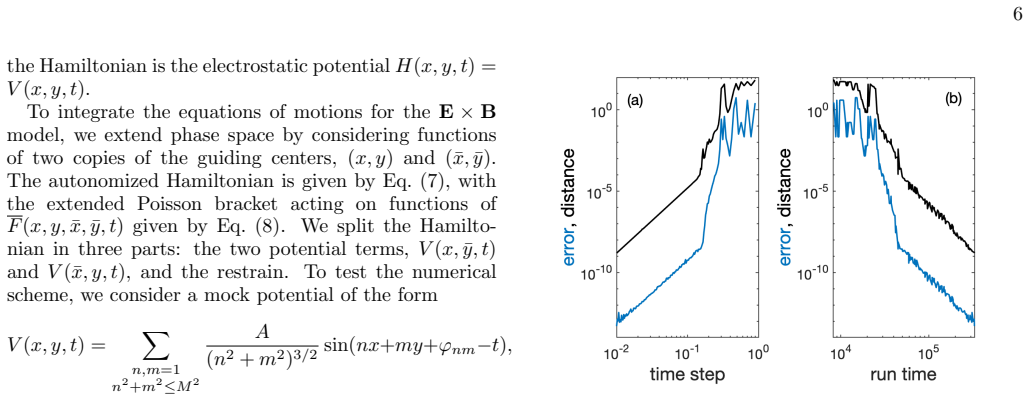
J. Masoliver and A. Ros, European Journal of Physics 32, 431 (2011). 14 FIG. 6. Comparison of the (a) accuracy and (b) efficacy of extended phase-space symplectic integration using different split-operator schemes – see legend and main text. 2S corre- sponds to the 2 nd-order Strang (a.k.a.Verlet) scheme, 4FR to the 4 th-order Forest-Ruth, and 4/6BM to th...
work page 2011
-
[11]
V. I. Arnold,Mathematical Methods of Classical Mechan- ics, 2nd ed., Graduate Texts in Mathematics, Vol. 60 (Springer, New York, 1989)
work page 1989
- [12]
-
[13]
J. E. Marsden and T. S. Ratiu,Introduction to Mechanics and Symmetry, 2nd ed., Texts in Applied Mathematics, Vol. 17 (Springer, New York, 1999)
work page 1999
-
[14]
R. I. McLachlan, Commun. Comput. Phys.31, 987 (2022)
work page 2022
- [15]
-
[16]
R. I. McLachlan and P. Atela, Nonlinearity5, 541 (1992)
work page 1992
- [17]
-
[18]
J. Laskar and P. Robutel, Celestial Mechanics and Dy- namical Astronomy80, 39 (2001)
work page 2001
-
[19]
A. C. Petit, J. Laskar, G. Bou´ e, and M. Gastineau, A&A 628, A32 (2019)
work page 2019
- [20]
-
[21]
Pihajoki, Celest Mech Dyn Astr121, 211 (2015)
P. Pihajoki, Celest Mech Dyn Astr121, 211 (2015)
work page 2015
- [22]
-
[23]
T. F. Viscondi, I. L. Caldas, and P. J. Morrison, Physics of Plasmas24, 032102 (2017)
work page 2017
- [24]
- [25]
-
[26]
Python codes for theE×Bmodel:http://github.com/ cchandre/GC2D
-
[27]
F. Mauger and C. Chandre, SoftwareX28, 101968 (2024). [28]QMol-gridpackage repositories: GitHubhttps: //github.com/fmauger1/QMol-grid. MathWorkhttps: //www.mathworks.com/matlabcentral/fileexchange/ 171414-qmol-grid
work page 2024
- [28]
- [29]
-
[30]
J. R. Cary and A. J. Brizard, Reviews of Modern Physics 81, 693 (2009)
work page 2009
-
[31]
Fass` o, Journal of Computational Physics189, 527 (2003)
F. Fass` o, Journal of Computational Physics189, 527 (2003)
work page 2003
- [32]
- [33]
-
[34]
R. I. McLachlan, SIAM Journal on Scientific Computing 16, 151 (1995)
work page 1995
-
[35]
I. Omelyan, I. Mryglod, and R. Folk, Computer Physics Communications146, 188 (2002). [37]pyhamsyspython package:https://pypi.org/project/ pyhamsys/. GitHub:https://github.com/cchandre/ pyhamsys
work page 2002
discussion (0)
Sign in with ORCID, Apple, or X to comment. Anyone can read and Pith papers without signing in.