REVIEW 3 major objections 4 minor 3 cited by
Leptophobic dark matter can excite collective plasmons in silicon, turning electron-search detectors into probes of nucleon-only dark matter.
Reviewed by Pith at T0; open to challenge. T0 means a machine referee read the full paper against a public rubric. the ladder, T0–T4 →
T0 review · deepseek-v4-flash
2026-08-04 08:50 UTC pith:HVQ6OYBQ
load-bearing objection A clean application of the established plasmon channel to leptophobic DM, with new SENSEI-based limits; the main caveat is an unquantified hadronic-loop cutoff that shifts all limits by an order-one factor. the 3 major comments →
Direct Detection of Leptophobic Dark Matter with Electronic Collective Excitations
The pith
A machine-rendered reading of the paper's core claim, the machinery that carries it, and where it could break.
Core claim
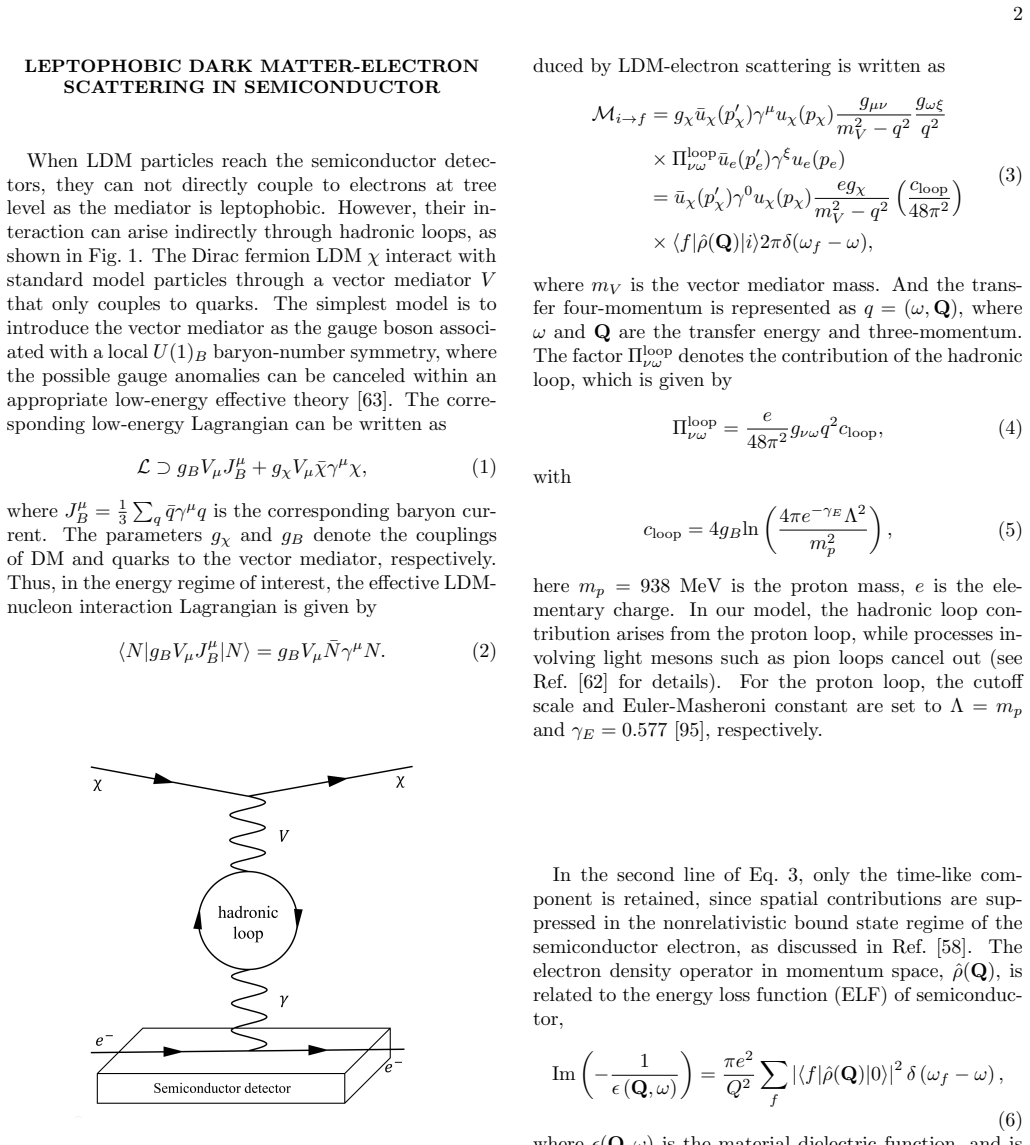
The central claim is that a dark-matter candidate with no tree-level coupling to electrons can still ionize a semiconductor through hadronic loop-induced vector-mediator–photon mixing. The proton-loop contribution produces an effective dark-matter–electron coupling proportional to c_loop = 4 g_B ln(4π e^{-γ_E} Λ²/m_p²) with the cutoff chosen as Λ = m_p; this enters the scattering amplitude and, combined with the silicon energy-loss function, yields a rate that peaks sharply in the plasmon region near ω ≈ 15 eV. Direct plasmon excitation requires dark-matter speeds ≳ 0.01c, which the paper obtains from boosted dark matter and cosmic-ray up-scattered dark matter. Analyzing SENSEI data at 534.9
What carries the argument
The central object is the proton-loop-induced vector-mediator–photon mixing: a one-loop diagram converts the baryonic vector mediator into a photon, giving a momentum-dependent effective dark-matter–electron coupling. This effective coupling drives transitions in the semiconductor, whose response is encoded in the energy-loss function Im[−1/ϵ(Q,ω)] of silicon; the rate is resonantly enhanced when the energy transfer matches the plasmon mode. The mechanism only becomes active for dark-matter velocities above roughly 0.01c, which is why the paper invokes boosted and cosmic-ray up-scattered dark-matter fluxes.
Load-bearing premise
The proton-loop coefficient c_loop is set by a logarithmically divergent integral cut off at Λ = m_p, with pion-type meson loops assumed to cancel exactly; if the true cutoff or meson contribution differs, every exclusion limit shifts vertically by an order-one factor.
What would settle it
Measure or compute the hadronic loop amplitude from the γ*→hadrons spectral function (e.g., using e+e− annihilation data) to fix c_loop without ad hoc cutoffs; if the actual coefficient is an order of magnitude smaller than Eq. (5), the SENSEI-derived exclusions would weaken correspondingly, and if pion loops do not cancel, the predicted event-rate shape in the 3–6 electron-hole bins would change.
If this is right
- Silicon detectors designed for dark-matter–electron scattering are also sensitive to leptophobic dark matter through the loop-induced channel, without new experimental infrastructure.
- SENSEI's null 4–6 electron events translate into new 90% exclusion limits on the dark-matter–nucleon cross section in the sub-MeV mass range, reaching about 10^-31 cm².
- The strongest constraint comes from the 5-electron-hole bin, and the limits weaken as the boosted-dark-matter mass splitting shrinks because the rate scales roughly as 1/μ².
- Cosmic-ray up-scattered dark matter gives a limit comparable to the two-component boosted-dark-matter scenario with a 1 MeV heavier component.
- Future detectors with lower thresholds and larger exposures would push this probe to still smaller cross sections and higher masses.
Where Pith is reading between the lines
- The overall normalization of every exclusion limit is set by the logarithmically divergent loop coefficient with cutoff Λ = m_p and by the assumption that pion loops cancel; choosing a different cutoff, such as Λ ≈ 4π m_p, would shift all contours vertically by an order-one factor—this is an editorial inference from Eq. (5), not a claim the paper tests.
- The same loop mechanism should operate in other target materials, so existing data from noble-liquid and other semiconductor detectors could be re-analyzed for this leptophobic channel; this is a testable extension the paper leaves implicit.
- A first-principles fix of the loop coefficient, for instance from e+e− → hadrons data or lattice calculations of the γ*→hadrons spectral function, would remove the cutoff ambiguity and make the derived limits robust; this is a concrete future calculation rather than a result of this paper.
Editorial analysis
A structured set of objections, weighed in public.
Referee Report
Summary. The paper considers a leptophobic dark matter (DM) model in which a U(1)_B vector mediator couples DM to quarks/nucleons but not at tree level to electrons. It argues that a hadronic (proton) loop induces V–gamma mixing, so leptophobic DM can scatter off electrons in a silicon target and excite plasmons for DM speeds v > 0.01c. Using the DarkELF dielectric function and SENSEI 3–6 electron-hole data, the authors compute 90% C.L. exclusion limits on the spin-independent DM–nucleon cross section for sub-MeV DM in two relativistic-flux scenarios: boosted DM in two-component models and cosmic-ray upscattered DM. The central result is a new exclusion reach down to about 10^-31 cm^2 in the keV–MeV mass range.
Significance. If robust, this is a worthwhile extension of electronic-collective-excitation searches to a class of hadrophilic DM models that are usually probed only by nuclear recoil. The paper makes good use of publicly available DarkELF results and public SENSEI data, and the kinematic requirement for direct plasmon excitation (v > 0.01c) is clearly identified. The main value is the demonstration that a semiconductor electron signal can constrain leptophobic DM despite the absence of a tree-level coupling to electrons. The result is, however, conditional on the normalization of the hadronic loop amplitude, which is not fixed in a scheme-independent way.
major comments (3)
- [Sec. II, Eq. (5) and Eq. (9)] The loop coefficient c_loop in Eq. (5) is the overall normalization of the effective DM–electron interaction. The proton loop is logarithmically divergent, and the paper sets the cutoff to Lambda = m_p by hand. With Lambda = m_p, the logarithm is ln(4π e^{-γ_E}) ≈ 1.95; with Lambda = 4π m_p, the logarithm increases by about ln(16π^2) ≈ 5.1, so c_loop changes by a factor ~3.6. Since the rate in Eq. (9) scales as c_loop^2, every exclusion limit in Figs. 3 and 4 shifts by an order of magnitude. Thus the headline sensitivity of ~1e-31 cm^2 is not robust unless c_loop is obtained from a scheme-independent calculation or its uncertainty is quantified. At minimum, the authors should show the limits for two representative cutoff scales (e.g., Lambda=m_p and Lambda=4π m_p) and state the resulting shift in the quoted cross-section limits.
- [Sec. II, text after Eq. (5)] The claim that 'processes involving light mesons such as pion loops cancel out (see Ref. [62])' is load-bearing because it is part of the determination of c_loop. The paper does not reproduce the argument or state the symmetry that enforces the cancellation. If the cancellation is only approximate, or if higher hadronic states contribute, the effective DM–electron coupling changes and the limits in Figs. 3 and 4 are modified. The authors should present the loop calculation or at least a clear derivation of the cancellation to the level of detail needed to assess its reliability.
- [Sec. II, Eq. (13) and Fig. 4] The CRDM flux is computed under the assumption of a homogeneous cosmic-ray distribution with an effective distance D = 8.02 kpc, obtained by integrating the NFW profile along the line of sight out to 10 kpc. The CRDM exclusion line in Fig. 4 scales linearly with D. Even though the paper notes that an inhomogeneous and larger-volume CR distribution would give a larger D (hence a larger flux and stronger limits), the quoted CRDM line is still tied to this O(1) model assumption. The authors should quantify the sensitivity of the CRDM limit to D and to the CR spectrum model, for example by showing the limit for D = 16 kpc or for the benchmark values used in Refs. [77] and [97]. Without this, the CRDM constraint is not robust at the factor-of-a-few level.
minor comments (4)
- [Fig. 2 caption] The caption says 'BDM with mχ1 = 1 MeV, mχ1 = 1 keV'; the second mass should presumably be mχ2 = 1 keV.
- [Throughout] There are several typos: 'Universes mass' (Introduction), 'Masssive' (Introduction), 'brenchmark' (Fig. 2 caption), and a missing space in '10^-10' in Fig. 4 axis label. A careful proofread is recommended.
- [Eq. (10) and Eq. (12)] The factor 2 in Eq. (10) is explained as accounting for two particles per annihilation, but Eq. (12) is quoted from the literature and may already include all-sky angular integration. Please clarify how the angular average used in Eq. (9) is consistent with the all-sky BDM flux in Eq. (12).
- [Sec. II, after Eq. (16)] The sentence 'The contribution from DM–electron scattering is suppressed by the proton loop and can therefore be neglected' is ambiguous: it refers to the CR upscattering of DM by cosmic-ray electrons. Please make this explicit.
Circularity Check
No significant circularity: the rate is a fixed convolution of external inputs and the SENSEI data are used only to set limits, not to fit parameters.
full rationale
The derivation chain is not circular. The theoretical rate in Eq. (9) is built from three independent inputs: the DarkELF dielectric function [53], the hadronic-loop mixing amplitude with explicit loop factor c_loop in Eq. (5), and model fluxes for BDM/CRDM. The SENSEI 3-6 e- upper limits from Table I are then compared with the predicted event count to obtain exclusion contours; ar{\sigma}_{\chi n} appears as a linear prefactor of the rate and is constrained, not fitted. No equation is equivalent to its own input by construction. The loop-normalization choice Lambda=m_p in Eq. (5) is an explicitly stated regulator choice adopted from Ref. [62]; it affects all limits by an order-one factor, but that is a model-dependence/robustness issue, not circularity. The only author-overlapping citation is Ref. [58] (Liang, Su, Wu, Zhu), used mainly for the kinematic condition v_chi >~ 0.01c and the general rate formalism; this is supporting background rather than the load-bearing derivation of the new exclusion limits, so it does not make the argument self-referential. In particular, the paper does not fit a parameter to SENSEI and then relabel that fit as a prediction.
Axiom & Free-Parameter Ledger
free parameters (3)
- Loop cutoff scale Λ =
Λ = m_p = 938 MeV
- Effective distance D for CRDM =
8.02 kpc
- Benchmark annihilation cross section ⟨σv⟩ =
5×10^-26 cm^3/s
axioms (4)
- domain assumption The hadronic loop mixing is dominated by the proton loop, with pion loops canceling exactly.
- domain assumption The dielectric response of silicon is taken from the DarkELF package.
- domain assumption The cosmic-ray distribution is homogeneous and line-of-sight integration is truncated at 10 kpc.
- standard math The bound-electron nonrelativistic limit, retaining only the time-like component of the current.
invented entities (1)
-
U(1)_B vector mediator V
no independent evidence
read the original abstract
Some new-generation dark matter detection experiments are primarily designed to search for the dark matter-electron interactions, but they can also be utilized to probe models in which dark matter couples exclusively to nucleon via the quantum effects. The hadronic loop-induced interactions can directly excite plasmons in semiconductors, thereby providing an additional channel for detecting the leptophobic dark matter. In this work, we investigate plasmon excitations in silicon detectors induced by boosted dark matter and cosmic-ray up-scattering dark matter via the hadronic loop process. By analyzing the available experimental data, we derive new exclusion limits on the leptophobic dark matter-nucleon scattering cross section in the sub-MeV mass range.
Figures


Forward citations
Cited by 3 Pith papers
-
Inelastic Scattering Effects on Attenuation of Boosted Dark Matter
Resonant excitation of nucleons into Δ(1232) during Earth passage is a non-negligible attenuation channel for boosted dark matter at E_χ ≈ 1–2 GeV, lowering the PandaX-4T upper bound on σ̄_n in the heavy-mediator regime.
-
Constraints on Axion-Like Particles with the Silicon Detector at a Nuclear Reactor
New 90% C.L. limits on the ALP–photon coupling in the 0.1–100 keV range are derived from Connie and Atucha-II reactor data via plasmon excitation in silicon; a 30 kg·yr Oscura-style run could improve on NEON by about tenfold.
-
Probing freeze-in dark matter using Bose-Einstein condensate in neutron star
Bose-Einstein condensate formation in neutron stars enhances dark matter annihilation by 10^15-10^20, allowing freeze-in models to produce observable heating and probe neutrino-fog scattering cross-sections.
Reference graph
Works this paper leans on
-
[1]
In this model, the DM consists of two species,χ 1 andχ 2, with the massesm χ1 > mχ2
Boosted DM in two-component DM model: A commonly studied framework for relativistic DM is boosted DM in the two-component DM model. In this model, the DM consists of two species,χ 1 andχ 2, with the massesm χ1 > mχ2 . The heavier DMχ 1, which constitutes the dominant DM component, does not cou- ple directly to SM particles and achieves the correct relic a...
-
[2]
In this framework, the DM halo in the Milky 4 Way can be accelerated by the scattering between high- energy cosmic-ray and DM
Cosmic-ray up-scattering DM:Apart from the BDM in two-component DM model, another popu- lar relativistic component of the DM flux in recent years arises from cosmic-ray up-scattering DM, which is short for CRDM. In this framework, the DM halo in the Milky 4 Way can be accelerated by the scattering between high- energy cosmic-ray and DM. Therefore, the dif...
2015
-
[3]
B. W. Lee and S. Weinberg, Phys. Rev. Lett.39, 165 (1977)
1977
-
[4]
Z. Bo et al. (PandaX), Phys. Rev. Lett.134, 011805 (2025), 2408.00664
Pith/arXiv arXiv 2025
-
[5]
J. Aalbers et al. (LZ), Phys. Rev. Lett.135, 011802 (2025), 2410.17036
Pith/arXiv arXiv 2025
- [6]
-
[7]
R. Essig, J. Mardon, and T. Volansky, Phys. Rev. D85, 076007 (2012), 1108.5383
Pith/arXiv arXiv 2012
-
[8]
Y. Hochberg, Y. Zhao, and K. M. Zurek, Phys. Rev. Lett.116, 011301 (2016), 1504.07237. 7
Pith/arXiv arXiv 2016
-
[9]
Y. Hochberg, T. Lin, and K. M. Zurek, Phys. Rev. D 94, 015019 (2016), 1604.06800
Pith/arXiv arXiv 2016
-
[10]
S. Derenzo, R. Essig, A. Massari, A. Soto, and T.-T. Yu, Phys. Rev. D96, 016026 (2017), 1607.01009
Pith/arXiv arXiv 2017
-
[11]
M. Ibe, W. Nakano, Y. Shoji, and K. Suzuki, JHEP03, 194 (2018), 1707.07258
Pith/arXiv arXiv 2018
-
[12]
M. J. Dolan, F. Kahlhoefer, and C. McCabe, Phys. Rev. Lett.121, 101801 (2018), 1711.09906
Pith/arXiv arXiv 2018
-
[13]
S. Knapen, T. Lin, and K. M. Zurek, Phys. Rev. D96, 115021 (2017), 1709.07882
Pith/arXiv arXiv 2017
-
[14]
R. Essig, J. Pradler, M. Sholapurkar, and T.-T. Yu, Phys. Rev. Lett.124, 021801 (2020), 1908.10881
Pith/arXiv arXiv 2020
-
[15]
V. V. Flambaum, L. Su, L. Wu, and B. Zhu, Sci. China Phys. Mech. Astron.66, 271011 (2023), 2012.09751
Pith/arXiv arXiv 2023
-
[16]
G. Elor, R. McGehee, and A. Pierce, Phys. Rev. Lett. 130, 031803 (2023), 2112.03920
Pith/arXiv arXiv 2023
-
[17]
L. Su, L. Wu, and B. Zhu, Phys. Rev. D105, 055021 (2022), 2105.06326
Pith/arXiv arXiv 2022
-
[18]
R. Calabrese, M. Chianese, D. F. G. Fiorillo, and N. Sa- viano, Phys. Rev. D105, 103024 (2022), 2203.17093
Pith/arXiv arXiv 2022
-
[19]
Z.-L. Liang, C. Mo, F. Zheng, and P. Zhang, Phys. Rev. D106, 043004 (2022), [Erratum: Phys.Rev.D 106, 109901 (2022)], 2205.03395
Pith/arXiv arXiv 2022
-
[20]
J. Li, L. Su, L. Wu, and B. Zhu, JCAP04, 020 (2023), 2210.15474
Pith/arXiv arXiv 2023
-
[21]
Y. Gu, L. Wu, and B. Zhu, Phys. Rev. D106, 075004 (2022), 2203.06664
Pith/arXiv arXiv 2022
-
[22]
L. Su, L. Wu, N. Zhou, and B. Zhu, Phys. Rev. D108, 035004 (2023), 2212.02286
Pith/arXiv arXiv 2023
-
[23]
S. Li et al. (PandaX), Phys. Rev. Lett.130, 261001 (2023), 2212.10067
Pith/arXiv arXiv 2023
-
[24]
J.-H. Liang, Y. Liao, X.-D. Ma, and H.-L. Wang, Phys. Rev. D110, L091701 (2024), 2405.04855
Pith/arXiv arXiv 2024
-
[25]
Balan et al., JCAP01, 053 (2025), 2405.17548
S. Balan et al., JCAP01, 053 (2025), 2405.17548
Pith/arXiv arXiv 2025
-
[26]
P. N. Bhattiprolu, R. McGehee, E. Petrosky, and A. Pierce, Phys. Rev. D111, 035027 (2025), 2408.07744
Pith/arXiv arXiv 2025
-
[27]
F. Lin, N. Liu, L. Su, and L. Wu (2025), 2504.13007
Pith/arXiv arXiv 2025
-
[28]
S. M. Griffin, G. D. Hadas, Y. Hochberg, K. Inzani, and B. V. Lehmann, Phys. Rev. Lett.135, 141803 (2025)
2025
-
[29]
A. Cheek, P. Figueroa, G. Herrera, and I. M. Shoemaker (2025), 2507.15956
Pith/arXiv arXiv 2025
- [30]
-
[31]
P. W. Graham, D. E. Kaplan, S. Rajendran, and M. T. Walters, Phys. Dark Univ.1, 32 (2012), 1203.2531
Pith/arXiv arXiv 2012
-
[32]
R. Essig, M. Fernandez-Serra, J. Mardon, A. Soto, T. Volansky, and T.-T. Yu, JHEP05, 046 (2016), 1509.01598
Pith/arXiv arXiv 2016
-
[33]
Y. Hochberg, T. Lin, and K. M. Zurek, Phys. Rev. D 95, 023013 (2017), 1608.01994
Pith/arXiv arXiv 2017
-
[34]
S. Knapen, T. Lin, M. Pyle, and K. M. Zurek, Phys. Lett. B785, 386 (2018), 1712.06598
Pith/arXiv arXiv 2018
-
[35]
N. A. Kurinsky, T. C. Yu, Y. Hochberg, and B. Cabrera, Phys. Rev. D99, 123005 (2019), 1901.07569
Pith/arXiv arXiv 2019
-
[36]
T. Trickle, Z. Zhang, and K. M. Zurek, Phys. Rev. Lett. 124, 201801 (2020), 1905.13744
Pith/arXiv arXiv 2020
-
[37]
A. Coskuner, A. Mitridate, A. Olivares, and K. M. Zurek, Phys. Rev. D103, 016006 (2021), 1909.09170
Pith/arXiv arXiv 2021
-
[38]
R. M. Geilhufe, F. Kahlhoefer, and M. W. Winkler, Phys. Rev. D101, 055005 (2020), 1910.02091
Pith/arXiv arXiv 2020
-
[39]
S. M. Griffin, Y. Hochberg, K. Inzani, N. Kurinsky, T. Lin, and T. Chin, Phys. Rev. D103, 075002 (2021), 2008.08560
Pith/arXiv arXiv 2021
-
[40]
E. Andersson, A. B¨ okmark, R. Catena, T. Emken, H. K. Moberg, and E. ˚Astrand, JCAP05, 036 (2020), 2001.08910
Pith/arXiv arXiv 2020
-
[41]
A. Esposito and S. Pavaskar, Phys. Rev. D108, L011901 (2023), 2210.13516
Pith/arXiv arXiv 2023
-
[42]
S. Autti et al. (QUEST-DMC), Eur. Phys. J. C84, 248 (2024), 2310.11304
Pith/arXiv arXiv 2024
-
[43]
F. Toschi et al. (DELight), Phys. Rev. D111, 032013 (2025), 2410.13684
Pith/arXiv arXiv 2025
- [44]
-
[45]
A. Aguilar-Arevalo et al. (DAMIC), Phys. Rev. D94, 082006 (2016), 1607.07410
Pith/arXiv arXiv 2016
-
[46]
L. Barak et al. (SENSEI), Phys. Rev. Lett.125, 171802 (2020), 2004.11378
Pith/arXiv arXiv 2020
-
[47]
Q. Arnaud et al. (EDEL WEISS), Phys. Rev. Lett.125, 141301 (2020), 2003.01046
Pith/arXiv arXiv 2020
-
[48]
D. W. Amaral et al. (SuperCDMS), Phys. Rev. D102, 091101 (2020), 2005.14067
Pith/arXiv arXiv 2020
- [49]
-
[50]
Z. Y. Zhang et al. (CDEX), Phys. Rev. Lett.129, 221301 (2022), 2206.04128
Pith/arXiv arXiv 2022
-
[51]
I. M. Bloch et al. (SENSEI), Phys. Rev. Lett.134, 161002 (2025), 2410.18716
arXiv 2025
-
[52]
K. Aggarwal et al. (DAMIC-M), Phys. Rev. Lett.135, 071002 (2025), 2503.14617
Pith/arXiv arXiv 2025
- [53]
-
[54]
S. Knapen, J. Kozaczuk, and T. Lin, Phys. Rev. D104, 015031 (2021), 2101.08275
Pith/arXiv arXiv 2021
-
[55]
S. Knapen, J. Kozaczuk, and T. Lin, Phys. Rev. D105, 015014 (2022), 2104.12786
Pith/arXiv arXiv 2022
-
[56]
C. Boyd, Y. Hochberg, Y. Kahn, E. D. Kramer, N. Kurinsky, B. V. Lehmann, and T. C. Yu, Phys. Rev. D108, 015015 (2023), 2212.04505
Pith/arXiv arXiv 2023
-
[57]
C. E. Dreyer, R. Essig, M. Fernandez-Serra, A. Sin- gal, and C. Zhen, Phys. Rev. D109, 115008 (2024), 2306.14944
Pith/arXiv arXiv 2024
-
[58]
N. Kurinsky, D. Baxter, Y. Kahn, and G. Krnjaic, Phys. Rev. D102, 015017 (2020), 2002.06937
Pith/arXiv arXiv 2020
-
[59]
Y. Hochberg, D. Novko, R. Ovadia, and A. Politano (2025), 2507.07164
Pith/arXiv arXiv 2025
-
[60]
Z.-L. Liang, L. Su, L. Wu, and B. Zhu, Phys. Rev. Lett. 134, 071001 (2025), 2401.11971
Pith/arXiv arXiv 2025
-
[61]
R. Essig, R. Plestid, and A. Singal, Commun. Phys.7, 416 (????), 2403.00123
-
[62]
J.-W. Sun, L. Wu, Y.-H. Xu, and B. Zhu (2025), 2501.07591
Pith/arXiv arXiv 2025
-
[63]
J. B. Dent, B. A. Friedman, J. L. Newstead, and S. Sab- harwal (2025), 2510.06574
arXiv 2025
-
[64]
M. Diamond, C. V. Cappiello, A. C. Vincent, and J. Bramante, Phys. Rev. Lett.132, 051001 (2024), 2307.13727
Pith/arXiv arXiv 2024
-
[65]
B. Batell, P. deNiverville, D. McKeen, M. Pospelov, and A. Ritz, Phys. Rev. D90, 115014 (2014), 1405.7049
Pith/arXiv arXiv 2014
-
[66]
P. Coloma, B. A. Dobrescu, C. Frugiuele, and R. Harnik, JHEP04, 047 (2016), 1512.03852
Pith/arXiv arXiv 2016
-
[67]
J. A. Dror, R. Lasenby, and M. Pospelov, Phys. Rev. Lett.119, 141803 (2017), 1705.06726
Pith/arXiv arXiv 2017
-
[68]
A. Berlin, N. Blinov, G. Krnjaic, P. Schuster, and N. Toro, Phys. Rev. D99, 075001 (2019), 1807.01730
Pith/arXiv arXiv 2019
-
[69]
A. Boyarsky, O. Mikulenko, M. Ovchynnikov, and L. Shchutska, JHEP03, 006 (2022), 2104.09688
Pith/arXiv arXiv 2022
-
[70]
K. Agashe, Y. Cui, L. Necib, and J. Thaler, JCAP10, 062 (2014), 1405.7370. 8
Pith/arXiv arXiv 2014
-
[71]
B. Fornal, P. Sandick, J. Shu, M. Su, and Y. Zhao, Phys. Rev. Lett.125, 161804 (2020), 2006.11264
Pith/arXiv arXiv 2020
-
[72]
D. Borah, M. Dutta, S. Mahapatra, and N. Sahu, Phys. Lett. B820, 136577 (2021), 2104.05656
Pith/arXiv arXiv 2021
-
[73]
A. Basu, A. Chakraborty, N. Kumar, and S. Sadhukhan, Phys. Rev. D111, 095016 (2025), 2310.09349
Pith/arXiv arXiv 2025
-
[74]
J. Li, T. Nomura, J. Pei, X. Yin, and C. Zhang, Phys. Rev. D108, 035021 (2023), 2302.09839
Pith/arXiv arXiv 2023
- [75]
-
[76]
H. Alhazmi, D. Kim, K. Kong, G. Mohlabeng, J.-C. Park, and S. Shin (2025), 2503.13598
Pith/arXiv arXiv 2025
-
[77]
T. Bringmann and M. Pospelov, Phys. Rev. Lett.122, 171801 (2019), 1810.10543
Pith/arXiv arXiv 2019
-
[78]
Y. Ema, F. Sala, and R. Sato, Phys. Rev. Lett.122, 181802 (2019), 1811.00520
Pith/arXiv arXiv 2019
-
[79]
C. V. Cappiello and J. F. Beacom, Phys. Rev. D 100, 103011 (2019), [Erratum: Phys.Rev.D 104, 069901 (2021)], 1906.11283
Pith/arXiv arXiv 2019
-
[80]
W. Wang, L. Wu, J. M. Yang, H. Zhou, and B. Zhu, JHEP12, 072 (2020), [Erratum: JHEP 02, 052 (2021)], 1912.09904
Pith/arXiv arXiv 2020
discussion (0)
Sign in with ORCID, Apple, or X to comment. Anyone can read and Pith papers without signing in.