REVIEW 5 major objections 5 minor 1 cited by
One unified autoregressive diffusion transformer can generate whole-body motion from text, music, speech, and spatial-temporal control signals, using reference motion as a conditioning signal, and is trained on a 286-hour unified motion-cap
Reviewed by Pith at T0; open to challenge. T0 means a machine referee read the full paper against a public rubric. the ladder, T0–T4 →
T0 review · deepseek-v4-flash
2026-08-04 08:33 UTC pith:RUVCLNH4
load-bearing objection Big curated dataset and a plausible unified model, but the SOTA claim rests on a closed in-house evaluation with unmatched baselines — send to review but demand external benchmarks. the 5 major comments →
OmniMotion-X: Versatile Multimodal Whole-Body Motion Generation
The pith
A machine-rendered reading of the paper's core claim, the machinery that carries it, and where it could break.
Core claim
The central proposal is that reference motion—user-supplied or from previously generated clips—acts as a conditioning signal that lets a single autoregressive diffusion transformer maintain consistency of content, style, and temporal dynamics while accepting text, speech, music, and global spatial-temporal control tokens as prefix context. Combined with a progressive training schedule that first aligns motion to text and then adds finer-grained conditions (reference motion, global motion, audio), the model is claimed to avoid the modality conflicts that earlier unified models suffer. The authors also introduce a dataset unification pipeline: 28 motion-capture datasets are retargeted to one w
What carries the argument
The load-bearing mechanism is an autoregressive diffusion transformer (DiT) in which all conditions—text, global motion, speech, music, and reference motion—are encoded by modality-specific encoders, linearly projected, and concatenated as prefix tokens with the noisy motion tokens. A set of spatial-temporal masks converts the same backbone into motion prediction, in-betweening, completion, and joint/trajectory-guided synthesis. The reference-motion condition, together with a progressive weak-to-strong training curriculum, is what the paper credits for consistent, controllable generation.
Load-bearing premise
The central superiority claim rests on the assumption that the self-constructed evaluation is a fair test: a 280-clip benchmark sampled from the authors' own dataset and scored with feature extractors retrained on that same dataset, so if that protocol favors the trained model, the claimed advantage over prior methods collapses.
What would settle it
Run the released OmniMotion-X model on standard public text-to-motion and music-to-dance benchmarks, scoring with the original published feature extractors rather than extractors retrained on OmniMoCap-X, and compare FID and R-precision to published baselines. If the gap reverses or vanishes, the central state-of-the-art claim is refuted.
If this is right
- If correct, a single model can replace task-specific pipelines for text-to-motion, music-to-dance, speech-to-gesture, and trajectory/joint control.
- Interactive generation becomes possible: a user can feed back a generated clip as reference motion to extend or edit a scene while keeping style and timing consistent.
- The unified 28-source, 286-hour dataset in one whole-body format could serve as a shared training and test bed for future multimodal motion models.
- The weak-to-strong conditioning schedule offers a recipe for combining semantic and hard constraints in other multimodal generative models.
- The render-and-caption pipeline could scale hierarchical text annotation to additional motion datasets beyond the ones collected here.
Where Pith is reading between the lines
- The reference-motion mechanism points toward a more general method for long-horizon and iteratively editable motion generation, applicable beyond animation to robotics and embodied control.
- The reported superiority should be read as provisional: the evaluation uses a test set sampled from the authors' own training distribution and metric extractors retrained on that same distribution, so cross-method comparability with established benchmarks is not established in this paper.
- The weak-to-strong training strategy may transfer to other multimodal generation domains where low-level signals (e.g., camera trajectories in text-to-video) tend to overwhelm high-level semantics.
- A natural testable extension is to run the released model on standard public text-to-motion and dance benchmarks with the original published metric extractors; that would show whether the gains generalize or are specific to the paper's evaluation protocol.
Editorial analysis
A structured set of objections, weighed in public.
Referee Report
Summary. The paper introduces OmniMotion-X, a unified autoregressive diffusion transformer for whole-body human motion generation from multiple modalities (text, music, speech, global spatial-temporal controls, and reference motion), together with a progressive weak-to-strong mixed-condition training strategy. It also contributes OmniMoCap-X, a dataset of 28 public sources standardized to SMPL-X at 30 fps, totaling 286.2 hours, with GPT-4o-generated hierarchical captions. The paper claims state-of-the-art performance on text-to-motion, music-to-dance, speech-to-gesture, and global spatial-temporal controllable generation. The T2M and GSTC evaluations are on a 280-clip test set sampled from the authors' own OmniMoCap-X, while M2D/S2G are evaluated on BEAT2 and AIST++/FineDance/PhantomDance. Results are mixed: OmniMotion-X is better on several T2M/GSTC metrics and on diversity, but worse than MotionCraft on whole-body FID for M2D and on hand FID for S2G.
Significance. If the claimed results are supported, this would be a substantial step toward a single model that handles multiple whole-body motion generation tasks, and the OmniMoCap-X dataset could be a useful community resource. The idea of using reference motion as a conditioning signal and the progressive training schedule are plausible and interesting. The paper also offers code and dataset links, which would aid reproducibility. However, the current evaluation does not convincingly establish the central 'significantly surpasses existing methods' claim, because the comparisons are confounded by architectural differences, text-encoder differences, and an in-house evaluation setup. The paper's contribution is promising, but the evidence needs to be strengthened before the SOTA claim can be accepted.
major comments (5)
- [Experiments, Table 4] The T2M comparison to MDM, MLD, and MoMask is not well-controlled. These methods are body-only and do not natively predict SMPL-X hand/face parameters, yet they are evaluated on a whole-body SMPL-X test set. The paper never describes how they are adapted to produce whole-body output (e.g., zero hand/face values, retargeting, or additional regressors). If the baselines output zeros or fixed hands/face, the re-trained whole-body feature extractor will penalize them for reasons orthogonal to generation quality, making the large FID gap (e.g., 72.928 vs. 3.199) uninterpretable. Please specify the adaptation and, if possible, include whole-body baselines trained on the same representation.
- [Experiments / Supplementary 'More Implementation Details'] The main evaluation is a closed loop. The model is trained on OmniMoCap-X, the test set is uniformly sampled from OmniMoCap-X, and the FID/R-precision feature extractors are re-trained on OmniMoCap-X. This makes the scores incommensurable with published numbers and systematically favors the model whose training distribution matches the evaluation distribution. No standard external benchmarks (e.g., HumanML3D for T2M, AIST++ protocol for M2D, BEAT2 protocol for S2G) are reported. Consequently, the abstract's 'state-of-the-art' and 'significantly surpasses' claims rest entirely on an in-house benchmark. Please report at least one standard external benchmark, or provide baselines retrained on the same data with identical feature extractors and text encoders.
- [Experiments, Table 6] Table 6 directly contradicts the broad 'significantly surpasses existing methods' claim. OmniMotion-X is worse than MotionCraft on whole-body FID for M2D (16.209 vs. 9.875) and worse on hand FID for S2G (9.095 vs. 5.370). The sentence 'The lower FID is mainly due to the relatively small test sets...' is not a quantitative explanation and does not address why the deficit appears on these specific metrics while the model is better on others. The paper should either acknowledge the trade-off and provide statistical significance or restrict the SOTA claim to the metrics/tasks where the improvement is consistent.
- [T2M experiments, Table 4] The paper acknowledges that OmniMotion-X uses T5-XXL while the MoMask* and MotionCraft* baselines use CLIP. Since the text encoder is a major component of text-conditioned generation, this difference alone could explain a substantial part of the R-precision and FID improvements. To isolate the contribution of the proposed architecture and training strategy, an ablation with a shared text encoder (e.g., CLIP for all methods, or T5-XXL for the retrained baselines) is needed. Without this, the superiority of OmniMotion-X over the '*' baselines is confounded.
- [OmniMoCap-X Dataset, Tables 2 and 3] The abstract and text describe OmniMoCap-X as integrating '28 publicly available MoCap sources,' but Table 2 indicates only 21/28 sources are mocap, and Table 3 lists five Single-View RGB sources (IDEA400, AIOZ, etc.). These are not marker-based motion capture and likely involve pose-estimation noise. The 'largest unified multimodal MoCap dataset' claim should be qualified accordingly, and the paper should report the quality-control procedure for the non-marker sources, since the data-quality argument is central to the dataset's contribution.
minor comments (5)
- [Unified Motion Representation] The pose tuple p_i is defined as (˙r_a, ˙r_x, ˙r_z, r_y, j_p, j_v, c_f, f), but the following sentence discusses j_r ∈ R^{6N'} (joint 6D rotations), which is not included in the tuple. Either add j_r to the tuple or remove the discussion.
- [Table 6 caption] The caption contains a typo: 'F IDW holeBody' should be 'FID (Whole-Body)'.
- [Supplementary 'Dataset Text Quality'] The average sentence length of 276.78 words across the collection seems implausibly large for a motion description and may be a typo (e.g., characters instead of words). Please verify and clarify.
- [Implementation Details] The paper states 'the default length of motion reference and prediction is 150' but does not explain how variable-length sequences are handled at inference or whether the autoregressive scheme supports arbitrary lengths. Clarify.
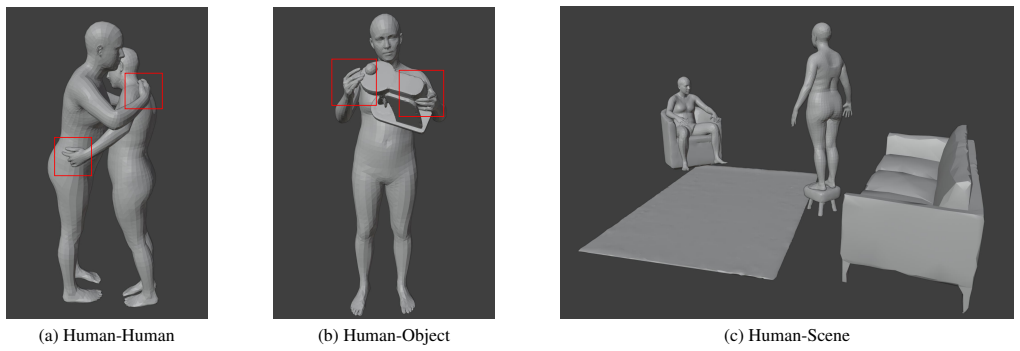
- [Conclusion and Discussion] The limitation states the method 'lacks scene, object, and human interaction constraints,' yet the dataset includes HOI, HSI, and HHI data. Clarify that these data are included for future tasks but are not currently modeled, to avoid an apparent contradiction.
Circularity Check
No circular derivation found; the SOTA claim is supported by experiments rather than by a self-referential reduction, though the evaluation is substantially in-house.
full rationale
The paper's central claim is empirical: OmniMotion-X is trained on the self-constructed OmniMoCap-X and evaluated on a test set sampled from that same dataset, with text/motion feature extractors re-trained on OmniMoCap-X (Supplementary, 'More Implementation Details'). This is an evaluation-validity concern — the benchmark is in-house and the metrics are in-distribution for the proposed model — but it is not a circularity in the derivation-chain sense: no equation equates a predicted quantity to a fitted input, and the baseline comparisons (e.g., MoMask* and MotionCraft* retrained on the same OmniMoCap-X) are not forced to produce the reported outcome by construction. The paper also reports external comparisons on AIST++/FineDance/PhantomDance and BEAT2 in Table 6, where results are mixed and the text itself concedes 'some distribution differences' and that 'superior diversity, which may also impact the FID' — a caveat rather than a guaranteed-win construction. Several self-citations exist (MotionCraft, Motion-X, HumanTomato), but they are used for architecture components and the evaluation protocol, not as load-bearing uniqueness theorems or as definitions of the target result. Overall, no specific circular step can be exhibited; the score reflects only the minor presence of self-cited evaluation infrastructure that makes the headline SOTA claim harder to independently verify.
Axiom & Free-Parameter Ledger
free parameters (3)
- Training stage durations =
460K / 460K / 230K / 920K steps
- Contrastive margin d =
10
- Reference/prediction clip length =
150 frames
axioms (4)
- domain assumption SMPL-X is a sufficient representation of whole-body motion across all tasks.
- domain assumption GPT-4o-generated hierarchical captions are accurate enough for text-motion alignment.
- domain assumption Re-trained contrastive feature extractors yield metrics comparable across methods.
- ad hoc to paper The 280-sample self-built test set is a fair benchmark for SOTA comparisons.
read the original abstract
This paper introduces OmniMotion-X, a versatile multimodal framework for whole-body human motion generation, leveraging an autoregressive diffusion transformer in a unified sequence-to-sequence manner. OmniMotion-X efficiently supports diverse multimodal tasks, including text-to-motion, music-to-dance, speech-to-gesture, and global spatial-temporal control scenarios (e.g., motion prediction, in-betweening, completion, and joint/trajectory-guided synthesis), as well as flexible combinations of these tasks. Specifically, we propose the use of reference motion as a novel conditioning signal, substantially enhancing the consistency of generated content, style, and temporal dynamics crucial for realistic animations. To handle multimodal conflicts, we introduce a progressive weak-to-strong mixed-condition training strategy. To enable high-quality multimodal training, we construct OmniMoCap-X, the largest unified multimodal motion dataset to date, integrating 28 publicly available MoCap sources across 10 distinct tasks, standardized to the SMPL-X format at 30 fps. To ensure detailed and consistent annotations, we render sequences into videos and use GPT-4o to automatically generate structured and hierarchical captions, capturing both low-level actions and high-level semantics. Extensive experimental evaluations confirm that OmniMotion-X significantly surpasses existing methods, demonstrating state-of-the-art performance across multiple multimodal tasks and enabling the interactive generation of realistic, coherent, and controllable long-duration motions.
Figures


Forward citations
Cited by 1 Pith paper
-
ViBES: A Conversational Agent with Behaviorally-Intelligent 3D Virtual Body
ViBES introduces a speech-language-behavior model using modality-specific transformer experts that jointly generates dialogue and 3D body actions, showing gains over separate co-speech and text-to-motion baselines on ...
Reference graph
Works this paper leans on
-
[1]
, " * write output.state after.block = add.period write newline
ENTRY address archivePrefix author booktitle chapter edition editor eid eprint howpublished institution isbn journal key month note number organization pages publisher school series title type volume year label extra.label sort.label short.list INTEGERS output.state before.all mid.sentence after.sentence after.block FUNCTION init.state.consts #0 'before.a...
-
[2]
write newline
" write newline "" before.all 'output.state := FUNCTION n.dashify 't := "" t empty not t #1 #1 substring "-" = t #1 #2 substring "--" = not "--" * t #2 global.max substring 't := t #1 #1 substring "-" = "-" * t #2 global.max substring 't := while if t #1 #1 substring * t #2 global.max substring 't := if while FUNCTION word.in bbl.in capitalize " " * FUNCT...
-
[3]
L.; Almeida, D.; Altenschmidt, J.; Altman, S.; Anadkat, S.; et al
Achiam, J.; Adler, S.; Agarwal, S.; Ahmad, L.; Akkaya, I.; Aleman, F. L.; Almeida, D.; Altenschmidt, J.; Altman, S.; Anadkat, S.; et al. 2023. Gpt-4 technical report. arXiv preprint arXiv:2303.08774
Pith/arXiv arXiv 2023
-
[4]
???? Mixamo
Adobe . ???? Mixamo . https://www.mixamo.com
-
[5]
Alexanderson, S.; Nagy, R.; Beskow, J.; and Henter, G. E. 2023. Listen, Denoise, Action! Audio-Driven Motion Synthesis with Diffusion Models. ACM Trans. Graph., 42(4): 44:1--44:20
2023
-
[6]
Ao, T. 2024. Body of Her: A Preliminary Study on End-to-End Humanoid Agent. arXiv preprint arXiv:2408.02879
Pith/arXiv arXiv 2024
-
[7]
P.; Li, J.; Vetrivel, K.; Agarwal, R.; Wu, J.; Gopinath, D.; Clegg, A
Ara \'u jo, J. P.; Li, J.; Vetrivel, K.; Agarwal, R.; Wu, J.; Gopinath, D.; Clegg, A. W.; and Liu, K. 2023. Circle: Capture in rich contextual environments. In Proceedings of the IEEE/CVF Conference on Computer Vision and Pattern Recognition, 21211--21221
2023
-
[8]
???? Autodesk MotionBuilder
Autodesk Inc. ???? Autodesk MotionBuilder
-
[9]
L.; Xie, X.; Petrov, I
Bhatnagar, B. L.; Xie, X.; Petrov, I. A.; Sminchisescu, C.; Theobalt, C.; and Pons-Moll, G. 2022. Behave: Dataset and method for tracking human object interactions. In Proceedings of the IEEE/CVF Conference on Computer Vision and Pattern Recognition, 15935--15946
2022
-
[10]
Bian, Y.; Zeng, A.; Ju, X.; Liu, X.; Zhang, Z.; Liu, W.; and Xu, Q. 2024. MotionCraft: Crafting Whole-Body Motion with Plug-and-Play Multimodal Controls. arXiv preprint arXiv:2407.21136
Pith/arXiv arXiv 2024
-
[11]
???? Blender
Blender Foundation . ???? Blender
-
[12]
Chen, J.; Liu, Y.; Wang, J.; Zeng, A.; Li, Y.; and Chen, Q. 2024 a . Diffsheg: A diffusion-based approach for real-time speech-driven holistic 3d expression and gesture generation. In Proceedings of the IEEE/CVF Conference on Computer Vision and Pattern Recognition, 7352--7361
2024
-
[13]
Chen, K.; Tan, Z.; Lei, J.; Zhang, S.-H.; Guo, Y.-C.; Zhang, W.; and Hu, S.-M. 2021. Choreomaster: choreography-oriented music-driven dance synthesis. ACM Transactions on Graphics (TOG), 40(4): 1--13
2021
-
[14]
Chen, L.-H.; Zhang, J.; Li, Y.; Pang, Y.; Xia, X.; and Liu, T. 2023 a . Humanmac: Masked motion completion for human motion prediction. In ICCV, 9544--9555
2023
-
[15]
Chen, R.; Shi, M.; Huang, S.; Tan, P.; Komura, T.; and Chen, X. 2024 b . Taming diffusion probabilistic models for character control. In ACM SIGGRAPH 2024 Conference Papers, 1--10
2024
-
[16]
Chen, X.; Jiang, B.; Liu, W.; Huang, Z.; Fu, B.; Chen, T.; and Yu, G. 2023 b . Executing your commands via motion diffusion in latent space. In CVPR, 18000--18010
2023
-
[17]
B.; and van de Panne, M
Cohan, S.; Tevet, G.; Reda, D.; Peng, X. B.; and van de Panne, M. 2024. Flexible motion in-betweening with diffusion models. In ACM SIGGRAPH, 1--9
2024
-
[18]
Dai, W.; Chen, L.-H.; Wang, J.; Liu, J.; Dai, B.; and Tang, Y. 2024. MotionLCM: Real-time Controllable Motion Generation via Latent Consistency Model. ECCV
2024
-
[19]
Delmas, G.; Weinzaepfel, P.; Lucas, T.; Moreno-Noguer, F.; and Rogez, G. 2022. Posescript: 3d human poses from natural language. In European Conference on Computer Vision, 346--362. Springer
2022
-
[20]
J.; and Hilliges, O
Fan, Z.; Taheri, O.; Tzionas, D.; Kocabas, M.; Kaufmann, M.; Black, M. J.; and Hilliges, O. 2023. ARCTIC: A dataset for dexterous bimanual hand-object manipulation. In Proceedings of the IEEE/CVF Conference on Computer Vision and Pattern Recognition, 12943--12954
2023
-
[21]
Feng, A.; Shin, S.; and Yoon, Y. 2022. A tool for extracting 3D avatar-ready gesture animations from monocular videos. In Proceedings of the 15th ACM SIGGRAPH Conference on Motion, Interaction and Games, 1--7
2022
-
[22]
Fieraru, M.; Zanfir, M.; Oneata, E.; Popa, A.-I.; Olaru, V.; and Sminchisescu, C. 2021 a . Learning complex 3d human self-contact. In Proceedings of the AAAI Conference on Artificial Intelligence, volume 35, 1343--1351
2021
-
[23]
Fieraru, M.; Zanfir, M.; Pirlea, S.-C.; Olaru, V.; and Sminchisescu, C. 2021 b . AIFit: Automatic 3D Human-Interpretable Feedback Models for Fitness Training. In The IEEE/CVF Conference on Computer Vision and Pattern Recognition (CVPR)
2021
-
[24]
G.; Wang, S.; and Cheng, L
Guo, C.; Mu, Y.; Javed, M. G.; Wang, S.; and Cheng, L. 2024 a . Momask: Generative masked modeling of 3d human motions. In CVPR, 1900--1910
2024
-
[25]
Guo, C.; Zou, S.; Zuo, X.; Wang, S.; Ji, W.; Li, X.; and Cheng, L. 2022. Generating diverse and natural 3d human motions from text. In CVPR, 5152--5161
2022
-
[26]
Guo, X.; Zhang, M.; Xie, H.; Gu, C.; and Liu, Z. 2024 b . Crowdmogen: Zero-shot text-driven collective motion generation. arXiv preprint arXiv:2407.06188
Pith/arXiv arXiv 2024
-
[27]
Han, B.; Peng, H.; Dong, M.; Ren, Y.; Shen, Y.; and Xu, C. 2024. AMD: Autoregressive Motion Diffusion. In AAAI, 2022--2030
2024
-
[28]
G.; Yurick, M.; Nowrouzezahrai, D.; and Pal, C
Harvey, F. G.; Yurick, M.; Nowrouzezahrai, D.; and Pal, C. 2020. Robust Motion In-Betweening. 39(4)
2020
-
[29]
P.; Yi, H.; H \"o schle, M.; Safroshkin, M.; Alexiadis, T.; Polikovsky, S.; Scharstein, D.; and Black, M
Huang, C.-H. P.; Yi, H.; H \"o schle, M.; Safroshkin, M.; Alexiadis, T.; Polikovsky, S.; Scharstein, D.; and Black, M. J. 2022. Capturing and Inferring Dense Full-Body Human-Scene Contact. In Proceedings IEEE/CVF Conf. on Computer Vision and Pattern Recognition (CVPR), 13274--13285
2022
-
[30]
Ionescu, C.; Papava, D.; Olaru, V.; and Sminchisescu, C. 2013. Human3. 6m: Large scale datasets and predictive methods for 3d human sensing in natural environments. IEEE transactions on pattern analysis and machine intelligence, 36(7): 1325--1339
2013
-
[31]
T.; and Zheng, W.-S
Ji, Y.; Xu, F.; Yang, Y.; Shen, F.; Shen, H. T.; and Zheng, W.-S. 2018. A large-scale RGB-D database for arbitrary-view human action recognition. In ACM MM, 1510--1518
2018
-
[32]
Jiang, B.; Chen, X.; Liu, W.; Yu, J.; Yu, G.; and Chen, T. 2024 a . Motiongpt: Human motion as a foreign language. NeurIPS
2024
-
[33]
Jiang, N.; Liu, T.; Cao, Z.; Cui, J.; Chen, Y.; Wang, H.; Zhu, Y.; and Huang, S. 2022. Full-Body Articulated Human-Object Interaction. ICCV, 3
2022
-
[34]
Jiang, N.; Zhang, Z.; Li, H.; Ma, X.; Wang, Z.; Chen, Y.; Liu, T.; Zhu, Y.; and Huang, S. 2024 b . Scaling up dynamic human-scene interaction modeling. In Proceedings of the IEEE/CVF Conference on Computer Vision and Pattern Recognition, 1737--1747
2024
-
[35]
J.; and Hilliges, O
Kaufmann, M.; Song, J.; Guo, C.; Shen, K.; Jiang, T.; Tang, C.; Z \'a rate, J. J.; and Hilliges, O. 2023. EMDB : The E lectromagnetic D atabase of G lobal 3 D H uman P ose and S hape in the W ild. In International Conference on Computer Vision (ICCV)
2023
-
[36]
Lauterbach, C.; Garland, M.; Sengupta, S.; Luebke, D.; and Manocha, D. 2009. Fast BVH construction on GPUs. In Computer Graphics Forum, volume 28, 375--384. Wiley Online Library
2009
-
[37]
D.; and Nguyen, A
Le, N.; Pham, T.; Do, T.; Tjiputra, E.; Tran, Q. D.; and Nguyen, A. 2023. Music-driven group choreography. In Proceedings of the IEEE/CVF Conference on Computer Vision and Pattern Recognition, 8673--8682
2023
-
[38]
Li, B.; Zhao, Y.; Zhelun, S.; and Sheng, L. 2022. Danceformer: Music conditioned 3d dance generation with parametric motion transformer. In Proceedings of the AAAI Conference on Artificial Intelligence, volume 36, 1272--1279
2022
-
[39]
Li, J.; Wu, J.; and Liu, C. K. 2023. Object motion guided human motion synthesis. ACM TOG, 42(6): 1--11
2023
-
[40]
Li, R.; Yang, S.; Ross, D. A.; and Kanazawa, A. 2021. Learn to Dance with AIST++: Music Conditioned 3D Dance Generation. arXiv:2101.08779
Pith/arXiv arXiv 2021
-
[41]
Li, R.; Zhao, J.; Zhang, Y.; Su, M.; Ren, Z.; Zhang, H.; Tang, Y.; and Li, X. 2023. Finedance: A fine-grained choreography dataset for 3d full body dance generation. In ICCV, 10234--10243
2023
-
[42]
J.; Li, H.; and Romero, J
Li, T.; Bolkart, T.; Black, M. J.; Li, H.; and Romero, J. 2017. Learning a model of facial shape and expression from 4D scans. ACM Trans. Graph., 36(6): 194--1
2017
-
[43]
Liang, H.; Bao, J.; Zhang, R.; Ren, S.; Xu, Y.; Yang, S.; Chen, X.; Yu, J.; and Xu, L. 2024 a . Omg: Towards open-vocabulary motion generation via mixture of controllers. In Proceedings of the IEEE/CVF Conference on Computer Vision and Pattern Recognition, 482--493
2024
-
[44]
Liang, H.; Zhang, W.; Li, W.; Yu, J.; and Xu, L. 2024 b . Intergen: Diffusion-based multi-human motion generation under complex interactions. IJCV, 1--21
2024
-
[45]
Liao, Y.; Fu, Y.; Cheng, Z.; and Wang, J. 2024. AnimationGPT:An AIGC tool for generating game combat motion assets. https://github.com/fyyakaxyy/AnimationGPT
2024
-
[46]
Lin, G.; Jiang, J.; Yang, J.; Zheng, Z.; and Liang, C. 2025. OmniHuman-1: Rethinking the Scaling-Up of One-Stage Conditioned Human Animation Models. arXiv preprint arXiv:2502.01061
Pith/arXiv arXiv 2025
-
[47]
Lin, J.; Zeng, A.; Lu, S.; Cai, Y.; Zhang, R.; Wang, H.; and Zhang, L. 2024. Motion-x: A large-scale 3d expressive whole-body human motion dataset. NeurIPS
2024
-
[48]
Ling, Z.; Han, B.; Li, S.; Shen, H.; Cheng, J.; and Zou, C. 2024. MotionLLaMA: A Unified Framework for Motion Synthesis and Comprehension. arXiv preprint arXiv:2411.17335
Pith/arXiv arXiv 2024
-
[49]
Ling, Z.; Han, B.; Wong, Y.; Kangkanhalli, M.; and Geng, W. 2023. Mcm: Multi-condition motion synthesis framework for multi-scenario. arXiv preprint arXiv:2309.03031
Pith/arXiv arXiv 2023
-
[50]
Liu, H.; Zhu, Z.; Becherini, G.; Peng, Y.; Su, M.; Zhou, Y.; Zhe, X.; Iwamoto, N.; Zheng, B.; and Black, M. J. 2023. Emage: Towards unified holistic co-speech gesture generation via masked audio gesture modeling. arXiv e-prints, arXiv--2401
2023
-
[51]
Liu, H.; Zhu, Z.; Iwamoto, N.; Peng, Y.; Li, Z.; Zhou, Y.; Bozkurt, E.; and Zheng, B. 2022. Beat: A large-scale semantic and emotional multi-modal dataset for conversational gestures synthesis. In European conference on computer vision, 612--630. Springer
2022
-
[52]
Liu, Y.; Yang, H.; Si, X.; Liu, L.; Li, Z.; Zhang, Y.; Liu, Y.; and Yi, L. 2024. Taco: Benchmarking generalizable bimanual tool-action-object understanding. In Proceedings of the IEEE/CVF Conference on Computer Vision and Pattern Recognition, 21740--21751
2024
-
[53]
Loper, M.; Mahmood, N.; Romero, J.; Pons-Moll, G.; and Black, M. J. 2023. SMPL: A skinned multi-person linear model. In Seminal Graphics Papers: Pushing the Boundaries, Volume 2, 851--866
2023
-
[54]
Lu, S.; Chen, L.-H.; Zeng, A.; Lin, J.; Zhang, R.; Zhang, L.; and Shum, H.-Y. 2024 a . Humantomato: Text-aligned whole-body motion generation. ICML
2024
-
[55]
Lu, S.; Wang, J.; Lu, Z.; Chen, L.-H.; Dai, W.; Dong, J.; Dou, Z.; Dai, B.; and Zhang, R. 2024 b . ScaMo: Exploring the Scaling Law in Autoregressive Motion Generation Model. arXiv preprint arXiv:2412.14559
Pith/arXiv arXiv 2024
-
[56]
Luo, M.; Hou, R.; Li, Z.; Chang, H.; Liu, Z.; Wang, Y.; and Shan, S. 2024. M^3 GPT: An Advanced Multimodal, Multitask Framework for Motion Comprehension and Generation . arXiv preprint arXiv:2405.16273
Pith/arXiv arXiv 2024
-
[57]
Mao, J.; Zhao, S.; Song, S.; Shi, T.; Ye, J.; Zhang, M.; Geng, H.; Malik, J.; Guizilini, V.; and Wang, Y. 2024. Learning from Massive Human Videos for Universal Humanoid Pose Control. arXiv preprint arXiv:2412.14172
Pith/arXiv arXiv 2024
-
[58]
Mason, I.; Starke, S.; and Komura, T. 2022. Real-time style modelling of human locomotion via feature-wise transformations and local motion phases. Proceedings of the ACM on Computer Graphics and Interactive Techniques, 5(1): 1--18
2022
-
[59]
P.; McVicar, M.; Battenberg, E.; and Nieto, O
McFee, B.; Raffel, C.; Liang, D.; Ellis, D. P.; McVicar, M.; Battenberg, E.; and Nieto, O. 2015. librosa: Audio and music signal analysis in python. SciPy, 2015: 18--24
2015
-
[60]
A.; Tzionas, D.; and Black, M
Pavlakos, G.; Choutas, V.; Ghorbani, N.; Bolkart, T.; Osman, A. A.; Tzionas, D.; and Black, M. J. 2019. Expressive body capture: 3d hands, face, and body from a single image. In Proceedings of the IEEE/CVF conference on computer vision and pattern recognition, 10975--10985
2019
-
[61]
Peebles, W.; and Xie, S. 2023. Scalable diffusion models with transformers. In Proceedings of the IEEE/CVF international conference on computer vision, 4195--4205
2023
-
[62]
J.; and Varol, G
Petrovich, M.; Black, M. J.; and Varol, G. 2021. Action-conditioned 3d human motion synthesis with transformer vae. In ICCV, 10985--10995
2021
-
[63]
J.; and Varol, G
Petrovich, M.; Black, M. J.; and Varol, G. 2023. TMR: Text-to-motion retrieval using contrastive 3D human motion synthesis. In ICCV, 9488--9497
2023
-
[64]
Plappert, M.; Mandery, C.; and Asfour, T. 2016. The KIT motion-language dataset. Big data, 4(4): 236--252
2016
-
[65]
R.; Chandrasekaran, A.; Athanasiou, N.; Quiros-Ramirez, A.; and Black, M
Punnakkal, A. R.; Chandrasekaran, A.; Athanasiou, N.; Quiros-Ramirez, A.; and Black, M. J. 2021. BABEL: Bodies, action and behavior with english labels. In CVPR, 722--731
2021
-
[66]
W.; Hallacy, C.; Ramesh, A.; Goh, G.; Agarwal, S.; Sastry, G.; Askell, A.; Mishkin, P.; Clark, J.; et al
Radford, A.; Kim, J. W.; Hallacy, C.; Ramesh, A.; Goh, G.; Agarwal, S.; Sastry, G.; Askell, A.; Mishkin, P.; Clark, J.; et al. 2021. Learning transferable visual models from natural language supervision. In International conference on machine learning, 8748--8763. PmLR
2021
-
[67]
Raffel, C.; Shazeer, N.; Roberts, A.; Lee, K.; Narang, S.; Matena, M.; Zhou, Y.; Li, W.; and Liu, P. J. 2020. Exploring the limits of transfer learning with a unified text-to-text transformer. Journal of machine learning research, 21(140): 1--67
2020
-
[68]
C.; and Liu, Z
Siyao, L.; Yu, W.; Gu, T.; Lin, C.; Wang, Q.; Qian, C.; Loy, C. C.; and Liu, Z. 2022. Bailando: 3d dance generation by actor-critic gpt with choreographic memory. In CVPR, 11050--11059
2022
-
[69]
Tevet, G.; Raab, S.; Gordon, B.; Shafir, Y.; Cohen-Or, D.; and Bermano, A. H. 2022. Human motion diffusion model. In ICLR
2022
-
[70]
Tseng, J.; Castellon, R.; and Liu, K. 2023. Edge: Editable dance generation from music. In CVPR, 448--458
2023
-
[71]
E.; Beskow, J.; Holzapfel, A.; Oudeyer, P.-Y.; and Alexanderson, S
Valle-P \'e rez, G.; Henter, G. E.; Beskow, J.; Holzapfel, A.; Oudeyer, P.-Y.; and Alexanderson, S. 2021. Transflower: Probabilistic Autoregressive Dance Generation with Multimodal Attention. ACM Trans. Graph., 40(6): 195:1--195:14
2021
-
[72]
N.; Kaiser, .; and Polosukhin, I
Vaswani, A.; Shazeer, N.; Parmar, N.; Uszkoreit, J.; Jones, L.; Gomez, A. N.; Kaiser, .; and Polosukhin, I. 2017. Attention is all you need. NeurIPS
2017
-
[73]
Wikipedia contributors . 2024. FBX. Wikipedia, The Free Encyclopedia. Last edited on 1 October 2024, at 12:38 (UTC). Accessed [insert access date]
2024
-
[74]
Xie, Y.; Jampani, V.; Zhong, L.; Sun, D.; and Jiang, H. 2024. Omnicontrol: Control any joint at any time for human motion generation. In ICLR
2024
-
[75]
Xu, G.; Tao, J.; Li, W.; and Duan, L. 2024 a . Learning semantic latent directions for accurate and controllable human motion prediction. In European Conference on Computer Vision, 56--73. Springer
2024
-
[76]
Xu, L.; Lv, X.; Yan, Y.; Jin, X.; Wu, S.; Xu, C.; Liu, Y.; Zhou, Y.; Rao, F.; Sheng, X.; et al. 2024 b . Inter-x: Towards versatile human-human interaction analysis. In CVPR, 22260--22271
2024
-
[77]
J.; Liu, E.; Lagasse, R.; Mohammadi, H.; Cheng, L.; and Lim, A
Yazdian, P. J.; Liu, E.; Lagasse, R.; Mohammadi, H.; Cheng, L.; and Lim, A. 2023. Motionscript: Natural language descriptions for expressive 3d human motions. arXiv preprint arXiv:2312.12634
arXiv 2023
-
[78]
Yi, H.; Liang, H.; Liu, Y.; Cao, Q.; Wen, Y.; Bolkart, T.; Tao, D.; and Black, M. J. 2023. Generating holistic 3d human motion from speech. In Proceedings of the IEEE/CVF Conference on Computer Vision and Pattern Recognition, 469--480
2023
-
[79]
Zhan, X.; Yang, L.; Zhao, Y.; Mao, K.; Xu, H.; Lin, Z.; Li, K.; and Lu, C. 2024. Oakink2: A dataset of bimanual hands-object manipulation in complex task completion. In Proceedings of the IEEE/CVF Conference on Computer Vision and Pattern Recognition, 445--456
2024
-
[80]
Zhang, J.; Luo, H.; Yang, H.; Xu, X.; Wu, Q.; Shi, Y.; Yu, J.; Xu, L.; and Wang, J. 2023 a . NeuralDome: A Neural Modeling Pipeline on Multi-View Human-Object Interactions. In CVPR
2023
discussion (0)
Sign in with ORCID, Apple, or X to comment. Anyone can read and Pith papers without signing in.