REVIEW 4 major objections 5 minor 57 references
NeuralTouch claims that a tactile reinforcement learning policy conditioned on neural descriptor fields can refine vision-based grasping poses to sub-millimeter accuracy and transfer zero-shot to real robots.
Reviewed by Pith at T0; open to challenge. T0 means a machine referee read the full paper against a public rubric. the ladder, T0–T4 →
T0 review · deepseek-v4-flash
2026-08-04 08:26 UTC pith:ZPCPZAKG
load-bearing objection NeuralTouch shows that NDF-conditioned tactile RL is a genuine improvement for precise grasping, but the real-world zero-shot evidence only covers cylindrical features—the abstract's 'general framework' language outruns the data. the 4 major comments →
NeuralTouch: Neural Descriptors for Precise Sim-to-Real Tactile Robot Control
The pith
A machine-rendered reading of the paper's core claim, the machinery that carries it, and where it could break.
Core claim
The central claim is that neural descriptor fields can serve as the conditioning signal for a tactile servoing policy, replacing the hand-specified contact geometry used by prior tactile RL. The policy takes tactile images, proprioception, and an NDF descriptor of the target pose, and outputs a 7D action (end-effector twist and gripper width). Because NDF descriptors are SE(3)-equivariant and encode geometric correspondence across objects in a category, the same trained policy can servo to different target features on unseen objects, and even switch targets online by updating the input descriptor. The authors show that this raises simulated grasping accuracy to roughly a millimeter position
What carries the argument
The key object is the neural pose descriptor field: a function that maps a 6D pose and an object point cloud to a descriptor vector, built from an SE(3)-equivariant occupancy network. It defines a target contact pose implicitly, so the RL policy can read the desired geometric relationship without a categorical contact type. The policy is a deep RL network trained with a policy-gradient algorithm, conditioned on the descriptor along with tactile images and proprioception. The descriptor does the work of disambiguating which feature is the target—something tactile feedback alone cannot do, as the ablation with a tactile-only RL baseline shows.
Load-bearing premise
The entire zero-shot sim-to-real claim rests on the real-to-sim tactile image translation being accurate enough—and the paper itself reports that this transfer fails on curved surfaces and on very light contacts, so if that translation is inaccurate for a new geometry or contact force, the policy cannot transfer.
What would settle it
Take a previously unseen object with a curved or non-cylindrical contact surface (e.g., a mug handle or a spherical knob), run the NeuralTouch pipeline with the same trained policy and translation model, and measure the achieved grasp pose error and task success. If the success rate collapses or errors exceed a few millimeters, the claim that the framework generalizes beyond cylindrical features is falsified.
If this is right
- Grasping accuracy in simulation improves to sub-millimeter position error (0.7–1.0 mm across six target features), compared to 9.5–13.6 mm for NDF alone.
- A single policy, without retraining, can servo to different target contact features and switch targets online by changing the input descriptor.
- Zero-shot sim-to-real transfer works for cylindrical features: bottle-lid opening success rises to 85–90% and peg-out/in-hole reaches 55% for a bolt with 2 mm clearance.
- The framework removes the need for predefined contact-geometry types in tactile servoing, extending from flat edges and surfaces to curved surfaces and handles.
Where Pith is reading between the lines
- If the descriptor continues to generalize, combining NeuralTouch with closed-loop insertion policies—which the authors note are complementary—could yield full assembly tasks that are robust to pose errors.
- The tactile real-to-sim transfer is the bottleneck; improving its fidelity for light contacts and curved surfaces, perhaps with physics-based simulators or better domain randomization, would likely extend the method beyond cylindrical features.
- Because the descriptor can be swapped online, the same policy architecture could be trained once on many categories and then used for few-shot adaptation to new tasks by providing one or a few demonstrations of the target pose descriptor.
- The failure mode of tactile aliasing on light contacts suggests that adding force or shear information, or temporal accumulation of contacts, may be necessary for sub-millimeter real-world accuracy.
Editorial analysis
A structured set of objections, weighed in public.
Referee Report
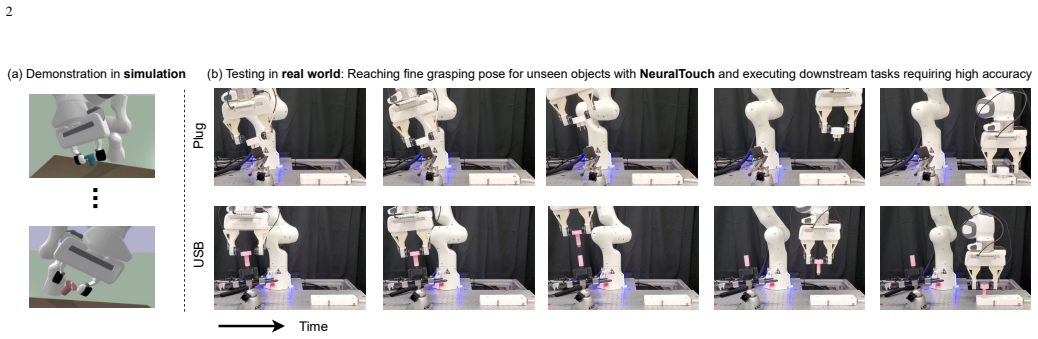
Summary. The paper proposes NeuralTouch, a two-stage manipulation framework that combines Neural Descriptor Fields (NDF) for coarse, category-level grasp pose generation with a deep RL policy that refines the pose using tactile images, proprioception, and NDF target descriptors. The fine-phase policy is trained in simulation with PPO and transferred zero-shot to a real Franka arm with TacTip sensors via a pix2pix-based real-to-sim tactile translation. In simulation, NeuralTouch reduces position errors from 9.5-13.6 mm (NDF) to 0.7-1.0 mm and outperforms an RL-touch baseline lacking descriptors. Real-world experiments on bottle-lid opening and peg-out/in-hole with cylindrical objects report higher success rates than NDF alone. The paper claims this is a general framework for precise contact-rich manipulation.
Significance. If the reported results hold, NeuralTouch is a valuable contribution: it shows that conditioning a tactile RL policy on neural descriptors can substantially improve precision over vision-only NDF while retaining category-level generalization, and it demonstrates zero-shot sim-to-real for cylindrical features. The simulation ablation is well motivated, the online target-switching result (Fig. 6) is compelling, and the authors are transparent about the tactile-transfer limitations on curved surfaces and light contacts. However, the absence of statistical rigor and the narrow real-world geometry scope mean the evidence does not yet support the strong 'general framework' claim.
major comments (4)
- [Sec. V-A / Tables I-IV] The central quantitative claims are reported without error bars, standard deviations, or trial counts. Table I gives 'average' errors with no variance despite the training curves in Fig. 5 being over 10 seeds; Table II gives success rates for 60 trials without confidence intervals; Tables III-IV give success rates without stating the number of real-world trials. This makes it impossible to assess whether the large improvements (e.g., 0.8 mm vs 13.6 mm in Table I) are significant or stable. Please report per-seed/per-trial statistics, confidence intervals, and trial counts for all tables.
- [Sec. IV-C2 / V-A / Eq. (4)] The training initial poses are sampled uniformly from [±20 mm, ±20°] rather than from the NDF optimizer, because 'initial grasping poses are not sampled from the NDF optimizer during training' (Sec. IV-C2). The Table I comparison with the NDF baseline is therefore not an end-to-end comparison from the same coarse-pose distribution: the NDF row reports errors of the NDF-generated pose, while the NeuralTouch row reports errors after refinement from random poses within a fixed box. To substantiate the claim that NeuralTouch improves NDF-based grasping, the evaluation should initialize the policy from the NDF output (or a held-out set of NDF failures) and report the resulting final errors, or at least report the distribution of NDF initial errors and show the policy is robust over that distribution.
- [Sec. IV-C3 / V-C1 / Abstract] The zero-shot sim-to-real evidence is restricted to cylindrical features. The authors state that the tactile real-to-sim transfer 'performed unsatisfactorily with the curved surfaces of the mugs and handles' (Sec. IV-C3), so real-world experiments were limited to cylinders; they additionally report failures on light contacts due to tactile aliasing (Sec. V-C1). Consequently, the real-world results support the method for cylinder-like geometries with relatively firm contacts only. The abstract's 'general framework for precise, contact-rich robotic manipulation' and the phrase 'various objects' overstate the demonstrated scope. Either add real-world experiments on non-cylindrical features or revise the claims to specify cylindrical-contact geometry.
- [Sec. IV-C3 / Fig. 2] The real-to-sim tactile image transfer is a load-bearing component of the zero-shot claim, but it is evaluated only qualitatively. No quantitative validation of the pix2pix transfer accuracy (e.g., pose-estimation error on a held-out set of real contacts) is provided, and the paper notes that it 'performed unsatisfactorily' for curved surfaces. Given that the policy depends on this transfer, please report quantitative transfer accuracy and, ideally, analyze how transfer error compares to the policy's tolerance. This would clarify the boundary conditions of the otherwise promising results.
minor comments (5)
- [Sec. II-C] Typo: 'relared' should be 'related'.
- [Sec. IV-C1 / Eq. (4)] The number of target descriptor samples per feature is fixed at 12, but the sampling procedure is not described; please specify how the 12 descriptors are drawn (e.g., from demonstrations, perturbed poses) and whether this choice affects performance.
- [Fig. 5] The caption labels 'Without Neural Descriptors' and 'With Neural Descriptors' without indicating which curve corresponds to which color; please clarify in the caption or legend.
- [Table I] The heading 'average error' is ambiguous because the rows aggregate over six target features; please define how the average is computed and report per-feature results with variance.
- [Sec. III-C / Fig. 6] The online target-switching demo is interesting, but the quantitative success of switching (e.g., number of trials) is not reported; please add at least a brief evaluation or clarify that it is a qualitative illustration.
Circularity Check
No significant circularity: NeuralTouch's improvements are empirical results from an external NDF representation and a goal-conditioned RL policy.
full rationale
The paper's central claim is an empirical system result, not a derivation that reduces to its own inputs. The coarse grasping pose is obtained from the external Neural Descriptor Fields work (Simeonov et al., [4]) via Eq. (4), which is a pose regression objective, not a fitted prediction of the paper's own evaluation outcomes. The RL policy is trained with PPO in simulation, conditioned on target NDF descriptors, tactile images, and proprioception; the descriptors are observations specifying the goal, not parameters fitted to the test results. The reported simulation and real-world success rates are measured outcomes of executing the policy, and there is no equation in the paper where the predicted quantity is identical by construction to a fitted input. The real-to-sim tactile transfer uses a pix2pix GAN trained on paired simulated/real tactile images, following prior work [26], [27]; this is a domain-transfer component and is not a claim that the downstream task success is statistically forced by that training data. Self-citations appear (e.g., Tactile Gym 2.0 [27], real-to-sim translation [26], tactile aliasing [57]), but they are supporting tools or explanatory references, not load-bearing uniqueness theorems or the sole justification for the central improvement claim. The manuscript explicitly reports limitations—curved-surface transfer failure (Sec. IV-C3) and light-contact aliasing (Sec. V-C1)—which narrow the scope of the 'general framework' claim but do not indicate circular reasoning. The central derivation chain is therefore self-contained with respect to the paper's inputs.
Axiom & Free-Parameter Ledger
free parameters (2)
- Initial pose perturbation range =
±20 mm, ±20° in each translation/rotation axis
- Number of target descriptor samples per feature =
12
axioms (5)
- domain assumption The target contact is assumed to be where tactile sensors are perpendicular to the local surface (normal contact assumption).
- domain assumption The pretrained occupancy network on ShapeNet categories (bottles, mugs, bolts) generalizes to unseen real-world objects in these categories.
- domain assumption The pix2pix GAN trained on paired real/sim images transfers real tactile images to simulated ones with sufficient fidelity for the policy.
- domain assumption PyBullet with modelled TacTip sensors accurately simulates contact dynamics needed for policy training.
- domain assumption Uniformly sampled initial poses in the range [±20mm, ±20°] represent the distribution of NDF optimizer errors at test time.
read the original abstract
Grasping accuracy is a critical prerequisite for precise object manipulation, often requiring careful alignment between the robot hand and object. Neural Descriptor Fields (NDF) offer a promising vision-based method to generate grasping poses that generalize across object categories. However, NDF alone can produce inaccurate poses due to imperfect camera calibration, incomplete point clouds, and object variability. Meanwhile, tactile sensing enables more precise contact, but existing approaches typically learn policies limited to simple, predefined contact geometries. In this work, we introduce NeuralTouch, a multimodal framework that integrates NDF and tactile sensing to enable accurate, generalizable grasping through gentle physical interaction. Our approach leverages NDF to implicitly represent the target contact geometry, from which a deep reinforcement learning (RL) policy is trained to refine the grasp using tactile feedback. This policy is conditioned on the neural descriptors and does not require explicit specification of contact types. We validate NeuralTouch through ablation studies in simulation and zero-shot transfer to real-world manipulation tasks--such as peg-out-in-hole and bottle lid opening--without additional fine-tuning. Results show that NeuralTouch significantly improves grasping accuracy and robustness over baseline methods, offering a general framework for precise, contact-rich robotic manipulation.
Figures


Reference graph
Works this paper leans on
-
[1]
Adelson, and Sergey Levine
Roberto Calandra, Andrew Owens, Dinesh Jayaraman, Justin Lin, Wen- zhen Yuan, Jitendra Malik, Edward H. Adelson, and Sergey Levine. More than a feeling: Learning to grasp and regrasp using vision and touch.IEEE Robotics and Automation Letters, 3(4):3300–3307, 2018
2018
-
[2]
Simple, a visuotactile method learned in simulation to precisely pick, localize, regrasp, and place objects.Science Robotics, 9(91):eadi8808, 2024
Maria Bauza, Antonia Bronars, Yifan Hou, Ian Taylor, Nikhil Chavan- Dafle, and Alberto Rodriguez. Simple, a visuotactile method learned in simulation to precisely pick, localize, regrasp, and place objects.Science Robotics, 9(91):eadi8808, 2024
2024
-
[3]
Planning visual-tactile precision grasps via complementary use of vision and touch.IEEE Robotics and Automation Letters, 8(2):768–775, 2023
Martin Matak and Tucker Hermans. Planning visual-tactile precision grasps via complementary use of vision and touch.IEEE Robotics and Automation Letters, 8(2):768–775, 2023
2023
-
[4]
Neural descriptor fields: Se (3)-equivariant object representations for manipu- lation
Anthony Simeonov, Yilun Du, Andrea Tagliasacchi, Joshua B Tenen- baum, Alberto Rodriguez, Pulkit Agrawal, and Vincent Sitzmann. Neural descriptor fields: Se (3)-equivariant object representations for manipu- lation. In2022 International Conference on Robotics and Automation (ICRA), pages 6394–6400. IEEE, 2022
2022
-
[5]
N. Lepora. Soft Biomimetic Optical Tactile Sensing With the TacTip: A Review.IEEE Sensors Journal, 21(19):21131–21143, October 2021
2021
-
[6]
A. C. Abad and A. Ranasinghe. Visuotactile sensors with emphasis on gelsight sensor: A review.IEEE Sensors Journal, 20(14):7628–7638, July 2020
2020
-
[7]
Chenghua Lu, Kailuan Tang, Max Yang, Tianqi Yue, Haoran Li, and Nathan F. Lepora. Dexitac: Soft dexterous tactile gripping.IEEE/ASME Transactions on Mechatronics, 30(1):333–344, 2025
2025
-
[8]
Rotipbot: Robotic handling of thin and flexible objects using rotatable tactile sensors.IEEE Transactions on Robotics, pages 1–19, 2025
Jiaqi Jiang, Xuyang Zhang, Daniel Fernandes Gomes, Thanh-Toan Do, and Shan Luo. Rotipbot: Robotic handling of thin and flexible objects using rotatable tactile sensors.IEEE Transactions on Robotics, pages 1–19, 2025
2025
-
[9]
Representation reinforcement learning-based dense control for point following with state sparse sensing of 3-d snake robots
Lixing Liu, Jiashun Liu, Xian Guo, Wei Huang, Yongchun Fang, and Jianye Hao. Representation reinforcement learning-based dense control for point following with state sparse sensing of 3-d snake robots. IEEE/ASME Transactions on Mechatronics, 30(2):851–861, 2025. 10
2025
-
[10]
Max Yang, Chenghua Lu, Alex Church, Yijiong Lin, Chris Ford, Haoran Li, Efi Psomopoulou, David AW Barton, and Nathan F Lepora. Anyrotate: Gravity-invariant in-hand object rotation with sim-to-real touch.arXiv preprint arXiv:2405.07391, 2024
Pith/arXiv arXiv 2024
-
[11]
Church, J
A. Church, J. Lloyd, R. Hadsell, and N. F Lepora. Deep reinforcement learning for tactile robotics: Learning to type on a braille keyboard. IEEE Robotics and Automation Letters, 5(4):6145–6152, July 2019
2019
-
[12]
Amadio, A
F. Amadio, A. Colomé, and C. Torras. Exploiting symmetries in reinforcement learning of bimanual robotic tasks.IEEE Robotics and Automation Letters, 4(2):1838–1845, 2019
2019
-
[13]
Where shall i touch? vision-guided tactile poking for transparent object grasping.IEEE/ASME Transactions on Mechatronics, 28(1):233– 244, 2023
Jiaqi Jiang, Guanqun Cao, Aaron Butterworth, Thanh-Toan Do, and Shan Luo. Where shall i touch? vision-guided tactile poking for transparent object grasping.IEEE/ASME Transactions on Mechatronics, 28(1):233– 244, 2023
2023
-
[14]
W. Yuan, S. Dong, and E. H. Adelson. Gelsight: High-resolution robot tactile sensors for estimating geometry and force.Sensors, 17(12):2762, November 2017
2017
-
[15]
Learning generaliz- able vision-tactile robotic grasping strategy for deformable objects via transformer.IEEE/ASME Transactions on Mechatronics, 30(1):554–566, 2025
Yunhai Han, Kelin Yu, Rahul Batra, Nathan Boyd, Chaitanya Mehta, Tuo Zhao, Yu She, Seth Hutchinson, and Ye Zhao. Learning generaliz- able vision-tactile robotic grasping strategy for deformable objects via transformer.IEEE/ASME Transactions on Mechatronics, 30(1):554–566, 2025
2025
-
[16]
Attention is all you need.Advances in neural information processing systems, 30, 2017
Ashish Vaswani, Noam Shazeer, Niki Parmar, Jakob Uszkoreit, Llion Jones, Aidan N Gomez, Łukasz Kaiser, and Illia Polosukhin. Attention is all you need.Advances in neural information processing systems, 30, 2017
2017
-
[17]
Lepora and J
N. Lepora and J. Lloyd. Pose-Based Tactile Servoing: Controlled Soft Touch Using Deep Learning.IEEE Robotics & Automation Magazine, 28(4):43–55, December 2021
2021
-
[18]
Lepora, Alex Church, Conrad de Kerckhove, Raia Hadsell, and John Lloyd
Nathan F. Lepora, Alex Church, Conrad de Kerckhove, Raia Hadsell, and John Lloyd. From pixels to percepts: Highly robust edge perception and contour following using deep learning and an optical biomimetic tactile sensor.IEEE Robotics and Automation Letters, 4(2):2101–2107, 2019
2019
-
[19]
N. F. Lepora, Y . Lin, B. Money-Coomes, and J. Lloyd. Digitac: A digit- tactip hybrid tactile sensor for comparing low-cost high-resolution robot touch.IEEE Robotics and Automation Letters, 7(4):9382–9388, 2022
2022
-
[20]
Lloyd and N
J. Lloyd and N. Lepora. Goal-Driven Robotic Pushing Using Tactile and Proprioceptive Feedback.IEEE Transactions on Robotics, 38(2):1201– 1212, April 2022
2022
-
[21]
John Lloyd and Nathan F. Lepora. Pose-and-shear-based tac- tile servoing.The International Journal of Robotics Research, 0(0):02783649231225811, 0
-
[22]
Achu Wilson, Helen Jiang, Wenzhao Lian, and Wenzhen Yuan. Cable routing and assembly using tactile-driven motion primitives.arXiv preprint arXiv:2303.11765, 2023
Pith/arXiv arXiv 2023
-
[23]
Cable manipulation with a tactile-reactive gripper
Yu She, Shaoxiong Wang, Siyuan Dong, Neha Sunil, Alberto Rodriguez, and Edward Adelson. Cable manipulation with a tactile-reactive gripper. The International Journal of Robotics Research, 40(12-14):1385–1401, 2021
2021
-
[24]
Skill generalization of tubular object manipulation with tactile sensing and sim2real learning.Robotics and Autonomous Systems, 160:104321, 2023
Yongqiang Zhao, Xingshuo Jing, Kun Qian, Daniel Fernandes Gomes, and Shan Luo. Skill generalization of tubular object manipulation with tactile sensing and sim2real learning.Robotics and Autonomous Systems, 160:104321, 2023
2023
-
[25]
Visual-tactile multimodal- ity for following deformable linear objects using reinforcement learning
Leszek Pecyna, Siyuan Dong, and Shan Luo. Visual-tactile multimodal- ity for following deformable linear objects using reinforcement learning. In2022 IEEE/RSJ International Conference on Intelligent Robots and Systems (IROS), pages 3987–3994. IEEE, 2022
2022
-
[26]
Church, J
A. Church, J. Lloyd, R. Hadsell, and N. Lepora. Tactile Sim-to-Real Policy Transfer via Real-to-Sim Image Translation. InProceedings of the 5th Conference on Robot Learning, pages 1–9. PMLR, October 2021
2021
-
[27]
Y . Lin, J. Lloyd, A. Church, and N. Lepora. Tactile gym 2.0: Sim-to- real deep reinforcement learning for comparing low-cost high-resolution robot touch. volume 7 ofProceedings of Machine Learning Research, pages 10754–10761. IEEE, August 2022
2022
-
[28]
Yijiong Lin, Alex Church, Max Yang, Haoran Li, John Lloyd, Dandan Zhang, and Nathan F. Lepora. Bi-touch: Bimanual tactile manipulation with sim-to-real deep reinforcement learning.IEEE Robotics and Automation Letters, 8(9):5472–5479, 2023
2023
-
[29]
Neural fields in visual computing and beyond
Yiheng Xie, Towaki Takikawa, Shunsuke Saito, Or Litany, Shiqin Yan, Numair Khan, Federico Tombari, James Tompkin, Vincent Sitzmann, and Srinath Sridhar. Neural fields in visual computing and beyond. In Computer Graphics Forum, volume 41, pages 641–676. Wiley Online Library, 2022
2022
-
[30]
Touchsdf: A deepsdf approach for 3d shape reconstruction using vision-based tactile sensing.IEEE Robotics and Automation Letters, 2024
Mauro Comi, Yijiong Lin, Alex Church, Alessio Tonioni, Laurence Aitchison, and Nathan F Lepora. Touchsdf: A deepsdf approach for 3d shape reconstruction using vision-based tactile sensing.IEEE Robotics and Automation Letters, 2024
2024
-
[31]
Mauro Comi, Alessio Tonioni, Max Yang, Jonathan Tremblay, Valts Blukis, Yijiong Lin, Nathan F Lepora, and Laurence Aitchison. Snap-it, tap-it, splat-it: Tactile-informed 3d gaussian splatting for reconstructing challenging surfaces.arXiv preprint arXiv:2403.20275, 2024
Pith/arXiv arXiv 2024
-
[32]
Se (3)-equivariant relational rearrangement with neural descriptor fields
Anthony Simeonov, Yilun Du, Yen-Chen Lin, Alberto Rodriguez Garcia, Leslie Pack Kaelbling, Tomás Lozano-Pérez, and Pulkit Agrawal. Se (3)-equivariant relational rearrangement with neural descriptor fields. In Conference on Robot Learning, pages 835–846. PMLR, 2023
2023
-
[33]
Anthony Simeonov, Ankit Goyal, Lucas Manuelli, Lin Yen-Chen, Alina Sarmiento, Alberto Rodriguez, Pulkit Agrawal, and Dieter Fox. Shelving, stacking, hanging: Relational pose diffusion for multi-modal rearrangement.arXiv preprint arXiv:2307.04751, 2023
Pith/arXiv arXiv 2023
-
[34]
Local neural descriptor fields: Locally conditioned object representations for manipulation
Ethan Chun, Yilun Du, Anthony Simeonov, Tomas Lozano-Perez, and Leslie Kaelbling. Local neural descriptor fields: Locally conditioned object representations for manipulation. In2023 IEEE International Conference on Robotics and Automation (ICRA), pages 1830–1836. IEEE, 2023
2023
-
[35]
Yixuan Wang, Zhuoran Li, Mingtong Zhang, Katherine Driggs- Campbell, Jiajun Wu, Li Fei-Fei, and Yunzhu Li. D3fields: Dynamic 3d descriptor fields for zero-shot generalizable robotic manipulation.arXiv preprint arXiv:2309.16118, 2023
Pith/arXiv arXiv 2023
-
[36]
Center-of-mass- based object regrasping: A reinforcement learning approach and the ef- fects of perception modality.IEEE/ASME Transactions on Mechatronics, 30(2):1356–1365, 2025
Renpeng Wang, Yu Xie, Houde Liu, and Wei Zhou. Center-of-mass- based object regrasping: A reinforcement learning approach and the ef- fects of perception modality.IEEE/ASME Transactions on Mechatronics, 30(2):1356–1365, 2025
2025
-
[37]
Tactile-based insertion for dense box-packing
Siyuan Dong and Alberto Rodriguez. Tactile-based insertion for dense box-packing. In2019 IEEE/RSJ International Conference on Intelligent Robots and Systems (IROS), pages 7953–7960. IEEE, 2019
2019
-
[38]
Jha, Diego Romeres, Sangwoon Kim, Daniel Nikovski, and Alberto Rodriguez
Siyuan Dong, Devesh K. Jha, Diego Romeres, Sangwoon Kim, Daniel Nikovski, and Alberto Rodriguez. Tactile-rl for insertion: Generalization to objects of unknown geometry. In2021 IEEE International Conference on Robotics and Automation (ICRA), pages 6437–6443, 2021
2021
-
[39]
Sims- hear: Sim-to-real shear-based tactile servoing.arXiv preprint arXiv:2508.20561, 2025
Kipp McAdam Freud, Yijiong Lin, and Nathan F Lepora. Sims- hear: Sim-to-real shear-based tactile servoing.arXiv preprint arXiv:2508.20561, 2025
Pith/arXiv arXiv 2025
-
[40]
Carolina Higuera, Joseph Ortiz, Haozhi Qi, Luis Pineda, Byron Boots, and Mustafa Mukadam. Perceiving extrinsic contacts from touch improves learning insertion policies.arXiv preprint arXiv:2309.16652, 2023
Pith/arXiv arXiv 2023
-
[41]
Tac2pose: Tactile object pose estimation from the first touch.The International Journal of Robotics Research, 42(13):1185–1209, 2023
Maria Bauza, Antonia Bronars, and Alberto Rodriguez. Tac2pose: Tactile object pose estimation from the first touch.The International Journal of Robotics Research, 42(13):1185–1209, 2023
2023
-
[42]
Tactile object pose estimation from the first touch with geometric contact rendering
Maria Bauza Villalonga, Alberto Rodriguez, Bryan Lim, Eric Valls, and Theo Sechopoulos. Tactile object pose estimation from the first touch with geometric contact rendering. InConference on Robot Learning, pages 1015–1029. PMLR, 2021
2021
-
[43]
Coarse-to-fine imitation learning: Robot manipulation from a single demonstration
Edward Johns. Coarse-to-fine imitation learning: Robot manipulation from a single demonstration. In2021 IEEE International Conference on Robotics and Automation (ICRA), pages 4613–4619, 2021
2021
-
[44]
Pointnet++: Deep hierarchical feature learning on point sets in a metric space.Advances in neural information processing systems, 30, 2017
Charles Ruizhongtai Qi, Li Yi, Hao Su, and Leonidas J Guibas. Pointnet++: Deep hierarchical feature learning on point sets in a metric space.Advances in neural information processing systems, 30, 2017
2017
-
[45]
Vector neurons: A general framework for so (3)-equivariant networks
Congyue Deng, Or Litany, Yueqi Duan, Adrien Poulenard, Andrea Tagliasacchi, and Leonidas J Guibas. Vector neurons: A general framework for so (3)-equivariant networks. InProceedings of the IEEE/CVF International Conference on Computer Vision, pages 12200– 12209, 2021
2021
-
[46]
Occupancy networks: Learning 3d reconstruction in function space
Lars Mescheder, Michael Oechsle, Michael Niemeyer, Sebastian Nowozin, and Andreas Geiger. Occupancy networks: Learning 3d reconstruction in function space. InProceedings of the IEEE/CVF conference on computer vision and pattern recognition, pages 4460– 4470, 2019
2019
-
[47]
Optimal deep learning for robot touch: Training accurate pose models of 3d surfaces and edges.IEEE Robotics & Automation Magazine, 27(2):66–77, 2020
Nathan F Lepora and John Lloyd. Optimal deep learning for robot touch: Training accurate pose models of 3d surfaces and edges.IEEE Robotics & Automation Magazine, 27(2):66–77, 2020
2020
-
[48]
Pybullet, a python module for physics simulation for games, robotics and machine learning, 2016
Erwin Coumans and Yunfei Bai. Pybullet, a python module for physics simulation for games, robotics and machine learning, 2016
2016
-
[49]
Fots: A fast optical tactile simulator for sim2real learning of tactile-motor robot manipulation skills.IEEE Robotics and Automation Letters, 2024
Yongqiang Zhao, Kun Qian, Boyi Duan, and Shan Luo. Fots: A fast optical tactile simulator for sim2real learning of tactile-motor robot manipulation skills.IEEE Robotics and Automation Letters, 2024
2024
-
[50]
Efficient tactile simulation with differentiability for robotic manipulation
Jie Xu, Sangwoon Kim, Tao Chen, Alberto Rodriguez Garcia, Pulkit Agrawal, Wojciech Matusik, and Shinjiro Sueda. Efficient tactile simulation with differentiability for robotic manipulation. In6th Annual Conference on Robot Learning, 2022
2022
-
[51]
Neural contact fields: Tracking extrinsic contact with tactile sensing
Carolina Higuera, Siyuan Dong, Byron Boots, and Mustafa Mukadam. Neural contact fields: Tracking extrinsic contact with tactile sensing. 11 In2023 IEEE International Conference on Robotics and Automation (ICRA), pages 12576–12582, 2023
2023
-
[52]
Active extrinsic contact sensing: Application to general peg-in-hole insertion
Sangwoon Kim and Alberto Rodriguez. Active extrinsic contact sensing: Application to general peg-in-hole insertion. In2022 International Conference on Robotics and Automation (ICRA), pages 10241–10247, 2022
2022
-
[53]
Shapenet: An information-rich 3d model repository.arXiv preprint arXiv:1512.03012, 2015
Angel X Chang, Thomas Funkhouser, Leonidas Guibas, Pat Hanrahan, Qixing Huang, Zimo Li, Silvio Savarese, Manolis Savva, Shuran Song, Hao Su, et al. Shapenet: An information-rich 3d model repository.arXiv preprint arXiv:1512.03012, 2015
Pith/arXiv arXiv 2015
-
[54]
J. Schulman, F. Wolski, A. Radford, and O. Klimov. Proximal policy optimization algorithms.arXiv preprint:1707.06347, 2017
Pith/arXiv arXiv 2017
-
[55]
Raffin, A
A. Raffin, A. Hill, M. Ernestus, A. Gleave, A. Kanervisto, and N. Dor- mann. Stable baselines3, 2019
2019
-
[56]
Isola, J
P. Isola, J. Y . Zhu, T. Zhou, and A. A Efros. Image-to-image translation with conditional adversarial networks. InProceedings of the IEEE Conference on Computer Vision and Pattern Recognition (CVPR), pages 1125–1134, July 2017
2017
-
[57]
John Lloyd, Yijiong Lin, and Nathan F Lepora. Probabilistic discrim- inative models address the tactile perceptual aliasing problem.arXiv preprint arXiv:2106.02125, 2021
Pith/arXiv arXiv 2021
discussion (0)
Sign in with ORCID, Apple, or X to comment. Anyone can read and Pith papers without signing in.