Mass and Decay-Constant Evolution of Heavy Quarkonia and B_c States from Thermal QCD Sum Rules
Pith reviewed 2026-05-18 03:54 UTC · model grok-4.3
The pith
Heavy quarkonia and B_c states lose mass and decay strength with rising temperature in a binding-energy hierarchy.
A machine-rendered reading of the paper's core claim, the machinery that carries it, and where it could break.
Core claim
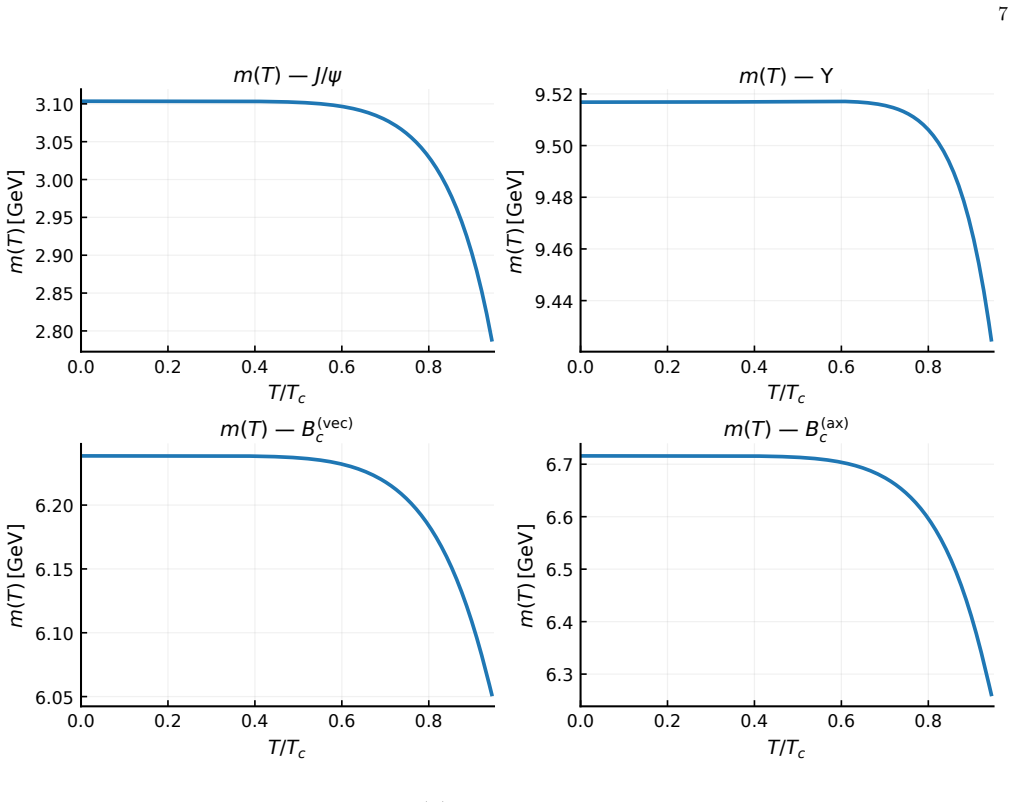
Within the leading-order plus dimension-4 condensate framework of thermal QCD sum rules, calibrated at zero temperature to experimental and LHCb values and employing a vacuum-stability-constrained temperature-dependent continuum threshold together with lattice-informed gluon condensates, the masses and decay constants of J/ψ, Υ, and B_c evolve such that near the critical temperature the relative suppression of the decay constants follows the order Υ < J/ψ < B_c, consistent with their binding energies; the same analysis yields a 1P–1S mass splitting of 0.477 GeV for the B_c system.
What carries the argument
Finite-temperature QCD sum rules with a temperature-dependent continuum threshold constrained by vacuum stability and limited to leading-order plus dimension-4 condensates.
If this is right
- The suppression hierarchy is consistent with binding energies and lattice spectral trends.
- The predicted 0.477 GeV 1P–1S splitting for B_c aligns with LHCb observations of orbitally excited states.
- The results supply a coherent finite-temperature baseline for later inclusion of radiative, higher-dimensional, and width effects.
Where Pith is reading between the lines
- The hierarchy suggests B_c states may dissociate earlier than pure bottomonium in the quark-gluon plasma formed in heavy-ion collisions.
- The same sum-rule setup could be applied to other mixed heavy-flavor systems to map their thermal stability.
- Direct comparison with full lattice QCD spectral functions would test whether the leading-order plus D=4 truncation remains adequate at high temperature.
Load-bearing premise
That leading-order plus dimension-4 condensates together with a temperature-dependent continuum threshold are sufficient to capture the dominant thermal evolution without higher-order terms or resonance-width corrections.
What would settle it
A lattice spectral-function calculation or heavy-ion data set showing that the decay-constant suppression of B_c is not stronger than that of J/ψ near the critical temperature.
Figures


read the original abstract
We analyze the thermal behavior of heavy vector and axial-vector mesons ($J/\psi$, $\Upsilon$, and $B_c$) within the finite-temperature QCD sum-rule framework. Using updated PDG-2024 quark masses, modern lattice-informed gluon condensates, and a temperature-dependent continuum threshold constrained by vacuum stability, we compute the evolution of the masses $m(T)$ and decay constants $f(T)$ up to $T/T_c \lesssim 0.9$. At $T=0$ the sum rules are calibrated to reproduce the experimental and LHCb masses and reference decay constants within the expected $\mathcal{O}(10\%)$ accuracy of a leading-order $+$ $D{=}4$ phenomenological analysis. The subsequent finite-temperature evolution should therefore be interpreted as a calibrated model prediction within this framework rather than as a fully parameter-free determination. Near the critical temperature, the relative suppression follows a clear hierarchy $\Upsilon < J/\psi < B_c$, consistent with their binding energies and lattice spectral trends. The predicted $1P$--$1S$ splitting for the $B_c$ system, $0.477~\mathrm{GeV}$, is consistent with the LHCb observation of orbitally excited $B_c^{+}$ states. The results provide a coherent finite-temperature baseline for future extensions including radiative, higher-dimensional, and width effects.
Editorial analysis
A structured set of objections, weighed in public.
Referee Report
Summary. The manuscript applies finite-temperature QCD sum rules to the vector and axial-vector channels of J/ψ, Υ, and B_c states. A leading-order perturbative term plus the dimension-4 gluon condensate is used, together with a temperature-dependent continuum threshold s0(T) fixed by a vacuum-stability constraint. Zero-temperature parameters are calibrated to PDG-2024 masses and reference decay constants; the finite-T evolution is presented as a calibrated model prediction. Near Tc the authors report a suppression hierarchy Υ < J/ψ < B_c and a 1P–1S splitting of 0.477 GeV for the B_c system.
Significance. If robust, the work supplies a coherent phenomenological baseline for the thermal evolution of heavy-quarkonium masses and decay constants that is consistent with binding-energy ordering and existing lattice spectral trends. The explicit calibration to vacuum data and the use of updated quark masses plus lattice-informed condensates are positive features of the analysis.
major comments (2)
- [Finite-temperature sum-rule analysis] The central hierarchy Υ < J/ψ < B_c near Tc is obtained after fixing the functional form of s0(T) by the vacuum-stability requirement. The manuscript does not quantify how alternative parametrizations (linear versus exponential drop, or different stability windows) shift the extracted m(T) and f(T) for each state; because this choice is shared across channels and directly controls the Borel-window stability, it is load-bearing for the reported ordering.
- [Truncation and systematic uncertainties] The truncation to leading-order perturbative contributions plus only the D=4 gluon condensate is stated to carry sizable systematic uncertainty. No estimate is provided of the size of omitted higher-dimensional condensates or finite-width corrections on the temperature evolution of the masses and decay constants; this omission affects the reliability of the quantitative hierarchy and the 0.477 GeV splitting prediction.
minor comments (2)
- [Introduction and calibration] The abstract refers to 'reference decay constants'; the main text should explicitly list the numerical values adopted for f at T=0 for each channel.
- [Formalism] Notation for the decay constant in the B_c axial-vector channel should be clarified to avoid confusion with the vector channel.
Simulated Author's Rebuttal
We thank the referee for the careful and constructive report. We address each major comment below and indicate the revisions we intend to implement.
read point-by-point responses
-
Referee: The central hierarchy Υ < J/ψ < B_c near Tc is obtained after fixing the functional form of s0(T) by the vacuum-stability requirement. The manuscript does not quantify how alternative parametrizations (linear versus exponential drop, or different stability windows) shift the extracted m(T) and f(T) for each state; because this choice is shared across channels and directly controls the Borel-window stability, it is load-bearing for the reported ordering.
Authors: We agree that the parametrization of s0(T) is a key ingredient that influences Borel-window stability and the resulting thermal evolution. Our choice was fixed by the vacuum-stability constraint to maintain consistency across the temperature range and channels. In the revised manuscript we will add a dedicated sensitivity study that examines the effect of alternative forms (linear versus exponential) and modest variations in the stability window. This analysis will quantify the shifts in m(T) and f(T) and demonstrate that the reported suppression hierarchy remains stable within the expected uncertainties of the framework. revision: yes
-
Referee: The truncation to leading-order perturbative contributions plus only the D=4 gluon condensate is stated to carry sizable systematic uncertainty. No estimate is provided of the size of omitted higher-dimensional condensates or finite-width corrections on the temperature evolution of the masses and decay constants; this omission affects the reliability of the quantitative hierarchy and the 0.477 GeV splitting prediction.
Authors: Our analysis is performed at leading order with the dimension-4 gluon condensate, as is standard for this phenomenological approach, and the manuscript already characterizes the finite-T results as calibrated model predictions within this truncation. We acknowledge that a more explicit discussion of the omitted higher-dimensional operators and finite-width effects would improve the presentation. In the revision we will include a short subsection that provides order-of-magnitude estimates, drawn from existing literature, for the potential impact of these contributions on the mass and decay-constant evolution near Tc. This will help qualify the quantitative hierarchy and the quoted B_c splitting. revision: yes
Circularity Check
No significant circularity; standard calibration and thermal inputs remain independent
full rationale
The analysis calibrates zero-temperature sum-rule parameters to experimental masses and decay constants in the conventional manner for QCD sum rules, then evolves the system using temperature-dependent gluon condensates taken from lattice QCD and a continuum threshold adjusted to preserve Borel stability. These thermal modifications supply external content not present in the T=0 fit, so the reported mass and decay-constant evolution, including the hierarchy near Tc, does not reduce to the inputs by construction. The paper itself describes the finite-T results as a calibrated model prediction rather than a parameter-free derivation, which is consistent with the method and does not constitute circularity under the stated criteria.
Axiom & Free-Parameter Ledger
free parameters (2)
- temperature-dependent continuum threshold
- gluon condensate values
axioms (2)
- domain assumption Leading-order plus dimension-4 operator product expansion remains adequate at finite temperature
- ad hoc to paper Vacuum stability constraint determines the temperature dependence of the continuum threshold
Lean theorems connected to this paper
-
IndisputableMonolith/Cost/FunctionalEquation.leanwashburn_uniqueness_aczel unclear?
unclearRelation between the paper passage and the cited Recognition theorem.
We model the continuum threshold as s0(T)=s0(0)[1−(T/Tc)^nC]+(m1+m2)^2(T/Tc)^nC ... with channel-specific exponents nΥ=12, nJ/ψ=8, nB(V)c=7, nB(A)c=7.5
-
IndisputableMonolith/Foundation/RealityFromDistinction.leanreality_from_one_distinction unclear?
unclearRelation between the paper passage and the cited Recognition theorem.
the temperature dependence of the gluon condensate is anchored to modern lattice-QCD determinations of the equation of state and crossover temperature
What do these tags mean?
- matches
- The paper's claim is directly supported by a theorem in the formal canon.
- supports
- The theorem supports part of the paper's argument, but the paper may add assumptions or extra steps.
- extends
- The paper goes beyond the formal theorem; the theorem is a base layer rather than the whole result.
- uses
- The paper appears to rely on the theorem as machinery.
- contradicts
- The paper's claim conflicts with a theorem or certificate in the canon.
- unclear
- Pith found a possible connection, but the passage is too broad, indirect, or ambiguous to say the theorem truly supports the claim.
Reference graph
Works this paper leans on
-
[1]
A. I. Bochkarev and M. E. Shaposhnikov, Nuclear Physics B268, 220 (1986)
work page 1986
-
[2]
C. A. Dominguez and M. Loewe, Phys. Lett. B233, 201 (1989)
work page 1989
- [3]
- [4]
- [5]
-
[6]
E. V. Veliev, K. Azizi, H. Sundu, and N. Aksit, Nucl. Phys. B Proc. Suppl.219-220, 170 (2011)
work page 2011
-
[7]
E. V. Veliev, K. Azizi, H. Sundu, and N. Ak¸ sit, Journal of Physics G: Nuclear and Particle Physics39, 015002 (2012)
work page 2012
-
[8]
E. V. Veliev, K. Azizi, H. Sundu, G. Kaya, and A. T¨ urkan, Eur. Phys. J. A47, 110 (2011), arXiv:1103.4330 [hep-ph]
work page internal anchor Pith review Pith/arXiv arXiv 2011
-
[9]
Thermal properties of $D_2^*(2460)$ and $D_{s2}^*(2573)$ tensor mesons using QCD sum rules
K. Azizi, H. Sundu, E. V. Veliev, and A. T¨ urkan, J. Phys. G: Nucl. Part. Phys.41, 035003 (2014), arXiv:1308.0887 [hep-ph]
work page internal anchor Pith review Pith/arXiv arXiv 2014
- [10]
-
[11]
Thermal Spectrum of Heavy Vector and Axial Vector Mesons in the Framework of QCD Sum Rules Method
E. Yazici, arXiv 10.48550/arXiv.1605.05289 (2016), 1605.05289 [hep-ph]
work page internal anchor Pith review Pith/arXiv arXiv doi:10.48550/arxiv.1605.05289 2016
-
[12]
Navas and others (Particle Data Group), Phys
S. Navas and others (Particle Data Group), Phys. Rev. D110, 030001 (2024), with 2024 online updates at pdg.lbl.gov
work page 2024
-
[13]
The equation of state in (2+1)-flavor QCD
A. Bazavov and others (HotQCD Collaboration), Phys. Rev. D90, 094503 (2014), arXiv:1407.6387 [hep-lat]
work page internal anchor Pith review Pith/arXiv arXiv 2014
-
[14]
Bazavovet al.(HotQCD), Chiral crossover in QCD at zero and non-zero chemical potentials, Phys
A. Bazavov and others (HotQCD Collaboration), Phys. Lett. B795, 15 (2019), arXiv:1812.08235 [hep-lat]
-
[15]
Aaij and others (LHCb Collaboration), arXiv (2025), submitted to Phys
R. Aaij and others (LHCb Collaboration), arXiv (2025), submitted to Phys. Rev. Lett., 2507.02149 [hep-ex]
- [16]
- [17]
- [18]
- [19]
-
[20]
D. E. Miller, inESI Research Program Workshop on Quantization, Generalized BRS Cohomology and Anoma- lies(1998) arXiv:hep-ph/9907535
work page internal anchor Pith review Pith/arXiv arXiv 1998
-
[21]
P. S. H. Collaboration), Nucl. Phys. A982, 847 (2019), arXiv:1807.05607 [hep-lat]
work page internal anchor Pith review Pith/arXiv arXiv 2019
-
[22]
S. Bors´ anyi, S. D¨ urr, Z. Fodor, C. Hoelbling, S. D. Katz, S. Krieg, S. Mages, D. N´ ogr´ adi, A. P´ asztor, A. Sch¨ afer, K. K. Szab´ o, B. C. T´ oth, and N. Trombit´ as, J. High Energy Phys.2014(04), 132
work page 2014
-
[23]
S. Kim, P. Petreczky, and A. Rothkopf, J. High Energy Phys.2018(11), 088, arXiv:1808.08781 [hep-lat]
work page internal anchor Pith review Pith/arXiv arXiv 2018
-
[24]
G. Li, B. Chen, and Y. Liu, Chinese Physics C47, 023103 (2023)
work page 2023
-
[25]
Complex heavy-quark potential and Debye mass in a gluonic medium from lattice QCD
Y. Burnier and A. Rothkopf, Phys. Rev. D95, 054511 (2017), arXiv:1607.04049 [hep-lat]
work page internal anchor Pith review Pith/arXiv arXiv 2017
-
[26]
Acharya and others (ALICE Collaboration), Phys
S. Acharya and others (ALICE Collaboration), Phys. Rev. Lett.132, 042301 (2024), arXiv:2210.08893 [hep- ex]. Appendix A: Analytical estimates for OPE convergence and Borel stability
-
[27]
Dimensional estimate of the OPE convergence To estimate the truncation uncertainty without repeat- ing the full numerical Borel analysis, we evaluate the ra- tio R6/4(M2, T)≡ bBΠ(D=6)(M2, T) bBΠ(D=4)(M2, T) . Using the canonical scalingsbBΠ(D=4) ∼ ⟨αsG2⟩T /M2 and bBΠ(D=6) ∼κΛ 6/M4 with Λ≃0.24 GeV andκ=O(1), and taking⟨α sG2⟩0 = 0.012 GeV 4 together with t...
-
[28]
Borel stability and pole dominance The stability of the working windows summarized in Table I was originally established in Ref. [11]. To ver- ify that the updated lattice-informed thermal inputs pre- serve the Borel plateaus, we have repeated the stability scan atT=0 for all channels. Figure 3 shows the ex- tracted massm(M 2) as a function of the Borel p...
-
[29]
Working range in temperature Combining the dimensional estimateR 6/4 ≲0.1 with the legacy Borel stability criteria leads to the same con- servative domainT≲0.9T c adopted in the main text. Above this temperature, higher-dimensional operators and finite-width effects are expected to become compa- rable to theD=4 contribution, and the results should be inte...
discussion (0)
Sign in with ORCID, Apple, or X to comment. Anyone can read and Pith papers without signing in.