REVIEW 4 major objections 6 minor 47 references
This paper presents zkSTAR, which lets regulators verify that industrial-control attack alarms are temporally and statistically consistent, and proves a compromised utility cannot suppress alarms without exposing utility data.
Reviewed by Pith at T0; open to challenge. T0 means a machine referee read the full paper against a public rubric. the ladder, T0–T4 →
zkSTAR proves with zero-knowledge proofs that a utility's Kalman-filter-based attack alarms were computed correctly, keeping sensor data private.
T0 review reviewed 2026-08-04 challenge →
load-bearing objection Genuinely new application and solid engineering, but the central security claim collapses: the proof never binds sensor readings to physical reality, so a compromised utility can still suppress alarms. the 4 major comments →
zkSTAR: A zero knowledge system for time series attack detection enforcing regulatory compliance in critical infrastructure networks
The pith
A machine-rendered reading of the paper's core claim, the machinery that carries it, and where it could break.
The reading
Core claim
The central claim is that correct execution of a standard residual-based attack detector can be made publicly verifiable in zero knowledge. Concretely, zkSTAR defines a temporal-statistical consistency relation for each detection window: the extended Kalman filter output must follow from the previous state through the committed model, successive state estimates must be linked by matching hashes, and the standardized residual statistic must be compared with a chi-square upper control limit. Any proof artifact that verifies against this relation certifies the alarm or no-alarm decision. The paper proves that under the knowledge-soundness property of the proving system, detection suppression oc
What carries the argument
The load-bearing object is the temporal-statistical consistency relation, enforced by two zk-SNARK circuits. A zk-SNARK is a succinct cryptographic proof that a computation was performed correctly without revealing its inputs. The temporal-consistency circuit runs batched extended-Kalman-filter steps for each time interval, checks Kalman-gain reconstruction against the state covariance, and links intervals through randomized hash fingerprints. The statistical-consistency circuit validates an offline singular-value decomposition and computes the chi-square statistic against a pre-committed upper control limit. Expensive linear algebra is done offline and checked inside the circuit with small
Load-bearing premise
The load-bearing premise is that the sensor readings entering the detector are authentic physical measurements; the proof only certifies the arithmetic performed on data the utility supplies, so an attacker who can feed fake readings can keep the alarm off and still produce a verifying proof.
What would settle it
Simulate a data-driven attack at the sensor layer where the adversary replaces the sensor measurements with values that keep the detector's test statistic below the alarm threshold, and have the utility generate a proof for that window; if the proof verifies while the attack is underway, the claim that verification rules out detection suppression is refuted.
If this is right
- Regulators can audit detection outcomes on demand without receiving operational sensor data, replacing full-data audits with proof verification.
- A utility under active attack cannot suppress or rewrite alarms without violating proof verification or the temporal-statistical consistency relation.
- Detection quality in the zero-knowledge version matches the non-zero-knowledge detector on real-world industrial-control datasets across varying interval sizes and precision scale factors.
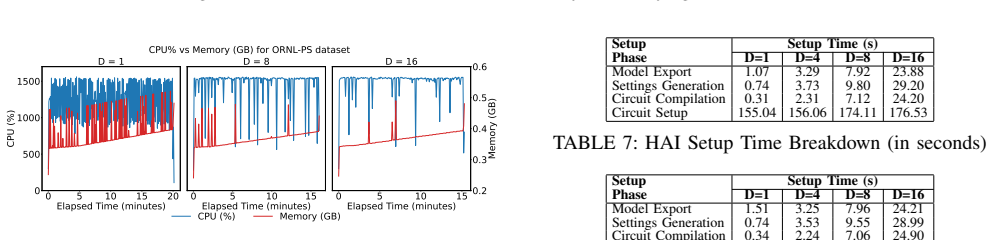
- Proof generation can be batched across temporal intervals with speedups that grow with interval size, and regulator-side verification completes in roughly one to one-and-a-half seconds.
Where Pith is reading between the lines
- Editorial inference: the guarantee is about computational integrity, not physical authenticity. The sensor readings entering the detector are supplied by the utility, so the real-world ceiling on attack suppression is whatever protects sensor data before it enters the detector; adding hardware attestation at the sensor boundary would close that gap.
- Editorial inference: the same two-circuit pattern (a temporal-consistency proof plus a statistical-decision proof) could be applied to other residual-based monitors by swapping the chi-square check for the corresponding hypothesis test.
- Editorial inference: the paper's on-demand proof model lets a regulator tune audit frequency per utility; raising frequency tightens deterrence against suppression at the cost of prover compute, a trade-off the paper does not quantify.
Editorial analysis
A structured set of objections, weighed in public.
Referee Report
Summary. The paper proposes zkSTAR, a system that wraps a utility-level EKF-based anomaly detector and its chi-square hypothesis test in Halo2/ezkl zk-SNARKs. It defines temporal consistency (TC) and statistical consistency (SC) conditions, introduces a security model based on the relation R_t in Eq. (9), and claims that under the knowledge-soundness of the proving system a compromised utility cannot falsify or suppress alarms without being detected. The framework is evaluated on the HAI and ORNL-PS datasets, reporting detection quality, proof/key sizes, proof-generation time, memory usage, and verification latency.
Significance. If the security claim were valid, the architecture would be a valuable contribution to privacy-preserving regulatory oversight of ICS anomaly detectors. The engineering data — proof-generation times of roughly 66–82 s, verification under 1.5 s, and relatively modest key/proof sizes — are useful and suggest practical feasibility as a proof-of-computation layer. However, the central advertised guarantee, that regulators can verify correctness and prevent suppression of alarms without visibility into utility-level data, is not supported. The proofs certify only that the reported alarm is the correct output of a computation over prover-supplied data; they do not certify that those data correspond to physical sensor reality. The formal results are largely definitional restatements of Halo2 knowledge-soundness, and the matrix formulas used in the statistical kernel are internally inconsistent. The experiments do not exercise the adversarial suppression scenarios that the theorems address. The paper is best evaluated as an engineering prototype, not as a validated security mechanism.
major comments (4)
- [Section 4.4, Eq. (9), Definition 9, Section 5.5] The central security claim conflates proof-of-computation with proof-of-physical-alarm. In Eq. (9), R_t is a relation over the prover-supplied tuple (Δ_in, Δ_out) and witness Ω. The only sensor-dependent component is y_t inside Δ_in, and no constraint in R_t, in the TC/SC kernels, or in the assumptions of Section 5.5 binds y_t to the actual physical sensor readings. Definition 9 defines detection suppression as Verify=1 while the extracted witness is outside R_t. Under this definition, a compromised utility that replaces the true measurement stream y_t with a crafted y_t^* for which the EKF residual chi-square statistic remains below the UCL is not 'suppressing' at all: the reported tuple satisfies R_t and the proof verifies. Thus the abstract's claim that zkSTAR 'prevents suppression of alarms without visibility into utility-level data' does not follow from the model. The missing assump
- [Theorem 4.3 and Appendix B.4] Theorem 4.3 is a definitional restatement of Halo2 knowledge-soundness rather than a substantive security result. Since Definition 9 already defines suppression as producing a verifying proof with a witness outside R_t, the inequality Pr[Verify=1 and witness ∉ R_t] ≤ negl(λ) is exactly the knowledge-soundness guarantee of the underlying proving system. The proof in Appendix B.4 writes down that inequality and then restates the TC/SC conditions; it introduces no argument specific to false sensor data or to the ICS application. In particular, it does not address the adversary who keeps the witness inside R_t by submitting false measurements, which is the attack that matters for a compromised OT layer.
- [Definition 1, Lemma 1, Theorem 4.2, Appendices B.2–B.3] Lemma 1 is false as stated, and Theorem 4.2 does not follow. Definition 1 defines probabilistic similarity only when both test statistics exceed the chi-square threshold, so two realizations that both fall below the UCL yield statistically consistent outcomes ρ=ρ=0 but are not probabilistically similar by the given definition; the necessity direction of Lemma 1 fails. More fundamentally, Theorem 4.2 asserts that temporal consistency implies statistical consistency. Temporal consistency chains state estimates and hash commitments across time steps; it does not relate the reported residual/alarm to the alarm that would be computed on genuine physical measurements. A false y_t that is internally consistent with the model will satisfy the hash chain and produce a verifying proof while ρ differs from the value computed on true data. The proof in Appendix B.3 relies on Lemma 1 and on the unsup
- [Section 3.2, Eq. (8), Algorithm 4, Algorithm 5] The SVD and chi-square formulas contain matrix-order errors. In Section 3.2, the paper states S_t = U_t Σ_t U_t^T and then writes τ_t = (S_t)^{-1/2} r_t = U_t Σ_t^{-1/2} r_t. For a symmetric S with that eigendecomposition, S^{-1/2} = U Σ^{-1/2} U^T, so the expression is missing a U^T factor. Algorithm 4's SVD reconstruction check compares (U Σ^{-1/2})^T (U Σ^{-1/2}) with S^T S; for S = U Σ U^T this compares Σ^{-1} with U Σ^2 U^T, which is not a valid reconstruction check. Algorithm 5 then computes T = ||U Σ^{-1/2} r||², which is not the chi-square statistic for the stated residual covariance. If the SC circuit enforces these formulas, the 'statistical consistency' certificate is for a different statistic, and the comparison to χ²_{m,α} in the security analysis is not meaningful.
minor comments (6)
- [Eq. (3)] The prior covariance update is written as P_{t|t−1} = G_t P_{t|t−1} G_t^T + Q_{t−1}, with the same symbol on both sides. The RHS should be P_{t−1|t−1}.
- [Definition 1] The condition in Definition 1 is duplicated: it states '˜T_t > χ²_{p,α} and ˜T_t > χ²_{p,α}' with no condition on T_t. This looks like a typo, but as written it does not define a symmetric relation.
- [Algorithm 5, line 8–9] There is a syntax error: 'if T_{χ²,W} > χ²_{m,α} then ρ_W ← 1 then' contains a stray 'then'. Also, the computation uses U Σ^{-1/2} r rather than the correctly transposed form noted in the major comment.
- [Section 5.1 and Table 3] The text says the TC circuit grows exponentially with the detection-window size, but Table 3 shows roughly linear growth in circuit size as D increases from 1 to 32. The wording should be corrected.
- [Appendix B.4] The notation for the extractor changes from E_U in Definition 9 to E_A in the proof of Theorem 4.3. This should be made consistent.
- [Section 6] The experimental section measures detection quality and resource usage but does not test the security claim: there is no adversarial experiment in which a compromised prover attempts to suppress an alarm by submitting false sensor data. Since the theorems are the paper's main claim, such an experiment (or a clear statement that it is out of scope) is needed.
Circularity Check
Theorem 4.3 restates Halo2 knowledge-soundness: 'detection suppression' is defined as a witness outside R_t, so the advertised anti-suppression guarantee is assumed, not derived, and false sensor data are excluded by definition.
specific steps
-
self definitional
[Section 4.4, Definition 9 and Theorem 4.3 (with Eq. (9))]
"Definition 9 (Detection Suppression). The detection framework characterized by M(.;θ) is deemed to have been suppressed when the following conditions hold Verify(vkt,Π_t,Δin_t,Δout_t)=1 ((Δin_t,Δout_t),E_U(Δin_t,Δout_t))∉R_t. ... Theorem 4.3 ... detection suppression occurs with only negligible probability under the knowledge-soundness property of the underlying proving system."
Suppression is defined as exactly the event Halo2 knowledge-soundness already rules out: Verify accepts while the extracted witness is outside R_t. Since R_t in Eq. (9) is the relation for which knowledge-soundness guarantees a witness exists, Theorem 4.3 is a paraphrase of Halo2 soundness, not a derived guarantee about alarms. The advertised claim that a compromised utility cannot 'suppress alarms' is therefore assumed by Definition 9: an adversary who replaces sensor readings y_t with y_t* that keep Tχ2≤UCL produces a no-alarm output whose witness is in R_t, the proof verifies, and the alarm is suppressed without triggering Definition 9. The paper's own Lemma 1 concedes that 'a data driven ICS attack orchestration might in theory go undetected,' so the central security theorem reduces to
full rationale
The concrete engineering in zkSTAR—the TC/SC kernel decomposition, EKF and chi-square circuits, SVD/KRC checks, and the HAI/ORNL-PS experiments—is self-contained and not circular; detection quality is compared against the non-ZKP version and the measurements are reported honestly. The circularity is confined to the formal security claim. Theorem 4.3's conclusion is Definition 9 plus Halo2 knowledge-soundness, so the 'infeasibility of detection suppression' is true by construction rather than by a derivation that connects proofs to physical attacks. Section 5.5 lists assumptions about the CRS, model well-formedness, honest-but-curious verifier, and channel integrity, but never includes or proves authenticity of the sensor stream y_t inside Δin. Thus the mapping from proof verification to 'prevention of suppression of alarms' in the abstract and Theorems 4.2–4.3 is not established: the substantive sensor-injection attack is outside R_t and Definition 9. The score reflects partial rather than total circularity because the protocol implementation and empirical evaluation have independent content, even though the paper's headline security guarantee reduces to its own definition.
Axiom & Free-Parameter Ledger
free parameters (6)
- UCL (HAI) =
5e-3
- UCL (ORNL-PS) =
2e-2
- ε_KC and ε_SVD =
0.1
- Precision scale factor (PSF) =
8, 10, 12
- EKF/LSTM model parameters θ =
not disclosed
- Degrees of freedom p, detection window sizes W and D =
p unspecified; D in {4,8,16,32}
axioms (6)
- standard math Hash function is collision-resistant, hiding, and one-way
- domain assumption Halo2 zk-SNARK is knowledge-sound and the CRS is honestly generated
- ad hoc to paper EKF model is 'well-formed and strongly sensitive to the Jacobian matrices'
- domain assumption Residuals follow N(0,S) so the standardized statistic is χ²-distributed
- domain assumption Regulator is honest-but-curious and communication channels preserve integrity
- ad hoc to paper Sensor measurements y_t supplied to the proof are authentic ground-truth data
Cite this review
Pith. "Pith review of zkSTAR: A zero knowledge system for time series attack detection enforcing regulatory compliance in critical infrastructure networks." pith.science (2026). https://pith.science/paper/RPY7UFP7
@misc{pith2026251023060,
  author       = {Pith},
  title        = {Pith review of: zkSTAR: A zero knowledge system for time series attack detection enforcing regulatory compliance in critical infrastructure networks},
  year         = {2026},
  howpublished = {\url{https://pith.science/paper/RPY7UFP7}},
  note         = {Machine review of arXiv:2510.23060}
}
read the original abstract
Industrial control systems (ICS) form the operational backbone of critical infrastructure networks (CIN) such as power grids, water supply systems, and gas pipelines. As cyber threats to these systems escalate, regulatory agencies are imposing stricter compliance requirements to ensure system-wide security and reliability. A central challenge, however, is enabling regulators to verify the effectiveness of detection mechanisms without requiring utilities to disclose sensitive operational data. In this paper, we introduce zkSTAR, a zero-knowledge based cyberattack detection framework that leverages zk-SNARKs to enable regulatory compliance while delivering provable detection guarantees with complete data privacy. Our approach builds on established residual-based statistical hypothesis testing methods applied to state-space detection models. Specifically, we design a two-pronged zk-SNARK architecture that enforces (i) temporal consistency of the state-space dynamics and (ii) statistical consistency of the detection tests, enabling regulators to verify correctness and prevent suppression of alarms without visibility into utility-level data. We formally analyze the soundness and zero-knowledge properties of our framework and validate its practical feasibility through computational experiments on real-world ICS datasets. Our work demonstrates that zkSNARKs can provide a compliant, scalable, privacy-preserving alternative for detecting data-driven cyberattacks on ICS driven critical infrastructure networks.
Figures



Reference graph
Works this paper leans on
-
[1]
Additional progress needed to improve information sharing under the cybersecurity act of 2015
J. V . Cuffari, “Additional progress needed to improve information sharing under the cybersecurity act of 2015.” https://www.oig.dhs. gov/sites/default/files/assets/2022-08/OIG-22-59-Aug22.pdf, 2022
2015
-
[2]
Stuxnet: Dissecting a cyberwarfare weapon,
R. Langner, “Stuxnet: Dissecting a cyberwarfare weapon,”IEEE Security & Privacy, vol. 9, no. 3, pp. 49–51, 2011
2011
-
[3]
Cyber risk to mission case study: Triton
B. Jeffries, S. Saravia, C. Carter, and Z. Ankuda, “Cyber risk to mission case study: Triton.” https://apps.dtic.mil/sti/html/trecms/ AD1183008/, 2022
2022
-
[4]
A tale of two industroyers: It was the season of darkness,
L. Salazar, S. R. Castro, J. Lozano, K. Koneru, E. Zambon, B. Huang, R. Baldick, M. Krotofil, A. Rojas, and A. A. Cardenas, “A tale of two industroyers: It was the season of darkness,” in2024 IEEE Symposium on Security and Privacy (SP), pp. 312–330, IEEE, 2024
2024
-
[5]
Nolan,Cybersecurity and information sharing: Legal challenges and solutions, vol
A. Nolan,Cybersecurity and information sharing: Legal challenges and solutions, vol. 5. Congressional Research Service, 2015
2015
-
[6]
Detection and differentia- tion of replay attack and equipment faults in scada systems,
D. Li, N. Gebraeel, and K. Paynabar, “Detection and differentia- tion of replay attack and equipment faults in scada systems,”IEEE Transactions on Automation Science and Engineering, vol. 18, no. 4, pp. 1626–1639, 2020
2020
-
[7]
Deep learning based covert attack identification for industrial control systems,
D. Li, P. Ramanan, N. Gebraeel, and K. Paynabar, “Deep learning based covert attack identification for industrial control systems,”arXiv preprint arXiv:2009.12360, 2020
Pith/arXiv arXiv 2009
-
[8]
Specifi- cation mining for intrusion detection in networked control systems.,
M. Caselli, E. Zambon, J. Amann, R. Sommer, and F. Kargl, “Specifi- cation mining for intrusion detection in networked control systems.,” inUSENIX Security Symposium, pp. 791–806, 2016
2016
-
[9]
Robustness of the markov-chain model for cyber-attack detection,
N. Ye, Y . Zhang, and C. M. Borror, “Robustness of the markov-chain model for cyber-attack detection,”IEEE Transactions on Reliability, vol. 53, no. 1, pp. 116–123, 2004
2004
-
[10]
Limiting the impact of stealthy attacks on industrial control systems,
D. I. Urbina, J. A. Giraldo, A. A. Cardenas, N. O. Tippenhauer, J. Valente, M. Faisal, J. Ruths, R. Candell, and H. Sandberg, “Limiting the impact of stealthy attacks on industrial control systems,” in Proceedings of the 2016 ACM SIGSAC Conference on Computer and Communications Security, pp. 1092–1105, ACM, 2016
2016
-
[11]
Cyber threats and defence approaches in scada systems,
D.-H. Kang, B.-K. Kim, and J.-C. Na, “Cyber threats and defence approaches in scada systems,” in16th International Conference on Advanced Communication Technology, pp. 324–327, IEEE, 2014
2014
-
[12]
Taxonomy of attacks on industrial control protocols,
Z. Drias, A. Serhrouchni, and O. V ogel, “Taxonomy of attacks on industrial control protocols,” in2015 International Conference on Protocol Engineering (ICPE) and International Conference on New Technologies of Distributed Systems (NTDS), pp. 1–6, IEEE, 2015
2015
-
[13]
An online de- tection framework for cyber attacks on automatic generation control,
T. Huang, B. Satchidanandan, P. Kumar, and L. Xie, “An online de- tection framework for cyber attacks on automatic generation control,” IEEE Transactions on Power Systems, vol. 33, no. 6, pp. 6816–6827, 2018
2018
-
[14]
Detection of covert attacks and zero dynamics attacks in cyber-physical systems,
A. Hoehn and P. Zhang, “Detection of covert attacks and zero dynamics attacks in cyber-physical systems,” inAmerican Control Conference (ACC), 2016, pp. 302–307, IEEE, 2016
2016
-
[15]
Multi-agent approach for enhancing security of protection schemes in cyber-physical energy systems,
M. S. Rahman, M. A. Mahmud, A. M. T. Oo, and H. R. Pota, “Multi-agent approach for enhancing security of protection schemes in cyber-physical energy systems,”IEEE Transactions on Industrial Informatics, vol. 13, no. 2, pp. 436–447, 2017
2017
-
[16]
A degradation-based detec- tion framework against covert cyberattacks on scada systems,
D. Li, K. Paynabar, and N. Gebraeel, “A degradation-based detec- tion framework against covert cyberattacks on scada systems,”IISE Transactions, vol. 53, no. 7, pp. 812–829, 2021
2021
-
[17]
Blockchain-based decentralized replay attack detection for large-scale power systems,
P. Ramanan, D. Li, and N. Gebraeel, “Blockchain-based decentralized replay attack detection for large-scale power systems,”IEEE Trans- actions on Systems, Man, and Cybernetics: Systems, vol. 52, no. 8, pp. 4727–4739, 2021
2021
-
[18]
An online approach to covert attack detection and identification in power sys- tems,
D. Li, N. Gebraeel, K. Paynabar, and A. S. Meliopoulos, “An online approach to covert attack detection and identification in power sys- tems,”IEEE Transactions on Power Systems, vol. 38, no. 1, pp. 267– 277, 2022
2022
-
[19]
Ver- ifiable differential privacy,
A. Narayan, A. Feldman, A. Papadimitriou, and A. Haeberlen, “Ver- ifiable differential privacy,” inProceedings of the Tenth European Conference on Computer Systems, pp. 1–14, 2015
2015
-
[20]
The knowledge complex- ity of interactive proof-systems,
S. Goldwasser, S. Micali, and C. Rackoff, “The knowledge complex- ity of interactive proof-systems,” inProviding Sound Foundations for Cryptography: On the Work of Shafi Goldwasser and Silvio Micali, pp. 203–225, 2019
2019
-
[21]
Non-interactive zero- knowledge and its applications,
M. Blum, P. Feldman, and S. Micali, “Non-interactive zero- knowledge and its applications,” inProviding Sound Foundations for Cryptography: On the Work of Shafi Goldwasser and Silvio Micali, pp. 329–349, 2019
2019
-
[22]
A note on efficient zero-knowledge proofs and arguments,
J. Kilian, “A note on efficient zero-knowledge proofs and arguments,” inProceedings of the twenty-fourth annual ACM symposium on Theory of computing, pp. 723–732, 1992
1992
-
[23]
Computationally sound proofs,
S. Micali, “Computationally sound proofs,”SIAM Journal on Com- puting, vol. 30, no. 4, pp. 1253–1298, 2000
2000
-
[24]
Quadratic span programs and succinct nizks without pcps,
R. Gennaro, C. Gentry, B. Parno, and M. Raykova, “Quadratic span programs and succinct nizks without pcps,” inAdvances in Cryptology–EUROCRYPT 2013: 32nd Annual International Confer- ence on the Theory and Applications of Cryptographic Techniques, Athens, Greece, May 26-30, 2013. Proceedings 32, pp. 626–645, Springer, 2013
2013
-
[25]
Pinocchio: Nearly practical verifiable computation,
B. Parno, J. Howell, C. Gentry, and M. Raykova, “Pinocchio: Nearly practical verifiable computation,”Communications of the ACM, vol. 59, no. 2, pp. 103–112
-
[26]
Snarks for c: Verifying program executions succinctly and in zero knowledge,
E. Ben-Sasson, A. Chiesa, D. Genkin, E. Tromer, and M. Virza, “Snarks for c: Verifying program executions succinctly and in zero knowledge,” inAdvances in Cryptology–CRYPTO 2013: 33rd Annual Cryptology Conference, Santa Barbara, CA, USA, August 18-22,
2013
-
[27]
Geppetto: Versatile verifiable computation,
C. Costello, C. Fournet, J. Howell, M. Kohlweiss, B. Kreuter, M. Naehrig, B. Parno, and S. Zahur, “Geppetto: Versatile verifiable computation,” in2015 IEEE Symposium on Security and Privacy, pp. 253–270, IEEE, 2015
2015
-
[28]
Succinct{Non- Interactive}zero knowledge for a von neumann architecture,
E. Ben-Sasson, A. Chiesa, E. Tromer, and M. Virza, “Succinct{Non- Interactive}zero knowledge for a von neumann architecture,” in23rd USENIX Security Symposium (USENIX Security 14), pp. 781–796, 2014
2014
-
[29]
zkmlaas: a verifiable scheme for machine learning as a service,
C. Huang, J. Wang, H. Chen, S. Si, Z. Huang, and J. Xiao, “zkmlaas: a verifiable scheme for machine learning as a service,” inGLOBECOM 2022-2022 IEEE Global Communications Conference, pp. 5475– 5480, IEEE, 2022
2022
-
[30]
ezdps: An efficient and zero-knowledge ma- chine learning inference pipeline,
H. Wang and T. Hoang, “ezdps: An efficient and zero-knowledge ma- chine learning inference pipeline,”arXiv preprint arXiv:2212.05428, 2022
Pith/arXiv arXiv 2022
-
[31]
Preserving privacy and security in federated learning,
T. Nguyen and M. T. Thai, “Preserving privacy and security in federated learning,”arXiv preprint arXiv:2202.03402, 2022
Pith/arXiv arXiv 2022
-
[32]
Fedzkp: Federated model ownership verification with zero- knowledge proof,
W. Yang, Y . Yin, G. Zhu, H. Gu, L. Fan, X. Cao, and Q. Yang, “Fedzkp: Federated model ownership verification with zero- knowledge proof,”arXiv preprint arXiv:2305.04507, 2023
Pith/arXiv arXiv 2023
-
[33]
Drynx: Decentralized, secure, verifiable system for statistical queries and machine learning on distributed datasets,
D. Froelicher, J. R. Troncoso-Pastoriza, J. S. Sousa, and J.-P. Hubaux, “Drynx: Decentralized, secure, verifiable system for statistical queries and machine learning on distributed datasets,”IEEE Transactions on Information Forensics and Security, vol. 15, pp. 3035–3050, 2020
2020
-
[34]
Long short-term memory kalman filters: Recurrent neural estimators for pose regularization,
H. Coskun, F. Achilles, R. DiPietro, N. Navab, and F. Tombari, “Long short-term memory kalman filters: Recurrent neural estimators for pose regularization,” inProceedings of the IEEE International Conference on Computer Vision, pp. 5524–5532, 2017
2017
-
[35]
Chi-square quantile-based multivariate variance mon- itoring for individual observations,
W.-Y . Hwang, “Chi-square quantile-based multivariate variance mon- itoring for individual observations,”Communications in Statistics- Simulation and Computation, vol. 46, no. 7, pp. 5392–5409, 2017
2017
-
[36]
A. J. Menezes, P. C. van Oorschot, and S. A. Vanstone,Handbook of Applied Cryptography. CRC Press, 1996
1996
-
[37]
ezkl: Zero-knowledge ma- chine learning inference framework
T. South, A. Camuto, and contributors, “ezkl: Zero-knowledge ma- chine learning inference framework.” https://github.com/zkonduit/ ezkl, 2024. Accessed: 2025-02-12
2024
-
[38]
Analysis and im- provement of the consistency of extended kalman filter based slam,
G. P. Huang, A. I. Mourikis, and S. I. Roumeliotis, “Analysis and im- provement of the consistency of extended kalman filter based slam,” in2008 IEEE International Conference on Robotics and Automation, pp. 473–479, IEEE, 2008
2008
-
[39]
Energy sector cybersecurity preparedness
“Energy sector cybersecurity preparedness.” https://www.energy. gov/ceser/activities/cybersecurity-critical-energy-infrastructure/ energy-sector-cybersecurity
-
[40]
Hai security datasets,
H.-K. Shin, W. Lee, S. Choi, J.-H. Yun, and B.-G. Min, “Hai security datasets,” 2023
2023
-
[41]
Classification of disturbances and cyber-attacks in power systems using heterogeneous time- synchronized data,
S. Pan, T. Morris, and U. Adhikari, “Classification of disturbances and cyber-attacks in power systems using heterogeneous time- synchronized data,”IEEE Transactions on Industrial Informatics, vol. 11, no. 3, pp. 650–662, 2015
2015
-
[42]
Developing a hybrid intrusion detection system using data mining for power systems,
S. Pan, T. Morris, and U. Adhikari, “Developing a hybrid intrusion detection system using data mining for power systems,”IEEE Trans- actions on Smart Grid, vol. 6, no. 6, pp. 3104–3113, 2015
2015
-
[43]
A decoupled feedback structure for covertly appropriat- ing networked control systems,
R. S. Smith, “A decoupled feedback structure for covertly appropriat- ing networked control systems,”IFAC Proceedings Volumes, vol. 44, no. 1, pp. 90–95, 2011
2011
-
[44]
Detecting integrity attacks on scada systems,
Y . Mo, R. Chabukswar, and B. Sinopoli, “Detecting integrity attacks on scada systems,”IEEE Transactions on Control Systems Technol- ogy, vol. 22, no. 4, pp. 1396–1407, 2014
2014
-
[45]
Cyber security analysis of state estimators in electric power systems,
A. Teixeira, S. Amin, H. Sandberg, K. H. Johansson, and S. S. Sastry, “Cyber security analysis of state estimators in electric power systems,” in49th IEEE Conference on Decision and Control (CDC). Atlanta, GA. DEC 15-17, 2010, pp. 5991–5998, 2010
2010
-
[46]
Halo2: The halo2 zero-knowledge proving system
Zcash Team, “Halo2: The halo2 zero-knowledge proving system.” https://github.com/zcash/halo2, 2023. Accessed: 2025-10-26. Ethics Consideration None LLM Usage Considerations LLMs were used solely for editorial purposes in the prepa- ration of this manuscript (e.g., grammar refinement, stylistic polishing, and clarity improvements). All outputs were man- ua...
2023
-
[2013]
90–108, Springer, 2013
Proceedings, Part II, pp. 90–108, Springer, 2013
2013
This paper was first reviewed by deepseek-v4-flash on August 4, 2026.
discussion (0)
Sign in with ORCID, Apple, or X to comment. Anyone can read and Pith papers without signing in.