REVIEW 3 major objections 5 minor 29 references
Hawking-radiation fluctuations can imprint a correlation echo on the switching events of a black-hole phase transition, giving a measurable signature of both the transition and the radiation noise.
Reviewed by Pith at T0; open to challenge. T0 means a machine referee read the full paper against a public rubric. the ladder, T0–T4 →
T0 review · deepseek-v4-flash
2026-08-04 07:57 UTC pith:QFZVZTLK
load-bearing objection The black-hole echo is a real calculation but lives in an ad hoc Gaussian regulator: the effect is genuine within the model, yet its existence is not robust to the choice of smoothing width. the 3 major comments →
Black hole echos reflect the phase transition and fluctuations in Hawking radiation
The pith
A machine-rendered reading of the paper's core claim, the machinery that carries it, and where it could break.
Core claim
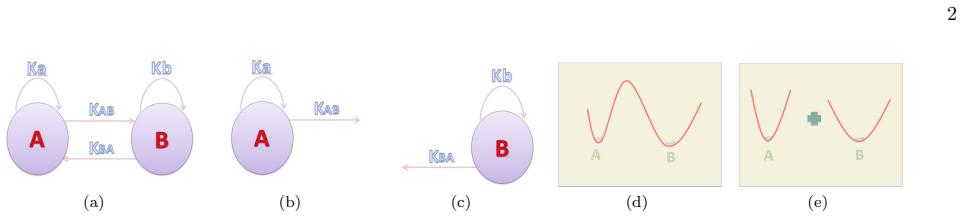
The central claim is that the correlation difference delta(t1,t2) = |f_ba(t1,t2) - f_b(t1) f_a(t2)|, built from the probability of observing a small-to-large-to-small switching sequence in an RNAdS black hole and the product of the two single-switch probabilities, is nonzero precisely because the local Hawking radiation rate fluctuates. In the reaction-diffusion model, the Hawking rate is expanded about the stable horizon radii; the expansion's quadratic coefficient K_a2 (equivalently the relative fluctuation parameter alpha) controls delta. When K_a2 = K_b2 = 0, the event distributions become independent exponentials and delta = 0. The paper further establishes that the echo maximum occurs
What carries the argument
The central object is the two-event correlation difference delta(t1,t2) = |f_ba(t1,t2) - f_b(t1) f_a(t2)|, where f_ba is the joint distribution for consecutive A-to-B-to-A switching events and f_a, f_b are the single-event distributions. The argument is carried by closed-form Green's functions of a linearized reaction-diffusion equation for each stable black-hole phase, with the Hawking radiation rate Taylor-expanded and smoothed by a Gaussian of width b; the key parameter is alpha = (s-1)/(4theta), the relative fluctuation of the Hawking rate against the local relaxation rate. When alpha = 0 the echo disappears, so alpha is what converts radiation noise into a measurable correlation.
Load-bearing premise
The calculation assumes the two black-hole phases behave as independent, nearly Gaussian probability clouds that mix only through rare switching events; if the clouds overlap substantially or the local distribution is not Gaussian, the closed-form echo formulas and the predicted peak would not hold.
What would settle it
Turn off the quadratic Hawking-rate fluctuation terms (K_a2 = K_b2 = 0) in the model and compute delta; the paper predicts delta = 0. If the full master equation still yields a nonzero echo, the factorization assumption is wrong. Experimentally, record Hawking-phonon arrival times in an analogue black hole near the phase transition and check for a delta peak near the critical temperature.
If this is right
- A nonzero echo directly implies that Hawking radiation fluctuates; a perfectly smooth emission law would give delta = 0.
- The echo peak near the critical temperature offers a correlation-based probe of the black-hole phase transition, with the peak marking phase degeneracy.
- The echo time is governed by the effective rates K_eff = K_phase + K_HR + relaxation corrections, so timing measurements can separate phase-transition kinetics from radiation-induced decay.
- Varying charge and pressure shifts the free-energy landscape and hence the echo amplitude, making the echo a probe of how black-hole structure responds to thermodynamic conditions.
- The estimated Hawking rate for analogue black holes in atomic condensates (~0.1 per second) suggests the correlation may be within reach of table-top experiments.
Where Pith is reading between the lines
- Editorial extension: the same event-correlation statistic could transfer to any bistable stochastic system with a noisy decay channel, so the 'echo' may be a general witness of hidden fluctuations rather than a black-hole-specific effect.
- Editorial extension: because the Gaussian localization width b enters the echo amplitude directly, the model predicts that the echo shape carries information about the spatial/temporal profile of Hawking emission; measuring that shape could discriminate Poisson-like from bursty radiation.
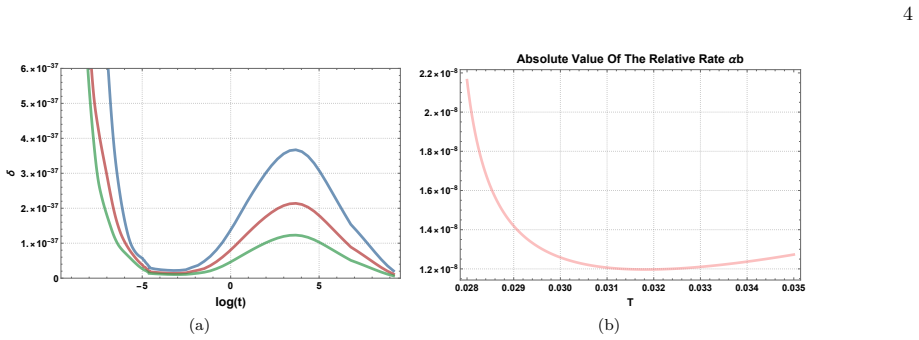
- Editorial extension: the temperature curve of the relative fluctuation alpha_b shows a dip-and-rise shape, suggesting a crossover where evaporation begins to dominate kinetic switching; this crossover could be located observationally as a shift in echo time with temperature.
- Editorial extension: applying the same difference-function analysis to gravitational waves from cosmological phase transitions, as the authors hint, would require treating bubble nucleation as the switching event and the radiation noise as the fluctuating channel, offering a testable extension of the formalism.
Editorial analysis
A structured set of objections, weighed in public.
Referee Report
Summary. The manuscript models an RNAdS black hole on a free-energy landscape with two stable basins, treats the phase transition as diffusive barrier crossing, and adds Hawking evaporation as a local kinetic rate. The local rate is smoothed by a Gaussian of width b, and the resulting single-event and joint-event switching distributions f_a, f_b, f_ba are obtained from analytically solved Green's functions. The central quantity is the difference function δ(t1,t2)=|f_ab(t1,t2)-f_a(t1)f_b(t2)|, interpreted as an echo. The authors report that δ is nonzero only when the quadratic Hawking-fluctuation coefficients K_a2, K_b2 are present, that the echo peaks near the critical temperature, and that its amplitude depends on T, Q, P, η, and b. They propose this as a possible signature of black-hole phase transitions and Hawking-radiation fluctuations.
Significance. If the model assumptions can be justified, the paper would offer a novel theoretical link between black-hole thermodynamics and event-correlation echoes of the type studied in single-molecule kinetics. The analytic work is internally consistent: the Gaussian integrations are performed explicitly, and the expected δ=0 limit is correctly recovered when the Hawking-fluctuation coefficients vanish. However, the central nonzero δ is controlled by an ad hoc Gaussian-smoothing width b whose physical origin is not derived, and the predicted magnitudes are extremely small. The claim that the echo 'reflects' Hawking-radiation fluctuations is therefore conditional on untested model assumptions rather than a robust, falsifiable prediction at this stage.
major comments (3)
- [Eq. (7); Table I] The central effect is controlled entirely by K_a2=K_HR(r_A)/(√π b_a^3), the second-order coefficient obtained by replacing the Hawking-rate delta function with a Gaussian of width b_a and Taylor-truncating. No physical derivation of b_a is given. For b_a→∞, K_a2→0 and δ→0, so the effect is regulator-dependent. For small b_a, the truncated rate (1−x²/b_a²) becomes negative for |x|>b_a, an unphysical source. Table I shows the peak changes by a factor ~7.7 (from 1.04431×10^-34 to 1.35417×10^-35) when b_a is varied from 50 to 100 at fixed η=100, T=0.03. The authors must derive b_a from microphysics (e.g., a thermal width) or replace the delta-smoothing by a Taylor expansion of the actual smooth Hawking rate and show that α remains nonzero and the echo is not an artifact of the regulator.
- [Text after Eq. (5); Eqs. (8)-(9), (A1)-(A13)] The closed-form Green's functions assume that the full two-basin problem separates into two independent half-reactions with Gaussian local stationary distributions, justified by an analogy to matrix models with negligible off-diagonal terms. This is load-bearing: all event distributions follow from these independent Gaussian solutions, and no estimate is provided for the neglected off-diagonal coupling or non-Gaussian corrections. Near the critical temperature the barrier between basins is small, so the separation is least controlled precisely where the echo is claimed to peak. A quantitative justification for the RNAdS parameters, or a numerical solution of the full master equation, is needed to support the central result.
- [Eq. (4) and parameter dependence; Fig. 4] The Hawking radiation rate in Eq. (4) is imported from Ref. [18] without derivation. Since the new physics enters through the second derivative of this rate, a reader cannot judge whether K_a2 has the correct sign or magnitude without repeating that derivation. Moreover, the reported dependences of the echo peak on T, Q, and P are model outputs with no error budget or physical units; the absolute peak heights (order 10^-34) are far below any conceivable detector sensitivity, and no observational strategy is given. The paper should state whether the effect is meant as a conceptual signature or a quantitative observable, and if the latter, provide an estimate of signal size and noise.
minor comments (5)
- [After Eq. (9)] The symbol α_a appears where α_b is meant in the definition of the relative Hawking rate for state B; correct the notation.
- [Eq. (7)] The rendered equation appears to omit the division by √π b_a in the first term; the definitions of K_a1 and K_a2 immediately after Eq. (8) indicate the intended form. Please clarify.
- [Eqs. (A11)-(A13) and main text] The prefactors Δ_a and Δ_ba are time-dependent (through (1−e^{-2λst}) and the coefficients A, B, C), but the text writes them as constants in front of exponentials. State the time dependence explicitly to avoid confusion.
- [Fig. 5 caption] The notation δ(t1,t2/k) is ambiguous. Define k precisely (e.g., t1 = k t2) and label axes accordingly.
- [General] The term 'echo' is easily confused with gravitational-wave echoes. Define the intended meaning at first use and distinguish it from that literature. Also, Table I should specify how the echo peak amplitude and echo time are extracted from δ(t), and in what units.
Circularity Check
No significant circularity: the echo is a computed output of the stated model; only the ad hoc Gaussian width b is treated as physical evidence, a robustness caveat rather than a hidden reduction.
specific steps
-
other
[Eq. (6)-(7) ansatz and Table I discussion]
"we use Gaussian functions to simulate δ functions at a specific radius to smooth out Hawking radiation rates in the stable state for ease of analytic treatment ... although varying parameter b alters the contribution of Hawking radiation to the effective rates, we can at least observe distinct changes in both the echo peak height and its temporal position solely due to modifications in Hawking radiation."
The echo's existence is tied by construction to the regulator coefficient K_a2=K_HR(r_A)/(√π b_a^3), since the paper states 'Without Hawking fluctuations (i.e., K_a2=K_b2=0), the distributions simplify to exponential forms, yielding δ=0'. The width b_a is an ad hoc input introduced 'for ease of analytic treatment', not derived from microphysics, so nonzero δ is partly an output of the regulator. Treating b-variation (Table I) as evidence 'solely due to modifications in Hawking radiation' re-labels the regulator's built-in coupling as independent confirmation. This is a robustness caveat rather than a hidden fit: the T,Q,P dependence is computed, and any Taylor expansion of K_HR(r) yields a quadratic term, giving the correlation physical content beyond the ansatz.
full rationale
The derivation is self-contained: given the RNAdS free energy landscape (Eq. 3), the Stefan-Boltzmann Hawking rate (Eq. 4), transition-state theory rates, and the linearized Smoluchowski operator, the Green's functions (8)-(9) and event distributions (A11)-(A13) are derived in the appendix using a standard OU/Fokker-Planck solution (external refs [13],[19]). The difference function δ is then an explicit function of these inputs, and its temperature/charge/pressure dependence (Figs. 3-4) is computed, not fitted; no fitted parameter is renamed as a prediction, no uniqueness theorem is imported from the authors' prior work, and the self-citations ([9]-[11],[18]) supply a published landscape-kinetics framework that does not already contain the echo. The main caveat is the Gaussian δ-smoothing width b_a (Eqs. 6-7), introduced 'for ease of analytic treatment' without microphysical derivation; the paper itself states δ=0 when the quadratic Hawking-fluctuation coefficient vanishes, and Table I shows ~8x peak sensitivity to b (50 to 100). The sign and magnitude of the fluctuation term are regulator-dependent, so the quantitative echo amplitude is not robust - a correctness/robustness concern, partly flagged by the authors, not a circular reduction. Also load-bearing but unproven: the separation of the full distribution into independent local Gaussian basins ('analogous to matrix models where off-diagonal terms are negligible') and the ad hoc localization of the Hawking rate; if these fail, the closed forms fail, but assumptions are not circularity. The two-event echo formalism is cited to external refs [12],[13], so the novelty is the black-hole application, which is a forward computation.
Axiom & Free-Parameter Ledger
free parameters (2)
- b_a, b_b =
50 (also 100 in Table I)
- η =
50, 100, 200, 10^4, 10^5
axioms (5)
- domain assumption RNAdS black holes admit a generalized free energy landscape G=M-TS with horizon radius as order parameter and extended-phase-space pressure P=3/(8πL^2)
- domain assumption Hawking radiation rate K_HR satisfies Eq. (4)
- ad hoc to paper The full dynamics decomposes into two independent half-reactions with Gaussian local stationary distributions
- ad hoc to paper Hawking radiation rate is local and can be smoothed by a Gaussian of width b to mimic a delta function
- standard math Ornstein-Uhlenbeck Green's function solution is valid for the transformed equation
read the original abstract
Black holes are thermal objects. They can form thermodynamic phases and exhibit phase transitions. Furthermore, black holes can also radiate, termed as Hawking radiation. However, the signatures of these behaviors are challenging to observe. In this work,we consider Hawking radiation in black hole phase transitions. We uncovered that an echo can emerge from the correlations between individual single event and joint two events. This provides possible signature of black hole phase transition and fluctuations in Hawking radiation.
Figures



Reference graph
Works this paper leans on
-
[1]
S. W. Hawking, Particle creation by black holes, Com- munications in mathematical physics43, 199 (1975)
1975
-
[2]
× 10-8 2.2 × 10⁻⁸ T Absolute Value Of The Relative Rate αb (b) FIG. 3. (a) Same-time difference functionδ(t) versus log(t) for temperaturesT= 0.0312 (blue), 0.0313 (red), and 0.0314 (green), with fixedQ= 0.1,P= 0.003/(8π),η= 100, andb a =b b = 50. The echo time is defined as the location of the maximum following an initial rapid decrease. (b) Relative Haw...
-
[3]
S. W. Hawking and D. N. Page, Thermodynamics of black holes in anti-de sitter space, Communications in Mathematical Physics87, 577 (1983)
1983
-
[4]
J. D. Bekenstein, Black holes and entropy, Physical Re- view D7, 2333 (1973)
1973
-
[5]
B. Dolan, The cosmological constant and the black hole equation of state, Classical and Quantum Gravity28, 125020 (2011), arXiv:1008.5023 [gr-qc]
Pith/arXiv arXiv 2011
-
[6]
× 10-37 log(t) δ (a) 0.028 0.029 0.030 0.031 0.032 0.033 0.034 0.035 1.2 × 10⁻⁸ 1.4 × 10⁻⁸ 1.6 × 10⁻⁸ 1.8 × 10⁻⁸
-
[7]
D. Kastor, S. Ray, and J. Traschen, Enthalpy and the me- chanics of ads black holes, Classical and Quantum Grav- ity26, 195011 (2009), arXiv:0904.2765 [hep-th]
Pith/arXiv arXiv 2009
-
[8]
B. Dolan, Pressure and volume in the first law of black hole thermodynamics, Classical and Quantum Gravity 28, 235017 (2011), arXiv:1106.6260 [gr-qc]
Pith/arXiv arXiv 2011
-
[9]
D. Kubiznak and R. Mann, P-v criticality of charged ads black holes, Journal of High Energy Physics07, 033 (2012), arXiv:1205.0559 [hep-th]
Pith/arXiv arXiv 2012
-
[10]
B. F. Whiting and J. W. York Jr, Action principle and 6 partition function for the gravitational field in black-hole topologies, Physical Review Letters61, 1336 (1988)
1988
-
[11]
Li and J
R. Li and J. Wang, Thermodynamics and kinetics of hawking-page phase transition, Physical Review D102, 024085 (2020)
2020
-
[12]
R. Li, K. Zhang, and J. Wang, Thermal dynamic phase transition of reissner-nordstr¨ om anti-de sitter black holes on free energy landscape, Journal of High Energy Physics 2020, 1 (2020)
2020
-
[13]
Li and J
R. Li and J. Wang, Generalized free energy landscape of a black hole phase transition, Physical Review D106, 106015 (2022)
2022
-
[14]
Yang and J
S. Yang and J. Cao, Two-event echos in single-molecule kinetics: a signature of conformational fluctuations, The Journal of Physical Chemistry B105, 6536 (2001)
2001
-
[15]
Cao, Event-averaged measurements of single-molecule kinetics, Chemical Physics Letters327, 38 (2000)
J. Cao, Event-averaged measurements of single-molecule kinetics, Chemical Physics Letters327, 38 (2000)
2000
-
[16]
A. Chamblin, R. Emparan, C. Johnson, and R. My- ers, Charged ads black holes and catastrophic hologra- phy, Physical Review D60, 064018 (1999), arXiv:hep- th/9902170 [hep-th]
arXiv 1999
-
[17]
A. Chamblin, R. Emparan, C. Johnson, and R. Myers, Holography, thermodynamics and fluctuations of charged ads black holes, Physical Review D60, 104026 (1999), arXiv:hep-th/9904197 [hep-th]
Pith/arXiv arXiv 1999
-
[18]
Wu, Multicritical phenomena of reissner-nordstrom anti-de sitter black holes, Physical Review D62, 124023 (2000)
X. Wu, Multicritical phenomena of reissner-nordstrom anti-de sitter black holes, Physical Review D62, 124023 (2000)
2000
-
[19]
Zwanzig,Nonequilibrium Statistical Mechanics(Ox- ford University Press, 2001)
R. Zwanzig,Nonequilibrium Statistical Mechanics(Ox- ford University Press, 2001)
2001
-
[20]
R. Li, K. Zhang, and J. Wang, Kinetics and its turnover of hawking-page phase transition under the black hole evaporation, Physical Review D104, 084060 (2021)
2021
-
[21]
Risken and K
H. Risken and K. Voigtlaender, Solutions of the fokker- planck equation describing the thermalization of neu- trons in a heavy gas moderator, Zeitschrift f¨ ur Physik B Condensed Matter54, 253 (1984)
1984
-
[22]
Hogan, Gravitational radiation from cosmological phase transitions, Monthly Notices of the Royal Astro- nomical Society218, 629 (1986)
C. Hogan, Gravitational radiation from cosmological phase transitions, Monthly Notices of the Royal Astro- nomical Society218, 629 (1986)
1986
-
[23]
W. G. Unruh, Experimental black-hole evaporation?, Physical Review Letters46, 1351 (1981)
1981
-
[24]
Weinfurtner, E
S. Weinfurtner, E. W. Tedford, M. C. Penrice, W. G. Unruh, and G. A. Lawrence, Measurement of stimulated hawking emission in an analogue system, Physical review letters106, 021302 (2011)
2011
-
[25]
V. I. Kolobov, K. Golubkov, J. R. Mu˜ noz de Nova, and J. Steinhauer, Observation of stationary spontaneous hawking radiation and the time evolution of an analogue black hole, Nature Physics17, 362 (2021)
2021
-
[26]
Steinhauer, Observation of quantum hawking radiation and its entanglement in an analogue black hole, Nature Physics12, 959 (2016)
J. Steinhauer, Observation of quantum hawking radiation and its entanglement in an analogue black hole, Nature Physics12, 959 (2016). Appendix A: End matter
2016
-
[27]
Green’s function From the partial differential equation, one can get the equation satisfied by its Green function ∂ ∂t G(x, y, t) =−(Ka1 +K AB)G(x, y, t) +Ka2 x2G(x, y, t) +λ aθa ∂ ∂x ∂ ∂x + x θa G(x, y, t) (A1) For simplicity, some of the lower corner symbols a are omitted from the above symbols. The initial condition is G(x, y,0) =δ(x−y) (A2) Applying t...
-
[28]
In fact, the second equal sign in the equation (A10) is normalization process of flux:Fa =K BAρb/ P KBAρb
Distributions of single event and joint two events One obtains the distribution of the kinetic event of transitionf a(t) fa(t) = R ∞ −∞ R ∞ −∞ dx dy KABGa(x, y, t)KBAρb(y)R ∞ −∞ dxKBAρb =K AB Z ∞ −∞ Z ∞ −∞ dx dy Ga(x, y, t)ρb(y) (A10) whereρ b(x) =e − x2 2θb /√2πθb. In fact, the second equal sign in the equation (A10) is normalization process of flux:Fa =...
-
[29]
For example,B b depends ont 1
Difference function in time under different parameters It is important to note that these parameters are also functions of time. For example,B b depends ont 1. In summary, the specific dependence on eithert 1 ort 2 is not explicitly indicated here; however, it can be inferred from the subscript ofλ, whereacorresponds to 2 andbcor- responds to 1. A complet...
discussion (0)
Sign in with ORCID, Apple, or X to comment. Anyone can read and Pith papers without signing in.