REVIEW 3 major objections 5 minor 91 references
BBOPlace-Bench: Benchmarking Black-Box Optimization for Chip Placement
T0 review · 3 major / 5 minor · reviewed 2026-08-04 · deepseek-v4-flash
Pith's one-line read This paper introduces the first benchmark built specifically for black-box optimization in chip placement and provides evidence that BBO configurations can match or beat analytical and reinforcement-learning placers on wirelength.
desk verdict Useful benchmark, but the 'BBO beats analytical' headline rests on HPO tuning DREAMPlace itself. read the letter →
The pith
A machine-rendered reading of the paper's core claim, the machinery that carries it, and where it could break.
The reading
What carries the argument
The load-bearing machinery is a decoupled framework that splits chip placement into problem formulation (how a genotype becomes physical coordinates), optimization algorithm, and evaluation. The three formulations are the core objects: sequence pair (two permutations decoded by longest common subsequence into macro coordinates), mask-guided optimization (grid coordinates refined by a wire-mask greedy decoder that places macros on the lowest incremental-wirelength grid), and hyperparameter optimization (a solution is a full configuration of the analytical placer DREAMPlace, and running that placer is the decoding step). The framework standardizes two industrial chip suites and three metric ti
What would settle it
Run the same five algorithms under the same protocol but replace DREAMPlace with a different analytical placer as both the GP-HPWL evaluator and the HPO decoder; if HPO loses its ranking advantage over MGO and the RL/analytical baselines, the paper's central comparative result is an artifact of DREAMPlace's hyperparameter sensitivity rather than a general BBO advantage.
Extended reading notes
Core claim
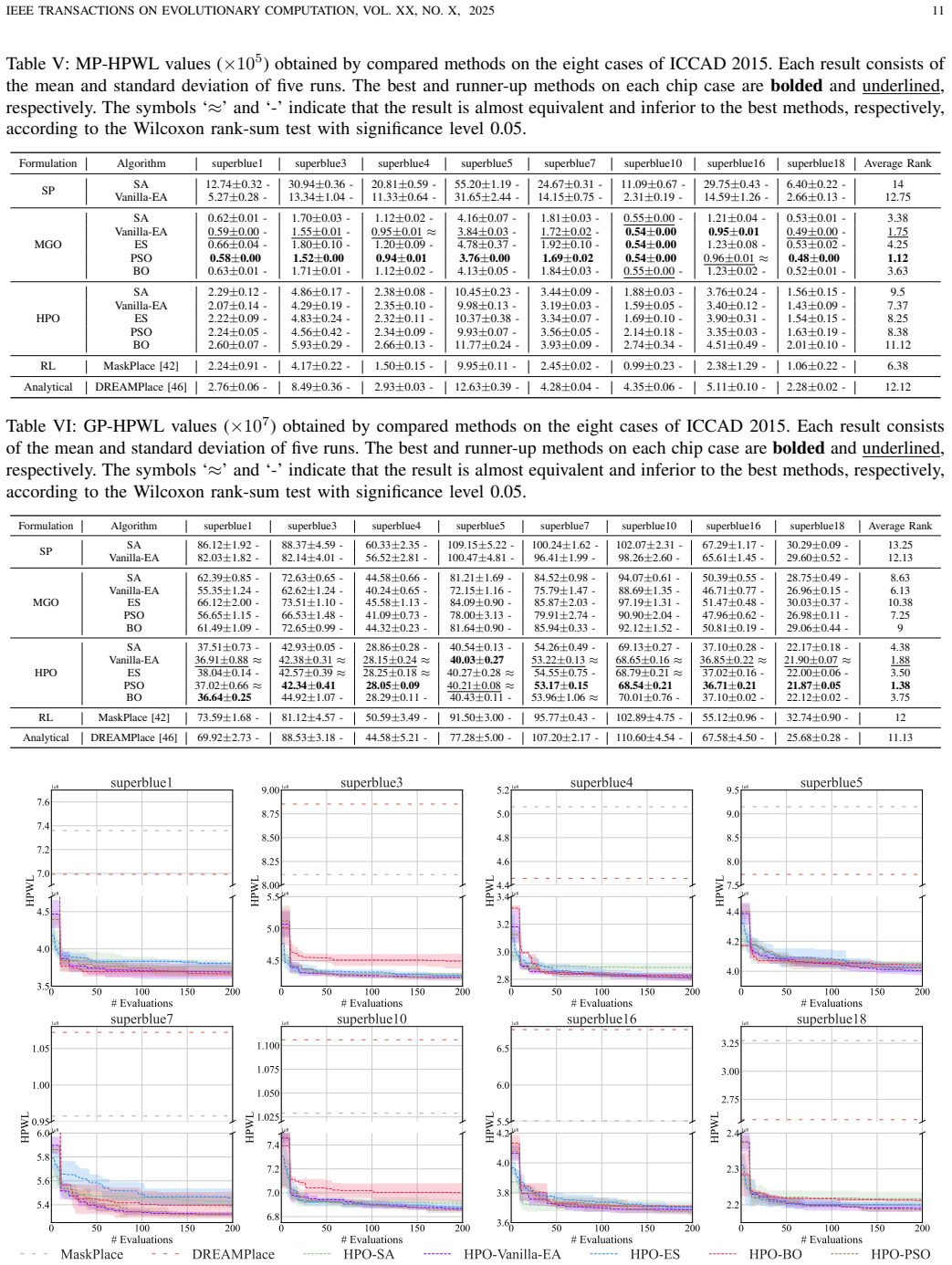
The paper's central discovery is a layered comparative result. On six ISPD 2005 and eight ICCAD 2015 cases, with five seeds and fixed evaluation budgets (10,000 evaluations for macro-placement HPWL, 200 for global-placement HPWL), the sequence-pair formulation consistently ranks last, while mask-guided optimization (MGO) and hyperparameter optimization (HPO) dominate it. Across algorithms, Vanilla-EA and PSO are the strongest optimizers, particularly as the number of macros grows; Bayesian optimization struggles in high-dimensional MGO spaces but is competitive in the low-budget HPO setting. The headline numbers: HPO-Vanilla-EA and HPO-PSO reach average ranks of 2 and 2.67 on ISPD GP-HPWL, b
Load-bearing premise
The comparisons assume DREAMPlace is an impartial downstream evaluator for every formulation, even though the HPO formulation's entire search space is DREAMPlace's own configuration space; if DREAMPlace favors its own tuned configurations, the headline rankings would shift.
Editorial extensions
If this is right
- If the results hold, BBO can field competitive solutions for both macro placement and global placement on industrial-scale chips, not just toy circuits.
- BBOPlace-Bench gives the BBO community a real-world, high-dimensional, and expensive-evaluation testbed where new algorithms can be compared under identical budgets and metrics.
- The HPO formulation's success indicates that tuning a strong analytical placer's hyperparameters is itself a powerful placement strategy, worth pursuing alongside direct macro-placement search.
- The weak correlation between GP-HPWL and timing metrics (WNS) warns that wirelength gains do not automatically translate into PPA gains; multi-objective BBO is the next target.
- At 200 evaluations, the GP-HPWL setting is an expensive-optimization testbed, and the fact that BO did not dominate there suggests a gap between BO's theoretical sample efficiency and practical performance on placement objectives.
Reading between the lines
- Because the HPO search space is exactly DREAMPlace's hyperparameter space, an independent reading is that the 'BBO beats analytical placer' result is partly 'tuned DREAMPlace beats default DREAMPlace'; a starker test would use a different analytical placer as the HPO decoder and as the GP-HPWL evaluator for all formulations.
- The benchmark's decoupling makes it straightforward to reuse as a testbed for meta-BBO, algorithm configuration, or surrogate modeling on a hard real-world objective—none of which the paper itself explores.
- A testable extension: freeze the hyperparameters found by HPO and run each macro placement through DREAMPlace with those settings; if the wirelength gap over MGO-EA persists, the gain is genuinely in macro placement, not just in hyperparameter tuning.
- Another extension: vary the standard-cell placer in the GP-HPWL evaluation while keeping macro placement fixed, to measure how much of the reported advantage is downstream-engine-specific.
Editorial analysis
A structured set of objections, weighed in public.
Referee Report
Summary. The paper introduces BBOPlace-Bench, proposed as the first benchmark tailored to black-box optimization (BBO) for chip placement. It integrates three problem formulations — Sequence Pair (SP), Mask-Guided Optimization (MGO), and Hyperparameter Optimization (HPO) over DREAMPlace — and five BBO algorithm families (SA, Vanilla-EA, CMA-ES, PSO, BO), with standardized preprocessing for ISPD 2005 and ICCAD 2015, and three evaluation levels: MP-HPWL, GP-HPWL, and PPA. The experiments compare formulations and algorithms under a shared protocol and also compare against analytical (DREAMPlace) and RL (AlphaChip, MaskPlace, EfficientPlace) baselines. The headline findings are that MGO and HPO dominate SP, EAs tend to outperform SA and BO, and, under GP-HPWL, HPO-based BBO methods achieve better average ranks than the analytical and RL baselines. The authors are careful to frame the experiments as illustrative case studies and to acknowledge limitations, including the reliance on commercial PPA tools.
Significance. The benchmark is potentially useful to the BBO community: it provides a modular, decoupled interface, unified preprocessing of two industrial benchmark suites, three search-space paradigms, a wide selection of out-of-the-box BBO algorithms, and both cheap (MP-HPWL) and expensive (GP-HPWL/PPA) evaluation settings. If the comparison protocol were unbiased, the result that some BBO configurations can compete with analytical and RL placers would be notable and would support the paper's central claim. The paper also contains genuinely valuable internal comparisons — e.g., the scalability failure of SP, the relative performance of BO in high dimensions, and the trade-off between MGO and HPO — that do not depend on the cross-paradigm baseline comparison. The paper ships code, reports standard deviations over five seeds, and uses Wilcoxon rank-sum tests for within-benchmark comparisons, which are good practices that strengthen the empirical claims.
major comments (3)
- [§III-B3, §III-D, Tables IV and VI] The central claim that BBO configurations are competitive with representative analytical and RL baselines in GP-HPWL is undermined by an asymmetric evaluation protocol. For SP and MGO, macro placement is performed by the BBO method and then DREAMPlace completes standard-cell placement with (presumably default) hyperparameters. For HPO, the search space is exactly DREAMPlace’s hyperparameter space (Algorithm 3, Table I) and each solution decoding is a full DREAMPlace run with tuned hyperparameters. The paper itself acknowledges this in §IV-B(b): the HPO advantage is ‘attributable to its capability of tuning the hyperparameters of the analytical placer DREAMPlace.’ Thus the high average ranks of HPO-Vanilla-EA (2.0) and HPO-PSO (2.67) in Table IV, and 1.88/1.38 in Table VI, may reflect hyperparameter tuning of the baseline engine rather than an independent black-box placement capability. T
- [§IV-C-b, Table VII] The PPA evaluation selects for each algorithm the single best placement across runs by GP-HPWL, reports no variance, and provides no external baselines. Metrics such as routed wirelength differ by well under 1% in several cases (e.g., superblue1: 75.06 vs 74.90 vs 75.23 m for SA/Vanilla-EA/PSO), yet the text states that PSO ‘performs the best in five cases’ and Vanilla-EA in three. These rankings are not accompanied by any significance test or repeatability measure, and best-of-N selection can introduce bias when runs are few. The claims in this subsection should be softened to descriptive observations or supplemented with variance/statistics over runs.
- [§IV-A, §IV-B, §IV-C] The comparison against external baselines is not controlled for hyperparameter tuning. The BBO algorithms are given a defined search budget and, for HPO, the ability to tune DREAMPlace, while the analytical and RL baselines (DREAMPlace, MaskPlace, EfficientPlace, AlphaChip) are taken from the literature or from default configurations. This is acknowledged only implicitly. A fairer statement would be that BBO with access to the downstream placer’s configuration space is competitive with untuned analytical baselines, or the authors should tune the baselines with a comparable budget. This does not invalidate the within-benchmark comparisons, but it is load-bearing for the abstract’s wording that ‘some BBO configurations ... are competitive with representative analytical and reinforcement learning baselines.’
minor comments (5)
- [§IV-A] For ICCAD 2015, macros are defined as the 512 largest modules by area. This is an important design choice, but no sensitivity analysis is given for this threshold; Table VIII varies macro count only for MGO, not for the SP and HPO formulations. The arbitrariness of this choice should be at least flagged in the main text.
- [§II-A] Typo: ‘cooling schedule (refereed to as temperature)’ should be ‘referred to as temperature.’
- [§IV-A] Footnote 4 contains a doubled URL prefix: ‘https://https://github.com/...’.
- [Table IX] The formatting of the SP rows in Table IX is unclear: the optimization/evaluation times for SP SA and Vanilla-EA are merged in a way that makes the per-iteration time hard to read. Please reformat the table for readability.
- [Abstract / §V] The abstract is appropriately hedged (‘some BBO configurations ... are competitive’), but the Conclusion states more strongly that ‘EAs demonstrate better overall performance than SA and BO ... and also achieve state-of-the-art performance compared to the mainstream chip placement methods.’ Given the asymmetric protocol, the conclusion overstates the evidence. Please align the strength of the claims with the controlled part of the experiments.
Circularity Check
No significant circularity; the benchmark is empirical and self-contained, with only minor non-load-bearing self-citation.
full rationale
BBOPlace-Bench is an empirical benchmark, not a derivation. Its main claims are comparisons of algorithms and formulations under a shared protocol, and these are supported by fresh experiments on ISPD 2005 and ICCAD 2015. The closest thing to a circular step is the GP-HPWL advantage of the HPO formulation, which arises because HPO optimizes DREAMPlace's own hyperparameters while SP/MGO are evaluated with a fixed DREAMPlace completion. However, the paper explicitly discloses and attributes this: 'the HPO problem formulation leads to the best performance, which is attributable to its capability of tuning the hyperparameters of the analytical placer DREAMPlace.' This is a stated property of the formulation, not a hidden prediction that reduces to a fitted input. The MGO formulation comes from the authors' prior work [68], but it is re-implemented and re-evaluated here with multiple algorithms and new benchmarks; the citation is background, not load-bearing. No uniqueness theorem or ansatz is smuggled in via self-citation, and no known result is merely renamed. The comparison against analytical and RL baselines may have an experimental-design weakness (default hyperparameters for the baseline DREAMPlace), but that is a correctness/robustness concern, not circularity by construction.
Assumptions & free parameters
free parameters (5)
- ICCAD 2015 macro count =
512 largest modules by area
- Evaluation budgets =
10,000 MP-HPWL; 200 GP-HPWL
- Population size and SA schedule =
pop_size=50; T0=100, decay=0.99, update=100
- HPO search space ranges =
Table I (15 hyperparameters, e.g., targetdensity [0.8,1.2])
- MGO grid resolution n×n =
not reported in text
assumptions (5)
- domain assumption HPWL is a valid proxy for final chip PPA
- domain assumption DREAMPlace is an appropriate universal downstream placer and analytical baseline
- ad hoc to paper The 512 largest modules represent macro sets on ICCAD 2015
- domain assumption Three problem formulations (SP, MGO, HPO) are representative of BBO for chip placement
- domain assumption Wire-mask-guided decoding [68] correctly converts any solution to legal placement with low HPWL
Cite this review
Pith. "Pith review of BBOPlace-Bench: Benchmarking Black-Box Optimization for Chip Placement." pith.science (2026). https://pith.science/paper/RATSBHTN
@misc{pith2026251023472,
  author       = {Pith},
  title        = {Pith review of: BBOPlace-Bench: Benchmarking Black-Box Optimization for Chip Placement},
  year         = {2026},
  howpublished = {\url{https://pith.science/paper/RATSBHTN}},
  note         = {Machine review of arXiv:2510.23472}
}
read the original abstract
Chip placement is a vital stage in modern chip design, and black-box optimization (BBO) has been applied to it for decades. Early BBO efforts, however, were limited by immature problem formulations and inefficient algorithm designs, leading to worse efficiency, quality, and scalability than mainstream analytical methods. Recent advances in BBO have shown strong potential, but a unified, BBO-specific benchmark for thoroughly assessing various problem formulations and BBO algorithms is lacking. To fill this gap, we propose BBOPlace-Bench, the first benchmark tailored for evaluating and developing BBO algorithms for chip placement. It integrates three BBO problem formulations and offers a modular, flexible framework that enables users to seamlessly implement, test, and compare their own algorithms. It aggregates representative modern chip cases and standardizes their formats, providing uniform and comprehensive information to support BBO optimization. Moreover, it integrates representative BBO algorithm families, including simulated annealing, population-based search (including GA, CMA-ES, and PSO), and Bayesian optimization, and systematically evaluates their performance across different problem formulations using key chip-placement metrics. We position these experiments primarily as illustrative case studies under a shared evaluation protocol, including common benchmark instances, metric definitions, evaluation pipeline, and search budgets. Under this protocol, some BBO configurations (e.g., GA under the mask-guided optimization formulation) are competitive with representative analytical and reinforcement learning baselines. BBOPlace-Bench not only facilitates the development of efficient BBO-driven solutions for chip placement but also broadens the practical application scenarios urgently needed by the BBO community.
Figures


Figures from the paper (1 more)

Reference graph
Works this paper leans on
-
[1]
AutoDMP: Automated DREAMPlace-based macro placement,
A. Agnesina, P. Rajvanshi, T. Yang, G. Pradipta, A. Jiao, B. Keller, B. Khailany, and H. Ren, “AutoDMP: Automated DREAMPlace-based macro placement,” inProceedings of the 27th International Symposium on Physical Design, Virtual, 2023, pp. 149–157
2023
-
[2]
Toward an open-source digital flow: First learnings from the OpenROAD project,
T. Ajayi, V . A. Chhabria, M. Fogac ¸a, S. Hashemi, A. Hosny, A. B. Kahng, M. Kim, J. Lee, U. Mallappa, M. Neseem, G. Pradipta, S. Reda, M. Saligane, S. S. Sapatnekar, C. Sechen, M. Shalan, W. Swartz, L. Wang, Z. Wang, M. Woo, and B. Xu, “Toward an open-source digital flow: First learnings from the OpenROAD project,” inProceedings of the 56th Annual Desig...
2019
-
[3]
Net-based force-directed macrocell place- ment for wirelength optimization,
S. Alupoaei and S. Katkoori, “Net-based force-directed macrocell place- ment for wirelength optimization,”IEEE Transactions on Very Large Scale Integration Systems, vol. 10, no. 6, pp. 824–835, 2002
2002
-
[4]
HPO-B: A large-scale reproducible benchmark for black-box HPO based on OpenML,
S. P. Arango, H. S. Jomaa, M. Wistuba, and J. Grabocka, “HPO-B: A large-scale reproducible benchmark for black-box HPO based on OpenML,”arXiv:2106.06257, 2021
arXiv 2021
-
[5]
Audet and W
C. Audet and W. Hare,Derivative-Free and Blackbox Optimization. Springer, 2017
2017
-
[6]
B ¨ack,Evolutionary Algorithms in Theory and Practice: Evolution Strategies, Evolutionary Programming, Genetic Algorithms
T. B ¨ack,Evolutionary Algorithms in Theory and Practice: Evolution Strategies, Evolutionary Programming, Genetic Algorithms. Oxford University Press, 1996
1996
-
[7]
BoTorch: A framework for efficient Monte-Carlo Bayesian optimization,
M. Balandat, B. Karrer, D. R. Jiang, S. Daulton, B. Letham, A. G. Wil- son, and E. Bakshy, “BoTorch: A framework for efficient Monte-Carlo Bayesian optimization,” inAdvances in Neural Information Processing Systems 33, Virtual, 2020, pp. 21 524–21 538
2020
-
[8]
A survey on high-dimensional Gaussian process modeling with application to Bayesian optimization,
M. Binois and N. Wycoff, “A survey on high-dimensional Gaussian process modeling with application to Bayesian optimization,”ACM Transactions on Evolutionary Learning and Optimization, vol. 2, no. 2, pp. 1–26, 2022
2022
Show all 91 references
-
[9]
On wirelength estimations for row-based placement,
A. E. Caldwell, A. B. Kahng, S. Mantik, I. L. Markov, and A. Ze- likovsky, “On wirelength estimations for row-based placement,”IEEE Transactions on Computer-Aided Design of Integrated Circuits and Systems, vol. 18, no. 9, pp. 1265–1278, 1999
1999
-
[10]
CircuitNet: An open-source dataset for machine learning in VLSI CAD applica- tions with improved domain-specific evaluation metric and learning strategies,
Z. Chai, Y . Zhao, W. Liu, Y . Lin, R. Wang, and R. Huang, “CircuitNet: An open-source dataset for machine learning in VLSI CAD applica- tions with improved domain-specific evaluation metric and learning strategies,”IEEE Transactions on Computer-Aided Design of Integrated Circ...
2023
-
[11]
Flexible multiple- objective reinforcement learning for chip placement,
F.-C. Chang, Y .-W. Tseng, Y .-W. Yu, S.-R. Lee, A. Cioba, I.-L. Tseng, D.-s. Shiu, J.-W. Hsu, C.-Y . Wang, C.-Y . Yanget al., “Flexible multiple- objective reinforcement learning for chip placement,”arXiv:2204.06407, 2022
2022 arXiv
-
[12]
Essential issues in analytical place- ment algorithms,
Y . Chang, Z. Jiang, and T. Chen, “Essential issues in analytical place- ment algorithms,”IPSJ Transactions on System LSI Design Methodol- ogy, vol. 2, pp. 145–166, 2009
2009
-
[13]
B*-trees: A new representation for non-slicing floorplans,
Y .-C. Chang, Y .-W. Chang, G.-M. Wu, and S.-W. Wu, “B*-trees: A new representation for non-slicing floorplans,” inProceedings of the 37th Annual Design Automation Conference, Los Angeles, CA, 2000, pp. 458–463
2000
-
[14]
NTUplace3: An analytical placer for large-scale mixed-size designs with preplaced blocks and density constraints,
T.-C. Chen, Z.-W. Jiang, T.-C. Hsu, H.-C. Chen, and Y .-W. Chang, “NTUplace3: An analytical placer for large-scale mixed-size designs with preplaced blocks and density constraints,”IEEE Transactions on Computer-Aided Design of Integrated Circuits and Systems, vol. 27, no. 7, p...
2008
-
[15]
RePlAce: Advancing solution quality and routability validation in global placement,
C.-K. Cheng, A. B. Kahng, I. Kang, and L. Wang, “RePlAce: Advancing solution quality and routability validation in global placement,”IEEE Transactions on Computer-Aided Design of Integrated Circuits and Systems, vol. 38, no. 9, pp. 1717–1730, 2018
2018
-
[16]
The policy-gradient placement and generative routing neural networks for chip design,
R. Cheng, X. Lyu, Y . Li, J. Ye, J. Hao, and J. Yan, “The policy-gradient placement and generative routing neural networks for chip design,” in Advances in Neural Information Processing Systems 35, New Orleans, LA, 2022, pp. 26 350–26 362
2022
-
[17]
On joint learning for solving placement and routing in chip design,
R. Cheng and J. Yan, “On joint learning for solving placement and routing in chip design,” inAdvances in Neural Information Processing Systems 34, Virtual, 2021, pp. 16 508–16 519
2021
-
[18]
Deb,Multi-Objective Optimization Using Evolutionary Algorithms
K. Deb,Multi-Objective Optimization Using Evolutionary Algorithms. Wiley, 2001
2001
-
[19]
PyPop7: A pure-Python li- brary for population-based black-box optimization,
Q. Duan, G. Zhou, C. Shao, and Others, “PyPop7: A pure-Python li- brary for population-based black-box optimization,”Journal of Machine Learning Research, vol. 25, no. 296, pp. 1–28, 2024
2024
-
[20]
High-dimensional bayesian optimiza- tion with sparse axis-aligned subspaces,
D. Eriksson and M. Jankowiak, “High-dimensional bayesian optimiza- tion with sparse axis-aligned subspaces,” inProceedings of the 37th Conference on Uncertainty in Artificial Intelligence, Virtual Event, 2021, pp. 493–503
2021
-
[21]
Scalable global optimization via local Bayesian optimization,
D. Eriksson, M. Pearce, J. R. Gardner, R. Turner, and M. Poloczek, “Scalable global optimization via local Bayesian optimization,” in Advances in Neural Information Processing Systems 32, Vancouver, Canada, 2019, pp. 5497–5508
2019
-
[22]
A tutorial on Bayesian optimization,
P. I. Frazier, “A tutorial on Bayesian optimization,”arXiv:1807.02811, 2018
2018 arXiv
-
[23]
Garnett,Bayesian Optimization
R. Garnett,Bayesian Optimization. Cambridge University Press, 2023
2023
-
[24]
LaMPlace: Learning to optimize cross-stage metrics in macro placement,
Z. Geng, J. Wang, Z. Liu, S. Xu, Z. Tang, S. Kai, M. Yuan, J. Hao, and F. Wu, “LaMPlace: Learning to optimize cross-stage metrics in macro placement,” inProceedings of the 13th International Conference on Learning Representations, Singapore, 2025
2025
-
[25]
Reinforcement learning within tree search for fast macro placement,
Z. Geng, J. Wang, Z. Liu, S. Xu, Z. Tang, M. Yuan, J. Hao, Y . Zhang, and F. Wu, “Reinforcement learning within tree search for fast macro placement,” inProceedings of the 41st International Conference on Machine Learning, Vienna, Austria, 2024, pp. 15 402–15 417
2024
-
[26]
That chip has sailed: A critique of unfounded skepticism around AI for chip design,
A. Goldie, A. Mirhoseini, and J. Dean, “That chip has sailed: A critique of unfounded skepticism around AI for chip design,”arxiv:2411.10053, 2024
2024 arXiv
-
[27]
Addendum: A graph placement methodology for fast chip design,
A. Goldie, A. Mirhoseini, M. Yazgan, J. W. Jiang, E. Songhori, S. Wang, Y .-J. Lee, E. Johnson, O. Pathak, A. Novaet al., “Addendum: A graph placement methodology for fast chip design,”Nature, vol. 634, no. 8034, pp. E10–E11, 2024
2024
-
[28]
Genetic learning particle swarm optimization,
Y .-J. Gong, J.-J. Li, Y . Zhou, Y . Li, H. S.-H. Chung, Y .-H. Shi, and J. Zhang, “Genetic learning particle swarm optimization,”IEEE Transactions on Cybernetics, vol. 46, no. 10, pp. 2277–2290, 2015
2015
-
[29]
DREAMPlace 3.0: Multi- electrostatics based robust VLSI placement with region constraints,
J. Gu, Z. Jiang, Y . Lin, and D. Z. Pan, “DREAMPlace 3.0: Multi- electrostatics based robust VLSI placement with region constraints,” inProceedings of the 33rd IEEE/ACM International Conference on Computer-Aided Design, San Diego, CA, 2020, pp. 1–9
2020
-
[30]
Con- figX: Modular configuration for evolutionary algorithms via multitask IEEE TRANSACTIONS ON EVOLUTIONARY COMPUTATION, VOL. XX, NO. X, 2025 16 reinforcement learning,
H. Guo, Z. Ma, J. Chen, Y . Ma, Z. Cao, X. Zhang, and Y .-J. Gong, “Con- figX: Modular configuration for evolutionary algorithms via multitask IEEE TRANSACTIONS ON EVOLUTIONARY COMPUTATION, VOL. XX, NO. X, 2025 16 reinforcement learning,” inProceedings of the 39th AAAI Confere...
2025
-
[31]
The CMA evolution strategy: A tutorial,
N. Hansen, “The CMA evolution strategy: A tutorial,” arXiv:1604.00772, 2016
2016 arXiv
-
[32]
Evolution strategies,
N. Hansen, D. V . Arnold, and A. Auger, “Evolution strategies,” in Springer Handbook of Computational Intelligence. Springer, 2015, pp. 871–898
2015
-
[33]
Ripple: A robust and effective routability-driven placer,
X. He, T. Huang, L. Xiao, H. Tian, and E. F. Y . Young, “Ripple: A robust and effective routability-driven placer,”IEEE Transactions on Computer- Aided Design of Integrated Circuits and Systems, vol. 32, no. 10, pp. 1546–1556, 2013
2013
-
[34]
Corner block list: An effective and efficient topological representation of non-slicing floorplan,
X. Hong, G. Huang, Y . Cai, J. Gu, S. Dong, C.-K. Cheng, and J. Gu, “Corner block list: An effective and efficient topological representation of non-slicing floorplan,” inProceedings of the 13th IEEE/ACM Inter- national Conference on Computer Aided Design, San Jose, CA, 2000, pp. 8–12
2000
-
[35]
Data-driven evolutionary optimization: An overview and case studies,
Y . Jin, H. Wang, T. Chugh, D. Guo, and K. Miettinen, “Data-driven evolutionary optimization: An overview and case studies,”IEEE Trans- actions on Evolutionary Computation, vol. 23, no. 3, pp. 442–458, 2019
2019
-
[36]
Efficient global optimiza- tion of expensive black-box functions,
D. R. Jones, M. Schonlau, and W. J. Welch, “Efficient global optimiza- tion of expensive black-box functions,”Journal of Global Optimization, vol. 13, no. 4, pp. 455–492, 1998
1998
-
[37]
A tale of two nets: Studies of wirelength progression in physical design,
A. B. Kahng and S. Reda, “A tale of two nets: Studies of wirelength progression in physical design,” inProceedings of the 7th International Workshop on System-level Interconnect Prediction, Munich, Germany, 2006, pp. 17–24
2006
-
[38]
Particle swarm optimization,
J. Kennedy and R. Eberhart, “Particle swarm optimization,” inPro- ceedings of 3rd International Conference on Neural Networks, Perth, Australia, 1995, pp. 1942–1948
1995
-
[39]
ICCAD-2015 CAD contest in incremental timing-driven placement and benchmark suite,
M. Kim, J. Hu, J. Li, and N. Viswanathan, “ICCAD-2015 CAD contest in incremental timing-driven placement and benchmark suite,” inProceedings of the 28th IEEE/ACM International Conference on Computer-Aided Design, Austin, TX, 2015, pp. 921–926
2015
-
[40]
A new method of locating the maximum point of an arbitrary multipeak curve in the presence of noise,
H. J. Kushner, “A new method of locating the maximum point of an arbitrary multipeak curve in the presence of noise,”Journal of Basic Engineering, vol. 86, no. 1, pp. 97–106, 1964
1964
-
[41]
ChiPFormer: Transferable chip placement via offline decision transformer,
Y . Lai, J. Liu, Z. Tang, B. Wang, J. Hao, and P. Luo, “ChiPFormer: Transferable chip placement via offline decision transformer,” inPro- ceedings of the 40th International Conference on Machine Learning, Honolulu, HI, 2023, pp. 18 346–18 364
2023
-
[42]
MaskPlace: Fast chip placement via reinforced visual representation learning,
Y . Lai, Y . Mu, and P. Luo, “MaskPlace: Fast chip placement via reinforced visual representation learning,” inAdvances in Neural In- formation Processing Systems 35, New Orleans, LA, 2022, pp. 24 019– 24 030
2022
-
[43]
iEDA: An open-source infrastructure of EDA,
X. Li, Z. Huang, S. Tao, Z. Huang, C. Zhuang, H. Wang, Y . Li, Y . Qiu, G. Luo, H. Li, H. Shen, M. Chen, D. Bu, W. Zhu, Y . Cai, X. Xiong, Y . Jiang, Y . Heng, P. Zhang, B. Yu, B. Xie, and Y . Bao, “iEDA: An open-source infrastructure of EDA,” inProceedings of the 29th Asia an...
2024
-
[44]
DREAMPlace 4.0: Timing-driven placement with momentum-based net weighting and Lagrangian-based refinement,
P. Liao, D. Guo, Z. Guo, S. Liu, Y . Lin, and B. Yu, “DREAMPlace 4.0: Timing-driven placement with momentum-based net weighting and Lagrangian-based refinement,”IEEE Transactions on Computer-Aided Design of Integrated Circuits and Systems, vol. 42, no. 10, pp. 3374– 3387, 2023
2023
-
[45]
POLAR 3.0: An ultrafast global placement engine,
T. Lin, C. C. N. Chu, and G. Wu, “POLAR 3.0: An ultrafast global placement engine,” inProceedings of the 28th IEEE/ACM International Conference on Computer-Aided Design, Austin, TX, 2015, pp. 520–527
2015
-
[46]
DREAMPlace: Deep learning toolkit-enabled GPU acceleration for modern VLSI placement,
Y . Lin, Z. Jiang, J. Gu, W. Li, S. Dhar, H. Ren, B. Khailany, and D. Z. Pan, “DREAMPlace: Deep learning toolkit-enabled GPU acceleration for modern VLSI placement,”IEEE Transactions on Computer-Aided Design of Integrated Circuits and Systems, vol. 40, no. 4, pp. 748–761, 2020
2020
-
[47]
Evolution of heuristics: Towards efficient automatic algorithm design using large language model,
F. Liu, T. Xialiang, M. Yuan, X. Lin, F. Luo, Z. Wang, Z. Lu, and Q. Zhang, “Evolution of heuristics: Towards efficient automatic algorithm design using large language model,” inProceedings of the 41st International Conference on Machine Learning, Vienna, Austria, 2024, pp. 32...
2024
-
[48]
A systematic survey on large language models for algorithm design,
F. Liu, Y . Yao, P. Guo, Z. Yang, Z. Zhao, X. Lin, X. Tong, M. Yuan, Z. Lu, Z. Wanget al., “A systematic survey on large language models for algorithm design,”arXiv:2410.14716, 2024
2024
-
[49]
Xplace: An extremely fast and extensible placement framework,
L. Liu, B. Fu, S. Lin, J. Liu, E. F. Y . Young, and M. D. F. Wong, “Xplace: An extremely fast and extensible placement framework,”IEEE Transactions on Computer-Aided Design of Integrated Circuits and Systems, vol. 43, no. 6, pp. 1872–1885, 2024
2024
-
[50]
ePlace: Electrostatics-based placement using fast Fourier transform and Nesterov’s method,
J. Lu, P. Chen, C.-C. Chang, L. Sha, D. J.-H. Huang, C.-C. Teng, and C.-K. Cheng, “ePlace: Electrostatics-based placement using fast Fourier transform and Nesterov’s method,”ACM Transactions on Design Automation of Electronic Systems, vol. 20, no. 2, pp. 1–34, 2015
2015
-
[51]
Neural exploratory landscape analysis for meta-black-box-optimization,
Z. Ma, J. Chen, H. Guo, and Y .-J. Gong, “Neural exploratory landscape analysis for meta-black-box-optimization,” inProceedings of the 13th International Conference on Learning Representations, Singapore, 2025
2025
-
[52]
MetaBox: A benchmark platform for meta-black-box optimization with reinforcement learning,
Z. Ma, H. Guo, J. Chen, Z. Li, G. Peng, Y .-J. Gong, Y . Ma, and Z. Cao, “MetaBox: A benchmark platform for meta-black-box optimization with reinforcement learning,” inAdvances in Neural Information Processing Systems 36, New Orleans, LA, 2023, pp. 10 775–10 795
2023
-
[53]
Toward automated algorithm design: A survey and practical guide to meta-black-box- optimization,
Z. Ma, H. Guo, Y .-J. Gong, J. Zhang, and K. C. Tan, “Toward automated algorithm design: A survey and practical guide to meta-black-box- optimization,”IEEE Transactions on Evolutionary Computation, 2025
2025
-
[54]
An industrial view of electronic design automation,
D. MacMillen, R. Camposano, D. Hill, and T. W. Williams, “An industrial view of electronic design automation,”IEEE Transactions on Computer-Aided Design of Integrated Circuits and Systems, vol. 19, no. 12, pp. 1428–1448, 2000
2000
-
[55]
Progress and challenges in VLSI placement research,
I. L. Markov, J. Hu, and M.-C. Kim, “Progress and challenges in VLSI placement research,” inProceedings of the 25th IEEE/ACM International Conference on Computer-Aided Design, San Jose, CA, 2012, pp. 275–282
2012
-
[56]
Exploratory landscape analysis,
O. Mersmann, B. Bischl, H. Trautmann, M. Preuss, C. Weihs, and G. Rudolph, “Exploratory landscape analysis,” inProceedings of the 13th Genetic and Evolutionary Computation Conference, Dublin, Ire- land, 2011, pp. 829–836
2011
-
[57]
A graph placement methodology for fast chip design,
A. Mirhoseini, A. Goldie, M. Yazgan, J. W. Jiang, E. Songhori, S. Wang, Y .-J. Lee, E. Johnson, O. Pathak, A. Naziet al., “A graph placement methodology for fast chip design,”Nature, vol. 594, no. 7862, pp. 207– 212, 2021
2021
-
[58]
VLSI module placement based on rectangle-packing by the sequence-pair,
H. Murata, K. Fujiyoshi, S. Nakatake, and Y . Kajitani, “VLSI module placement based on rectangle-packing by the sequence-pair,”IEEE Transactions on Computer-Aided Design of Integrated Circuits and Systems, vol. 15, no. 12, pp. 1518–1524, 1996
1996
-
[59]
The ISPD 2005 placement contest and benchmark suite,
G.-J. Nam, C. J. Alpert, P. Villarrubia, B. Winter, and M. Yildiz, “The ISPD 2005 placement contest and benchmark suite,” inProceedings of the 9th International Symposium on Physical Design, San Francisco, CA, 2005, pp. 216–220
2005
-
[60]
Bayesian optimization for macro placement,
C. Oh, R. Bondesan, D. Kianfar, R. Ahmed, R. Khurana, P. Agarwal, R. Lepert, M. Sriram, and M. Welling, “Bayesian optimization for macro placement,”arXiv:2207.08398, 2022
2022 arXiv
-
[61]
A review of population-based metaheuristics for large-scale black-box global optimization—Part I,
M. N. Omidvar, X. Li, and X. Yao, “A review of population-based metaheuristics for large-scale black-box global optimization—Part I,” IEEE Transactions on Evolutionary Computation, vol. 26, no. 5, pp. 802–822, 2022
2022
-
[62]
IncreMacro: Incremental macro placement refinement,
Y . Pu, T. Chen, Z. He, J. Qin, C. Bai, H. Zheng, Y . Lin, and B. Yu, “IncreMacro: Incremental macro placement refinement,”IEEE Trans- actions on Computer-Aided Design of Integrated Circuits and Systems, vol. 44, no. 8, pp. 3222–3235, 2025
2025
-
[63]
SOO-Bench: Benchmarks for evaluating the stability of offline black-box optimization,
H. Qian, Y . Zhu, X. Shu, X. An, Y . Wen, S. Liu, H. Lu, A. Zhou, K. Tang, and Y . Yu, “SOO-Bench: Benchmarks for evaluating the stability of offline black-box optimization,” inProceedings of the 13th International Conference on Learning Representations, Singapore, 2025
2025
-
[64]
C. E. Rasmussen and C. K. I. Williams,Gaussian Processes for Machine Learning. The MIT Press, 2006
2006
-
[65]
Finite Markov chain results in evolutionary computation: A tour d’horizon,
G. Rudolph, “Finite Markov chain results in evolutionary computation: A tour d’horizon,”Fundamenta Informaticae, vol. 35, no. 1-4, pp. 67– 89, 1998
1998
-
[66]
VLSI cell placement techniques,
K. Shahookar and P. Mazumder, “VLSI cell placement techniques,”ACM Computing Surveys, vol. 23, no. 2, pp. 143–220, 1991
1991
-
[67]
Taking the human out of the loop: A review of Bayesian optimization,
B. Shahriari, K. Swersky, Z. Wang, R. P. Adams, and N. de Freitas, “Taking the human out of the loop: A review of Bayesian optimization,” Proceedings of the IEEE, vol. 104, no. 1, pp. 148–175, 2016
2016
-
[68]
Macro placement by wire-mask- guided black-box optimization,
Y . Shi, K. Xue, L. Song, and C. Qian, “Macro placement by wire-mask- guided black-box optimization,” inAdvances in Neural Information Processing Systems 36, New Orleans, LA, 2023, pp. 6825–6843
2023
-
[69]
Monte Carlo tree search based variable selection for high dimensional Bayesian optimization,
L. Song, K. Xue, X. Huang, and C. Qian, “Monte Carlo tree search based variable selection for high dimensional Bayesian optimization,” in Advances in Neural Information Processing Systems 35, New Orleans, LA, 2022
2022
-
[70]
Fast and accurate routing demand estimation for efficient routability-driven placement,
P. Spindler and F. M. Johannes, “Fast and accurate routing demand estimation for efficient routability-driven placement,” inProceedings of the 14th Conference on Design, Automation & Test in Europe, Nice, France, 2007, pp. 1–6
2007
-
[71]
Information- theoretic regret bounds for Gaussian process optimization in the bandit setting,
N. Srinivas, A. Krause, S. M. Kakade, and M. W. Seeger, “Information- theoretic regret bounds for Gaussian process optimization in the bandit setting,”IEEE Transactions on Information Theory, vol. 58, no. 5, pp. 3250–3265, 2012. IEEE TRANSACTIONS ON EVOLUTIONARY COMPUTATION, V...
2012
-
[72]
LLaMEA: A large language model evolu- tionary algorithm for automatically generating metaheuristics,
N. v. Stein and T. B ¨ack, “LLaMEA: A large language model evolu- tionary algorithm for automatically generating metaheuristics,”IEEE Transactions on Evolutionary Computation, vol. 29, no. 2, pp. 331–345, 2025
2025
-
[73]
Nonconvex optimization by fast simulated annealing,
H. H. Szu and R. L. Hartley, “Nonconvex optimization by fast simulated annealing,”Proceedings of IEEE, vol. 75, no. 11, pp. 1538–1540, 1987
1987
-
[74]
A memetic algorithm for VLSI floorplanning,
M. Tang and X. Yao, “A memetic algorithm for VLSI floorplanning,” IEEE Transactions on Systems, Man, and Cybernetics, vol. 37, no. 1, pp. 62–69, 2007
2007
-
[75]
MuJoCo: A physics engine for model-based control,
E. Todorov, T. Erez, and Y . Tassa, “MuJoCo: A physics engine for model-based control,” inProceedings of the 35th IEEE/RSJ International Conference on Intelligent Robots and Systems, Vilamoura, Portugal, 2012, pp. 5026–5033
2012
-
[76]
How do dynamic events change the fitness landscape of traveling salesman problems?
H. Tong, M. Li, J. Liu, and X. Yao, “How do dynamic events change the fitness landscape of traveling salesman problems?”IEEE Transactions on Evolutionary Computation, vol. 29, no. 5, pp. 1463–1474, 2025
2025
-
[77]
Design-Bench: Bench- marks for data-driven offline model-based optimization,
B. Trabucco, X. Geng, A. Kumar, and S. Levine, “Design-Bench: Bench- marks for data-driven offline model-based optimization,” inProceedings of the 39th International Conference on Machine Learning, Baltimore, MD, 2022, pp. 21 658–21 676
2022
-
[78]
Placement in integrated circuits using cyclic reinforcement learning and simulated annealing,
D. Vashisht, H. Rampal, H. Liao, Y . Lu, D. Shanbhag, E. Fallon, and L. B. Kara, “Placement in integrated circuits using cyclic reinforcement learning and simulated annealing,”arXiv:2011.07577, 2020
2011 arXiv
-
[79]
Two Arch2: An improved two-archive algorithm for many-objective optimization,
H. Wang, L. Jiao, and X. Yao, “Two Arch2: An improved two-archive algorithm for many-objective optimization,”IEEE Transactions on Evo- lutionary Computation, vol. 19, no. 4, pp. 524–541, 2015
2015
-
[80]
Learning search space partition for black-box optimization using Monte Carlo tree search,
L. Wang, R. Fonseca, and Y . Tian, “Learning search space partition for black-box optimization using Monte Carlo tree search,” inAdvances in Neural Information Processing Systems 33, Virtual, 2020, pp. 19 511– 19 522
2020
-
[81]
Benchmarking end-to-end performance of AI- based chip placement algorithms,
Z. Wang, Z. Geng, Z. Tu, J. Wang, Y . Qian, Z. Xu, Z. Liu, S. Xu, Z. Tang, S. Kaiet al., “Benchmarking end-to-end performance of AI- based chip placement algorithms,” inAdvances in Neural Information Processing Systems 38, San Diego, CA, 2025
2025
-
[82]
Reinforcement learning policy as macro regulator rather than macro placer,
K. Xue, R.-T. Chen, X. Lin, Y . Shi, S. Kai, S. Xu, and C. Qian, “Reinforcement learning policy as macro regulator rather than macro placer,” inAdvances in Neural Information Processing Systems 38, Vancouver, Canada, 2024, pp. 140 565–140 588
2024
-
[83]
Escaping local optima in global placement,
K. Xue, X. Lin, Y . Shi, S. Kai, S. Xu, and C. Qian, “Escaping local optima in global placement,”arXiv:2402.18311, 2024
2024 arXiv
-
[84]
Offline multi-objective optimization,
K. Xue, R.-X. Tan, X. Huang, and C. Qian, “Offline multi-objective optimization,” inProceedings of the 41st International Conference on Machine Learning, Vienna, Austria, 2024, pp. 55 595–55 624
2024
-
[85]
Multi-agent dynamic algorithm configuration,
K. Xue, J. Xu, L. Yuan, M. Li, C. Qian, Z. Zhang, and Y . Yu, “Multi-agent dynamic algorithm configuration,” inAdvances in Neural Information Processing Systems 35, New Orleans, LA, 2022, pp. 20 147– 20 161
2022
-
[86]
CircuitNet 2.0: An advanced dataset for promoting machine learning innovations in realistic chip design environment,
J. Xun, Z. Chai, Y . Zhao, Y . Lin, R. Wang, and R. Huang, “CircuitNet 2.0: An advanced dataset for promoting machine learning innovations in realistic chip design environment,” inProceedings of the 12th In- ternational Conference on Learning Representations, Vienna, Austria, 2024
2024
-
[87]
NAS-Bench-101: Towards reproducible neural architecture search,
C. Ying, A. Klein, E. Christiansen, E. Real, K. Murphy, and F. Hutter, “NAS-Bench-101: Towards reproducible neural architecture search,” in Proceedings of the 36th International Conference on Machine Learning, Long Beach, CA, 2019, pp. 7105–7114
2019
-
[88]
Y . Yu, H. Qian, and Y .-Q. Hu,Derivative-Free Optimization: Theoretical Foundations, Algorithms, and Applications. Springer, 2025
2025
-
[89]
Zhang, R
X. Zhang, R. Cheng, Y . Tian, and Y . Jin,Evolutionary Large-Scale Multi-Objective Optimization and Applications. John Wiley & Sons, 2024
2024
-
[90]
DeepGate4: Efficient and effective representation learning for circuit design at scale,
Z. Zheng, S. Huang, J. Zhong, Z. Shi, G. Dai, N. Xu, and Q. Xu, “DeepGate4: Efficient and effective representation learning for circuit design at scale,”arxiv:2502.01681, 2025
2025 arXiv
-
[91]
Z.-H. Zhou, Y . Yu, and C. Qian,Evolutionary Learning: Advances in Theories and Algorithms. Springer, 2019
2019
Reviewed August 4, 2026 · model on record in the stance chip above.
Discussion (0). Continue with ORCID to comment.