REVIEW 3 major objections 4 minor 26 references
Adding a process-mining conformance reward to sequence-level GRPO improves math reasoning on five benchmarks.
Reviewed by Pith at T0; open to challenge. T0 means a machine referee read the full paper against a public rubric. the ladder, T0–T4 →
2026-08-04 07:34 UTC pith:2KREZ7KB
load-bearing objection The conformance-reward idea is genuinely new and worth taking seriously, but the experiments do not isolate the proposed reward, so the central empirical claim is not yet supported. the 3 major comments →
Rewarding Structural Conformance of Reasoning using Process Mining
The pith
A machine-rendered reading of the paper's core claim, the machinery that carries it, and where it could break.
Core claim
The paper's central claim is that a scalar conformance reward, computed as the harmonic mean of fitness and precision between the policy's discovered reasoning process and the teacher's reasoning log, can be added to the format and answer rewards without changing the underlying optimization machinery, and that this yields better mathematical reasoning than outcome-only rewards. The claim is demonstrated by training 1.5B and 7B backbones with the proposed PM4GRPO objective and reporting consistent gains over existing baselines on five benchmarks, including the hardest competition-style sets. The paper also argues that the approach preserves the policy's freedom of thought rather than forcing
What carries the argument
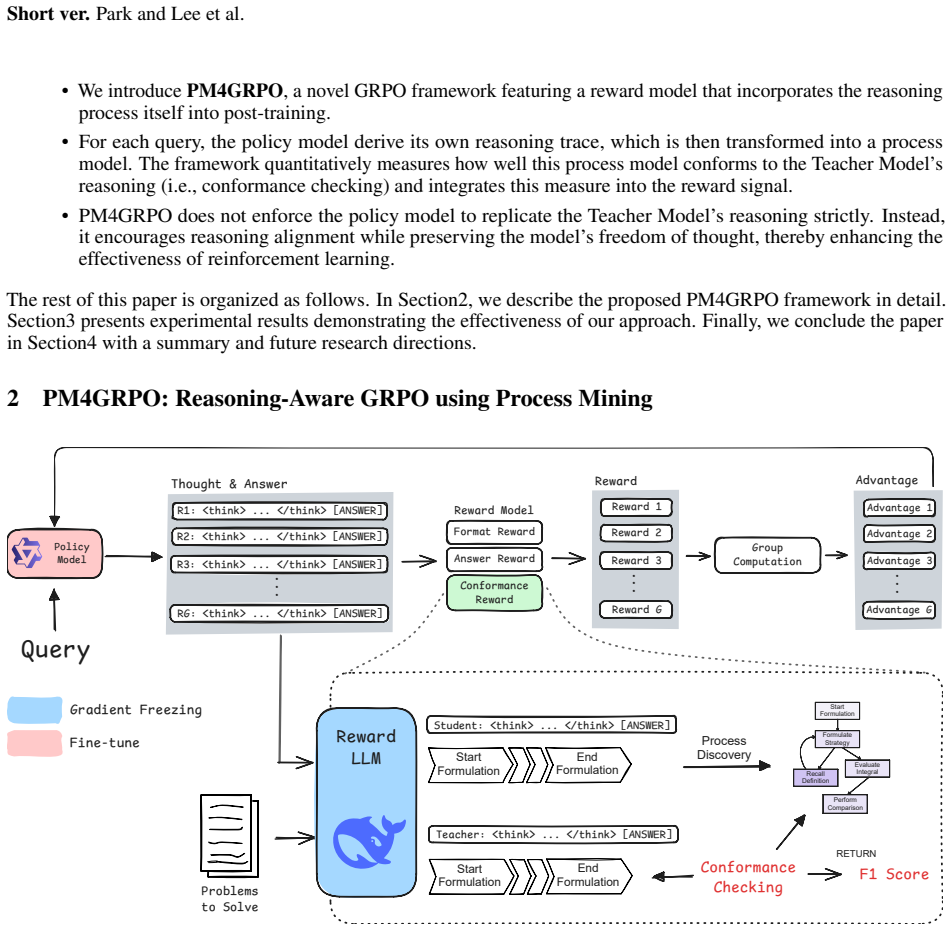
The load-bearing object is the conformance reward Rc_i = 2·fitness_i·precision_i/(fitness_i+precision_i), the F1 score of two process-mining measures. The pipeline: each reasoning trace is turned into an event log; Inductive Miner builds a process model from the policy's log; alignment-based conformance checking compares that model against the teacher's trace, producing fitness (how much of the teacher's behavior the model can reproduce) and precision (how much behavior the model allows that the teacher never shows). The reward is assigned at the sequence level, and the paper pairs it with a sequence-level importance-ratio objective so the optimization unit matches the reward unit.
Load-bearing premise
The conformance reward is only as meaningful as the conversion of free-text reasoning chains into discrete event-log activities, and the paper does not describe how that conversion is done.
What would settle it
Train the same sequence-level objective with conformance rewards computed against permuted or randomly shuffled teacher reasoning logs; if the benchmark scores stay at the same level, the structural conformance signal is not what drives the improvement.
If this is right
- If correct, RL post-training for reasoning can be improved without additional human annotation, since the teacher's reasoning traces are already available.
- Process-level rewards can be combined with any sparse outcome reward, suggesting a general recipe for making GRPO-style training reasoning-aware.
- The policy is nudged toward structural similarity to the teacher while keeping freedom to choose its own words, so the method may scale to larger backbones without overfitting to the teacher's surface text.
- Because the reward is computed per query at sequence level, it can be applied to domains beyond math wherever a reference reasoning trace exists.
Where Pith is reading between the lines
- A plausible next step is ablating fitness and precision separately; the paper reports only their harmonic mean, so it is unknown whether the gain comes from rewarding coverage of teacher steps, penalizing extra steps, or both.
- If the conformance signal mainly rewards structural regularity, it could transfer to other multi-step tasks such as code generation or tool use; if it mainly rewards matching the teacher's specific steps, transfer may be limited.
- A controlled study comparing different schemes for converting free-text reasoning into event-log activities would show how much of the reported gain depends on that unstated conversion step.
- A testable extension: run the same pipeline with a weaker or randomly selected teacher; if gains persist, the reward's value may come from process structure itself rather than from teacher quality.
Editorial analysis
A structured set of objections, weighed in public.
Referee Report
Summary. The paper proposes PM4GRPO, a GRPO-based post-training method that augments standard answer/format rewards with a process-mining conformance reward. For each query, the policy's free-text reasoning trace is converted into an event log and a process model via Inductive Miner; the teacher model's trace serves as the reference log. Alignment-based conformance checking yields fitness and precision scores, whose harmonic mean (Eq. 5) is added to the answer and format rewards within a sequence-level GSPO objective (Eq. 6). Experiments on MATH500, OlympiadBench, Minerva, AIME24, and AIME25 with 1.5B and 7B Qwen backbones report consistent gains over several published baselines.
Significance. The idea of treating LLM reasoning as a process and using conformance checking as a dense, annotation-free reward is novel and potentially valuable for RL-based reasoning post-training. The paper explicitly provides code and checkpoints, which supports reproducibility. If the reported gains were shown to be caused by the conformance reward, the method would be a meaningful addition to the sparse-reward reasoning literature. However, as presented, the experiments do not isolate the proposed reward component, and the process-mining pipeline is underspecified, so the central empirical claim is not yet established.
major comments (3)
- [§3.2, Tables 1–2, Eq. (6)] The central claim that adding the conformance reward Rc to Rf+Ra 'significantly outperforms' GRPO-based post-training is not supported by the reported experiments. The comparisons are against externally reported systems with different backbones, training data, reward definitions, and hyperparameters. There is no controlled ablation on the same backbone and data with R=Rf+Ra versus R=Rf+Ra+Rc, no reward-weight sensitivity analysis, and no multiple-seed variance or significance testing. Without such an ablation, the observed gains cannot be attributed to Eq. (5)–(6); they could stem from the GSPO objective, training configuration, or other factors. This is the most load-bearing gap and must be addressed.
- [§2.2.2, Eq. (4), Figure 1] The process-mining pipeline is not specified to the level needed for reproducibility or for assessing what the reward actually measures. The paper does not state how free-text reasoning chains are converted into event logs: what are the activity labels (e.g., Formulation, Integral, Comparison), what algorithm extracts them, whether human annotation or an LLM is used, and how noise is handled. Inductive Miner's noise threshold and the cost function for alignment-based conformance checking are also omitted. Since fitness and precision, and hence Rc, depend directly on these choices, the reported numbers cannot be independently verified. Please specify the full pipeline, including any prompts or heuristics, and justify the choices.
- [§2.2, Eq. (2), Eq. (6)] The reward composition in Eq. (6) sums components with different scales and semantics: Rf and Ra are binary or near-binary, while Rc is a harmonic mean in [0,1]. The group advantage in Eq. (2) is computed on this sum with the standard-deviation normalization omitted. Depending on the relative frequency of correct answers and format compliance, the conformance term may dominate or be negligible for reasons unrelated to reasoning quality. The paper should report the actual reward distributions, whether normalization is applied in practice, and an ablation that varies the weight of Rc. Without this, the sensitivity of the method to reward scaling is unknown.
minor comments (4)
- [Abstract] The abstract describes a method named 'TACReward' and links to TACReward repositories, while the full text uses 'PM4GRPO' throughout. This inconsistency is confusing and should be corrected.
- [Figure 1] The figure contains a box labeled 'Fine-tune Reward LLM', but the text states that no additional architecture or reward model is trained. This label is misleading; consider replacing it with 'Conformance Reward Computation'.
- [§2.1, Eq. (3)] The importance ratio uses an exponent 1/|yi|, but the text does not define |yi| explicitly. It also refers to 'sequence-level likelihood' without stating whether this is the average per-token log-probability. Please clarify the notation.
- [Table 2] The Minerva Math column shows '36.529.2' in the STILL-3 row, which appears to be missing a separator between 36.5 and 29.2. Please fix the formatting.
Circularity Check
No circularity: the conformance reward is a direct construction from teacher/student traces and is evaluated on independent benchmarks; the lack of an ablation is an attribution issue, not a circularity.
full rationale
The paper's central derivation is Eq. 4–6: the conformance reward Rc is computed by process mining (Inductive Miner plus alignment-based conformance checking) directly from the policy model's reasoning trace and the teacher model's trace, with no fitted parameters and no use of the evaluation benchmarks in the reward definition. The subsequent empirical claim is tested on independent math benchmarks (MATH500, OlympiadBench, Minerva, AIME24/25) reported in Tables 1 and 2. Thus the reward is not defined in terms of the predicted quantity, no fitted input is renamed as a prediction, and no load-bearing self-citation or imported uniqueness theorem appears. The main weakness is experimental: Section 3 contains no ablation with Rc removed (i.e., R = Rf + Ra), so the reported gains are not cleanly attributable to the proposed reward. However, missing attribution is not circularity: it does not show that Eq. 5 reduces to Eq. 6 by construction or that the evaluation result is encoded in the reward. The policy is initialized from R1-Distill-Qwen and the teacher traces come from the DeepSeek-R1 lineage, which is a potential confound, but a confound is not a definitional circularity under the stated rules. A fair verdict is therefore no significant circularity, score 0.
Axiom & Free-Parameter Ledger
free parameters (3)
- Reward weights =
1 (implicit)
- GSPO clipping epsilon =
not reported
- Group size G =
not reported
axioms (4)
- domain assumption Reasoning traces can be represented as event logs with meaningful activity labels (e.g., Formulation, Evaluation, Comparison).
- domain assumption Teacher reasoning traces from DeepMath-103k (generated by DeepSeek-R1) are a reliable gold standard for reasoning quality.
- standard math Inductive Miner and alignment-based conformance checking produce valid fitness/precision scores for single-trace process models.
- standard math The GSPO objective in Eq 1 is a valid sequence-level policy-gradient objective.
Cite this review
Pith. "Pith review of Rewarding Structural Conformance of Reasoning using Process Mining." pith.science (2026). https://pith.science/paper/2KREZ7KB
@misc{pith2026251025065,
  author       = {Pith},
  title        = {Pith review of: Rewarding Structural Conformance of Reasoning using Process Mining},
  year         = {2026},
  howpublished = {\url{https://pith.science/paper/2KREZ7KB}},
  note         = {Machine review of arXiv:2510.25065}
}
read the original abstract
Recent advances in sparse reward policy gradient methods have enabled effective reinforcement learning (RL)-based language model post-training. However, for reasoning tasks such as mathematical problem solving, binarized outcome rewards provide limited feedback on intermediate reasoning steps. While some studies have attempted to address this issue by estimating overall reasoning quality, it remains unclear whether these rewards are reliable proxies for the quality of stepwise reasoning. In this study, we consider reasoning as a structured process and propose TACReward, the reward model that can be seamlessly integrated into sparse reward policy gradient methods without additional human annotation costs or architectural modifications. TACReward aggregates stepwise structural deviations between teacher and policy reasoning using process mining techniques, producing a scalar output reward range of [0, 1] to indicate reasoning quality. Experiments on multiple mathematical reasoning benchmarks demonstrate that integrating the TACReward into sparse reward frameworks encourages the policy model to improve the structural quality of reasoning. Consequently, this leads to consistent performance improvements over existing sparse reward frameworks. Our code and checkpoints are publicly available at https://github.com/Thrillcrazyer/TACReward and https://huggingface.co/Thrillcrazyer/TACReward7B.
Figures
Reference graph
Works this paper leans on
-
[1]
A survey of reinforcement learning for large reasoning models.arXiv preprint arXiv:2509.08827, 2025
Kaiyan Zhang, Yuxin Zuo, Bingxiang He, Youbang Sun, Runze Liu, Che Jiang, Yuchen Fan, Kai Tian, Guoli Jia, Pengfei Li, et al. A survey of reinforcement learning for large reasoning models.arXiv preprint arXiv:2509.08827, 2025
Pith/arXiv arXiv 2025
-
[2]
Training language models to follow instructions with human feedback.Advances in neural information processing systems, 35:27730–27744, 2022
Long Ouyang, Jeffrey Wu, Xu Jiang, Diogo Almeida, Carroll Wainwright, Pamela Mishkin, Chong Zhang, Sandhini Agarwal, Katarina Slama, Alex Ray, et al. Training language models to follow instructions with human feedback.Advances in neural information processing systems, 35:27730–27744, 2022
2022
-
[3]
Deepseekmath: Pushing the limits of mathematical reasoning in open language models
Zhihong Shao, Peiyi Wang, Qihao Zhu, Runxin Xu, Junxiao Song, Xiao Bi, Haowei Zhang, Mingchuan Zhang, YK Li, Yang Wu, et al. Deepseekmath: Pushing the limits of mathematical reasoning in open language models. arXiv preprint arXiv:2402.03300, 2024
Pith/arXiv arXiv 2024
-
[4]
Manning, and Chelsea Finn
Rafael Rafailov, Archit Sharma, Eric Mitchell, Stefano Ermon, Christopher D. Manning, and Chelsea Finn. Direct preference optimization: your language model is secretly a reward model, 2023
2023
-
[5]
Proximal policy optimization algorithms, 2017
John Schulman, Filip Wolski, Prafulla Dhariwal, Alec Radford, and Oleg Klimov. Proximal policy optimization algorithms, 2017
2017
-
[6]
Hybridflow: A flexible and efficient rlhf framework
Guangming Sheng, Chi Zhang, Zilingfeng Ye, Xibin Wu, Wang Zhang, Ru Zhang, Yanghua Peng, Haibin Lin, and Chuan Wu. Hybridflow: A flexible and efficient rlhf framework. InProceedings of the Twentieth European Conference on Computer Systems, EuroSys ’25, page 1279–1297. ACM, March 2025
2025
-
[7]
Posterior-grpo: Rewarding reasoning processes in code generation, 2025
Lishui Fan, Yu Zhang, Mouxiang Chen, and Zhongxin Liu. Posterior-grpo: Rewarding reasoning processes in code generation, 2025
2025
-
[8]
Process reinforcement through implicit rewards.arXiv preprint arXiv:2502.01456, 2025
Ganqu Cui, Lifan Yuan, Zefan Wang, Hanbin Wang, Wendi Li, Bingxiang He, Yuchen Fan, Tianyu Yu, Qixin Xu, Weize Chen, et al. Process reinforcement through implicit rewards.arXiv preprint arXiv:2502.01456, 2025
Pith/arXiv arXiv 2025
-
[9]
Springer Publishing Company, Incorporated, 2nd edition, 2016
Wil van der Aalst.Process Mining: Data Science in Action. Springer Publishing Company, Incorporated, 2nd edition, 2016
2016
-
[10]
Discovering block-structured process models from event logs-a constructive approach
Sander JJ Leemans, Dirk Fahland, and Wil MP Van Der Aalst. Discovering block-structured process models from event logs-a constructive approach. InInternational conference on applications and theory of Petri nets and concurrency, pages 311–329. Springer, 2013
2013
-
[11]
Conformance checking using cost-based fitness analysis
Arya Adriansyah, Boudewijn F van Dongen, and Wil MP van der Aalst. Conformance checking using cost-based fitness analysis. In2011 ieee 15th international enterprise distributed object computing conference, pages 55–64. IEEE, 2011
2011
-
[12]
Grpo-lead: A difficulty-aware reinforcement learning approach for concise mathematical reasoning in language models, 2025
Jixiao Zhang and Chunsheng Zuo. Grpo-lead: A difficulty-aware reinforcement learning approach for concise mathematical reasoning in language models, 2025
2025
-
[13]
Group sequence policy optimization.arXiv preprint arXiv:2507.18071, 2025
Chujie Zheng, Shixuan Liu, Mingze Li, Xiong-Hui Chen, Bowen Yu, Chang Gao, Kai Dang, Yuqiong Liu, Rui Men, An Yang, et al. Group sequence policy optimization.arXiv preprint arXiv:2507.18071, 2025
Pith/arXiv arXiv 2025
-
[14]
Understanding r1-zero-like training: A critical perspective.arXiv preprint arXiv:2503.20783, 2025
Zichen Liu, Changyu Chen, Wenjun Li, Penghui Qi, Tianyu Pang, Chao Du, Wee Sun Lee, and Min Lin. Understanding r1-zero-like training: A critical perspective.arXiv preprint arXiv:2503.20783, 2025
Pith/arXiv arXiv 2025
-
[15]
Daya Guo, Dejian Yang, Haowei Zhang, Junxiao Song, Ruoyu Zhang, Runxin Xu, Qihao Zhu, Shirong Ma, Peiyi Wang, Xiao Bi, et al. Deepseek-r1: Incentivizing reasoning capability in llms via reinforcement learning.arXiv preprint arXiv:2501.12948, 2025
Pith/arXiv arXiv 2025
-
[16]
Zhiwei He, Tian Liang, Jiahao Xu, Qiuzhi Liu, Xingyu Chen, Yue Wang, Linfeng Song, Dian Yu, Zhenwen Liang, Wenxuan Wang, et al. Deepmath-103k: A large-scale, challenging, decontaminated, and verifiable mathematical dataset for advancing reasoning.arXiv preprint arXiv:2504.11456, 2025
Pith/arXiv arXiv 2025
-
[17]
Let’s verify step by step
Hunter Lightman, Vineet Kosaraju, Yuri Burda, Harrison Edwards, Bowen Baker, Teddy Lee, Jan Leike, John Schulman, Ilya Sutskever, and Karl Cobbe. Let’s verify step by step. InThe Twelfth International Conference on Learning Representations, 2023
2023
-
[18]
Chaoqun He, Renjie Luo, Yuzhuo Bai, Shengding Hu, Zhen Leng Thai, Junhao Shen, Jinyi Hu, Xu Han, Yujie Huang, Yuxiang Zhang, et al. Olympiadbench: A challenging benchmark for promoting agi with olympiad-level bilingual multimodal scientific problems.arXiv preprint arXiv:2402.14008, 2024
Pith/arXiv arXiv 2024
-
[19]
Solving quantitative reasoning problems with language models.Advances in neural information processing systems, 35:3843–3857, 2022
Aitor Lewkowycz, Anders Andreassen, David Dohan, Ethan Dyer, Henryk Michalewski, Vinay Ramasesh, Ambrose Slone, Cem Anil, Imanol Schlag, Theo Gutman-Solo, et al. Solving quantitative reasoning problems with language models.Advances in neural information processing systems, 35:3843–3857, 2022
2022
-
[20]
Matharena: Evaluating llms on uncontaminated math competitions, February 2025
Mislav Balunovi´c, Jasper Dekoninck, Ivo Petrov, Nikola Jovanovi´c, and Martin Vechev. Matharena: Evaluating llms on uncontaminated math competitions, February 2025. 5 Short ver .Park and Lee et al
2025
-
[21]
Skywork open reasoner 1 technical report, 2025
Jujie He, Jiacai Liu, Chris Yuhao Liu, Rui Yan, Chaojie Wang, Peng Cheng, Xiaoyu Zhang, Fuxiang Zhang, Jiacheng Xu, Wei Shen, Siyuan Li, Liang Zeng, Tianwen Wei, Cheng Cheng, Bo An, Yang Liu, and Yahui Zhou. Skywork open reasoner 1 technical report, 2025
2025
-
[22]
Graph-r1: Unleashing llm reasoning with np-hard graph problems, 2025
Yuyao Wang, Bowen Liu, Jianheng Tang, Nuo Chen, Yuhan Li, Qifan Zhang, and Jia Li. Graph-r1: Unleashing llm reasoning with np-hard graph problems, 2025
2025
-
[23]
Imitate, explore, and self-improve: A reproduction report on slow-thinking reasoning systems, 2024
Yingqian Min, Zhipeng Chen, Jinhao Jiang, Jie Chen, Jia Deng, Yiwen Hu, Yiru Tang, Jiapeng Wang, Xiaoxue Cheng, Huatong Song, Wayne Xin Zhao, Zheng Liu, Zhongyuan Wang, and Ji-Rong Wen. Imitate, explore, and self-improve: A reproduction report on slow-thinking reasoning systems, 2024
2024
-
[24]
Wong, and Yu Cheng
Runzhe Zhan, Yafu Li, Zhi Wang, Xiaoye Qu, Dongrui Liu, Jing Shao, Derek F. Wong, and Yu Cheng. Exgrpo: Learning to reason from experience, 2025
2025
-
[25]
Trl: Transformer reinforcement learning
Leandro von Werra, Younes Belkada, Lewis Tunstall, Edward Beeching, Tristan Thrush, Nathan Lambert, Shengyi Huang, Kashif Rasul, and Quentin Gallouédec. Trl: Transformer reinforcement learning. https: //github.com/huggingface/trl, 2020
2020
-
[26]
Pytorch: An imperative style, high-performance deep learning library.Advances in neural information processing systems, 32, 2019
Adam Paszke, Sam Gross, Francisco Massa, Adam Lerer, James Bradbury, Gregory Chanan, Trevor Killeen, Zeming Lin, Natalia Gimelshein, Luca Antiga, et al. Pytorch: An imperative style, high-performance deep learning library.Advances in neural information processing systems, 32, 2019. 6
2019
This paper was first reviewed by deepseek-v4-flash on August 4, 2026.
discussion (0)
Sign in with ORCID, Apple, or X to comment. Anyone can read and Pith papers without signing in.