REVIEW 3 major objections 4 minor 48 references
Gravitational redshift enters the Josephson effect only through clocks and voltage conversion, leaving local junction physics and Shapiro-step positions unchanged.
Reviewed by Pith at T0; open to challenge. T0 means a machine referee read the full paper against a public rubric. the ladder, T0–T4 →
T0 review · deepseek-v4-flash
2026-08-04 07:19 UTC pith:RIOBT4ZN
load-bearing objection A solid covariant treatment of Josephson physics in Schwarzschild undercut by an unresolved internal contradiction in the critical-current scaling. the 3 major comments →
Josephson's effect in the Schwarzschild background
The pith
A machine-rendered reading of the paper's core claim, the machinery that carries it, and where it could break.
Core claim
The paper establishes a proper-to-asymptotic dictionary for Josephson phenomena on a static slice of Schwarzschild spacetime. It finds that the observed AC Josephson frequency is the difference of redshifted voltage drops, that the asymptotic critical current scales as Ic,inf = alpha Ic^proper, that power scales as alpha^2 P^proper, and that Shapiro-step positions expressed in asymptotic voltages are identical to their flat-space values. Gravity acts as a kinematic clock and energy reshaping, not as a modification of the junction itself.
What carries the argument
The gauge-invariant condensate momentum p_mu = hbar d_mu theta - q A_mu, which controls phase dynamics through u^mu p_mu = mu; the conserved current j^mu whose hypersurface flux defines the current measured per unit Killing time; the Tolman-Ehrenfest equilibrium condition alpha(mu - q Phi) = constant on each bank; and the lapse alpha = sqrt(-xi^2) as the clock/redshift conversion factor.
Load-bearing premise
The derivation assumes that inside each superconducting bank the condensate phase rate is controlled by a well-defined local proper bias V_i^proper through the quasi-static Josephson relation, with the banks in Tolman-Ehrenfest equilibrium and the weak link short enough that lapse and curvature do not vary across it.
What would settle it
Measure the Josephson frequency of a junction at two different heights in a terrestrial gravitational field with the same locally applied proper bias: the paper predicts an asymptotic frequency difference Delta omega / omega = (Phi_N(r1) - Phi_N(r2))/c^2, approximately g Delta h / c^2. Alternatively, test a vertical SQUID for any linear-in-(g Delta h/c^2) shift of the DC lobe centers in external flux, which the paper predicts to be absent at linear order; observing such a shift would falsify the redshift-only picture.
If this is right
- With a locally fixed proper bias, the Josephson frequency observed at infinity is suppressed by alpha(r) and vanishes as the junction approaches the horizon; with bias delivered from infinity, the observed frequency is flat-space (2e/hbar)V_infinity, independent of position.
- Shapiro-step positions in asymptotic voltage are exactly <V_infinity> = n hbar Omega_infinity/2e whenever both DC bias and RF drive are specified at infinity; only step heights and lobe envelopes are modulated by the differential propagation phase.
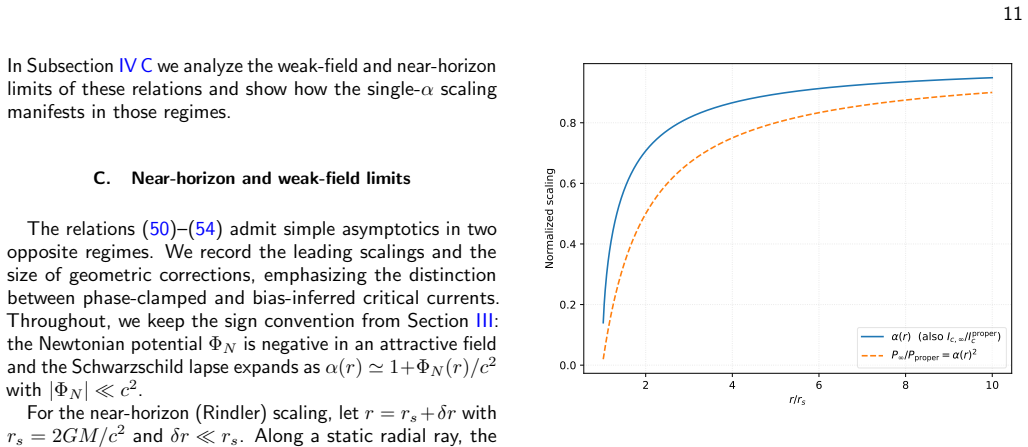
- The asymptotic critical current scales as a single power of the lapse, Ic,inf = alpha Ic^proper, for both phase-clamped and bias-inferred protocols, with curvature corrections of order (L/Rc)^2.
- Power measured at infinity scales as alpha^2 P^proper, because one alpha comes from the current flux and a second from the redshift of energy per Cooper pair.
- In a vertical dc-SQUID with junctions at different radii, DC lobe centers in external flux are not shifted at linear order; the envelope is deformed quadratically in (g Delta h / c^2) and the overall amplitude is rescaled by the average lapse.
Where Pith is reading between the lines
- If the same proper-to-asymptotic dictionary is applied to slowly rotating backgrounds, the nonzero shift vector should introduce frame-dragging and Sagnac contributions into the junction phase and loop constraint—an extension the paper explicitly flags.
- The invariance of step loci in asymptotic variables suggests a metrological protocol: a superconducting circuit whose frequency is referenced to infinity could serve as a gravitational redshift test that is insensitive to junction material details.
- The clean separation between redshift and propagation phases means RF lobe shifts in a vertical SQUID could, in principle, be engineered to isolate the Shapiro delay by equalizing geometric path lengths, giving a tabletop handle on a purely general-relativistic phase.
- The kinematic scaling laws imply that near-horizon observations of a junction's critical current would vanish linearly with proper distance to the horizon even if local physics is unchanged, offering a microphysics-independent signature for compact-object environments.
Editorial analysis
A structured set of objections, weighed in public.
Referee Report
Summary. The paper develops a covariant, analytic framework for Josephson phenomena in static curved spacetimes and applies it to the Schwarzschild exterior. It claims three main results: a redshifted AC Josephson law, Eq. (25), in which the Killing-time phase rate is proportional to α1V1^proper − α2V2^proper; an invariant Shapiro-step locus when both bias and drive are specified at infinity; and a DC critical-current mapping I_c,∞ ≃ α I_c^proper with power scaling P∞ ≃ α² P_proper. It also analyzes a vertical dc-SQUID with junctions at different radii, concluding that gravity does not shift the DC interference pattern at linear order and that RF lobe translations are controlled by differential propagation phases. The framework combines the gauge-invariant condensate momentum, the Tolman–Ehrenfest equilibrium condition, a static-slice Ginzburg–Landau formulation, and conserved hypersurface fluxes.
Significance. If correct, the paper provides a clean and potentially useful separation between local Josephson microphysics and global redshift/clock effects. The central AC construction is explicit, gauge-invariant, and parameter-free, with the proper-to-asymptotic conversions derived from Killing projections rather than assumed ad hoc. The near-horizon and weak-field scalings are concrete and falsifiable, and the SQUID analysis gives an unambiguous qualitative prediction: no O(Δα) DC lobe shift. These are genuine strengths. However, the headline single-α scaling of the critical current is undermined by an internal contradiction in Appendix E and by an under-specified 'bias-inferred' protocol in §IVB. Because the critical-current scaling is one of the paper's three stated main results, this issue must be resolved before the paper can be accepted.
major comments (3)
- [Appendix E, final paragraph; cf. §IVB and §IVC] Appendix E directly contradicts the main text. It states that the Rindler limit gives 'the phase-clamped scaling I_c,∞^(phase) ∼ α I_c^proper and the bias-inferred scaling I_c,∞^(bias) ∼ α² I_c^proper [cf. (50)–(54) and (56)–(57)]'. But Eq. (53) asserts I_c,∞^(bias) ≃ α I_c^proper, Eq. (54) repeats the single-α law, and Eqs. (56)–(57) both scale as α I_c^proper. The abstract and §VI also state a single power of α. This is not a cosmetic typo: the two derivations disagree on an observable scaling, and the reader is given no definition of the 'bias-inferred' protocol that could resolve the discrepancy. Please remove the α² statement or exhibit a precise protocol that produces it.
- [§IVB, text following Eq. (52)] The 'bias-inferred' critical-current argument is sketched rather than derived. The paper says one ramps an asymptotic bias δV∞, inserts Δφ(t) = Δφ0 + (2e/ℏ)δV∞ t into Eq. (50), and takes a 'time-averaged current near the edge of stability' to obtain the critical value. But the time average of α I_c^proper sin(Δφ0 + ωt) over a complete cycle is exactly zero, and no threshold, switching, or averaging protocol is defined. Thus Eq. (53) is not established by the given argument. A concrete operational definition — for example, a dissipative RSJ model, a switching-current distribution, or a finite-time ramp criterion — is needed before the single-α scaling can be regarded as derived, and before the Appendix E contradiction can be resolved.
- [§IIIB, RF-driven case] The derivation of the invariant Shapiro-step locus is internally sound, but its domain should be stated more carefully. Equation (36) is obtained by writing V_i^proper = V_i^∞/α_i for both banks and then substituting into Eq. (25). This assumes that both the DC bias and the RF drive are specified at infinity and that the local proper drop is exactly V∞/α. If the RF drive is delivered by a transmission line or cavity with nontrivial impedance matching, additional α-dependent factors could enter the local amplitude. The paper should state this assumption explicitly when claiming exact invariance of step loci.
minor comments (4)
- [§IIB] The sentence 'When α is approximately constant over the junction area, (16)-(16) give the kinematic conversion' contains a typo: it should refer to Eqs. (16)–(17).
- [§IIA and §IV] The sign convention q = +2e is introduced without comment. In standard BCS theory the Cooper pair carries charge −2e, and the sign of the Josephson relation is convention-dependent. A brief note on the chosen sign convention would remove ambiguity.
- [§V] The expansion in Eq. (75) contains a term proportional to ρ² sin²(πf)/|cos(πf)|, which diverges near the lobe minima. The exact envelope (73) is finite there, so the expansion is not uniformly valid. Please state that the quadratic approximation is meant away from the minima.
- [Appendix D] In the radial-null equation dt/dr = (1 − r_s/r)^{-1}, the sign should be specified for outgoing versus ingoing rays. The subsequent logarithmic expressions are clear, but the sign convention should be explicit.
Circularity Check
No circularity: AC/DC results follow from externally grounded local Josephson relation and explicit proper↔asymptotic dictionary; Appendix E's α² statement is an internal inconsistency, not circular.
full rationale
Walking the derivation chain, I find no circular step. The AC Josephson law is built on the standard covariant relation u^μ p_μ = μ (Eq. 5, cited to Son and textbooks) and the Tolman–Ehrenfest equilibrium condition (Eq. 10, cited to Tolman/Ehrenfest), neither of which is authored by the present authors. Eq. (25) follows by taking the difference of Eq. (11) across the two banks; the asymptotic form (26) uses V_i^∞ ≡ α_i V_i^proper, an explicitly defined dictionary, not a fitted or imported uniqueness result. The statement that Shapiro steps sit at ⟨V∞⟩ = nℏΩ∞/2e (Eq. 36) is the flat-space law rewritten in that dictionary; it is definitional in presentation, but the paper openly labels it as an operational convention ('when the DC bias is delivered from infinity'), so it is not a hidden assumption of the conclusion. Similarly, Ic,∞ ≃ α Ic^proper follows from the conserved-flux definition I∞ = ∫_S α J^i s_i dA (Eqs. 16–18, 48–49) plus the GL current–phase relation; no parameter is fitted and no external result is imported from the authors. No self-citation chain is load-bearing; references such as [12] are external consistency checks. Correctness caveat: Appendix E's final paragraph asserts a bias-inferred α² scaling ('...the phase-clamped scaling I_c,∞^(phase) ∼ α I_c^proper and the bias-inferred scaling I_c,∞^(bias) ∼ α² I_c^proper [cf. (50)–(54) and (56)–(57)]'), while Eqs. (50)–(54) and (56)–(57) state I_c,∞^(bias) ≃ α I_c^proper. This is an internal inconsistency / omitted derivation, not a circularity. It undermines the manuscript's central DC scaling but does not make the derivation circular.
Axiom & Free-Parameter Ledger
axioms (5)
- domain assumption Local Josephson relation u^μ p_μ = μ (Eq. 5), with p_μ = ℏ∂_μθ − qA_μ.
- domain assumption Banks are quasi-static: u^μ = U^μ = ξ^μ/α inside each bank, up to small superflow corrections (Section II A).
- domain assumption Tolman–Ehrenfest equilibrium condition α(μ − qΦ) = const on each bank (Eq. 10).
- domain assumption Static background with timelike Killing field, zero shift, and classical electromagnetic test field on a fixed Schwarzschild metric.
- domain assumption Short-junction and weak-curvature hierarchy: L ≪ R_c and L ≪ ℓ_α, so lapse and metric are nearly constant across the barrier.
read the original abstract
We develop a fully covariant, analytic framework for Josephson phenomena in static curved spacetimes and specialize it to the Schwarzschild exterior. The formulation rests on two invariant elements: the gauge-invariant condensate momentum that governs phase dynamics and the conserved current whose hypersurface flux encodes transport for an observer at infinity. Using the timelike Killing field to relate proper and asymptotic quantities, we derive a redshifted AC Josephson law in which the asymptotic phase-evolution rate is proportional to the difference of redshifted voltage drops, i.e. to $V_i^\infty \equiv \alpha_i V_i^{\rm proper}$; equivalently, it depends on $\alpha_i V_i^{\rm proper}$ for local control. Under RF drive specified at infinity, the Shapiro-step loci are invariant (expressed in asymptotic voltages) while propagation phases set any apparent lobe translation. For DC transport, a short-junction solution on a static slice yields the proper current-phase relation; mapping to asymptotic observables gives a single-power redshift scaling of critical currents, $I_{c,\infty}\propto \alpha I_c^{\rm proper}$, whereas power scales as $P_\infty\propto \alpha^2 P_{\rm proper}$. In a "vertical" dc-SQUID with junctions at different radii, gravity does not shift the DC interference pattern at linear order; it produces a small envelope deformation and an amplitude rescaling. Gravity does not alter the local Josephson microphysics; it reshapes the clocks and energy accounting that define measurements at infinity. The resulting predictions are gauge- and coordinate-invariant, operationally stated in terms of an experimenter who can control (proper vs. asymptotic bias), and remain analytic from the weak-field regime to the near-horizon limit.
Figures




Reference graph
Works this paper leans on
-
[1]
Hence∆ φ[C]is strictly gauge invariant
Under Aµ →A µ + ∂µχ and θ→θ + q ℏ χ, the 1-form p in (A1) is invariant. Hence∆ φ[C]is strictly gauge invariant
-
[2]
Since∆ φ[C] = ℏ−1 R C ι∗(p), functoriality of the pullback gives∆ φ[Φ(C)] = ℏ−1 R C Φ∗ι∗(p) = ∆φ[C]
LetΦ : Σ t → Σt be a smooth spatial diffeomor- phism (change of coordinates or a smooth deforma- tion of the embedding). Since∆ φ[C] = ℏ−1 R C ι∗(p), functoriality of the pullback gives∆ φ[Φ(C)] = ℏ−1 R C Φ∗ι∗(p) = ∆φ[C]. Thus the construction de- pends only on the geometric image of the curve, not on coordinates
-
[3]
phase difference
Consider two curves C1,C 2 ⊂ Σt with the same end- points x1,2 and define the closed loop L = C1 − C2. In a vortex-free, simply connected domain one has d(dθ) = 0, so by Stokes’ theorem ∆φ[C1]−∆φ[C 2] =− q ℏ I L Ai dxi =− q ℏ Z S(L) Bisi dA=−2π Φloop Φ0 ,(A3) where S(L)is any surface inΣ t with boundary L, Φloop = R S BisidA is the magnetic flux through S...
-
[4]
Possible new effects in superconductive tunnelling,
B. D. Josephson, “Possible new effects in superconductive tunnelling,” Phys. Lett.1, 251–253 (1962)
1962
-
[5]
Josephson Currents in Superconducting Tunneling: The Effect of Microwaves and Other Observa- tions,
Sidney Shapiro, “Josephson Currents in Superconducting Tunneling: The Effect of Microwaves and Other Observa- tions,” Phys. Rev. Lett.11, 80 (1963)
1963
-
[6]
Microwave-induced d.c. voltages across josephson junctions,
D.N. Langenberg, D.J. Scalapino, B.N. Taylor, and R.E. Eck, “Microwave-induced d.c. voltages across josephson junctions,” Physics Letters20, 563–565 (1966)
1966
-
[7]
Tinkham,Introduction to Superconductivity, Interna- tional series in pure and applied physics (McGraw-Hill, 1975)
M. Tinkham,Introduction to Superconductivity, Interna- tional series in pure and applied physics (McGraw-Hill, 1975)
1975
-
[8]
The electromagnetic equations of the supraconductor,
F. London and H. London, “The electromagnetic equations of the supraconductor,” Proceedings of the Royal Society of London. Series A - Mathematical and Physical Sciences 149, 71–88 (1935). 23
1935
-
[9]
On the Weight of Heat and Thermal Equilibrium in General Relativity,
Richard C. Tolman, “On the Weight of Heat and Thermal Equilibrium in General Relativity,” Phys. Rev.35, 904–924 (1930)
1930
-
[10]
Temperature Equilib- rium in a Static Gravitational Field,
Richard Tolman and Paul Ehrenfest, “Temperature Equilib- rium in a Static Gravitational Field,” Phys. Rev.36, 1791– 1798 (1930)
1930
-
[11]
Superconductors and gravitational drag,
Bryce S. DeWitt, “Superconductors and gravitational drag,” Phys. Rev. Lett.16, 1092–1093 (1966)
1966
-
[12]
Electrodynamics in curved spacetime: 3 + 1 formulation,
K. S. Thorne and D. MacDonald, “Electrodynamics in curved spacetime: 3 + 1 formulation,” Monthly Notices of the Royal Astronomical Society198, 339–343 (1982)
1982
-
[13]
Hydrodynamics of relativistic systems with broken continuous symmetries,
D. T. Son, “Hydrodynamics of relativistic systems with broken continuous symmetries,” Int. J. Mod. Phys. A16S1C, 1284–1286 (2001), arXiv:hep-ph/0011246
Pith/arXiv arXiv 2001
-
[14]
Su- perconductors and Gravity,
Antonio Gallerati and Giovanni Alberto Ummarino, “Su- perconductors and Gravity,” Symmetry14, 554 (2022), arXiv:2203.09417 [gr-qc]
Pith/arXiv arXiv 2022
-
[15]
Joseph- son AC effect induced by weak gravitational field,
Giovanni Alberto Ummarino and Antonio Gallerati, “Joseph- son AC effect induced by weak gravitational field,” Class. Quant. Grav.37, 217001 (2020), arXiv:2009.04967 [gr-qc]
Pith/arXiv arXiv 2020
-
[16]
Gravitational Redshift Tests with Atomic Clocks and Atom Interferometers,
Fabio Di Pumpo, Christian Ufrecht, Alexander Friedrich, Enno Giese, Wolfgang P. Schleich, and William G. Un- ruh, “Gravitational Redshift Tests with Atomic Clocks and Atom Interferometers,” PRX Quantum2, 040333 (2021), arXiv:2104.14391 [quant-ph]
Pith/arXiv arXiv 2021
-
[17]
A lab-based test of the gravitational redshift with a miniature clock net- work,
Xin Zheng, Jonathan Dolde, Matthew C. Cambria, Hong Ming Lim, and Shimon Kolkowitz, “A lab-based test of the gravitational redshift with a miniature clock net- work,” Nature Commun.14, 4886 (2023), arXiv:2207.07145 [physics.atom-ph]
Pith/arXiv arXiv 2023
-
[18]
A Holographic Josephson Junction,
Gary T. Horowitz, Jorge E. Santos, and Benson Way, “A Holographic Josephson Junction,” Phys. Rev. Lett.106, 221601 (2011), arXiv:1101.3326 [hep-th]
Pith/arXiv arXiv 2011
-
[19]
Gravitational and Inertial Effects in Quan- tum Fluids,
J. Anandan, “Gravitational and Inertial Effects in Quan- tum Fluids,” Phys. Rev. Lett.47, 463 (1981), [Erratum: Phys.Rev.Lett. 52, 401 (1984)]
1981
-
[20]
Effect of newtonian gravitational potential on a superfluid josephson interferometer,
Jeeva Anandan, “Effect of newtonian gravitational potential on a superfluid josephson interferometer,” Physical Review B30, 3717–3721 (1984)
1984
-
[21]
Ohm’s law in general relativity and Coriolis force effects in rotating conductors,
B. J. Ahmedov, “Ohm’s law in general relativity and Coriolis force effects in rotating conductors,” Grav. Cosmol.4, 139– 141 (1998), arXiv:gr-qc/0701046
Pith/arXiv arXiv 1998
-
[22]
General relativistic thermoelectric effects in superconductors,
B. J. Ahmedov, “General relativistic thermoelectric effects in superconductors,” Gen. Rel. Grav.31, 357–369 (1999), arXiv:gr-qc/0701072
Pith/arXiv arXiv 1999
-
[23]
Ohm’s Law for Plasma in General Relativity and Cowling’s Theorem,
Bahodir B. Ahmedov, “Ohm’s Law for Plasma in General Relativity and Cowling’s Theorem,” Astrophys. Space Sci. 331, 565–573 (2011), arXiv:1008.3025 [astro-ph.SR]
Pith/arXiv arXiv 2011
-
[24]
Gravito- electromagnetic fields and superconductors in a regime of weak static gravitational field,
D. K. Das, S. Panda, and Salila Das, “Gravito- electromagnetic fields and superconductors in a regime of weak static gravitational field,” Phys. Scripta98, 055804 (2023)
2023
-
[25]
Thermoelectric conduction in General Relativity: a causal, stable, and well-posed theory,
Lorenzo Gavassino, “Thermoelectric conduction in General Relativity: a causal, stable, and well-posed theory,” (2025), arXiv:2509.23845 [gr-qc]
arXiv 2025
-
[26]
Quantum Interference Effects in Josephson Tunnel- ing,
R. C. Jaklevic, John Lambe, A. H. Silver, and J. E. Mer- cereau, “Quantum Interference Effects in Josephson Tunnel- ing,” Phys. Rev. Lett.12, 159–160 (1964)
1964
-
[27]
Fourth Test of General Relativity,
Irwin I. Shapiro, “Fourth Test of General Relativity,” Phys. Rev. Lett.13, 789–791 (1964)
1964
-
[28]
The Shapiro time delay and the equivalence principle,
Markus P¨ ossel, “The Shapiro time delay and the equivalence principle,” (2019), arXiv:2001.00229 [gr-qc]
Pith/arXiv arXiv 2019
-
[29]
Observation of a gravitational Aharonov-Bohm effect,
Chris Overstreet, Peter Asenbaum, Joseph Curti, Minjeong Kim, and Mark A. Kasevich, “Observation of a gravitational Aharonov-Bohm effect,” Science375, abl7152 (2021)
2021
-
[30]
Gravitational Aharonov-Bohm effect,
R. Y. Chiao, N. A. Inan, M. Scheibner, J. Sharping, D. A. Singleton, and M. E. Tobar, “Gravitational Aharonov-Bohm effect,” Phys. Rev. D109, 064073 (2024), arXiv:2311.07764 [gr-qc]
Pith/arXiv arXiv 2024
-
[31]
Gravitational Metrological Triangle,
Claus Lammerzahl and Sebastian Ulbricht, “Gravitational Metrological Triangle,” Phys. Rev. Lett.133, 241402 (2024), arXiv:2402.04135 [gr-qc]
Pith/arXiv arXiv 2024
-
[32]
Eric Gourgoulhon,3+1 Formalism in General Relativity, Lecture Notes in Physics (Springer, 2012)
2012
-
[33]
Eric Poisson,A Relativist’s Toolkit: The Mathematics of Black-Hole Mechanics(Cambridge University Press, 2009)
2009
-
[34]
Ther- modynamic Equilibrium in General Relativity,
J. A. S. Lima, A. Del Popolo, and A. R. Plastino, “Ther- modynamic Equilibrium in General Relativity,” Phys. Rev. D 100, 104042 (2019), arXiv:1911.09060 [gr-qc]
Pith/arXiv arXiv 2019
-
[35]
The thermodynamics of black holes,
Robert M. Wald, “The thermodynamics of black holes,” Living Rev. Rel.4, 6 (2001), arXiv:gr-qc/9912119
Pith/arXiv arXiv 2001
-
[36]
Antonio Barone and Gianfranco Patern` o,Physics and Appli- cations of the Josephson Effect(Wiley, 1982)
1982
-
[37]
Codata recommended values of the fundamental physical constants: 2018,
Eite Tiesinga, Peter J. Mohr, David B. Newell, and Barry N. Taylor, “Codata recommended values of the fundamental physical constants: 2018,” Journal of Physical and Chemical Reference Data50(2021), 10.1063/5.0064853
-
[38]
On the Theory of super- conductivity,
V. L. Ginzburg and L. D. Landau, “On the Theory of super- conductivity,” Zh. Eksp. Teor. Fiz.20, 1064–1082 (1950)
1950
-
[39]
Su- perconductor in static gravitational, electric and magnetic fields with vortex lattice,
Giovanni Alberto Ummarino and Antonio Gallerati, “Su- perconductor in static gravitational, electric and magnetic fields with vortex lattice,” Results Phys.30, 104838 (2021), arXiv:2110.07335 [gr-qc]
Pith/arXiv arXiv 2021
-
[40]
Possible alterations of local gravitational field inside a superconductor,
G. A. Ummarino and A. Gallerati, “Possible alterations of local gravitational field inside a superconductor,” Entropy 23, 193 (2021), arXiv:2102.01489 [gr-qc]
Pith/arXiv arXiv 2021
-
[41]
Ginzburg-Landau Formalism in Curved Spacetime,
Mohammad Amin Rastkhadiv, “Ginzburg-Landau Formalism in Curved Spacetime,” (2025), arXiv:2509.12731 [cond- mat.supr-con]
arXiv 2025
-
[42]
P G de Gennes,Superconductivity of metals and alloys(W. A. Benjamin, Inc.,New York, 1965)
1965
-
[43]
Ge- ometric Josephson junction,
Fabiano F. Santos and Henrique Boschi-Filho, “Ge- ometric Josephson junction,” JHEP01, 135 (2025), arXiv:2407.10008 [hep-th]
Pith/arXiv arXiv 2025
-
[44]
Analogue simulation of quantum gravity black hole models in a dc-SQUID array,
Marco D. Maceda and Carlos Sab ´ ın, “Analogue simulation of quantum gravity black hole models in a dc-SQUID array,” Sci. Rep.15, 20626 (2025), arXiv:2507.14150 [physics.gen- ph]
Pith/arXiv arXiv 2025
-
[45]
Building an AdS/BCFT Josephson junction within Horndeski gravity,
Fabiano F. Santos and Henrique Boschi-Filho, “Building an AdS/BCFT Josephson junction within Horndeski gravity,” (2025), arXiv:2510.07165 [hep-th]
Pith/arXiv arXiv 2025
-
[46]
Interaction Between Macroscopic Quantum Sys- tems and Gravity,
Antonio Gallerati, Giovanni Modanese, and Giovanni Um- marino, “Interaction Between Macroscopic Quantum Sys- tems and Gravity,” Front. in Phys.10, 941858 (2022), arXiv:2206.07574 [gr-qc]
Pith/arXiv arXiv 2022
-
[47]
Massive quantum systems as interfaces of quantum mechanics and gravity,
Sougato Bose, Ivette Fuentes, Andrew A. Geraci, Saba Mehsar Khan, Sofia Qvarfort, Markus Rademacher, Muddassar Rashid, Marko Toroˇ s, Hendrik Ulbricht, and Clara C. Wanjura, “Massive quantum systems as interfaces of quantum mechanics and gravity,” Rev. Mod. Phys.97, 015003 (2025), arXiv:2311.09218 [quant-ph]
Pith/arXiv arXiv 2025
-
[48]
Quantum sensing from gravity as a universal dephasing channel for qubits,
Alexander V. Balatsky, Pedram Roushan, Joris Schaltegger, and Patrick J. Wong, “Quantum sensing from gravity as a universal dephasing channel for qubits,” Phys. Rev. A111, 012411 (2025), arXiv:2406.03256 [quant-ph]
Pith/arXiv arXiv 2025
discussion (0)
Sign in with ORCID, Apple, or X to comment. Anyone can read and Pith papers without signing in.