Baryon-antibaryon photoproduction cross sections off the proton
Pith reviewed 2026-05-18 03:18 UTC · model grok-4.3
The pith
GlueX data show baryon-antibaryon photoproduction explained by double t-channel exchange
A machine-rendered reading of the paper's core claim, the machinery that carries it, and where it could break.
Core claim
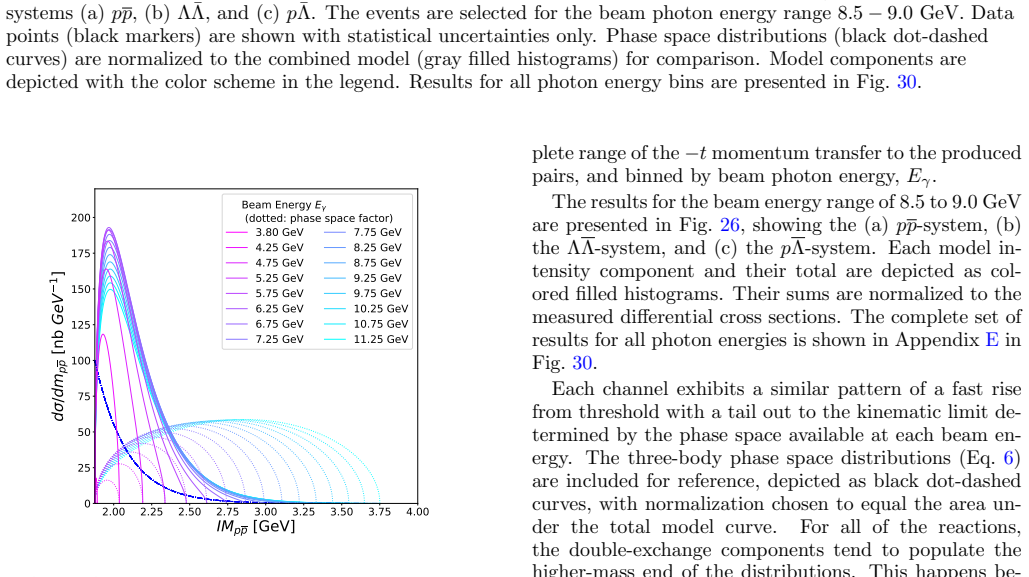
The GlueX experiment has observed p p-bar and, for the first time, Lambda Lambda-bar and p Lambda-bar photoproduction from a proton target at photon energies up to 11.6 GeV. The angular distributions are forward peaked for all produced pairs, consistent with Regge-like t-channel exchange. Asymmetric wide-angle anti-baryon distributions show the presence of additional processes. In a phenomenological model, consistency is found with a double t-channel exchange process where anti-baryons are created only at the middle vertex. The model matches all observed distributions with a small number of free parameters. No narrow resonant structures were found in these reaction channels.
What carries the argument
double t-channel exchange process where anti-baryons are created only at the middle vertex
Load-bearing premise
That a double t-channel exchange process alone, with anti-baryons only at the middle vertex, accounts for the observed distributions without needing resonances or other mechanisms.
What would settle it
Detection of a narrow peak in the invariant mass distribution of any produced pair or significant deviation from the model's predictions in angular distributions at different photon energies.
Figures




read the original abstract
The GlueX experiment at Jefferson Lab has observed $p\bar{p}$ and, for the first time, $\Lambda\bar{\Lambda}$ and $p\bar{\Lambda}$ photoproduction from a proton target at photon energies up to 11.6 GeV. The angular distributions are forward peaked for all produced pairs, consistent with Regge-like $t$-channel exchange. Asymmetric wide-angle anti-baryon distributions show the presence of additional processes. In a phenomenological model, we find consistency with a double $t$-channel exchange process where anti-baryons are created only at the middle vertex. The model matches all observed distributions with a small number of free parameters. In the hyperon channels, we observe a clear distinction between photoproduction of the $\Lambda\bar{\Lambda}$ and $p\bar{\Lambda}$ systems but general similarity to the $p\bar{p}$ system. We report both total cross sections and cross sections differential with respect to momentum transfer and the invariant masses of the created particle pairs. No narrow resonant structures were found in these reaction channels. The suppression of $s\bar{s}$ quark pairs relative to $d\bar{d}$ quark pairs is similar to what has been seen in other reactions.
Editorial analysis
A structured set of objections, weighed in public.
Referee Report
Summary. The manuscript reports measurements from the GlueX experiment of p p-bar, Lambda Lambda-bar, and p Lambda-bar photoproduction off the proton at photon energies up to 11.6 GeV. Angular distributions are forward-peaked for all channels, consistent with Regge-like t-channel exchange, while asymmetric wide-angle anti-baryon distributions indicate additional processes. A phenomenological double t-channel exchange model (anti-baryons created only at the middle vertex) is shown to describe all observed angular and invariant-mass distributions with a small number of free parameters. Total and differential cross sections (w.r.t. momentum transfer and pair invariant masses) are presented, with no narrow resonant structures observed and s s-bar suppression similar to other reactions.
Significance. If the central claims hold, the work supplies the first data on Lambda Lambda-bar and p Lambda-bar photoproduction in this energy range, extending the experimental record of baryon-pair production. The parsimonious double t-channel model provides a concrete, testable description of the forward peaking and asymmetries, strengthening the case for t-channel dominance in the Regge regime. The reported absence of narrow structures and the quark-pair suppression pattern add quantitative constraints useful for future amplitude analyses and Regge phenomenology.
major comments (1)
- [Phenomenological model and results sections] The central interpretation that the double t-channel exchange process fully accounts for the forward-peaked distributions, asymmetric wide-angle anti-baryon distributions, and absence of narrow structures rests on the phenomenological model matching the data with few free parameters. However, no chi-squared per degree of freedom, parameter uncertainties, or direct comparisons to single t-channel Regge models or models including s-channel terms are reported for the differential distributions. This quantitative gap directly affects the load-bearing claim of model adequacy and uniqueness.
minor comments (2)
- [Abstract] The abstract states that the model matches distributions but provides no information on systematic uncertainties, background subtraction procedures, or the statistical criteria used to conclude the absence of narrow resonances; adding these would improve clarity for readers.
- [Cross-section results] Cross-section tables or figures should explicitly list both statistical and systematic uncertainties for each bin to allow independent assessment of the reported values.
Simulated Author's Rebuttal
We thank the referee for the positive evaluation of the significance of our measurements and for the constructive comment on the phenomenological model. We address the major comment below and will revise the manuscript to strengthen the quantitative support for our interpretation.
read point-by-point responses
-
Referee: The central interpretation that the double t-channel exchange process fully accounts for the forward-peaked distributions, asymmetric wide-angle anti-baryon distributions, and absence of narrow structures rests on the phenomenological model matching the data with few free parameters. However, no chi-squared per degree of freedom, parameter uncertainties, or direct comparisons to single t-channel Regge models or models including s-channel terms are reported for the differential distributions. This quantitative gap directly affects the load-bearing claim of model adequacy and uniqueness.
Authors: We agree that including chi-squared per degree of freedom, parameter uncertainties, and explicit comparisons to alternative models would improve the rigor of the model section. In the revised manuscript we will add the chi-squared per degree of freedom values for the fits to the angular and invariant-mass distributions, together with the uncertainties on the fitted parameters. We will also include a direct comparison to a simple single t-channel Regge model, which we find fails to reproduce the observed forward-backward asymmetry in the anti-baryon angular distributions; this comparison will be shown in a new figure or table. A full s-channel resonance model is beyond the scope of the present phenomenological approach, but the absence of narrow structures already limits resonant contributions, and we will add a short discussion clarifying this point. These additions directly address the quantitative gap noted by the referee. revision: yes
Circularity Check
No circularity: experimental measurements and phenomenological consistency check are self-contained
full rationale
The paper's central results are direct experimental observations of cross sections, angular distributions, and invariant-mass spectra from the GlueX detector. The phenomenological model of double t-channel exchange is introduced only as a consistency check that reproduces the data shapes using a small number of adjustable parameters; it is not presented as a first-principles derivation, prediction, or uniqueness theorem. No equations or claims reduce the reported measurements to the model parameters by construction, and no self-citation chains or imported ansätze carry the load-bearing interpretation. The analysis therefore remains independent of its own fitted inputs.
Axiom & Free-Parameter Ledger
free parameters (1)
- Phenomenological model parameters
axioms (1)
- domain assumption Forward peaking of angular distributions arises from Regge-like t-channel exchange
Reference graph
Works this paper leans on
-
[1]
40±.20 .40±.20 .40±.20 θ5 (GeV−2) lower vertex slope (α ′ 3 ind 2σdouble/t′ 1u′
-
[2]
14±.03 .10±.03 .40±.03 θ6 (GeV2) cutoff oft ′ 1 (t1 cutoff ind 2σdouble/t′ 1u′
-
[3]
15) θ7 (GeV−2) upper vertex slope (α ′ 1 ind 2σdouble/t′ 1u′
49±.20 .00±.20 .50±.20 Double Exchange-II (k= 3) (Eq. 15) θ7 (GeV−2) upper vertex slope (α ′ 1 ind 2σdouble/t′ 1u′
-
[4]
80±.40 - - θ8 (GeV−2) lower vertex slope (α ′ 3 ind 2σdouble/t′ 1u′
-
[5]
1.60±.40 - - θ9 (GeV2) cutoff oft ′ 1 (t1 cutoff ind 2σdouble/t′ 1u′
-
[6]
49±.20 - - histogram bin: LX (x;w,θ) = Y j e−Mj(x;w,θ)[Mj(x;w,θ)] Oj Oj! ,(17) whereO j is the observed or measured number of events at bin-jforXin the data without acceptance correction. Mj represents the expected number of events in binj, generated from the combined model with parameter set θand fractionsw(see Eq. 18), reconstructed using the reconstruc...
work page 1977
-
[7]
Modeling with embedded reconstruction efficiency The global negative-log-likelihood function, defined in Eq. 21, is a quantitative measure of the extent to which the data can be approximated by the reconstructed Monte Carlo simulations. The likelihood incorporates an efficiency factor,ϵ(x;θ), embedded in the binned his- togram representation of the observ...
-
[8]
Online optimization focusing on local efficiency mapping Instead of attempting to map the entire global effi- ciencyg(x ′) as a fixed function and optimize the likeli- hood function across the entire parameter space (which is referred to as “offline optimization” in this context), we reformulate the problem as an “Online Optimiza- tion” [39]: minimizing a...
-
[9]
However, since the global negative-log-likelihood defined in Eq
Stochastic Gradient Descent Conventional gradient-based optimization techniques can be very effective with direct access to the gradient value. However, since the global negative-log-likelihood defined in Eq. 21 does not have any analytic form, di- rect computation of its gradient is infeasible. Instead, we use a stochastic approximation to the gradient [...
-
[10]
H. H. Binghamet al., Phys. Rev. D8, 1277 (1973)
work page 1973
- [11]
- [12]
-
[13]
J. Bodenkamp, D. Fries, A. Markou, E. Seitz, H. Behrend, W. Hesse, T. Miyachi, W. McNeely, and V. Schr¨ oder, Nuclear Physics B255, 717 (1985)
work page 1985
-
[14]
Stokes,Search for Resonances in the Photoproduction of Proton-Antiproton Pairs, Ph.D
B. Stokes,Search for Resonances in the Photoproduction of Proton-Antiproton Pairs, Ph.D. thesis, Florida State Univ. (2006)
work page 2006
-
[15]
Phelps,Antibaryon Photoproduction using CLAS at Jefferson Lab, Ph.D
W. Phelps,Antibaryon Photoproduction using CLAS at Jefferson Lab, Ph.D. thesis, Florida International Univ. (2017)
work page 2017
- [16]
-
[17]
Benkheiriet al., Physics Letters B68, 483 (1977)
P. Benkheiriet al., Physics Letters B68, 483 (1977). 33
work page 1977
-
[18]
B. G. Gibbard, L. A. Ahrens, K. Berkelman, D. G. Cas- sel, C. T. Day, D. J. Harding,et al., Phys. Rev. Lett.42, 1593 (1979)
work page 1979
- [19]
-
[20]
C. Amsler and F. Myhrer, Annual Review of Nuclear and Particle Science41, 219 (1991)
work page 1991
- [21]
-
[22]
B. S. Zou and H. C. Chiang, Phys. Rev. D69, 034004 (2004)
work page 2004
-
[23]
A. Sibirtsev, J. Haidenbauer, S. Krewald, U.-G. Meißner, and A. W. Thomas, Phys. Rev. D71, 054010 (2005)
work page 2005
-
[24]
X.-W. Kang, J. Haidenbauer, and U.-G. Meißner, Phys. Rev. D91, 074003 (2015)
work page 2015
-
[25]
J. Haidenbauer and U.-G. Meißner, EPJ Web Conf.258, 06002 (2022)
work page 2022
-
[26]
L.-Y. Dai, J. Haidenbauer, and U.-G. Meißner, Journal of High Energy Physics07, 078 (2017)
work page 2017
-
[27]
P. D. Barneset al., Phys. Rev. C62, 055203 (2000)
work page 2000
-
[28]
J. Haidenbauer, K. Holinde, and J. Speth, Nucl. Phys. A 562, 317 (1993)
work page 1993
- [29]
- [30]
-
[31]
S. Acharya, D. Adamova, A. Adler, J. Adolfsson, G. A. Rinella, M. Agnello, N. Agrawal, Z. Ahammed, S. Ah- mad, S. U. Ahn,et al., Physics Letters B829, 137060 (2022)
work page 2022
-
[32]
V. M. Sarti, The European Physical Journal C85, 1068 (2025)
work page 2025
-
[33]
T. Gutsche, S. Kuleshov, V. E. Lyubovitskij, and I. T. Obukhovsky, Phys. Rev. D94, 034010 (2016)
work page 2016
-
[34]
T. Gutsche, S. Kuleshov, V. E. Lyubovitskij, and I. T. Obukhovsky, Phys. Rev. D96, 054024 (2017)
work page 2017
-
[35]
R. Schumacher and H. Li (GlueX), AIP Conf. Proc. 2130, 020007 (2019)
work page 2019
- [36]
-
[37]
Li,Baryon-Antibaryon Photoproduction off the Pro- ton, Ph.D
H. Li,Baryon-Antibaryon Photoproduction off the Pro- ton, Ph.D. thesis, Carnegie Mellon University, Depart- ment of Physics (2023)
work page 2023
-
[38]
S. Adhikariet al.(GlueX), Nucl. Instrum. Meth. A987, 164807 (2021)
work page 2021
-
[39]
Navaset al.(Particle Data Group), Phys
S. Navaset al.(Particle Data Group), Phys. Rev. D110, 030001 (2024)
work page 2024
-
[40]
P. D. B. Collins,An Introduction to Regge Theory and High Energy Physics, Cambridge Monographs on Math- ematical Physics (Cambridge University Press, 1977)
work page 1977
-
[41]
E. Byckling and K. Kajantie,Particle Kinematics, A Wiley-Interscience publication (Wiley, 1973)
work page 1973
-
[42]
Shi, M. and Danilkin, I. V. and Fern´ andez-Ram´ ırez, C. and Mathieu, V. and Pennington, M. R. and Schott, D. and Szczepaniak, A. P., Phys. Rev. D91, 034007 (2015)
work page 2015
-
[43]
S. U. Chung,Spin formalisms, Tech. Rep. (Brookhaven Nat. Lab., 2008)
work page 2008
- [44]
-
[45]
J. Nys, A. N. H. Blin, V. Mathieu, C. Fern´ andez- Ram´ ırez, A. Jackura, A. Pilloni, J. Ryckebusch, A. P. Szczepaniak, and G. Fox (Joint Physics Analysis Cen- ter), Phys. Rev. D98, 034020 (2018)
work page 2018
- [46]
-
[47]
R. Barlow and C. Beeston, Computer Physics Commu- nications77, 219 (1993)
work page 1993
-
[48]
A. D. Flaxman, A. T. Kalai, and H. B. McMahan, (2004), arXiv:cs/0408007 [cs.LG]
work page internal anchor Pith review Pith/arXiv arXiv 2004
-
[49]
J. Bodenkamp, D. C. Fries, A. Markou, E. Seitz, H. J. Behrend, H. Fenner, W. P. Hesse, T. Miyachi, W. A. McNeely, and V. Schr¨ oder, Phys. Lett. B133, 275 (1983)
work page 1983
- [50]
-
[51]
M. Mestayeret al.(CLAS), Phys. Rev. Lett.113, 152004 (2014)
work page 2014
-
[52]
Bocquetet al., Physics Letters B366, 447 (1996)
G. Bocquetet al., Physics Letters B366, 447 (1996)
work page 1996
-
[53]
Wroblewski, Acta Physica Polonica
A. Wroblewski, Acta Physica Polonica. Series B16, 379 (1985)
work page 1985
-
[54]
P. Malhotra and R. Orava, Zeitschrift f¨ ur Physik C Par- ticles and Fields17, 85 (1983)
work page 1983
-
[55]
K. Abe, K. Abe, T. Abe,et al.(SLD Collaboration), Phys. Rev. D59, 052001 (1999)
work page 1999
- [56]
-
[57]
Accardiet al., The European Physical Journal A60, 173 (2024)
A. Accardiet al., The European Physical Journal A60, 173 (2024)
work page 2024
-
[58]
Baiet al.(BES Collaboration), Phys
J. Baiet al.(BES Collaboration), Phys. Rev. Lett.91, 022001 (2003)
work page 2003
- [59]
- [60]
-
[61]
GlueX data access via Durham HEP Database (2025)
work page 2025
-
[62]
S. Boyd and L. Vandenberghe,Convex optimization (Cambridge University Press, 2004)
work page 2004
discussion (0)
Sign in with ORCID, Apple, or X to comment. Anyone can read and Pith papers without signing in.