Proximity-induced superconductivity and emerging topological phases in altermagnet-based heterostructures
Pith reviewed 2026-05-18 03:14 UTC · model grok-4.3
The pith
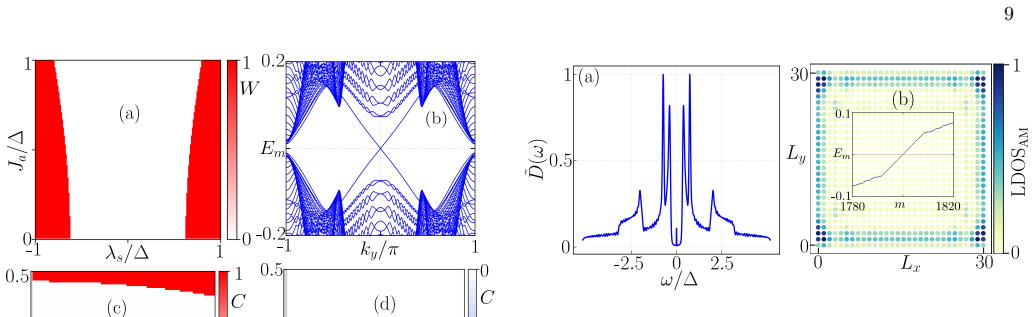
Adding Rashba spin-orbit coupling to altermagnet-superconductor heterostructures induces both weak and strong topological superconducting phases with edge modes.
A machine-rendered reading of the paper's core claim, the machinery that carries it, and where it could break.
Core claim
In a d-wave altermagnet proximitized to an s-wave superconductor, the proximity effect first induces even-parity singlet and triplet pairing amplitudes. Introducing Rashba spin-orbit coupling generates odd-parity triplet components. The resulting effective two-dimensional system then realizes both weak topological superconducting phases characterized by a winding number and strong topological superconducting phases characterized by a Chern number, each hosting edge-localized modes.
What carries the argument
Effective Green's function derived from the self-energy after integrating out the superconductor, combined with Rashba spin-orbit coupling to enable odd-parity triplet pairing and computation of winding and Chern numbers.
If this is right
- Odd-parity triplet pairing amplitudes become accessible in the altermagnet layer once Rashba coupling is present.
- The heterostructure supports both weak and strong topological phases in the same two-dimensional platform.
- Edge-localized modes appear whose protection is tied to the winding number or Chern number.
- The setup functions as a versatile platform for engineering topological superconductivity without net magnetization.
Where Pith is reading between the lines
- Varying the strength of the Rashba coupling or the altermagnet exchange field could map out a phase diagram separating the weak and strong topological regions.
- Similar proximity setups with other altermagnet symmetries might produce higher-order topological states or Majorana corner modes.
- Experimental signatures could include quantized conductance plateaus or specific spin-polarized currents along the sample edges.
Load-bearing premise
The effective Hamiltonian and Green's function obtained by integrating out the superconducting degrees of freedom accurately describe the proximity-induced pairing amplitudes and band topology in the altermagnet layer without significant higher-order corrections or unaccounted interface effects.
What would settle it
Transport or tunneling spectroscopy that finds no zero-energy edge states and measures trivial values of both the winding number and Chern number when Rashba strength is increased would show the topological phases do not emerge.
Figures




read the original abstract
We present a theoretical framework for investigating superconducting proximity effect in altermagnet (AM)-superconductor (SC) heterostructures. In general, AMs, characterized by vanishing net magnetization but spin-split electronic spectra, provide a promising platform for realizing unconventional magnetic phases. We consider a two-dimensional $d$-wave AM proximity coupled to a three dimensional ordinary $s$-wave SC. By integrating out the superconducting degrees of freedom, we derive an effective Hamiltonian that describes the proximity-induced modifications in the AM layer in the form of a self-energy. We then derive an effective Green's function to obtain the proximity-induced pairing amplitudes in the AM layer and classify the induced pairing amplitudes according to their parity, frequency, and spin. We find the presence of even-parity singlet and triplet pairing amplitudes in the AM layer. To achieve the odd-parity triplet components, important to realize topological superconductivity, we introduce a layer of Rashba spin-orbit coupling (RSOC) in the heterostructure. We analyse the band topology of this proximity-induced AM-RSOC layer and demonstrate the emergence of both weak and strong topological superconducting phases with edge-localized modes, characterized by winding number and Chern number. These findings highlight the role of AM-SC hybrid setup as a versatile platform for realizing odd-parity triplet pairings and engineering topological superconductivity in two-dimension.
Editorial analysis
A structured set of objections, weighed in public.
Referee Report
Summary. The paper develops a theoretical model for proximity-induced superconductivity in a 2D d-wave altermagnet (AM) layer coupled to a 3D s-wave superconductor (SC). By integrating out the SC degrees of freedom, an effective Hamiltonian and Green's function are derived to obtain and classify the induced pairing amplitudes (even-parity singlet and triplet) in the AM layer. Introduction of Rashba spin-orbit coupling (RSOC) is shown to generate odd-parity triplet components, leading to both weak and strong topological superconducting phases characterized by winding number and Chern number, with associated edge-localized modes.
Significance. If the effective model holds, the work provides a route to engineer odd-parity topological superconductivity in altermagnetic systems that lack net magnetization but exhibit spin-split bands. This could be relevant for spintronics and topological quantum computing platforms. The use of standard Green's function techniques and topological invariant calculations is a strength, though the result depends on the accuracy of the proximity approximation.
major comments (1)
- [Derivation of effective Hamiltonian and Green's function] The central claim that RSOC enables weak and strong topological SC phases with winding/Chern numbers and edge modes rests on the effective Green's function and self-energy correctly classifying even/odd-parity pairings. The integration of the 3D s-wave SC into the 2D d-wave AM (described in the derivation of the effective Hamiltonian) assumes perturbative tunneling and neglects higher-order interface hybridization, lattice mismatch, or 3D momentum conservation effects. These could renormalize the induced triplet components or shift the topological transition points, undermining the classification and band topology analysis.
minor comments (2)
- [Pairing classification] The abstract states that even-parity singlet and triplet pairings are found, but the transition to odd-parity via RSOC would benefit from an explicit statement of which pairing channels are symmetry-allowed before and after RSOC addition.
- [Band topology analysis] Clarify whether the topological invariants (winding number, Chern number) are computed for the full effective Hamiltonian including RSOC or for a simplified model; specify the parameter regime (e.g., strength of RSOC relative to AM splitting) where the weak/strong phases appear.
Simulated Author's Rebuttal
We thank the referee for their careful reading of our manuscript and for the constructive feedback. We address the major comment on the derivation of the effective Hamiltonian below, providing clarification on our modeling assumptions while agreeing to strengthen the discussion of limitations.
read point-by-point responses
-
Referee: [Derivation of effective Hamiltonian and Green's function] The central claim that RSOC enables weak and strong topological SC phases with winding/Chern numbers and edge modes rests on the effective Green's function and self-energy correctly classifying even/odd-parity pairings. The integration of the 3D s-wave SC into the 2D d-wave AM (described in the derivation of the effective Hamiltonian) assumes perturbative tunneling and neglects higher-order interface hybridization, lattice mismatch, or 3D momentum conservation effects. These could renormalize the induced triplet components or shift the topological transition points, undermining the classification and band topology analysis.
Authors: We thank the referee for this important observation. Our derivation follows the standard perturbative tunneling approach commonly used to integrate out the degrees of freedom of a 3D s-wave superconductor in proximity to a 2D layer, yielding an effective self-energy and Green's function. This framework is appropriate for the weak-coupling regime relevant to proximity-induced superconductivity and enables the analytic classification of induced pairing amplitudes by parity, frequency, and spin. We agree that higher-order hybridization, lattice mismatch, and full 3D momentum conservation are neglected and could quantitatively renormalize the induced amplitudes or shift transition points. However, the qualitative emergence of even-parity singlet and triplet components, as well as the odd-parity triplet terms generated by Rashba SOC, arises directly from the symmetry properties of the altermagnet and the interface and remains robust within the model's scope. To address the concern, we will revise the manuscript by adding an explicit discussion of these approximations in the methods and conclusions sections, including their potential impact on topological invariants and a statement that more microscopic treatments could refine the quantitative details. This constitutes a partial revision focused on improved transparency rather than altering the core calculations. revision: partial
Circularity Check
No circularity: standard integration and topological analysis from model assumptions
full rationale
The derivation begins from an explicit model Hamiltonian for the 2D d-wave altermagnet coupled to 3D s-wave superconductor, applies the standard technique of integrating out SC degrees of freedom to obtain a self-energy and effective Green's function, classifies the resulting even-parity pairings by parity/frequency/spin, adds an RSOC term to generate odd-parity components, and computes winding/Chern numbers plus edge modes directly from the resulting effective Hamiltonian. None of these steps reduce to a self-definition, a fitted parameter renamed as prediction, or a load-bearing self-citation; each is an independent calculation whose output is falsifiable against the input model. The paper is therefore self-contained against external benchmarks.
Axiom & Free-Parameter Ledger
axioms (2)
- domain assumption Altermagnets are modeled as two-dimensional d-wave systems with spin-split spectra but vanishing net magnetization.
- domain assumption Integrating out the three-dimensional s-wave superconductor degrees of freedom produces a valid effective self-energy and Green's function for the altermagnet layer.
Lean theorems connected to this paper
-
IndisputableMonolith/Cost/FunctionalEquation.leanwashburn_uniqueness_aczel unclear?
unclearRelation between the paper passage and the cited Recognition theorem.
By integrating out the superconducting degrees of freedom, we derive an effective Hamiltonian... self-energy Σ(ω) = λs Δ / sqrt(Δ² - (ω-iη)²) (ω I + Δ τx σ0)
-
IndisputableMonolith/Foundation/AlexanderDuality.leanalexander_duality_circle_linking unclear?
unclearRelation between the paper passage and the cited Recognition theorem.
We analyse the band topology... characterized by winding number and Chern number
What do these tags mean?
- matches
- The paper's claim is directly supported by a theorem in the formal canon.
- supports
- The theorem supports part of the paper's argument, but the paper may add assumptions or extra steps.
- extends
- The paper goes beyond the formal theorem; the theorem is a base layer rather than the whole result.
- uses
- The paper appears to rely on the theorem as machinery.
- contradicts
- The paper's claim conflicts with a theorem or certificate in the canon.
- unclear
- Pith found a possible connection, but the passage is too broad, indirect, or ambiguous to say the theorem truly supports the claim.
Forward citations
Cited by 3 Pith papers
-
Interplay between Superconductivity and Altermagnetism in Disordered Materials and Heterostructures
Spatial variations of the superconducting order parameter in altermagnets induce magnetization through a new coupling, producing proximity-induced magnetization and 0-pi transitions in Josephson junctions.
-
Topological superconductivity and superconducting diode effect mediated via unconventional magnet and Ising spin-orbit coupling
A 1D model with unconventional magnetism plus Rashba and Ising SOC supports topological superconductivity with four Majorana end modes in both BCS and FFLO channels and yields a field-free SDE with diode efficiency ar...
-
Competition and coexistence of superconducting symmetries in $p$-wave magnets
Self-consistent BdG calculations on a p-wave magnet model show magnetic coupling drives transitions from dominant s-wave to mixed p_x-wave and then to equal-spin p_y-wave superconductivity with coexistence and competi...
Reference graph
Works this paper leans on
-
[1]
L. ˇSmejkal, J. Sinova, and T. Jungwirth, “Beyond con- ventional ferromagnetism and antiferromagnetism: A phase with nonrelativistic spin and crystal rotation sym- metry,” Phys. Rev. X12, 031042 (2022)
work page 2022
-
[2]
Emerging re- search landscape of altermagnetism,
L. ˇSmejkal, J. Sinova, and T. Jungwirth, “Emerging re- search landscape of altermagnetism,” Phys. Rev. X12, 040501 (2022)
work page 2022
-
[3]
Editorial: Altermagnetism—a new punch line of fundamental magnetism,
I. Mazin (The PRX Editors), “Editorial: Altermagnetism—a new punch line of fundamental magnetism,” Phys. Rev. X12, 040002 (2022)
work page 2022
-
[4]
Ferroically ordered mag- netic octupoles ind-wave altermagnets,
S. Bhowal and N. A. Spaldin, “Ferroically ordered mag- netic octupoles ind-wave altermagnets,” Phys. Rev. X 14, 011019 (2024)
work page 2024
-
[5]
Altermagnetism in mnte: Origin, predicted manifestations, and routes to detwinning,
I. I. Mazin, “Altermagnetism in mnte: Origin, predicted manifestations, and routes to detwinning,” Phys. Rev. B 107, L100418 (2023)
work page 2023
-
[6]
Crystal thermal transport in altermagnetic ruo 2,
X. Zhou, W. Feng, R.-W. Zhang, L. ˇSmejkal, J. Sinova, Y. Mokrousov, and Y. Yao, “Crystal thermal transport in altermagnetic ruo 2,” Phys. Rev. Lett.132, 056701 (2024)
work page 2024
-
[7]
Efficient spin-to-charge conversion via altermagnetic spin splitting effect in antiferromagnet ruo2,
H. Bai, Y. C. Zhang, Y. J. Zhou, P. Chen, C. H. Wan, L. Han, W. X. Zhu, S. X. Liang, Y. C. Su, X. F. Han, F. Pan, and C. Song, “Efficient spin-to-charge conversion via altermagnetic spin splitting effect in antiferromagnet ruo2,” Phys. Rev. Lett.130, 216701 (2023)
work page 2023
-
[8]
Broken kramers degeneracy in altermagnetic mnte,
S. Lee, S. Lee, S. Jung, J. Jung, D. Kim, Y. Lee, B. Seok, J. Kim, B. G. Park, L. ˇSmejkal, C.-J. Kang, and C. Kim, “Broken kramers degeneracy in altermagnetic mnte,” Phys. Rev. Lett.132, 036702 (2024)
work page 2024
-
[9]
Minimal models and transport properties of unconventionalp-wave magnets,
B. Brekke, P. Sukhachov, H. G. Giil, A. Brataas, and J. Linder, “Minimal models and transport properties of unconventionalp-wave magnets,” Phys. Rev. Lett.133, 236703 (2024)
work page 2024
-
[10]
Y. Nagae, L. Katayama, and S. Ikegaya, “Flat-band zero-energy states and anomalous proximity effects in p-wave magnet–superconductor hybrid systems,” Phys. Rev. B111, 174519 (2025)
work page 2025
-
[11]
A. B. Hellenes, T. Jungwirth, R. Jaeschke-Ubiergo, A. Chakraborty, J. Sinova, and L. ˇSmejkal, “P-wave magnets,” arXiv:2309.01607 [cond-mat.mes-hall]
-
[13]
G. Deutscher and P. G. de Gennes, “Proximity effects.” pp 1005-34 of Superconductivity. Vols. 1 and 2. Parks, R. D. (ed.). New York, Marcel Dekker, Inc., 1969. (1969)
work page 1969
-
[14]
Odd triplet superconductivity and related phenomena in superconductor-ferromagnet structures,
F. S. Bergeret, A. F. Volkov, and K. B. Efetov, “Odd triplet superconductivity and related phenomena in superconductor-ferromagnet structures,” Rev. Mod. Phys.77, 1321–1373 (2005)
work page 2005
-
[15]
Proximity effects in superconductor- ferromagnet heterostructures,
A. I. Buzdin, “Proximity effects in superconductor- ferromagnet heterostructures,” Rev. Mod. Phys.77, 935– 976 (2005)
work page 2005
-
[16]
Random-matrix theory of quantum transport,
C. W. J. Beenakker, “Random-matrix theory of quantum transport,” Rev. Mod. Phys.69, 731–808 (1997)
work page 1997
-
[17]
Superconducting proximity effect and majorana fermions at the surface of a topological insulator,
L. Fu and C. L. Kane, “Superconducting proximity effect and majorana fermions at the surface of a topological insulator,” Phys. Rev. Lett.100, 096407 (2008)
work page 2008
-
[18]
P. Burset, B. Lu, G. Tkachov, Y. Tanaka, E. M. Han- kiewicz, and B. Trauzettel, “Superconducting proximity effect in three-dimensional topological insulators in the presence of a magnetic field,” Phys. Rev. B92, 205424 (2015)
work page 2015
-
[19]
D. Chevallier, P. Simon, and C. Bena, “From andreev bound states to majorana fermions in topological wires on superconducting substrates: A story of mutation,” Phys. Rev. B88, 165401 (2013)
work page 2013
-
[20]
Proximity-induced superconductivity in weyl semimet- als,
U. Khanna, A. Kundu, S. Pradhan, and S. Rao, “Proximity-induced superconductivity in weyl semimet- als,” Phys. Rev. B90, 195430 (2014)
work page 2014
-
[21]
P. Sitthison and T. D. Stanescu, “Robustness of topolog- ical superconductivity in proximity-coupled topological insulator nanoribbons,” Phys. Rev. B90, 035313 (2014)
work page 2014
-
[22]
Unconventional superconductivity on a 14 topological insulator,
J. Linder, Y. Tanaka, T. Yokoyama, A. Sudbø, and N. Nagaosa, “Unconventional superconductivity on a 14 topological insulator,” Phys. Rev. Lett.104, 067001 (2010)
work page 2010
-
[23]
Proximity- induced unconventional superconductivity in topological insulators,
A. M. Black-Schaffer and A. V. Balatsky, “Proximity- induced unconventional superconductivity in topological insulators,” Phys. Rev. B87, 220506 (2013)
work page 2013
-
[24]
Odd-frequency superconducting pairing in multiband superconductors,
A. M. Black-Schaffer and A. V. Balatsky, “Odd-frequency superconducting pairing in multiband superconductors,” Phys. Rev. B88, 104514 (2013)
work page 2013
-
[25]
P. Dutta and A. M. Black-Schaffer, “Signature of odd- frequency equal-spin triplet pairing in the josephson cur- rent on the surface of weyl nodal loop semimetals,” Phys. Rev. B100, 104511 (2019)
work page 2019
-
[26]
P. Dutta, F. Parhizgar, and A. M. Black-Schaffer, “Finite bulk josephson currents and chirality block- ade removal from interorbital pairing in magnetic weyl semimetals,” Phys. Rev. B101, 064514 (2020)
work page 2020
-
[27]
The- ory of tunneling spectroscopy in unconventional p-wave magnet-superconductor hybrid structures,
K. Maeda, B. Lu, K. Yada, and Y. Tanaka, “The- ory of tunneling spectroscopy in unconventional p-wave magnet-superconductor hybrid structures,” Journal of the Physical Society of Japan93, 114703 (2024)
work page 2024
-
[28]
Andreev reflection at the altermagnet- superconductor interface,
M. Papaj, “Andreev reflection at the altermagnet- superconductor interface,” Phys. Rev. B108, L060508 (2023)
work page 2023
-
[29]
Andreev reflection in altermagnets,
C. Sun, A. Brataas, and J. Linder, “Andreev reflection in altermagnets,” Phys. Rev. B108, 054511 (2023)
work page 2023
-
[30]
W. Zhao, Y. Fukaya, P. Burset, J. Cayao, Y. Tanaka, and B. Lu, “Orientation-dependent transport in junc- tions formed byd-wave altermagnets andd-wave super- conductors,” Phys. Rev. B111, 184515 (2025)
work page 2025
-
[31]
dc joseph- son effect in altermagnets,
J. A. Ouassou, A. Brataas, and J. Linder, “dc joseph- son effect in altermagnets,” Phys. Rev. Lett.131, 076003 (2023)
work page 2023
-
[32]
Phase-shifted an- dreev levels in an altermagnet josephson junction,
C. W. J. Beenakker and T. Vakhtel, “Phase-shifted an- dreev levels in an altermagnet josephson junction,” Phys. Rev. B108, 075425 (2023)
work page 2023
-
[33]
Q. Cheng and Q.-F. Sun, “Orientation- dependent josephson effect in spin-singlet superconductor/altermagnet/spin-triplet supercon- ductor junctions,” Phys. Rev. B109, 024517 (2024)
work page 2024
-
[34]
A. Pal, D. Mondal, T. Nag, and A. Saha, “Josephson current signature of floquet majorana and topological accidental zero modes in altermagnet heterostructure,” arXiv:2505.05302 [cond-mat.mes-hall]
-
[35]
Lebreuilly, Physical Review A96, 10.1103/Phys- RevA.96.033828 (2017)
Y. Fukaya, K. Maeda, K. Yada, J. Cayao, Y. Tanaka, and B. Lu, “Josephson effect and odd-frequency pair- ing in superconducting junctions with unconventional magnets,” Physical Review B111(2025), 10.1103/phys- revb.111.064502
-
[36]
Field-free josephson diode effect in altermagnet/normal metal/altermagnet junctions,
Q. Cheng, Y. Mao, and Q.-F. Sun, “Field-free josephson diode effect in altermagnet/normal metal/altermagnet junctions,” Phys. Rev. B110, 014518 (2024)
work page 2024
-
[37]
D. Chakraborty and A. M. Black-Schaffer, “Perfect superconducting diode effect in altermagnets,” (), arXiv:2408.07747 [cond-mat.supr-con]
-
[38]
D. Debnath, A. Saha, and P. Dutta, “Spin- polarization and diode effect in thermoelectric current through altermagnet-based superconductor heterostruc- tures,” arXiv:2509.12198 [cond-mat.supr-con]
-
[39]
Magnetoelectric effect in superconductors with d-wave magnetization,
A. A. Zyuzin, “Magnetoelectric effect in superconductors with d-wave magnetization,” arXiv:2402.15459 [cond- mat.supr-con]
-
[40]
Nonlinear su- perconducting magnetoelectric effect,
J.-X. Hu, O. Matsyshyn, and J. C. Song, “Nonlinear su- perconducting magnetoelectric effect,” Physical Review Letters134(2025), 10.1103/physrevlett.134.026001
-
[41]
Finite- momentum cooper pairing in proximitized altermag- nets,
S.-B. Zhang, L.-H. Hu, and T. Neupert, “Finite- momentum cooper pairing in proximitized altermag- nets,” Nature Communications15, 1801 (2024)
work page 2024
-
[42]
Zero-field finite-momentum and field-induced superconductivity in altermagnets,
D. Chakraborty and A. M. Black-Schaffer, “Zero-field finite-momentum and field-induced superconductivity in altermagnets,” (), arXiv:2309.14427 [cond-mat.supr- con]
-
[43]
Alter- magnetic routes to majorana modes in zero net magne- tization,
S. A. A. Ghorashi, T. L. Hughes, and J. Cano, “Alter- magnetic routes to majorana modes in zero net magne- tization,” Phys. Rev. Lett.133, 106601 (2024)
work page 2024
-
[44]
D. Mondal, A. Pal, A. Saha, and T. Nag, “Distinguish- ing between topological majorana and trivial zero modes via transport and shot noise study in an altermagnet het- erostructure,” Phys. Rev. B111, L121401 (2025)
work page 2025
-
[45]
Creation and manipula- tion of higher-order topological states by altermagnets,
Y.-X. Li, Y. Liu, and C.-C. Liu, “Creation and manipula- tion of higher-order topological states by altermagnets,” Phys. Rev. B109, L201109 (2024)
work page 2024
-
[46]
Majorana corner modes and tunable patterns in an altermagnet heterostructure,
Y.-X. Li and C.-C. Liu, “Majorana corner modes and tunable patterns in an altermagnet heterostructure,” Phys. Rev. B108, 205410 (2023)
work page 2023
-
[47]
Topolog- ical superconductivity in two-dimensional altermagnetic metals,
D. Zhu, Z.-Y. Zhuang, Z. Wu, and Z. Yan, “Topolog- ical superconductivity in two-dimensional altermagnetic metals,” Phys. Rev. B108, 184505 (2023)
work page 2023
-
[48]
Realizing tunable higher-order topological su- perconductors with altermagnets,
Y.-X. Li, “Realizing tunable higher-order topological su- perconductors with altermagnets,” Phys. Rev. B109, 224502 (2024)
work page 2024
-
[49]
Unpaired majorana fermions in quantum wires,
A. Y. Kitaev, “Unpaired majorana fermions in quantum wires,” Physics-Uspekhi44, 131–136 (2001)
work page 2001
-
[50]
Topological insulators and su- perconductors,
X.-L. Qi and S.-C. Zhang, “Topological insulators and su- perconductors,” Rev. Mod. Phys.83, 1057–1110 (2011)
work page 2011
-
[51]
Introduction to topological superconductivity and majorana fermions,
M. Leijnse and K. Flensberg, “Introduction to topological superconductivity and majorana fermions,” Semicond. Sci. Technol.27, 124003 (2012)
work page 2012
-
[52]
New directions in the pursuit of majorana fermions in solid state systems,
J. Alicea, “New directions in the pursuit of majorana fermions in solid state systems,” Rep. Prog. Phys.75, 076501 (2012)
work page 2012
-
[53]
Non-abelian anyons and topological quantum computation,
C. Nayak, S. H. Simon, A. Stern, M. Freedman, and S. D. Sarma, “Non-abelian anyons and topological quantum computation,” Rev. Mod. Phys.80, 1083–1159 (2008)
work page 2008
-
[54]
Non-abelian statistics of half-quantum vortices in p-wave superconductors,
D. A. Ivanov, “Non-abelian statistics of half-quantum vortices in p-wave superconductors,” Phys. Rev. Lett.86, 268–271 (2001)
work page 2001
-
[55]
Topological quantum computation,
M. Freedman, A. Kitaev, M. Larsen, and Z. Wang, “Topological quantum computation,” Bull. Am. Math. Soc.40, 31–38 (2003)
work page 2003
-
[56]
A. Stern, “Non-abelian states of matter,” Nature464, 187–193 (2010)
work page 2010
-
[57]
R. M. Lutchyn, J. D. Sau, and S. D. Sarma, “Ma- jorana fermions and a topological phase transition in semiconductor-superconductor heterostructures,” Phys. Rev. Lett.105, 077001 (2010)
work page 2010
-
[58]
A. Das, Y. Ronen, Y. Most, Y. Oreg, M. Heiblum, and H. Shtrikman, “Zero-bias peaks and splitting in an al– inas nanowire topological superconductor as a signature of majorana fermions,” Nat. Phys.8, 887–895 (2012)
work page 2012
-
[59]
Majorana quasiparticles in condensed mat- ter,
R. Aguado, “Majorana quasiparticles in condensed mat- ter,” Riv. Nuovo Cimento40, 523–593 (2017)
work page 2017
-
[60]
Proposal for realizing majorana fermions in chains of magnetic atoms on a superconductor,
S. Nadj-Perge, I. K. Drozdov, B. A. Bernevig, and A. Yazdani, “Proposal for realizing majorana fermions in chains of magnetic atoms on a superconductor,” Phys. Rev. B88, 020407 (2013)
work page 2013
-
[61]
Visualizing majorana fermions in a chain of magnetic atoms on a superconductor,
A. Yazdani, “Visualizing majorana fermions in a chain of magnetic atoms on a superconductor,” Physica Scripta 2015, 014012 (2015). 15
work page 2015
-
[62]
Topolog- ical superconducting phase in helical shiba chains,
F. Pientka, L. I. Glazman, and F. von Oppen, “Topolog- ical superconducting phase in helical shiba chains,” Phys. Rev. B88, 155420 (2013)
work page 2013
-
[63]
En- gineering anomalous floquet majorana modes and their time evolution in a helical shiba chain,
D. Mondal, A. K. Ghosh, T. Nag, and A. Saha, “En- gineering anomalous floquet majorana modes and their time evolution in a helical shiba chain,” Phys. Rev. B 108, L081403 (2023)
work page 2023
-
[64]
Sig- natures of majorana fermions in hybrid superconductor- semiconductor nanowire devices,
V. Mourik, K. Zuo, S. M. Frolov, S. R. Plissard, E. P. A. M. Bakkers, and L. P. Kouwenhoven, “Sig- natures of majorana fermions in hybrid superconductor- semiconductor nanowire devices,” Science336, 1003– 1007 (2012)
work page 2012
-
[65]
Search for majorana fermions in super- conductors,
C. Beenakker, “Search for majorana fermions in super- conductors,” Annu. Rev. Condens. Matter Phys.4, 113– 136 (2013)
work page 2013
-
[66]
P. Chatterjee, S. Banik, S. Bera, A. K. Ghosh, S. Prad- han, A. Saha, and A. K. Nandy, “Topological supercon- ductivity by engineering noncollinear magnetism in mag- net/superconductor heterostructures: A realistic pre- scription for the two-dimensional kitaev model,” Phys. Rev. B109, L121301 (2024)
work page 2024
-
[67]
T. Fukui, Y. Hatsugai, and H. Suzuki, “Chern numbers in discretized brillouin zone: Efficient method of com- puting (spin) hall conductances,” J. Phys. Soc. Jpn.74, 1674–1677 (2005)
work page 2005
-
[68]
Hamiltonian approach to the transport properties of su- perconducting quantum point contacts,
J. C. Cuevas, A. Mart´ ın-Rodero, and A. L. Yeyati, “Hamiltonian approach to the transport properties of su- perconducting quantum point contacts,” Phys. Rev. B 54, 7366–7379 (1996)
work page 1996
-
[69]
Symmetry and topology in superconductors –odd-frequency pairing and edge states–,
Y. Tanaka, M. Sato, and N. Nagaosa, “Symmetry and topology in superconductors –odd-frequency pairing and edge states–,” Journal of the Physical Society of Japan 81, 011013 (2012)
work page 2012
-
[70]
Odd- frequency superconducting pairing in one-dimensional systems,
J. Cayao, C. Triola, and A. M. Black-Schaffer, “Odd- frequency superconducting pairing in one-dimensional systems,” The European Physical Journal Special Topics 229, 545–575 (2020)
work page 2020
-
[71]
Classification of pair symmetries in supercon- ductors with unconventional magnetism,
K. Maeda, Y. Fukaya, K. Yada, B. Lu, Y. Tanaka, and J. Cayao, “Classification of pair symmetries in supercon- ductors with unconventional magnetism,” Phys. Rev. B 111, 144508 (2025)
work page 2025
-
[72]
P. Dutta, F. Parhizgar, and A. M. Black-Schaffer, “Su- perconductivity in spin-3/2 systems: Symmetry classifi- cation, odd-frequency pairs, and bogoliubov fermi sur- faces,” Phys. Rev. Res.3, 033255 (2021)
work page 2021
-
[73]
Phenomenological theory of unconventional superconductivity,
M. Sigrist and K. Ueda, “Phenomenological theory of unconventional superconductivity,” Rev. Mod. Phys.63, 239–311 (1991)
work page 1991
-
[74]
Large joseph- son current in weyl nodal loop semimetals due to odd- frequency superconductivity,
F. Parhizgar and A. M. Black-Schaffer, “Large joseph- son current in weyl nodal loop semimetals due to odd- frequency superconductivity,” npj Quantum Materials5, 42 (2020)
work page 2020
-
[75]
Topological insulators and superconductors: ten- fold way and dimensional hierarchy,
S. Ryu, A. P. Schnyder, A. Furusaki, and A. W. W. Lud- wig, “Topological insulators and superconductors: ten- fold way and dimensional hierarchy,” New Journal of Physics12, 065010 (2010)
work page 2010
-
[76]
Classification of topological quantum matter with sym- metries,
C.-K. Chiu, J. C. Y. Teo, A. P. Schnyder, and S. Ryu, “Classification of topological quantum matter with sym- metries,” Rev. Mod. Phys.88, 035005 (2016)
work page 2016
-
[77]
Topo- logical characterization and stability of floquet majorana modes in rashba nanowires,
D. Mondal, A. K. Ghosh, T. Nag, and A. Saha, “Topo- logical characterization and stability of floquet majorana modes in rashba nanowires,” Phys. Rev. B107, 035427 (2023)
work page 2023
-
[78]
Proximity effects at ferromagnet-superconductor interfaces,
K. Halterman and O. T. Valls, “Proximity effects at ferromagnet-superconductor interfaces,” Phys. Rev. B 65, 014509 (2001)
work page 2001
-
[79]
Curvature control of the superconducting prox- imity effect in diffusive ferromagnetic nanowires,
T. Salamone, H. G. Hugdal, M. Amundsen, and S. H. Ja- cobsen, “Curvature control of the superconducting prox- imity effect in diffusive ferromagnetic nanowires,” Phys. Rev. B105, 134511 (2022)
work page 2022
-
[80]
Proximity effects in ferromagnet/superconductor heterostructures,
K. B. Efetov, I. A. Garifullin, A. F. Volkov, and K. West- erholt, “Proximity effects in ferromagnet/superconductor heterostructures,” inMagnetic Heterostructures: Ad- vances and Perspectives in Spinstructures and Spintrans- port, edited by H. Zabel and S. D. Bader (Springer Berlin Heidelberg, Berlin, Heidelberg, 2008) pp. 251–290
work page 2008
-
[81]
J. Linder, T. Yokoyama, and A. Sudbø, “Theory of su- perconducting and magnetic proximity effect in s/f struc- tures with inhomogeneous magnetization textures and spin-active interfaces,” Phys. Rev. B79, 054523 (2009)
work page 2009
discussion (0)
Sign in with ORCID, Apple, or X to comment. Anyone can read and Pith papers without signing in.