Manipulating Excitation Dynamics in Structured Waveguide Quantum Electrodynamics
Pith reviewed 2026-05-18 03:08 UTC · model grok-4.3
The pith
Patterned coupling directionalities in waveguide QED produce four distinct excitation behaviors via subradiant eigenmode interferences.
A machine-rendered reading of the paper's core claim, the machinery that carries it, and where it could break.
Core claim
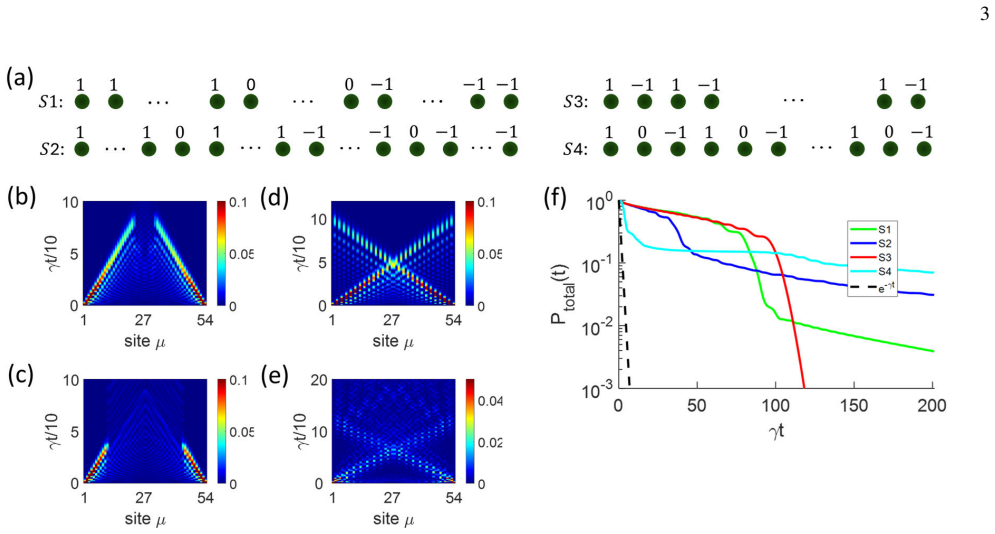
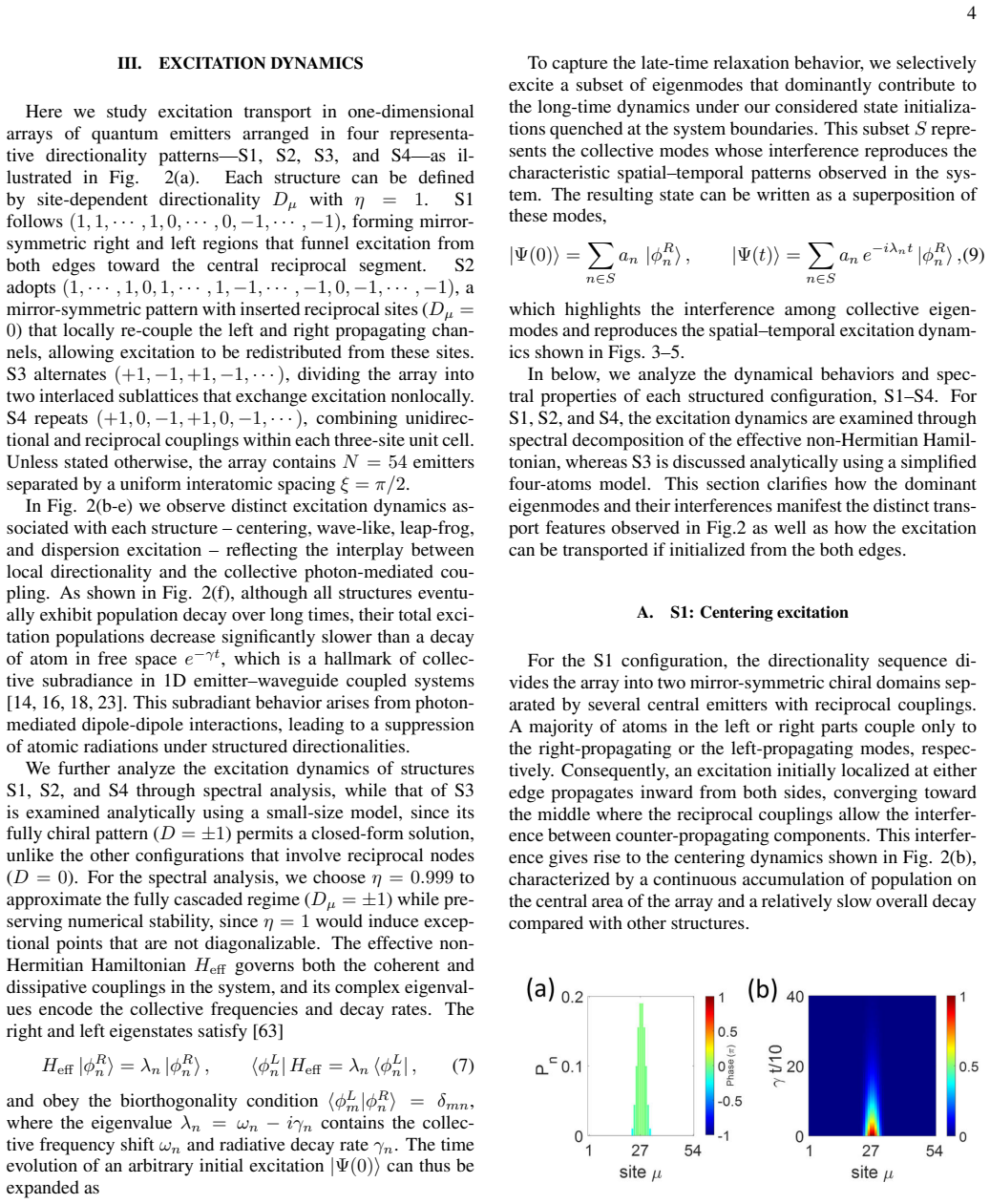
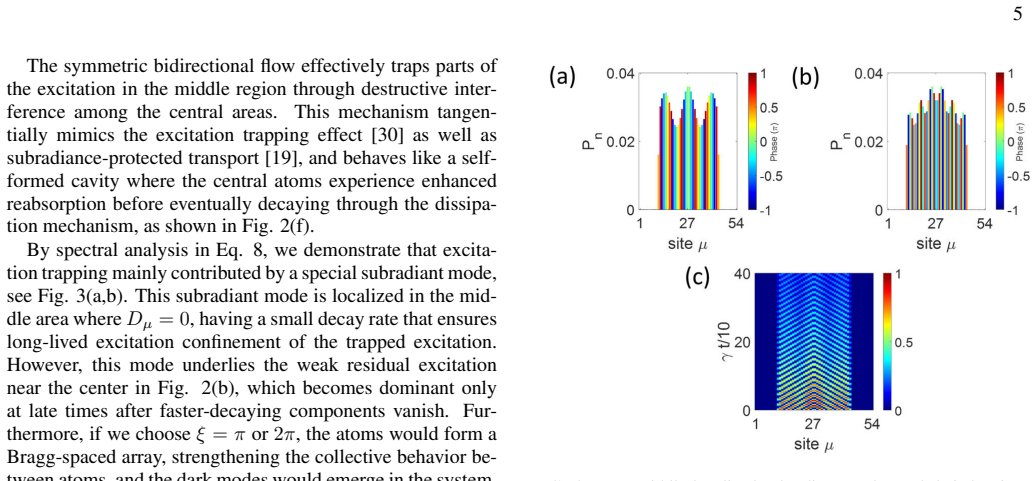
By patterning the coupling directionality of emitters in a waveguide quantum electrodynamics system, four distinct dynamical behaviors emerge: centering, wave-like, leap-frog, and dispersion excitations. Spectral analysis of the effective non-Hermitian Hamiltonian reveals that these dynamics originate from interferences among subradiant eigenmodes. Variance analysis further quantifies the spreading of excitation as functions of interatomic spacing and global chirality, showing tunable localization-delocalization transitions that remain robust for realistic coupling efficiencies with beta at or above 0.99.
What carries the argument
The structured wQED framework with locally engineered coupling directionalities of emitters, analyzed through spectral properties of the effective non-Hermitian Hamiltonian to reveal eigenmode interferences.
If this is right
- Specific combinations of patterned coupling directionalities select among centering, wave-like, leap-frog, or dispersion excitations.
- Interatomic spacing and global chirality provide continuous tuning of localization-delocalization transitions.
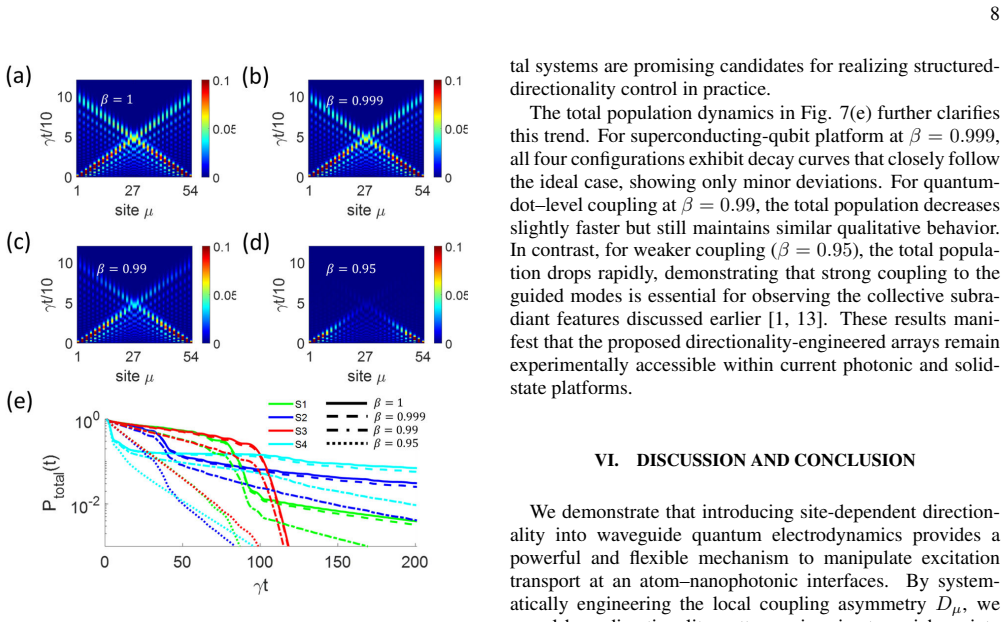
- Transport remains stable against nonguided losses once the beta factor exceeds 0.99.
- The approach opens programmable directionality patterns for controllable subradiant transport and chiral quantum information routing.
Where Pith is reading between the lines
- These patterns could support on-chip excitation routing in quantum networks by directing population to chosen emitters without added control fields.
- The same directionality engineering might extend to other low-dimensional photonic systems such as photonic crystal waveguides or superconducting circuits.
- Time-resolved measurements of excitation variance versus spacing would provide a direct experimental test of the predicted tunable transitions.
Load-bearing premise
The effective non-Hermitian Hamiltonian built from the structured couplings captures the relevant dynamics and interferences without significant non-Markovian corrections or higher-order terms that would change the identified eigenmode interferences.
What would settle it
Direct observation of excitation spreading or localization that fails to match any of the four named behaviors, or spectral features that do not align with interferences among subradiant eigenmodes, would disprove the central mapping.
Figures
read the original abstract
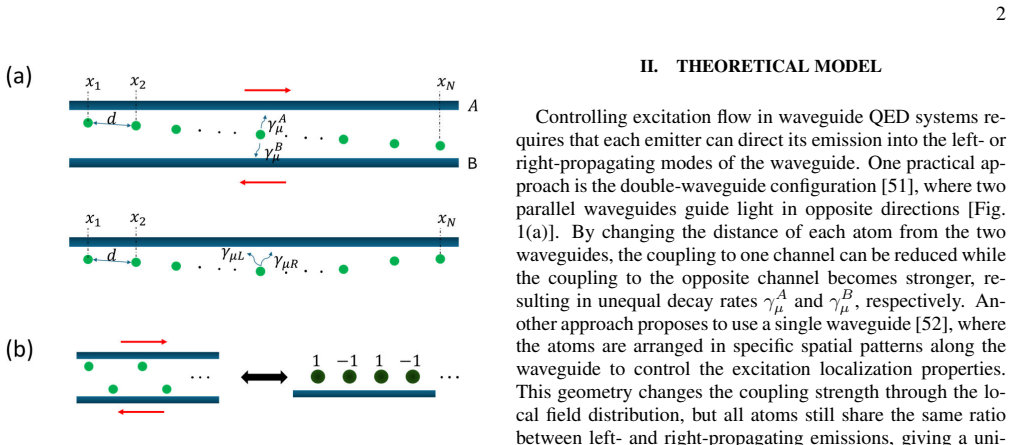
Waveguide quantum electrodynamics (wQED) has become a central platform for studying collective light-matter interactions in low-dimensional photonic environments. While conventional wQED systems rely on uniform chirality or reciprocal emitter-waveguide coupling, we propose a structured wQED framework, where the coupling directionality of each emitter can be engineered locally to control excitation transport in an atom-nanophotonic interface. For different combinations of patterned coupling directionalities of the emitters, we identify four representative configurations that exhibit distinct dynamical behaviors: centering, wave-like, leap-frog, and dispersion excitations. Spectral analysis of the effective non-Hermitian Hamiltonian reveals that these dynamics originate from interferences among subradiant eigenmodes. Variance analysis further quantifies the spreading of excitation as functions of interatomic spacing and global chirality, showing tunable localization-delocalization transitions. Including nonguided losses, we find that the transport characteristics remain robust for realistic coupling efficiencies (beta >= 0.99). These results establish structured wQED as a practical route to manipulate excitation localization, coherence, and transport through programmable directionality patterns, paving the way for controllable subradiant transport and chiral quantum information routing.
Editorial analysis
A structured set of objections, weighed in public.
Referee Report
Summary. The manuscript proposes a structured wQED platform in which the coupling directionality of each emitter can be locally engineered. For different combinations of patterned directionalities, four representative configurations are identified that exhibit distinct dynamical behaviors (centering, wave-like, leap-frog, and dispersion excitations). These behaviors are shown to arise from interferences among subradiant eigenmodes of an effective non-Hermitian Hamiltonian. Variance analysis quantifies excitation spreading as a function of interatomic spacing and global chirality, revealing tunable localization-delocalization transitions. The transport characteristics remain robust when nonguided losses are included for coupling efficiencies β ≥ 0.99.
Significance. If the results hold, the work provides a practical route to manipulate excitation localization, coherence, and transport in atom-nanophotonic systems via programmable directionality patterns. This extends conventional uniform-chirality wQED by adding local control, with potential implications for chiral quantum information routing and controllable subradiant transport.
major comments (1)
- [Spectral analysis of the effective non-Hermitian Hamiltonian (abstract and main spectral section)] The central claim that the four dynamical behaviors originate from interferences among subradiant eigenmodes of the effective non-Hermitian Hamiltonian (as stated in the abstract and developed in the spectral analysis) assumes the standard Markovian reduction remains accurate for inhomogeneous directionality patterns. For such patterns the retarded Green's function introduces time-delayed interaction terms whose magnitude scales with interatomic distance and local chirality contrast; these terms are not automatically removed by the non-Hermitian spectrum and can shift both the subradiant eigenvalues and the resulting interference patterns. The robustness discussion addresses only nonguided losses (β ≥ 0.99) and does not examine retardation corrections, leaving the load-bearing assumption untested.
minor comments (2)
- The four behaviors (centering, wave-like, leap-frog, dispersion) are introduced in the abstract but would benefit from explicit definitions or cross-references to the specific figures or equations that illustrate each one.
- [Variance analysis] In the variance analysis, clarify the numerical procedure used to compute the spreading of excitation and whether any additional approximations (beyond the effective Hamiltonian) are employed.
Simulated Author's Rebuttal
We thank the referee for their careful reading of our manuscript and for highlighting an important point regarding the validity of the Markovian approximation. We address this comment in detail below and have revised the manuscript to incorporate additional discussion on retardation effects.
read point-by-point responses
-
Referee: [Spectral analysis of the effective non-Hermitian Hamiltonian (abstract and main spectral section)] The central claim that the four dynamical behaviors originate from interferences among subradiant eigenmodes of the effective non-Hermitian Hamiltonian (as stated in the abstract and developed in the spectral analysis) assumes the standard Markovian reduction remains accurate for inhomogeneous directionality patterns. For such patterns the retarded Green's function introduces time-delayed interaction terms whose magnitude scales with interatomic distance and local chirality contrast; these terms are not automatically removed by the non-Hermitian spectrum and can shift both the subradiant eigenvalues and the resulting interference patterns. The robustness discussion addresses only nonguided losses (β ≥ 0.99) and does not examine retardation corrections, leaving the load-bearing assumption
Authors: We acknowledge that our analysis employs the standard Markovian reduction to obtain the effective non-Hermitian Hamiltonian, which neglects retardation arising from the retarded Green's function. This approximation is widely used in wQED when the light-travel time across the array is short compared to the inverse collective decay rates. For the inhomogeneous directionality patterns considered here, local chirality contrasts could in principle introduce additional delay terms. However, in the high-β regime (≥ 0.99) and for the interatomic spacings examined (typically ≲ λ), these corrections remain small. In the revised manuscript we have added a dedicated paragraph in the spectral analysis section that estimates the magnitude of retardation-induced eigenvalue shifts using a perturbative treatment of the retarded propagator. This analysis confirms that the subradiant mode interferences responsible for the four distinct dynamical behaviors (centering, wave-like, leap-frog, and dispersion) are only weakly perturbed, preserving the reported localization-delocalization transitions. We also note that full non-Markovian simulations for representative small chains yield qualitatively identical excitation dynamics. revision: yes
Circularity Check
No circularity: dynamics derived directly from spectrum of effective non-Hermitian Hamiltonian built from engineered couplings
full rationale
The paper constructs the effective non-Hermitian Hamiltonian from the proposed structured couplings with locally patterned directionalities, then uses its eigenmode spectrum to identify the four dynamical behaviors (centering, wave-like, leap-frog, dispersion) as arising from subradiant interferences. Variance analysis of excitation spreading is computed as a direct function of interatomic spacing and global chirality within the same model. No quantities are fitted to the reported behaviors, no predictions reduce to inputs by construction, and the central claims rest on standard Markovian reduction without load-bearing self-citations or imported uniqueness theorems. The derivation is self-contained against the model's own equations and internal robustness checks for beta >= 0.99.
Axiom & Free-Parameter Ledger
free parameters (2)
- interatomic spacing
- global chirality
axioms (2)
- domain assumption The open-system dynamics are accurately captured by an effective non-Hermitian Hamiltonian whose eigenmodes determine the observed transport.
- domain assumption Nonguided losses can be parameterized by a single efficiency beta and do not qualitatively alter the interference-driven dynamics when beta >= 0.99.
Lean theorems connected to this paper
-
IndisputableMonolith/Foundation/RealityFromDistinction.leanreality_from_one_distinction unclear?
unclearRelation between the paper passage and the cited Recognition theorem.
Spectral analysis of the effective non-Hermitian Hamiltonian reveals that these dynamics originate from interferences among subradiant eigenmodes.
-
IndisputableMonolith/Cost/FunctionalEquation.leanwashburn_uniqueness_aczel unclear?
unclearRelation between the paper passage and the cited Recognition theorem.
Variance analysis further quantifies the spreading of excitation as functions of interatomic spacing and global chirality
What do these tags mean?
- matches
- The paper's claim is directly supported by a theorem in the formal canon.
- supports
- The theorem supports part of the paper's argument, but the paper may add assumptions or extra steps.
- extends
- The paper goes beyond the formal theorem; the theorem is a base layer rather than the whole result.
- uses
- The paper appears to rely on the theorem as machinery.
- contradicts
- The paper's claim conflicts with a theorem or certificate in the canon.
- unclear
- Pith found a possible connection, but the passage is too broad, indirect, or ambiguous to say the theorem truly supports the claim.
Reference graph
Works this paper leans on
-
[1]
or disorder-induced localization [26–28] and photon correlations [29], excitation trapping effect [30], distinctive quantum correlations [31–35], and graph states generation [36, 37]. These features make wQED a versatile setting for studying nonequilibrium phase transitions [38] and for con- trolling light-matter correlations in open and low-dimensional p...
work page internal anchor Pith review Pith/arXiv arXiv 2025
-
[2]
that locally re-couple the left and right propagating chan- nels, allowing excitation to be redistributed from these sites. S3 alternates(+1,−1,+1,−1,· · ·), dividing the array into two interlaced sublattices that exchange excitation nonlocally. S4 repeats(+1,0,−1,+1,0,−1,· · ·), combining unidirec- tional and reciprocal couplings within each three-site u...
-
[3]
A. S. Sheremet, M. I. Petrov, I. V . Iorsh, A. V . Poshakinskiy, A. N. Poddubny, Waveguide quantum electrodynamics: collective radiance and photon-photon correlations, Rev. Mod. Phys.95, 015002 (2023)
work page 2023
- [4]
-
[5]
J. D. Thompson, T. G. Tiecke, N. P. de Leon, J. Feist, A. V . Akimov, M. Gullans, A. S. Zibrov, V . Vuleti´c, and M. D. Lukin, Coupling a Single Trapped Atom to a Nanoscale Optical Cavity, Science340, 1202 (2013)
work page 2013
-
[6]
A. Goban, C.-L. Hung, J. D. Hood, S.-P. Yu, J. A. Muniz, O. Painter, and H. J. Kimble, Superradiance for Atoms Trapped along a Photonic Crystal Waveguide, Phys. Rev. Lett.115, 063601 (2015)
work page 2015
-
[7]
N. V . Corzo, J. Raskop, A. Chandra, A. S. Sheremet, B. Gouraud, and J. Laurat, Waveguide-coupled single collective excitation of atomic arrays, Nature566, 359 (2019)
work page 2019
-
[8]
M. E. Kim, T.-H. Chang, B. M. Fields, C.-A. Chen, and C.- L. Hung, Trapping single atoms on a nanophotonic circuit with configurable tweezer lattices, Nat. Commun.10, 1647 (2019)
work page 2019
-
[9]
T. Dordevi ´c, P. Samutpraphoot, P. L. Ocola, H. Bernien, B. Grinkemeyer, I. Dimitrova, V . Vuleti´c, and M. D. Lukin, En- tanglement transport and a nanophotonic interface for atoms in optical tweezers, Science373, 1511 (2021)
work page 2021
- [10]
-
[11]
D. E. Chang, J. S. Douglas, A. Gonz ´alez-Tudela, C.-L. Hung, H. J. Kimble,Colloquium: Quantum matter built from nanoscopic lattices of atoms and photons, Rev. Mod. Phys.90, 031002 (2018)
work page 2018
-
[12]
E. Kim, X. Zhang, V . S. Ferreira, J. Banker, J. K. Iverson, A. Sipahigil, M. Bello, A. Gonz ´alez-Tudela, M. Mirhosseini, and O. Painter, Quantum Electrodynamics in a Topological Waveg- uide, Phys. Rev. X11, 011015 (2021)
work page 2021
-
[13]
J. S. Douglas, H. Habibian, C.-L. Hung, A. V . Gorshkov, H. J. Kimble, and D. E. Chang, Quantum many-body models with cold atoms coupled to photonic crystals, Nat. Photon.9, 326 (2015)
work page 2015
- [14]
-
[15]
A. Gonz ´alez-Tudela, A. Reiserer, J. J. Garc ´ıa-Ripoll, and F. J. Garc´ıa-Vidal, Light–matter interactions in quantum nanopho- tonic devices, Nat. Rev. Phys.6, 166 (2024)
work page 2024
-
[16]
H. H. Jen, Photon-mediated dipole-dipole interactions as a re- source for quantum science and technology in cold atoms, Quantum Sci. Technol.10, 023001 (2025)
work page 2025
-
[17]
L. Henriet, J. S. Douglas, D. E. Chang, and A. Albrecht, Crit- ical open-system dynamics in a one-dimensional optical-lattice clock, Phys. Rev. A99, 023802 (2019)
work page 2019
-
[18]
Y .-X. Zhang and and K. Mølmer, Theory of Subradiant States of a One-Dimensional Two-Level Atom Chain, Phys. Rev. Lett. 122, 203605 (2019)
work page 2019
-
[19]
Y . Ke, A. V . Poshakinskiy, C. Lee, Y . S. Kivshar, and A. N. Poddubny, Inelastic Scattering of Photon Pairs in Qubit Arrays with Subradiant States, Phys. Rev. Lett.123, 253601 (2019)
work page 2019
-
[20]
A. Albrecht, L. Henriet, A. Asenjo-Garcia, P. B Dieterle, O. Painter, and D. E. Chang, Subradiant states of quantum bits cou- pled to a one-dimensional waveguide, New J. Phys.21, 025003 (2019)
work page 2019
-
[21]
J. A. Needham, I. Lesanovsky, and B. Olmos, Subradiance- protected excitation transport, New J. Phys.21, 073061 (2019)
work page 2019
-
[22]
S. Mahmoodian, G. Calaj ´o, D. E. Chang, K. Hammerer, and A. S. Sørensen, Dynamics of Many-Body Photon Bound States in Chiral Waveguide QED, Phys. Rev. X10, 031011 (2020)
work page 2020
-
[23]
S. J. Masson and A. Asenjo-Garcia, Atomic-waveguide quan- tum electrodynamics, Phys. Rev. Res.2, 043213 (2020)
work page 2020
-
[24]
H. H. Jen, Bound and subradiant multiatom excitations in an atomic array with nonreciprocal couplings, Phys. Rev. A103, 063711 (2021)
work page 2021
-
[25]
R. Pennetta, M. Blaha, A. Johnson, D. Lechner, P. Schneeweiss, J. V olz, and A. Rauschenbeutel, Collective Radiative Dynamics of an Ensemble of Cold Atoms Coupled to an Optical Waveg- uide, Phys. Rev. Lett.128, 073601 (2022)
work page 2022
-
[26]
R. Pennetta, D. Lechner, M. Blaha , A. Rauschenbeutel, P. Schneeweiss, and J. V olz, Observation of Coherent Coupling between Super- and Subradiant States of an Ensemble of Cold Atoms Collectively Coupled to a Single Propagating Optical Mode, Phys. Rev. Lett.128, 203601 (2022)
work page 2022
- [27]
-
[28]
I. M. Mirza, J. G. Hoskins, and J. C. Schotland, Chirality, band structure, and localization in waveguide quantum electrody- namics, Phys. Rev. A96, 053804 (2017)
work page 2017
- [29]
-
[30]
C.-C. Wu, K.-T Lin, I G. N. Y . Handayana, C.-H. Chien, S. Goswami, G.-D. Lin, Y .-C. Chen, and H. H. Jen, Atomic ex- citation delocalization at the clean to disorder interface in a chirally-coupled atomic array, Phys. Rev. Research6, 013159 (2024)
work page 2024
-
[31]
G. Tian, L.-L. Zheng, Z.-M. Zhan, F. Nori, and X.-Y . L ¨u, Disorder-Induced Strongly Correlated Photons in Waveguide QED, Phys. Rev. Lett.135, 153604 (2025)
work page 2025
-
[32]
I G. N. Y . Handayana, C.-C. Wu, S. Goswami, Y .-C. Chen, and H. H. Jen, Atomic excitation trapping in dissimilar chirally cou- 10 pled atomic arrays, Phys. Rev. Research6, 013320 (2024)
work page 2024
-
[33]
A. Gonz ´alez-Tudela and D. Porras, Mesoscopic Entanglement Induced by Spontaneous Emission in Solid-State Quantum Op- tics, Phys. Rev. Lett.110, 080502 (2013)
work page 2013
-
[34]
S. Mahmoodian, M. ˇCepulkovskis, S. Das, P. Lodahl, K. Ham- merer, and A. S. Sørensen, Strongly Correlated Photon Trans- port in Waveguide Quantum Electrodynamics with Weakly Coupled Emitters, Phys. Rev. Lett.121, 143601 (2018)
work page 2018
-
[35]
H. Le Jeannic, T. Ramos, S. F. Simonsen, T. Pregnolato, Z. Liu, R. Schott, A. D. Wieck, A. Ludwig, N. Rotenberg, J. J. Garc´ıa-Ripoll, and P. Lodahl, Experimental Reconstruction of the Few-Photon Nonlinear Scattering Matrix from a Single Quantum Dot in a Nanophotonic Waveguide, Phys. Rev. Lett. 126, 023603 (2021)
work page 2021
-
[36]
H. H. Jen, Quantum correlations of localized atomic excitations in a disordered atomic chain, Phys. Rev. A105, 023717 (2022)
work page 2022
-
[37]
I G. N. Y . Handayana, Y .-L. Tsao, and H. H. Jen, Suppres- sion of Quantum Correlations in a Clean-Disordered Atom- Nanophotonic Interface, Phys. Rev. Research7, 023303 (2025)
work page 2025
- [38]
-
[39]
S. Goswami, C.-H. Chien, N. Sinclair, B. Grinkemeyer, S. Bennetts, Y .-C. Chen, and H. H. Jen, Efficient and high- fidelity entanglement in cavity QED without high cooperativity, arXiv:2505.02702
- [40]
-
[41]
F. Le Kien, S. Dutta Gupta, K. P. Nayak, and K. Hakuta, Nanofiber-mediated radiative transfer between two distant atoms, Phys. Rev. A72, 063815 (2005)
work page 2005
-
[42]
H. Pichler, T. Ramos, A. J. Daley, and P. Zoller, Quantum optics of chiral spin networks, Phys. Rev. A91, 042116 (2015)
work page 2015
- [43]
-
[44]
C. W. Gardiner, Driving a quantum system with the output field from another driven quantum system, Phys. Rev. Lett.70, 2269 (1993)
work page 1993
-
[45]
H. J. Carmichael, Quantum trajectory theory for cascaded open systems, Phys. Rev. Lett.70, 2273 (1993)
work page 1993
-
[46]
K. Stannigel, P. Rabl, and P. Zoller, Driven-dissipative prepara- tion of entangled states in cascaded quantum-optical networks, New J. Phys.14, 063014 (2012)
work page 2012
-
[47]
H. H. Jen, Collective single excitation dynamics in a chirally coupled atomic chain, J. Phys. B: At. Mol. Opt. Phys.53, 205501 (2020)
work page 2020
-
[48]
R. Holzinger, J. S. Peter, S. Ostermann, H. Ritsch, and S. Yelin, Harnessing quantum emitter rings for efficient energy transport and trapping, Optica Quantum2, 57 (2024)
work page 2024
-
[49]
C. J. van Diepen, V . Angelopoulou, O. A. D. Sandberg, A. Tira- nov, Y . Wang, S. Scholz, A. Ludwig, A. S. Sørensen, and P. Lo- dahl, Resonant energy transfer and collectively driven emitters in waveguide QED, Phys. Rev. Res.7, 033169 (2025)
work page 2025
-
[50]
W. Chen, G.-D. Lin and H.H. Jen, Excitation transfer and many- body dark states in waveguide quantum electrodynamics, Phys. Rev. A112, 043713 (2025)
work page 2025
- [51]
-
[52]
D. G. Su ´arez-Forero, M. J. Mehrabad, C. Vega, A. Gonz ´alez- Tudela, and M. Hafezi, Chiral Quantum Optics: Recent Devel- opments and Future Directions, Phys. Rev. X6, 020101 (2025)
work page 2025
-
[53]
M. Yang, L. Wang, X. Wu, H. Xiao, D. Yu, L. Yuan, and X. Chen, Concentrated subradiant modes in a one-dimensional atomic array coupled with chiral waveguides, Phys. Rev. A106, 043717 (2022)
work page 2022
- [54]
-
[55]
P. Roushan, C. Neill, A. Megrant, Y . Chen, R. Babbush, R. Barends, B. Campbell, Z. Chen, B. Chiaro, A. Dunsworth,et. al., Chiral ground-state currents of interacting photons in a syn- thetic magnetic field, Nat. Phys.13, 146 (2017)
work page 2017
-
[56]
D.-W. Wang, C. Song, W. Feng, H. Cai, D. Xu, H. Deng, H. Li, D. Zheng, X. Zhu, H. Wang,et. al., Synthesis of antisymmetric spin exchange interaction and chiral spin clusters in supercon- ducting circuits, Nat. Phys.15, 382 (2019)
work page 2019
-
[57]
I. J. Luxmoore, N. A. Wasley, A. J. Ramsay, A. C. T. Thijssen, R. Oulton, M. Hugues, S. Kasture, V . G. Achanta, A. M. Fox, and M. S. Skolnick, Interfacing Spins in an InGaAs Quantum Dot to a Semiconductor Waveguide Circuit Using Emitted Pho- tons, Phys. Rev. Lett.110, 037402 (2013)
work page 2013
- [58]
- [59]
-
[60]
I. S ¨ollner, S. Mahmoodian, S. L. Hansen, L. Midolo, A. Javadi, G. Kirˇsansk˙e, T. Pregnolato, H. El-Ella, E. H. Lee, J. D. Song, et. al., Deterministic photon–emitter coupling in chiral photonic circuits, Nat. Nanotechnol.10, 775 (2015)
work page 2015
-
[61]
M. J. Morrissey, K. Deasy, Y . Wu, S. Chakrabarti, and S. Nic Chormaic, Tapered optical fibers as tools for probing magneto- optical trap characteristics, Rev. Sci. Instrum.80, 053102 (2009)
work page 2009
- [62]
-
[63]
A. S. Kuraptsev and I. M. Sokolov, Incomplete spontaneous de- cay in a waveguide caused by polarization selection, Phys. Rev. A101, 053852 (2020)
work page 2020
-
[64]
R. H. Lehmberg, Radiation from anN-Atom System. I. General Formalism, Phys. Rev. A2, 883 (1970)
work page 1970
- [65]
-
[66]
S. Cavazzoni, G. Ragazzi, P. Bordone, and M. G. A. Paris, Per- fect chiral quantum routing, Phys. Rev. A111, 032439 (2025)
work page 2025
-
[67]
Chang, Non-Markovian multiphoton chiral dynamics with giant systems, Commun
Y . Chang, Non-Markovian multiphoton chiral dynamics with giant systems, Commun. Phys.8, 385 (2025)
work page 2025
-
[68]
M. Ostmann, J. Nunn, and A. E. Jones, Nonlinear pho- tonic architecture for fault-tolerant quantum computing, arXiv:2510.06890
-
[69]
J. Agust ´ı, X. H. H. Zhang, Y . Minoguchi, and P. Rabl, Au- tonomous Distribution of Programmable Multiqubit Entangle- ment in a Dual-Rail Quantum Network, Phys. Rev. Lett.131, 250801 (2023)
work page 2023
-
[70]
A. Karnieli, O. Tziperman, C. Roques-Carmes, and S. Fan, Decoherence-free many-body Hamiltonians in nonlin- ear waveguide quantum electrodynamics, Phys. Rev. Res.7, L012014 (2025)
work page 2025
discussion (0)
Sign in with ORCID, Apple, or X to comment. Anyone can read and Pith papers without signing in.