REVIEW 3 major objections 6 minor 1 cited by
A single language model switching between teacher and student roles, trained only on its own self-generated problems from one trivial seed, improves across seven math benchmarks and beats models trained on over 7,000 labeled examples.
Reviewed by Pith at T0; open to challenge. T0 means a machine referee read the full paper against a public rubric. the ladder, T0–T4 →
T0 review · deepseek-v4-flash
2026-08-04 00:31 UTC pith:EASDRUWR
load-bearing objection OpenSIR is a genuine, well-ablated extension of verifier-free self-play, but its reward loop never validates majority-vote labels against ground truth and the abstract oversells what the body shows. the 3 major comments →
OpenSIR: Open-Ended Self-Improving Reasoner
The pith
A machine-rendered reading of the paper's core claim, the machinery that carries it, and where it could break.
Core claim
OpenSIR's central claim is that verifier-free, annotation-free self-improvement is possible for LLM math reasoning when the same policy is trained in both roles. The teacher samples reference problems from a pool initialised to a single trivial problem and generates new problems, each required to name its mathematical concepts. The student produces G solution attempts per problem; the most frequent parsed answer becomes the reference answer, and the solve rate is its frequency. The teacher's novelty score is a weighted sum of a triangular solvability reward (peaking at an intermediate solve rate and zero outside the accepted band), a normalised solution-length reward, a diversity reward meas
What carries the argument
The load-bearing mechanism is the closed teacher-student loop inside one policy, driven by two reward functions. The teacher reward is a novelty score: a triangular solvability term that rewards problems whose self-solve rate is near 0.7 and assigns zero outside the [0.5, 0.9] band; a solution-length term that rewards longer multi-step solutions; a diversity term that measures cosine distance from all problems already in the pool; and a format term. The student reward is self-consistency: a solution earns credit if its parsed answer equals the majority-vote answer across G attempts, plus a format bonus. Both rewards are standardised into advantages and combined in a policy-gradient update wi
Load-bearing premise
The load-bearing assumption is that the majority-vote answer produced by the model's own solutions is correct for the problems that pass the [0.5, 0.9] solve-rate filter; the paper's single external check of that filter agrees with the reference answer on only 70.82% of sampled problems.
What would settle it
Audit the training labels directly: take OpenSIR-generated problems that pass the [0.5, 0.9] solve-rate filter, obtain independent ground-truth solutions from human annotators or a much stronger solver, and compare them with the majority-vote references used in training. If agreement is at or below the 70.82% reported in the paper's external check, the correctness signal is too noisy to carry the claimed gains. A complementary test: run the same OpenSIR training but replace self-consistency labels with independent ground-truth labels and see whether the benchmark advantage persists.
If this is right
- If the results hold, neither a human-annotated dataset nor an external verifier is required for reinforcement-learning-based math reasoning; training on self-generated problems is enough.
- The gains are not an artifact of the starting point: switching from a trivial arithmetic seed to a geometry or a competition-level problem changes final accuracy by less than 0.5 points.
- The additional compute for self-generated problems is modest: one extra forward pass per problem on top of G solution attempts, an overhead of about 12.5% at G=8.
- The improvement appears to be genuine reasoning capacity rather than memorisation: pass@k curves improve at all sampling budgets and on benchmarks far from the training distribution.
- The method can also be combined with annotated data: mixing self-generated problems with GSM8K raises average accuracy from 38.42 to 41.29, above either source alone.
Where Pith is reading between the lines
- Editorial inference: because the correctness reward trusts the model's own majority answer, the framework can only be as sound as that label. The paper's own external check of the 0.5-threshold variant found agreement with the reference answer on 70.82% of sampled problems; if that rate is representative, roughly 29% of retained training labels are wrong, and part of the reported gain could be for
- Editorial inference: the difficulty-calibration idea—keep self-solve rate near a fixed target while maximising diversity—is domain-agnostic. In code, formal proof, or puzzle domains where self-consistency or executable checks can stand in for the majority vote, the same two-term novelty reward could yield open-ended self-improvement.
- Editorial inference: the diversity reward as implemented is a global repulsion from the pool; the paper's own extended training shows a plateau after step 350, suggesting this mechanism eventually saturates. A richer diversity signal operating on discovered concepts or skills, rather than raw embeddings, is the natural next lever for unbounded exploration.
Editorial analysis
A structured set of objections, weighed in public.
Referee Report
Summary. OpenSIR proposes a self-play reinforcement-learning framework in which a single instruction-tuned LLM alternates between a teacher role (generating math problems) and a student role (solving them). Problem generation is seeded from a growing pool of self-generated problems, and rewards are computed from solve-rate-based difficulty, solution length, embedding diversity, and format. Reference answers are obtained by majority voting over G sampled solutions, and the student reward is the agreement of each solution with that reference. Training uses a GRPO-style on-policy update. Starting from a single trivial seed, the paper reports consistent average gains on five math benchmarks across four model families, with ablations attributing the gains to difficulty calibration, diversity rewards, and joint teacher-student training. The central claim is that verifier-free, annotation-free self-improvement for LLM math reasoning is possible and can match or exceed GRPO baselines trained on thousands of human-annotated examples.
Significance. If the central claim holds, the result is significant: it would remove the reward-verification bottleneck that currently ties RLVR to curated, labeled datasets. The paper has notable strengths: per-seed results are reported in Tables 5-6, ablations isolate the contribution of each reward component, the seed-robustness study addresses a natural concern, and the pass@k analysis in A.6 speaks against a purely format-only gain. The method is also comparatively lightweight, with code and datasets released. However, the core claim rests on the reliability of self-generated majority-vote reference answers, and the manuscript does not establish that reliability; its own external check (Table 2) shows only 70.82% agreement with GPT-5 for the main configuration. The contribution is therefore promising but not yet proven to the standard required for the advertised verifier-free claim.
major comments (3)
- [§2.2 Eq. (1), §2.3.2 Eq. (6), Table 2] The entire student training signal is defined with respect to the reference answer a* = arg max_a count(a_j) from the policy's own G samples, and Eq. (6) rewards every solution that matches a*. The paper asserts that high solve rates indicate reliable answers, but no ground-truth validation of a* is provided. In Table 2, the column labeled 'vality' is actually measured by comparing GPT-5's majority answer to the reference answer, and for the main OpenSIR_0.5 configuration this agreement is 70.82%. If this estimate is even approximately correct, roughly 29% of training labels are wrong: correct solutions are penalized and the policy is rewarded for consistently reproducing majority errors. This is a load-bearing issue for the central claim of verifier-free, annotation-free self-improvement. The paper also conflates 'validity' (logical well-posedness, as defined in §4.1) with answer agreem
- [§3.4, Tables 5 and 6] The headline 'OpenSIR outperforms all GRPO baselines' is supported almost entirely by average differences, but with three seeds the evidence is often weak. For Llama-3.2-3B-Instruct, OpenSIR vs. GRPO_gsm8k is 38.42±0.27 vs. 37.83±0.37 (difference 0.59, overlapping standard deviations); for Qwen-2.5-3B-Instruct, 50.85±0.38 vs. 50.56±0.45 (difference 0.29). These are not statistically reliable differences. The claim should be restricted to configurations where the difference is robust (e.g., Gemma-2-2B-Instruct, where the gap is about 1.9 points) or should be backed by paired significance testing and effect sizes. As written, the abstract and §3.4 overstate the evidence for the comparison that is central to the paper's positioning.
- [A.7 and Abstract/Conclusion] The paper's own extended-training analysis states that performance plateaus after step 350 and that generated problems become increasingly similar and repetitive, attributing this to a less effective diversity reward over longer horizons. This is an admitted bound on the open-endedness that the title, abstract ('sustains open-ended exploration'), and conclusion ('continuously discover and master increasingly challenging mathematical concepts') claim. The claims should be qualified to the observed 200-350 step horizon, or the diversity mechanism should be shown to be extendable. As written, the evidence directly supports self-improvement over a bounded curriculum, not sustained open-ended learning.
minor comments (6)
- [Eq. (2)] The text says the solvability score 'decreases to 1/n at the boundaries,' but n is not defined and the formula gives 1/G at the boundaries. Replace '1/n' with '1/G'.
- [Abstract vs. §3.2] The abstract (as provided) claims 'seven math benchmarks' and reports gains on 'reasoning models' (+3.1 and +4.4), but the body evaluates five math benchmarks and does not report reasoning-model training results. Align the abstract with the experiments actually presented.
- [Table 2] The column labeled 'Validity' is not problem validity as defined in §4.1 — it is agreement between GPT-5's majority answer and the reference answer. Rename it to 'Answer agreement with GPT-5' to avoid misleading readers. Similarly, 'Solve Rate' in this table is GPT-5's solve rate, not the model's solve rate in Eq. (1); clarify the column.
- [Algorithm 1, line 7] The symbol q_i is overloaded. In line 4, q_{i,1:G} denotes a group of G problems generated from reference problem p_i; in line 7, the loop should iterate over individual generated problems q_{i,j} (or a renamed variable). The current notation makes the subsequent selection steps hard to follow and should be corrected for reproducibility.
- [Figure 2 / Appendix B] The human evaluation uses only 20 problems per source and the annotators are the paper's authors. Report inter-annotator agreement and state the small sample as a limitation, or the difficulty-ranking conclusions in §4.1 should be treated as illustrative.
- [Section 2.2] In the sentence 'we denote s qi = SolveRate(q_i)', the subscript formatting is broken; it should be s_{q_i} or a similar consistent notation.
Circularity Check
Training rewards reduce to self-agreement by construction, but the headline benchmark result is externally measured, so the core claim is not fully circular.
specific steps
-
self definitional
[§2.2 Eq. (1); §2.3.2 Eq. (6)]
"SolveRate(qi) = count(a∗)/G where a∗ = arg max a∈a1:G count(a), (1) ... scorecorrect(oj, aj) = 1[aj = a∗] + δscoreS_fom(oj), (6)"
The reference answer a* is the majority answer over G solutions sampled from the same policy πθ. The student correctness reward is then defined as agreement with a*. Therefore 'correctness' is, by construction, self-consistency rather than agreement with any external answer. The paper's own Table 2 check (GPT-5 majority vs reference answer) reports only 70.82% agreement on the main configuration, so a substantial fraction of training labels can be wrong while still being reinforced. This makes the training loop closed, although the reported benchmark gains are measured on held-out external benchmarks and are therefore not forced by this definition alone.
-
other
[§2.1–§2.3.1, Eq. (1)–(2), Eq. (5)]
"We use solve rate as a proxy for solvability—problems with s qi > smax are likely too easy, while those with s qi < smin are either too difficult or malformed. ... score_sol(qi) = ..."
The difficulty signal that drives the teacher reward is computed from SolveRate in Eq. (1), i.e., from the same policy's majority-vote consistency. The teacher is therefore rewarded for generating problems for which the student policy itself reaches moderate self-consistency; 'appropriate challenge' is defined relative to the policy's own current outputs rather than an independent notion of mathematical difficulty. This is a deliberate self-play curriculum, but it means the difficulty-calibration component also reduces to self-agreement.
full rationale
OpenSIR's central advertised result—that a model trained only on self-generated problems with majority-vote labels improves on external math benchmarks—is not itself a tautology: the numbers in Table 1 come from solving held-out GSM8K, MATH-500, Minerva, OlympiadBench, and College Math problems, so the main empirical claim has independent content. The circularity is internal to the training signal: Eq. (1) defines the reference answer a* as the majority of G solutions drawn from the current policy πθ, Eq. (6) rewards a student solution iff it matches a*, and Eq. (2)/Eq. (5) reward the teacher for problems whose self-consistency lands in a target interval. Thus 'correctness' and 'appropriate difficulty' are, by construction, self-agreement objectives rather than externally verified quantities. The paper's own GPT-5 check (Table 2) reports only 70.82% agreement with the reference answer on the main configuration, corroborating that the labels can diverge from an independent judge. Since the loop is transparent and the final evaluation is external, this is partial, not total, circularity: the method's internal rewards reduce to self-consistency, but the benchmark gains are not derived from that definition alone. No load-bearing self-citation or imported uniqueness theorem is present.
Axiom & Free-Parameter Ledger
free parameters (6)
- Solve-rate window (s_min, s_max) =
(0.5, 0.9)
- Novelty reward weights (alpha, lambda, gamma, delta) =
(1.0, 1.0, 1.0, 0.1)
- Solution attempts G =
8
- Length normalization (l_base, l_cap) =
l_base = 1000 tokens; l_cap value not stated
- GRPO hyperparameters (KL, LR, batch, steps) =
1e-4, 3e-7, 256, 200
- Embedding encoder for diversity =
Linq-Embed-Mistral (7B, frozen)
axioms (5)
- domain assumption For problems with self-reported solve rate in [0.5, 0.9], the majority-vote answer over G=8 solutions is correct (or a usable training label).
- domain assumption Base instruction models already contain enough mathematical knowledge to bootstrap open-ended exploration from the trivial seed '1+1'.
- domain assumption Cosine distance in embedding space tracks mathematical-concept novelty.
- domain assumption Self-consistency (solve rate) is a stable estimate of problem difficulty for the evolving policy.
- standard math GRPO on-policy updates with KL penalty provide stable optimization.
read the original abstract
Recent advances in large language model (LLM) reasoning through reinforcement learning rely on annotated datasets for verifiable rewards, which may limit models' ability to surpass human-level performance. While self-play offers a promising alternative, prior methods yield only marginal or even negative gains on post-trained models because they generate problems that cluster around familiar concepts rather than discovering novel ones. We introduce Open-Ended Self-Improving Reasoner (OpenSIR), a self-play framework in which a single LLM alternates teacher and student roles to generate and solve novel problems without external verifiers or annotated data. Starting from a single seed problem, OpenSIR sustains open-ended exploration through diversity rewards that push the model toward unfamiliar concepts and difficulty calibration that keeps problems learnable. Across seven math benchmarks, OpenSIR consistently improves all models, averaging +3.6 points on instruction models and +3.1 on reasoning models, while recent self-play baselines yield marginal or even negative gains; starting from a single trivial seed, it also surpasses GRPO baselines trained on over 7K annotated examples. Despite training only on self-generated math, OpenSIR is the only self-play method that transfers to general reasoning, improving by at least +4.4 points on reasoning models.
Figures







Forward citations
Cited by 1 Pith paper
-
PopuLoRA: Co-Evolving LLM Populations for Reasoning Self-Play
PopuLoRA shows that co-evolving populations of LoRA adapters through cross-evaluated self-play can outperform compute-matched single-agent baselines on multiple code and math reasoning benchmarks.
Reference graph
Works this paper leans on
-
[2]
doi: 10.1126/science.aay2400. Yang Chen, Zhuolin Yang, Zihan Liu, Chankyu Lee, Peng Xu, Mohammad Shoeybi, Bryan Catan- zaro, and Wei Ping. AceReason-Nemotron: Advancing Math and Code Reasoning through Rein- forcement Learning, May
-
[6]
Bo Liu, Leon Guertler, Simon Yu, Zichen Liu, Penghui Qi, Daniel Balcells, Mickel Liu, Cheston Tan, Weiyan Shi, Min Lin, Wee Sun Lee, and Natasha Jaques
URLhttps://proceedings.neurips.cc/paper_files/paper/2022/ hash/18abbeef8cfe9203fdf9053c9c4fe191-Abstract-Conference.html. Bo Liu, Leon Guertler, Simon Yu, Zichen Liu, Penghui Qi, Daniel Balcells, Mickel Liu, Cheston Tan, Weiyan Shi, Min Lin, Wee Sun Lee, and Natasha Jaques. SPIRAL: Self-Play on Zero-Sum Games Incentivizes Reasoning via Multi-Agent Multi-T...
2022
-
[7]
Zhihong Shao, Peiyi Wang, Qihao Zhu, Runxin Xu, Junxiao Song, Xiao Bi, Haowei Zhang, Mingchuan Zhang, Y
URLhttps://proceedings.neurips.cc/paper_files/paper/2024/ hash/7d0c6ff18f16797b92e77d7cc95b3c53-Abstract-Conference.html. Zhihong Shao, Peiyi Wang, Qihao Zhu, Runxin Xu, Junxiao Song, Xiao Bi, Haowei Zhang, Mingchuan Zhang, Y . K. Li, Y . Wu, and Daya Guo. DeepSeekMath: Pushing the Limits of Mathematical Reasoning in Open Language Models, April
2024
-
[8]
Every morning Aya goes for a9-kilometer-long walk and stops at a coffee shop afterwards
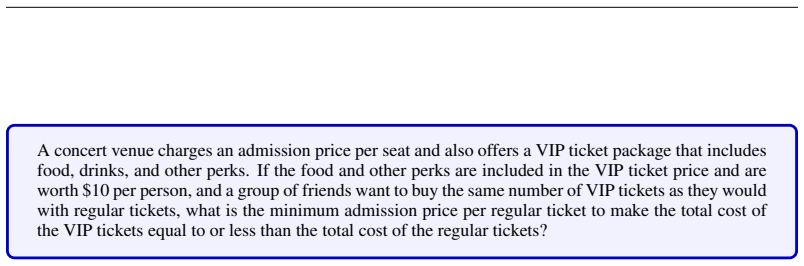
How many units are in the length of AD? Figure 15: A geometry problem from the MATH dataset, representing a different mathematical domain from the trivial arithmetic seed. Every morning Aya goes for a9-kilometer-long walk and stops at a coffee shop afterwards. When she walks at a constant speed ofskilometers per hour, the walk takes her 4 hours, including...
2024
-
[10]
URLhttps://proceedings. mlr.press/v235/tang24k.html. Gemma Team, Morgane Riviere, Shreya Pathak, Pier Giuseppe Sessa, Cassidy Hardin, Surya Bhu- patiraju, Léonard Hussenot, Thomas Mesnard, Bobak Shahriari, Alexandre Ramé, et al. Gemma 2: Improving open language models at a practical size.arXiv preprint arXiv:2408.00118,
-
[11]
Qwen2 technical report.arXiv preprint arXiv:2407.10671,
Qwen Team. Qwen2 technical report.arXiv preprint arXiv:2407.10671,
-
[12]
doi: 10.1038/s41586-019-1724-z
ISSN 1476-4687. doi: 10.1038/s41586-019-1724-z. 13 Leandro von Werra, Younes Belkada, Lewis Tunstall, Edward Beeching, Tristan Thrush, Nathan Lambert, Shengyi Huang, Kashif Rasul, and Quentin Gallouédec. Trl: Transformer reinforcement learning.https://github.com/huggingface/trl,
-
[20]
set_id":
You will be presented with multiple sets of 5 math problems to evaluate. For each set, please complete the following three-step annotation process. # Step 1: Identify Topics Foreach problem, identify ALL relevant mathematical topics from the following list: 24 - Algebra - Geometry - Calculus - Probability - Statistics - Number Theory - Combinatorics - Opt...
2023
-
[44]
Model Acc OpenSIR 38.42 OpenSIRMATH 38.67 OpenSIRAIME 38.81 Table 7: Performance of OpenSIR with different initial seed problem
and their average with standard deviation as super- script. Model Acc OpenSIR 38.42 OpenSIRMATH 38.67 OpenSIRAIME 38.81 Table 7: Performance of OpenSIR with different initial seed problem. 22 A.6 OPENSIR INCENTIVISESREASONINGCAPACITY To verify whether OpenSIR elicits genuine reasoning improvements rather than memorisation, we evaluate pass@k performance o...
2025
-
[80]
What is 1+1?
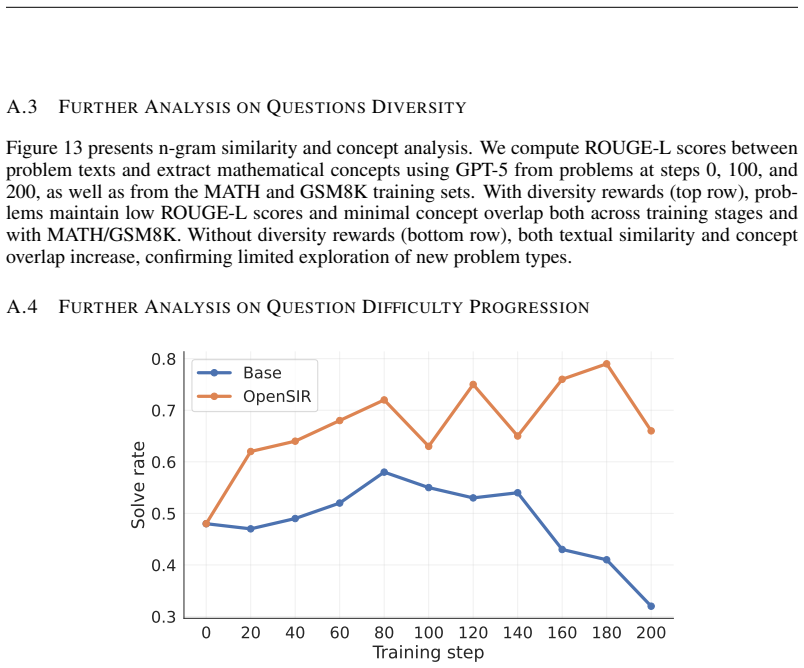
then declines (0.58→0.32 at step 200), confirming the V-shaped difficulty pattern trend from Section 4.1: problems initially become easier as OpenSIR learns appropriate calibration, then progressively harder as it increases challenge. Crucially, this pattern shows that OpenSIR’s reasoning ability improved over training. A.5 SENSITIVITY TO THE INITIAL SEED...
2024
-
[2016]
ISSN 0028-0836, 1476-4687. doi: 10.1038/nature16961. David Silver, Julian Schrittwieser, Karen Simonyan, Ioannis Antonoglou, Aja Huang, Arthur Guez, Thomas Hubert, Lucas Baker, Matthew Lai, Adrian Bolton, Yutian Chen, Timothy Lillicrap, Fan Hui, Laurent Sifre, George van den Driessche, Thore Graepel, and Demis Hassabis. Mastering the game of Go without hu...
-
[2017]
ISSN 1476-4687. doi: 10.1038/nature24270. Yifan Sun, Jingyan Shen, Yibin Wang, Tianyu Chen, Zhendong Wang, Mingyuan Zhou, and Huan Zhang. Improving Data Efficiency for LLM Reinforcement Fine-tuning Through Difficulty- targeted Online Data Selection and Rollout Replay, June
-
[2018]
Table 11: The training configurations for the experiments
Warmup steps 20 Training steps 100/200 KL loss coefficient1×10 −4 Gradient norm clipping 0.5 Seeds 42/43/44 GPUs 3 H100 Rollout Batch size† 256 Max prompt length 1024 Max solution length 2048 Number of rollouts per prompt 8 Temperature 1.0 Teacher Rewards Solvability weight (α) 1.0 Solution length weight (λ) 1.0 Diversity weight (γ) 1.0 Format weight (δ) ...
2048
-
[2019]
URLhttps://openreview.net/forum? id=SkxpxJBKwS. Jakob Bauer, Kate Baumli, Feryal Behbahani, Avishkar Bhoopchand, Nathalie Bradley-Schmieg, Michael Chang, Natalie Clay, Adrian Collister, Vibhavari Dasagi, Lucy Gonzalez, Karol Gre- gor, Edward Hughes, Sheleem Kashem, Maria Loks-Thompson, Hannah Openshaw, Jack Parker- Holder, Shreya Pathak, Nicolas Perez-Nie...
1935
-
[2021]
Chengsong Huang, Wenhao Yu, Xiaoyang Wang, Hongming Zhang, Zongxia Li, Ruosen Li, Jiaxin Huang, Haitao Mi, and Dong Yu
URLhttps: //datasets-benchmarks-proceedings.neurips.cc/paper/2021/hash/ be83ab3ecd0db773eb2dc1b0a17836a1-Abstract-round2.html. Chengsong Huang, Wenhao Yu, Xiaoyang Wang, Hongming Zhang, Zongxia Li, Ruosen Li, Jiaxin Huang, Haitao Mi, and Dong Yu. R-Zero: Self-Evolving Reasoning LLM from Zero Data, August
2021
-
[2022]
Alex Havrilla, Edward Hughes, Mikayel Samvelyan, and Jacob Abernethy
doi: 10.1126/science.ade9097. Alex Havrilla, Edward Hughes, Mikayel Samvelyan, and Jacob Abernethy. Synthetic Problem Gen- eration for Reasoning via Quality-Diversity Algorithms, June
-
[2024]
doi: 10.18653/v1/2024.acl-long.211
Association for Computational Linguistics. doi: 10.18653/v1/2024.acl-long.211. Dan Hendrycks, Collin Burns, Saurav Kadavath, Akul Arora, Steven Basart, Eric Tang, Dawn Song, and Jacob Steinhardt. Measuring Mathematical Problem Solv- ing With the MATH Dataset.Proceedings of the Neural Information Processing Systems Track on Datasets and Benchmarks, 1, December
discussion (0)
Sign in with ORCID, Apple, or X to comment. Anyone can read and Pith papers without signing in.