Controlling Traffic without Tolls: A Non-Monetary Framework for Autonomous Intersections
Pith reviewed 2026-05-18 01:34 UTC · model grok-4.3
The pith
Timestamp scheduling at autonomous intersections steers traffic toward efficient routes without tolls
A machine-rendered reading of the paper's core claim, the machinery that carries it, and where it could break.
Core claim
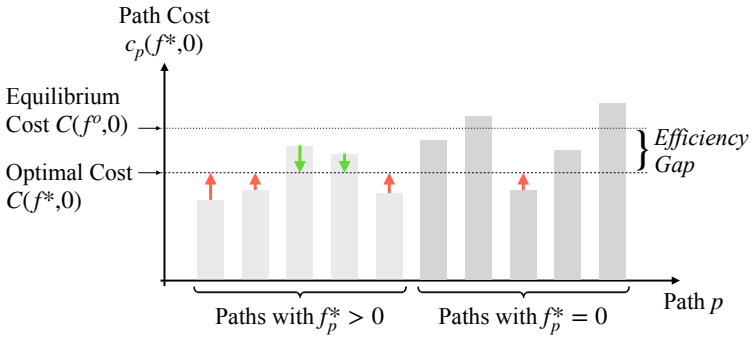
The framework leverages autonomous intersection management to influence routing decisions without tolls through timestamp-based scheduling adjustments at roadside units that introduce path-dependent node costs. The resulting model admits a congestion-game formulation with path-dependent node costs. Existence and essential uniqueness of equilibrium flows are established, eliminating ambiguities due to multiple equilibria and enabling a scalable and tractable bilevel optimization formulation for system-level incentive design. Experiments on the Sioux Falls network show that the proposed approach reduces the efficiency gap between user equilibrium and system-optimal flows by up to 71 percent.
What carries the argument
Timestamp-based scheduling adjustments that introduce path-dependent node costs into a congestion-game model of vehicle routing, yielding essentially unique equilibria.
Load-bearing premise
That timestamp scheduling can create path-dependent node costs which turn vehicle routing into a congestion game whose equilibria are essentially unique and accurately represent real routing decisions.
What would settle it
Running detailed traffic simulations on the Sioux Falls network with the timestamp adjustments applied and measuring whether the realized flows achieve close to 71 percent gap reduction while exhibiting only one dominant equilibrium pattern.
Figures






read the original abstract
The increasing complexity of urban transportation systems, driven by connected and automated vehicles, calls for new modeling paradigms and scalable control strategies. We propose a non-monetary control framework that leverages autonomous intersection management to influence routing decisions without tolls. The approach uses timestamp-based scheduling adjustments at roadside units (RSUs) to introduce path-dependent delays or advancements, steering traffic toward socially efficient flows. We develop a hierarchical architecture that separates real-time intersection control from network-level coordination. The resulting model admits a congestion-game formulation with path-dependent node costs. We establish the existence and essential uniqueness of equilibrium flows, eliminating ambiguities due to multiple equilibria and enabling a scalable and tractable bilevel optimization formulation for system-level incentive design. Experiments on the Sioux Falls network show that the proposed approach reduces the efficiency gap between user equilibrium and system-optimal flows by up to 71% under realistic constraints. These results demonstrate the potential of non-monetary, infrastructure-light control for next-generation intelligent transportation and urban mobility systems.
Editorial analysis
A structured set of objections, weighed in public.
Referee Report
Summary. The paper proposes a non-monetary traffic control framework for autonomous intersections that uses timestamp-based scheduling at RSUs to impose path-dependent node delays, steering flows toward system-optimal outcomes. It formulates the problem as a congestion game with these path-dependent costs, asserts existence and essential uniqueness of equilibria to remove multiplicity ambiguities, and employs the result in a bilevel optimization for network-level coordination. Experiments on the Sioux Falls network report reductions of up to 71% in the efficiency gap between user equilibrium and system-optimal flows under realistic constraints.
Significance. If the uniqueness result holds under the proposed scheduling, the work would offer a scalable, infrastructure-light alternative to toll-based control for connected automated vehicles, with direct applicability to intelligent transportation systems. The reported 71% gap closure on a standard benchmark network would represent a substantial practical advance if shown to be robust and independent of solver artifacts.
major comments (3)
- [§4] §4 (Equilibrium Analysis), Theorem on essential uniqueness: the proof that path-dependent node costs induced by RSU timestamp scheduling preserve the monotonicity or potential-function structure required for essential uniqueness in congestion games is not detailed; without an explicit argument ruling out non-monotonic crossing cost curves arising from upstream path differences, the claim that uniqueness eliminates bilevel ambiguities remains unverified.
- [§6] §6 (Experiments), Sioux Falls results: the 71% gap reduction is reported without accompanying verification that the computed equilibrium is the unique one (e.g., via multiple random initializations or enumeration of equilibria) or details on data exclusion rules and error bars, making it impossible to assess whether the outcome is an artifact of the particular solver path rather than a general property of the model.
- [Model Formulation] Model section (path-dependent cost definition): the node costs are constructed directly from the same timestamp scheduling rule that serves as the decision variable in the upper-level bilevel program; this interdependence must be shown not to introduce circularity that undermines the uniqueness result used to justify tractability of the optimization.
minor comments (2)
- [Abstract] Abstract: the phrase 'essential uniqueness' is introduced without a one-sentence clarification of its precise meaning in the congestion-game setting or a pointer to the relevant theorem.
- [Notation] Notation: the definition of arrival-time-dependent node costs would benefit from an explicit small example equation showing how upstream path choice affects downstream delay under the scheduling rule.
Simulated Author's Rebuttal
We thank the referee for their detailed and constructive comments on our manuscript. We have addressed each of the major concerns raised and outline our responses below. We believe these revisions will improve the clarity and rigor of the paper.
read point-by-point responses
-
Referee: [§4] §4 (Equilibrium Analysis), Theorem on essential uniqueness: the proof that path-dependent node costs induced by RSU timestamp scheduling preserve the monotonicity or potential-function structure required for essential uniqueness in congestion games is not detailed; without an explicit argument ruling out non-monotonic crossing cost curves arising from upstream path differences, the claim that uniqueness eliminates bilevel ambiguities remains unverified.
Authors: We are grateful for this observation, which points to a need for greater detail in our proof. In the revised manuscript, we will provide an expanded proof in Section 4 that explicitly establishes the preservation of monotonicity for the path-dependent costs. We will introduce an additional lemma demonstrating that the timestamp scheduling rule induces cost functions that are monotone in the flow variables, thereby ruling out non-monotonic crossings from upstream path dependencies. This will confirm that the essential uniqueness holds and supports the tractability of the bilevel formulation. revision: yes
-
Referee: [§6] §6 (Experiments), Sioux Falls results: the 71% gap reduction is reported without accompanying verification that the computed equilibrium is the unique one (e.g., via multiple random initializations or enumeration of equilibria) or details on data exclusion rules and error bars, making it impossible to assess whether the outcome is an artifact of the particular solver path rather than a general property of the model.
Authors: We agree that additional empirical validation would strengthen the experimental claims. Accordingly, we will revise Section 6 to include results from multiple solver initializations (e.g., 10 random starts) to confirm convergence to the same equilibrium point, as predicted by theory. We will also specify the data handling procedures for the Sioux Falls network and include error bars or confidence intervals for the reported efficiency gap reductions across these runs. revision: yes
-
Referee: [Model Formulation] Model section (path-dependent cost definition): the node costs are constructed directly from the same timestamp scheduling rule that serves as the decision variable in the upper-level bilevel program; this interdependence must be shown not to introduce circularity that undermines the uniqueness result used to justify tractability of the optimization.
Authors: We thank the referee for raising this important point about the model structure. To clarify, the formulation is hierarchical and non-circular: the upper level selects the timestamp scheduling parameters as decision variables, which then fix the path-dependent node costs for the lower-level game. The uniqueness theorem applies to the lower-level equilibrium for any given fixed upper-level choice. We will add explicit text in the model section to delineate this separation and explain why no circular dependency exists in the mathematical program. revision: yes
Circularity Check
No significant circularity; uniqueness established as independent mathematical property
full rationale
The paper introduces a congestion-game model with path-dependent node costs arising from its timestamp-based RSU scheduling, then separately claims to establish existence and essential uniqueness of equilibria for that model. This uniqueness is presented as a derived result that removes multiple-equilibrium ambiguities and thereby enables the bilevel optimization. No quoted passage shows the uniqueness being obtained by definition, by fitting parameters to the target outcome, or by a self-citation chain that reduces to the present work. The Sioux Falls experiments supply an external numerical check. The derivation chain is therefore self-contained against the paper's own stated assumptions and does not reduce to tautology.
Axiom & Free-Parameter Ledger
axioms (1)
- domain assumption Existence and essential uniqueness of equilibrium flows in the congestion game with path-dependent node costs
Lean theorems connected to this paper
-
IndisputableMonolith/Cost/FunctionalEquation.leanwashburn_uniqueness_aczel unclear?
unclearRelation between the paper passage and the cited Recognition theorem.
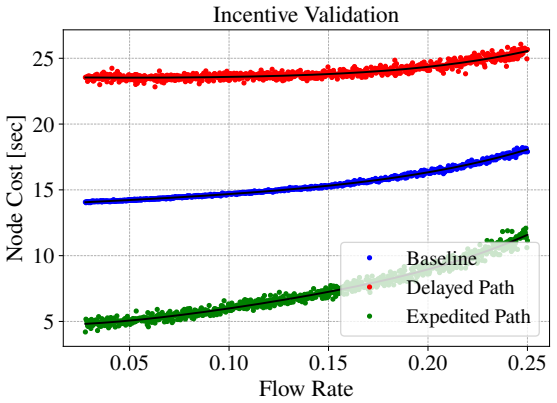
We establish an experimentally validated analytical model, prove the existence and essential uniqueness of equilibrium flows and formulate the planner’s problem as an offline bilevel optimization program
-
IndisputableMonolith/Foundation/ArithmeticFromLogic.leanLogicNat.induction unclear?
unclearRelation between the paper passage and the cited Recognition theorem.
Φ(f, u) := Σ_e ∫_0^{f_e} c_e(x) dx + Σ_v ∫_0^{f_v} c_v(y) dy + f·u
What do these tags mean?
- matches
- The paper's claim is directly supported by a theorem in the formal canon.
- supports
- The theorem supports part of the paper's argument, but the paper may add assumptions or extra steps.
- extends
- The paper goes beyond the formal theorem; the theorem is a base layer rather than the whole result.
- uses
- The paper appears to rely on the theorem as machinery.
- contradicts
- The paper's claim conflicts with a theorem or certificate in the canon.
- unclear
- Pith found a possible connection, but the passage is too broad, indirect, or ambiguous to say the theorem truly supports the claim.
Reference graph
Works this paper leans on
-
[1]
The 2019 urban mobility report
D. Schrank, B. Eisele, and T. Lomax, “The 2019 urban mobility report.” Texas A&M Trans- portation Institute with Cooperation from INRIX, Tech. Rep., 2019
work page 2019
-
[2]
Litman,Smart transportation emission reduction strategies
T. Litman,Smart transportation emission reduction strategies. Victoria, BC, Canada: Victoria Transport Policy Institute, 2017
work page 2017
-
[3]
T. Roughgarden, “Routing games,” inAlgorithmic Game Theory. Cambridge: Cambridge University Press, 2007, pp. 461–486
work page 2007
-
[4]
Review of road traffic control strategies,
M. Papageorgiou, C. Diakaki, V . Dinopoulou, A. Kotsialos, and Y. Wang, “Review of road traffic control strategies,”Proceedings of the IEEE, vol. 91, no. 12, pp. 2043–2067, 2003
work page 2043
-
[5]
Autonomous and semiautonomous intersection man- agement: A survey,
Z. Zhong, M. Nejad, and E. E. Lee, “Autonomous and semiautonomous intersection man- agement: A survey,”IEEE Intelligent Transportation Systems Magazine, vol. 13, no. 2, pp. 53–70, 2020
work page 2020
-
[6]
“a survey on intersection management of connected autonomous vehicles,
M. Khayatian, M. Mehrabian, E. Andert, R. Dedinsky, S. Choudhary, Y. Lou, and A. Shir- vastava, ““a survey on intersection management of connected autonomous vehicles,”ACM Transactions on Cyber-Physical Systems, vol. 4, pp. 1–27, 2020
work page 2020
-
[7]
A multiagent approach to autonomous intersection management,
K. Dresner and P . Stone, “A multiagent approach to autonomous intersection management,” Journal of Artificial Intelligence Research, vol. 31, pp. 591–656, 2008
work page 2008
-
[8]
Road paper. Some theoretical aspects of road traffic research
J. G. Wardrop, “Road paper. Some theoretical aspects of road traffic research.”Proceedings of the Institution of Civil Engineers, vol. 1, no. 3, pp. 325–362, 1952
work page 1952
-
[9]
M. Beckmann, C. B. McGuire, and C. B. Winsten,Studies in the Economics of Transportation. New Haven, Connecticut: Yale University Press, 1956
work page 1956
-
[10]
E. Koutsoupias and C. Papadimitriou, “Worst-case equilibria,” inProceedings of the 16th An- nual Symposium on Theoretical Aspects of Computer Science, C. Meinel and S. Tison, Eds. Berlin, Heidelberg: Springer Berlin Heidelberg, 1999, pp. 404–413
work page 1999
-
[11]
T. Roughgarden and E. Tardos, “How bad is selfish routing?”Journal of the ACM, vol. 49, no. 2, pp. 236–259, 2002
work page 2002
-
[12]
Bounding the inefficiency of equilibria in nonatomic congestion games,
——, “Bounding the inefficiency of equilibria in nonatomic congestion games,”Games and Economic Behavior, vol. 47, no. 2, pp. 389–403, 2004
work page 2004
-
[13]
Roughgarden,Twenty Lectures on Algorithmic Game Theory
T. Roughgarden,Twenty Lectures on Algorithmic Game Theory. Cambridge, United Kingdom: Cambridge University Press, 2016
work page 2016
-
[14]
B. Monnot, B. Francisco, and G. Piliouras, “Routing games in the wild: Efficiency, equilibra- tion, regret and a price of anaychy via long division,”ACM Transactions on Economics and Computation, vol. 10, no. 1, pp. 2:1–1:25, 2022
work page 2022
-
[15]
Tolls for heterogeneous selfish users in multicom- modity networks and generalized congestion games,
L. Fleischer, K. Jain, and M. Mahdian, “Tolls for heterogeneous selfish users in multicom- modity networks and generalized congestion games,” in45th Annual IEEE Symposium on Foundations of Computer Science. Rome, Italy: IEEE, 2004, pp. 277–285. 24
work page 2004
-
[16]
Pricing network edges for heterogeneous selfish users,
R. Cole, Y. Dodis, and T. Roughgarden, “Pricing network edges for heterogeneous selfish users,” inProceedings of the Thirty-Fifth Annual ACM Symposium on Theory of Computing. San Diego, California: ACM, 2003, pp. 521–530
work page 2003
-
[17]
Optimal taxes in atomic con- gestion games,
D. Paccagnan, R. Chandan, B. L. Ferguson, and J. R. Marden, “Optimal taxes in atomic con- gestion games,”ACM Transactions on Economics and Computation, vol. 9, no. 3, pp. 19:1–19:33, 2021
work page 2021
-
[18]
Wealth inequality and the price of anarchy,
K. Gemici, E. Koutsoupias, B. Monnot, C. Papadimitriou, and G. Piliouras, “Wealth inequality and the price of anarchy,” in36th International Symposium on Theoretical Aspects of Computer Science, R. Niedermeier and C. Paul, Eds., no. 31. Berlin, Germany: Leibniz International Proceedings in Informatics, 2019, pp. 31:1–31:16
work page 2019
-
[19]
System optimal routing of traffic flows with user constraints using linear programming,
E. Angelelli, V . Morandi, M. Savelsbergh, and M. G. Speranza, “System optimal routing of traffic flows with user constraints using linear programming,”European Journal of Operational Research, vol. 293, no. 3, pp. 863–879, 2021
work page 2021
-
[20]
Optimal tolling for multitype mixed autonomous traffic net- works,
D. A. Lazar and R. Pedarsani, “Optimal tolling for multitype mixed autonomous traffic net- works,”IEEE Control Systems Letters, vol. 5, no. 5, pp. 1849–1854, 2021
work page 2021
-
[21]
Congestion pricing for efficiency and equity: Theory and applications to the San Francisco Bay area,
C. Maheshwari, K. Kulkarni, D. Pai, J. Yang, M. Wu, and S. Sastry, “Congestion pricing for efficiency and equity: Theory and applications to the San Francisco Bay area,”arXiv preprint arXiv:2401.16844, 2024
-
[22]
When efficiency meets equity in congestion pricing and revenue refunding schemes,
D. Jalota, K. Solovey, K. Gopalakrishnan, S. Zoepf, H. Balakrishnan, and M. Pavone, “When efficiency meets equity in congestion pricing and revenue refunding schemes,”IEEE Transac- tions on Control of Network Systems, vol. 11, no. 2, pp. 1127–1138, 2024
work page 2024
-
[23]
Information-driven autonomous intersection control via incentive compatible mechanisms,
M. O. Sayin, C.-W. Lin, S. Shiraishi, J. Shen, and T. Bas ¸ar, “Information-driven autonomous intersection control via incentive compatible mechanisms,”IEEE Transactions on Intelligent Transportation Systems, vol. 20, no. 3, pp. 912–924, 2018
work page 2018
-
[24]
Today me, tomorrow thee: efficient resource allocation in competitive settings using karma games,
A. Censi, S. Bolognani, J. G. Zilly, S. S. Mousavi, and E. Frazzoli, “Today me, tomorrow thee: efficient resource allocation in competitive settings using karma games,” inIEEE Intelligent Transportation Systems Conference (ITSC). Auckland, New Zealand: IEEE, 2019, pp. 686–693
work page 2019
-
[25]
Informational braess’ para- dox: the effect of information on traffic congestion,
D. Acemoglu, A. Makhdoumi, A. Malekian, and A. Ozdaglar, “Informational braess’ para- dox: the effect of information on traffic congestion,”Operations Research, vol. 66, no. 4, pp. 893–917, 2018
work page 2018
-
[26]
Value of information in Bayesian routing games,
M. Wu, S. Amin, and A. E. Ozdaglar, “Value of information in Bayesian routing games,” Operations Research, vol. 69, no. 1, pp. 148–163, 2021
work page 2021
-
[27]
E. Kamenica and M. Gentzkow, “Bayesian persuasion,”American Economic Review, vol. 101, no. 6, pp. 2590–2615, 2011
work page 2011
-
[28]
Reducing congestion through information design,
S. Das, E. Kamenica, and R. Mirka, “Reducing congestion through information design,” in 55th Annual Allerton Conference on Communication, Control, and Computing (Allerton). Monti- cello, Illinois: IEEE, 2017, pp. 1279–1284
work page 2017
-
[29]
Information design in Bayesian routing games,
L. Cianfanelli, A. Ambrogio, and G. Como, “Information design in Bayesian routing games,” in62nd IEEE Conference on Decision and Control (CDC). Marina Bay Sands, Singapore: IEEE, 2023, pp. 3945–3949. 25
work page 2023
-
[30]
Strategic information platforms in trans- portation networks,
H. Tavafoghi, A. Shetty, K. Poolla, and P . Varaiya, “Strategic information platforms in trans- portation networks,” in57th Annual Allerton Conference on Communication, Control, and Com- puting (Allerton). Monticello, Illinois: IEEE, 2019, pp. 816–823
work page 2019
-
[31]
A review of urban transporta- tion network design problem,
R. Z. Farahani, E. Miandoabchi, W. Y. Szeto, and H. Rashidi, “A review of urban transporta- tion network design problem,”European Journal of Operational Research, vol. 229, no. 2, pp. 281–302, 2013
work page 2013
-
[32]
Optimal intervention in transporta- tion networks,
L. Cianfanelli, G. Como, A. E. Ozdaglar, and F. Parise, “Optimal intervention in transporta- tion networks,”IEEE Transactions on Automatic Control, vol. 68, no. 12, pp. 7073–7088, 2023
work page 2023
-
[33]
On the severity of Braess’s paradox: Designing networks for selfish users is hard,
T. Roughgarden, “On the severity of Braess’s paradox: Designing networks for selfish users is hard,”Journal of Computer and System Sciences, vol. 72, pp. 922–953, 2006
work page 2006
-
[34]
Y.-T. Lin, H. Hsu, S.-C. Lin, C.-W. Lin, I. H.-R. Jiang, and C. Liu, “Graph-based modeling, scheduling, and verification for intersection management of intelligent vehicles,”ACM Trans- actions on Embedded Computing Systems (TECS), vol. 18, no. 5s, pp. 1–21, 2019
work page 2019
-
[35]
K. Yang, S. I. Guler, and M. Menendez, “Isolated intersection control for various levels of ve- hicle technology: Conventional, connected, and automated vehicles,”Transportation Research Part C: Emerging Technologies, vol. 72, pp. 109–129, 2016
work page 2016
-
[36]
Y. Guan, Y. Ren, S. E. Li, Q. Sun, L. Luo, , and K. Li, ““centralized cooperation for connected and automated vehicles at intersections by proximal policy optimization,”IEEE Transactions on Vehicular Technology, vol. 69, pp. 12 597–12 608, 2020
work page 2020
-
[37]
Y. Wu, H. Chen, and F. Zhu, “DCL-AIM: Decentralized coordination learning of autonomous intersection management for connected and automated vehicles,”Transportation Research Part C: Emerging Technologies, vol. 103, pp. 246–260, 2019
work page 2019
-
[38]
Reinforcement- learning-based job-shop scheduling for intelligent intersection management,
S.-C. Huang, K.-E. Lin, C.-Y. Kuo, L.-H. Lin, M. O. Sayin, and C.-W. Lin, “Reinforcement- learning-based job-shop scheduling for intelligent intersection management,” inDesign, Au- tomation & Test in Europe Conference & Exhibition (DATE). Antwerp, Belgium: IEEE, 2023, pp. 1–6
work page 2023
-
[39]
Transportation cost and benefit analysis,
T. Litman, “Transportation cost and benefit analysis,”Victoria Transport Policy Institute, vol. 31, pp. 1–19, 2009
work page 2009
-
[40]
State-driven priority schedul- ing mechanisms for driverless vehicles approaching intersections,
K. Zhang, D. Zhang, A. de La Fortelle, X. Wu, and J. Gregoire, “State-driven priority schedul- ing mechanisms for driverless vehicles approaching intersections,”IEEE Transactions on In- telligent Transportation Systems, vol. 16, no. 5, pp. 2487–2500, 2015
work page 2015
-
[41]
Competitive packet routing with priority lists,
T. Harks, B. Peis, D. Schmand, B. Tauer, and L. V . Koch, “Competitive packet routing with priority lists,”ACM Transactions on Economics and Computation (TEAC), vol. 6, no. 1, pp. 1–26, 2018
work page 2018
-
[42]
Competitive routing over time,
M. Hoefer, V . S. Mirrokni, H. R¨oglin, and S.-H. Teng, “Competitive routing over time,”Theo- retical Computer Science, vol. 412, no. 39, pp. 5420–5432, 2011
work page 2011
-
[43]
Routing games with edge priorities,
R. Scheffler, M. Strehler, and L. V . Koch, “Routing games with edge priorities,”ACM Transac- tions on Economics and Computation, vol. 10, no. 1, pp. 1–27, 2022. 26
work page 2022
-
[44]
Strategic control of intersections for efficient traffic routing without tolls,
Y. Saltan, A. Kosay, C.-W. Lin, and M. O. Sayin, “Strategic control of intersections for efficient traffic routing without tolls,” inProceedings of the 5th IFAC Workshop on Cyber-Physical Human Systems, vol. 58. Antalya, T ¨urkiye: IFAC, 2024, pp. 175–180
work page 2024
-
[45]
Congestion games with player-specific payoff functions,
I. Milchtaich, “Congestion games with player-specific payoff functions,”Games and Economic Behavior, vol. 13, pp. 111–124, 1996
work page 1996
-
[46]
Weighted congestion games with separable preferences,
——, “Weighted congestion games with separable preferences,”Games and Economic Behavior, vol. 67, pp. 750–757, 2009
work page 2009
-
[47]
A class of games possessing pure-strategy nash equilibria,
R. W. Rosenthal, “A class of games possessing pure-strategy nash equilibria,”International Journal of Game Theory, vol. 2, pp. 65–67, 1973
work page 1973
-
[48]
D. Monderer and L. S. Shapley, “Potential games,”Games and Economic Behavior, vol. 14, pp. 124–143, 1996
work page 1996
-
[49]
How much can taxes help selfish routing?
R. Cole, Y. Dodis, and T. Roughgarden, “How much can taxes help selfish routing?”Journal of Computer and System Sciences, vol. 72, no. 3, pp. 444–467, 2006
work page 2006
-
[50]
On the existence of pure Nash equilibria in weighted congestion games,
T. Harks and M. Klimm, “On the existence of pure Nash equilibria in weighted congestion games,”Mathematics of Operations Research, vol. 37, no. 3, pp. 419–436, 2012
work page 2012
-
[51]
The existence, uniqueness and stability of traffic equilibria,
M. J. Smith, “The existence, uniqueness and stability of traffic equilibria,”Transportation Re- search Part B: Methodological, vol. 13, no. 4, pp. 295–304, 1979
work page 1979
-
[52]
A simplicial homology algorithm for Lipschitz optimisation,
S. C. Endres, C. Sandrock, and W. W. Focke, “A simplicial homology algorithm for Lipschitz optimisation,”Journal of Global Optimization, vol. 72, pp. 181–217, 2018
work page 2018
-
[53]
R. Storn and K. Price, “Differential evolution - A simple and efficient heuristic for global optimization over continuous spaces,”Journal of Global Optimization, vol. 11, pp. 341–359, 1997
work page 1997
-
[54]
Generalized simulated annealing algorithm and its application to the Thomson model,
Y. Xiang, D. Y. Sun, W. Fan, and X. G. Gong, “Generalized simulated annealing algorithm and its application to the Thomson model,”Physics Letters A, vol. 233, no. 3, pp. 216–220, 1997
work page 1997
-
[55]
An efficient approach to solving the road network equilibrium traffic assignment problem,
L. J. LeBlanc, E. K. Morlok, and W. P . Pierskalla, “An efficient approach to solving the road network equilibrium traffic assignment problem,”Transportation Research, vol. 9, no. 5, pp. 309–318, 1975
work page 1975
-
[56]
Microscopic traffic simulation using sumo,
P . A. Lopez, M. Behrisch, L. Bieker-Walz, J. Erdmann, Y.-P . Fl¨otter¨od, R. Hilbrich, L. L ¨ucken, J. Rummel, P . Wagner, and E. Wießner, “Microscopic traffic simulation using sumo,” inPro- ceedings of the 21st International Conference on Intelligent Transportation Systems (ITSC). Maui, Hawaii: IEEE, 2018, pp. 2575–2582
work page 2018
-
[57]
Multivariate stochastic approximation using a simultaneous perturbation gradi- ent approximation,
J. C. Spall, “Multivariate stochastic approximation using a simultaneous perturbation gradi- ent approximation,”IEEE Transactions on Automatic Control, vol. 37, no. 3, pp. 332–341, 1992. 27
work page 1992
discussion (0)
Sign in with ORCID, Apple, or X to comment. Anyone can read and Pith papers without signing in.