Macroscopic active matter under confinement: dynamical heterogeneity, bursts, and glassy behavior in a few-body system of self-propelling camphor surfers
Pith reviewed 2026-05-18 01:39 UTC · model grok-4.3
The pith
Self-propelled camphor surfers confined in a circle exhibit glassy slowing and density-dependent bursts due to an intermediate length scale.
A machine-rendered reading of the paper's core claim, the machinery that carries it, and where it could break.
Core claim
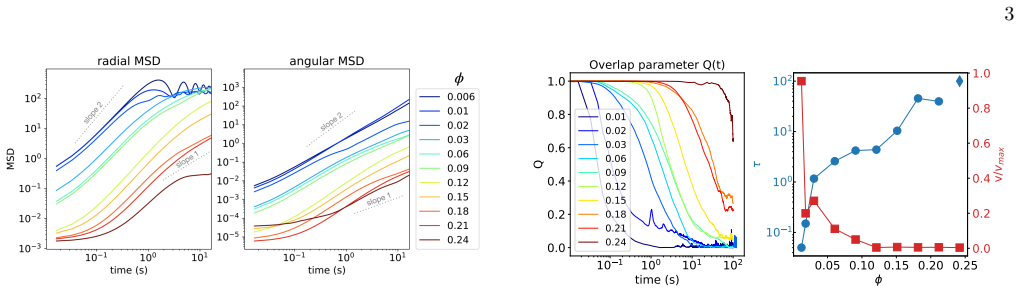
In a confined few-body system of inertial self-propelled camphor particles, dynamical heterogeneity and bursts give way to glassy behavior at intermediate densities. Analysis of the overlap order parameter shows slowing of particle rearrangements with rising density, accompanied by reduced burst amplitude and frequency. A minimal inertial active-particle model reproduces the observed steady states by introducing an intermediate length scale larger than individual particles; this scale supports caging structures essential to the glass-like transition. The system thus acts as a macroscopic active glass with additional density-dependent bursting.
What carries the argument
The intermediate length scale larger than the particle size in the inertial active-particle model, which enables caging structures and the glass-like transition.
If this is right
- Dynamical slowing down occurs as particle density increases, as seen in the overlap order parameter.
- Both amplitude and frequency of bursts decrease with increasing particle density.
- The minimal inertial model reproduces the dynamical steady states.
- Caging-like structures form due to the intermediate length scale.
- The system provides a macroscopic analog of an active glass with density-dependent bursting.
Where Pith is reading between the lines
- The bursting and glassy behavior may generalize to other inertial active systems under confinement.
- Changing the confinement size could reveal how the intermediate scale depends on system dimensions.
- Suppressing chemical effects in experiments would test if the model captures the essential physics.
- This macroscopic system enables direct observation of active glass features that are difficult to track microscopically.
Load-bearing premise
The observed dynamical slowing, bursts, and caging arise primarily from inertial effects and long-ranged interactions in the minimal model rather than from unmodeled chemical gradients or camphor-specific boundary effects.
What would settle it
A simulation of the minimal model using only short-range repulsive forces instead of long-ranged interactions, to see if the intermediate length scale and associated caging and glassy transition still occur.
Figures



read the original abstract
We study a few-body system composed of self-propelling camphor surfers confined within a circular boundary. These millimeter-sized particles move in a regime where inertia and long-ranged interactions play a significant role, leading to surprisingly complex and subtle collective dynamics. These dynamics include self-organized bursts and glassy behavior at intermediate densities--phenomena not apparent from ensemble-averaged steady-state measures. By analyzing quantities like the overlap order parameter, we observe that the system exhibits dynamical slowing down as particle density increases. This slowdown is also reflected in the bursting activity, where both the amplitude and frequency of bursts decrease with increasing particle density. A minimal inertial active-particle model reproduces these dynamical steady states, revealing the importance of a new intermediate length scale--larger than the particle size. This intermediate scale is critical for the formation of structures resembling caging and plays a key role in the glass-like transition. Our results describe a macroscopic analog of an active glass with the additional phenomena of density-dependent bursting.
Editorial analysis
A structured set of objections, weighed in public.
Referee Report
Summary. The manuscript examines a few-body system of millimeter-sized self-propelling camphor surfers confined in a circular boundary. The particles exhibit complex collective dynamics including self-organized bursts and glassy behavior at intermediate densities, which are not evident from ensemble-averaged measures. Analysis of the overlap order parameter reveals dynamical slowing down with increasing density, accompanied by decreases in burst amplitude and frequency. A minimal inertial active-particle model is presented that reproduces these dynamical steady states, identifying a new intermediate length scale larger than the particle size as crucial for caging structures and the glass-like transition. The work positions this as a macroscopic analog of an active glass featuring density-dependent bursting.
Significance. If the reproduction holds without implicit tuning, this provides a valuable macroscopic, few-body platform for active glassy dynamics that includes density-dependent bursting not captured by steady-state averages alone. The combination of experiment and minimal inertial modeling, with emphasis on dynamical heterogeneity beyond ensemble measures, strengthens the contribution to active matter studies.
major comments (1)
- [§4 (Minimal inertial active-particle model)] §4 (Minimal inertial active-particle model): the long-ranged interaction term is not shown to be derived from camphor dissolution physics (Marangoni flows or concentration-gradient decay); if instead chosen phenomenologically to match pair statistics or overlap decay, the reported intermediate length scale (larger than particle diameter) becomes an input rather than emergent, which is load-bearing for the abstract claim that inertia plus long-range forces alone produce the caging and glass-like transition.
minor comments (2)
- [Abstract] Abstract: the phrase 'a new intermediate length scale' is introduced without stating its approximate numerical value or the procedure used to extract it from the model or data.
- [Figure captions] Figure captions: several captions lack detail on the precise definition of the overlap order parameter and whether error bars reflect statistical or systematic uncertainty.
Simulated Author's Rebuttal
We thank the referee for their careful reading of the manuscript and for the constructive comment on the minimal inertial active-particle model. We address the point below.
read point-by-point responses
-
Referee: [§4 (Minimal inertial active-particle model)] §4 (Minimal inertial active-particle model): the long-ranged interaction term is not shown to be derived from camphor dissolution physics (Marangoni flows or concentration-gradient decay); if instead chosen phenomenologically to match pair statistics or overlap decay, the reported intermediate length scale (larger than particle diameter) becomes an input rather than emergent, which is load-bearing for the abstract claim that inertia plus long-range forces alone produce the caging and glass-like transition.
Authors: We appreciate the referee highlighting the need for a clearer physical grounding of the interaction term. The functional form is motivated by the known long-range hydrodynamic and chemical effects in camphor systems (Marangoni flows and slow concentration-gradient relaxation), as established in the camphor-boat literature; it is not an arbitrary fit to the overlap or pair data. In the revised manuscript we will expand §4 with a short derivation sketch and citations showing how the interaction range follows from the expected decay length of the camphor concentration field. Parameter sweeps in the model confirm that the intermediate length scale (distinct from the particle diameter) is not imposed by hand but arises dynamically as the distance at which inertial particles experience sufficient mutual influence to produce caging and the observed density-dependent slowing; ranges that are either too short or too long fail to recover the experimental burst statistics and overlap decay. This supports the claim that inertia together with long-range forces is sufficient for the glass-like phenomenology in this confined few-body setting. revision: partial
Circularity Check
No significant circularity; model reproduction and emergent scale are independent of target observables
full rationale
The paper reports experimental observations of density-dependent dynamical slowing, bursts, and overlap-order-parameter decay in confined camphor surfers. It then introduces a minimal inertial active-particle model whose long-ranged interactions and inertia are stated to reproduce the same steady-state measures. The intermediate length scale larger than particle diameter is described as revealed by the model and critical for caging-like structures. No equation is shown in which this scale is defined in terms of the caging it explains, nor is it obtained by fitting a parameter to the very overlap or burst statistics being predicted. No self-citation is invoked to justify uniqueness of the interaction form or to forbid alternatives. The derivation therefore remains self-contained: the model inputs (inertia plus long-range forces) are independent of the glass-like transition metrics, and the reproduction constitutes external validation rather than tautology. This is the normal, non-circular outcome for a minimal-model comparison to experiment.
Axiom & Free-Parameter Ledger
free parameters (1)
- intermediate length scale
axioms (1)
- domain assumption Inertial effects and long-ranged interactions play a significant role in the millimeter-sized particle regime.
Lean theorems connected to this paper
-
IndisputableMonolith/Foundation/Cost/FunctionalEquation.leanwashburn_uniqueness_aczel unclear?
unclearRelation between the paper passage and the cited Recognition theorem.
Particles interact via a two–length-scale pair potential … v(r) = (σ/r)^n + (ε_s/2)[1−tanh k(r−σ_s)] … minimal inertial active-particle model
-
IndisputableMonolith/Foundation/ArithmeticFromLogic.leanLogicNat_induction unclear?
unclearRelation between the paper passage and the cited Recognition theorem.
dynamical slowing down … overlap order parameter Q(t) … structural relaxation time τ_α … caging … glass-like transition
What do these tags mean?
- matches
- The paper's claim is directly supported by a theorem in the formal canon.
- supports
- The theorem supports part of the paper's argument, but the paper may add assumptions or extra steps.
- extends
- The paper goes beyond the formal theorem; the theorem is a base layer rather than the whole result.
- uses
- The paper appears to rely on the theorem as machinery.
- contradicts
- The paper's claim conflicts with a theorem or certificate in the canon.
- unclear
- Pith found a possible connection, but the passage is too broad, indirect, or ambiguous to say the theorem truly supports the claim.
Reference graph
Works this paper leans on
-
[1]
A. Cavagna and I. Giardina,Annu. Rev. Condens. Matter Phys., 2014,5, 183–207
work page 2014
-
[2]
Chat´ e,Annual Review of Condensed Matter Physics, 2020,11, 189–212
H. Chat´ e,Annual Review of Condensed Matter Physics, 2020,11, 189–212
work page 2020
-
[3]
M. C. Marchetti, J.-F. Joanny, S. Ramaswamy, T. B. Liverpool, J. Prost, M. Rao and R. A. Simha,Reviews of modern physics, 2013,85, 1143–1189
work page 2013
-
[4]
M. J. Bowick, N. Fakhri, M. C. Marchetti and S. Ra- maswamy,Phys. Rev. X, 2022,12, 010501
work page 2022
-
[5]
C. Bechinger, R. Di Leonardo, H. L¨ owen, C. Reichhardt, G. Volpe and G. Volpe,Rev. Mod. Phys., 2016,88, 045006
work page 2016
-
[6]
M. E. Cates and J. Tailleur,Annu. Rev. Condens. Matter Phys., 2015,6, 219–244
work page 2015
-
[7]
T. E. Angelini, E. Hannezo, X. Trepat, M. Marquez, J. J. Fredberg and D. A. Weitz,Proceedings of the National Academy of Sciences, 2011,108, 4714–4719
work page 2011
-
[8]
K. Nishizawa, K. Fujiwara, M. Ikenaga, N. Nakajo, M. Yanagisawa and D. Mizuno,Scientific reports, 2017, 7, 15143
work page 2017
-
[9]
B. R. Parry, I. V. Surovtsev, M. T. Cabeen, C. S. O’hern, E. R. Dufresne and C. Jacobs-Wagner,Cell, 2014,156, 183–194
work page 2014
-
[10]
N. Klongvessa, F. Ginot, C. Ybert, C. Cottin-Bizonne and M. Leocmach,Physical review letters, 2019,123, 248004
work page 2019
-
[11]
S. K. Nandi, R. Mandal, P. J. Bhuyan, C. Dasgupta, M. Rao and N. S. Gov,Proceedings of the National Academy of Sciences, 2018,115, 7688–7693
work page 2018
-
[12]
L. M. Janssen,Journal of Physics: Condensed Matter, 2019,31, 503002
work page 2019
- [13]
-
[14]
S. Soh, K. J. Bishop and B. A. Grzybowski,The Journal of Physical Chemistry B, 2008,112, 10848–10853
work page 2008
- [15]
- [16]
-
[17]
D. Boniface, C. Cottin-Bizonne, R. Kervil, C. Ybert and F. Detcheverry,Physical Review E, 2019,99, 062605
work page 2019
-
[18]
C. Gouiller, C. Ybert, C. Cottin-Bizonne, F. Raynal, M. Bourgoin and R. Volk,Physical Review E, 2021,104, 064608
work page 2021
- [19]
-
[20]
Y. Xu, N. Takayama, H. Er and S. Nakata,The Journal of Physical Chemistry B, 2021,125, 1674–1679
work page 2021
- [21]
- [22]
-
[23]
M. I. Kohira, Y. Hayashima, M. Nagayama and S. Nakata,Langmuir, 2001,17, 7124–7129
work page 2001
- [24]
-
[25]
M. Bourgoin, R. Kervil, C. Cottin-Bizonne, F. Raynal, R. Volk and C. Ybert,Physical Review X, 2020,10, 021065
work page 2020
-
[26]
C. Gouiller, F. Raynal, L. Maquet, M. Bourgoin, C. Cottin-Bizonne, R. Volk and C. Ybert,Physical Re- view Fluids, 2021,6, 014501
work page 2021
-
[27]
N. J. Suematsu, Y. Ikura, M. Nagayama, H. Kitahata, N. Kawagishi, M. Murakami and S. Nakata,The Journal of Physical Chemistry C, 2010,114, 9876–9882
work page 2010
- [28]
-
[29]
O. Dauchot, G. Marty and G. Biroli,Physical review let- ters, 2005,95, 265701
work page 2005
- [30]
-
[31]
S. Soh, M. Branicki and B. A. Grzybowski,The Journal of Physical Chemistry Letters, 2011,2, 770–774
work page 2011
-
[32]
N. A. Ara´ ujo, L. M. Janssen, T. Barois, G. Boffetta, I. Cohen, A. Corbetta, O. Dauchot, M. Dijkstra, W. M. Durham, A. Dussutouret al.,Soft matter, 2023,19, 1695–1704
work page 2023
-
[33]
G. L. Hunter and E. R. Weeks,Reports on progress in physics, 2012,75, 066501
work page 2012
-
[34]
P. J. Lu and D. A. Weitz,Annu. Rev. Condens. Matter Phys., 2013,4, 217–233
work page 2013
- [35]
-
[36]
N. J. Suematsu, T. Sasaki, S. Nakata and H. Kitahata, Langmuir, 2014,30, 8101–8108
work page 2014
-
[37]
N. Laˇ cevi´ c, F. W. Starr, T. Schrøder and S. C. Glotzer, The Journal of chemical physics, 2003,119, 7372–7387
work page 2003
-
[38]
M. Rosenblum, A. Pikovsky, J. Kurths, C. Sch¨ afer and P. A. Tass, inHandbook of biological physics, Elsevier, 2001, vol. 4, pp. 279–321
work page 2001
- [39]
- [40]
-
[41]
M. Cosentino Lagomarsino, P. Jona and B. Bassetti, Phys. Rev. E, 2003,68, 021908
work page 2003
-
[42]
L¨ owen,The Journal of chemical physics, 2020,152, 040901
H. L¨ owen,The Journal of chemical physics, 2020,152, 040901
work page 2020
-
[43]
L. Caprini and U. Marini Bettolo Marconi,The Journal of Chemical Physics, 2021,154,
work page 2021
-
[44]
N. V. Gribova, Y. D. Fomin, D. Frenkel and V. N. Ryzhov,Phys. Rev. E, 2009,79, 051202
work page 2009
-
[45]
J. Mart´ ın-Roca, R. Martinez, F. Mart´ ınez-Pedrero, J. Ram´ ırez and C. Valeriani,The Journal of Chemical Physics, 2022,156, 164502
work page 2022
discussion (0)
Sign in with ORCID, Apple, or X to comment. Anyone can read and Pith papers without signing in.